Chris Flynn, Here be Leviathans (#BookReview)

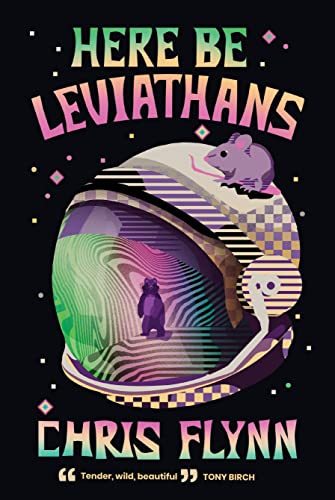
I am not one of those readers who shun weird narrators. Indeed, you’ll find several in this blog, including a skeleton, a dead baby, a foetus and a mammoth fossil. The critical thing for me is not who the narrator is, but whether that narrator is convincing and offers a perspective that engages my mind and heart. Of all the writers I’ve read over the last decade, one that stands out in his ability to surprise and excite me with different voices is Chris Flynn. His short story collection, Here be Leviathans, is astonishing from its first page to its last in its array of narrators.

There are nine stories in this collection, and it is a testament to Flynn that by the second or third one I was fully invested in who would be the narrator this time. I was never disappointed, albeit they ranged from the animate (like the grizzly bear which opens the collection, in “Inheritance”) to the inanimate (such as the airplane seat which narrates the second story, “22F”).

But, before I continue with Flynn’s book, I want to share something he says in his also entertaining “Afterword/Acknowledgements/Blame apportioned” statement. Describing one of his stories as having been inspired by Thea Astley, he refers to his role as one of the judges in Meanjin’s Tournament of Books and shares the exact words of his that I quoted back in my 2013 post on that tournament:

Astley was the progenitor, the chain-smoking, wise-cracking, jazz-loving four times Miles Franklin-winning champion of linguistic manipulation whose style got on Helen Garner’s nerves and who pushed the envelope of Australian literature when no-one else had the cojones to do so.

Flynn’s work is different to Astley’s – time and experimentation having moved on – but he too pushes the envelope of Australian literature, which is why he was one of the writers mentioned the article that inspired my recent Monday Musings on weird Australian fiction. And like Astley, his interests are personal and political. He’s interested in the ways we live in the world, in the injustices we enact, which translates to a concern with issues like colonialism, the environment, and the fallout from an unbridled interest in progress. His touch might feel lighter than Astley’s – he can be laugh-out-loud funny at times – but fundamentally both writers question who we are as human beings. What does what we do say about who we are?

“What a piece of work is man” (Shakespeare via Albert VI)

So, let’s explore Flynn’s brand of weirdness, and why I enjoyed it so much – despite the fact that the opening sentences of the first story, “Inheritance”, were truly shocking:

I ate a kid called Ash Tremblay yesterday. Parts of him, at least. The good bits. The crunchy skull, the brain, a juicy haunch.

What is a reader to think? Fortunately, you don’t have to think very long because very soon our narrator outs himself (it is a “he”) as a bear. He shares a few home truths about humans and our assumptions and behaviours. If you ignore the gruesomeness – after all, a bear has got to eat – the story is pretty funny. Its ostensible subject matter is inherited memory – in this case the bear has inherited Ash’s memory – but it is also a work of ecofiction, which includes exploration of issues like sustainability and colonialism. It is refreshingly bold, asking us to envisage different ways of acting in nature, and, at 30 pages, it is also long. But who cares?

The second, much shorter story, “22F”, is also a work of ecofiction. Its first line seemed ordinary enough, “The first day in a new workplace is always nerve-wracking”. It is, isn’t it? As the story progresses, however, you start to wonder just who this new employee is until the penny drops, it’s seat 22F on a plane. After this story, I thoroughly enjoyed the challenge of working out who was telling each story as I started it. But, back to 22F. In his Afterword, Flynn explains that the story was inspired by the Werner Herzog documentary Wings of Hope about the sole survivor of a 1971 airplane crash. Herzog and that survivor, Juliane Koepcke, return to the site of the crash, and find parts of the plane in the jungle. Flynn writes:

Memory and place. A reminder that we are only passing through and that everything is part of something larger.

Along the way, though, he discusses other issues, like workplace behaviour:

Toilets are inveterate boasters and disgusting perverts. You can’t believe half of what they say.

Eventually 22F’s plane crashes, and while the bodies disintegrate reasonably quickly, 22F is “fashioned from material that does not break down so readily … I will be here for a very long time”.

And so the stories continue, some with multiple voices. “The Strait of Magellan”, for example, is told by the appropriately named super yacht Nemesis, with interspersed commentary by a pandemic virus, HHSV1-ABAD. “Shot down in flames”, on the other hand, is told in sequential voices – by a creek which has been here for sixty-thousand years (that is, that’s how long it’s had its name!), a red fox, a rifle, and finally a bushfire, which wins the day:

I ate the defiant people who stayed.

Such arrogance. Who do they think they are, that they might resist me? I am elemental. I define this paltry world. I decide who stays in their current state and who transforms. I will find you and I will devour you, for I am Alpha and Omega. I was there at the beginning and I will be there at the end. There is no escape.

Many of the stories’ narrators, in fact, identify human stupidity – and arrogance.

In his Afterword, Flynn describes the last story “Kiss tomorrow goodbye” as the “hardest” story to read, but that does it an injustice. It’s the only one narrated by humans, and is inspired by the people who live in the tunnels under Las Vegas. It looks hard because there’s not a punctuation mark in its 30 pages, and its spelling is idiosyncratic to say the least, but in fact the voice and its rhythms are such that it’s not hard to read. It’s a story about survival and makes for a good end to the collection – one that leaves us in no doubt about all the troubling issues that Flynn has explored throughout but that also offers a glimmer of hope in the ingenuity and defiance of its protagonists.

The question of course is do these weird perspectives work or are they just a writerly exercise in “pushing the envelope”? For me they worked. It was fun trying to nut out whose voice it was this time. But there was a point to all this, because these are voices we can’t really argue with. They are not us, but they know us intimately. They speak their truths, like Albert VI, the space monkey (macaque) in “Alas, poor Yorick” who is so hopeful of surviving his space mission but who, like all the Alberts preceding him, is ultimately another pawn in the space race.

Colonial aggression and environmental destruction are recurring themes in the collection, but both are subsumed into an overriding idea which concerns something more paradoxical – mortality and survival. Death or its threat pervades the stories, but there are openings too. Some are small, but they are there.

In his Afterword, Flynn says that “they don’t make them like Astley anymore. She wrote what she wanted and didn’t give a shit”. I disagree. I think they do, and Flynn is one of them. It is great that there are publishers around like UQP who are willing to work with such writers.

Chris Flynn
Here be Leviathans
St Lucia: UQP, 2022
233pp.
ISBN: 9780702262777

Review copy courtesy UQP, via publicist Brendan Fredericks

Debra Dank, We come with this place (#BookReview)

First Nations people are advised that this post contains the names of deceased people.

It has been my reading group’s tradition for some years now to read a book by a First Nations writer in July, the month in which NAIDOC Week occurs. Coincidentally, NAIDOC Week’s 2023 theme was “For our elders”, which worked beautifully with our chosen book, Debra Dank’s We come with this place, because a large part of it is about the value and importance of elders and ancestors.

This was not, however, why we chose Dank’s book from the options before us. Its subject matter intrigued us, about which more anon, but we were also influenced by the fact that, at the time we were choosing, it had just won a record number of four awards in the New South Wales Premier’s Literary Awards: the Douglas Stewart Prize for Non-Fiction, the UTS Glenda Adams Award for New Writing, the Indigenous Writers’ prize, and the overall Book of the Year. It was also shortlisted for this year’s Stella Prize, and, after we scheduled it, it won the ALS Gold Medal. These are significant awards and, for most of us, the book lived up to its advance publicity.

I mentioned the subject matter above, but We come with this place is one of those books that is tricky to categorise. It’s a sort of multigenerational memoir that is also a guide to her culture and a community history of her people, before and after colonisation. It grew out of her PhD in Narrative Theory and Semiotics. Dank describes it in her Preface as a:

strange kind of letter written to my place – a recording of events and activities that I and my family have experienced, in order to tell Garranjini that I remember, and I know. It is all based on real events. Some parts have been reimagined, because they happened outside my presence, and several names have been changed. Our relationship with our place, however, is genuine and lives in ways that not easily told in English words or western ways.

She goes on to say that she wanted to show “how story works in my community, and how it has contributed to our living with country for so long”. It also felt imperative, she says, to talk about the “voices, human and non-human, who guided the Gudanji for centuries before anyone else stepped onto this land”. This is a truly generous thing to do, and my group loved that, loved how Dank shared her story, and particularly how she helped us whitefellas “see” how First Nations people understand and relate to Country. I knew much of this from all I’ve read and heard, but this book really grew my understanding.

The other special thing about this book for me is that it is set in an area I know. I spent three formative late-childhood years in Mount Isa, close to Camooweal where Dank’s mother’s family were based. I visited Camooweal several times, and traversed parts of the Barkly Tableland which encompasses her Country. The first First Nations people I heard of were the Kalkadoons, whom Dank mentions in her book. Dank herself, though, is a Gudanji/Wakaja woman, the former through her mother and the latter, her father.

“to see the pain as it lies in the landscape”

We come with this place is a confronting book, from its perfect and defiant title to its chronicling of the atrocities that her people faced. The fear of children being taken away pervades the book. There are stories of massacres, and other appalling brutalities including a rape of her father’s mother. Lucy’s “choices were both dire – a drover’s boy or a special girl. The same, just in different clothes”. There is intergenerational trauma, which Dank exemplifies through her father, Soda. Hardworking and loving, he bears traumas, which she characterises as “newer stories … that pushed and jostled with the older stories” and sometimes “pushed their way out with a violence” that was often directed at her mother, and sometimes herself.

Dank doesn’t hold back; the way she tells it is strong, speaking her truths and segueing between past and present, between brutal history and rejuvenating story, between people and ancestors. Amongst the tough stories are warm-hearted anecdotes about family life. An example is Dank telling of being on country with her grandfather Bimbo and her surprise and joy in learning how to catch fish in arid land. The stories speaking of deep love sit alongside the hard ones, and together convey that the people, their ancestors, and Country are interconnected. This idea is mirrored in the structure.

However, I admit that I did, initially, find the structure a bit confusing, but as I read on, I started to sense an overriding arc similar to that of Bangarra Dance Theatre’s recent offering, Yuldea. Both start with origin stories, then move through colonial history, and conclude with the power of kinship and connection to Country. But it’s not as linear as this sounds. For example, starting the book, and threading through Dank’s narrative are the three Water-women who came from sea in the Gulf of Carpentaria, and travel far to create “the freshwater and hill country” of the Gudanji. They also end the book, giving it an overall cyclical structure which, I think, reflects First Nations’ understanding of life. Other cycles occur within this structure, so there is a continuous sense of moving forwards and back in time, as experiences and stories build on each other to create “Gudanji memory” – for us, and for her people to whom she is writing. This idea of building “memory” from stories, from lines between places and the things that have happened there, is strange to western ways of thinking, but Dank makes it make sense. She shows us how stories are made and passed on through Country.

I’ve been trying to decide how to end this post, and then it came to me that the best way might be with some words from Dr Tyson Yunkaporta’s Introduction to the book. He is a First Nations scholar, founder of the Indigenous Knowledge Systems Lab at Deakin University in Melbourne, and the author of Sand talk. He admits to not being able to face “the through line of history from the savagery of the frontier wars to the interventionist policies of today”. Dank, though, has. He writes:

She hurts us, digs bullets out of old wounds that never healed properly, sucks out the poison and then begins our healing with love and laughter. She does this for everybody, no matter which side of the rifle you’re on.

Dank, in other words, doesn’t pull any punches, but neither does she ram them down your gullet. Her aim is to tell the truth, proud and clear, but to do it in order for healing to take place. Isn’t that what we all want?

Kim (Reading Matters) also loved this book.

Debra Dank
We come with this place
London: Echo, 2022
252pp.
ISBN: 9781760687397

Edwina Preston, Bad art mother (#BookReview)

Edwina Preston’s Bad art mother was my reading group’s June book, replacing our previously scheduled book because we’d heard Bad art mother was to be the featured book in the Canberra Writers Festival session, Canberra’s Biggest Book Club. This suited me, as, coincidentally, I’d just started reading it!

Bad art mother has been shortlisted for two awards this year (so far), the Stella Prize, and the Christina Stead Award for Fiction (in the NSW Premier’s Literary Awards). Not a bad achievement for a book that was rejected by publishers over 20 times before being picked up by Wakefield Press.

The novel is mostly set in 1960s Melbourne, which was a time of social change. While feminism was around the corner but not there yet, the city’s life was being influenced by the postwar influx of European migrants. Preston captures this well, said our Melbourne-born members. The story draws its inspiration from various Australian arts practitioners who were active in the mid-twentieth century – the Heide Circle and the artist Mirka Mora and her husband Georges, in Melbourne, and the Tasmanian poet Gwen Harwood. Bad art mother is the third book I’ve read in recent years inspired in some way by the Heide story, the others being Emily Bitto’s novel The strays (my review) and Jane Sinclair’s memoir, Shy love smiles and acid drops (my review). Interestingly, all of them focus to some degree on the damage done to children.

I enjoyed the experience of reading Bad art mother, not only for its expressive language, but also for its intriguing, complex structure. It is told primarily from the point of view of a young boy, Owen, whose mother, Veda Grey, is struggling to make her name as a poet. However, we also get Veda’s point-of-view through letters she writes to her sister. After opening with Veda’s book launch in 1970, the novel is told in six parts, which to-and-fro in time, but it has an overall chronological trajectory, with part one telling of his parents’ meeting and his birth, and the final part being set around 2016 when Veda’s book is about to be republished in an anniversary edition. The central four parts commence with Owen as an adult in the 1980s, before returning to his childhood in the 1960s. It sounds complicated but it works. Lives, after all, are rarely simple and linear. Owen’s certainly wasn’t. Wanting to be just a kid, he had to be the grown-up more often than not.

The other thing to mention is that Owen tells his story first person, but to a specific person, “you”, whom we soon discover is Ornella, his father’s “sister”. That is, she was the daughter of the Italian family that “adopted” his father when he came to work in their restaurant at the age of 19. Throughout his childhood, Owen is passed between his parents, the rich but dysfunctional Parishes (to whom his mother entrusts him in a deal that buys her more time for her art), and Ornella. It is Ornella who saves him when all the others fail. She is the unimaginative one, the stern one, but also the stable, reliable one, the one who picked him up “on time, every time“. Owen knows that he owes his life to her, and now, as she is failing with dementia, he visits her and tells her his story, expressing what she means to him, while also working through his feelings for his mother.

“I will hang my anger out to dry” (Veda)

The book spans Owen’s life from the 1960s to the 2010s, but with its focus being the 1960s, it is, essentially, a work of historical fiction. Why did Preston choose to write about this time? I like my historical fiction to have some relevance to the time in which it is written. Fortunately, Preston’s novel does – and it concerns the challenge creative women face. There are three such women in the story. Rosa, the muralist, works in Owen’s father’s restaurant, and does it her way. She is not a tortured soul, but it takes a long time for her art to be accepted. Mrs Parish is an ikebana artist who quietly finds her own way by removing herself to Japan. And, of course, Veda, the poet – the only one who is a mother. She struggles big-time with her drive to create and her role as a mother. She writes to her sister:

How does one protect them? Sometimes I think I would throw in every hope of my own, every dream of literary prowess or success, to protect him, even for one second, from any hurt that might come to him.

But would I, Tilde? Would I?

If it came to it, I wonder how I would make such a choice. I should hope that if ever given that choice I would make the right one, but I know I would resent it for the rest of my life. I would never be happy. I would be a bloody, injured banshee who ruined everyone around her.

What sort of a mother chooses a book over a child?

Sometimes I am not sure what I am capable of at all.

The point, then, is that it is hard for women to make art and be recognised for it, and it is especially hard when the woman is also a mother. The tension for Veda is palpable through both Owen’s story and her own letters. And this brings me to the issue which triggers the novel’s crisis, anger. When Veda shows her anger at how she and her work had been treated, things go wrong and her life falls apart. Owen’s partner Julia tells him in 2016 when Veda’s poems are being re-released, that she remains relevant because, for all the progress that had been made in the interim, “it’s still hard to be angry, if you’re a woman. It’s still not allowed”. This was a major takeaway from the book for my reading group.

Bad art mother is an intelligent novel that offers no answers to the quandary it presents, but that asks the right questions. Good on Wakefield for taking it on.

Lisa also enjoyed this book.

Edwina Preston
Bad art mother
Mile End: Wakefield Press, 2022
317pp.
ISBN: 9781743059012

Review copy courtesy Wakefield Press

Tuesday Atzinger, The River (#Review)

Back in January I reviewed two stories from Ellen van Neerven and Rafeif Ismail’s anthology Unlimited futures: Speculative, visionary Blak+Black fiction for Bill’s (The Australian Legend) Australian Women Writers Gen 5 Week. The stories I reviewed were the second and third in the anthology because they were the first two by Australians in it. The anthology’s first story, however, is African in origin. Titled “The River”, it is by Tuesday Atzinger, who is described in the book’s Biographical Notes as “a poet and emerging writer … [who] … explores and celebrates Afro-blackness, queerness, disability and feminism. They peddle in discomfort and their primary goal is to fling words together to make you squirm”. Atzinger currently lives in Melbourne “on the unceded lands of the Wurundjeri People of the Kulin Nations”.

“The River” is worth discussing for several reasons, but specifically because it’s the first piece in the anthology, so was, presumably, chosen for a reason. Some of that reason is explained in the anthology’s introduction, which, by the by, takes the form of a conversation between the two editors. One of the topics they discuss is the cover, which was designed by Larrakia woman, Jenna Lee. Ismail describes it as looking at “the interaction of separate cultures in the most respectful and wonderful way”, and also sees it as suggesting “infinity”. It does, doesn’t it. Van Neerven adds that it also reflects “the movements of water” in the anthology. She says:

We were going to begin the anthology with water to allow those kinds of threads of connection and continuation to flow into each other. For me the cover really kind of feels like rivers connecting and the light that is created through water, but it’s also water that we protect and have a relationship and a responsibility to.

Water! Such a complex element in our lives. Most of my friends adore the sea, but for me it’s the rivers that draw me most. They can be young, direct, and fast, or slow, meandering, and somehow wise, or anything inbetween. They can be critical to creation stories, and this role is part of Atzinger’s opening story, making it particularly appropriate as the opening piece.

The first thing to say about “The River” is its form – it is a short story in verse. The River is not named, but we know it’s in Africa, partly because an African word, Ubuntu, is repeated throughout the story: “Ubuntu/Together”. According to the New World EncyclopediaUbuntu pronounced [ùbúntú], is a traditional African concept. The word ubuntu comes from the Zulu and Xhola languages, and can be roughly translated as “humanity towards others”.’ It has been adopted more widely around the world for its humanistic concepts – and is also, would you believe, “used by the Linux computer operating system” to convey the sense of bringing “the spirit of Ubuntu to the software world”. Valid appropriation? I didn’t find much concern about this use on the ‘net.

Anyhow, to the story itself. We are immediately introduced to the River, and a village that lies near it. The word “prosperous” is used, but we are warned that things aren’t so simple:

Shallow water so clear that the stones beneath it glistened brightly
Depths dark and mysterious, hiding all that lay below
The River, ever a source of sustenance
                                                                      And of danger

The story starts with creation: “Eons ago/The River had rippled in welcome as the people first arrived”. It provided refuge and sustenance; it saw “passion, grief, joy and courage”; it saw, in other words, the life of the community, of “the people who slept under the sun”. It had also seen “a lineage of Chiefs/Some wise, some brave, some imperious” until the present one “Mehluli – the Warrior Chief”. He is described in words like “proud”, “arrogant”, “dominating” and “greedy”. He desires a woman, Thandeka, but she already has a “perfect love” with Amandla, a hunter. Amandla fears the River, fears the aformentioned danger, and while she’s away hunting her fears are justified when the Warrior Chief makes his move on Thandeka.

The problem is that you “cannot refuse the chief”. Violence ensues. The River acts in an unusual way, and a dramatic story follows as Thandeka fights back, as does the River, to right the balance that has been disturbed. It is, ultimately, a story with a moral, a story to teach proper behaviour, right values.

The story is told in a beautiful, poetic style. The changing rhythms and strong use of repetition convey elemental and opposing tones – prosperity and togetherness versus power and greed. “The River” is a thoroughly enjoyable read. It is founded in the sorts of lesson-giving stories that are part of most belief systems, but its queer-love narrative brings the story and its traditional message into modern thinking and times. A worthy first story for the anthology, I think.

Tuesday Atzinger
“The river”
in Ellen van Neerven and Rafeif Ismail (ed.), Unlimited futures: Speculative, visionary Blak+Black fiction
North Fremantle: Fremantle Press in association with Djed Press, 2022
pp. 23-41
ISBN: 9781760991463 (eBook)

Bonnie Garmus, Lessons in chemistry (#BookReview)

Bonnie Garmus’ debut novel Lessons in chemistry made a splash on best-of-2022 booklists last year, resulting in my reading group scheduling it this year. It is an enjoyable read, but the intriguing thing is that more than one reader I know couldn’t remember what it was about a few months after reading it. Each remembered enjoying it but could not recollect the details. Why is this? Why, in fact, are there some books that we read and enjoy but forget quickly, while others linger long after we’ve turned the last page? I will leave this for you to ponder. Meanwhile, I’ll get onto the book.

Most of you will know the basic story, but I’m going to document it anyhow – because, you know, I might forget it down the track. It is historical fiction set in the 1960s, and tells the story of female scientist, Elizabeth Zott, whose only ambition is to be a research chemist but whose career is constantly derailed by powerful men’s determination to keep women out of the laboratory. She ends up in the most unlikely job, the host of an afternoon cooking show which, despite her best efforts not to fit the female-TV-star mould, becomes a hit.

Everyone in my reading group thoroughly enjoyed the read, despite some reservations, to which I’ll return later. Our overall assessment was that, with its stereotyped, larger-than-life characters who don’t really change, it read like a fairytale, fantasy or, revenge comedy. But, we also recognised that it dealt with some relevant and serious topics, particularly regarding the inequitable treatment of women – in science, and in life. So, here is the question: given my earlier comment regarding readers forgetting its details not long after reading it, how effective is its light, comedic approach to making the message stick? Humour is a tricky thing. We love reading it, but does it move us to take its target seriously?

Like all writing, some humour is more effective than others. Satire, for example, with its characteristic clever, ironic wit engages my brain and, in doing so, can help the message go down. Lessons in chemistry has some of these elements, but it felt more situational and laugh-out-loud than satiric. This is what makes it so enjoyable, but such humour can sometimes bury the message. Time will tell for me!

And now, let’s look at its humour. Some of my favourite scenes came from the cooking show which Elizabeth Zott uses to teach her housewife audience chemistry, but more than that, to empower them. In one show, she describes different chemical bonds, one being the hydrogen bond:

“I call this the ‘love at first sight’ bond because both parties are drawn to each other based solely on visual information: you like his smile, he likes your hair. But then you talk and discover he’s a closet Nazi and thinks women complain too much. Poof. Just like that the delicate bond is broken. That’s the hydrogen bond for you ladies — a chemical reminder that if things are too good to be true, they probably are.”

“See?” a woman in Santa Monica demanded as she turned to her sullen seventeen-year-old daughter, the girl’s eyeliner so thick, it looked as if planes could land there. “What did I tell you? Your bond with that boy is hydrogen only. When are you going to wake up and smell the ions?”

Her poor producer Walter Pine, whose boss is demanding sexy clothes and cocktails with the cooking, tries in vain to rein her in.

Rowing is another topic that recurs through the novel. Obstetrician Dr Mason wants to get single-mother Elizabeth back in the boat when her baby, Mad, is just one year old. He discovers that she has a keen, helpful neighbour, and suggests that she ask this neighbour to help out:

“At four thirty in the morning?”
“This is what is so unsung about rowing,” Dr. Mason said, turning to leave. “It happens at a time when no one’s really that busy.”

That made me splutter my coffee – as did so many other observations throughout the book. It is a chuckle-inducing read, replete with funny one-liners and surprising similes alongside its array of set pieces.

But, as I said, my group did have some reservations, though they varied. One, for example, didn’t like the anthropomorphism involving the dog, Six-Thirty, while others of us appreciated his astute commentary on his human companions. Another felt it read a bit like a catalogue of issues – suicide, rape, domestic abuse, single-parenthood, and plagiarism, among others. And a couple of us found it somewhat anachronistic. I usually give historical fiction authors a lot of leeway in this regard, but the novel felt imbued with a strong 21st century sensibility. For example, Elizabeth Zott’s young daughter responds to minister Wakeley’s question about her age with “I’m not allowed to give out private information.” Most of us remember the 1960s, but we don’t remember this sort of idea being promulgated. It was just “don’t talk to strangers”.

“Chemistry is change” (Elizabeth)

Garmus was 65 when the book was published, making her a late-bloomer in terms of a novelistic career. However, it also means that she has a lot of life experience to share. She – through Elizabeth – believes that science has much to offer human beings. Elizabeth is infuriated that “too many brilliant minds are kept from scientific research thanks to ignorant biases like gender and race”. She believes that science can be empowering – “when women understand chemistry, they understand how things work”. Indeed, for her science encompasses

the real rules that govern the physical world. When women understand these basic concepts, they can begin to see the false limits that have been created for them. 

Beyond this, however, is the over-riding philosophy that life, like chemistry, is all about change. Through the book Elizabeth has to cope with a range of challenges, some of them serious, and some, in fact, tragic. It is her faith in science – plus the support of some decent people, it has to be said – that see her through.

Lessons in chemistry is not a perfect book, but it is great fun to read and it has a big heart. I can forgive it its little failings for these.

Brona (Brona’s books) and kimbofo (Reading Matters) both enjoyed this book too.

Bonnie Garmus
Lessons in chemistry
Transworld, 2022
391pp.
ISBN: 9781473594531

William Trevor, The dressmaker’s child (#Review)

I knew, when Kim (Reading Matters) and Cathy (746 Books) announced their “A year with William Trevor” project, that I had a little book containing some William Trevor short stories but, could I find it? Nope. It was a little book after all. And then, voilà, just the other day while I was doing my book decluttering and packing, I came across it. It’s Pocket Penguin 22 from Penguin’s 70 Years celebration, and is called The dressmaker’s child, but it contains three short stories, so these will be my (very willing) contribution to the project. Two of the stories were chosen by the author from previous collections, but for the titular story this is its first appearance in book form.

Most of you will know of Trevor (1928-2016) but, in a nutshell, he’s an Irish writer of novels and novellas, short stories and plays. He won many literary awards in his life, and was particularly well regarded as a short story writer – making him right up my alley. In fact I have read one of his short stories before, early in this blog.

In her most recent Trevor review (of a novel titled The children of Dynmouth) kimbofo writes that it didn’t take her long to feel that she was in “familiar William Trevor turf in which he takes a seemingly ordinary character with eccentric traits and lets them loose in a confined setting”. This could apply to the short story, “The dressmaker’s child”, as it is about a young nineteen-year-old motor mechanic, Cahal, working for his father in a small town. He’s the only son in a family of girls – all of whom have left – and he is “scrawny” with a “long face usually unsmiling”. The story opens on him applying WD-40 “to the only bolt his spanner wouldn’t shift”, which sets a tone that perhaps other things are, or might be, locked up for our protagonist.

As he continues to work on the car, a young Spanish couple appears, wanting to be driven out to see the Sacred Virgin (Our Lady of Tears) who they believed – that is, they had been told so by a barman – would bless their marriage. Now Cahal knows the statue’s special spiritual status had been disproved and thus rejected by the church, but with a 50-euros job in the offing, he doesn’t actively dissuade them from their mission.

Trevor describes the trip, complete with hints of self-delusions, until on the way home Cahal’s car hits a child – the dressmaker’s child – who is known to run at cars and who, up till then at least, had never been hurt. With the Spanish couple kissing in the back of the car, and choosing avoidance over action, Cahal continues driving despite being aware of “something white lying” on the road behind him. Back in town, nothing is said about the dressmaker’s daughter for a few days, but Cahal remains uncertain. It affects his relationship with his young woman, and when the dressmaker herself starts to appear in town at his side, hinting that she knows what had happened, but is not reporting him, his fears and uncertainty increase.

This is not a thriller, but there is a plot and an ending (of course) so I will leave the story here. It’s nightmarish stuff, but very real too.

Trevor’s writing, his unfolding of story and character, is a pleasure to read. Take Cahal’s character, for example. From the stuck bolt (albeit does start to loosen, hinting at possibilities), he is depicted as rather gormless, bowling along, taking opportunities as they come without a lot of consideration – and somewhat different to his father who, during a conversation about the Swedish couple, shakes his head “as if he doubted his son, which he often did and usually with reason.”

This brings me to the point of the story which, as we are slowly brought to see, is the impact on Cahal of what he did or didn’t do – and the almost catatonic fear it engenders:

Continuing his familiar daily routine of repairs and servicing and answering the petrol bell, Cahal found himself unable to dismiss the connection between them that the dressmaker had made him aware of when she’d walked behind him in the night, and knew that the roots it came from spread and gathered strength and were nurtured, in himself, by fear. Cahal was afraid without knowing what he was afraid of, and when he tried to work this out he was bewildered. 

It changes his life – not in the way we might expect but in a way that shows with absolute clarity how avoidance and inaction can be as potent as anything else. Trevor, like my favourite short story writers, is less about drama and more about the complex realities of human interaction in which accommodations rather than simple resolutions are more often the go. I look forward to the next story.

William Trevor
“The dressmaker’s child”
in William Trevor, The dressmaker’s child
London: Penguin Books, 2005
pp. 1-20
ISBN: 9780141022536
(First published in The New Yorker magazine, October 4, 2004: available online)

Maggie O’Farrell, The marriage portrait (#BookReview)

I have mentioned Author’s Notes a few times recently, because I have read a few works of historical fiction. Maggie O’Farrell’s latest novel, The marriage portrait, is another historical novel and so here I am again talking Author’s Notes. The marriage portrait, as you probably already know, is based on the life of Lucrezia de’ Medici, who lived from 1545 to 1561. Her death was ascribed at the time to “putrid fever” (or pulmonary tuberculosis). However, very soon after she died, rumours started that she had been poisoned by order of her husband, Alfonso II, Duke of Ferrara. That suspicion inspired English poet Robert Browning to write his dramatic monologue, “My Last Duchess“. It was this poem and a portrait of Lucrezia that inspired the novel.

O’Farrell writes in her Author’s Note that “I have tried to use what little is known about her short life but I have made a few alterations, in the name of fiction” and goes on to explain some of those alternations and why she made them. I have always argued that historical fiction is just that, fiction. We should not read it as history, that is, we should not rely on it for the facts. However, good historical fiction will provide some truths, and we do find some in O’Farrell’s novel.

The marriage portrait is told in two alternating chronological strands, one starting with Lucrezia’s conception in 1544, and the other a day or so before her death in 1561. In these two strands we are given the whole of Lucrezia’s life. We see her growing up as a resourceful, intelligent but needy middle child in a large family where she felt different from her younger and older siblings. Presumably this is O’Farrell’s invention to enhance her isolation. And we see the last year of her marriage: its deterioration as she fails to bear an heir (to a man who went on to marry twice more without issue) and her realisation that he means to kill her. Not surprisingly, we quickly become engaged in Lucrezia and her plight. O’Farrell knows how to tug our heart strings.

“The ladies . . . are forced to follow the whims …” (Boccaccio)

When I read novels, I believe in reading everything, which here included some matter before the story starts. First is a small paragraph headed Historical Note, telling us of Lucrezia’s death and the rumours concerning it. This is followed by two epigraphs, one from Browning’s poem referring to the portrait, and one from Boccaccio’s The decameron which commences with “The ladies . . . are forced to follow the whims, fancies and dictates of their fathers, mothers, brothers and husbands …” Hence some of the aforementioned truths.

I’m not going to spend a lot of time on the novel but, overall, I found it a readable and immersive story about what was a brutal time period, particularly for women and the serving classes. (I use “serving” rather than “servant” to encompass a wider group of people.) There’s nothing particularly new here, but O’Farrell shows very clearly how women and the serving classes were pawns in the political power plays of the time, with little or nothing to protect them except, sometimes, luck – or the courage of another.

There is more, though, to the novel, than politics and power, gender and class. O’Farrell also looks at that aspect of Renaissance life that we all love, art and artists. Admittedly, politics and class have a hand here too, but Lucrezia herself (the fictional one, anyhow) is depicted as a skilled artist, and her work, materials and technique are described in loving detail. It is through her art that Lucrezia most often can assert herself, albeit that assertion must be hidden from others.

I could argue, too, that the novel suggests the way politics and power can destroy love, loyalty and affection between, in this case, marriage partners and siblings. This could be a modern reading of the situation, but I’m not completely averse to us “moderns” understanding the past through our own lens.

As for the writing itself, it’s gorgeously lush, though verges on the overdone at times. Cosimo’s tigress is described as moving “like honey dropping from a spoon”; she doesn’t “so much pace as pour herself, as if her very essence was molten, simmering, like the ooze from a volcano”. Lucrezia’s husband Alfonso is depicted as “an aquatic creature, half man, half fish, crawling up out of the shores of a river, silvered tail glistening in moonlight”. However, despite this, the rich, descriptive writing seemed appropriate for the opulence of the period. And, there is some more restrained, to-the-point writing, such as this introduction of the man whom those versed in historical fiction will recognise as the likely villain:

The man emerges, shoulder first from the branches, the papers still clutched in his hand. He makes his way through the garden but, unlike Alfonso, he doesn’t pick his way along the paths: he walks through the flowerbeds as if they aren’t there, striding over the low green hedges, through the blooms, scattering bees and petals in his wake. Here is a man, Lucrezia thinks, as she eyes his progress, who waits on no one, who lets nothing get in his way.

His name is Leonello, and Lucrezia recognises him for what he is.

O’Farrell is an experienced writer, so the novel is carefully plotted and structured. I enjoyed her use of parallels to foreshadow later actions. The strangling of the guard Contrari, for example, heralds a later strangling, and our tigress is described by Lucrezia as “a creature captured against its will, a creature whose desires have all been disregarded”, which mirrors her own experience later.

The marriage portrait is not a subtle novel, and it does play somewhat with the historical record, as discussed in the Author’s Note. It’s also excruciatingly brutal at times. But, I did become engrossed in the era and invested in Lucrezia’s plight. A moving read. 

Note: This book was my reading group’s April selection, but due to a COVID-risk I did not attend the meeting.

Maggie O’Farrell
The marriage portrait
London: Tinder Press, 2022
438pp.
eISBN: 9781472223869

Stella Prize 2023 Winner announced

The 2023 Stella Prize winner was announced tonight and, for the second year in a row, it’s a poetry collection …

Sarah Holland-Batt’s The jaguar

Darn it! I nearly bought it last weekend when I was at the National Library but with my move and having stuff everywhere, I put it back down again and thought, maybe later. I guess it’s now not “maybe” but “yes later”. However, I’m pleased to share that a couple of bloggers I know have already read and reviewed it – like Kim at Reading Matters and Jonathan at Me fail? I fly! Check their posts if you are interested.

The judges said that The jaguar “investigates the body as a site of both pleasure and frailty”. The panel chair, Alice Pung, expanded on this saying that

… This is a book that cuts through to the core of what it means to descend into frailty, old age, and death. It unflinchingly observes the complex emotions of caring for loved ones, contending with our own mortality and above all – continuing to live.

It’s a response, I understand, to the death of Holland-Batt’s father. Those who have followed my blog for a while will understand, then, why I really would like to read it. Stella CEO, Jaclyn Booton, describes it as “a gift of a book” that “examines questions of grief and memory and care”.

You can read more on the Stella website, including an excerpt from Sarah Holland-Batt’s acceptance. She commented that she was “thrilled to enter into the company of the extraordinary writers who have received the Stella” and also said:

“It’s both an indescribable joy and a deep honour to receive the Stella Prize for The Jaguar. I wrote this book during an intensely challenging period, as my father was dying, and just after. It was the friendship, generosity, and camaraderie of women that not only saw me through this difficult time, but that has been the sustaining armature of my writing life.

Just to remind you, the judges were author Alice Pung, in the chair, with her co-judges bibliophile and host of The Garrett podcast (among many other roles) Astrid Edwards; essayist and literary critic BeeJay Silcox; writer, editor, broadcaster, and Walkley award-winning journalist Jeff Sparrow; and First Nations poet, essayist and legal advisor Alison Whittaker.

I have read eight of the ten previous winners: Carrie Tiffany’s Mateship with birds (2013, my review), Clare Wright’s The forgotten rebels of Eureka (2014, my review), Emily Bitto’s The strays (2015, my review), Charlotte Wood’s The natural way of things (2016, my review), Heather Rose’s The museum of modern love (2017, my review), Vicki Laveau-Harvie’s The erratics (2019, my review), Jess Hill’s See what you made me do (2020, my review), and Evelyn Araluen’s Dropbear (2022, my review).

Thoughts anyone?

Robert Drewe, Nimblefoot (#BookReview)

Nimblefoot is Robert Drewe’s eight novel, but is the first of his that my reading group has done. Drewe is a prolific and versatile writer, having written memoir and other nonfiction, as well as short stories and novels, both. contemporary-set and historical. In other words, he is not easy to compartmentalise. He has appeared before in my blog, with his 2015 Seymour Biography Lecture and in a Monday Musings Spotlight post in 2019, and now, finally, he comes in a review.

Nimblefoot is historical fiction. It was inspired by the story of Johnny Day (1856-1885), who is described by the book’s promotion as Australia’s first international sports hero. He was a “pedestrian” (the fore-runner of racewalking) and, as a 9- and 10-year-old, he won several races, becoming World Champion. But this wasn’t Johnny’s only sporting claim to fame. In 1870, at the age of 14 and by then an apprentice jockey, he won the Melbourne Cup on a horse named Nimblefoot (which was surely a “give” of a title for Drewe, considering Day’s speed-walking career as well!)

Anyhow, here was another situation where I was keen for an author’s Afterword. Drewe explains his inspiration, saying that “several years ago Nat Williams, Treasures curator at the National Library of Australia, and Dr Sarah Engledow, senior historian at the National Portrait Gallery, showed me a portrait of a small boy named Johnny Day”. They clearly knew the reason for this portrait, but continues Drewe, “research into his life after his Melbourne Cup victory proved fruitless”. He thought it strange “that the famous walker and rider had left no cultural footprint”. Hence, his decision to imagine what might have become of him. A member of my reading group pointed out that Wikipedia does complete Johnny Day’s story. However, that page was written in late 2022, after the publication of this novel. Information on Johnny Day is now findable through Trove, but this letter to the editor of Sportsman after his death suggests that there really wasn’t much written about him. Further, Drewe took many years to write this novel so it’s likely that, when he started at least, Trove did not have the content it does now.

So now, that out of the way, on with the post … except that I will say one more thing about Trove. It looks like Robert Drewe loves Trove as much as I do, because Nimblefoot is full of delicious anecdotes from the period – mid-1860s to around 1880 – in which the novel is set. They were so delicious that I checked a couple – including one about the explorer John Horrocks being shot by his camel. Sure enough, there they were. Indeed, if I have a criticism of the novel, it’s that at times it felt like Drewe let his research – let these delicious little stories – get in the way of his own story, resulting in not so quite as tight a novel as, say, Eleanor Limprecht’s The Coast.

However, I did thoroughly enjoy the novel. Nimblefoot, like much of Drewe’s work, is an evocative read about “colourful” (euphemistically-speaking) time in Australian history. Drewe mixes real personages of the time, like Prince Alfred and the Chief Commissioner of Police Frederick Standish, with fictional characters, and takes our hero, Johnny Day, from his home in Ballarat and Melbourne to Perth and southwest Western Australia where he goes on the run after some seedy happenings involving the aforesaid Prince Alfred and Standish put him in danger. Along the way, we glean much social history, particularly about life on the land and in small town Australia, where Johnny takes on many jobs, including yardman, ostler and swamper. It was in some of these sections that I felt Drewe digressed somewhat from his centre, but the picture he built engaged me, nonetheless.

It engaged me not just because of the character of Johnny, whom you can’t help liking and wanting to keep safe, and not just because of his depiction of the times, but also because of his writing (laced, I must say, with wry humour). From his earliest books, Drewe has been able to capture the essence of a place beautifully. Here is a Pedestrian race-day:

It’s a cloudless February afternoon, so still the air’s vibrating. One of those windless country afternoons with cicadas buzzing and crows gagging and whiffs of dead things in the bushes. (“This hot, humming afternoon”)

How can you not “feel” that? In this chapter, Drewe also makes all sorts of social commentary, but subtly, so that you are just aware of it as you pass through:

And around they go. Past the first billboard. Pears Soap. A black kid sitting in a tin bath, while a white boy in a sailor suit, all blond and curls and dimples, scrubs the blackness off him.

What were they thinking? We know, don’t we?

Anyhow, moving on. In the first third of the novel, the scene is set, with Drewe setting us up for Johnny’s life after winning the Melbourne Cup. It’s a story of exploitation (at best) and corruption (at worst) with Johnny being used and abused for the benefit of others, including his father who makes money on his races, Nimblefoot’s owner who manages to not pay him his jockey winner’s fee, and Prince Albert (and his cronies, including Standish) who take him like a trophy to Melbourne’s seamy and seed sites, the bars and brothels frequented by the powerful. It is after this night, when Johnny witnesses violence and murder, that he goes on the run, ending up in Western Australia.

Nimblefoot is many novels in one. It’s an adventure story with a picaresque element, which we takes to many locations and introduces many characters. It’s a man-hunt thriller. It’s a coming-of-age story in which Johnny experiences love and gains wisdom: “Never seen my father looking helpless and weak before. It’s him in another different light. The older I get, the more different lights there are”. And it’s a social history …

But why, besides the inspiration to imagine Johnny Day’s life, did Drewe write this novel? In my Monday Musings Spotlight on him, I refer to a 2009 interview with Drewe which discusses his interest in writing both novels and short stories. He essentially said that in novels he’s “interested in ideas” while short stories are easier for “relationships … and conflicts between people”. So, what are the ideas Drewe explores here? My sense is that it has something to do with exposing Australian society of the period. Larrkinism would be a generous way of putting it, but Drewe delves deeper, showing the way power, masculine power, to be precise, so easily bends to exploitation, corruption and lawlessness. Along the way, references are made to the roles played by women (in brothels, hospitals, and on properties), to Nyoongar history and culture, and to “better” men. It’s a realistic picture and one that feels authentic to the milieu in which the novel is set.

Nimblefoot is not the most perfect novel I’ve read. Besides the many historical digressions, there is also a curious switching between third and first person voices throughout the novel. They surprised at times, but they did give freshness and reality to Johnny’s experience. Overall, Nimblefoot proved to be a good read that managed to keep me engaged from its opening words to its end, despite the moving stress I was under. Not all books would have achieved that.

Lisa has also reviewed this novel.

Robert Drewe
Nimblefoot
Hamish Hamilton, 2022
315pp.
ISBN: 9781760143749 (eBook)

Stella Prize 2023 Shortlist announced

It says something about my discombobulated year that I didn’t post on the Stella Prize longlist. And then, I was packing for Melbourne this morning while I listened to the shortlist announcement on ABC RN Breakfast. (Something new I think for Stella.) I didn’t have time to stop and write my post, then, but here I am overnighting in Wangaratta – don’t laugh truckie Bill – and have a few minutes to write a post.

I haven’t read any of the shortlist, you probably won’t be surprised to hear, but as I heard the announcement, I remembered that I had one on my TBR, so I immediately swapped out one of the books I had selected for my holiday reading pile to include it.

This year’s judges are author Alice Pung, in the chair, with her co-judges bibliophile and host of The Garrett podcast (among many other roles) Astrid Edwards; essayist and literary critic BeeJay Silcox; writer, editor, broadcaster, and Walkley award-winning journalist Jeff Sparrow; and First Nations poet, essayist and legal advisor Alison Whittaker. None of these were on last year’s panel. Stella, in fact, does a stellar (sorry!) job of keeping its panels fresh.

You may remember that poetry was added as an eligible form for the prize last year. Indeed, a poetry collection won last year

The shortlist

The 2023 Stella Prize shortlist is:

  • Debra Dank, We come with this place (Echo Publishing, memoir)
  • Eloise Grills, big beautiful female theory (Affirm Press, graphic memoir for want of a better description): Kate’s review
  • Sarah Holland-Batt, The jaguar (University of Queensland Press, poetry collection): Jonathan’s review
  • Adriane Howell, Hydra (Transit Lounge, novel): Lisa’s review
  • Louisa Lim, Indelible city (Text Publishing, memoir)
  • Edwina Preston, Bad art mother  (Wakefield Press, novel): on my TBR, Lisa’s review

The announcement this morning included an interview with Stella Prize CEO Jaclyn Booton and shortlisted author Edwina Preston who said that her book had been rejected 25 times before it found a publisher. She said that if she hadn’t had an agent who kept plugging away, she would have given up. Good on Wakefield! It’s a lovely little independent press in Adelaide, which publishes across an impressive range of fiction and nonfiction forms. I visited them once, many years ago, and have reviewed many of their books. 

So, three nonfiction works/memoirs, one poetry collection, and two novels, continuing wonderful diversity of form that characterises the Stella Prize. I must say – though I haven’t included them all here – the covers for these books are stunning – strong, expressive covers that eschew those book cover cliches so often associated with books by or featuring women.

Alice Pung says of the shortlist:

Although all the books on our shortlist are very different, common themes emerge about a woman’s relationship to her art and to the world around her. All our shortlisted books also explore with moving complexity some of the most pivotal relationships in a woman’s life, and their roles as daughters, partners, wives, and mothers.

Each shortlisted author will receive $4,000 in prize money. The winner will receive $60,000 (through the support of the Wilson Foundation). There’s more on the shortlist on the Stella website.

The winner will be announced on 27 April.

Comments?