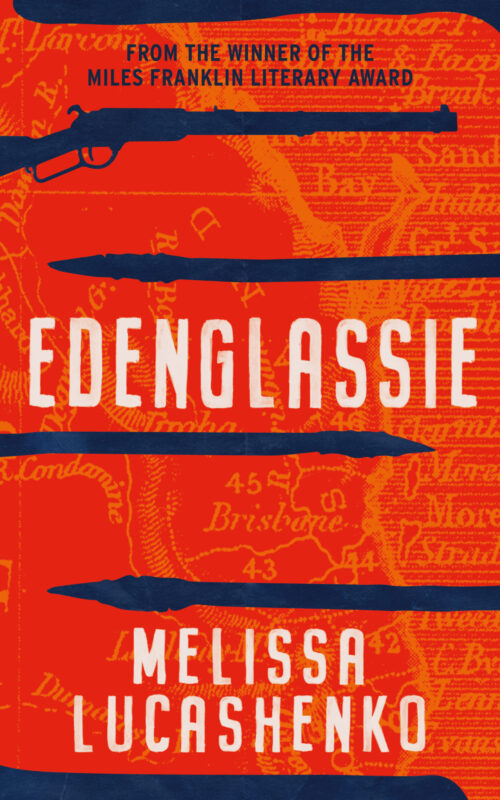
Melissa Lucashenko, Edenglassie (#BookReview)

Broadly speaking, Melissa Lucashenko’s latest novel, Edenglassie, does for southeast Queensland what Kim Scott’s That deadman dance does for Noongar country in southwest Western Australia. Both tell of the early days of their respective colonies from a First Nations perspective; both are written in a generous spirit but with absolute clarity about the dispossession that took place; and both suggest things could have been different.

Unlike That deadman dance, however, Edenglassie, is a dual narrative story. The main storyline, featuring two young people, Mulanyin and Nita, is set around the Magandjin or Meanjin (Brisbane) region during the mid-1850s, making it just a little later than Scott’s first contact narrative. Dispossession, massacres and other brutalities from the colonisers were met with armed resistance, but there were also attempts to work together. Paralleling this historical story is a modern one, featuring Granny Eddie, Winona, and Dr Johnny, set in the same area at the time of its 2024 bicentenary. These stories, one using historical realism and the other modern humour, riff off each other to provide a complex picture of the colonial project – then and now.

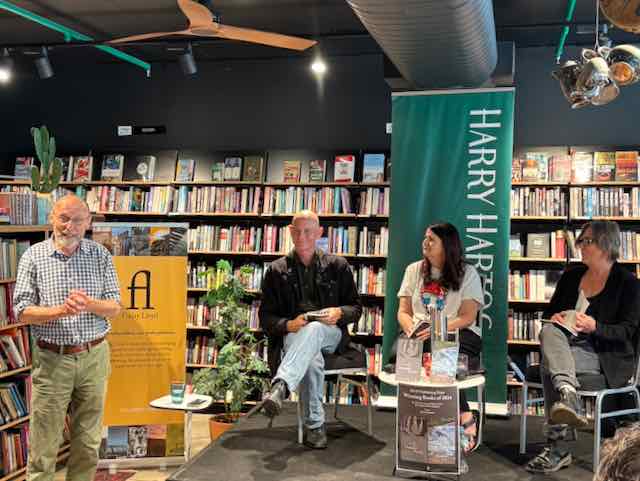
Melissa Lucashenko said much that interested me in the conversation I attended for this book, but here I’ll focus on two points she made. One is that the book’s central question is “what was going through these people’s [the colonisers’] minds?” Things could have been different then, she said, and could still be now. The other point is that she wanted to counteract the trope of the dying race. This idea has been slowly changing since Mabo, she said, but is still evident. The modern storyline, with its confident and politically involved Goorie characters, ensures that we see a vibrant, living culture in action.

Realising these two ideas is a big ask, and in my reading group there were some equivocations, but I think Lucashenko pulls it off, through creating engaging characters who come alive on the page and narratives that ring true to their times. Mulanyin, the kippa (young initiated man) from the historical period, and Winona, the fiery young woman in modern times, represent the passion of youth. They are impatient and want things to happen – or change – now. Both, however, also have elders guiding them – in the Goorie way, which is to encourage people to work it out for themselves and to remedy their mistakes.

“needing to endure the unendurable” (Mulanyin)

So, what is it that these young characters must contend with? The novel starts with two pointed events. In the modern storyline, Granny Eddie trips over a jutting tree root and is ignored by passersby until two young brown faces – Malaysian students as it turns out – help her up and get her to hospital. The modern scene is set, and all is not well.

We then flash back to 1840 where members of the Goorie Federation are looking forward to the imminent departure of the dagai, only to be told that this is now unlikely. A Goorie mother wonders what

If life never returned to normal. If the rule of law was never restored. What would her son see as a man? … Would her daughters be subject to the terrors the dagai brought?

What indeed?

Having asked the question, Lucashenko then moves her historical story to 1854-1855. Mulanyin is living with his law-brother Murree north of his own saltwater Nerang/Yugambeh home. Here, he is in close contact with the colonisers, and particularly with the Petries. At this time, the Petries, particularly the young Tom Petrie, were sympathetic to, and tried in their own way to work with, the Goories on whose land they resided. Lucashenko seems to be saying that, given colonisation was happening and wasn’t going to be undone, there were ways in which it might have been made to work (or, at least, work better). Conversations between Tom, Mulanyin, and other characters, explore their differences, particularly regarding attitudes to country. Mulanyin wants to know

what goes on in the brain of an Englishman? When he arrives in another man’s country to steal his land, and water, and game, and then with a straight face, calls those he steals from thieves? Is this how it is in Scotland? Is this why your people have fled that terrible place?’

The ensuing discussion has Tom struggling to explain the English, but admitting that “in their ignorance, they don’t understand that the land here has its own Law. They think that only their British law exists”. However, he says, they “respect some boundaries still … Those that are well defended”.

What did ‘well defended’ look like, Mulanyin wondered, if not like a thousand Goories assembled at the Woolloongabba pullen pullen? If not like Dundalli, leading the warriors who had willingly assembled under him, from Dugulumba to K’gari?

Fair point, Mulanyin.

Meanwhile, the modern-day characters are living with the fall-out from the failure of the colonisers to make it work and of the colonised to succeed in their resistance. Goories are still here, yes, but life is a struggle, and Winona wants to fight back, wants “to bite em hard onetime, while we got the chance”. She can’t understand why Granny Eddie, who grew up “with a dirt floor and empty belly” doesn’t think she deserves more. Granny, though, is two things. A pragmatist who sees that “Dagai not going away! We gotta get on with them”. And she’s an elder well-versed in her culture, so when Winona takes a hardline with Dr Johnny, who claims Aboriginal heritage, Granny says

“You’re thinking like a whitefella when ya close him out. That’s not our way. We bring people in, we bring our Mob home, and we care about them. We teach them how to behave proper way…”

Further, she argues,

“We can’t be sunk in bitterness … Or stuck in the past. We need to focus on the good dagais, like Cathy and Zainab, and them Petries, and –.”

Winona, Granny Eddie and Mulanyin all make sense, but they speak from different angles. What makes Edenglassie so interesting is the way Lucashenko gives space and respect to these angles. She certainly shows what was lost – and the utter unfairness of it. But, with the generosity of spirit we keep seeing, she also shares through her characters what living with deep connection to country means. And, she encourages everyone to think about alternative ways we can do this.

Towards the end of the novel, Gaja (Aunty) Iris shares an important story with our modern protagonists, introducing it with

we all know how important our stories are … People all over the world keep their stories close. Middle Eastern people believe … that by telling a story you can change the world, and nothing is as powerful as the right story at the right time.

With ideas about truth-telling and decolonisation becoming part of modern Australian culture, now feels like the right time for stories like Edenglassie. It might be an uncomfortable time to be a settler Australian, but that’s nothing compared with what First Nations people have endured and continue to endure. The least we can do is try to understand. Books like Lucashenko’s not only help us along this path but give us a lively read at the same time.

Melissa Lucashenko
Edenglassie
St Lucia: UQP, 2023
306pp.
ISBN: 9780702266126

Delicious descriptions: Charlotte Wood on silence and solitude

It’s some time since I wrote a Delicious Descriptions post, but I want to explore Charlotte Wood’s novel Stone Yard devotional (my review) just a little more. Although I finished it over a week ago, I keep thinking about its evocation of quiet lives in retreat – and what Wood might be saying.

I am, admittedly, a woman of “a certain age”, but, nonetheless, I am surprised to find that where once I loved filling my life with noise and action, I am now enjoying quiet. By noise and action, I don’t mean energetic activity – I’ve never minded being sedentary – but I mean I have never actively chosen quietness. Recently, however, this has changed. Now when Mr Gums and I drive long distances, for example, we often drive in silence – no music, no audiobooks, podcasts or radio programs, just silence. And, I like it.

It is this silence that Wood’s unnamed narrator in Stone Yard devotional seeks, and Wood writes about it in a way that not only makes it meaningful in terms of why we might seek it, but that is calming to read.

It starts the afternoon our narrator arrives at the abbey. “The silence is so thick,” she writes, “it makes me feel wealthy”. What an idea that is, “the silence is so thick it makes me feel wealthy”. A couple of paragraphs later, she explains that the abbey’s welcome booklet says they “accept that guests might want total solitude”. “Noise is discouraged”, and guests “are free to decline joining others for eating or worship”. She “cannot think of a greater act of kindness than to offer such privacy to a stranger”.

A couple of pages after this, and despite not being required to join in, our narrator decides to go to Lauds in the little church, and finds herself wondering how they get anything done with all this toddling into church every couple of hours. But then she realises that this “is the work. This is the doing”. She finds herself “drenched in a weird tranquility” and she wonders whether this has come from

being somewhere so quiet; a place entirely dedicated to silence. In the contemporary world, this kind of stillness feels radical, illicit.

Such silence, however, while appealing in theory, is not as simple as it sounds. She talks about the Lectio Divina, which Wikipedia describes as a traditional monastic practice comprising “four separate steps: read; meditate; pray; contemplate”. This is a step too far for our narrator at this point in her journey, and she finds herself arguing internally with what she is seeing, but

Despite this, the process is strangely beautiful. Sister Bonaventure says getting caught on a word is the point, and if you remain troubled or confused by it, you just ‘hand it over to God’. This is so antithetical to everything I have believed (knowledge is power, question everything, take responsibility) that it feels almost wicked. The astonishing – suspect – simplicity of just . . . handing it over.

The narrator is an atheist and the novel is not about religion per se, so she comprehends this concept more broadly in the sense of letting the things that bother you just sit, instead of endlessly turning them over.

This brings me to the idea I shared in my post on the novel, that of

waiting. An incomplete, unhurried emergence of understanding, sitting with questions that are sometimes never answered.

Thoughts about stillness, silence, solitude, and contemplation, freedom and peace, form the backbone of this novel, but they are tested by the visitations or “visitants”. They are also specifically tested by the idea of an active life. Sister Helen Parry distances herself from the abbey’s inhabitants, getting on with her activist work via “internet video calls … calling for action on this or that”. She brings, says the narrator, “everything we so painstakingly left behind”. Local farmer Richard Gittens’ wife, Annette, views life at the abbey as “sick … unnatural”.

And yet … (indeed, Elie Wiesel’s “and yet” is the narrator’s favourite phrase) … the end, when it comes, seems to suggest that there is a place for all. And that, maybe, there is no either-or, but what is right for us at different points in time. A gift of a book for anyone interested in thinking about how to live in our noisy, troubled and troubling world.

Charlotte Wood, Stone Yard devotional, Crows Nest, Allen & Unwin, 2024

Charlotte Wood, Stone Yard devotional (#BookReview)

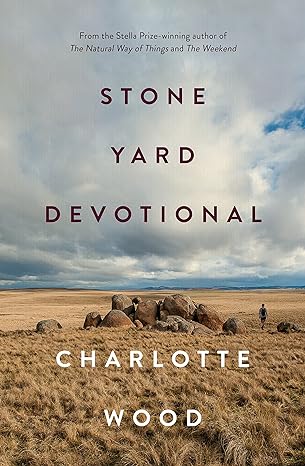
Charlotte Wood’s most recent novel, Stone Yard devotional, is set in the Monaro, a region just south of where I live. It’s a landscape that is much loved by many of us, including Nigel Featherstone, whose My heart is a little wild thing (my review) is also set there. The Monaro is expansive country, a dry, golden-brown plateau, characterised by rocky outcrops here and there, much as the cover shows. There are also hills in the distance, and big skies. Perfect country for contemplation, I’d say, which is exactly what Wood’s unnamed protagonist is doing there. (In fact, it’s also what Featherstone’s protagonist went there to do, for a very different reason – although, coincidentally, both books have something to do with mothers).

Stone Yard devotional is a quiet and warm-hearted read, one that asks its readers to not rush ahead looking for a plot, but to think about the deeper things that confront us all at one time or another. These things are hinted at by the two epigraphs, one being Australian musician Nick Cave’s “I felt chastened by the world”, and the other American writer Elizabeth Hardwick‘s “This is what I have decided to do with my life just now. I will do this work of transformed and even distorted memory and lead this life, the one I am leading today”. Add these to the title – with its hardscrabble sounding “Stone Yard” set against the gentle, inwardness of “devotional” – and you have a sense of the intensity to be found within.

“a place of industry, not recreation”

While this is not a plot-driven novel, there is a definite narrative arc. Taking the form of undated journal entries, the novel covers a period in the life of a middle-aged woman who has left her city life – her husband, her job in threatened species conservation, and her friends – to live in an abbey on the Monaro. It starts with a five-day stay, which is followed by more stays until the time comes when she arrives and doesn’t leave. Why she does this is not explicitly explained but through her contemplations we come to see that there’s unresolved grief in her life over the death of her parents some three decades earlier and, alongside this, a level of existential despair which has built up over time.

This is the set up. The narrative arc comes from three “visitations” to the abbey – a mouse plague which ramps up as the novel progresses, and the celebrity “environmental activist nun” Helen Parry, who accompanies the bones of the murdered Sister Jenny who had left the abbey decades ago to work among poor women in Thailand. These three events, both real and metaphoric in import, present practical and moral challenges, “a rupture” but also “a frisson of change”, for our narrator, and for all at the abbey.

So, we follow Wood’s narrator as she settles into life at the abbey, taking on the role of cooking for the group, and, as their non-religious member, the shopping and other errands that need to be done. Much industry is required to keep the place running when there is no financial help from the church, but the main industry is emotional and spiritual (in its wider meaning). Early on, our narrator recognises that prayer and contemplation “is the work … is the doing”. For her, as an atheist, this is not religious in origin or intent, but nonetheless contemplation is the real work she does while living at the abbey.

Much of this contemplation is invoked by flashbacks to and memories of events from the past, some experienced by her and others that happened around her (like the suicide of a farmer). Many involve her beloved and humane mother, who, like nuns Helen and Jenny, was an “unconventional”, determined to continue along her path despite what others thought. Such contemplation is hard, and our narrator is tested by the “visitations”, particularly Helen Parry with whom she has history involving bullying at school. Our narrator wishes to apologise but, as she comes to see, the hard work is in coming to that point of apology, not in having the apology accepted. But, forgiveness and atonement are only part of the bigger questions posed in this novel. Grief, despair and, ultimately, how to live are also part of its ambit – and are set against the shadow of climate change and its implications for our lives and choices.

This sort of exploration, however, can only work if we like the telling, and I found it thoroughly compelling. Stone Yard devotional is delicious for its details about life in an abbey on the “high, dry, Monaro plains, far from anywhere”, and for its insights into the women living there. No character is fully developed, but each, from the “business-like but soft-looking” leader Sister Simone to the distressed Sister Bonaventure, feels real in the role she’s been given in the narrative. While there’s not a lot of dialogue, our narrator reports on interactions between the women, and these contribute to her contemplations about life. She is not perfect and admits to moments of pettiness and poor judgement in her dealings with her co-habitants. Contrasting this little community is local farmer Richard Gittens, who supports the abbey in many practical ways and who represents, as our narrator recognises, “decency”.

All this is told in spare but expressive writing that maintains a tone which is serious and reflective, but which never becomes bleak.

There is no single, final enlightenment, but rather, as the narrator says earlier in the novel, “an incomplete, unhurried emergence of understanding, [a] sitting with questions that are sometimes never answered”. This is the sort of writing I love to read. In some fundamental way, it reminded me of my favourite Wallace Stegner quote. In Angle of repose, he wrote that “civilisations grow by agreements and accommodations and accretions, not by repudiations”. Through living this life in retreat, Wood’s narrator comes to know herself better. In so doing, she is able to lay some of her demons to rest, not through any major crisis but through quiet contemplation. The abbey does, indeed, turn out to be a “place of refuge, of steadiness. Not agitation”.

Interestingly, and perhaps pointedly, the novel ends on an anecdote about the narrator’s mother and her “reverence for the earth itself”. Ultimately, Wood invites us, without exhortation, to not be “chastened by the world” but to do the hard work of thinking about what is really important. A compassionate, and gently provocative, book.

Kimbofo (Reading Matters) also liked this book.

Charlotte Wood
Stone Yard devotional
Crows Nest: Allen & Unwin, 2023
297pp.
ISBN: 9781761069499

Sean Doyle, Australia’s trail-blazing first novelist: John Lang (#BookReview)

Sean Doyle’s literary biography, Australia’s trail-blazing first novelist: John Lang, provides insights not only into this “idiosyncratic” man, but into two colonial societies – Australia and India – through the early to mid nineteenth-century. Doyle’s is not the first biography of John Lang, but it’s the first I’ve read.

However, Lang (1816-64) himself is not new to me. In 2018, I reviewed his 1853 novel, The forger’s wife, when it was published by Grattan Street Press in their Colonial Australian Popular Fiction series. But, even that wasn’t my first mention of Lang, as I had written briefly about him in a 2012 Monday Musings on Australia’s “pioneer novelists”. In that post, I wrote that he was born at Parramatta, went to Cambridge in 1838 where he became a barrister, and returned to Sydney in 1841, before leaving again a few years later to live in India and England. All this is covered in excellent detail in Doyle’s biography (with relevant clarifications).

John Lang, The forgers wife

I also noted that, according to (my 1994 edition of) The Oxford companion to Australian literature, “the enigma surrounding the life and personality of John Lang has not, even a century later and in spite of considerable literary research, been completely solved”. It is, however, believed he wrote the fiction work, Legends of Australia, which was anonymously published in 1842. The Oxford companion suggests that authorship of this “would entitle Lang to the distinction of being the first Australian-born novelist”. I added that there is a 2005 biography of Lang by Victor Crittenden, whose title says a lot: John Lang: Australia’s larrikin writer: barrister, novelist, journalist and gentleman. He was a contributor to Charles Dickens’ periodical Household Words. All of this is also covered by Doyle, but with additional research, which confirms some of the information that the Oxford companion writers “believed”.

Sean Doyle opens his book with a Preface which sets his biographer’s ground rules. Arguing that the richness of Lang’s life is in the details, he admits that not only did Lang lack a champion “to carry his flame posthumously”, but that there are few contemporary sources and what does exist is sketchy. No diaries or letters are known to survive. So, the temptation of course is to look to his novels, but, as Doyle cautions, while these can be “a looking-glass into his own life … any correlation requires caution”. His process then was “to assemble the verifiable facts, identify the spaces between them, and navigate the spaces with the firm aim of being true to what we know of his temperament, life and times”. He argues that Lang’s “known actions and ways inform the spaces of the unknown”.

Doyle then moves to his Introduction where he makes a strong argument for why this man deserves this biography, starting with Lang’s being “the first Australian-born novelist”, not with 1853’s The forger’s wife, but with Violet, or the danseuse, which was published in 1836 (and identified as being by Lang in Crittenden’s biography). Doyle names many other firsts, including the first Australian satire (Legends of Australia, 1842), full-length detective-novel in English (The forger’s wife, 1853), Indian travelogue by an Australian (Wanderings in India, 1859), and supernatural tale by an Australian (“Fisher’s ghost”, 1836). Other firsts include making the first translation of a classic (a Roman poem) in New South Wales. These firsts, Doyle admits, were more easily come by in the early days of a colony, but argues this doesn’t diminish the achievement.

“He just couldn’t help being idiosyncratic” (Doyle)

The rest of the book, until the Epilogue, chronicles Lang’s life, in nicely readable detail, through 25 chronological and clearly titled chapters, such as “Chapter 1, Family and Social Background”; “Chapter 11, Calcutta, 1842”; and “Chapter 21, Furlough in the UK (and a Creative Peak) 1852-’54”. In the telling, Doyle conveys much about Lang’s personality and character, which he gleans from the sources he has. These include, for example, newspaper reports of Lang’s “ill-advised” comments on the franchise and representation in New South Wales’s colonial legislature while seconding Wentworth’s motion supporting the idea. This is just one of many occasions in Lang’s life – as documented by Doyle – in which he shoots himself in the foot (as they say!) The end result is a biography that portrays a man – a “currency lad” no less – who had a lot of talent, a lot of heart and a lot to offer but who, more often than not, undercut himself through poor judgment and/or poor timing and/or an inability or refusal to read the times and produce accordingly. Lang wanted to emulate Dickens’ success, but “he just couldn’t help being idiosyncratic” – in his literary, personal and political lives.

Nonetheless, Lang achieved much in his relatively short life of 47 years. He is, argues Doyle, better known in India, than Australia, largely because of his support of Rani of Jhansi during her battles against the East India Company, but also for, as a barrister, winning Sikh Jyoti Prasad’s suit against the Company. Indeed, Doyle’s coverage of Lang in India at the time the Company fell and the British Raj commenced makes good, albeit distressing reading. It’s an ugly history, as we know. Lang also established, in 1845 in Meerut, a newspaper titled The Mofussilite, which documented many of India’s sociopolitical challenges of the time, and was often critical of the Company and the British.

The Epilogue provides a thoughtful summation of Lang’s achievements and significance, particularly in terms of his writing, and of the social, political, literary and personal circumstances that affected who he was and what he achieved. It makes a case for Lang’s place in Australia’s literary history, arguing that

without his balanced depiction of the convict era, the colony’s story is lopsided. This matters: a culture is the sum of the stories it tells itself.

The Epilogue, in fact, is a useful document on its own.

The biography is written in a popular-history style, meaning it has a strong narrative drive, with a liberal use of exclamation marks, some foreshadowing, and, for some chapters, serial-like cliff-hanger endings (which feel appropriate to Lang’s era). Doyle wants to understand Lang’s character and actions, and he pursues this with the gusto of a story-teller but with an eye on the facts and truths as he sees them.

Doyle is clearly keen to get the story of Lang and “his rollicking times” known. His research feels thorough and the characterisation as accurate as he can glean from this research. There are end-notes which cite sources for important points and a list of mainly secondary sources (biographies, histories, articles and websites). At times I would have liked to better understand which gaps were being filled, which thoughts and feelings were guessed rather than known, albeit Doyle heralds some with “maybe”-type markers and recognisable pop-psychology. There is no index, which is a big negative for me in biographies, but I know they are expensive, and the chronological telling will help people hone in on where the persons or events they are researching might be.

I did have questions as I read. What was Lang’s attitude to his wife and children, who left him in India, and whom he apparently never saw again, and where did First Nations people fit in those early colonial days of “big” men and their “progressive” ideas? But these are not necessarily germane to the main story here. Lang’s life is story enough, and Doyle has delved as far as he can.

Australian’s trail-blazing first novelist makes good reading for anyone interested in Australia’s literary history.

Note: Four of Lang’s works are available at Project Gutenberg Australia.

Sean Doyle
Australia’s first trail-blazing novelist: John Lang
Newport, NSW: Big Sky Publishing, 2023
372pp.
ISBN: 9781923004382

(Review copy courtesy the author.)

Gail Jones, Salonika burning (#BookReview)

Australian author Gail Jones’ ninth novel, Salonika burning, is a curious but beautiful novel, curious because she fictionalises four real people for whom she has no evidence that they met or knew each other, and beautiful because of her writing and the themes she explores. The novel is set during World War 1, but its focus is firmly on the interior rather than the grand stage of battle.

It opens dramatically with the burning of the city of Salonika (Thessaloniki). This is another curious thing, because this destructive event was caused not by an act of war but an accidental kitchen fire. Also, the novel is not set in Salonika but some 90 miles off, in and around “the field of tents that comprised the Scottish Women’s Hospital”, on the shores of Lake Ostrovo in Macedonia. It is 1917, and the novel’s narrative centre is this hospital and those working in and around it. Here, not Salonika, is where our four main characters are based — Stella, an assistant cook/hospital orderly; Olive, an ambulance driver; surgeon Grace; and Stanley, an orderly with the Royal Army Medical Corps. They are based on the Australians, writer Miles Franklin and adventurer Olive King, and the British painters, Grace Pailthorpe and Stanley Spencer. In her Author’s Note, Jones makes clear that she has fictionalised these characters, and that while all are known to have worked in the vicinity, there is no evidence that they met or even knew each other. It is “a novel which takes many liberties and is not intended to be read as a history”. This is fine with me. After all, a novel, by definition, is not history. The novel follows these characters over a few months after the burning of Salonika.

“everything was coming apart”

So, why Salonika? I see a few reasons. For a start, its burning sets the novel’s tone. On the first page we are presented with opposing ideas. The sight of the burning city is described as “strangely beautiful” but, on the other hand, “alarm, instant fear, the sufferings of others … were no match for excitement at a safe distance”. As the fire died, “excitement left and in its place was a murky lugging of spirit”. Throughout the novel, Salonika represents these contradictions, this tension between what is ugly, what is beautiful; between what is random, what is not; and in how to respond to, or feel about, what is being experienced.

The Salonika fire also encompasses the idea of witness and representation. In the opening scene, Jones describes a painting made of the fire by William T. Wood. It is a “morning-after scene, brightly calm, with a floaty view from the heavens” done in his “signature pastels, remote as a child’s dream and thinly decorative”. Those who saw this painting later, she writes, “saw the pretty lies of art”, whereas “former residents and soldiers said, No, it wasn’t like that”. This tension too is played out in the characters as they think about how they might represent their experience.

The burning of Salonika, then, embodies several ideas that are followed through in the novel. But, Salonika is also relevant to the plot. The novel’s narrative arc lies mainly in the characters and their emotional reactions to what is happening as the months wear on. Not only is there the war with its injured and dying soldiers, but malaria is rife, and the privations they experience, professionally and personally, are exacerbated by the burning of Salonika and the attendant shortage of essential provisions – food, petrol, medical supplies. However, a plot also unfolds, and it is something that happens on the way to Salonika, well into the story, which sets the novel’s final drama in motion.

Salonika burning traverses themes that are the stuff of the best war literature – themes that expose the “idiocy of this war, of all wars” and its impact on those caught up in it – but it offers its own take. The telling feels disjointed, particularly at the start, with its constant switching between the perspectives of the four characters who interact very little with each other until well into the novel – and even then it’s often uneasy, as befits their temperaments. And yet, the novel is compelling to read, primarily because of these characters. They are beautifully individuated, so flawed, so human, so real.

Olive, who is the first character we meet, and the one who closes the novel, is confident, tough and practical. Grace, too, is tough, doing her “duty” with a “dull vacancy”. Stella, at 38, the oldest of the four, is “cranky and wanting more”, more excitement to write about, but she believes in “chin-up and perseverance”, while the youngest, 26-year-old Stanley, is “ill-fitted … to this life of rough cynical men”.

These are “intolerable” times, and we are privy to their struggle to maintain their sanity. Olive resorts to her German grammar to escape the emotional load, while Stanley has his mules and favourite painters, his “Holy Rhymers”. Stella, “writing jolly accounts in her diary”, thinks about what stories she will tell, while Grace has her favourite brother to think about and write to. The disjointed structure mirrors, I think, their sense of isolation. Contact and the potential for friendship is there, but Matron discourages emotional engagement. There’s “no room for emotion”, she says, just “duty”. Olive, who seems to represent the novel’s moral centre, thinks otherwise:

It seemed another kind of duty, not to forget. Olive wanted to speak of what she had seen and known, though she suffered too much remembrance.

This could neatly segue to that issue of representation, and the post-war work done by Stella, Grace and Stanley, but instead, I want to conclude with another idea. On a supply trip to Salonika, Olive, “driving in her safe foreign aura”, had been indulging in a dose of self-pity, but is suddenly confronted by the loss Salonika’s burning represented for its residents, “and only now understood that it was the woe of others that claimed importance”. Likewise, Stanley, Grace and Stella are confronted with the woes of others through the novel’s closing drama, and must decide where their humanity lies.

I started this post noting some curious things about Jones’ approach to her story, but these didn’t spoil the read. Rather, they added to my interest as I read it. Ultimately, Salonika burning is a true and tenderly written novel that captures the essence of war’s inhumanity, and then goes about extracting the humanity out of it. A worthy winner of the 2023 ARA Historical Novel Prize.

Lisa and Brona also read and enjoyed this book.

Further reading

Gail Jones
Salonika Burning
Melbourne: Text Publishing, 2022
249pp.
ISBN: 9781922458834

Michael Fitzgerald, Late (#BookReview)

Australian author Michael Fitzgerald’s novel Late owes something to what is known as the alternate (alternative) history genre, or what I call “what if” novels. Here, the underlying story is, what if Marilyn Monroe had not died in 1962 but, instead, had instead escaped Hollywood’s oppressive celebrity culture and moved to Sydney, Australia?

It’s hard to imagine any celebrity who has inspired more books, films, songs – you name it – than Marilyn Monroe. Just check out Wikipedia’s page listing them. There are over twenty works of literature, of which I’ve only read one, Andrew O’Hagan’s The life and opinions of Maf the dog and of his friend Marilyn Monroe (my review).

Now though, I should ‘fess up that nowhere in Fitzgerald’s book does he name Marilyn Monroe. His narrator is unnamed. However, she tells us she is also known as Zelda Zonk, a name once used by Marilyn Monroe, and the biography she gives us is that of Monroe down to her birth and death dates, the details of her marriages, and much more. So, given our narrator is intended to be Marilyn, the question is why? Why write a(nother) story using Marilyn, rather than start from scratch? And why do it using another of her personas, Zelda Zonk? I don’t know, but I’ll have a go at thinking about it.

So, let’s start with the setting. We are in 1980s Sydney, so Marilyn has been in Sydney for a couple of decades. She is living in a modernist (Harry Seidler-designed) building in Vaucluse, not far from some of the cliffs in Sydney which, in the 1980s, were also the site of gay-hate crimes known as the “Sydney cliff murders”. Notwithstanding that darkness, Sydney is beautifully evoked.

Early in the novel, our narrator meets a young man Daniel, who turns out to be gay and who is locked out of the apartment he is house-sitting. The relationship that ensues brought to mind Sigrid Nunez’s The invulnerables (my review) in which an older woman develops a friendship with a young man, but they are different books, so let’s move on. Our narrator and Daniel discover points on which they connect – from something as simple as their mothers’ names (Gladys and Gladyne) to something more fundamental like both having experienced adoption and a sense of being outsiders. Trust and tenderness develop between them, as they walk, ride on a ferry together, and cook a meal for Shabbat.

Now, a little aside: I’m not sure how to refer to the narrator because, as she writes in the opening paragraph of Scene (aka Chapter) 2, “I am not always Zelda, and Zelda is not always me”. Indeed, she writes, “Zelda is everything that I’m not […] She is the me who goes on living”, and later again, she is “the protectress of my spirit, of the shattered sense of me”. If I name her Zelda in my post, I am ignoring the distinction, and I don’t to do that. So, I am going to stick with the term “narrator”.

“What I have to say is important and personal” (Zelda)

Our narrator’s voice is variously wise, funny, erudite, and also at times self-deprecating. She is out to set the record straight in terms of her reputation as the “dumb blonde”, the “beautiful child”, the difficult actress who was always “late”:

You see, I wasn’t late: they were in a God-awful American hurry. Yes, let it be said for the record, being late wasn’t a problem: they were in this crazy rush to the moon. In any case, who aspires to be on time when, for my Art, readiness is all?

And when it really counted, let’s face it, my timing was perfect.

Drop-dead perfect.

So much in those few sentences.

She makes us see her life from a different perspective, such as the time she wore the see-through rhinestone dress to sing Happy Birthday to JFK. I don’t know what Monroe really thought or intended but that is perhaps not the point. Michael Fitzgerald gives her a voice that reflects on her experience, on how the culture manipulated her, on the hurts of being commodified and ignored as a person. Marilyn is a wonderful vehicle for interrogating celebrity, and Zelda for exploring how an escapee might see the experience and move on from it.

There are several questions to ask about this book, besides why Marilyn. Another is, why is she speaking now, a couple of decades after her arrival in Sydney? This one she answers – it’s because “the cliffs have been warning me, for months now, that evil dwells here”. And this is where Daniel as a young gay man comes in. He is the vehicle for exploring the homophobia of the time, the gay-hate crimes and cliff-murders. He is a gentle person with his own crisis, and is drawn to Zelda “like an old person or wounded animal is”. Our narrator empathises with him, and the other young men who have disappeared, and wants to help him. Their cliff-top nemesis is, pointedly, blond.

I won’t say more about the plot, because the novel’s main interest lies in the narrator’s musings. They are what I most enjoyed – her clever allusions to movies, books, poetry, and songs, her witty footnotes, her humanity, and the entertaining wordplay (starting with the multiple meanings of the title itself).

I don’t know if I understood the novel the way Fitzgerald intended, but I enjoyed the voice. It is confident, witty, in-your-face. “Without a sense of humour, we are animals, we are lost,” she says. It is also intelligent and thoughtful. This Marilyn – if I can call her that at this point – has come through and is living life the way she wants to live it, but she has heart too, and cares about the young men. It’s a surprising thing that Fitzgerald has done to put the two ideas together, but I think he has made it work. After all, why not have a gay icon care about saving young gay men?

So, I found it an absorbing to read, one that encourages us to think about who Marilyn might have been had she been allowed to be herself. And who Daniel might be if allowed to be himself!

Right near the end, our narrator comments,

Don’t you think it’s funny? How we still haven’t explored these shadows of the human heart?

Maybe we never will, fully, but books like this encourage us to keep trying.

Lisa also enjoyed and reviewed this book.

Michael Fitzgerald
Late: A novel
Melbourne: Transit Lounge, 2023
208pp.
ISBN: 9781923023024 

(Review copy courtesy Transit Lounge via publicist Scott Eathorne)

Anna Funder, Wifedom (#BookReview)

Anna Funder’s Wifedom: Mrs Orwell’s invisible life is a book with a mission, a mission that is implied in its full title. That mission is to examine the notion of “wifedom”, and the way patriarchy works to construct it, through the example of the invisible – or, as Funder also calls it, erased – life of George Orwell’s wife, Eileen O’Shaughnessy.

To do this, she wrangles Eileen out of the shadows of history to produce an intelligent, funny, warm-hearted, loyal and hard-working woman who, observed novelist Lettice Cooper, loved George “deeply, but with a tender amusement”. It’s an engrossing story, well-told. However, it’s a challenging read too.

Funder explains early in the book that her interest in Eileen came from reading something Orwell wrote about women and wives – after Eileen had died. It’s astonishingly misogynistic, and made her wonder who Eileen was and what she might have thought. Funder set about reading six Orwell biographies written between 1972 and 2003, but she found them unhelpful when it came to Eileen. Indeed, she says, they gave so little that they “started to seem like fictions of omission”. Funder then, logically, went to these biographers’ sources. She found some more bits and pieces about Eileen, but it wasn’t enough. All she had was “a life in facts, a woman in pieces”, so she “considered writing a novel – a counterfiction to the one in the biographies”. But, she was fascinated “by the sly ways” in which Eileen had been hidden, and she felt a novel couldn’t effectively explore this. Then she “found the letters”.

These were six letters that Eileen had written to her good friend Norah from just after her marriage in 1936 until 1944, but they had not been discovered until 2005. These letters gave her Eileen’s voice – and this voice was “electrifying”. Funder believed she could no longer write a novel. She writes,

I wanted to make her live, and at the same time to reveal the wicked magic trick that had erased her, and that still holds sway today. I thought of it as writing a fiction of inclusion.

“it’s hard … for history to find you”

This is where the book gets tricky, because, while I found Wifedom a fascinating read, it raised questions too, and they are intrinsic to what Funder is trying to achieve, and how she goes about achieving it. The book is divided into five parts, with the first part titled “Wifedom, A Counterfiction”. What does this mean? She doesn’t immediately explain what I have described above. Instead, she opens her book on a scene in which she imagines Eileen writing a letter to Norah – and she includes excerpts from that letter. This throws us readers in at the deep end. As we get into the book, we come to recognise these imagined sections, because they are identified by indentation, and opening and closing graphical symbols, but at the beginning it’s a bit mystifying, albeit an engaging way to capture our interest.

Early in the read, then, it becomes apparent that Wifedom comprises a complex mixture of processes and forms. The imagined sections are interspersed throughout the book between more traditional biographical writing about Eileen and George’s life. And interspersed between these are reflections from Funder’s own life, because one of her points is that the patriarchy, the “patri-magic”, which erased Eileen’s life from George’s biography, still exists and is evident in her own life as a wife and mother, despite her supportive husband and “egalitarian” marriage. I’m not going to focus on this aspect of the book, though, because it seems to fade away somewhat as Eileen and George’s story picks up, and is not, anyhow, where I want to go in this post.

Instead, I want to tease out the process. Early on Funder writes that

Looking for Eileen involved the pleasure of reading Orwell on how power works. Finding her held the possibility of revealing how it works on women: how a woman can be buried first by domesticity and then by history.

This is not particularly new. Anyone interested in feminism is aware of how women have been lost in (and thus to) history. However, Funder’s book is enlightening in this regard. She does an excellent job of interrogating how it can happen. It happens when biographers ignore or play down the role of women in their subjects’ lives. Through cross-matching her sources she finds example after example of Eileen’s contributions being downplayed or omitted. She shows how the use of passive voice and terms like “wife” rather than Eileen’s name work to make her disappear. (Orwell does it himself in Homage to Catalonia.) She finds examples where biographers, disconcerted by some of George’s behaviour, excuse it (how often are men excused!), or, uncertain about evidence, will rephrase it. For example, Funder writes that Eileen

noted his extraordinary political simplicity – which seems to have worried one of the biographers, who rewrote her words to give him an ‘extraordinary political sympathy’.

Eileen’s words come from a 1938 letter to Marjorie Dakin. The biographer is Crick. (Another of the textual clues to readers in this book is that Eileen’s words are conveyed in italics, while the words of others are enclosed in quotation marks.)

But here’s the challenge – interpretation. Funder writes early in her book that,

As serendipity would have it, in 2020 Sylvia Topp published Eileen: The Making of George Orwell, which contained much material I hadn’t found, and was thrilled to read, though we interpret it differently, and so build differing portraits of Eileen.

She does not explain what she means here, but in the very thorough Notes at the end of the book, Funder elaborates on Topp’s approach to Eileen. Put simply, Topp, Funder says, sees Eileen as one of those celebrated people’s partners who devoted their lives “joyfully to assisting the talented partners in all their various needs knowing all along that they would be under-appreciated, and often ignored, and yet never faltering in their dedication, or in their willingness to submerge their own personal talents into their partners’ success.” Topp, then, sees Eileen as a “helpmeet of genius” while Funder is interested, as she writes in these Notes, “in examining what it took, perhaps, to be in that marriage, and that dream”.

So, what we have here is interpretation. Topp had the same sources that Funder did. Indeed, she added some to Funder’s arsenal. But, she interprets them differently. As a feminist, I easily aligned with Funder’s interpretation, but as I read I also had this little niggle that Funder was interpreting her sources – from the perspective of her times, values and gender – just as other biographers had before her.

Wifedom was my reading group’s April book. Our conversation focused mainly on the biographical content – on Eileen’s life, on George Orwell and his books, and on the impact of patriarchy on Eileen. We were horrified by the life led by Eileen, as Funder tells it – and the facts seem inarguable. Their relationship appeared to us to have been so one-sided. Eileen did all the domestic work, and it was hard work given the primitive rural cottage that they called home. She was, often, the main breadwinner, and she did his typing, as well as offering editorial comment. She was necessary to him. Meanwhile, he focused on his writing and, we gathered, chasing other women. And yet, Eileen stayed with George. Why, we wondered?

We didn’t delve into the interpretation issue, albeit I would have loved to, but I needed more time to collect my thoughts. We did, however, discuss why we thought Eileen stayed with George which, I guess, was us interpreting what we’d read! Various ideas were put forward, including that Eileen might have been a “rescuer”, or that she knew she was unlikely to have been published herself (in a patriarchal world) and so channelled her energies through George, or, simply, that she loved him and, much like Topp argued, willingly helped him in any way she could.

So, there you have it! History, biography, it’s all a matter of the facts you have, and the way you see them. I don’t mean to devalue the biographer’s art by that statement, but simply to recognise that even the most formal, most rigorously documented biography will, necessarily, be affected by the biographer and their times. For this reason, I found Wifedom an absorbing and provocative read, though perhaps only partly in the way Funder intended.

Anna Funder
Wifedom: Mrs Orwell’s invisible life
Hamish Hamilton, 2023
511pp.
ISBN: 9781760143787

Monday musings on Australian literature: Stella Prize 2024 Winner

The 2024 Stella Prize winner was announced last Thursday, the 2nd of May, but that was the also the day my blog turned 15, and I didn’t want to flood cyberspace with too many posts. Then this weekend was the SixDegrees meme which meant another post coming at you. So, I decided to do my Stella 2024 post, this year, as a Monday Musings. It makes sense to do so, in fact, because it’s an historic win. First though, the winner, for those of you who haven’t heard yet:

Alexis Wright’s Praiseworthy

Why historic? Again, some of you will already know this, but Alexis Wright, one of our leading First Nations writers, is the first writer to win the Stella twice in its 12 year history. An impressive achievement by any measure. I am embarrassed to say, however, that of the now four Stella winners I haven’t read, Wright’s two are among them. This is not because I don’t want to read them, but because they are big tomes, and my life doesn’t seem to lend itself these days to chunksters. I read and loved her multi-award winning novel Carpentaria (my post), which was big enough – at over 500 pages – but that was before blogging when time pressures felt different! Clearly, though, I should make time for this because, from what I can tell, its subject matter is something I care about and it has the wit and playfulness, passion and imagination, that I loved in Carpentaria.

Praiseworthy has already been recognised by the literary establishment. Last year it won the Fiction Book Award in the Queensland Literary Awards. Further, as publisher Giramondo shares, it has been shortlisted for many other awards: The Dublin Literary Award 2024; the People’s Choice Award, the Christine Stead Prize for Fiction and the Indigenous Writers Prize in the 2024 New South Wales Premier’s Literary Award; The James Tait Black Prize for Fiction 2024; and the Queensland Premier’s Award for a Work of State Significance in the 2023 Queensland Literary Awards.

The chair of the judging panel said this about the book:

Praiseworthy is mighty in every conceivable way: mighty of scope, mighty of fury, mighty of craft, mighty of humour, mighty of language, mighty of heart. Praiseworthy is not only a great Australian novel – perhaps the great Australian novel – it is also a great Waanyi novel. And it is written in the wild hope that, one day, all Australian readers might understand just what that means. I do not understand. Not yet. But I can feel history calling to me in these pages. Calling to all of us. Imagine if we listened.

Giramondo’s (above-linked) page for the book, includes excerpts from other critics and reviewers. Samuel Rutter of the New York Times Book Review describes it as “the most ambitious and accomplished Australian novel of this century”, while Jane Gleeson-White wrote in The Conversation that “Praiseworthy is Alexis Wright’s most formidable act of imaginative synthesis yet…a hero’s journey for an age of global warming, a devastating story of young love caught between two laws, and an extended elegy and ode to Aboriginal law and sovereignty”. More than one references Ulysses, such as Ruth Padel, who describes it in The Spectator as “an impassioned environmental Ulysses of the Northern Territory… Playful, formally innovative, multi-storied, allegorical, protean and dizzyingly exhilarating, it is long, lyrical and enraged”. Several, in fact, praise the language; and many comment on its satirical aspect, its lyricism, its comedy. Lynda Ng, in Meanjin, calls it:

The finest distillation yet of Wright’s themes – a bold assertion of Aboriginal sovereignty that successfully encompasses all areas of life: culture, economy, and jurisprudence.

Of course, Giramondo has selected excerpts that praise, but the sources of that praise are impressive.

There are those who think that she should/may/will be Australia’s next Nobel Laureate for Literature.

Returning to the Stella, you can read more on the Stella website, including a link to Alexis Wright’s acceptance speech, and an expressive video performance of a brief scene from the novel by Boonwurrung actor Tasma Walton.

Just to remind you, this year’s Stella judges were writer, literary critic, Artistic Director of the Canberra Writers Festival and this year’s chair, BeeJay Silcox; Filipino-Australian poet, performer, arts producer, and advocate, Eleanor Jackson; First Nations award-winning poet and arts board member, Cheryl Leavy; novelist, occasional critic and full-time dad, Bram Presser; and writer and historian, Dr Yves Rees.

Wikipedia offers a well-presented complete list of the winners and all the short and longlisted books.

Thoughts anyone?

Rachel Matthews, Never look desperate (#BookReview)

One of the most appealing things about Rachel Matthews’ third novel, Never look desperate, is that it features some decent men. In this #metoo era, which differs little from what came before, there’s plenty of fiction which shows men in less than stellar light. And that’s fair enough. One of the reasons I read fiction is to expand my understanding of the issues I care about. I can feel along with the so-called sad girl stories, and applaud the angry feminist ones. However, most men I know, like most women I know, are decent human beings trying to live good, fulfilled lives. And this, essentially, is the subject matter of Matthews’ novel.

Never look desperate follows three main characters, in alternating, third-person chapters. These characters are 49-year-old Bernard, 54-year-old Minh, and Bernard’s recently widowed 70-year-old mother Goldie. It is set in Melbourne, immediately post-pandemic. People are starting to get out and about again, but the pandemic’s shadow lingers in the background. Bernard and Minh are single, lonely, and seeking connection.

Bernard, a photographer who works at Officeworks, dearly misses his father Marvin, who had died 12 months ago. He also wears a locket encasing some of his dead-ex-wife’s ashes around his neck. He had loved his wife, and the fact that they were divorced when she died, does not lessen his grief. With both gone, he feels that from now, “the world would keep taking pieces of him”, but he’s surviving – just. The last time he’d had sex, on a Tinder date, “it was all over in one minute and 10 seconds – the same time it took him to microwave porridge”.

Vietnamese-born Minh, who came to Australia by boat when she was seven, works at the Kino cinema complex. She has never married, though has had her share of boyfriends. She loves her mother, but rarely sees her because her evangelical step-father had kicked her out long ago. We first meet her as she wakes, gasping, from “night terrors”, and we soon learn that she carries trauma from the loss of her father on that boat from Vietnam and from the racism she experienced as the only Vietnamese kid at school.

Goldie is more complicated. She’s “alternative”, and uncompromising. She is implicated in her husband’s death, though this is not a legal issue in the novel, because she had slowly replaced his blood pressure tablets with alternative medicines. She has a new lover, but she’s prickly – and grief and ageing are not making her any easier to be with. However, Franz is hanging in there. As she does with the other characters, Matthews nails her with sentences like this:

Goldie didn’t really have friends. Her old workmates from a community centre in Collingwood, found her difficult to work with, but we were grateful when she wrestled with management for better conditions.

She is the most difficult character for readers to identify with, but she has her own baggage, including a tough upbringing, during which her mother would lock her in a dark laundry, aka “the Thinking Room”.

“the world was different now” (Goldie)

So, we have three people who are all grieving or have suffered losses in their lives. Bernard and Minh meet early on via the dating app Tinder, and through the rest of the novel there’s a rom-com type tension regarding whether they will overcome their anxieties and get together. The novel’s other main tension concerns whether there will be a rapprochement between Goldie and Bernard, whose upbringing had been difficult with such an inflexible, “alternative” mother, and who believes that she does not grieve his beloved father. We though know better. (Marvin, whom we only know by hearsay, is one of the book’s joys.)

Now this might all sound ho-hum, but it’s definitely not, for a few reasons. One is the humour. Matthews captures the place and time, and her characters, with light satire that preserves their humanity while letting us laugh at the things they and we do in these strange times of ours. She hones in on some of the absurdities and pretensions of our times, without condemning. After all, who knows who will have the last laugh! That said, the IKEA and cruise-ship scenes are priceless.

Another reason is the characterisation. These characters are real. We know them, and, even if we are not exactly like them, we have surely suffered similar sadnesses and insecurities. This week, for example, we lunched with a recently widowed friend, and as I greeted her with a hug, she said “oh, a lovely hug”. One of the points Matthews makes so eloquently in this novel is the longing “to be touched” in those left alone – especially during the pandemic. So, there’s genuine pathos here, too, as we watch our characters struggle, hard, to beat back their justifiable fears and reconnect.

Related to the characterisation is the setting. Melburnians will love all the grounding references to places, products and businesses that carry signals for those who know, but are self-explanatory enough for those who don’t. The novel is also peppered with pop-culture references, particularly to music but also to film and TV shows, which will be more universal for the generations involved.

Then there is the quiet wisdom. Bernard’s dad had told him once that “a sad day is only a day”. This is not to minimise intense grief, of course, but it puts into perspective the little ups and downs that we can let get on top of us if we don’t take care. Matthews shows the various kindnesses people meet through life, often in unexpected places, and also that online-friendships, like Minh has with Suzy in New York, are real and sustainable.

Goldie recognises early in the novel that “the world was different now. She just had to find her way”. By novel’s end, our characters are finding their way. The future isn’t guaranteed, but they are on their way with a little more connection in their lives. What did E.M. Forster say in Howard’s End? “Only connect”. Yet again, we see his wisdom – and Matthews has given it to us in a funny, warm-hearted novel that is a real pleasure to read.

Lisa (ANZLitLovers) also enjoyed this novel.

Rachel Matthews
Never look desperate
Melbourne: Transit Lounge, 2023
297pp.
ISBN: 9780645565393

(Review copy courtesy Transit Lounge, via Scott Eathorne, Quikmark Media)

Shankari Chandran, Chai time at Cinnamon Gardens (#BookReview)

Shankari Chandran’s Miles Franklin Award winning novel, Chai time at Cinnamon Gardens, was my reading group’s March book. Unfortunately I was out of town at the time of the meeting, but of course I wanted to read it – and I did, finally!

Like many people, I think, when I first saw the book, I assumed it was one of those cosy crime novels set in a nursing home or retirement village. The title and the pretty cover certainly suggest that. Only a fraction of this first impression was right, though. It is set in a nursing home, and crimes do occur, but it is not a crime novel and nor is it cosy. Instead, it is a serious, thoughtful and immersive novel that covers many issues confronting modern multicultural Australia, but that also has one main driving idea – which I’ll get to soon.

First, though, I want to clear up another assumption I had, which was that Chandran is a Sri Lankan-Australian writer. Wikipedia told me otherwise. It describes her as a British-Australian writer, who was born in London to Tamil refugees from Sri Lanka. She grew up in Canberra, and studied law at the University of New South Wales, before working as a human rights lawyer in London for a decade. She now lives in Sydney. Chai time at Cinnamon Gardens is her third novel. GoodReads describes her first novel, Song of the Sun God (2017), as being “about three generations of Australian Tamil women and the choices they make to survive Sri Lanka’s civil war“. I don’t know what that novel’s overarching idea is, but Chai time at Cinnamon Gardens also draws from its main characters’ experiences during that civil war, and I do have a view on what drives it, so let’s get to the novel.

It is set in the Cinnamon Gardens Nursing Home in a fictional Sydney suburb called Westgrove, which situates it in Sydney’s multicultural western suburbs. The home is taken over in the early 1980s by Sri Lankan migrants, Cedric, Zakhir, and his wife Maya who wants to transform it to a place “where people will be valued”. The novel is told through multiple alternating voices, but starts with a Prologue which describes the home and which, if you read carefully, also prepares us for what’s to come:

Arabian jasmine climbs the wooden trellises staked in the garden beds. They are bold travellers, dark vines carrying white stars up the two-storey walls and around the windows of the residence. The plant grows obediently in the quiet suburb of Westgrove, Sydney, but its tropical ancestors are a wild breed, a vine that grows rampant in the villages of Sri Lanka, a home more familiar to many of the residents.

“Bold travellers”, “dark vines”, and “white stars” together with words like “obediently” and “wild” suggest a tension that we are going to explore.

We then start the narrative proper. It’s 2020, and Maya is now old and living as a resident in the home – albeit one who still holds many strings. Ruben is attending her, and we become aware that he bears fresh and old scars on his body. As the narrative progresses, we learn that the fresh scars come from recent racist attacks on him in the vicinity of the home, while the old scars relate to his experiences in Sri Lanka during the war. These scars more literally embody the tensions that pervade the novel.

From here, the rest of our narrators, all third person, are gradually introduced – Ruben; Maya’s daughter Anjali (Anji), who now manages the home; Anji’s old schoolfriend Nikki, who is the home’s geriatrician; and Nikki’s husband Gareth, who is white-Australian and a local councillor. There are other characters, including, most significantly, Anji’s also white-Australian husband, Nathan, and Maya’s aforementioned husband, Zakhir who disappeared, now presumed dead, ten years before the novel’s opening.

A strength of the novel is the way these characters inveigle their way into our hearts and minds so that we care about them, even the unappealing Gareth who, blinded by self-pity, rashly but unintentionally unleashes the dreadful drama that unfolds. It all hinges on racism. Chandran exposes the awful truth of how endemic racism is in Australian society and how, as a result, things can so quickly get out of hand. Interspersed with this present-day storyline are Maya’s, Ruben’s and Zakhir’s backstories, which explain why they had come to Australia – personally, in terms of what they had experienced during the civil war, and politically, in terms of their Tamil heritage and what that civil war was about.

I said at the beginning that the novel covers many issues which confront modern Australia, but that it also has one main driving idea. The issues include racism, colonialism, and multiculturalism; trauma, loss and grief; friendship, family and community; and the role played by the media, including social media, in fuelling emotions rather than encouraging reason. Underpinning these issues is the idea that drives the narrative – storytelling, and “the most powerful” of all stories, history. By framing her story within the Sri Lankan civil war and its battle over contested histories, Chandran makes her novel relevant to all cultures and societies where history has been used to oppress minorities resulting in violence, disempowerment and oppression, where distortion produces misinformation and confusion that can be manipulated to serve personal and political ends.

As grim and confronting as much of it is, Chai time at Cinnamon Gardens is not without hope. Alongside Chandran’s exploration of the misuse of history is a commitment to the positive value of story. To this end Maya, from the beginning, interviews all residents of the home, capturing their lives and their dreams in order to properly know and care for them. This provides the book with another underlying tension, that between histories that erase and stories that “must not be erased”.

Does it all work? Chandran holds a lot of balls in the air. Early on I felt caught in an awkward amalgam of a contemporary novel about middle class angst (husband versus wife, daughter versus mother, and so on) and one exploring critical political ideas. Also, there’s constant moving backwards and forwards in place and time, the plot felt a little contrived in places, and the main themes are hammered home. However, Chandran balances the tone well, mixing light humour and satire with sadness and tragedy, and the characters are vividly and sympathetically drawn. The end result is a book that reveals our essence, and asks us to consider how we might live together in respectful community. Consequently, despite some unevenness, I greatly enjoyed the read.

Shankari Chandran
Chai time at Cinnamon Gardens
Ultimo: Ultimo Press, 2022
360pp.
ISBN: 9781761151408