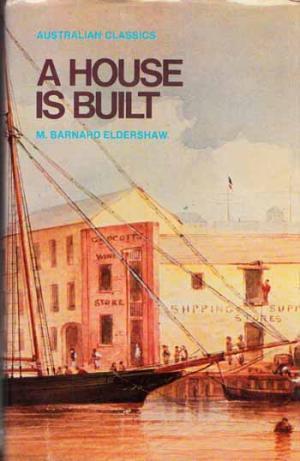
I had identified two novels for my 1929 read, M. Barnard Eldershaw’s A house is built and another. With Lisa also considering A house is built, I decided to go for the other. I started it, and am loving it, but I won’t finish it in time, so I thought I’d check my Australian anthologies for a 1929 offering, and found one. In the Macquarie PEN anthology of Australian literature is the first chapter of a book I’d been unaware of until I wrote my 1929 Monday Musings post this week. The book is The middle parts of fortune: Somme and Ancre, 1916, by Frederic Manning.
It particularly caught my attention because the title sounds more like a nonfiction book. So, I checked it. Yes, it is fiction, I clarified, and has an interesting history. I’ll start, though, with the author…
Frederic Manning (1882-1935) was born in Sydney. An apparently sickly child, he was educated at home, and when a teenager he formed a close friendship with Rev. Arthur Galton, who was secretary to the Governor of New South Wales. When Galton returned to England in 1898, Manning went with him, but returned to Australia in 1900. However, he returned to England in 1903 – when he was 21 – and there he remained. He produced all his writing from there, but the Australian Dictionary of Biography (linked on his name) claims him as Australian.
That’s all very well – for us to say now – but at the time of his death, according to Nicole Moore who wrote his entry in the Anthology, he was “largely unknown in Australia”. And yet, she continues, “his novel, The middle parts of fortune: Somme and Ancre, 1916 (1929) is cited around the world as one of the most significant and memorable novels of the First World War”. Indeed, she writes, it is “often grouped” with Ernest Hemingway’s Farewell to arms and Erich Remarque’s All quiet on the western front.
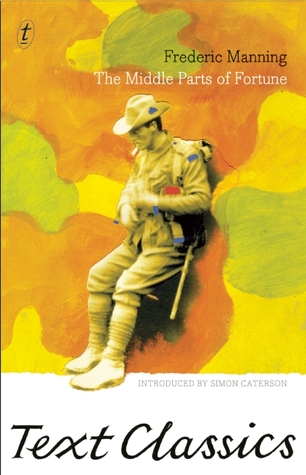
Manning served in the war from October 1915, first as Private (no. 19022) and later as a second lieutenant, though apparently the officer’s life did not suit him. He drank, and resigned his commission in February 1918. Wikipedia explains explains that, with increasing demand through the 1920s for writing about the war, and his having published some poems and a biography, he was encouraged to write a novel about his wartime experiences – and so The middle parts of fortune was born.
The story does not end here, however. The first edition was published privately and anonymously, under subscription, says Moore. Soon after, in 1930, an expurgated edition was published under the title Her privates we, with the author now identified as Private 19022. This version, Moore says, “removed the soldiers’ expletives that strongly punctuate the text”. Acceptable, apparently, for the private edition, but not for the public one! Wikipedia says that Manning was first credited as the author, posthumously in 1943, but the original text wasn’t widely published until 1977.
Wikipedia identifies the book’s admirers as including Ernest Hemingway, Arnold Bennett, Ezra Pound, and T. E. Lawrence. Lawrence is quoted as saying of The Middle Parts of Fortune that “your book be famous for as long as the war is cared for – and perhaps longer, for there is more than soldiering in it. You have been exactly fair to everyone, of all ranks: and all your people are alive”, while Ernest Hemingway called it “the finest and noblest novel to come out of World War I”. How could I have not known it?
Now, the book … Wikipedia says that each chapter begins with a quote from Shakespeare – answering a question I had, because Chapter 1 so starts. The source of the quote, however, is not cited, but a quick internet search revealed it to come from Act III, Scene 2 of Henry IV Part 2:
By my troth, I care not; a man can die but once;
we owe God a death. … and let it go which way it will,
he that dies this year is quit for the next.
It basically says that we can only die once, and that we’ll all die one day – so, we may as well accept our fate? A soldier’s creed?
Before I say briefly discuss the first chapter, I’ll add that Nicole Moore says that the protagonist’s nationality is not “made explicit” which is “in keeping with the novel’s deflation of military hierarchies and nationalism”. She goes on to say that it explores “the effect of war on reason and selfhood” and is thus “an existentialist study of the extremes of human experience”.
I’ve read several novels, over the years, about World War 1, including – to share another Australian one – David Malouf’s Fly away Peter. It too powerfully evokes the terrible impact of that war.
So, Manning’s Chapter 1 introduces us to a soldier stumbling back to the trenches after some action during which many men had been lost. Soon, he – named Bourne, we learn – is joined by a couple of Scottish soldiers – not from his battalion – and then an officer from his. The rest of the excerpt chronicles his moving through a “battered trench” to join his compatriots in their dugout, before setting off again to meet their captain and retire to their tents in the ironically, but truthfully, named “Happy Valley”.
The tone is one of desperate resignation. Faces are blank (despite “living eyes moving restlessly” in them); no energy is wasted in unnecessary talk; and whiskey is a necessary support after “the shock and violence of the attack, the perilous instant”. The description of their progress from the dugout to the camp above ground beautifully exemplifies the writing:
they saw nothing except the sides of the trench, whitish with chalk in places, and the steel helmet and lifting swaying shoulders of the man in front, or the frantic uplifted arms of the shattered trees, and the sky with clouds broken in places, through which opened the inaccessible peace of the stars.
The “frantic uplifted arms of the shattered trees” and the “inaccessible peace of the stars” conveys it all – and this is only Chapter1.
If you would like to know more about this novel, you can check Lisa’s blog, as she knew of this book and reviewed it back in 2015!
Read for the 1929 reading week run by Karen (Kaggsy’s Bookish Rambling) and Simon (Stuck in a Book).
Frederic Manning
The middle parts of fortune: Somme and Ancre, 1916 (1929)
in Macquarie PEN anthology of Australian literature (ed. Nicholas Jose)
Crows Nest: Allen & Unwin, 2009
pp. 365-369
ISBN: 9781741754407






 Whispering Gums