Shirley Hazzard, The bay of noon (#BookReview)

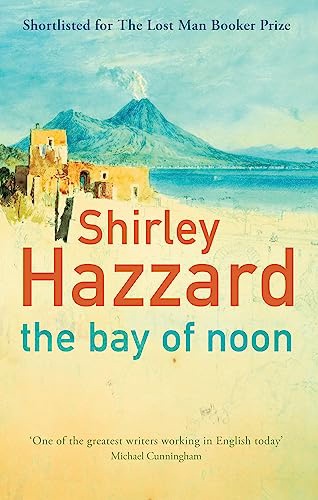
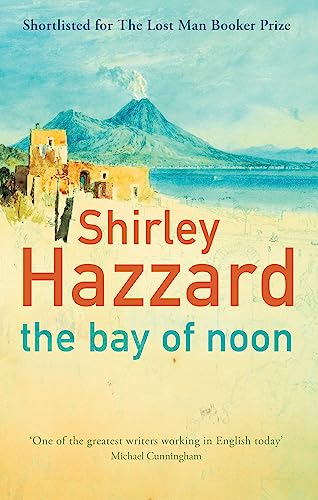
Shirley Hazzard’s novella, The bay of noon, has been in my sights for a long time, but finally, this Novellas-in-November year, I managed to get it out of my sights and into my hands. It’s the first of two novellas I read for the month, but the second to review. Such was my November (and we are now well into December!)

Published in 1970, The bay of noon was Hazzard’s second novel. It was one of six books nominated for the Lost Man Booker Prize in 2010. This was a special award created to, in effect, right a wrong which occurred when a change in the Booker Prize rules resulted in books published in 1970 missing out on a chance for Booker glory. The award was decided by public vote, with JG Farrell’s Troubles emerging the victor.

I’ve read three books by Hazzard before blogging, but since then I’ve just read one short story – “The picnic” – for the 1962 Club. In my post on that story, I referred to a review in The Guardian of Shirley Hazzard’s Collected stories. The reviewer Stephanie Merritt writes that “Hazzard’s recurring themes here – enlarged upon in her novels – are love, self-knowledge and disappointment”.

This is true of The bay of noon, which tells of a young Jenny, who, though born in England, had been sent to Cape Town with other young children to escape the Blitz. Post-war she was reunited with her older brother but, realising that her love for him was unhealthy, she leaves England to take up a job with NATO in Naples, bringing me to another of Hazzard’s recurring themes, that of young women leaving home to find their place. I understand from her biography that Hazzard herself worked for NATO in Naples in the timeframe this book is set, so she knows whereof she writes – which is not to say that she is writing her life. This is fiction, so while Hazzard draws on her own experiences, Jenny’s story is not hers.

Anyhow, we are in Naples, and it is some years after World War II, the mid 1950s in fact. Hazzard loved Italy, and her description of Naples at this time is imbued with a love born of knowing a place authentically, not as a sightseer. Naples is poor, and damaged both by war and a Mt Vesuvius eruption in 1944. Hazzard’s evocation of the city is a joy to read. A “through the looking-glass” city of both “apartness” and “continuity”, it also provides a moody, sometimes metaphoric, backdrop for our newcomer Jenny.

The storyline is straightforward. Knowing no-one outside of her work, Jenny follows up a letter of introduction to the charming and welcoming writer Gioconda, whose married lover, and Roman film director, Gianni, she also meets. Soon, however, through her work, Jenny also comes to know a Scotsman, Justin Tulloch, and a relationship of sorts develops between them. These relationships, and how they play out – with their mysteries and betrayals – form the nub of the story, but they are not what the novel is about. That is not so straightforward, but there are clues.

The title offers one clue, particularly, for me, the idea of “noon” as a time when the sun is at its highest, when the light is brightest, and so, perhaps representing a moment of clarity and, perhaps, also, of transition or change? Another clue is in the epigraph from Auden’s “Goodbye to the mezzogiorno” and in the opening paragraphs, both of which encompass ideas about memory and experience. The story is told first person through Jenny’s eyes, and there is a sense as the novel progresses of her working through an experience. Or, perhaps, not so much “working through” as allowing the passage of time to do its work. In the opening paragraphs, Jenny speaks of experiences building up “until you literally sink under them” but is also aware that, with the passage of time, memory, which was once “clouded with effects and what seemed to be their causes”, can become protective. As Auden concludes his poem:

… though one cannot always
Remember exactly why one has been happy,
There is no forgetting that one was.

But of course, not all memories are happy – and time can’t make them so. Gioconda, who had suffered loss, says

‘When people say of their tragedies, “I don’t often think of it now”, what they mean is it has entered permanently into their thoughts, and colours everything…’ (p. 67)

Just prior to this, she admits:

‘When I talk of it this way, now, to you, it all comes out as if there were some sequence, some logic, instead of moods, contradictions, alternatives. The design imposes itself afterwards. And is false, must be false.’ (p. 66)

It’s a curious but beguiling novel. The writing has a formal, intellectual – almost dispassionate, and sometimes elegiac – tone. It feels as though it belongs to a much earlier time, earlier in a way than the time in which it is set. This works somehow, partly because of Hazzard’s clear and measured prose, partly because the characters themselves seem to belong to an earlier time, and partly because Jenny is telling us the story from some time in the future.

As I read The bay of noon, I kept trying to place it within a wider literary tradition. It belongs, in part, to those stories about young people being taken under the wing by more experienced elders. Jenny observes the world she is drawn into, gradually becoming a more active and confident player in it. However, an Englishwoman, she remains an outsider, so retains her observer status which, over time enables her to see some realities she had missed in the first flush.

This is not a simple coming-of-age story, as it might look on the surface. Jenny is not an ingenue, but neither is she, at the start, experienced enough to understand the complex emotions and tragedies her older friends have experienced. Moreover, Hazzard has set the novel in a time that was itself complex, as Europe, and Naples specifically, was emerging from the war and – hmmm, was what? I wanted to say remaking itself, but that’s not the sense we get of Naples. It’s more one of being itself.

Towards the end, Jenny, reflecting on that past time in Naples, likens it to a

vineyard that had been left to flourish intact … among the deadly apartment buildings, not so much showing how it was as what has happened to it.

And that is the book’s ultimate meaning for me. It is not about who we are, what we hoped for, or where we have arrived, but about, in the closing words of the novel, “how we came”. Life, in other words, is a process, a journey that doesn’t always take us where we plan or expect.

Read for Novellas in November. Also read by Brona for the month. Read very late for the 1970 Year Club run by Karen (Kaggsy’s Bookish Ramblings) and Simon (Stuck in a Book)

Shirley Hazzard
The bay of noon
ISBN: 9781860494543
Virago Press, 2005 (originally published 1970)
182pp.

Marion Halligan, Wishbone (#BookReview)

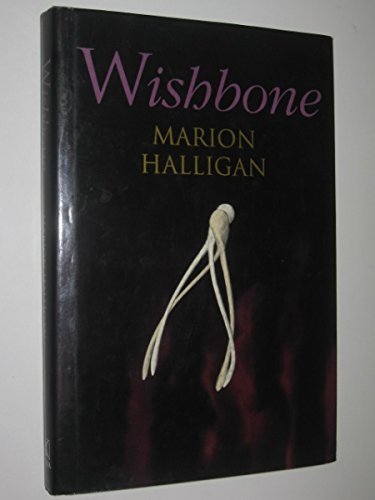
My reading group’s last meeting of the year took the form of a tribute to Marion Halligan, who died earlier this year and who had generously attended our meeting when we discussed her Valley of grace (my review). We have done this once before with Helen Garner (albeit she hadn’t died) and it worked well. The process is that we choose something we want to read and share our thoughts with the group. I have read several of Halligan’s books, but I have a few on my TBR, so of course I chose one of those, Wishbone, her fourth novel, published in 1994.

Before I share my thoughts on that, I thought you might like to know what everyone read. Ten members attended the meeting. Some read two books, while others chose a short story or article. It is, after all, a busy time of year. The novels read were, in chronological order, Wishbone (1), The golden dress (2), The fog garden (1), Valley of grace (1), Goodbye sweetheart (2). Three people read her most recent memoir, Words for Lucy, while others read selections from Canberra tales (“Most mortal enemy”), The taste of memory (the first piece), Canberra Red (“A city of mind”), and Shooting the fox (“Shooting the fox”). In other words, we read widely across her oeuvre, resulting in an enjoyable – and occasionally excitable – meeting as we teased out some of her themes and ideas, including how much of her fiction was drawn from life!

“who knows what the hell is going on”

So now, Wishbone. It tells the story of a woman, Emmanuelle, her “motley family”, and the wishes they have for themselves. The novel starts with a young, passionate Emmanuelle having an affair with a married man, but it soon jumps some years hence when she is now married (to a man named Lance), and living in well-heeled Sydney with two children, Maud and William. The rest of the novel follows a period in the lives of these four and others in their close circle – friends, family and employees. During this time, we experience a life-threatening stroke, extra-marital affairs, mistaken assumptions, and a suspicious death, all set within perfectly rendered scenes of domesticity. Halligan can make you gasp with her audaciousness.

As I was reading this novel, a light dawned for me about why I so often use Jane Austen as a benchmark for writing I love. I do like all sorts of writing, but I am particularly drawn to writing that exposes human nature with wit, irony and a generous spirit. This is what Austen does, and this is also what Halligan does. Wishbone is a generous story about messy human lives. Halligan writes with a knowingness about those deep-down thoughts, wishes, and desires we all have, but she is also forgiving about her characters’ foibles and less admirable traits and behaviours. In Wishbone, she explores the tension between our wishes – particularly regarding love – and living with what you’ve got.

There’s something of a fatalist element, here, in the sense that we think we have choice in all this, but choice proves in fact to be elusive. Things happen that we have no control over. Late in the novel, as Emmanuelle sits around the kitchen table with her two children and au pair Mel, in what looks to be a cosy domestic scene, a question – which is both literal and existential – is suddenly proffered, “who knows what the hell is going on”. Who indeed? (And who is asking the question? Emmanuelle, surely, but there’s also an omniscient voice overlaying the characters’ perspectives. At least I believe so. Wishbone slides seamlessly between voices and perspectives in a way that never loses the reader, but that ensures we see multiple sides of things.)

This brings me to style, and how Halligan does what she does. Halligan is a born short-story writer. As I started Wishbone, I almost wondered whether I was reading a book of short stories. Every chapter is gorgeously titled and most felt like they could stand on their own as little nuggets from a life. The opening chapter, The Glade, tells of Emmanuelle’s youthful affair with her married man. It starts:

The difficulty of a love affair between a young woman and a married man may be its logistics. Where can they go? He lives with his wife. She lives with her parents.

They can’t afford hotels, and anyhow it’s too risky as the town is small, but Brian knows “a good place”, a little glade under a cliff. Whenever Brian thinks of going to the glade, he whistles Handel’s tune, “Where e’er you walk”, which “always gladdened his wife’s heart, because she knew her husband was feeling cheerful”. Halligan’s discussion of this song, Brian’s behaviour, and the wife’s response is delicious in more ways than this little irony, but I will just share Halligan’s nailing the point, with “the song told her about the walking and the sitting but what she didn’t know about was the lying”. Just think of the double meaning in that last word! This writing just makes you splutter.

From here, the plot unfolds quietly but surely. Hints are dropped but aren’t heavy-handed, so we are still surprised when certain events occur, which brings me to the title, and its reference to wishes. In the third chapter, The Man in the Train, there is a mostly mundane discussion about wishes until the chapter’s titular, and unnamed, “man” asks Emmanuelle what she would wish for. Her answer?

I would wish for the gift of making dangerous choices.

As the novel progresses, various characters express their wishes. Emmanuelle’s friend Susie idly wishes she were a widow, while au pair Mel wishes she were beautiful. Emmanuelle wants more passion from her husband, while chauffeur Stuart wants money. And so on … What these characters learn, you won’t be surprised to hear, is that their seemingly ordinary, or common, wishes often carry a danger that is not expected. You know that saying, “be careful what you wish for”. But Halligan’s book is no simple moral tale. What Emmanuelle realises near the end, in fact, is that all choices can be dangerous. Susie asks her:

Have you ever wished Lance dead?
I’ve wished him different.
And did that come true?
Not in ways that I’d have chosen.

Where does this leave us? We won’t stop wishing, and we certainly can’t stop making choices, but we can think about our choices and be realistic about the outcomes, whether they are the expected or unexpected ones. In the end, Emmanuelle probably has the answer:

being alive is like reading a book. You might think you’ve got a fair idea of the plot but you don’t actually know what’s going to happen next, you’re as much a mystery to yourself as a character in a novel. Perhaps the secret is just to keep turning the pages.

Reading Wishbone has reminded me how much I enjoy Halligan. I must get back to that TBR.

Marion Halligan
Wishbone
Port Melbourne: William Heinemann Australia, 1994
235pp.
ISBN: 0855615974

Monday musings on Australian literature: Forgotten writers 8, Jessie Urquhart

While some of the forgotten writers I have shared in this series are in the category of interesting-to- know-about-but-not-necessarily-to-read, others probably are worth checking out again. Jessie Urquhart is one of these latter, though I’ve not read any of her novels, so don’t quote me!

However, there are articles for her in Wikipedia and the AustLit database, and I have mentioned her on my blog before, so this must all count for something in her favour. My reference was in a Monday Musings on Australian women writers of the 1930s in which I discussed an article by Zora Cross. She talked about, among other things, writers who had achieved success abroad without leaving home. One of those she named was Jessie Urquhart, who, she says, “will not, I think, do her best work until, like Alice Grant Rosman, she  relinquishes journalism for fiction”. I commented at the time that this was interesting from someone who, herself, combined fiction and poetry writing with journalism. I also wondered whether Urquhart needed her journalistic work to survive. (I suspect she did.)

I also wrote earlier this year about Urquhart on the Australian Women Writers (AWW) blog, as did Elizabeth Lhuede last year. This post draws from both posts and a little extra research. In my post, I shared a 1924-published short story titled “The waiting”. It is an urban story about a very patient woman. It’s not a new story, but Urquhart writes it well. … check it out at AWW. You might also like to read the story Elizabeth posted, “Hodden Grey”, which is a rural story. Like many writers of her time, Urquhart turned her head to many ideas and forms.

Jessie Urquhart

Novelist, short story writer and journalist Jessie Urquhart (1890-1948) was born in Sydney in 1890, the younger daughter of William and Elizabeth Barsby Urquhart. Her father, who was a Comptroller-General of NSW prisons, had emigrated from Scotland in 1884. She joined the Society of Women Writers and was secretary for 1932-33. She had an older sister, Eliza (1885–1968) with whom she emigrated to England in 1934 (years after Zora Cross’s article!) There is much we don’t know about her life, though her father’s obituary does say that neither of the sisters married.

In an article titled “Women in the World” in 1932, The Australian Women’s Mirror includes a paragraph on Urquhart, because they were about the serialise her story Giving Amber her chance. They say she “started writing very young, and in her teens had a novel, Wayside, published; she is now a Sydney journalist. Short stories and articles from her pen have appeared in the Mirror, her latest contribution being “The Woman Prisoner” (W.M. 8/3/32), based on her knowledge of the Long Bay women’s reformatory.”

Elizabeth’s thorough research found that Urquhart had turned to short story writing and journalism, in the 1920s, with most work published in The Sydney Mail, but she was also published in The Sydney Morning Herald, The Australian Woman’s MirrorThe Australian Women’s Weekly, The Sun and Queensland Figaro. Elizabeth read (and enjoyed) many of her stories, and wrote that they cover “a broad range of settings and topics, giving glimpses into the lives of modern Australian urban and rural women and men, encompassing the adventures of spies, adulterers, thieves and deserters; the faithful and unfaithful alike”.

According to Elizabeth, Urquhart’s first publications actually appeared when she was in her twenties, including a series of sketches titled Gum leaves which was published in The Scottish Australasian. The Goulburn Penny Post quoted the paper’s editor, who said that:

The sketches represent her initial effort, and indicate that she has the gift of vivid description and the art of storytelling in a marked degree. All the delineations show power and a creative facility which promises well. Some are indeed gems. [The author shows] promise of a successful literary career.

Her novel Wayside appeared in 1919, and is probably based on these sketches. (She was not a teen in 1919, so I’m not sure about The Australian Women’s Mirror’s facts.)

Anyhow, according to Elizabeth, Urquhart had “a year’s study abroad” sometime in the late 1920s or early 1930s, and wrote more articles on her return. She lived in Bellevue Hill, Sydney, and continued to publish what Elizabeth nicely characterises as “her quirky short fiction”. She also wrote more novels. Giving Amber a chance, serialised in 1932 in The Australian women’s mirror, was published in book form in 1934. The Hebridean was serialised in 1933, but was not published in book form though, wrote Elizabeth, it was “arguably” the better novel. She liked “its setting and its depiction of class tensions” and believes – a propos my introduction to this post – that it deserves to be more widely read.

Another novel, Maryplace: the story of three women and three men, was published in 1934, but unlike the previous novels does not appear to have been serialised. Elizabeth found a contemporary review, which she liked for the sense it gives of the debates surrounding Australian writing at this time, including a reading public “mistrustful of its own novelists”. The author of the review writes that Maryplace is

a story which takes the art of the Australian novel to a new plane of modernity of treatment and universality of appeal.

In style, in theme, and in the power of characterisation and analysis this book is far above the work of the average of our novelists. It is deserving of the highest recommendation. Despite the fact that the scenes of Maryplace, with the exception of one period, are laid in a New South Wales country town, the story will be of equal interest to any reader of novels anywhere. That, after all, is the real art of the novel, and it is one which is not so frequently cultivated by our writers that we can afford to ignore it when we encounter it.

The reviewer believes there’s been too much self-conscious talk about “an Australian story-art”, that all literature is naturally a product of the country which produces it and the life and times in which it is produced. In other words, says R.N.C.,

All stories have their roots in the soil. They will be true of a nation and be part of a national contribution to art without ceaseless striving to label them and brand them as ‘Australian’ on every page and in every paragraph.

Urquhart’s story, R.N.C continues, has the “unselfconsciousness that gives her book a real Australian atmosphere and setting” but that also “makes it a story of absorbing human interest and power so as to be a world novel for the world”. (I like R.N.C.’s thinking.)

The novel apparently deals with the class tensions, and a changing order which sees “the local butcher or grocer” no longer willing to deliver their goods to “the back door”. This is part, says R.N.C. of “any fast changing democracy, and Miss Urquhart in her Maryplace has drawn it with pitiless detachment, giving to her theme sympathy and understanding but the touch of irony and satire which it demands”.

After she went to England in 1934, Urquhart’s stories continued to appear in the Australian press, but whether she published elsewhere is not clear. She was clearly still active in writing circles in 1941, because she was chosen as Australia’s delegate to the PEN conference in London. She and her sister survived bombing during the war, and Jessie sent regular reports about life in London to The Sydney Morning Herald.

In 1944, the Herald reported that “gossip of London theatres, the Boomerang Club, books and their authors comes from Miss Jessie Urquhart, formerly of Sydney, who went to England before the outbreak of war”. It says that “during the first great blitz, she was an A.R.P. telephone worker” but was now “a reader for Hutchinson’s Publishing firm”. She and Eliza had been “staying with novelist Henrietta Leslie in Hertfordshire for the past three months”. Wikipedia tells me that Leslie was a “British suffragette, writer and pacifist”, which makes sense when you read in the next sentence that Jessie had “just been re-elected to the committee of the Free Hungarian Club Committee” which was chaired by Hungarian writer and exile, Paul Tabori.

She is an interesting woman, and would surely be a great subject for one of Australia’s literary biographers!

Anyhow, in 1945, another Sydney Morning Herald paragraph advised that Jessie and Eliza Urquhart would “probably visit Australia” again in 1946, and that they had reported that London was “beginning to recapture its old smartness”. I suspect Jessie never did get back to Australia, as she died in a nursing home in St John’s Wood, London, in April 1948. Eliza died in 1972.

Sources

Monday musings on Australian literature: Nonfiction awards 2024

It’s been a very busy weekend, and I have a few posts waiting to do, plus a reading group book to finish for tomorrow, so this post is a quick one. Phew, you are probably saying if you stuck with me over the weekend!

Today’s topic recognises that our litblogosphere’s annual Nonfiction November event, currently coordinated by Liz Dexter, starts today. I don’t usually write a Monday Musings for this event, but I thought it might be interesting to look at what Australian works of nonfiction won awards this year. Most of the awards are specific nonfiction awards, but some are more general awards which can be won by fiction or nonfiction (like the Stella, albeit was won by fiction this year.)

I’ll list the awards alphabetically by title of award:

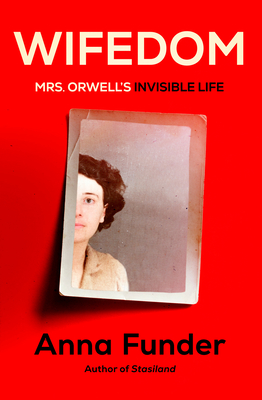
  • ABIA Biography Book of the Year: Anna Funder, Wifedom: Mrs Orwell’s invisible life (biography) (my review)
  • ABIA General Non-Fiction Book of the Year: Thomas Mayo and Kerry O’Brien, The Voice to Parliament handbook (handbook)
  • ACT Literary Awards, Nonfiction: Kate Fullagar, Bennelong & Phillip: A history unravelled (history)
  • Finlay Lloyd 20/40 Prize, Nonfiction Winner: Sonya Voumard, Tremor (I’ll be reporting more on this prize and the Fiction winner next weekend) (memoir/essay)
  • Indie Awards Book of the Year Non-fiction: David Marr, Killing for country: A family story (history)(Jonathan’s post)
  • Magarey Medal for Biography: Ann-Marie Priest, My tongue is my own: A life of Gwen Harwood (biography)
  • Mark and Evette Moran Nib Literary Award: to be announced on 27 November, but 5 of the 6 shortlisted titles are nonfiction
  • National Biography Award: Lamisse Hamouda, The shape of dust (memoir)
  • NSW Premier’s History Prize, Australian History: Alecia Simmonds, Courting: An intimate history of love and the law (history)
  • NSW Premier’s Literary Awards, Douglas Stewart Prize for Non-fiction: Christine Kenneally, Ghosts of the orphanage (history) (Janine’s review)
  • Northern Territory Literary Awards, Charles Darwin University Creative Non-Fiction Award: Dave Clark, Remember (creative nonfiction about truthtelling)
  • Prime Minister’s Literary Award, Australian History: Ryan Cropp, Donald Horne: A life in the lucky country (biography) (Lisa’s review)
  • Queensland Literary Awards, The University of Queensland Non-Fiction Book Award: Abbas El-Zein, Bullet, paper, rock: A memoir of words and wars (memoir)
  • Victorian Premier’s Literary Awards, Prize for Non-fiction: Ellen van Neerven, Personal score: Sport, culture, identity (memoir and polemic)

So 14 awards here, and life writing (biography and memoir) is by far the most represented “genre”, partly because some of the awards are specifically for biography (life writing). History is second, and again, this is partly because there are specific history prizes (some of which are won by biography!) It is noteworthy, however, that other genres – nature writing and eco-nonfiction, for example – rarely get a look-in in these sorts of awards. And yet, there is some excellent writing in these genres being published (by Upswell, for example).

And a little survey

Do you write nonfiction or non-fiction? In my admittedly minimal research, I have read that Americans are more likely to drop the hyphen, and this seems to play out in American versus English dictionaries.

I note that:

  • Liz has nonfiction in her banner, which is how I first titled this post
  • the above Australian awards vary in their usage – some using the hyphen and some not, but the hyphenated form seems to be winning.

I am tending to go with not, just as during my lifetime (or is it life-time!!) we’ve dropped the hyphen from tomorrow and today. (Hmm, a little research into these revealed that Chaucer for example had “tomorrow” – in his form “tomorwe” – unhyphenated. It was then later hyphenated and later again, re-unhyphenated – and I think I really need the hyphen there! Actually, it’s not as simple as this because through much of time the two forms have coexisted!)

What do you do?

Monday musings on Australian literature: Fearless reviewing in 1970

I concluded last week’s Monday Musings by saying that I wasn’t finished with 1970. There are several posts I’m hoping to write, drawing from my 1970 research, but I’m starting with this one simply because it picks up on a comment I made last week.

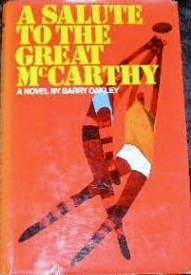
That comment referenced George Johnston, and a review by John Lleonart of Barry Oakley’s A salute to the Great McCarthy in The Canberra Times (8 August). I wrote that Lleonart had some “niggles” about the book but concluded that Oakley had “given us in McCarthy a classic figure of Australian mores to rank with George Johnston’s My brother Jack“. I didn’t, however, share those niggles. He wasn’t the only one with “niggles” about the book he was reviewing, so I thought to write a post sharing some of the criticisms reviewers expressed, because they are enlightening about what was and wasn’t liked in writing and about the art of reviewing itself.

Lleonart starts his review by saying that “it’s a pity Barry Oakley shaped up for his new novel in the cultural cringe position”, and goes on to say that

Oakley could have scored both for Australian literature and the game had he followed the elementary rule that there are no beg pardons.

Instead of striding, chest out and blast you Jack after the ball, he tends to prop, apparently listening for the footsteps of intellectual hatchetmen.

But, these are not his main “niggles” (as he calls them). They include that, while “Oakley has a lot of natural ability with words … sometimes he carelessly drops into cliches”; that some of the characters are “cardboard”; and that the novel’s “social attitudes” look back to those of Lawson. Lleonart concludes, however, on the positives, which include not only the aforementioned reference to Johnston’s novel, but that our footballer protagonist McCarthy “finds in fiercely competitive sport a means of expression and, in its best moments, even a sense of the inner poetry of life.”

Suzanne Edgar, whose poetry collection The love procession I’ve reviewed here, wrote about two recent novels in The Canberra Times (March 7). She suggested that they had “appeared in answer to Thomas Keneally’s demand for acceptable middle-brow Australian fiction”. But,

The trouble is that only people who are serious about reading are likely to pay $3 and more for a hard cover book. If you pay that you are not usually after the sort of light-weight escapist stuff that can be had for 80c from any newsagent’s shelves.

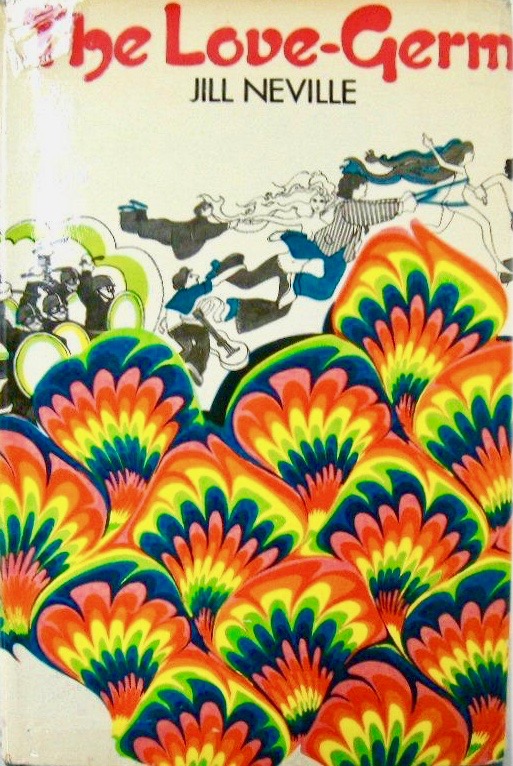
Unfortunately, Jill Neville’s The love germ and Keith Leopold’s My brow is wet are just “simple, uncomplicated bed-time stories”. Neville, Edgar continues, writes “like a slick and practised copy writer slinging words and fashionable ideas around with studied, gay abandon and not too much discretion; ‘desorified’ is one of her more flippant coinings”.

Leopold’s book, on the other hand, is “your academic’s pipe dream, the clever, but of course tongue-in-cheek crime story relieved by satiric treatment of Australian ivory towers. The sort of thing they would all like to write if they were not so busy publishing or perishing six days a week”. Edgar then goes on to say that “Mr Leopold’s unexceptional thesis is that there is dishonesty in all of us”. She gives a brief run-down of the plot – which sounds basic on the face of it – and concludes that it’s “amusing enough, but not really solid value for your money”. So, overall, entertaining enough reads but not worth buying in a $3 hardback. (That said, don’t you think that Weidenfeld and Nicolson’s 1969 hardback cover for The love germ is pretty gorgeous!)

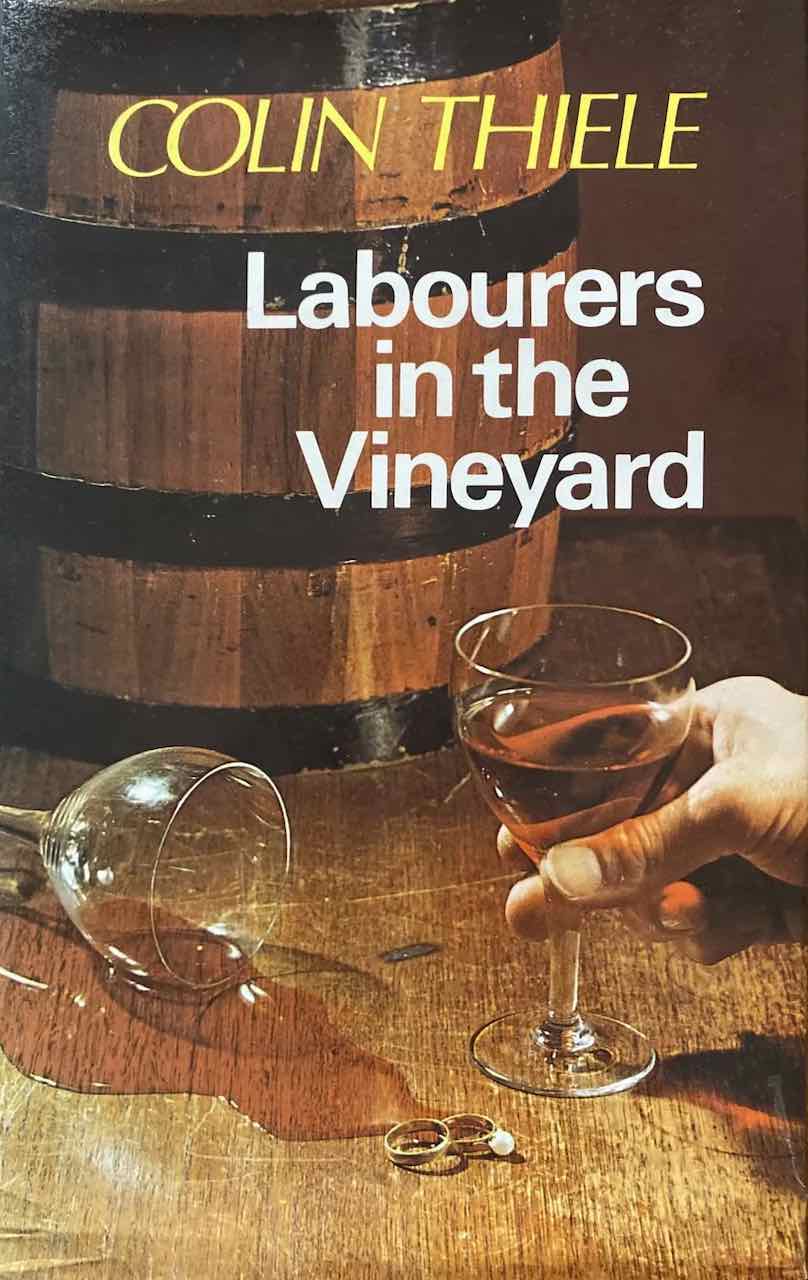
Finally, there’s Margaret Masterman, also writing in The Canberra Times (May 30). She reviews Colin Theile’s adult novel, Labourers in the vineyard. The review is headed “Novel improves as it goes along”. Masterman starts by quoting from the novel, then writes:

After encountering this rhetorical blast on page two of Colin Thiele’s latest novel nothing would have persuaded me to read the remaining 245 pages had I not, as a reviewer, been paid to do so.

But, she is being paid, so she continues:

As Mr Thiele gets a firm grip on his narrative however, it becomes clear that such assaults upon the natural resources of the English language are only the occasional excesses of an eloquent and highly inventive writer, one moreover who is directed by a positive if imperfectly sustained artistic purpose.

She tries to place the novel within a wider literary tradition. She suggests that Thiele “conceived Labourers in the vineyard on the lines of the traditional regional novel”, and says that

Focusing his story on a long-established German settlement in the Barossa Valley … he aims as I see it to invest “the valley” with something of the imaginative presence of Scott’s border country, George Eliot’s midlands, Mauriac’s sands and pine forests around Bordeaux, and above all Thomas Hardy’s Wessex.

She then compares the novel with Hardy’s Wessex novels, writing that

Into a modest 247 pages he has organised a remarkable variety of fictional material, much of which is nostalgically familiar to lovers of the Wessex novels. His plot is highly contrived and marked by melodramatic coincidences. The moods and predicaments of his characters are closely related to their rural environment and commented on by a chorus of humorous rustics.

Masterman discusses the book at some depth, pointing out its strengths but also its failings. Seasonal festivals and country trials, for example, “are vigorously and sometimes brilliantly described” but Thiele fails to “infuse the countryside with any genuine imaginative significance”. Because of his detailed knowledge of the region, he does give his story “an illusion of reality”. Her conclusion, however, is qualified. She’d clearly much rather be reading Hardy!

I enjoyed Labourers in the vineyard as a lavish and well organised entertainment which stirred memories of the people, the woodlands, the heaths and milky vales of a great novelist whose works in these days are too often neglected.

These are just three examples I found in my research, but they nicely exemplify some of the things that are important to me when I think about my reading. What is the writing like? How does the novel fit within its perceived “genre” (defined loosely)? How relevant is the novel to the concerns of its day?

What do you think?

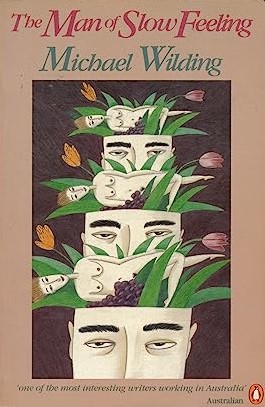
Michael Wilding, The man of slow feeling (#Review, #1970 Club)

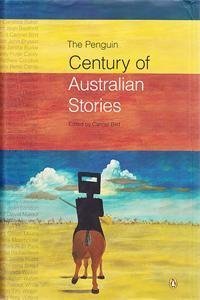
Michael Wilding’s short story, “The man of slow feeling”, is hopefully the first of two reviews I post for the 1970 Club, but we’ll see if I get the second one done. I have been making a practice of reading Australian short stories for the Year Clubs, so when the year is chosen I go to my little collection of anthologies looking for something appropriate. My favourite anthology for this purpose is The Penguin century of Australian stories, edited by Carmel Bird, because it is a large comprehensive collection and because the stories are ordered chronologically with the year of publication clearly identified. Love it!

Who is Michael Wilding?

With these later year clubs, like 1970, there’s a higher chance that the authors we read might still be alive. This, I believe, is the case with Michael Wilding. Born in England in 1942, he took up a position as lecturer at the University of Sydney from 1963 to 1967, before returning to England. However, two years later, in 1969, he returned to Australia and stayed. He was appointed Professor of English and Australian Literature at the University of Sydney in 1993, and remained in that position until he retired in 2000.

AustLit provides an excellent summary of his career. As an academic, he has, they say, had a distinguished career as a literary scholar, critic, and editor”, specialising in seventeenth and early eighteenth century English literature. Since the early 1970s, he has also “built a reputation as an important critic and scholar of Australian literature” focusing in particular on Marcus Clarke, William Lane and Christina Stead. And, he has been active as a publisher, having co-founded two presses, and at least one literary magazine.

However, he also, says AustLit, “came to prominence as creative writer in the late 1960s, when he was at the forefront of the ‘new writing’ movement which emerged in Australia in at that time”. He was part of a group of writers, editors and publishers “who were influential in promoting new and experimental writing, and in facilitating the revitalised Australian literary landscape of the late 1960s and 1970s”. AustLit doesn’t identify who was in that influential group, but I think Kerry Goldsworthy does in her introduction to Penguin’s anthology. She writes that “short fiction was the dominant literary form in Australia in the 1970s” and the most recognised practitioners were Frank Moorhouse, Peter Carey, Murray Bail and Michael Wilding. (All men, interestingly.) This writing, says Goldsworthy, was heavily influenced by European and American postmodern writing, but she doesn’t specifically reference Wilding’s story in her discussion.

Wilding has published over twenty novels and short story collections. AustLit adds that his short stories have also been published widely in anthologies, and that many have also been translated. Wikipedia provides an extensive list of his writing.

“The man with slow feeling”

“The man with slow feeling” is a third-person story about an unnamed man who, as the story opens, is in hospital after a serious accident from which he had not been expected to survive. However, he does survive. Gradually his sight and speech return, but not his sensation. That is, he can’t taste food or feel touch.

Soon though, he realises that sensation is returning, just some time after the actual experience. For example, he and his partner, Maria, make love, but he feels nothing – until some hours later. Not good! Not only is there the problem of feeling nothing, but when they are making love, he might experience some unpleasant sensation from three hours ago. Then, when he is out shopping three hours later, he experiences the orgasm. Or, regarding food, he will eat lunch but not taste it until 4pm. It is all, to say the least, disorienting. So, he sets up a system where he records his “sensate actions” so he can prepare (or “warn”) himself “after a three hours’ delay … of what he was about to feel”.

I’m sure you can see the practical problem with this. Soon, he becomes trapped in “a maze of playback and commentary and memory”, where he is trying to record the present for the future while at the same time experiencing the past. It becomes intolerable.

The tone is one of disassociation, alienation – which had me heading off down that more “modernist” path. But, the “recorder” aspect suggested that the theme involves partly, at least, exploring the conflicted role of recording versus experiencing – which is a more post-modern idea. Can you do both? Can a writer do both? Can, I remember discussing at length during my film librarian career, a documentary filmmaker record and not experience (or not affect the experience) during the act of recording? What are the bargains you make between the two?

I don’t know enough about this time in Australian literature – I haven’t read enough – to understand where Wilding’s ideas and thoughts fit into the zeitgeist. In her introduction to the anthology, Kerryn Goldsworthy says that the writing of this time incorporated “elements of fantasy, surrealism, fabulist, literary self-consciousness, and the process of storytelling itself”. She says the stories by Murray Bail and Peter Carey are concerned with “the riddles and paradoxes of representation itself”. Wilding’s story could also be read as part of this exploration.

This is a dark story in which, if I stick with my idea about the theme, Wilding suggests that the life of sensation is what it’s all about. Fair enough, but where does that leave the writer (or recorder)?

“The man with slow feeling” had me intrigued from its opening lines to its close. I’m not sure I have fully grasped all that Wilding intended by it, but this was a time of experimentation with the short fiction form and new writerly freedoms. I wish I could point you to an online version of the story.

* Read for the 1970 reading week run by Karen (Kaggsy’s Bookish Ramblings) and Simon (Stuck in a Book).

Michael Wilding
“The man with slow feeling” (orig. pub. Man: Australian Magazine for Men, July 1970)
in Carmel Bird (ed.), The Penguin century of Australian stories
Camberwell: Penguin Books, 2006 (first ed. 2000)
pp. 232-238

Monday musings on Australian literature: 1970 in fiction

Once again it’s Karen’s (Kaggsy’s Bookish Rambling) and Simon’s (Stuck in a Book) “Year Club” week. This week, it is 1970, and it runs from today, 14th to 20th October. As for the last 6 clubs, I am devoting my Monday Musings to the week.

Despite the excitement and idealism of the 1960s, 1970 Australia was strongly conservative, politically speaking, with some notorious conservative leaders (like Joh Bjelke-Petersen, Sir Henry Bolte, and Robert Askin) being premiers of their respective states. But, there were exceptions. The socially progressive Don Dunstan became premier of South Australia during the year, and, while our Prime Minister, John Gorton, was a conservative, he was recognised as a supporter of the arts.

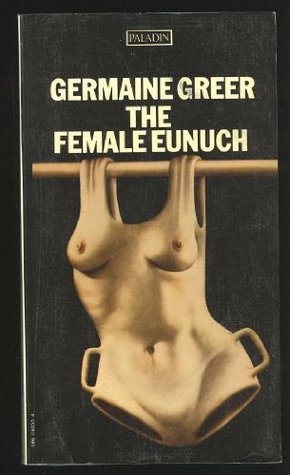
The war in Vietnam was still underway but was becoming increasingly unpopular. This was the year Australia decided to go metric for weights and measures, and, more relevant to this post, it was also the year that Germaine Greer’s The female eunuch (which I read the following year) was published.

A brief 1970 literary recap

Books were of course published across all forms, but my focus is Australian fiction, so here is a selection of novels published in 1970:

  • Jessica Anderson, The last man’s head
  • Richard Beilby, No medals for Aphrodite
  • Richard Butler, Sharkbait
  • Diane Cilento, Hybrid
  • Jon Cleary, Helga’s web
  • J.M. (John Mill) Couper, The thundering good today
  • Geoffrey Dutton, Tamara
  • Catherine Gaskin, Fiona
  • Shirley Hazzard, The Bay of Noon
  • Edward Lindall, A gathering of eagles
  • William Marshall, The age of death
  • Cynthia Nolan, A bride for St Thomas
  • Barry Oakley, A salute to the Great Macarthy AND Let’s hear it for Prendergast
  • Dal Stivens, A horse of air
  • Colin Thiele, Labourers in the vineyard
  • Ron Tullipan, Daylight robbery
  • Barbara Vernon, Bellbird (based on the ABC television series)
  • F.B. Vickers, No man is himself
  • Patrick White, The vivisector

A few of these writers are still respected and read today; a few are known but read less frequently; while some have fallen out of public consciousness (to my knowledge, anyhow!)

Of those I didn’t know, a couple caught my attention for their subject matter. F.B. Vickers is one. Trove describes No man is himself as “A novel set in the north west of Western Australia concerning an officer in charge of Native Welfare who is sympathetic to Aborigines but involved in personal difficulties with the white community and his wife.” The other is Edward Lindall whose A gathering of eagles is also set in Western Australia, and has a First Nations character. Google Books describes it as a “thriller set in the remote barren wasteland of north western Australia; an outcast Aboriginal woman, Ilkara, assists the survivors of a murderous plot to outwit their would-be killers.” The Encyclopedia of Science Fiction says Lindall was the pseudonym used by Edward Ernest Smith (1915-1978). He is also listed at a Classic Crime Fiction site.

Writers born this year include novelists Julia Leigh and Caroline Overington, and those who died include Herz Bergner (whose Between sea and sky I’ve reviewed), children’s fiction writer Nan Chauncy, Frank Dalby Davison (who was part of “the triumvirate” with Marjorie Barnard and Flora Eldershaw), and George Johnston.

There were not many literary awards, yet, though the state awards we know were getting close. And, several of the main awards made in 1970 weren’t to fiction. The ALS Gold Medal, for example, went to historian Manning Clark, and the Colin Roderick Award to Margaret Lawrie’s Myths and legends of Torres Strait.

There were some fiction awards, however, including of course, the Miles Franklin Award, which went to Dal Stevens’ A horse of air. The trade union-supported Mary Gilmore Award (my post on this award) was made to Keith Antill for Moon in the ground. It’s an Australian science fiction story set around the secretive Pine Gap near Alice Springs. The “$1,000 Rothman’s award for the best Australian novel of 1969” was awarded in 1970 to George Johnston‘s “semi-autobiography Clean straw for nothing” (from Trove).

The state of the art

As for previous club years, I checked Trove to see what newspapers were saying about Australian fiction. This was a little trickier for 1970 because, due to copyright, many newspapers from this time have not yet been digitised. However, some papers, most notably The Canberra Times and Tribune, along with some regional ones, have made their content available to Trove. To them I am most grateful.

George Johnston

Book cover

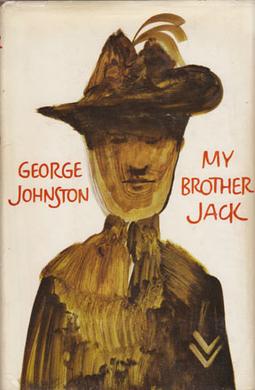
If one name loomed large in my my 1970 Trove research, it was George Johnston, and not just because he died in July. There were, of course, the obituaries, but, unrelated to his death, is his being used as a benchmark by commentators. For example, John Lleonart, reviewing Barry Oakley’s A salute to the Great McCarthy in The Canberra Times (8 August), has some “niggles” about the book but concludes that “Oakley has given us in McCarthy a classic figure of Australian mores to rank with George Johnston’s My brother Jack“.

Meanwhile, in discussions about the need for more Australian content on television, the television miniseries of My brother Jack was suggested as a benchmark for good Australian television content. Frances Kelly, writing in The Canberra Times (August 26), discusses the economic and artistic challenges to producing more “good” Australian content, and suggests one solution could be for Australia to

follow the BBC’s lead and begin work on adaptations. There are many fine Australian novels, which if we must still fly the flag, would bear dramatisation. My brother Jack was a shining example. 

The obituaries sum up Johnston’s career well – at least as it was seen at the time of his death. Maurice Dunlevy writes in The Canberra Times (23 July) that:

He had come back to his gumtree and kookaburra womb to find a new land, a people without a soul, and some uncomfortable ghosts from his past. “I would like to help Australians to find a new identity, a new soul, a new spirit”, he said on television. But to do so he had to sort out his own attitude to a country where he had left “the irrecapturable rapture of being young”. He was trying to do this in the third volume of the trilogy [A cartload of clay] during the past year.

Roger Milliss discusses Johnston at some depth in Tribune (12 August), concluding that

the important thing is the task that George Johnston recognised and set for himself — that of modernising Australian literature, of dragging it screaming into the 1970’s, of giving it a shape consistent with the world around it. That task must now be taken over by someone else — perhaps a writer who will emerge from the ranks of this new emerging generation.

These two obituaries make good reading if you are a Johnston fan.

Bookworm diggers

Meanwhile, over in South Vietnam, reported the Victor Harbour Times (May 29), Australian soldiers were well supplied with most amenities, but were running short of reading material. They had, says the report, “ample supplies of newspapers and regularly published magazines” but “novels, other books and paperbacks [were] in short supply”. Donations were being called for, and the Army would deliver them.

Australian classics

Publishers publishing classics is not new, but it’s always interesting to see “what” publishers see as those worth publishing at a particular time. In 1970, the Australian publisher Rigby published two Australian classics, Rolf Boldrewood’s Robbery under arms and Marcus Clarke’s For the term of his natural life, in $1.25 paperback editions. The Canberra Times (May 30), described them as “quite massive little tomes as paperbacks go” but said they gave readers “the opportunity of owning at a reasonable price two books that will be read and reread as long as Australian literature survives”. I love the qualification, “as long as Australian literature survives”. I wonder what the reporter thought might happen? Anyhow, these are still recognised “classics” but more have been added to the Australian classics pantheon since then.

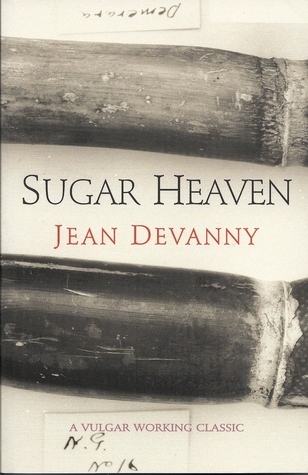
While not quite making classics status, two other authors from the past were mentioned in the year’s papers. One was Communist Party member, Jean Devanny, whose papers were donated by her daughter to the University of Townsville. (I included her in my post on women writers and politics in the 1930s.) The Tribune‘s report (January 28) says that Jean Devanny had had more than 20 books published by Australian and overseas publishers. One of her best known, Sugar heaven (1936), is a novel of class and politics on the Queensland cane fields, and was published in the Soviet Union in 1968.

The other author, Vance Palmer (1885-1959), came from the same era, and while not a Communist, was left-leaning politically. By 1970, he was seen as old-fashioned, but Professor Harry Heseltine thought he was due for a reassessment, and published his Vance Palmer in 1970. I will share more about this in another post.

Censorship and Book Bans

“Australia is still the country of interfering and sometimes ridiculous censorship, but there are signs of vitality on the cultural scene” (Paris newspaper Le Monde, The Canberra Times, December 21, 1970).

The last book banned in Australia was Philip Roth’s Portnoy’s complaint. It was banned in 1969, but after protestations by booksellers and publishers, and two trials in New South Wales which ended in hung juries, the ban was lifted in 1971. In 1970, however, it was all still happening. There’s way too much reporting for me to cover here, so I’m just to entertaining references to whet your appetite.

The University of New South Wales’ student newspaper, Tharunka (April 21), devoted a special literary supplement to the issue, asking writers to comment on censorship. One was Thomas Keneally, who commenced his piece by saying he felt “uneasy contributing to a forum on censorship because I have never achieved banmanship”. He is tongue-in-cheek about the reasons for the ban, which had to do with its being a “dirty” book. Keneally doesn’t see orgasm as “the key to the vision of man”, and argues that “there is very little of less value to the novelist than a person enjoying himself”. Fair point! Nonetheless, despite his “spinsterish views on eroticism in literature”, he thinks the ban is “an embarrassment”.

Maurice Dunlevy takes satire further in his article “The Portnoy tug-of-war” (The Canberra Times, September 5). Do read it … And, for a more recent history of the saga, check this article by Sian Cian in The Guardian (February 2, 2022). She quotes Des Cowley, of the State Library of Victoria:

“There’s been a lot written about the whole saga with Penguin and the legal case, but a little part of that story is that a small group of people got together and defended the right of literature to exist. It is such a beautiful case because, in a way, it ushers in the change Australia saw between the 1960s and 70s, with the progressive Whitlam government, and going from a literary backwater to a world stage.”

I’m not finished with 1970 … but this post is long enough. I’d love to hear any thoughts you have about the year, or about the stories I’ve shared here.

Sources

  • 1970 in Australian Literature (Wikipedia)
  • Joy Hooton and Harry Heseltine, Annals of Australian literature, 2nd ed. OUP, 1992

Previous Monday Musings for the “years”: 1929, 1936, 1937, 1954, 1940 and 1962.

Do you plan to take part in the 1970 Club – and if so how?

Monday musings on Australian literature: Nettie Palmer on Australian novels

Nettie Palmer has appeared a few times before on this blog, and is likely to appear again, because she was such an active member of Australia’s early to mid-twentieth century literary community, and she was a keen supporter and promoter of Australian writing and writers. Three years ago, I wrote about an article she’d written in 1930 in which she discussed pleasing “advances” in the Australian novel. This post draws on an article she wrote for the Illustrated Tasmanian Mail, a couple of years earlier, on 15 August 1928.

The article seems to have been inspired by the novel competition the Bulletin ran that year. There were, according to Palmer, some 536 entries, which she suggests is “a matter for national astonishment”, given the effort it takes to write a novel.

While only few can win, she says, “the lift in the status of the Australian novel will be considerable”. She goes on to talk about the challenge the judges face, and suggests that, with all that reading to do, their minds are likely to be ‘attracted by what was “striking” rather than what was merely solid’. She says that Australia’s chief literary prize-winner to date had been “that rather esoteric writer, Katharine Susannah Prichard”, and identifies some of the prizes she had won – for The pioneers (1915, my review), a short story, and a play. Will she win again, Palmer wonders. She wouldn’t be surprised if she did, Palmer continues, because Prichard “has always added something fresh and original to our literary store”. As it turns out, Prichard did win this prize, for Coonardoo, but jointly with The house is built by the collaborative novelists known as M. Barnard Eldershaw.

However, I have digressed a little, as my point here is to share Palmer’s thoughts on the Australian novel. Her life’s work seems to have been, at least partly, to define the Australian novel. Anyhow, she comments that she had been “examining a great many Australian stories in magazines, journals, books and manuscripts” and one of the things that has struck her was “the immense variety of geographical angles from which Australia can be regarded”. She takes, as an example, the idea of “the north-west”. For a Victorian, this means “the Mallee country, with its acres cleared for wheat, running up to the irrigated country with Mildura and its fruits and close settlement of semi-urban, rather ‘American’ homes”, while in South Australia it means “the interior, near the transcontinental line, given up to sheep”. In Western Australia, on the other hand, it’s “the country used by H. E. Riemann in his book of short stories, Nor’-West o’ West, set in Broome and its hinterland”. And so on … This, she says, “is just to name one half-point of the compass”. She discusses this a little more, but then says the thing that I really wanted to share:

The point is … that the life and problems of various parts of Australia show immense contrasts, from pearling at Broome to legislating at Canberra. Our writers have the task of gradually revealing it all to us.

This is it, it seems to me, in a nutshell. At some fundamental level, an Australian novel – or any nationality’s novel for that matter – is one which reveals who we are, in all our richness and diversity. It is what, I think, Miles Franklin intended by endowing an award for a novel that conveys “Australian life in any of its phases”. For Palmer, and I suspect Franklin, there was an awareness of the role the arts can play in nation-building, which is understandable given their times. The thing is, we are still nation-building – maybe always will be – and so today, we have First Nations writers and migrant-background writers trying hard to reveal to us their view of Australia. For as long as society keeps changing, there is a role for writers to “reveal it all to us” – even while they also explore the universal – don’t you think?

PS: On Wednesday, Mr Gums and I start a 14-day outback Queensland tour. I may not manage to write Monday Musings on the next two Mondays, but we’ll see. Apologies in advance for this potential hiatus! Monday Musings will not be lost forever.

Kurt Vonnegut, Slaughterhouse-Five (#BookReview)

While my reading group’s main reading fare has, from the start, been contemporary fiction, we also mix it up a bit. We do non-fiction, for example, and most years we try to do a classic. Over the years we’ve done Jane Austen, Elizabeth von Arnim, Anton Chekhov, EM Forster, and Randolph Stow, to name a few. This year we turned to Kurt Vonnegut, and, because we couldn’t decide which book to do, we narrowed it to two – Cat’s cradle and Slaughterhouse-Five – and let members decide. You can tell from the post title which one I chose. This was because I have read Cat’s cradle, albeit decades ago. Most of the group, however, read Cat’s cradle, because they’d read Slaughterhouse-Five before.

So, Slaughterhouse-Five it is then – and I’m confronted by the old challenge of what to say about a classic, and a cult classic at that. This book has been analysed ad infinitum, and been found, as the decades have trundled by, to retain its relevance to new generations. However, before I say more, let me give a very brief synopsis, just in case there’s someone out there who doesn’t know the story.

“jumbled and jangled”

Ha, did I say brief synopsis? Easier said than done, but I’ll give it a try. Slaughterhouse-Five tells the story of Billy Pilgrim, from his early years, through his time as an American soldier during World War II including being in Dresden when it was bombed, to the post-war years. During his life, Billy is also abducted by flying saucer and taken to the planet of Tralfamadore, where he is displayed in a zoo. The critical issue underpinning all this is that Billy was damaged by his wartime experiences, something we now recognise as PTSD. Vonnegut conveys – and represents – Billy’s discombobulation, his trauma, through a complex non-linear, non-chronological narrative, in which Billy, who “has come unstuck in time”, travels not only back and forth through time, but also back and forth between Earth and Tralfamadore. 

Slaughterhouse-Five is, as a result, a challenging, sometimes mystifying read, but it is also an exhilarating one, because Vonnegut tells his story through satire and absurdity, both of which I love. In the first chapter, the narrator, who is Vonnegut, tells us about writing the book we are now reading. As he hands his finished book to the publisher, he says

It is so short and jumbled and jangled, Sam, because there is nothing intelligent to say about a massacre.

Alongside the occasional appearance of this first-person narrator, we have the unsuccessful science fiction writer Kilgore Trout, who can also be read as a version – caricature – of Vonnegut. His “unpopularity was deserved”, the narrator tells us. “His prose was frightful. Only his ideas were good”. But, Billy loves him. We first meet Trout when Billy is introduced to him by Rosewater, another patient in the hospital to which Billy had committed himself when he feels he is “going crazy”:

Rosewater was twice as smart as Billy, but he and Billy were dealing with similar crises in similar ways. They had both found life meaningless, partly because of what they had seen in war. Rosewater, for instance, had shot a fourteen-year-old fireman, mistaking him for a German soldier. So it goes. And Billy had seen the greatest massacre in European history, which was the fire-bombing of Dresden. So it goes.

If you’ve read the novel, you will know that “so it goes” is its over-riding refrain. Used over 100 times, at moments of murder, death, and other disasters, it functions as a motif, one that both underlines and undermines the horror, by drawing attention to it, then passing it off. The constant opposition, in the novel, of the serious with the offhand keeps the reader unsettled, which is part of the point.

The occasional self-conscious appearance of the author/Vonnegut and the references to Kilgore Trout, along with its story-within-a-story framework, its wild playing with time and place, its fragmentary approach to storytelling, and its unapologetic undermining of “reality”, make this book a postmodern work, if that interests you. By this I mean what sort of work it is doesn’t matter, really. It’s what the work says or makes you feel that really counts. However, it’s these features and techniques which enable Vonnegut to convey what he wants to say in such a powerful way. The how of it is inseparable from the meaning of it.

Slaughterhouse-Five is said to be about many things, including war and pacifism, fate and free will, our experience of time. I could discuss each of these in turn, but the academics already have. I’ll simply say that my primary takeaway is that it’s about the absurdity and incomprehensibility of life and, by example, about how our everyman Billy Pilgrim copes (or doesn’t) with such life.

Slaughterhouse-Five was published at the height of the Vietnam War and the anti-war movement. It was, it seems, the right novel at the right time. Although Vonnegut had had some success before, this was the novel that apparently established him. I can see why. With wars just keeping on coming – and being just as horrific and absurd as the ones that came before them, I can also see why this novel continues to speak to new generations of readers. I mean, how can you not laugh at Billy on display in Tralfamadore:

Then he did exercises he had learned in the Army—straddle jumps, deep knee bends, sit-ups and push-ups. Most Tralfamadorians had no way of knowing Billy’s body and face were not beautiful. They supposed that he was a splendid specimen. This had a pleasant effect on Billy, who began to enjoy his body for the first time.

And, you know what? I’m going to leave you right here, because if this doesn’t convey why this book is such a complex, funny, humane read, I don’t know what will.

Kurt Vonnegut
Slaughterhouse-Five, or, The children’s crusade
Horizon Ridge Publishing, 2024 (Orig. pub. 1969)
199pp.
ASIN: ‎ B0D9SKLL68

Monday musings on Australian literature: Forgotten writers 7, Grace Ethel Martyr

The forgotten writers I have been writing about vary greatly, and most will stay forgotten because, to be honest, their time has past and not all writing remains relevant. This is not to say, however, that they are not worth revisiting. They are, after all, part of our literary culture, and they paved ways, whether we are aware of it or not. Grace Ethel Martyr is an example. She is notable enough to have entries in AustLit and Wikipedia, and was interesting enough in her time to catch the attention of Zora Cross (who wrote about her for a series she did for The Australian Women’s Mirror.)

Martyr is another writer I have posted about on the Australian Women Writers (AWW) blog, but again, I am not including here the piece written by her that I published there. Titled “The blue jar”, its subject is domestic violence, though that term would not have been used then. It’s not typical of her best-known work. However, in the light of our own times, it is worth reading. It is told from the 1920s perspective that women just need to put up with brutal husbands and manage as best they can. They didn’t have much choice. But, in this story, a bit of luck comes the wife’s way … check it out at AWW.

Grace Ethel Martyr

Grace Ethel Martyr (1888-1934) was a Victorian-born poet, short story writer and journalist. She wrote under various permutations of her name – G. E. Martyr; E. Martyr; Ethel Martyr; Grace E. Martyr; and G. Ethel Martyr.

Born in Ballarat, she was the only daughter of James Kent and Grace Flora Martyr. She grew up in Maldon in central Victoria, but spent much of her working life in Bendigo. She apparently passed the University of Melbourne matriculation examination in 1906, but I haven’t found evidence that she went on to university. AustLit and Wikipedia both say she was employed by the Bank of New South Wales, for whom her father had worked, for four and a half years, but left due to ill-health. While working at the bank, she published a collection of patriotic war poems, Afterwards and other verses (1918), but she didn’t begin to write seriously until she had left the bank. Zora Cross (writing as Bernice May in The Australian Women’s Mirror) tells how this book was given to her to by Martyr’s cousin who wanted her assessment of it, and says it was she, Cross, who encouraged Martyr to leave the bank (though the ill-health part is also true, I believe).

The Sydney Morning Herald, 18 May 1918, commented on Afterwards and other verses, describing it as “unequal” (meaning “uneven”?) but also as

characterised by sincerity, depth of feeling, and a burning patriotism which redeems many shortcomings. Her technique, though not faultless, is usually correct, and at her best Miss Martyr can reach a high level of dignified expression.

Perth’s Western Mail, 31 May 1918, offers similarly qualified praise:

War has given inspiration to Miss Martyr’s muse, and if her verse does not reach the loftiest peaks, the level of its quality is rather beyond that common to such collections.

Writing about Martyr ten years later, Cross says that

So far, Miss Martyr’s best work has been done in verse. But her true vein is the child story and child-verse. I know of no Australian writer who has so beautifully caught the spirit of the child in verse as she has. And she is that rare writer, the one who never forgets that child-verse should also be poetry.

Martyr, then, wrote children’s poetry and fiction, including several stories serialised in The Australasian, but AusLit says that her principal literary output is the poetry she published in The Bulletin and The Australian Woman’s Mirror. In addition to this writing, Martyr also worked for The Bendigo Advertiser, where she edited the women’s columns and the children’s page, and she was Bendigo’s social correspondent for several Melbourne publications.

Cross praises much about her work, saying

She shows inner melody in her verse which is often of a very high standard. Her love of music and nature comes out in her poetry. Like all Australian writers her best work has appeared in the Bulletin.

Martyr won prizes at Ballarat’s South Street Literary Awards – in 1918 for best patriotic poem and in 1919 for best original poem. In 1920 she came second to David McKee Wright, from a field of 125 entries, in the Rupert Brooke Award, which was established by the Old Collegians’ Association of Melbourne’s Presbyterian Ladies’ College.

Martyr was also a pianist, and worked with musicians Margaret Sutherland and William James on various projects. In particular, she wrote stories and verses for the 3LO children’s hour, with James setting her verse to music. (William James is best known, to me anyhow, for the 15 Australian Christmas Carols he composed with lyricist John Wheeler. I wrote about them early in my blog.)

Martyr seems to be another example of a woman who managed to make a career for herself as a writer, by turning her hand to a wide variety of forms and audiences, but she also died relatively young. She was not completely forgotten, however, because five of her poems were included in Michael Sharkey’s 2018 anthology, Many such as she: Victorian women poets of World War One. An exhibition was held at Bendigo’s Soldiers Memorial Institute Military Museum in association with this book. Curator Kirsten McCay specifically mentioned Martyr, saying “Poet Grace Martyr lived locally and was a journalist for the Bendigo Advertiser. She also gave illustrated talks on famous composers at St Paul’s Cathedral, where a cross commemorates her life.”

Cross concluded her 1927 article with:

Grace Ethel Martyr’s work is always getting better, which is surely the best sign in any writer. Time, I think, will prove her to be one of the most sincere writers among us.

Six years later, at the age of 46, Martyr was dead. The report of her death, which was repeated in several Victorian newspapers, is brief but says that:

Miss Martyr’s literary gifts were apparent at an early age, and during the years that followed she established something of value to Australian literature.

I rest my case!

Sources