ALS Gold Medal (and 2009 award shortlist)

My recent review of Herz Bergner’s Between sky and sea reminded me of a rather ignored Australian literary award, the ALS Gold Medal, that I’d come across a few years ago but have let slip beneath my radar. It is time, methinks, to bring it to the fore. It was initially awarded by the Australian Literary Society (ALS) – hence its name – but this society was incorporated, in 1982, into the Association for the Study of Australian Literature (ASAL) and they now make the award. I suspect it does not receive the exposure that other awards do because there is no money attached, just – obviously – a gold medal, and oh, the glory, though perhaps there’s not much glory if no-one knows about it! There is a judging panel convened by an ASAL member from a state different to that of the previous year’s convenor and comprising other ASAL members.

The Gold Medal, just one of several awards they make, is awarded to “an outstanding literary work in the preceding calendar year”. They identify the award by the year for which the award is made and not in which it is announced and so last year’s winner, Christos Tsiolkas’ The slap, was announced in 2009, as the 2008 winner. This year’s award will be announced in July after ASAL’s annual conference, but the shortlist is out. It is:

While I haven’t read all of these, they are by respected writers who have won and/or been shortlisted for other significant Australian awards. It is therefore an award worth watching, if only because it represents another contribution to our assessment of Australian literature. I will keep you posted…

Herz Bergner, Between sky and sea

Hans Bergner, Between sea and sky
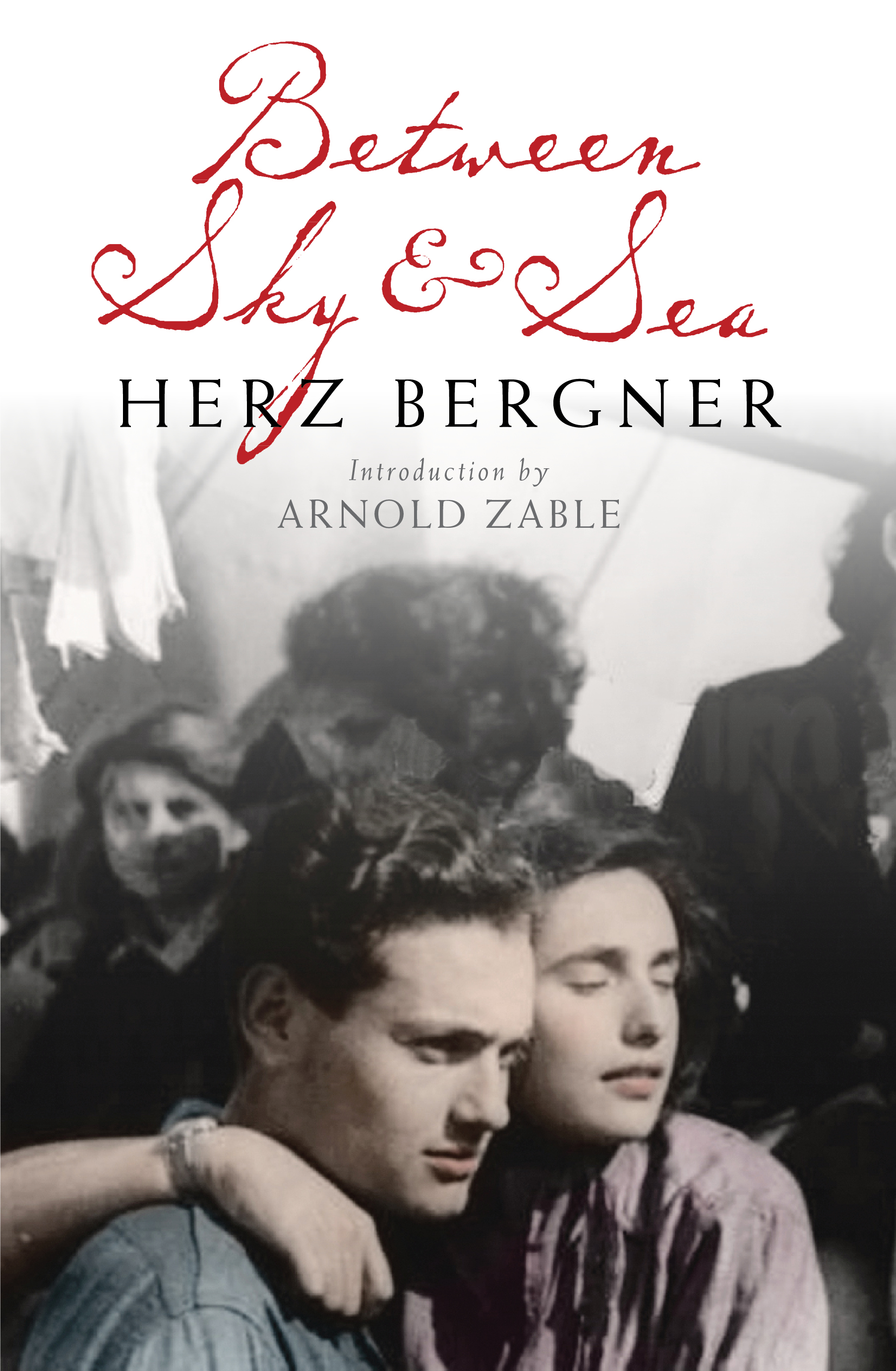
Book cover (Courtesy: Text Publishing)

Do you read introductions to novels? And, if you do, do you read them before or after you read the novel itself? I read them, but always afterwards because I like to come to  novels as objectively as I can. And so, this is what I did with Herz Bergner’s  Between sky and sea which won the Australian Literature Society’s Gold Medal for Book of the Year in 1948. I’d never heard of it. (Well, I wasn’t around then, but still …!) However, this year Text Publishing has republished it, which is a pretty savvy decision because, as Arnold Zable suggests in the introduction, it has some resonances for contemporary Australia – but more on that anon. Zable also tells us that while Bergner, a Polish Jew who emigrated to Australia in 1938, wrote the book in Yiddish, it was first published in English, having been translated by another Australian Jewish novelist, Judah Waten.

The novel has a straightforward plot. It tells the story of a group of Jewish refugees from the Nazi invasion of Poland who are passengers on an old Greek freighter bound for Australia where they hope for a new life. (Australians, at least, will see the contemporary resonances now. Think SIEV X, for example). There is, though, an older resonance which Bergner presumably knew – that of the MS St Louis which tried to find a home for Jewish refugees in 1939 after they were turned away from Cuba (and which later inspired the book Voyage of the damned, so titled because, as many of you know I’m sure, they continued to be turned away as they went from port to port). These resonances and more are all referred to in the Introduction. Knowing readers will pick many of them up, but isn’t that the fun of reading? To pick them up yourself? So, read the book, I say, and then the rather fine Introduction.

Anyhow, back to the book. As I was reading it, I couldn’t help also thinking of that allegorical boat trip, the Ship of Fools. This is not that allegory – they are not fools, and the boat does have a captain, but as I read the novel I felt that awful sense of a world out of control that the allegory represents.

If this book were a film, it would be described as having an ensemble cast, because it has no identifiable heroes or heroines, no real anti-heroes either. Rather, it has a bunch of people who are thrown together by circumstance but who have little in common other than that they are Jewish refugees. Their backgrounds are diverse and they vary in their practice of Judaism (if they practise it at all). They include Nathan and Ida (who lost their respective spouses and children while escaping the invasion), the know-it-all Fabyash and his family, the flirty but mostly kind-hearted Bronya and her stolid overweight husband Marcus, Mrs Hudess and her two daughters (whose only remaining possession is one doll), and several others. As you might expect with such a set up, the novel explores the increasing tensions – the arguments, the pettinesses alongside the kindnesses – that occur as supplies of food and water dwindle and people get sick, while the journey goes on and on without an end in sight:

They were ashamed to lift their heads, to look each other in the face, and for two reasons. Because Fabyash had sunk so low that he had stolen food from a child, and because Mrs Hudess, who was regarded as such a refined person, had burst forth with the language of the coarsest market vendor. To what depths suffering can bring a person.

The strength of the novel is, in fact, its characterisation. Despite its almost non-existent plot (though there is a climax that I won’t give away), the novel maintains our interest because its characters are real in the way they relate to each other and their circumstances. We know these people, we are these people. In this regard it is a little different from those Holocaust novels – many of which also deal with “ordinary” people – that work on a larger-than-life heroism-betrayal scale.

Towards the end of his introduction, Zable quotes Waten regarding the translation. Waten apparently translated it with Bergner by his side, and says that Bergner was “very odd because he wanted every word translated, and if the number of words came out fewer in English he wasn’t very happy. He never really mastered the English language”. This makes a bit of sense because there are times when the novel feels a little – well – wordy. This never becomes a big problem, however, because Bergner’s imagery (mostly simile and analogy) tends to be fresh and is often two-edged:

A soft haze shimmered in the summer air, caressing their faces like spider webs. [on Nathan and Ida’s escape from Warsaw]

and

For a moment the moon shone through, glittering like a lance, and then it was quickly hidden again.

and

… at midday when the sun was ripe and full like a great golden pear that hung heavily from the centre of the sky.

I enjoy writing like this that contains layers of meaning that make you think a little before you move on. The language is not particularly complex, but Bergner has a habit of inserting a word or phrase that undercuts your expectation and keeps you reading.

The themes are both particular and universal – particular because they specifically depict the anti-Semitism that was rife during World War 2 (to the extent that even the crew on the boat treat the passengers as less than human), and universal because they explore the various ways humans behave under stress. The overriding theme – the biggie, in fact – is the way we continue to turn away other. The irony is that even when we are the other – such as the Jews on this boat – we find otherness amongst ourselves to turn away (until a bigger calamity forces us to reconnect). Will we ever change? I fear not. In fact, that’s what makes the universal, universal, isn’t it?

It is encouraging to see publishers like Sydney University Press and Text Publishing – not to mention of course Penguin –  reissuing long out-of-print Australian classics. I hope it pays off, not only because I like to see forgotten Australian classics brought to life again but because, as in this book, the messages conveyed by these classics can be as valid today as they were when they were first written.

Herz Bergner (trans. by Judah Waten)
Between sky and sea
Melbourne: Text Publishing, 2010 (first ed. 1946)
215pp.
ISBN: 9781921656316

(Review copy supplied by Text Publishing)

Shirley Jackson, Charles

Before I start this review, I have a technical question. Does anyone know why advice to bloggers about maximising your site always say not to use something like “here” for a hyperlink but, rather, to add the link to the actual name of what is being linked to? In other words, to make the link so – Shirley Jackson’s Charlesrather than so – Shirley Jackson’s Charles can can be read here? I have done both but I have tended to prefer the “here” approach when I am making a link to the actual text of the item I am reviewing. Otherwise, the chances are – and this has happened – that the blog’s readers miss it because they will not know that the link under the title is the actual story and not just a link to an article about (or a source to buy) the story. My preference is to go for the unambiguous approach – but is there a really BIG reason why I shouldn’t? Enquiring minds – well mine anyhow – would love to know.

Anyhow, on to what will be a brief review of this week’s Library of America story. It’s by – well, if you’ve read the first para you’ll know by now – Shirley Jackson. Another American writer I’ve never heard of! Apparently she is best known for her “tales of psychological horror” (LOA introductory notes) but this one that they’ve presented to us, “Charles”, is an ordinary domestic life story. It was published in Mademoiselle magazine in 1948 and, again according to LOA, “is one of the first of her numerous semi-autobiographical stories of life as a 1940s housewife raising children who sometimes seemed one step outside her ability to control them”.

Well, that certainly seems to the the case in “Charles” because it is clear that the young protagonist of the story has it all over his parents. It’s a nice little story but rather predictable. I’d be surprised if any experienced reader didn’t “get” it some long time before the end. This spoils the story a little – although perhaps Jackson is playing a game with the reader, willing us to see what the parents clearly don’t? Whatever her intentions,  it nicely shows the wiliness of children and the gullibility of many parents. I think though, that to properly assess Ms Jackson, I should read one of her psychological tales rather than this little slice-of-life piece.

Edward Field, WWII (Poem)

Well, Library of America has surprised again. This week it is a poem (6 pages). I wasn’t expecting that, but as I like to delve into poetry every now and then I was rather pleased. The poem, “WWII” by Edward Field, was first published in 1967 in a collection titled Poets of World War II. According to LOA’s notes, the poem “recounts an actual incident” – and that’s certainly how it reads.

B-17 Bomber plan

B-17 Bomber (Royalty free image from Planes of WW2 website*)

It tells the story of an American bombing mission over Europe in which Field’s plane is damaged by flak and ends up having to ditch in the North Sea on its way back to England. It’s a very matter of fact poem that calmly documents the events, until the moment of ditching when, for a moment, the language becomes more expressive. Here is the beginning of the serious troubles with the plane:

Over the North Sea the third engine gave out
and we dropped low over the water.
The gas gauge read empty but by keeping the nose down
a little gas at the bottom of the tank sloshed forward
and kept our single engine going.

Pretty plainly descriptive. It sounds like they’re in a tight situation but they’ve got everything under control. And then, just nine lines on, that engine’s in trouble and we get:

listened as the engine stopped, a terrible silence,
and we went down into the sea with a crash,
just like hitting a brick wall,
jarring bones, teeth, eyeballs panicky.

Suddenly we get adjectives, a simile and a shift in rhythm, and we are right there with him. He then describes the exit from the plane, the rush for the life rafts which aren’t in a condition to accommodate them all, and the resulting loss of life among the crew. This, though, is not one of those heroic “band of brothers” war poems. It is about survival – our poet is not a coward, but neither does he risk his life to save others. He’s a realist. Soon after the plane ditches, he (the navigator) and the radio operator find themselves still on the plane, with the rafts already pushed off. Their colleagues tell him later that the cords holding the raft to the plane broke. He’s not 100% sure of that:

… but I wouldn’t have blamed them
for cutting them loose, for fear
that by waiting for us the plane would go down
and drag them with it.

Back to plain speaking. And it prepares us for when he too opts for survival – not by any sin of commission but by not engaging in heroics:

I chose to live rather than be a hero, as I still do today,
although at that time I believed in being heroic, in saving the world,
even if, when opportunity knocked,
I instinctively chose survival.

The poem ends – surely this is not a spoiler? can you spoil a poem? – with the idea that “This was a minor accident of war”. Life and death – all in a day’s work!

I liked this poem. It was not what I expected when I started it: it has few of the usual hallmarks of war poetry. There’s no breast-beating patriotism, no histrionics; its tone is neither tragic, nor melancholic, nor heroic. It’s a plainly told story about one man’s experience of one event in war, and its power lies in that and the understated style in which he tells it. Thanks, once again, to the Library of America for presenting me with something a little different.

*B-17 Bombers were flown by Field’s company, the Eighth Airforce. Attribution as requested: “This image comes from Airforce Image Gallery and has been modified and can be found at Planes of World War II page”.

Nathanael West, Business deal

This week’s Library of America offering was (or “is” since it’s still this week, but “was” cos I’ve read it – all this tense stuff can be so bothering!) Nathanael West’s Business deal. It’s short, and I’d just finished my novel for bookgroup, so I decided to read it.

I don’t know much about Nathanael West, other than recognising his name, but according to Wikipedia he lived from 1903 to 1940. Another writer who died young – though he wasn’t quite so young as the likes of poor Keats and Stephen Crane, neither of whom even made 30, and he died not of illness but in a car accident. Anyhow, Wikipedia describes West as “author, screenwriter and satirist”. The brief introductory notes accompanying the story say essentially the same thing. These notes suggest that his recognition as a writer comes mainly from his novels, but his money came from his plays. This LOA offering, however, is a short story. It was published in 1933 in a magazine called Americana, which apparently published a lot of satirical writing.

Business deal is about the head of a movie production company, which is rather aptly named “Gargantual Pictures”, planning his next takeovers while at the same time preparing not to pay a very successful young scriptwriter what he’s asking. This is not a subtle story, and neither character is particularly appealing:

The mongoose [the scriptwriter] sat comfortably and waited for the cobra [the company head] to strike again.

Effective image, eh? It is, in fact, a pretty typical negotiation story in which one side holds its ground while the other pulls out all arguments until one of them either capitulates or plays the winning card at just the right moment. I won’t tell which one is which, but if you think of which profession West was you may just work out who wins this particular deal! It’s a humorous if rather predictable story, but it does demonstrate the well-honed skills of a successful satirist. It is worth reading for that.

Thea Astley, The multiple effects of rain shadow (Review)

There are two main reasons why I like – actually love – to read Thea Astley. One is her language, her wonderful way with words that may, at times, be over-the-top but that is never clichéd. The other is her passion for the underdog, and thus for social justice in a world where it is often conspicuously absent.

Island, Palm and Sun

Island with palm, because Penguin will not answer emails regarding bookcover use (Courtesy: OCAL, via clker.com)

The multiple effects of rainshadow is Astley’s second last novel. Its overall subject matter is, as one character says late in the book, “the unmoored behaviour of humans”, an effective image given the book’s central motif is an island. It has a very loose plot which is based on an actual event that occurred on Palm Island in 1930. Palm Island was, at that time, essentially a dumping ground for Indigenous Australians deemed to be “problems”, but the event in question concerned the white superintendent, mad with grief at the recent death of his wife, running amok and setting fire to buildings (including his own home in which his children were sleeping). He was eventually shot (and killed) by an Indigenous man under the (cowardly) order of the white deputy superintendent. The novel explores, through multiple points of view and over a period of around 30 years, the impact of this event on six white people who were present on the island at the time – but interspersed between these voices is the voice of Manny, the man who shot the super. This is, I think, a pretty risky thing to do but Astley is not one to shy away from risks in her writing.

The voices are, in chapter order:

  • Manny Cooktown, first person, the indigenous “shooter” and main narrator who commences the story and appears between each voice, but does not conclude the novel
  • Mrs Curthoys, first person, landlady on Palm Island at the time of the incident
  • Gerald Morrow, third person, writer/editor who had gone to the Island to work as a foreman, for which he had no skill or experience, and who was in fact escaping the Island in a boat at the time of the incident
  • Captain Brodie, third person, the Superintendant who ran amok and was shot by Manny
  • Mr Vine, third person, a school teacher on the Island at the time of the incident
  • Father Donellan, third person, priest who visits regularly from the mainland and is responsible for the Island’s religious “needs”
  • Leonie née Curthoys, first person, daughter of Mrs Curthoys and so on the Island at the time of the incident
  • Omniscient author who carries the last chapter

Looks complex eh? But in fact it’s pretty straightforward in terms of knowing who is who, as each voice “manages” its own chapter. The chronology is a little trickier as many of the characters (let’s call them that from now on) flip between their present (some are writing from many years after the event) and the past. Did you notice that the first person voices belong to the two groups most recognised by Astley as disadvantaged: women and indigenous Australians? A subtle but clever use of her narrative structure to give them a voice!

The setting is, after all, very much a white patriarchal world, and marriage is seen in that light. Vine, for example, is told to get a wife  for

‘The boring bits. You know. Meals. Washing. Shopping. Kids. All that sort of thing. A man hasn’t time for that sort of thing.’

‘Why not a housekeeper, then?’

‘You are green. Cost too much …’

Not surprisingly Mrs Curthoys and Leonie do not find marriage much to their liking. The main underdogs in this novel though are the indigenous people, many of whom are brought to the Island – and therefore separated from their country – as problems, and are treated with disdain at best and real cruelty at worst by most of the white residents (from 1918 when the settlement begins to 1957 when the book closes). Astley offers, I’m afraid, little hope. She is not a cheery writer: her goal is to shock us into attention – and that she does. However, I can imagine some critics accusing her of putting contemporary views about feminism and indigenous relations in characters’ mouths. I would argue though that contemporary ideas do not spring from a vacuum, and that therefore the occasional more sensitive/egalitarian views expressed in the novel are historically valid.

I said at the beginning of this review that one of the main reasons I like Thea Astley is her language, so here are some examples of her imagery:

…whistlestop hamlets scattered along briefly tarred roads that led to further sprawls moated by loneliness …  [from school-teacher Vine, heading to a country school]

And I am weary of  a Celtic charm that is shaken like spice over any dish within gulping reach. We bore each other rancid. [Leonie on marriage and her philandering husband]

At least I’ll have tried. At least I’ll be learning to decline the gumleaf, conjugate the seasons. [Vine’s “do-gooder” son Matthew]

She also effectively mixes up the rhythm to make points or convey feeling, using short snappy sentences, repetition of phrases (such as Morrow’s “swing dip drag” as he sails across the sea), and punctuation-free streams of consciousness:

There was an unalterable plane geometry to his movements: the clock the tea/toast the clock the bell the classroom the toted piles of exercise books the bell the repeated texts the stale jokes the texts the bell the common-room bitchings the clock the bell … the … the … [schoolteacher Vine]

Astley is often quite self-conscious about the act and role of writing, and this is certainly the case in this novel. I’ll give just one example, the bitter rant of failed writer Gerald Morrow, who is jealous of the success of another, to him, lesser writer:

There must be a million readers out there who crave boredom! Who love the dangling participle! Who wallow in truisms and fatuous theorisings! … Slap in your popular aphorisms, buddy, but don’t make ’em think!

You could never accuse Astley of not making you think, but there has to be some irony here, some little sense of self-deprecation even, in the fact that she put these words in the mouth of a failed writer, as if she knew that for all her passion there’s only so much you can achieve with words. That may be so, but Astley has given it a darned good try!

Thea Astley
The multiple effects of rainshadow
Camberwell: Penguin, 1996
296pp.
ISBN:  9780143180265

James Thurber, The lady on the bookcase

James Thurber, 1945

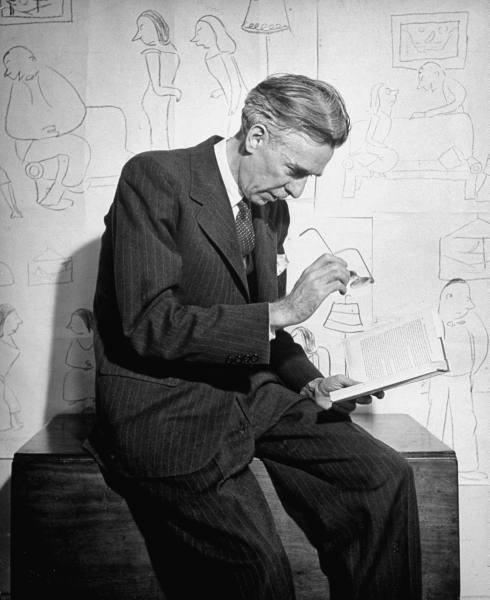
Thurber, 1945 (Courtesy: life.com, for personal non-commercial use)

If you like to think of yourself as a critic, read this. It is last week’s offering from the Library of America, and is an essay by James Thurber titled “The lady on the bookcase”; it was first published in The New York Times Magazine in 1945 under the title “Thurber as seen by Thurber”. I read it as a general spoof on the art of criticism; the Library of America says he “teases [his] colleagues and editors at The New Yorker.”

The scene is set in the first paragraph when he reports on a cartoonist complaining about being rejected:

“Why is it”, demanded the cartoonist, “that you reject my work and publish drawings by a fifth-rate artist like Thurber?” Ross came quickly to my defence like the true friend and devoted employer he is. “You mean third-rate”, he said quietly, but there was a warning glint in his steely gray eyes that caused the discomfited cartoonist to beat a hasty retreat.

Just this beginning, before I read any more, reminded me of why I had enjoyed Thurber in my baby-boomer youth when many of us read a bit of Thurber. Thurber was a writer and cartoonist, and in this essay he combines the two to poke fun at criticism … and at how editors tend to show a journalistic rather than a critical interest in his work by wanting to know the stories behind his work rather than analysing it.

He writes that:

I have never wanted to write about my drawings and I still don’t want to, but it occurred to me that it might be a good idea to do it now, when everybody is busy with something else, and get it over quietly.

… and, to continue his satire, he talks about “shoving” some of his originals around the floor until they “fell, or [he says archly] perhaps I pushed them, into five separate categories”. He goes on to describe the categories, illustrating each with some of his cartoons:

  • the Unconscious or Stream of Nervousness category
  • the space between the Concept of the Purely Accidental and the Theory of the Haphazard Determination
  • the theory of the Deliberate Accident or Conditioned Mistake
  • the Contributed Idea category
  • the Intentional or Thought-Up category

If you haven’t worked it out by now, you can’t take much of what he says seriously – and that is his point. Don’t, he tells us, try to categorise or apply psychological theories to someone’s work, go for a run instead. Then again, I wouldn’t take this too seriously either, because Thurber is also being disingenuous: in the tradition of the satirist, he sets us up at every point, only to pull us down again. After all, like any creative artist, he wants us to look at and respond to his work.

Have a look at it … I’m sure you’ll enjoy the ten cartoons reproduced even if you don’t want to read the essay.

Alan Bennett, The lady in the van

It is a truism that truth is stranger than fiction, and Alan Bennett’s The lady in the van is one work that proves it. It is strange – and wonderful – that a woman could have lived the way the eponymous lady did for as long as she did, and it is equally strange – and wonderful – that Bennett allowed her to do so in his front yard for as long as he did.

This piece was first published in the London Review of Books in 1989, but I only happened across it this year, twice! First was in the form of a BBC-4 audio CD given to my mother-in-law for Christmas by my brother. She was both mystified and entranced by it and insisted I hear it. Second was, soon after, in a review by kimbofo at Reading Matters. It became clear that this was meant to be my year for The lady in the van! And so, a couple of weeks ago I finally heard the CD, and today I finished the book. Like many before me, I was charmed.

The lady in the van is a simple tale about an eccentric old lady (though she’s only in her late 50s when the story starts in 1969) who lives in a van which Bennett eventually allows her to park in his front yard. That was in March 1974 and it continued until her death in 1989. Fifteen years! It reminded me a little of the Maylses Brothers‘ documentary film, Grey Gardens, which documents the lives of Edith Bouvier Beale and her daughter, also Edith Bouvier Beale, Jackie Kennedy’s aunt and cousin. Due to lack of funds they lived for years in dilapidation and squalor. But, while Bennett’s lady, Miss Shepherd, also lived in squalor, it’s the feisty eccentricity in all these women that associate them in my mind. They are all women who, despite their rather desperate circumstances (for whatever reason), refused to be ground down by it, who maintained some sense of pride and self in the face of a life most of us could not comprehend.

Anyhow, back to Bennett. The story is told primarily through diary excerpts, with a brief introduction, and a postscript added in 1994. In the beginning, there was Miss Shepherd (the name she gives but not her real name) and she was parked in the street in Alan Bennett’s neighbourhood. The first diary entry starts in October 1969, nearly 5 years before she moves into his front yard. Bennett explains how it is that she managed to live in her van on the neighbourhood streets for so long:

What made the social set-up funny was the disparity between the style in which the new arrivals found themselves able to live and their progressive opinions: guilt, put simply, which today’s gentrifiers are said famously not to feel … There was a gap between our social position and our social obligations. It was in this gap that Miss Shepherd (in her van) was able to live.

The whole thing does, I have to say, sound particularly English – the tolerance that enabled her to live that way for so long, and the polite and reserved rather than familiar “relationship” she and Bennett maintained over the years. Throughout the twenty years that the story covers, we learn a fair amount about Miss Shepherd despite her pretty effective attempts to keep herself to herself. We learn that she is committed to the Catholic Church (had in fact tried to be a nun) and politically conservative, and that she occupies herself selling pencils and writing letters and pamphlets. We also learn some things about Bennett, that he is kind (keeping an eye on her throughout, while respecting her privacy) but also that he likes a quiet life:

I was never under any illusion that the impulse [to let her in and stay] was purely charitable … But I wanted a quiet life as much as, and possibly more than, she did.

Bennett gives us a vivid picture of Miss S, through her bizarre sense of dress (including a skirt made of dusters) and her little speech mannerisms, such as her frequent use of the word “possibly”. One of Miss S’s problems is hygiene and toileting, and by the end she is incontinent. Throughout the story, Bennett refers to the smell (stench, actually) of her van. One day he mentions the smell to her, and she responds:

Well, what can you expect when they’re [construction workers] raining bricks down on me all day? And then I think there’s a mouse. So that would make a cheesy smell, possibly.

This is a woman with pride, despite the destitute situation she finds herself in. She is also resilient and sly, and contrives to pretty well always get what she wants. Bennett tells the story with humour but not patronisingly – and this is because it’s a humour that contains admiration for her resourcefulness, for someone who “even when she is poorly … knows exactly what she is about”. How could he do otherwise with a woman who announces to him: “I was a born tragedian … or a comedian possibly”. He clearly struggles with how much he should intervene and how much he wants to intervene. It’s a pretty invidious position to be in really – how far can you (should you, do you) extend charity?

All this said, there is something uncomfortable about it all, as there is about Grey Gardens, and this is the voyeurism involved. Both are truly fascinating stories – but a fascination tinged with horror. Are we plundering their lives for our own entertainment, or are we learning something about the resilience of the human spirit? It’s a fine line: I think Bennett, like the Maysles, has managed to draw it in the right place, and this is because of the humility and real affection with which they have presented these women. Bennett ends up, in the postscript

wondering at the bold life she has had and how it contrasts with my own timid way of going on – living, as Camus said, slightly the opposite of expressing. And I see how the location of Miss Shepherd’s van in front but to the side of where I write is the location of most of the stuff I write about; that too is to the side, and never what faces me.

Bennett, Alan
The lady in the van
London: Profile Books, 1999
92pp.
ISBN: 9781861971227

Bennett, Alan
The lady in the van (audio)
BBC Audiobooks, 2009
85 mins running time

Jack London, War

What do I know about Jack London? Not much really, except that he wrote adventure stories like Call of the wild and White fang, and, intriguingly, a study of London slums, People of the abyss. So, when this week’s Library of America story was “War” (1911) by Jack London, I decided to read it. You can read it too, here.

“War” is an adventure story, of sorts. It is also, obviously, a war story. The plot is a simple one: a young man of 24 or so is out on a scouting mission:

…his task was to find what he feared to find. He must go on, and on, until somewhere, some time, he encountered another man, or other men, from the other side, scouting, as he was scouting, to make a report, of having come in touch.

I like the way London universalises his story by using no names. There are only two characters that count: “the young man with the quick black eyes”, our protagonist, and “the man with the ginger beard” , whom he meets along the way. It’s a short, short story and is told in two parts. In the first we are introduced to the young man and learn that

He was no coward, but his courage was only that of the average civilised man, and he was looking to live, not die.

In this part he comes across “the man with the ginger beard”. In part two, still on his scouting mission, he comes across what appears to be “a deserted farmhouse” where, after being tempted (not biblically, but the allusion is biblical nonetheless) by apples, he has his second encounter with “the man with the ginger beard”. I am being purposefully vague here as I do not want to give away what is a quick and worthwhile read.

The story is sparely told. The language is simple and evocative, with minimal use of adjectives, giving a sense of a world pared to the elementals:

It was high noon of a breathless day of heat.

and

Twice he essayed to start, and twice he paused. He was appalled by his own loneliness.

and

Another day, hot and breathless.

and

Again outside, he led the horse around the barn and invaded [my emphasis] the orchard.

This is a story about the irony and inhumanity of war. It is not a new story really but, due primarily to the tight way in which London engages our imagination and builds to the climax, it is shocking nonetheless. Clearly there’s more to Jack London than I thought!

Sawako Ariyoshi, The doctor’s wife

The doctor’s wife is the third Ariyoshi novel that I’ve read. The other two – The River Ki and The twilight years – I read well over a decade ago. According to Wikipedia The doctor’s wife is considered her best novel. All, though, are fascinating reads providing an insight into a culture which is so different from my own but in which, at the same time, people experience similar desires, pressures and emotions.

The twilight years is set in 1970s Japan and beautifully captures the cultural changes that were occurring around the time as Japan was (and still probably is) moving from  feudal/traditional parent child relationships to our more modern independent ways, with women caught in the middle. The River Ki chronicles three generations of women from the late 19th to mid 20th century, exploring changing attitudes and expectations of women. You are probably getting a picture here and you’d be right: Ariyoshi’s overriding theme concerns the role of women in Japanese society, both historically and in modern times. (Ariyoshi died in 1984.)

Hanaoka Seishu

Hanaoka Seishu (Public domain, via Wikipedia)

The doctor’s wife is an historical novel, spanning 70 years from around 1760 to 1830 and based on the life of famous Japanese doctor Hanaoka Seishu. A quick plot summary. The doctor’s wife is Kae, a young woman from a wealthy family, who is lured to become Seishu’s bride by his ambitious mother Otsugi, herself a woman married from a wealthy into a poorer family. The novel then chronicles Kae’s life in this extended family household as Seishu develops his medical skill and training until, near the end, he performs the world’s first surgery under anaesthetic (1804, breast cancer)*. While Seishu’s development as a doctor frames the novel, the real plot concerns the relationship between Kae and Otsugi.

The novel is told in third person, mostly the more objective omniscient voice, but occasionally we feel we are specifically in the heads of Kae or Otsugi. According to my edition’s introduction, Ariyoshi had access to Seishu’s personal records, diaries and books. However, being a man of his time and a doctor focused on his research, he did not, I assume, document much of his family life. The story, then, of the women is largely fictional. Mostly through dialogue, with description as needed, Ariyoshi describes how the loving supportive role Otsugi initially presented towards her daughter-in-law changes when her son (who had been married to Kae in absentia some three years before) returns home from his medical studies in Kyoto. Overnight, the relationship, to Kae’s shock and distress, changes into a competitive one – a competition that has serious consequences as they vie to be guinea pigs for his experiments in anaesthesia. Both women are presented as flawed, but as it is Kae who opens the novel and is the more powerless, it is with her that we are most keen to identify and empathise.

Why has Ariyoshi chosen to tell this story of conflict and competition within an historically based story of a great man? Does the historical “truth” add credibility to her exploration of familial power discrepancies? I’m not sure it’s necessary, but perhaps it helps … It is a very human tale – the grand gestures made by the women to support his research are small in the scheme of things though the impact on them, particularly on Kae, is immense. Ariyoshi realistically explores the nuances of their relationship through the normal day-to-day patterns of life (weaving, cooking, house management, childbirth) suggesting that this sort of conflict doesn’t have to be but that it often (traditionally, even) is. In fact, we readers are lulled into seeing it as the norm – the lot of women – until we are shocked out of that frame of mind near the end by Seishu’s unmarried sister who says (in broken speech because she is ill):

I think this sort of tension among females . . . is . . . to the advantage . . . of . . . every male.

She continues to explain her particular perspective on women’s secondary lot, and pronounces that:

as long as there are men and women side by side on this earth, I wouldn’t want to be reborn a woman into such a world.

Clearly, given the story Ariyoshi has told, she rather agrees  – or, at least, agrees for such societies as she depicts here in which women’s lot is not only an inferior one but which work to discourage them from cooperating and supporting each other. The novel may be set in Japan, but the fundamental truths, unfortunately, are not so confined.

What I have described here is the main story, but there’s more here that can be discussed, including the development (or history) of medicine in the east and west, the experimentation on animals and humans, and Japanese social life and customs in the Tokugawa period.

It’s a short but engrossing read. It falters a little I think right at the end when the historical facts are presented so prosaically that they threaten to overwhelm its novelistic achievements, but the last line fuses the two so beautifully that you forgive this.  The doctor’s wife is a fascinating and keenly observed novel that deserves to be read.

*Ironically, in 1811, novelist Fanny Burney underwent a horrific mastectomy without anaesthesia because it was unknown in the west!

Sawako Ariyoshi
The doctor’s wife
(trans. by Wakako Hironaka and Ann Silla Kostant)
Tokyo: Kodansha International, 1966 (orig ed), 1978 (trans)
174pp.
ISBN: 0870114654