Madeleine St John, The women in black

The women in black, Madeleine St John, book cover

The women in black bookcover (Courtesy: Text Publishing)

One thing mystified me as I started reading Madeleine St John‘s The women in black and that is why she would write a book in 1993 about 1950s? It seemed an odd choice. And then, as I read further, it started to become clear. The time period represents one of those cultural watersheds that nations experience. In this particular case, it was a time of social change: not only were things starting to change for women, but the “reffos” or “Continentals” (as the post-war European refugees were disparagingly called) were beginning to impact Australian culture.

St John chronicles these changes lightly, with warmth and gentle humour, but also with determination. It’s not a coincidence, I think, that St John, born in 1941, would have been around the age of the youngest character, Lisa/Lesley Miles, at the time the book is set.

Hmm … having introduced a character now, I’d better talk briefly about the plot. It centres around the women who work in the Ladies’ Cocktail Frocks and the more exclusive Model Gowns sections of a fictional (but thinly veiled DJs) upper crust department store in Sydney called Goode’s, and takes place over the few weeks before and after Christmas. Model Gowns is staffed by one woman, the Continental or reffo, Magda, while Ladies’ Cocktail is staffed by the middle-aged Miss Jacobs, the 29-year-old almost-on-the-shelf Fay Baines, the 31-year-old married-but-so-far-childless Patty Williams. There is also the buyer Miss Cartwright. Overseeing them all is, of course, a man, Mr Ryder. Into this mix is thrown 17-year-old Lesley (who changes her name to Lisa) Miles, who has just finished her Leaving Certificate.

The story is told in short chapters, each one devoted to one or more of these characters. The tone is (almost conspiratorially) conversational, which invites the reader in. St John draws her characters effectively through brief sections of perfectly caught dialogue and succinct but apt descriptions. The style is witty, with light wordplay and irony. Here are some excerpts from Chapter 2:

Mrs Williams was a little, thin, straw-coloured woman with a worn-out face and a stiff-looking permanent wave. Her husband Frank was a bastard, naturally.  [ …]

At the weekends she visited her mother or one of her sisters; Frank drove her there and fetched her, and while she was ‘jaw, jaw, jawing’ he played golf on the public course at Kingsford or drank in the pub. He was a bastard of the standard-issue variety, neither cruel nor violent, merely insensitive and inarticulate.

[…]  as she left the surgery, the physician looking idly at her back view thought, she’d clean up quite well with a new hairdo, some paint on her face and a black nightie; but the husband probably wouldn’t notice, the bastard …

By the end of chapter 2 I was hooked. In three and a bit pages we were told all we needed (and probably more than we wanted) to know about poor little Patty Williams and her bastard of a husband. But Patty’s is just one story. There’s also Fay Baines who’s desperate to be married but meets all the wrong men through her well-meaning night club manager friend, Myra; and Lisa Miles who expects to do well in her end-of-school results but whose father thinks women have no business at university. Into this mix are thrown the outgoing, confident (but “god awful” to the women in black) Magda and her also Continental/reffo husband Stefan.

Magda takes an interest in Lisa and invites her home. She also tries a little matchmaking with Fay. Meanwhile, Patty does try that black nightie, with consequences she would never have foreseen. It could all go horribly wrong but, without spoiling anything too much, I’ll simply say that St John’s book follows, loosely and more lightly, the Jane Austen tradition, that is, it’s a comedy of manners. Unlike Austen though, she’s writing in an historical, rather than contemporary, time-frame, and so has a slightly different goal in mind – and that is documenting the social change I mentioned in my opening paragraph.

Two simple examples of this are “kissing” between friends, and food. Here is Lisa on “kissing”:

And she [Magda] kissed her on the cheek. Lisa smiled shyly at her. I’ve heard she thought, that Continentals kiss each other much more than we do: it means nothing. They do it all the time, even the men. The men even kiss each other.  But how strange I feel.

This little paragraph struck me; I realised that my friends and I kiss each other in greeting but it was not, I think, the norm among my parents’ generation. In one or two generations, in fact, the often-maligned (in the book and in reality at the time) Continentals had effected quite a change. And then there’s the food. By the end of the book, Lisa, Fay, and even Lisa’s father had tasted and enjoyed such exotic foods as salami. And again I reflected on the immense change in diet from my parents’ to my generation.

I won’t tell you more of the story. It’s a gentle one, but there is a drama concerning Patty, and some little tensions surrounding Fay and Lisa, that keep the book moving while it observes a society in change. There are some perfect descriptions of Sydney, such as this of the women coming to do their last minute Christmas shopping:

From the wooded slopes of the salubrious North Shore to the stuccoed charm of the Eastern Suburbs, from the passé gentility of the Western ditto to the terra incognita of the Southern had they travelled by train, bus, tram and even taxi cab to this scene of final frantic activity.

It’s a book almost of vignettes than of fully realised stories, and there’s the odd clumsy or heavy-handed bit, but St John has nonetheless managed to convey a convincing picture of Australian society at the time, while also telling an engaging and generous tale. And, just to show she has a sense of humour, St John, who was a libertarian at university, injects near the end her own little in-joke. Here is Lisa’s father on the possibility of her going to university:

But I’ll tell you one thing: if I decide you can go, and you do go, if I ever hear of you being mixed up with any of those libertarians they have there, you’re out of this house like a shot and I never want to see you again, is that understood? Right then. If you go, no libertarians, not even one.

I wonder what St John’s father – the prickly politician Edward St John – said to her!

Lisa at ANZLitLovers has also reviewed the book.

Madeleine St John
The women in black
Melbourne: Text Publishing, 2010 (orig. 1993)
234pp.
ISBN: 9781921656798

(Review copy courtesy Text Publishing)

Barbara Hanrahan, The scent of eucalyptus

Writer-artist Barbara Hanrahan was born half a generation before I was and in the city of Adelaide not a country town in Queensland, but the childhood she depicts in her first novel, The scent of eucalyptus, could almost have been mine. Almost, but not quite, as I was brought up in a standard nuclear family and she by three women – her mother, grandmother, and Aunt Reece (who had Downs Syndrome) – resulting in a somewhat different experience of home-life even if not of wider society.

And there’s another more crucial difference. The half generation time lag accounts for a major change appearing on the horizon – in the education of women. Hanrahan, like my mother who was born nearly half a generation earlier, suffered from the reduced opportunities and low expectations that were women’s lot back then. Both were expected to undertake commercial training at high school – rather than join the academic streams they desired – in order to fulfil “the plan” as Hanrahan calls it:

“( … Our expectations were swallowed by shorthand symbols, hammered by typewriter keys, imprisoned by the columns of a neatly-ruled ledger whose credit column never balances its debit.)

I was part of a school that was a factory, pumping forth each year, from the swollen Commercial class, the girls of fifteen who would go to work as typists and clerks. At eighteen they would be engaged, at twenty, married, at thirty – old. These were the girls I stood with under the lacquered fig trees in the Grade Seven photograph. (They are at their prime at the age of twelve … )

How sad that is. I loved this book from beginning to end. The writing is poetic – not the sort of poetry that is full of allusions and ambiguities in which you have to work hard to locate meaning, but the sort that paints word pictures of both the physical and emotional landscape. An example is her description of a visit to relations in the hills:

“I remember rising while it was still dark to visit them; … watching the sky turn pale and frayed with light; seeing houses jump forward from the darkness; hearing the cold voices of first roosters, the kookaburra’s ruffled peal.”

The writing is rhythmic. There are few wasted words, there is effective use of repetition, there is stream of consciousness, and she uses punctuation precisely to control flow and meaning.

Hanrahan tells her story more or less chronologically, with thematic chapters interspersed at appropriate points and occasional asides foreshadowing her future. The novel spans her life – this is an autobiographical novel – from birth to puberty. It’s not strong on plot, but there is a powerful story here about the development of self. For example, in chapter 2, we see the origins of the artist she was to become: “As a child and ever after, the minute, hidden facets of things intrigued me”.

The first few chapters introduce us to the significant people – the “important” three – in her life. Here she is on her mother:

“My mother was a lark whose tongue was cut; a gull with clipped wings. She learned to expect nothing that she did not strive for … My mother trod a familiar path; hedged by as many briers as Sleeping Beauty’s ever was”.

Such economy of expression that conveys so much. She writes similarly of her grandmother and aunt, and we learn how “the three” love and support each other but also harbour disappointments. These, though, our narrator is barely aware of:

“(I was deceived by familiarity. I didn’t see, couldn’t see, forgot to reason.)”

And so the novel progresses through infancy, kindergarten, and primary school until we reach the point at which I began this post. She paints perfect pictures of school days, of special holidays, of childhood friendships, of fears and hobbies, of a flirtation with religion, and of a sense throughout, but becoming stronger as she grows older, of being “different”:

“And as I grew older I became adept at leaping quicksilver from one of my selves to the other. And as I grew older the split grew deeper, yet I forgot it was there.”

This is a delicious novel – the language is almost mesmeric, capturing a world that has passed and yet is still part of our cultural landscape. I will finish with one final excerpt which delighted me. She, like most Australians, grew up with the image of outback Australia, our “sunburnt country”, firmly entrenched in her mind, but she, also like most Australians, was “a city child” and so she asks:

“But where were the hills of the history book, stitched with the pathways of Burke and Sturt and Leichhardt?- the hills of the sun-burned earth and budgerigar grass, and azure skies and fiery mountains we sang about at school before the flag spangled with all the stars of the Southern Cross I was never sure of seeing? Where were the old dark people I did not link with the lost couples on suitcases at the railway station? Where were the crocodiles and brolgas, the billabongs and snakes? Where were the flowers that wilted in blistered clay, the rusty waves of Spinifex that looped the cliff?

… I looked about me for the sunburned land. In vain.”

This is not the end of the book … but is as fine a place as any to end my review because it, as much as anything, conveys the paradox of her childhood – the knowing one thing but the seeing of/the being something else. This is a book for all Australians to read … and for anyone else who is interested in a thoughtful, lyrical rendition of a childhood.

Barbara Hanrahan
The scent of eucalyptus
St Lucia: University of Queensland Press, 1973
188pp.
ISBN: 0702225169

Katharine Susannah Prichard, The pioneers


Katharine Susannah Prichard

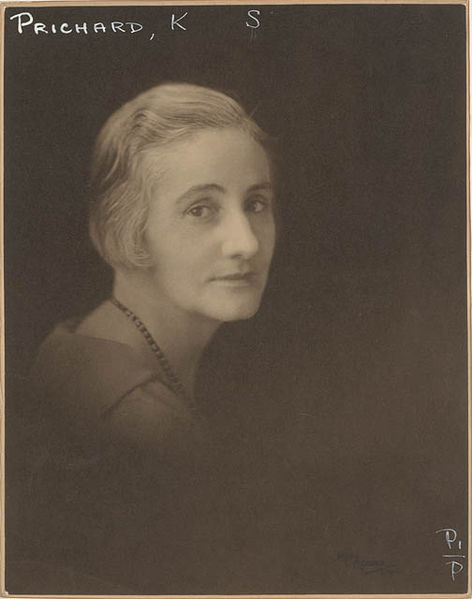
Prichard, 1927/8, by May Moore (Courtesy: State Library of NSW, via Wikimedia Commons)

Katharine Susannah Prichard (1883-1969) is probably not as well-known in Australia, let alone internationally, as she should be. She was born in Fiji, but grew up in Tasmania and Melbourne, travelled overseas and in other parts of Australia, before settling in Western Australia in 1919. She was a founding member of the Australian Communist Party (1920) and also of the Western Australian branch of the Fellowship of Australian Writers. Politics and literature, then, were the twin passions of her life. Her most famous novel and the only one I’d read until now, Coonardoo (1929), was remarkable in its time for its exploration of the relationship between white men and black women.

I don’t usually commence a review with a biography, but it felt appropriate in this case – partly because she is so little known despite her significance and partly because her politics were an intrinsic part of her literature. In the foreword to my new edition of the book, her granddaughter describes Prichard’s values as:

a huge love of and respect for the bush; the importance of living your life with integrity; of caring and fighting for the underdog; of holding strong principles and remaining true to them; and of embracing life with passion.

These values are evident in The pioneers, her first novel which won the Hodder and Stoughton All Empire Literature Prize for Australasia in 1915. She went on to write over thirty works, including novels, plays, short stories and poetry. But, perhaps that’s enough prelude for now – on with the book.

It’s a simple tale really, plot-wise. It starts with a couple, Donald and Mary Cameron, arriving by wagon in an unsettled area of Gippsland (in eastern Victoria) in the early-mid nineteenth century. They clear the land, build a home and establish a successful farm. Very early in the story, while Donald is away getting supplies, Mary is “visited” by two desperate men, Dan Farrell and Steve. A tricky situation for a woman on her own but she manages to win them over and they leave her, unharmed. The novel tells the story of these people – and the others who move into the district – over the next two decades or so, as they work to make lives for themselves, some honestly and some not so.  There are archetypal characters here – the hard-working, tough, taciturn farmer; the loving, but wise and stoical wife; the loyal but unappreciated-by-his-father son; and more. There are escaped convicts, cattle rustlers, and a thoroughly bad man.

This may all make it sound rather typical and a bit melodramatic. And, in fact, it does have its melodrama. But the book is more than this. Its overriding style, or approach, is social realism, as Prichard explores the hopes and wishes of a new country struggling to come to terms with its origins and forge a more positive future. Her style is not particularly innovative and, while the combination of social realism and melodrama is appropriate for a novel set in the nineteenth century, the melodrama was a little discordant to my modern ears.  Take this, for example:

It was as if that encounter in the valley of shadows had brushed all misunderstandings from the love that was like the sun between them. Deirdre had wrestled with death for possession of him.

A contemporary review suggested that the romance – which drives most of the melodrama – was included primarily to attract readers who may not be interested in the history. This could very well be so.

Despite not being particularly innovative, Prichard’s writing is sure and shows that while this was her first novel she’d been honing her craft for some time. I particularly loved her language. It is gorgeously descriptive. She perfectly captures the paradox of a place that is both beautiful and harsh – and effectively conveys the physical and emotional impact of the landscape:

The bright hours were rent by the momentary screeching and chatter of parroquets, as they flew, spreading the red, green and yellow of their breasts against the blue sky. At sunset and dawn there were merry melodious flutings, long, sweet, mating-calls, carollings and bursts of husky, gnomish laughter. Yet the silence remained, hovering and swallowing insatiably every sound.

The plot, as I’ve suggested, is a little melodramatic and fairly predictable but it’s a well-told tale, nonetheless, of good forces fighting bad, of compromises that are sometimes made, and of bad judgement calls that come back to bite you. The characters, while tending to archetype, are nonetheless real so that you believe them and their various plights. There is, I think, something reminiscent of Dickens here.

The themes reflect very much the values identified by her granddaughter in the foreword. The main characters are imbued with a strong sense of principles that they try to live by. When Mary meets the convicts early in the novel, she says:

But if you will believe the truth it is this: My heart is with you and all like you.

In her twenties, Prichard apparently met the Austrian sociologist, Rudolph Broda, who introduced her to the ideas of socialism and suggested that, as a new country, Australia was leading the world in social legislation. This idea is reflected in the novel. Early on, Mary says to Donald:

It’s a new country and a new people we’re making, they said at home, and I’m realising what they meant now.

Little did she know, then, what this “making” would really involve but defining “a new country” is clearly the goal Prichard set for herself. The novel concludes by suggesting that the new generation will

be a pioneer of paths that will make the world a better, happier place for everyone to live in.

Corny? Or aspirational? Take your pick … but whichever way you see it, this novel makes a significant contribution to the development of the Australian psyche, to our transition from colonial convict-fearing past to an independent self-realised future. I am glad it has been re-released and hope that more people read it.

Katharine Susannah Prichard
The pioneers
Singapore: Monsoon Books, 2010 [first ed. 1915]
272pp.
ISBN: 9789810848804

NOTE: An ebook version of the novel is available at Project Gutenberg.

Vale Ruth Park

“Harp in the South silenced: author Ruth Park dead at 93” confronted me this morning on page 3 of our daily newspaper. I guess it had to happen, but it is nonetheless sad to see such a grand dame of Australian literature leave us. I have referred to her several times on this blog, three of those times being focused specifically on her – reviews of Swords and crowns and rings, and Missus, and a Monday Musings dedicated to her – so that will give you some measure of my regard for her and, really, of her standing in Australia.

Susan Wyndham, who wrote the announcement I read, concluded with the following:

Park’s publisher at Penguin, Robert Sessions, once said that she was one of three older women who had a huge impact on him, along with the writer Thea Astley and the legendary editor Beatrice Davis. All have now died.

Astley and Park both had huge stature in Australian literature and they had that rare combination of talent and strength and humility, he said.

What more can I say, except, well done Ruth, we’ll miss you – but we’ll keep on reading you.

Ruth Park, Missus

Missus was the last written in Ruth Park‘s Harp in the South trilogy, but is the first in terms of chronology. The first two novels, Harp in the South and Poor man’s orange, were published in 1948 and 1949 respectively, while Missus was not published until 1985.

These first novels, which met with some controversy on publication, are set in early post-war Sydney, the tenements of Surry Hills, and deal with the lives of Mumma and Hughie Darcy and their daughters. Missus is set in the 1920s, in country New South Wales, and relates Mumma and Hughie’s youth and courting days. I have only just read Missus, partly because I read the first two in my teens which was, I have to admit, before Missus appeared on the scene.

You can tell that the writer of Missus is the writer of Swords and crowns and rings (1977). The latter is larger scale – and deals more consciously with its historical time-frame. That is, it more specifically addresses the wars and the Depression, and their impact on the main characters. However, the First World War and the coming Depression do provide the backdrop to Missus. Both books depict rural life and characters with convincing realism.

WARNING: SPOILER, IF YOU’VE NOT READ HARP IN THE SOUTH

Now, the plot. For those who’ve read the first two novels, the interest here is not whether Mumma (Margaret Kilker) and Hughie get together but how they get together and who they are. The first chapter – after a brief introduction to the town of Trafalgar including how the early settlers cruelly despatched the Indigenous inhabitants – introduces us to Hughie and his family. We meet his brother Jer (Jeremiah), who is born with “his feet back to front”, and we learn of the failure of his parents marriage, his mother’s early death and his being turfed out by his father when he was around 14 years old. Jer goes with him, and becomes both millstone and support from then on.

In Chapter 2, we are properly introduced to Margaret (who makes a brief appearance in the first chapter) and her family. Unlike Hughie, she grew up in a large, loving family, though not one without its stresses and losses. Margaret, we learn, has taken a shine to Hughie, much to her mother’s concern, because she sees Hughie for what he is, “a wild goose of a boy … [who’s] got flighty feet”, a “shifty article”. This mother (Rowena) is, in fact, a powerful presence. I love this description of Rowena after she decided to give up on (“on” being the operative word) her first true love:

Her chest ached as if it had a skewer stuck in it, but she tossed her head more often than she hung it.

From here on the story progresses chronologically as Hughie moves around the countryside obtaining and losing or leaving jobs, while Margaret stays at home waiting for Hughie’s occasional visits. The characters of our characters, if you know what I mean, are illuminated by the actions of, or their interactions with, other characters. Margaret’s younger sister, the jealous Josie, provides an interesting foil for Margaret as well as an opportunity for Park to explore women’s lack of rights. Josie marries young – for the wrong reason to the wrong man – and the marriage fails. She’s intelligent and manages to obtain accountant qualifications, but her attempt to set herself up as an accountant in the town fails because no-one will use a woman accountant. Other characters include Alf, Margaret’s long-suffering but sensible aunt who works as a housekeeper for the local priest and who, at different times, provides shelter and monetary support for Josie and Jer; the Biddles (the mustard-gas damaged Joe and his common law wife) who take in Hughie and then Jer at one time in their lives; and the redoubtable Bids Tookey who … but that might give away what little plot there is.

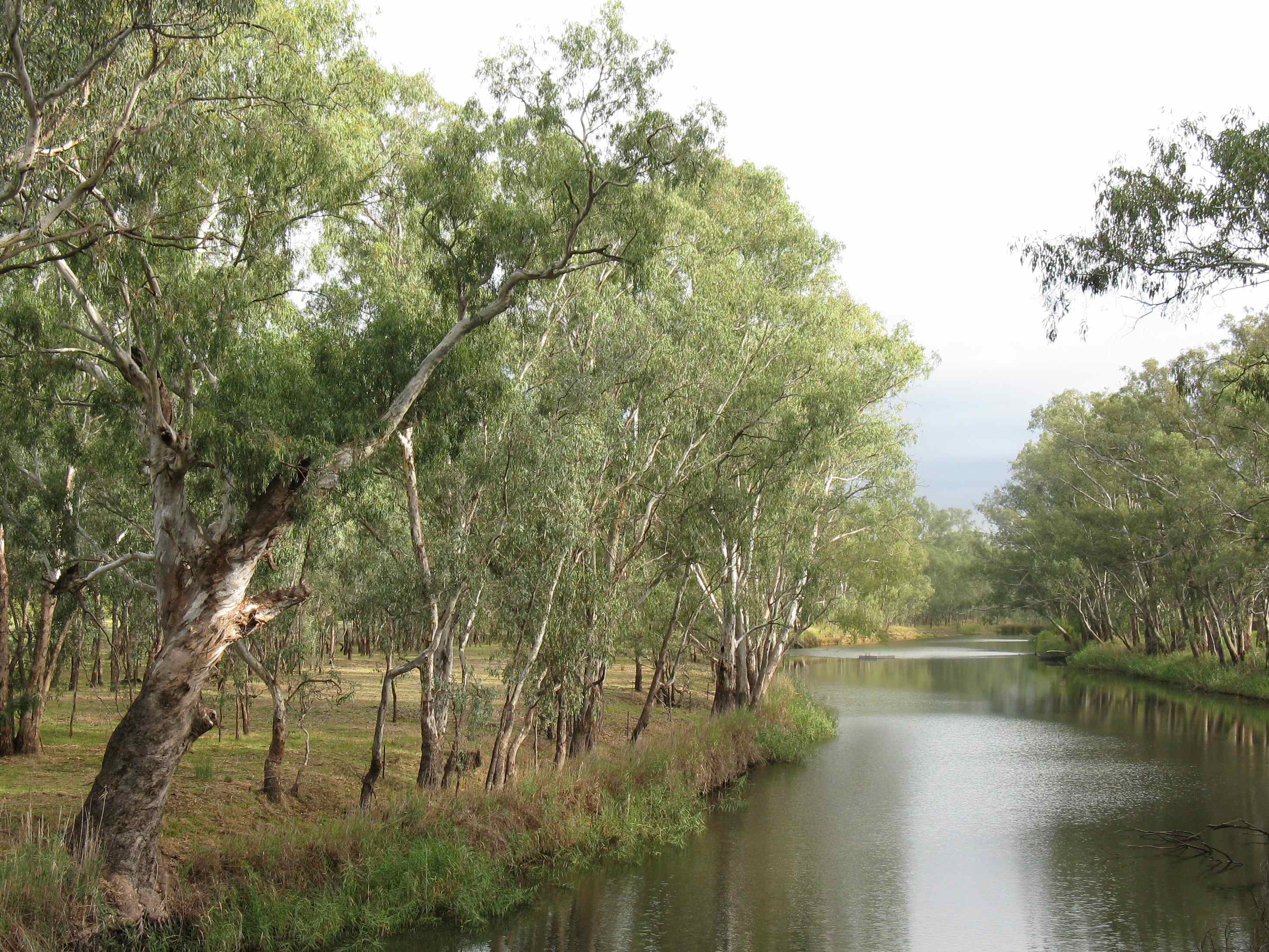
Sunday Creek, near Rutherglen

Australian country creek, lined by eucalypts

In just 250 pages Park paints a rich picture of 1920s life in rural Australia while at the same time developing Hughie and Margaret’s characters. Her characters are all flawed, some more than others, but she draws them with a clear-eyed warmth. She sees them for who they are but she respects them nonetheless. There’s no sentimentality here, but neither is it cynical or bitter. Her themes are universal ones: innocence and experience, familial and romantic love, deception and loyalty, most of it overlaid with that pragmatism that is necessary for survival in a hard place in hard times. As I wrote in this week’s Monday Musings, it’s not surprising that these books still resonate.

Finally, the language is lovely – simple, direct and evocative. Read this from the last few pages of the novel:

In the unkempt garden bloomed freesias and grape hyacinths. The eucalypt twig flushed red, the four creeks overflowed, lambs appeared on the hills, white as mushrooms and as sudden.

‘Them two had better wed quick,’ said Eny ominously, ‘or I won’t answer for Margaret’.

Ha! I think I’ll leave it there – pregnant with possibility …

Ruth Park
Missus
Ringwood: Penguin Books, 1985
247pp.
ISBN: 0140089438

Monday musings on Australian literature: Ruth Park

The muddle-headed wombat, book cover

Wombat book cover (Courtesy: HarperCollins Australia)

For a New Zealander, Ruth Park is a very popular Australian! Not only did she write the much-loved (and studied) Harp in the south trilogy, but she also wrote the hugely popular (in its time) radio serial The muddle-headed wombat, was married to the Australian D’Arcy Niland (now deceased) who wrote The shiralee, and is mother to children’s author-illustrators Deborah and Kilmeny (now deceased) Niland. Ruth Park also won the Miles Franklin Award with her Swords and crowns and rings, and wrote two very popular autobiographies, Fence around the cuckoo and Fishing in the Styx. And this is not all – or even all of the best – that she’s produced in her long career.

Park was born in New Zealand in the early 1920s and first came to Australia in 1940 when she met D’Arcy Niland. She writes that Australian writer Eve Langley*, with whom she had a longstanding friendship, said of Niland:

‘That’s a good face … Do you know what it is saying?’
‘No, what?’
‘It says “Take me or leave me.” I like that.’

So apparently did Park. She returned to Australia in 1942 to work as a journalist, and married Niland. They worked at various jobs in rural New South Wales for some years before Park’s stories gained the attention of the Australian Broadcasting Commission (ABC) resulting in their decision to try to make a living from free-lance writing. They wrote, and wrote, and wrote – anything that would earn money. They wrote, for example, short stories, genre stories (such as romances and westerns), radio talks and radio plays, scripts for radio comics, all the while honing their skills for their more serious writing goals. And they lived during these early years in Sydney’s inner city slum, Surry Hills.

These experiences of living in rural areas and city slums are clearly evident in Swords and crowns and rings (the story of the dwarf Jackie, and his love Cushie Moy) and the Harp in the south trilogy (the story of the Darcy – ha! – family). The thing I love about these books – both of which span the first 4-5 decades of the twentieth century – is the way Park explores gritty issues like poverty, abortion, religious bigotry, unemployment and illness with a psychological and social realism that also encompasses warmth and humour. Her main characters tend to be the quintessential Aussie battlers, but their concerns transcend time and place. It’s not surprising, really, that these works keep being read, re-published, set for study, and adapted for television and film.

Realism though is not the only string to Park’s fictional bow. She wrote in several “genres” for a range of audiences, including fantasy for children. Her Muddle-headed wombat stories ran on the ABC Children’s Session from 1957 to 1971. I have to say that I never have really been one for anthropomorphism, and have read few children’s classics featuring animals (no, not even The wind in the willows) but even I would tune in for the wombat! Park also wrote a children’s time-travel fantasy Playing Beatie Bow, which is taught in schools and has been made into a film.

And yet, for all this, I’m sure she is little known outside Australia … if I am wrong, please let me know!

In the meantime, I will conclude with her description in her first autobiography, Fence around the cuckoo, of her first sighting of Australia as she arrived by boat:

What I saw were endless sandstone cliffs reflecting the sunrise. A chill ran over my skin, my ears buzzed as they had once done when I was about to experience uncertainty about something as yet unknown. The sea fled south, its malachite green changing to beaming blue; the sky was sumptuous with a sun hotter than I had ever known.

This was my first glimpse of Australia Felix, the ancient, indifferent, nonpareil continent that was to become the love of my life.

Ruth Park is not one of those ground-breaking writers who makes you go, wow!, but  she is an excellent story-teller who has an enviable ability to create and develop memorable characters who confront the real “stuff” of life. You could do far worse than read her if you want an introduction to Australian literature. If I haven’t convinced you, read Lisa at ANZLitLovers and Tony of Tony’s Bookworld on Harp in the South, and kimbofo at Reading Matters on her “Top 10 novels about Australia”.

*Park mentions Langley (whom I reviewed early in this blog) several times in Fence around the cuckoo. One concerns Park’s decision to stay with Eve to escape a Peeping Tom uncle but, when she arrived at the windmill in which she believed Eve to be living, she found no Eve but another woman who had heard of Eve but not for some years. “What had happened to that weird girl?”, the new windmill resident wondered. Poor Eve. She was indeed a bit weird and had a rather sad life, but that is another story.

Kate Jennings, Snake

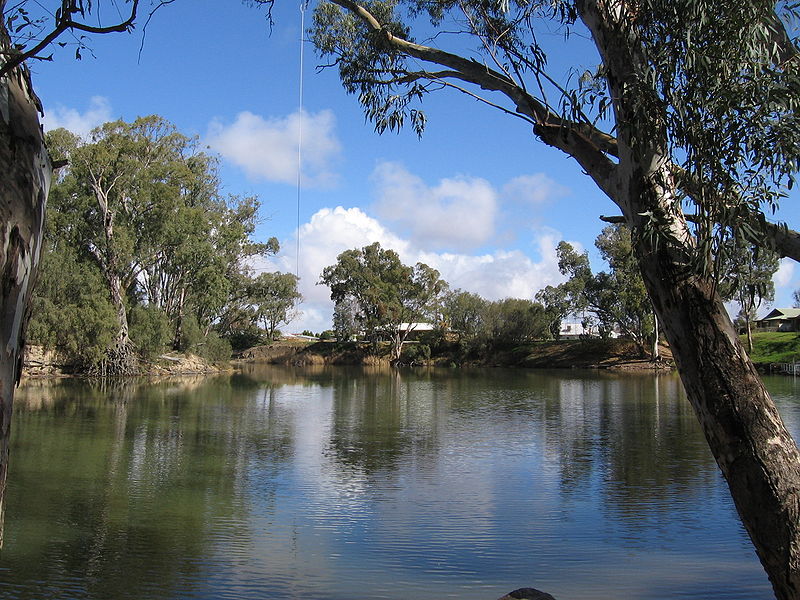
Murrumbidgee River

Murrumbidgee River in the Riverina (Courtesy: Mattinbgn, via Wikipedia, using CC-BY-SA 3.0)

In her “fragmented autobiography”, Trouble, Kate Jennings used excerpts from her first novel, Snake, to convey her childhood experience of growing up on a farm in the Riverina region of New South Wales. She had, she wrote, an “unhappy mother, diffident father”. Snake is the story of such a mother and father. While the novel is not totally “true” to her life in the factual sense, I have read enough novels and memoirs (such as Jill Ker Conway‘s The road from Coorain) about rural Australian life to know that it is “true” to the sort of experience it describes.

The blurbs on the back of my edition include the following descriptions: “a string of prose poems” (Times Literary Supplement) and a “domestic dystopia” (Sydney Morning Herald). The novel – novella in fact – is intriguingly structured. It has 4 parts. Parts 1 and 4 are short bookends, told in second person: the first part is addressed to the father and the last to the mother. The middle two parts are told in the more traditional third person voice and chronicle the life of the family: Rex the ironically named father, Irene the mother, and Girlie and Boy, the children who are caught in the middle. The chapters are short, some being only a paragraph or two long, and present vignettes of the family’s life rather than a simple this-then-that chronology. Dystopian is, unfortunately, an accurate description of their life. As Daphne, Irene’s sister, guesses on the wedding day,

Rex was a nice enough chap but about as interesting as a month of rainy Sundays. Irene will be bored with him before they arrive at the Blue Mountains guesthouse for their honeymoon.

While we never hear from Daphne again, she was not wrong. Rex is a “good man”, “decent”, a farmer of simple needs, while Irene, as her father realises, “dances to a tune no one else hears”. Not a likely recipe for success.

I thoroughly enjoyed this novel. Despite its unusual mix of voice and rather episodic form, it has a strong narrative that drives us on to its inevitable (but no spoiler here) conclusion. The snake motif runs through the book. Snakes are a fact of rural Australian life and so are a natural, real presence in the book, but their symbolic allusion to temptation, deceit and danger lurks behind every reference. Early in the novel, we are told of Irene’s youthful romantic tendencies – her love of

… smoky-voiced singers and innuendo-laced lyrics. Tommy Dorsey and Benny Goodman, Frank Sinatra and Peggy Lee, they were the snake charmers and Irene the snake.

Later, Girlie looks at snakes in a book on Australian fauna: they are “fanged, flickering, unblinking”.

Kate Jennings is a poet – as well as novelist and essayist – and it shows. The language is accessible but full of imagery. This is particularly apparent in the chapter titles, most of which are obvious in meaning, though some are more cryptic: “Home is the first and final poem”, “Send my roots rain” and “My mother has grown to an enormous height”. They are fun to think about as you read. There are some beautifully apposite descriptions. Here for example is Rex experiencing misgivings about his new wife:

The sight of her caused his nature – practical, honourable – to assert itself … What was done was done. Without being conscious of it, he coughed importantly – I am a man, I have a wife – and squirmed inside the jacket of his uniform until it sat better on his shoulders.

And here is Girlie reading:

Girlie read books like a caterpillar eating its way through the leaves on a tree.

Their town is, ironically, called Progress. However, very little “progress” occurs in the book. Rex struggles to keep the farm going in the face of mice and locust plagues, hail and dust storms. Irene tries to make a life that suits her romantic, imaginative spirit – she creates a garden, seeks friendships with interesting people, looks for work – but in the end nothing works:

Rex and Irene had given up arguing. He no longer bothered to tell her that he wasn’t asking much – harvest his crops, care for his animals, share it all with a good woman, tra-la – and Irene didn’t reply that far from not asking much, he was asking everything.

Such is the life of a mismatched couple. We’ve read of such couples before, and we will again, but for a clear-eyed, finely balanced, while also touching, portrayal, this one by Kate Jennings is hard to beat.

Kate Jennings
Snake
Sydney: Picador, 2003 (first pub. 1996)
153pp.
ISBN: 9780330364003

Arnold Jansen op de Haar, King of Tuzla

Translated works always represent a challenge. There is something slightly disconcerting about knowing that you are not reading the actual words of the author, but someone else’s interpretation of them. There’s been some discussion of this around the blogs and in the media this year, partly because of the publication of Why translation matters by award winning literary translator Edith Grossman.

Ramona Koval, of Radio National‘s The Bookshow, interviewed Edith Grossman earlier this year. Koval introduced the interview with:

According to Edith Grossman, translation is a strange craft, generally appreciated by writers, undervalued by publishers, trivialised by academics, and practically ignored by reviewers.

Well, maybe translators are ignored by professional reviewers, but I’ve often seen the issue discussed in blogs and online bookgroups. We are keenly aware of the translator’s role and have been known to compare translations. Anyhow, to continue… The Wikipedia article on Grossman includes a quote from a speech she made in 2003:

Fidelity is our noble purpose, but it does not have much, if anything, to do with what is called literal meaning. A translation can be faithful to tone and intention, to meaning. It can rarely be faithful to words or syntax, for these are peculiar to specific languages and are not transferable.

Arnold Jansen op de Haar, King of Tuzla bookcover

Book cover (Courtesy: Holland Park Press)

This brings me nicely to Arnold Hansen op de Haar’s King of Tuzla. I found it a strangely compelling book. I can’t say I loved it, and at the beginning I nearly gave it up, but it’s short and so I decided to push on. However, more of that anon. First a brief plot. It tells the story of a young Dutch army officer, Tijmen, who finds himself in the middle of the Bosnian War as part of a UN unit, and tracks his experience of the war and his feelings about it. Interspersed between his story are little “cameo” stories about various civilians and the impact of the war on them. In fact, the novel starts with one such cameo, the Muslim Galib who had been a civil servant but had lost his job due to the war and was now a farmer. These cameos do not become part of the main narrative.

The book is divided into 5 parts. The first three parts are essentially chronological, while the last two are told after the war, in flashback, some of it through Tijmen’s journal entries. Overall I liked the structure of the book. The early chronological sequence, the interspersed cameos that gave “life” (albeit often horrific) to the matter-of-factness of the military detail, and the change in pace and perspective in the last two parts give the book interest by layering meaning.

The characterisation of Tijmen and his fellow officers is effective. Tijmen himself is an intriguing character: a bit of a loner, interested in the arts (reading, ballet, iceskating), ambitious (but “Eleven years later and still he had got nowhere”), and a little proud (the King of Tuzla, the Duke of Sapna, is how he sees himself during the conflict). I must say, though, that I don’t quite know why the book has been described as a coming-of-age novel. He is an adult when the novel starts and, while he is a little naive in the ways of the world, I saw no coming-of-age focus.

The trouble is that the book is a bit of a plod to read at times, and I wonder whether this is to do with the translation. So, here’s the rub: do I place my concerns at the author’s or the translator’s feet? Part of the problem is the flow. It felt clipped and jerky, but not in a way that seemed like it was done for effect. And at times, the sentences just plodded on one after another, like a boring history text. Maybe all this was intended, but I found it hard going. In addition, there are errors, such as “the colonel still lay there snorting” (“Snoring” seems more likely) and some awkward expressions, such as “It was some minutes before Eddy was able to extricate himself from the situation with some difficulty”. Is this a translation problem? “With some difficulty” seems redundant, and makes the sentence clunky to read.

There are, however, also some lovely images and gorgeous rhythms. I particularly liked this, for example (despite the errant, to me, semi-colon after “popes”):

This was the area where the different population groups overlapped like different geological strata. It was the land of popes; the mullahs and rabbis, the Christians, the Muslims, the Jews and the gypsies. The land of the long hot summers and the long severe winters, of rakija, walnuts and prunes and the land of the centuries-old struggle between the Turks, Hungarians, Austrians and Germans…

And this poignant description of Tijmen’s flat:

Eight years in the same flat, where time’s mechanism had jammed. No-one had been loved there.

In the end, figuratively speaking as we learn this two-thirds of the way through the book, the war is too much for Tijmen and he leaves the army. The book concludes with some nicely structured words beautifully conveying what he had earlier described as “this uselessness, this futility, human helplessness”. (Wouldn’t it be better with another “this” before human?) This may not be the best war novel I’ve read, but it has its power.

This book has received some varied reviews. You may like to read a couple: Stu at winston’s dad and Lisa at ANZLitLovers.

Arnold Jansen op de Haar
(Trans. by Paul Vincent)
King of Tuzla
London: Holland Park Press, 2010
(Orig. pub. 1999)
199pp.
ISBN: 9781907320064

(Review copy supplied by Holland Park Press)

William James, On some mental effects of the earthquake

William James

William James (Presumed public domain, via Wikipedia)

There are a couple of reasons why I was intrigued to read this week’s Library of America offering. The most obvious is that it’s by William James. Not only is he a recognised American philosopher and psychologist, but he is also the brother of Henry James, and I have come across him several times in that context. For that reason alone, I was keen to read something by him, albeit a fairly small and very specific piece.

The other main reason, though, is more personal. In 1990, my family and I went to live in Southern California for a few years and, I have to say, there were several fears attached to this decision: guns, pollution, and earthquakes, not to mention the high probability that our kids would be kidnapped from under our noses in the queue for Disneyland! Well, the latter, you may be surprised to know, didn’t happen – and, while we were there during the Rodney King riots, we didn’t really have any run-ins with guns. We did, however, experience pollution. As for earthquakes, it just so happened that we were out of town on vacation for the two biggest that occurred during our time. All we experienced were a couple of tremors. Nonetheless, like all good Californians, we had our earthquake kit ready to go.

After that long introduction, let’s get to James. This essay, titled “On some mental effects of the earthquake” (1906), was written a few days after James and his wife, who were at Stanford University at the time, experienced the big San Francisco earthquake of 1906. He starts the essay with his east coast friend’s farewell statement: “I hope they give you a touch of earthquake while there, so that you may also become acquainted with that Californian institution”. Hmm … what’s that saying? What I’d say is: Be careful what you wish for?

As it turned out, the good people of Stanford were far enough away from the centre to feel the big shake (and quite a lot of damage) but minimal loss of life. James’s first reaction, once he realised what he was experiencing, was:

glee and admiration; glee at the vividness with which such an abstract idea or verbal term as “earthquake” could put on when translated into sensible reality and verified concretely [me: I think this means “at the excitement of experiencing an earthquake” don’t you!?]; and admiration at the way in which the frail little wooden house could hold itself together in spite of such a shaking. I felt no trace of fear; it was pure delight and welcome.

Ever the psychologist philosopher, he then analyses and articulates his early spontaneous non-fearful response. He said he “personified” it as having “animus and intent”, that it was easy to perceive it as “a living agent”. He goes on to say that he now understood how people mythologised catastrophe, that “it was impossible for untutored men to take earthquakes into their minds as anything but supernatural warnings or retributions”.  He also observes that most people slept outside the next few nights, not simply to be safer in case of a recurrence “but also to work off their emotion, and get the full unusualness out of the experience”. That makes sense to me and I rather like his way of articulating it.

In San Francisco proper, though, the situation was different (as we know). There was more devastation, and a lot of death. He managed to get to SF for the day and draws some conclusions from that too. As he says, his business is not with the “material ruin” but “with ‘subjective’ phenomena exclusively”. What he saw were people going about their business:

It was indeed a strange sight to see an entire population in the streets, busy as ants in an uncovered ant-hill scurrying to save their eggs and larvae.

And he is surprised, as were the officials, by the lack of criminal activity, besides petty pilfering. Is this the same now? Anyhow, this is not his main point. Two things, he says, stand out, and they are both “reassuring to human nature”:

  • “the improvisation of order out of chaos”: he notes that there are some people who are natural organisers (“natural order-makers”) and that at times like this they get to work. He suggests that while much of this was “American, much of it Californian” it would have happened in any country in crisis. In  fact, he says that “Like soldiering, it lies always latent in human nature”.
  • “universal equanimity”: he suggests that the expressions of horror and pathos came from elsewhere, but that the people experiencing the crisis just got on with recuperating. He writes that “the cheerfulness, or, at any rate, the steadfastness of tone, was universal. Not a single whine or plaintive word did I hear from the hundred losers whom I spoke to. Instead of that there was a temper of helpfulness beyond the counting”. And again, he suggests “it is easy to glorify this as something characteristically American, or especially Californian…But I like to think that what I write of is a normal and universal trait of human nature”.

I must say that I do like his lack of nationalism in all this, his suggestion that these positive and admirable traits are “human” rather than “American”. We have had many, many catastrophes and disasters since then, and I’d like to think that what James saw in 1906 has held true. But has it? Does more looting and crime go on now (as the media always implies)? Or, do the people on the ground immediately organise to help themselves and each other? Being one who likes to see the good us, I’d like to think so.

Helen Garner, Cosmo cosmolino

When I returned to seriously reading Australian writers back in the 1980s, there were four women writers who caught my attention, and I have loved them ever since. They were Elizabeth Jolley (1923-2007), Thea Astley (1925-2004), Olga Masters (1919-1986) and Helen Garner (b. 1942). Garner, the youngest by a couple of decades, is the only one still here, still writing novels, short stories, non-fiction and journal articles. I say I love her, but I can’t say I always agree with her. In fact, sometimes she makes me mad – but I admire her honesty and love her writing.

Cosmo cosmolino is not her most recent work. It was published in 1992 and has been on my TBR pile since my brother gave it to me in 1995. How embarrassing! But it finally managed to scramble to the top and I’m glad it did. It’s an intriguing book: it looks like two short stories (“Recording angel” and “Vigil”) and a novella (“Cosmo cosmolino”), but nowhere on the cover or the title page does it say “a collection of short stories”. This means, I think, that we are meant to see it as a novel.

So, how does it work as a novel? Each story would, I’m sure, stand perfectly well alone, but the two short stories also work as back stories to the novella. The tricky thing though is that the connections between these three are only obvious if you are an attentive reader – or, if you re-read it. For me it was a bit of both. I got some of the connections first time around, and others when I flicked through it to prepare this review. This is not a big problem but there is more depth if you have “got” the back stories when you read the final story.

And so, what are the three stories?

  • “Recording angel”. A recently separated woman (who is clearly Janet in the final story) visits an old friend and his wife in Sydney. This friend is seriously ill with brain cancer. He has not only been an important support and rescuer for her but the one who has “recorded” her life. And, he is never backward about telling her his view of what that is. She doesn’t always like or agree with this view, but she nonetheless fears the possibility that in sickness he will “forget everything” and that she will thereby lose an important connection with herself. There is a brief mention in this story of Ursula, who is the mother of the girl in the second story.
  • “Vigil”. A young woman, who is clearly “out of it” and waiting for her father to rescue her, has a boyfriend Ray(mond), who appears to be there more for the “good times” than for a mutually supportive relationship. When things go wrong, he’s not there for the count. This, we discover in the final story, is something he’s been trying to rectify ever since.
  • “Cosmo Cosmolino”. Three rather lonely people – the aforementioned Janet and Ray plus the rather fey artist, Maxine – find themselves sharing Janet’s house. It’s an uneasy grouping.  Ray is waiting for his big brother Alby (who once lived in Janet’s house) to arrive and take him away; Maxine would like a baby but is running out of time; and Janet is recovering from a broken marriage and doesn’t really know what she wants.

These are not strongly plot-driven stories. However, quite a bit happens on the emotional front, and this is Garner’s real subject.

Which brings us to the themes

Taken together, these stories are about the muddles people get into, particularly regarding their relationships with each other. Poor decisions, missed opportunities and the never-ending seeking for meaningful connection are the stuff of her fiction. But there is a departure in this book: the introduction of a spiritual (and at times magical) element, often involving some sense of “visitation”.

Angel Wings

Angel wings(Courtesy: OCAL via clker.com)

In the first story, the distraught woman is visited at the end by “a small, serious, stone-eyed angel of mercy”. In the second story Ray is dragged into a rather ghoulish underworld-like scene, after which he is told “You’ll be right … Things’ll be different now”. And in the final story there are all sorts of hints of spiritual happenings, including the “dark column” that shadows Janet, and Maxine’s “magical realist” flight “into the blinding upper sky” where “nameless souls and sacraments outrageously disport themselves”.

It all feels very un-Garner-like. She is usually firmly grounded in the real world of messy relationships where people struggle to connect and find meaning. But I should have been prepared: the novel’s epigraph from Rilke reads “Every angel is terrible”. “Terrible”, of course, has two meanings, and I suspect Garner is playing on both here – on the fear angels engender and the awe. As this paradox implies, there is no suggestion here of easy answers but more of possibilities. Here is Janet at the end:

Our minds are not hopeful, thought Janet; but our nerves are made of optimistic stuff.

I was intrigued by the use of “nerves” rather than “souls” or “spirits” given what had gone before, but I rather like her use of that word. It’s effectively ambiguous.

Finally, the style

The thing that marks Garner out for me is her expressive language. Her books are rarely long. This isn’t because she doesn’t have much to say but because she doesn’t waste words. Read this:

… The heart of the house was broken. It ought to have been blown up and scraped off the surface of the earth.

But houses as well as their owners must soldier on …

and this:

… and the architraves had lost their grip on the walls, and slouched this way and that …

and, finally, this:

The room contracted around Ray again, fitting itself tightly to the shape of him, squeezing …

I love the atmosphere and emotion conveyed by language like this.  Garner uses a lot of imagery and symbolism – but never simply. Birds, for example, can augur wonder and hope, or, particularly when “the failure bird” appears, something completely different. There are also biblical allusions, such as when Ray denies three times that he knew his girlfriend. No wonder he’s dragged into the underworld for a bit of shock therapy! From beginning to tend, the language never sways from conveying a sense of things being awry because the characters’ lives are so.

Cosmo Cosmolino is one of those books that is both accessible and challenging – and that is just the sort of book I like to read.

Helen Garner
Cosmo cosmolino
Ringwood, Vic: McPhee Gribble, 1992
221pp.
ISBN: 0869142844