Virginia Woolf, The mark on the wall (Review)

Back in November I wrote a post titled Nettie Palmer on short stories which resulted in Stefanie (of So Many Books) recommending one of her favourite short stories, Virginia Woolf‘s “The mark on the wall”. I told her I’d read it and, finally, I have.

This is the sort of story I like. It doesn’t have a strong plot but is the meditation of a lively, creative mind. This meditation is inspired by a mark on the wall which leads the first person narrator to wonder what the mark is, and what it might signify. She doesn’t want to get up to investigate, preferring to let her mind wander, as it will, on the possibilities:

How readily our thoughts swarm upon a new object, lifting it a little way, as ants carry a blade of straw to feverishly, and then leave it …

The story does progress, albeit in an organic, stream-of-consciousness way, rather than according to any clear logic. She wonders if the mark is a hole, then thinks it could be a stain, or even, perhaps, something more three-dimensional like a nail head that has broken through the paint. At the end, we do discover what the mark is, but that’s not the point of the story. The point is what she thinks about as she considers the mark …

And the things she thinks about are wide-ranging as we have come to expect in stream-of-consciousness, a technique of which Woolf was one of the early pioneers. The thing about stream-of-consciousness is not only that it tends to roam over a wide range of ideas and topics, but that these ideas and topics are very loosely connected. Sometimes the thread between them is barely visible, usually because the connection is idiosyncratic to the thought processes of the narrator.

This is the case with “The mark on the wall”. The first paragraph uses strong imagery – based around the colours of red and black – which encouraged me to expect something more dramatic than what did, in fact, follow. In the third paragraph she exclaims:

Oh! dear me, the mystery of life. The inaccuracy of thought! The ignorance of humanity!  To show how very little control of our possessions we have — what an accidental affair this living is after all our civilisation …

Nothing, though, is accidental in Woolf’s story, no matter how much the stream-of-consciousness form may lull us into thinking it is. This is the story of a woman concerned about the meaning or import of reality. She ponders the shallowness of “things” (including, even, knowledge). In the second paragraph she suggests the mark may have been made by a nail holding up a miniature that would have been

a fraud of course, for the people who had this house before us would have chosen pictures in this way — an old picture for an old room.

She writes of how we like to construct positive images of ourselves but how fragile this is, of how superficial reality is. Interestingly, while the story flits from idea to idea, there’s one motif (besides the mark) that recurs, Whitaker’s Table of Precedency. Whitaker’s exemplifies “the masculine point of view which governs our lives”. She uses it to represent the faith we have in rules, and the way we let rules and reality prevent our seeing the “sudden gleams of light”.

There’s a funny sequence in which she imagines a Colonel pontificating with other men on the history of objects like ancient arrowheads. The  Colonel, she imagines, might suffer a stroke and his last thought would be, not his wife and family, but the arrowhead which, she suggests in her stream-of-consciousness way,

is now in the case at the local museum, together with the foot of a Chinese murderess, a handful of Elizabethan nails, a great many Tudor pipes, a piece of Roman pottery, and the wine-glass that Nelson drank out of — proving I really don’t know what.

That made me, a librarian-archivist, laugh!

And so, what is it about? Well, the mark seems to represent the unwelcome intrusion of reality into her life – it gets in the way of her thinking (of her desire “to catch hold of the first idea that passes”) while also, paradoxically, offering inspiration to her thoughts. An intriguing story. And, like Stefanie did to me, I recommend it to you.

Virginia Woolf
“The mark on the wall”
Originally published: 1919
Available online at The Internet Archive 

Monday musings on Australian literature: Women writers and politics in the 1930s

I have written before about the fact that there’s been two periods in Australian literature when women writers seem to have flourished. One was around the 1920s to 1930s and the other around the 1970s to 1980s. Today I want to write a little about this first period because, from the perspective of 80 plus years later, it was an exciting period for women writers – that wasn’t sustained.

Australian academic Maryanne Dever says that “women represented a significant section of the writing community” in the interwar years and that this concentration “could be said to be one of the major distinguishing features of the then Australian literary landscape”.* Women were significant in the reviewing community, held office in major literary societies, judged literary competitions and edited anthologies. Many were also active politically. So, who were these women? I’m going to list just a few here.

Marjorie Barnard (1897-1987) and Flora Eldershaw (1897-1956)

Barnard and Eldershaw were major players in the Australian literary scene. They met at university and in 1929 won the Bulletin literary prize with their collaborative novel A house is built. Like all their collaborative works, they tackled in this book social issues, including gender stereotyping. Both held strong viewpoints regarding social justice and both were active in the Fellowship of Australian Writers, with Eldershaw becoming its first woman president in 1935. In their late thirties they shared a flat together and held what can best be described as “salons” at which a range of literary and political issues were explored with many of the intellectual luminaries of the time. Eldershaw was, not unusually for writers of the period, pro-Soviet. And she negotiated hard for writers to be supported, particularly in their old age.

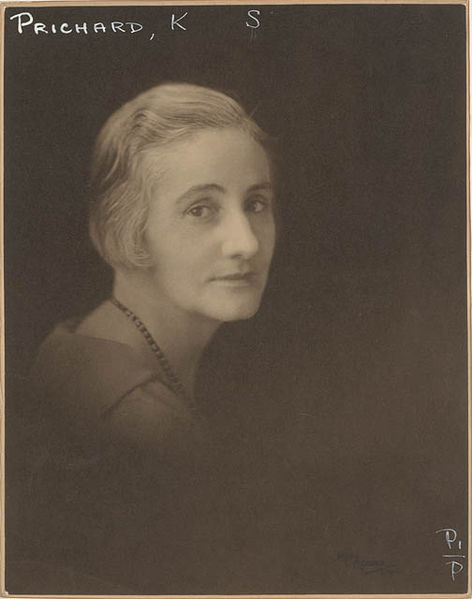
Katharine Susannah Prichard (1883-1969)

Katharine Susannah Prichard

Prichard, 1927/8 (Courtesy: State Library of NSW, via Wikimedia Commons)

Prichard, whose book The pioneers I’ve reviewed here, shared the 1929 Bulletin prize with M. Barnard Eldershaw, for her book Coonardoo (which I have also read, but many years ago). Coonardoo is one of the first Australian books to deal with a relationship between a white and an indigenous Australian. Prichard was a founding member of the Communist Party of Australia. Her novels documented people’s struggles, in work and relationships with each other. Her son, Ric Throssell, became an Australian diplomat and writer.

Miles Franklin (1879-1954)

Franklin’s career started long before the period I’m writing about here – My brilliant career was published in 1901 – but she was still active during this period and in fact won a prize in 1936 for her novel All that swagger**. I can’t resist sharing this excerpt which describes the hero, Danny, chopping down gum trees:

Guarding the illusive land were throngs of giants–the stateliest trees on the globe. Delacy was like an ant in the aisles of box trees and towering river gums, but he attacked them as an army, grunting with effort, sweat dripping from him. His slight form grew as wiry as steel; his hands were corneous and scarred with the work of felling and grubbing. (All that swagger, Ch. 3)

A contemporary reviewer described it as “probably the finest Australian novel ever written”. It deals with an Irish immigrant and his family’s history in Australia over 100 years, up to 1933. The Bulletin ‘s reviewer suggests that the hero, Danny, “seems certain to take a lasting place in Australian literary tradition.” The reviewer, I think, got that wrong, but Miles Franklin herself has achieved this through the eponymous prize she bequested. What is less well-known is that Franklin was politically active much of her life, and in fact spent around 9 years working for the National Women’s Trade Union League in Chicago from 1906 to 1915. On her return to Australia she worked hard to promote Australian literature, supporting, for example, the creation of fellowships for writers.

Other writers

Other politically active writers at the time included Jean Devanny, who was a Communist and who used her writing to promote her ideology; Eleanor Dark, who was active in the Labor left; and Nettie Palmer, who actively mentored younger writers like Marjorie Barnard and Flora Eldershaw and who, with her husband Vance, was anti-Fascist and a proponent of egalitarianism.

Literary histories about the period rarely mention any of these writers in isolation, which tells us something about the richness of the literary life of the time and of their collaborative approach to promoting not only Australian literature but also the values they thought should underpin Australian life. I never tire of reading about them, but I still have a way to go before I can feel well-read in their writings.

*From my research for Wikipedia. The citation is: Dever, Maryanne (1994) “Conventional women of ability: M. Barnard Eldershaw and the question of women’s cultural authority” in Dever, Maryanne (ed) Wildflowers and Witches: Women and Culture in Australia 1910-1945, St Lucia, University of Queensland Press, pp. 133–146

** Accessible online at Project Gutenberg Australia

DISCLAIMER: I have read works by most of these writers, but mostly long ago. I hope, in future months and years, to (re)read their works, and review them here.

Bettye Rice Hughes, A Negro tourist in Dixie (Review)

"Colored" waiting room sign, Roma, Georgia, 1943

Colored Waiting Room sign, Roma, Ga, 1943 (Public Domain: Library of Congress, via Wikipedia)

I have plenty to read at the moment, but when I see a Library of America story come through that is set in the early days of the Civil Rights Movement in the American South, well, I can’t resist. I’ve never heard of  the author Bettye Rice Hughes, which turns out to be not surprising as the Library of America people don’t know much about her either. In fact, at the end of their brief, but always interesting, introductory notes they write “If any of our readers happens to have additional information about Bettye Rice Hughes, we’d love to hear from you at lists@loa.org.” So, if you do, please contact them!

Anyhow, the article. LOA starts with some background, describing the Freedom Rides which occurred in the American South in 1960-1961. Their aim was to test compliance with the September 1960 Interstate Commerce Commission‘s (ICC) rules prohibiting interstate carriers from using segregated bus terminals, and mandating that seating on buses be “without regard to race, color, creed, or national origin.” Despite this and an earlier Supreme Court decision prohibiting segregation in interstate bus terminals, several Freedom Ride buses had met with violence, two being firebombed. In the wake of all this, in 1962, Miss Hughes set out alone, on a bus

to see at first hand how many Southern states were complying with the ICC ruling; and I also wanted to see if a female Negro tourist traveling alone – unheralded and unprepared for – would receive a different reception from that which had greeted the Freedom Riders.

What a brave woman! She travelled through Arkansas, Tennessee, South Carolina, Florida, Alabama, Georgia and back home via Texas but, she writes

interstate passengers going from east to the west by Greyhound bus over the southern route never set foot on Mississippi soil.

In fact, the bus took a circuitous route to drive around Mississippi! I guess we ca guess why …

Without spoiling anything – after all this is an article not a piece of fiction – I can report that she returned home unscathed. But that’s not to say it was all smooth sailing. In most of the places she visited she found that the letter of the law was being followed. However, the segregated areas – waiting rooms, cafeterias and toilets – still existed and her black American co-travelers continued to use them. Hughes though always used the “main” facilities and while on occasions the staff tried to move her on to “the other restaurant where you belong”, she stood her ground and was (eventually) served. As her journey wore on, she felt she was being watched by her black travel companions:

The other Negro passengers, who went to the waiting rooms formerly designated as “Colored”, had started watching to see what I was going to do at rest and lunch stops. Several of them asked me, ‘Are you riding for us?’ I said that in a sense I was. But no one offered to go into the main waiting area with me.

She provides several anecdotes to describe her experience, and the article – less than 6 pages – is worth reading for these and for her reflections on them. While she made it through safely, she says, “the threat of violence was always there”. She concludes that “the advances that have been won through group action” now need to be “reinforced by individual action”. Southern white people need to “get used to seeing Negroes in waiting rooms, rest rooms, and cafeterias” and Southern Negroes also need “to get used to seeing other Negroes bypassing the segregated areas so that they may take courage and insist on the best facilities and services available for their money”.

All I can say, again, is, what a brave woman … and what a shame we don’t know more about her.

Bettye Rice Hughes
“A Negro tourist in Dixie”
First published in The Reporter, April 26, 1962
Available: Online at the Library of America 

J. Herman Banning, The day I sprouted wings

There are a couple of reasons why I decided to read  James Herman Banning‘s (1899-1933) short essay, The day I sprouted wings, which was this week’s offering from the Library of America. Firstly, it is about the first male* African-American who achieved his pilot’s licence, which ties in nicely with the novel, Caleb’s Crossing, that I recently reviewed, about the first African-American to graduate from Harvard. And secondly, his attempt to be, with Thomas Allen, the first African-American to fly cross-country, was partly funded by Franklin Delano Roosevelt’s presidential campaign, and I recently reviewed Hazel Rowley’s biography of Franklin and Eleanor. I like it when my reading criss-crosses like this, filling in gaps and/or expanding out from one topic into another overlapping one.

Banning’s essay was first published in the Pittsburgh Courier in 1932. According to LOA’s notes, the Pittsburgh Courier was one of the leading “race” papers of the day. The article is very short but worth reading, not only because he tells an entertaining story about his first solo flight but also because he has a lovely, natural and expressive storytelling style. I’ll just give two examples.

The first one occurs in the second paragraph where he describes the importance of the first solo flight for pilots:

This is the first time when the student pilot conclusively proves to the world at large that he has both nerve and ability. To himself he proves that he is nothing but a scared, witless fool who hasn’t had half enough flying lessons.

The second example comes near the end of the article when he is in flight:

I felt as only one who flies can feel – that here, at last, I have conquered a new world, have moved into a new sphere. I had sprouted wings, a rhapsody in air, but the stark realisation came to me that I had yet a landing to make!

“A rhapsody in air”! Love it. The article also chronicles how he “acquired” his first plane and the circumstances leading to his first flight. It’s a good story. Not surprisingly, racism is a factor in his life – particularly in the manner of his death – but it is not something he raises in his story here. I’d love to know why he doesn’t … but that is another story I guess.

J. Herman Banning
“The day I sprouted wings”
First published: Pittsburgh Courier, December 17, 1932
Available: Online at the Library of America 

* Bessie Coleman (died 1926) was the first female pilot of African-American descent and the first person of African-American descent to hold an international pilot licence.

Monday musings on Australian literature: Meanjin’s Tournament of Books

Henry Handel Richardson in 1945, a year before...

Henry Handel Richardson, 1945 (Presumed Public Domain. Courtesy: Wikipedia)

Many Monday musings ago I wrote about the reduced visibility of women writers in Australia. I wasn’t the only one concerned and things have been afoot to up the ante for women writers. For example, a new award targeting women writers, the Stella Prize, was announced earlier this year. And now Meanjin, a longstanding literary magazine, is emulating the Morning News’ Tournament of Books (to which a favourite blogger, Hungry like the Woolf, introduced me a couple of years ago) by conducting a tournament comprising books by Australian women writers.

Meanjin describes the tournament as follows:

The way it works is this: 16 books are chosen … and then divided into pairs. A judge is given a pair, reads them both, writes up their decision process and announces which of the pair they deem the better book. That book then progresses into the next match to go up against a winner from a previous round. It’s a sporting tournament for people who don’t like sport.

This year, in light of the discussion around women’s writing and literary prizes, we’ve selected a short list of novels exclusively by Australian women. The list has been chosen by us, and is incomplete, capricious and arbitrary. That’s ok. There’s no way you could do Australian women authors justice in 16 books…

Fair enough … and being this upfront about their selection makes it hard for us to complain, doesn’t it? And really, I wouldn’t want to, because I can’t imagine we’d ever get universal agreement on 16 books, anyhow.

The tournament schedule can be viewed at the Meanjin site so I won’t detail it here, but I will list* the 16 books, partly because it’s a useful list, despite its arbitrariness, for those interested in Aussie women’s lit:

Regular readers of my blog will recognise some of my favourite and oft-mentioned authors here. Interestingly, a couple of young adult/children’s novels (those by Carmody and Marchetta) have been included – one of their “capricious” decisions, perhaps! Not that I have anything against such novels – I thoroughly enjoyed Marchetta’s Looking for Alibrandi – but I wonder whether they have the weight to beat a Stead or an Astley, a Wright or a Jolley, for example. Well, keep reading …

Round 1 results

  • Match 1, Gilgamesh beat The lost dog. Both are interesting books but Gilgamesh is a beautiful one. I would have chosen it too.
  • Match 2, The children’s Bach beat Mr Scobie’s riddle. This is harder. I love The children’s Bach but have not read Mr Scobie’s riddle. I’m not sure it’s the Jolley I’d have chosen … but, oops, I said I wasn’t going to go there, so let me just say that this match is a tricky one – the judge thought so too – and I’m glad I wasn’t asked to call it!
  • Match 3, My brilliant career beat Tirra lirra by the river. Another hard one, but My brilliant career would have to be the sentimental favourite in this pairing. And, anyhow, how could I not agree with a book the judge called “chick-lit amongst the gums” and “Austen in an Akubra with a broad Australian twang and some permanent sun damage”?
  • Match 4, Looking for Alibrandi beat Harp in the south. Interesting decision. A main criterion for the judge seemed to be the ability to stand the test of time … but, but, I argue, Looking for Alibrandi is only 20 years old while Harp in the south has already stood the test of time. And, I’m not sure that Alibrandi reaches adult audiences in the same way that Harp does. Still, perhaps I should read Alibrandi again to be sure.
  • Match 5, The secret river beat A kindness cup. Both good books, and a very hard choice … one the judge clearly found hard too. It seems as though it was Astley’s more dystopian view that was the deciding factor. That seems a bit of a cop out to me!
  • Match 6, The man who loved children beat Obernewtyn. Now this must surely have been a no-brainer and the judge agrees, explaining why they were (mis)matched in the first place. I’ll say no more.
  • Match 7, The fortunes of Richard Mahony beat Of a boy. Another pretty obvious choice, really. While I do think a short novel or novella can beat a hefty tome, this is probably not the hefty tome to be up against!
  • Match 8, The world beneath beat Carpentaria. Now this does surprise me. The latter won the Miles Franklin award while The world beneath was not shortlisted. I don’t think we should give excessive credence to awards but it seems the judge gave the match to The world beneath because he found Carpentaria “difficult”. Is this fair or right, I cry into cyberspace? No, but at least the judge admits to being “covered in the stench of subjectivity”, so all one can do is vote Carpentaria back in the zombie round.

Plot, humour  and readability seemed high on the various judges’ agendas. They would not be my top criteria but, as this tournament is mainly about promotion of women writers and having some fun, I’ll say no more, except that I’ll report again on the tournament after the second round has been played …

* The two linked titles are to reviews on this blog. I’ve read many of the books listed, but mostly long before I started this blog.

Monday musings on Australian literature: Ada Cambridge

Photograph of Ada Cambridge by Spencer Shier c...

Ada Cambridge, c. 1920, by Spencer Shier (Public domain, from National Library of Australia, via Wikipedia)

It’s time, methinks, for another Monday Musings post highlighting a specific writer – and this time I’ve chosen Ada Cambridge. I discovered Cambridge back in the late 1980s when there was a resurgence (in Australia anyhow) in recognition of women writers. What was great about this resurgence was that it not only saw increased publication of contemporary women writers, but also the republication of past writers. I sussed out and read quite a few of these older, oft-forgotten writers, including, obviously, Ada Cambridge (1844-1926) who was, in fact, one of Australia’s best-known writers in her time.

She was a fascinating woman. Born in England, she married the Reverend George Cross in 1870 and a few weeks later emigrated with him to Australia for his work. They lived in several towns in Victoria until 1913 when they returned to England. Cambridge came back to Australia in 1917, on Cross’s death, and remained here for the rest of her life. Like many clergymen’s wives she worked hard supporting her husband. She suffered her share of sadness, including losing children to illness, and shocked her husband by writing of her experience of religious doubt and marital trials.

Cambridge was a prolific writer but, as is the common lot of women writers, her role as wife and mother came first. She wrote in her memoir*, Thirty years in Australia, that “housework has all along been the business of life; novels have been squeezed into the odd times” and in those days housework was far more onerous than it is today. She must have been a wonderful time manager! I have read only two of her novels: A woman’s friendship (1889), which was published as part of the Colonial Texts series edited by, surprisingly, the Australian Defence Force Academy, and Sisters (1904), which was published by Penguin in their Penguin Australian Women’s Library series.

While Cambridge’s first writings were religious in nature, she moved on to tackle more controversial subjects, particularly relating to women and their relationships. It’s many years since I read these two books but I remember my surprise at their content. These are not traditional women’s romantic novels. They confront, instead, the dual constraints women faced in terms of class and gender, particularly regarding the desire for independence and the physical and intellectual impositions of marriage.

A woman’s friendship explores the friendship that develops between two women (both married, one to a journalist and the other to a squatter) and a man through The Reform Club, of which they are the only members. It toys with the fine balance between marital responsibility, sexual attraction and the desire for intellectual companionship – and Cambridge is pretty up-front about the sexual tensions and jealousies that can lie just below the surface of friendships like this. Pretty interesting stuff for that time – and it makes me think a little of Edith Wharton. However, I think Wharton focused more on the notion of entrapment and was rather bitter, whereas Cambridge was more pragmatic about human nature and consequently less tragic.

In Sisters, according to the notes on the back of my edition, Ada Cambridge “dispenses with conventional romantic notions about marriage”. And this, as I recollect, is pretty right. She explores the marriage fortunes (or misfortunes) of four well-to-do sisters – what they decide (do they marry for love, for money, or not at all) and the implications of their decisions. Cambridge is unsentimental (cynical even) about the idea of “happily ever after” showing rather that “I do” is just the beginning. Indeed, as Cambridge writes of one lover who doesn’t win his girl:

He did not know what a highly favoured mortal he really was, in that his beautiful love story was never to be spoiled by a happy ending.

I couldn’t resist quoting that, but it doesn’t represent the totality of Cambridge’s attitude to marriage. A review from The Argus, in 1907, of a later novel, A happy marriage, suggests:

Mrs Cross [aka Ada Cambridge] apparently is no idealist in the matter of marriage. She looks for disillusionment and expects differences of opinion. But she recognises the possibility of ultimate happiness in spite of some incompatibility. Perhaps after all, this is the wisest view and it is more wholesome not to glorify what is not infrequently inglorious. It is, besides, the highest optimism to be able to forecast a happy future from an unhappy present. In any case our authoress is quite impartial in her distribution of blame and very sane in her judgments of men and women.

Cambridge was, for me, a wonderful find … and one day I’ll read more of her work. Meanwhile, if you’d like to read her, you can access some of her work (particularly Sisters) at the following websites:

* As reported in The Sydney Morning Herald, 31 July 1926.

Mary Austin, The scavengers

I’ve never heard of Mary Austin but when I saw this story (essay), “The scavengers”, appear as a Library of America offering, I had to read it, because it’s about the deserts of California – and I love those deserts. Mary Austin (1868-1934) was an early nature writer about the American southwest. LOA’s notes tell us that she moved in the literary/artistic circles of her times. She met Ambrose Bierce (whose work she admired though she was less pleased with the man!). She collaborated with Ansel Adams on Taos Pueblo, a hand produced photographic essay. And Willa Cather apparently wrote the last chapters of Death comes for the archbishop while staying in Austin’s home in Taos. Austin and her husband were also involved in the California Water Wars, that were documented so dramatically in the film Chinatown.

According to LOA, she was “among the first to write with careful attention about the desert, and to do so in a way that managed to capture its beauty without indulging in undue sentimentality”. This essay “The scavengers” was first published in 1903 in her book of essays and stories titled The land of little rain, a book that was so well received it enabled her to write for the rest of her life.

Coyote in Death Valley

Coyote in Death Valley, Dec 1992

And so to “The scavengers”. It is a short essay describing, unsentimentally, the buzzards, vultures, ravens (or “carrion crow”), coyotes and Clark’s crows (or “camp robber”) which survive on the death of others. The essay opens on a vivid image:

Fifty-seven buzzards, one on each of fifty-seven posts at the rancho El Tejon, on a mirage-breeding September morning, sat solemnly while the white tilted travelers’ vans lumbered down the Canada de los Uvas. After three hours they had only clapped their wings, or exchanged posts.

She was, clearly, a careful observer. A major theme of the essay is nature’s balance which, in this case, means that when there is drought some creatures die and others (the scavengers) thrive. She graphically describes the slow death by starvation of the cattle with the buzzards waiting patiently for the end (because they will not feed until the last breath is drawn):

Cattle once down may be days in dying … It is doubtless the economy of nature to have the scavengers by to clean up the carrion, but a wolf at the throat would be a shorter agony than the long stalking and sometime perchings of these loathsome watchers.

She goes on to describe vultures, comparing their qualities with those of the buzzards, and then moves on to the other previously mentioned scavengers. She sees the raven as the “least objectionable” of them, partly because “he is nice in his habits and is said to have likable traits”. I particularly enjoyed her observation on “the interdependence of wild creatures, and their cognizance of the affairs of their own kind”. She suggests we may never fully credit this, and she’s probably right, though she’d probably also be astonished by how far science has come in the last century in terms of ecological knowledge. Anyhow, I liked the following description of animal behaviour as coyotes bring down an antelope:

… Rabbits sat up in the chaparral and cocked their ears, feeling themselves quite safe for the once as the hunt swung near them. Nothing happens in the deep wood that the blue jays are not all agog to tell …

She wonders how much of this knowledge of each other is learnt by experience and how much is taught by their “elders”. Austin surely would have loved David Attenborough – or even been him (if you know what I mean!) – had she been born a few decades later.

As I said, a main theme is the balance (or economy, as she calls it) of nature but she concludes on another idea, and that is the role of mankind. Nature, she says, cannot account for the works of man:

There is no scavenger that eats tin cans, and no wild thing leaves a like disfigurement on the forest floor.

Mary Austin
“The scavengers”
Available online at Library of America
Originally published in The land of little rain, 1903

Willa Cather, When I knew Stephen Crane

American author Stephen Crane in 1899

Stephen Crane, 1899 (Photographer unknown; Presumed public domain, via Wikipedia)

I haven’t reviewed a Library of America offering for a while and so have decided it’s time I dipped again into its offerings. Willa Cather‘s essay/journalistic piece “When I knew Stephen Crane”, which they published last month, appealed to me because of a couple of synchronicities. One is that Lisa of ANZLitLovers reviewed Crane’s The red badge of courage a few days ago, reminding me that I have yet to read Crane. The other is a little more obscure. Colleen of Bookphilia wrote a post earlier this week in which she complained about Anthony Trollope‘s admission that he would, in order to meet a deadline, submit work that he believed was not very good. The synchronicity is that in her essay Cather writes that Crane

gave me to understand that he led a double literary life; writing in the first place the matter that pleased himself, and doing it very well; in the second place, any sort of stuff that would sell. And he remarked that his poor was just as bad as it could possibly be …

Not having read Crane, I don’t know whether he really did present poor stuff, but Colleen, I suspect, would not be impressed with this admission!

“When I knew Stephen Crane” was first published in 1900, two weeks after Crane’s death. It documents 21-year-old Cather’s meeting with 23-year-old Crane in 1895 at the offices of the Nebraska State Journal not long after the journal had published The red badge of courage. The introductory notes state that she changed some facts and suggests she did this “to foretell his tragic fate and to reflect [her] own interest in writing and literature”. I can believe this may be the case as the article is peppered with foreshadowings of his early death. Nonetheless, the notes argue that her report “sounds authentic”.

Certainly, she doesn’t try to present him in a heroic light. She describes him as “thin to emaciation, his face was gaunt and unshaven … His grey clothes were much the worse for wear … He wore a flannel shirt and a slovenly apology for a necktie.” He had, in other words, “a disreputable appearance”. She writes that she had read and helped edit, for the journal, The red badge of courage:

… the grammatical construction of the story was so faulty that the managing editor had several times called on me to edit the copy. In this way I had read it very carefully, and through the careless sentence structure I saw the wonder of that remarkable performance.

She writes eloquently of her moment of revelation from Crane, saying that

The soul has no message for the friends with whom we dine every week. It is silenced by custom and convention … It selects its listeners wilfully, and seemingly delights to waste its best upon the chance wayfarer who meets us in the highway at a fated hour.

Hmm … I think there’s a lot of truth in this, at least in my experience as a giver and receiver of such “messages”. Anyhow, Cather, on a night when “the white, western moonlight threw sharp, blue shadows below us”, felt lucky to have had such a moment with Crane, one in which he talks about his craft, “his slow method of composition”. He tells her that while The red badge of courage had been written in 9 days, he had been unconsciously working on it throughout his boyhood. He also tells her that it would be months after he got an idea for a story before he’d feel able to write it:

‘The detail of a thing has to filter through my blood, and then it comes out like a native product, but it takes forever’, he remarked.

Cather also briefly refutes the criticism by some that Crane is “the reporter in fiction”, arguing that his newspaper account of a shipwreck he’d experienced was “lifeless” but his “literary product” (“The open boat”) was “unsurpassed in its vividness and constructive perfection”.

She concludes the article on a somewhat sentimental note which is not surprising given its publication so soon after his death … but even this sentimentality is expressed in the robust language that we know Cather for:

He drank life to the lees, but at the banquet table where other men took their ease and jested over their wine, he stood a dark and silent figure, sombre as Poe himself, not wishing to be understood …

It is for Cather’s own writing and her insights into character, as much as for what I learnt about Crane, that I enjoyed reading this offering from LOA. I will still, however, read Crane one day.

Monday musings on Australian literature: Five fascinating fictional fathers

This week’s Monday musings has a personal, sentimental, genesis. Last Friday, my 91-year-old father underwent his third major abdominal surgery in 6 years. It’s a big ask for an older body but he’s hanging in there. My parents, not surprisingly I suppose, were instrumental in my becoming a reader. My mother introduced me to Jane Austen. My father would let me bring my “28 books” (why I thought there were 28 is lost in my childhood haze) to him in bed in the morning so he could read them aloud to me. It was also he who introduced me, through reading aloud again, to Banjo Paterson‘s ballads. I have a lot to thank my parents for – and my being a reader is one of them.

All this got me to thinking of fathers in literature, and particularly Australian literature. There are a lot of men – yes, really! – in Australian fiction, but how often, I wondered, is their role as fathers a feature of the writing? As it turns out, it’s more common than I thought, but I’ll just share five here.

Elizabeth Jolley‘s My father’s moon (1989)

My father’s moon is the first book in Jolley’s semi-autobiographical trilogy and, while it is really about Vera and her challenge to find a place in the adult world, the support provided by her father is critical in her life … and Jolley writes of it beautifully:

He always told me when I had to leave for school, every term when I wept because I did not want to leave, he told me that if I looked at the moon, wherever I was, I was seeing the same moon that he was looking at, ‘And because of this’, he said, ‘you must know that I am not very far away. You must never feel lonely,’ he said. He said the moon would never be extinguished. Sometimes, he said, it was not possible to see the moon, but it was always there. He said he liked to think of it as his.

Murray Bail‘s Eucalyptus (1998)

Eucalyptus is one of my favourite books. The writing is gorgeous and it explores fatherhood from a surprising angle – for a modern novel. It is in fact a rather traditional fairy story, with a modern twist. The father in Eucalyptus sets a task for his daughter’s wooers – they must be able to identify every eucalypt tree on the property in order to win her hand, but this modern father finds that managing his daughter’s future is not quite as easy as he thought. She might in fact want a say in it.

Joan London‘s The good parents (2008)

Joan London targets, among other things, the whole issue of parenthood by exploring three generations or so of parents and children. The central family is Jacob and Toni, with their two children, and Jacob is given reasonable “airplay” in his own right as he contemplates his missing daughter and his role as her parent, and along the way his relationship with his mother, Arlene. He wonders, as many parents do at some stage, whether the choices he made for his and his family’s life were the best ones for his children.

Steve Toltz‘s A fraction of the whole (2008)

The father-son relationship is the central idea of Steve Toltz’s big, loose, baggy monster of a novel as it explores Jasper’s rather typical desire to not be his father, the free-thinking-out-there Martin. After a rather wild ride in which Jasper learns many important things, he realises that he will never be his father, that he is the sum of more than one part.

David Malouf‘s Ransom (2010)

And then there’s Ransom, Malouf’s reimagining of Priam’s approach to Achilles to retrieve the body of his son Hector in order to give him a proper burial. The book has larger themes – about daring to dream, about humility, about the power of compassion, to name a couple – but at the heart of it is the love of a father for his son. Without that, there would be no book and we would have missed another beautiful read from Malouf.

This is a pretty quick introduction to some views on fathers in recent Australian literature, because my time right now is otherwise engaged – but I’d love to hear if you have favourite literary fathers. Who are they, and why do you like them?

Weekends with T.S. Eliot (2)

Jeanette Winterson (b. 1959), British writer

Jeanette Winterson, 2005 (Image: Courtesy Mariusz Kubik, via Wikipedia using CC-BY-SA 3.0)

We are all everyone and everyone is us. (Fiona Shaw, talking about The waste land)

Last weekend I finished the Perspectives section of The waste land app, by listening to Fiona Shaw, Frank Turner and Jeanette Winterson. The fascinating thing is that they all say the same things, albeit in slightly different ways.

Timeless, universal, undated

Shaw talks about the timelessness of the poem, saying it doesn’t need to be brought up to date. Cities still exist, we still commute, we still visit suspect clairvoyance, she says. She also argues for its universality in the sense that we can be Hector sitting in the chair, or ourselves. We may only have one life but through poems like this we can also have many different lives. But we readers know this don’t we.

Turner’s take is a little different. He likens Bob Dylan to Eliot suggesting that both were “bottom feeders of the culture around them”. Putting it another way, he says they both have a “prophetic voice of judgement”, like prophets from the Old Testament. And you can’t get more timeless than that!

Winterson argues that Eliot, way back in 1922, saw where we were going: The waste land, she says, is “about now”, and is not “dated in any way”.

Captures the twentieth century

I love Shaw’s description that Eliot

Scraped a rake around the 20th century and gathered a leaf mould heap of what it was about.

Not bad, if you agree with her, for a poem written in the first quarter of the century.

Turner, similarly, describes the poem as “zeitgeisty”. He says Eliot identified that the forward progression that had been happening from the Renaissance to the first World War had come to an end. The waste land documents, he says, the failure of the progressive idea.

Winterson and Turner both call it a prophetic poem. While many saw a bright future after World War I, Eliot, says Winterson, saw the spiritual malaise coming. She suggests that if Eliot visited London and New York today he would not be surprised to see the economic crisis we are in, the way we have forgotten all values except “making money”.

Reinventing the language of poetry

Shaw talks of the way Eliot mixes banality (the throbbing of cities and machines) with lyricism (“the violet hour” for example). Turner, likewise, talks of how Eliot’s language can be angular and uncomfortable, and then suddenly be intersected with something lyrical, with more traditional “poesy”. Winterson articulates all this beautifully by describing how Eliot recognised (consciously or unconsciously?) that the language of poetry needed replenishing. He used, she says, fresh, direct, colloquial language, “the language of the everyday” to express “eternal things, the big ideas”.

As I listened to these various perspectives and how each saw the relevance of The waste land to now, I wondered whether it has been continuously relevant over the nearly 90 years since it was published – and somehow I think it has been. World War 2, the Cold War, the Vietnam War, the troubles in Ireland, not to mention strife in the Balkans, the Middle East, Africa and South America. Even when on the surface – as in the 1920s – life has seemed comfortable for many, there has been something not quite right, and so:

What is the city over the mountains
Cracks and reforms and bursts in the violet air
Falling towers
Jerusalem Athens Alexandria
Vienna London
Unreal
(from “V. What the thunder said”)

I’ll just leave it at that.