Dymphna Cusack, A window in the dark (Review)

Dymphna Cusack‘s A window in the dark has been glaring at me from my TBR pile for many years now. Not being able to stand it any longer, I decided to sneak it in before my next reading group book, Michelle de Kretser‘s Questions of travel. Posthumously published by the National Library of Australia, A window in the dark is Cusack’s chronicle of her teaching years, spanning 1922 to 1943.

For those who haven’t heard of her, Dymphna Cusack (1902-1981) is an Australian writer best known for her collaborative novel (with Florence James), Come in spinner (1951), and Caddie, the story of a barmaid (1953), which was made into a successful feature film in 1976. According to Debra Adelaide‘s comprehensive introduction, Cusack was not interested in writing her autobiography but, in the mid-1970s, three decades after she finished teaching, she decided to write about this part of her life. While much has changed since 1975/6 when she wrote it (let alone 1944 where the story ends), A window in the dark – “my job was opening a window in the dark for the minds entrusted me” – is an interesting read. It is not, though, a typical writer’s memoir; its focus really is teaching and education.

The book is well produced with an excellent introduction and explanation of its genesis by Debra Adelaide (though I would have loved an index). It was prepared from the version included with her papers held by the National Library of Australia. This version is probably the final draft, but Adelaide believes that Cusack would have done more work on it, had it found a publisher. Certainly, it does have some rough edges, but not enough to spoil the content nor to prevent our getting some sense of Cusack as a person, as a writer, and of course as a teacher.

Cusack tells the story of her years as a teacher chronologically, starting with university and her decision to accept a bonded Teachers College Scholarship. However, a number of themes run through the book and I’m going to frame the rest of this post through some of them.

Format: Photograph Notes: Dymphna Cusack (1902...“The sum total of my years of teaching in Broken Hill and Goulburn was the conviction that the high school curriculum was insane”

Cusack decided very early in her career that the curriculum she was required to teach was unsuitable for all but the minority who planned to go on to university. She rails, in particular, against the teaching of ancient languages (Latin) and against the focus on British history and English (as in from England) literature (both only to the end of the nineteenth century, what’s more). She criticises educational practice which relied heavily on examinations and argues against dependence on IQ assessment for identifying capable students. She is disgusted by corporal punishment. She does become a bit repetitive, as she moves from school to school, but that simply reinforces her passion for relevant education and humane methods. Being personally interested in local and contemporary history, she’s distressed that students weren’t taught about their own places. Students in Broken Hill were taught nothing about that city’s origins, nor its geology and botany. Students in Parkes learnt nothing about William Farrer and his pioneering work with wheat. And so on … Students learnt, well, I’ll let her tell you:

It was the same in every country town I lived in. An essential part of our history was ignored, whether massacres of whites by blacks or blacks by whites, while we got bogged down in the Hundred Years’ War or the Thirty Years’ War or the Seven Years’ War – all taught with no reference whatever to the basic economic causes underlying them.

She was happiest when, for various reasons, she was given non-examination classes to teach. Then she could teach what she thought was useful. A playwright herself, she was renowned for her drama classes, and the school plays she produced.

“I look so middle-class; it’s my nose”

Despite her ongoing frustrations (not to mention chronic health issues), she had, you can see from this quote, a sense of humour. Cusack belonged to that wonderful cohort of left-leaning writers in early to mid-twentieth century Australia, a cohort which included Miles Franklin (with whom she collaborated on books), Flora Eldershaw and Frank Dalby Davison.  She had a finely honed moral and social conscience, and was acutely aware of injustice. She was not above using her “middle-class” look to get a hearing on issues important to her. She was distressed that Australia, which, by the 1850s was

politically and socially the most advanced country in the world … should by the middle twenties be bogged down into a morass of social and sectarian bigotry and educational conservatism.

Cusack became convinced of the “wickedness of our economic system”, which could not fund milk for children of unemployed parents but could, somehow, find the “money for everything for war”. She abhorred the power those with money had over others. She became unpopular with the Department of Education for her outspokenness on social and economic justice issues, and was particularly critical of the treatment of “that much-maligned creature, the woman teacher”.

“What we want is the warmth, the humanity, the feeling for Newcastle that is inherent in everything you write about …”

So said BHP’s Newcastle manager Keith Butler to Cusack in 1943 as he offered to pay for a novel about Newcastle and the steelworks. Not surprisingly, Cusack would have none of it. She did, however, write her novel, titled Southern steel (1953), and it was, apparently, a positive portrayal. Cusack wrote throughout her teaching career – mostly plays, many of which were performed on the ABC but only some of which have ever been published. She tackled tricky-for-her-times issues such as racism, workers conditions’ and war. Her second novel, Jungfrau (1936), which explored young women, their sexuality and abortion, was runner-up in the Bulletin’s S. H. Prior memorial prize. It was shocking for its time.

“… I found in my teaching life teachers are sublime optimists – why, I never knew.”

And yet, she must have known, for she stuck to teaching through years of ill-health and poor treatment by those in power. She did it, partly of course to support herself, but partly too because she loved her students. She was still receiving thankyou letters from them in her last years. That surely says something.

Australian Women Writers ChallengeWhy, though, read a book written in the mid-1970s about education in the 1920s-40s? It is not, after all, a memoir, so there are gaps in the story of her life – particularly in terms of her significant relationships. And while she mentions some of the plays and novels she wrote during the time, she does this mostly in relation to something happening in her teaching life. Moreover, it’s not particularly interesting in terms of form. That is, she doesn’t play, as some writers do when writing non-fiction, with narrative style or voice or perspective. Yet, there are reasons for reading it. It works as social history and a history of education. It provides insight into the development of her political philosophy and social values. It shows off her skills as a writer, particularly her ability to evoke people and place. And, for all its seriousness, it contains many entertaining anecdotes.

I’m so glad I finally read what turned out to be a fascinating book about (and by) a compassionate, funny and feisty woman whose intelligence is displayed on every page. Would that every child had teachers like this.

Dymphna Cusack
A window in the dark
Canberra: National Library of Australia, 1991
175pp.
ISBN: 9780642105141

Irma Gold (ed), The invisible thread (Review)

The invisible thread, by Irma Gold

Cover (Courtesy: Irma Gold and Halstead Press)

I even get nervous when I open a book, you know, for the first time. It’s the same thing, isn’t it. You never know what you’ll find, do you? Each person, each book, is like a new world … (from Mark Henshaw’s Out of the line of fire, in The invisible thread)

At last, you may be thinking, she’s going to review the whole book. At least, I hope that’s what you’re thinking, because this book deserves a dedicated review rather than the scattered posts I’ve done to date. The book I’m talking about is, of course, Canberra’s centenary anthology The invisible thread.

The aim of the anthology is a little different to that of Meanjin‘s special Canberra issue, which I recently reviewed. While its editor, Sanders, wanted to offer “a taste of Canberra”, Gold’s aim was to present “literature of excellence” from writers, past and present, who have had a significant relationship with Canberra. For her, Canberra is “not the headline act” but provides “the invisible thread” linking the writers to each other and to the rest of Australia. In her foreword, Robyn Archer, the centenary’s Creative Director, puts it this way:

Many of the pieces are not about Canberra, but they reveal a diversity of interest and style among writers in this region, and thus reflect the unique nature of a city which is located rurally, but positioned nationally.

In other words, The invisible thread is not a parochial apologia for Canberra but an intelligent presentation of the city’s and thence the nation’s cultural, political, social and interpersonal life. The nation’s concerns are Canberra’s concerns – at both the macro (war, indigenous-non indigenous relationships, the environment, and so on) and the micro (birth, marriage, death, and everything in between) levels. You would be hard-pressed as an Australian, or even as an international citizen, not to find something in this book to interest and move you.

Reviewing an anthology is tricky though, and this is particularly so with The invisible thread because it comprises highly diverse pieces – poems, short stories, essays, and excerpts of novels and non-fiction works.  The pieces are not grouped by form, like the Meanjin issue, but in a more organic way intended to take us on a journey in which, editor Irma Gold writes in her Preface, “each work is allowed to converse with those beside it”. And so, in preparation for my reading group’s discussion, I went back to the start and read the book in the order presented. What a pleasure that turned out to be because I did indeed discover added meanings that weren’t necessarily apparent from the dipping-in-and-out approach I had been using.

Let me give an example. The anthology opens with an excerpt from war historian CEW Bean’s Anzac to Amiens, itself a condensation of his Official history of the first world war. I knew of Bean but had not read his history. I was surprised by his use of imagery, such as this:

And out on every beautiful fresh morning of spring come the butterflies of modern warfare – two or three of our own planes, low down …

After another war-related non-fiction piece, the anthology segues to a short story (“The Good Shoppers”) by Lesley Lebkowicz, which is about her refugee parents, now old and shopping in the supermarket but still affected by the Holocaust, and then to two poems about age (Judith Wright‘s “Counting in sevens” and AD Hope‘s “Meditation on a Bone”). The “conversation” encouraged by this sequence is complex and, I expect, different for each reader. For me, the juxtaposition suggests an irony: “war” steals “age” from many of the youths sent to it. This is just one small example of the sorts of “conversations” Gold has set up in the anthology. Considering them as I read the book added another layer to an enjoyable reading experience. I like reading that challenges my brain on multiple levels.

Compiling an anthology involves, obviously, selecting what to include. It must be hard enough to choose poems, short stories and essays, but what about writers who are best (or only) known for novels or non-fiction books? They can only be represented through excerpts, but there is the risk that these cut-down pieces will be less satisfying to read. Alternatively, of course, they might encourage us to locate the full work and read it. The Bean example above is an excerpt. There are many others, including those from Kate Grenville’s Sarah Thornhill, Jack Heath‘s Third transmission, and Roger McDonald‘s When colts ran. I have noted many to follow-up, which tells you how I found the excerpts overall!

A trickier challenge, probably, is that of representing diversity – not just regarding chronology, subject-matter, tone, and form or genre, but in terms of the writers themselves, such as their gender, or whether they are of indigenous, migrant or other minority background. What emphasis should be given to these in the selection process? And, anyhow, should the writer’s background be highlighted? I’m not sure what Gold and her committee decided about this but the anthology, while primarily representative of the majority culture, is not exclusively so and probably reflects the writing community it drew from.

This is not the last you’ll hear from me on the anthology. It is much too delicious, much too rich, much too full of “luminous moments”* for me not to continue to draw from it. I’m possibly – probably? – biased, but I believe this book should be on every Australian bookshelf and, without disrespecting Irma Gold’s hard work, I’d say it doesn’t really matter whether you read it in its original order or just dip into it as the spirit moves you. What would matter would be to not read any of  it at all.

Irma Gold (ed)
The invisible thread: One hundred years of words
Braddon: Halstead Press, 2012
256pp.
ISBN: 9781920831967

* from Marion Halligan’s essay “Luminous moments” which concludes the book.

Thea Astley, The monstrous accent on youth (Review)

I was going to start this post with that well-known quote by Sophocles – or was it Plato – complaining about the young people of today, but a little bit of research turned up the fact that that quote is somewhat spurious. It was probably inspired by Plato’s Republic in which he presents a dialogue with Sophocles about the ideal education, advocating a “stricter system” to ensure young people “grow up into well-conducted and virtuous citizens”. It was not a tirade on “the youth of today”. That permutation was the work of variously identified twentieth century writers/speakers.

So, instead, I’ll dive straight into Thea Astley‘s essay, “The monstrous accent on youth”. It was written in 1968 and reproduced in last year’s Meanjin anthology which contains a selection of essays organised by decade, starting with the 1940s. I plan to dip into the anthology over the year as there are essays by writers like Patrick White and David Malouf, poems by Judith Wright, and so on. A treasure for dipping into.

I was, I suppose, surprised by the Thea Astley essay, though in retrospect I probably shouldn’t have been. She was never one to go lightly and she sure doesn’t here in criticising the youth of the 1960s. She talks of discussing moral dilemmas in a “middle-class girls’ high school” and being horrified by her students’ callous responses to her questions about conscription during the Vietnam War:

Girls, like female spiders, want to have their men and eat them, too. I was appalled by the selfishness of their reactions and wondered if this were merely a by-product of thinking in a Liberal Party voting area.

She suggests that the generation of the 1960s were frank and (by implication “progressive”) about sex and drugs but had a “hard conservative core”. She then talks of discussions at Macquarie University and says attitudes were more liberal there, “particularly noticeable in the nuns”. (I went to Macquarie University in the 1970s and had many nuns and seminarians in my tutorials. She’s right. They were usually thoughtful tutorial participants.) But, she’s discouraged by the narrowness of the reading. Her students hadn’t read, she said, “Compton Burnett, Cheever, Edmund Wilson, Nabokov, Gordimer …”. Hmm, must say that, with the exception of Nabokov, I hadn’t read those writers then either – in fact, I didn’t even hear of Gordimer until the 1980s – and yet I called myself a reader.

She ponders the reading issue, wondering if that generation spent more time drinking than reading, and worries that “their livers are in more danger than their morals”! I found this fascinating given the current concerns about drinking and the young …

Anyhow, I started to be concerned that the essay was simply going to be a rant against the young and, while it is that to a degree, her main concern is more to do with social change, I think. She writes:

The permissiveness of our generation to the younger has created the monstrous over-rated importance of youth. Oldies – pregnant, sick, reeling – can tremble vertical upon trains and buses while thick-thighed youngsters cling to their seats.

“Thick-thighed”. That sounds like Astley. But, back to the argument. Here in this paragraph near the end of the essay is her main point: “life is so easy for the young and, because of this, so difficult”. She is, in other words, not completely critical of the young. She sees their behaviour in a wider social context, as something that’s partly of her generation’s own making. Perhaps she would have approved of Plato’s “stricter system”?

Thea Astley
“The monstrous accent on youth” (1968)
in Meanjin Anthology
Melbourne University, 2012
(Kindle ed.)

Barbara Baynton, A dreamer (Review)

Finally, having reviewed three stories in Barbara Baynton’s collection Bush studies, I start at the beginning with the story “A dreamer”.

This story is a little different to the three* I’ve reviewed to date, primarily because men do not play a significant role in the action or denouement of the plot. The plot is a simple one: a young pregnant woman arrives at a remote railway station, at night, expecting to be met by someone with a buggy. When that proves not to be the case, she decides to walk “the three bush miles” despite the windy, rainy night because it was “the home of her girlhood, and she knew every inch of the way”. Except …

… as it turns out, on a dark rainy night, she doesn’t. Baynton recounts the drama of the young woman’s walk – a wrong choice at a fork, near drowning on a creek crossing – and in the process idealises the mother-child relationship against hostile nature:

Her mother had planted these willows, and she herself had watched them grow. How could they be so hostile to her?

How indeed? This story is another example of Baynton’s gothic, of her non-romantic view of the Australian bush which is, for her, alienating and forbidding, particularly for women. If the language of the opening paragraph is unsettling – “night-hidden trees”, “closed doors”, “blear-eyed lantern” – it only gets worse as nature seems to conspire against the woman. The wind fights her “malignantly” and the water is “athletic furious”, but the woman sees “atonement in these difficulties and dangers”. Atonement for what is not made quite clear but it might simply be that the young woman has been away for some time: “Long ago she should have come to her old mother”. Visions of her mother and memories of her childhood keep her going: “soft, strong arms carried her on”. To avoid spoilers, I’ll leave the plot here. You can read the story at the link below.

In my last post on Baynton, I wrote briefly on reading short story collections in the order they are presented, rather than in the ad hoc way I’ve done with this collection. Mostly, I do read collections from beginning to end. Had I done so with this collection, I would have had, with this story, an effective introduction to Baynton’s style and themes without being confronted with her full fury. In other words, “A dreamer” is the perfect first story in a collection which ends with “The chosen vessel”*.

Barbara Baynton
“A dreamer”
in Bush studies
Sydney University Press, 2009
ISBN: 9781820898953

Available online: in Bush studies at Project Gutenberg.

This review will count towards my Australian Women Writers Challenge 2013.

*For my first three reviews of stories in this book, click the appropriate title: Scrammy ‘and, Squeaker’s mate, The chosen vessel.

Barbara Baynton, Scrammy ‘and (Review)

Barbara Baynton.

Presumed Public Domain: via Wikipedia

Back in November, Trevor at Mookse and the Gripes, decided that rather than write a single review of Alice Munro’s latest collection of short stories, Dear life, he would, over a period of time, read and review the individual stories.  Now, there’s something to be said for reviewing a collection of short stories as a collection because authors do put a lot of effort into the order of those stories. Reading them over a long period of time or, worse, out-of-order, could disrespect the author’s art. However, reviewing each story individually, enables us to give each one real recognition, and that has its value too methinks. Anyhow, this is what I’ve decided to do with Barbara Baynton‘s collection, Bush studies. I have, so far, reviewed the second story, “Squeaker’s mate”, and the sixth and last story, “The chosen vessel”. Today I’m going to review the third story, “Scrammy ‘and”, partly because Debbie of ExUrbanis likes it. Next, maybe, I’ll start at the beginning! I hope Baynton isn’t turning in her grave.

In her post on Australian classics for the Australian Women Writers Challenge 2012, Australian novelist Jennifer Mills wrote of discovering Barbara Baynton, saying that reading her was “an absolute pleasure”. She wrote:

Her work is distinguished by her rural character studies and a poignancy which verges on despair, and her stories are prototypes for the proliferation of outback gothic in our literature now. Baynton is part Henry Lawson, part Eudora Welty, and a master of the tension and texture of the short story form.

I couldn’t say it better myself! Mills’ comment that Baynton’s a master of “tension and texture” in the short story form is particularly true for “Scammy ‘and” because this story commences, quite deceptively as it turns out, with a fair dose of humour. It concerns an old shepherd and his dog Waderloo (Waterloo). The story starts with a flashback to a few weeks previously when the old man’s neighbours had headed into the nearest town to await the birth of their first baby (which, the old man thinks, “will be a gal too, sure to be! Women are orlways ‘avin’ gals. It’ll be a gal sure enough”.) The story then jumps forward to when the old man, having notched up the passing weeks, expects the young couple, who clearly provide some sense of security, to be back.

The humour in the first part of the story derives from Baynton’s description of the relationship between the man and his mate Waderloo as they go about their business. Here for example is the man talking to the dog about fixing a hat:

‘It’s all wrong, see!’ The dog said he did. ”Twon’t do!’ he shouted with the emphasis of deafness. The dog admitted it would not …

… and so on. The man and his dog resemble a Darby and Joan pair, dependent on each other, loyal to each other, but also having their little tiffs. However, underlying what seems like a light-hearted character study are intimations of something darker. First there’s the misogyny which features regularly in Baynton’s work. The old man is critical of the young woman despite her apparent attempts to help him, including fixing the hat. “‘The’re no good'” he says of women. This misogyny becomes more pointed in the parallel story of the man’s irritation with the ewe whose “blanky blind udder” means she can’t feed her “blanky bastard” of a lamb, and that he must feed it. Later on though the ewe is shown to be perfectly capable of teaching her lamb to drink.

But, there are intimations of other menace too.  Things are awry at the farm – including a tomahawk and an axe gone missing. Scrammy is mentioned in the second paragraph. The old man says:

”twarn’t Scrammy.’ But the gloom of fear settled on his wizened face as he shuffled stiffly towards the sheepyard.

As the story progresses, our disquiet increases, though for a while we are not quite sure where the problem is – is it an external threat or is it internal? The old man suspects “ther blacks”, “not poor ole Scrammy, ‘cos Scrammy wouldn’t ‘urt no-one”.  Baynton builds the tension slowly, but gradually, inexorably, it becomes clear – and halfway through the story the perspective shifts from the old man to the vagrant one-handed Scrammy, who’s seen the old man counting out his money. The menace grows. It’s melodramatic and almost a comedy of errors as Scrammy misreads clues … but I’ll leave the plot here.

Again, there’s none of Lawson’s pioneer romanticism here. Rather, this is a powerful story about refusing to see the truth –  or perhaps being scared of the truth. It’s not only the old man’s aloneness that makes him vulnerable but his prejudices. In the end, we see that wisdom is, in fact, more likely to be found in the ewe and the mother.

Barbara Baynton
“Scrammy ‘and”
in Bush studies
Sydney University Press, 2009
ISBN: 9781820898953

Available online: in Bush studies at Project Gutenberg

This review will count towards my Australian Women Writers Challenge 2013.

Patrick White, Happy Valley (Review)

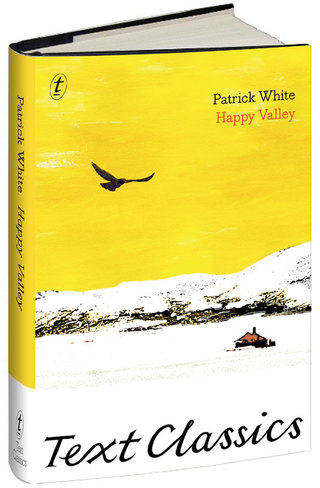
Patrick White, Happy Valley

Book cover (Courtesy: Text Publishing)

My love affair with Patrick White, figuratively speaking, began in my last year of high school when I studied Voss. Always partial to Aussie literature, I was, at 17 or 18, bowled over by White’s writing, passion and vision – and by his rather acerbic, though mostly compassionate, view of the way people submerge their “selves” in exterior trappings. I was consequently thrilled when Text decided to publish his first novel as part of its Text Classics series because this book, first published in 1939, was not published again in White’s lifetime. His decision, not his fans, I might add!

Why White refused its republication is a matter of some conjecture. He describes it in his autobiography, Flaws in the glass (1981), as “my first published, best forgotten novel”. Whatever the facts, being published in England and New York in 1939 probably made it easy to “lose”. All I can say is that it’s a great shame, because this is one helluva novel.

But let’s not conjecture, and get on with the book. It’s hard though to know where to start. As a newly released but first Patrick White, it’s going to be (and probably already has, but I’ve kept my eyes averted) the subject of much critical and literary analysis. How, this amateur blogger thinks, can I add to that? By, I suppose, just picking a few things that interested me.

There were several things that interested me in this novel, besides the fact that it is a good read. Perhaps I’d better explain that, the plot, first. It’s set in, yes, a town called Happy Valley, in the Snowy Mountains-Monaro region of New South Wales, just south of where I live and where Patrick White was a jackeroo for a year. If you know Patrick White, you’ll know the town’s name is ironic because White’s people are rarely happy. Life tends to be, for them, disappointing at best, sterile, depressing and/or meaningless at worst. In this book we have a large number of people and families, representing a cross-section of a typical country town: the doctor (Holliday), the teacher (Moriarty), the squatter (Furlow), the storekeepers (Quongs), the banker (Belper), the piano teacher (Alys Browne), the farm worker and “stud” (Clem Hagan), the “simpleton” (Chuffy Chambers). The novel begins and ends with the doctor, but its subject matter is the desire to escape. Many of the town’s residents don’t want to be there, and dream of ways out. Alys dreams of California, Hilda Holliday of Queensland, Sidney Furlow of anywhere-but-here, and so on. For the most part the novel chronicles the relationships between the people, explores the sources of their discontent, and teases them with future possibilities. It seems, until near the end, that nothing particularly dramatic will happen but then a shocking event occurs which precipitates decisions – some big, some small – that will change the lives of those concerned. For the better? Well, that’s a question for us readers to consider, but it’s important to recognise that for White the important decisions/shifts that have to be made are internal. Here is Alys near the end, seeing her escape dream for what it was:

I shall not hurry, she said, I shall shape time with what I have already got.

It’s a good story – and it’s clearly White.  There are a lot of characters, which can be the downfall of first novels, but White handles them well. The connections are clear and he keeps them all moving along so that we readers rarely, if ever, feel lost – once we have them in our heads.

What bowled me over most about the novel though is its style. It’s big – it’s inventive, expressive, rhythmic. As I was reading it, I was reminded of DH Lawrence (and his intense sensuality) and James Joyce (and his “stream of consciousness”). Peter Craven, who wrote the introduction to Text’s edition, agrees, and adds Gertrude Stein (whom I don’t know well enough) and Virginia Woolf (whom I should have picked too!). However, despite these pretty clear influences, the novel doesn’t feel slavish. Although this is (obviously) early in his career, his mature style is already evident. I was impressed by how he moves pretty seamlessly between description, dialogue and interior monologue, by how he shifts point-of-view, even within paragraphs, and by how, almost imperceptibly at times, he changes voice from third to second to first person. It’s spirited, gutsy writing. You feel, sometimes, that’s he’s strutting his stuff, but he rarely loses us and, while he may occasionally push a little too far, it doesn’t feel like showing-off but more like a writer with ideas bubbling out of him.

Earlier in the review, I mentioned writers that I felt influenced White, but now I want to mention one that I think was influenced by him, and that’s Thea Astley. She also had a pretty acerbic view of the world, and could skewer characters for their superficiality while maintaining, unless they really didn’t deserve it, compassion for them. White and Astley also use humour, usually wry or satiric rather than belly-laugh. I loved this description of a person in a bar early in the novel:

But another was an old man, one of those static old men you see in country bars, who seem to have no significance at all, except as recipients of drinks that they pour in through the meshes of a yellowish moustache, just standing and nodding, willing to listen to a story, but never giving much in return. They are generally called Abe or Joe. Though this one was called Barney, as a matter of fact.

That made me laugh; it’s the sort of writing that made me keep reading. But it’s not all quite this benign, because Happy Valley is a town where there “never was co-operation”, where “people existed in spite of each other”, where town “stud” Clem would like to “take a lump of wood, treat her almost like a snake”.

One of the threads running through the novel concerns the limits of language to express true feeling:

Both of them wanting to say something and then it only came in words.

White, I understand, would love to have been an artist, calling himself a “painter manque”, but oh dear, what words we would have missed had he done so.

Lisa of ANZ Litlovers, also a Patrick White fan, loved the book too.

Patrick White
Happy Valley
Melbourne: Text Publishing, 2012 (orig. published 1939)
407pp
ISBN: 9781921922916

(Review copy courtesy Text Publishing)

Thea Astley, Hunting the wild pineapple (Review)

Thea Astley‘s “Hunting the wild pineapple” is both a short story and the title of a collection of connected short stories (that includes, of course, the title story). Today I am going to write on the short story as it’s one of the 16 included in the current Meanjin Tournament of Books – and it has made it through to the second round.

“Hunting the wild pineapple” is the third story of eight, which are all narrated by a man called Leverson. It is set in far North Queensland in a place called Mango, which she writes about again in her 1987 novel, It’s raining in Mango. In this story, Leverson, accompanied by the American Mrs Crystal Bellamy who is “impossibly researching the human geography of the north for a nonsense thesis”, is visiting a pineapple farmer called Pasmore. Pasmore, while waiting for a lobster to thaw for dinner, takes his guests on a somewhat alcohol-fuelled car-ride, first to hunt for wild pineapples and then to visit his two migrant farm workers, “the two”.

It is pretty vintage Astley, at least mid-career Astley as I know her, with its lush, evocative, “imagistic” (as she once described it) language and its focus on inequitable human relationships in which one group, usually white men, wield power over another – women, migrants, and (though not in this particular story) indigenous people.

The story is set in the 1970s, and is characterised by satire and irony. Leverson describes Pasmore as

a well-intentioned buddy who wanted to prove we’re not all grubbing away at soil up here, that we’re smooth, polished, and have swung quite nicely, ta ever so, into the sophisticated seventies.

So smooth that outside the house we are left gawking at a whopping heart-shaped swimming-pool filled with blue tears that blinked as a woman (his wife?) plunged from sight.

See what I mean about the language? It’s packed with images and ideas that rub somewhat uncomfortably against each other. In Astley, discomforting language is de rigueur; it, more than plot or characterisation, is the tool she uses to unsettle us, to shock us out of our comfort zone and force us to confront the unkindness, the viciousness, if not the downright violence that she sees lurking beneath the surface of human interactions. (I admit now that I don’t always get it on a rational level, but it rarely fails to move me.) In this story, the relationships she spears with her pineapples are those between husband and wife (Mr Pasmore and Tubs), employer and worker (Mr Pasmore and migrant workers, Tom and Georgy), and even between colleagues (Tom and Georgy).

And yet, it’s Astley’s language that has got her most into trouble, because it is heavily imagistic (not at all spare, until perhaps her very last works which were a little sparer, comparatively speaking) and some readers and critics don’t like it. Here, for example, is Leverson on Pasmore presenting his hunted down, “huge humped” pineapple to Mrs Bellamy:

… he tattooed her arms with spikes; the head spears stabbed her skin. He lit, post-coitally I think nastily, a cigarette.

Not very subtle, eh, but effective in its hints of sex, power and violence. Similarly, here is Pasmore knocking on the door of “the two”, he

drummed a neat riff on the wall beside the open front door, the over-familiar, paternalistic-presumptuous tat-a-tat, tat-tat, and emitted hearty cries of boss-lure …

Writer and critic Kerryn Goldsworthy, like me, likes Astley. She says*:

I love Thea Astley’s writing and always have. I love its densely woven grammar, its ingrained humour, its uncompromising politics, its demented metaphors, and its undimmed outrage at human folly, stupidity and greed. I love the way that even at its most savage and despairing, it has always had a suggestion of redemptive energy working away somewhere in the plot, no matter how subterranean, outmaneuvered or comprehensively beaten down….

This story is a good example of the Astley that Goldsworthy and I like. There’s a savage bite to it, but there’s also the slightest hint of the opposite. I wonder how far it will get in Meanjin’s tournament.

Thea Astley
“Hunting the wild pineapple”
in Hunting the wild pineapple and other related stories
Ringwood: Penguin Books, 1979, pp. 63-76
175pp.
ISBN: 9780140058437

* from “Undimmed Outrage”, Australian Book Review, Sept 1999, Issue no 214.

Gerald Murnane, The plains (Review)

Gerald Murnane, The Plains, bookcover

Bookcover (Courtesy: Text Publishing)

Wayne Macauley, he of the Most Underrated Book Award fame, wrote in his introduction to my edition of Gerald Murnane‘s The plains that “you might not know where Murnane is taking you but you can’t help being taken”. That’s a perfect description of my experience of reading this now classic novella. It was like confronting a chimera – the lower case one, not the upper case – or, perhaps, a mirage. The more I read and felt I was getting close, the more it seemed to slip from my grasp, but it was worth the ride.

The plains was first published in 1982, which is, really, a generation ago. Australia had a conservative government. We still suffered from cultural cringe and also still felt that the outback defined us. All this may help explain the novel, but then again, it may not. However, as paradoxes and contradictions are part of the novel’s style, I make no apologies for that statement.

I’m not going to try to describe the plot, because it barely has one. It also has no named characters. However, it does have a loose sort of story, which revolves around the narrator who, at the start of the novel, is a young man who journeys to “the plains” in order to make a film. It doesn’t really spoil the non-existent plot to say he never does make the film. He does, however, acquire a patron – one of the wealthy landowners – who supports him in his endeavour over the next couple of decades. It is probably one of Murnane’s little ironies that our filmmaker spends more time writing. He says near the end:

For these men were confident that the more I strove to depict even one distinctive landscape – one arrangement of light and surfaces to suggest a moment on some plain I was sure of – the more I would lose myself in the manifold ways of words with no known plains behind them.

Hang onto that idea of sureness or certainty.

The book has a mythic feel to it, partly because of the lack of character names and the vagueness regarding place – we are somewhere in “Inner Australia” – and partly because of the philosophical, though by no means dry, tone. In fact, rather than being dry, the novel is rather humorous, if you are open to it. Some of this humour comes from a sense of the absurd that accompanies the novel, some from actual scenes, and some from the often paradoxical mind-bending ideas explored.

So, what is the novel about? Well, there’s the challenge, but I’ll start with the epigraph which comes from Australian explorer Thomas Mitchell‘s Three expeditions into the interior of eastern Australia, “We had at length discovered a country ready for the immediate reception of civilised man …”. Bound up in this epigraph are three notions – “interior”, “country” and “civilised”. These, in their multiple meanings, underpin the novel.

Take “interior”. Our narrator’s film is to be called The Interior. It is about “the interior” of the country, the plains, but it is also about the interior, the self, and how we define ourselves. While there are no named characters, there are people on the plains and there’s a sense of sophisticated thinking going on. Some plainspeople want to define the plains – their country, the interior – while others prefer to see them almost as undefinable, or “boundless”, as extending beyond what they can see or know. The plainspeople are “civilised” in the sense that they have their own artists, writers, philosophers, but it is hard for we readers to grasp just what this “civilisation” does for them. Is it a positive force? Does it make life better? “Civilised”, of course, has multiple meanings and as we read the novel we wonder just what sort of civilisation has ensconced itself on the plains.

These concepts frame the big picture but, as I was reading, I was confronted by idea after idea. My notes are peppered with jottings such as “tyranny of distance” and boundless landscapes; cultural cringe; exploration and yearning; portrait of the artist; time; history and its arbitrariness; illusion versus reality. These, and the myriad other ideas thrown up at us, are all worthy of discussion but if I engaged with them all my post would end up being longer than the novella, so I’ll just look at the issue of history, illusion and reality.

Towards the end of the novel we learn that our narrator’s patron likes to create “scenes”, something like living tableaux in which he assembles “men and women from the throng of guests in poses and attitudes of his own choosing and then taking photographs”. What is fascinating about this is the narrator’s ruminations on the later use of these “tedious tableaux” which have been created by a man who, in fact, admits he does not like “the art of photography”, doesn’t believe that photographs can represent the “visible world”. The landowner contrives the photos, placing people in groupings, asking them to look in certain directions. Our narrator says

There was no gross falsification of the events of the day. But all the collections of prints seemed meant to confuse, if not the few people who asked to ‘look at themselves’ afterwards, then perhaps the people who might come across the photographs years later, in their search for the earliest evidence that certain lives would proceed as they had in fact proceeded.

In other words, while the photos might document things that happened they don’t really represent the reality of the day, who spent time with whom, who was interested in whom and what. They might in fact give rise to a sense of certainty about life on the plains that is tenuous at best.

Much of the novel explores the idea of certainty and the sense that it is, perhaps, founded upon something very unstable. Murnane’s plainspeople tend to be more interested in possibilities rather than certainties. For them possibilities, once made concrete, are no longer of interest. It is in this vein that our narrator’s landowner suggests that darkness – which, when you think about it, represents infinite possibility – is the only reality.

The plains could be seen as the perfect novel for readers, because you can, within reason, pretty much make of it what you will. If this appeals to you, I recommend you read it. If it doesn’t, Murnane may not be the writer for you.

Lisa at ANZLitLovers, a Murnane fan, has reviewed The plains

Gerald Murnane
The plains
Melbourne: Text Publishing, 2012 (orig. published 1982)
174pp.
ISBN: 9781921922275

Barbara Baynton, The chosen vessel (Review)

I’m blaming author and blogger Karen Lee Thompson again for this post, because she wrote a wonderful comment on my post on Barbara Baynton‘s short story “Squeaker’s mate”, and I’m going to quote it pretty much in full (I hope that’s ok from a copyright point of view – tell me if it isn’t Karen Lee):

Barbara Baynton wrote some wonderful stories and, had literary politics been a little more inclusive in the days of the Bulletin, I’m sure she would have received wider recognition. Many of Baynton’s short stories, like ‘Squeakers Mate’, turn ‘The Australian Legend’ on its head and, perhaps because of this, the male literary elite (A.G. Stephens, A.A. Phillips for example) chose to modify or explain her work in various ways.

An interesting example of this editorial intrusion is the politics surrounding Baynton’s ‘The Chosen Vessel’ (Baynton’s preferred title was ‘What the Curlews Cried’) which I have read, in its various forms, a number of times. Stephens published it as ‘The Tramp’. It is believed he wanted the title to shift the focus away from the central woman and it allowed for clarity between a ‘tramp’ (an isolated individual) and a ‘swagman’ (a virtuous kind of everyman of the bush). Stephens also cut a significant part of the story before publication.

For anyone who enjoys ‘Squeakers Mate’, I’d suggest a reading of ‘What the Curlews Cried’ (aka ‘The Chosen Vessel’ or ‘The Tramp’), preferably in its unabridged form.

“The chosen vessel” and “Squeaker’s mate” are Baynton’s best known and most anthologised short stories. However, I hadn’t read “The chosen vessel” before and so decided, on Karen Lee’s recommendation, to read the version in Bush studies. According to my brief research, and Karen Lee can correct me if I’m wrong, The Bush studies version is the final complete version Baynton presented for publication. However, it is not the same as the original version which was submitted as “What the curlews cried” and then significantly edited by the Bulletin.

Anyhow, if I thought “Squeaker’s mate” was tough, then this one is tougher. The female protagonist is left alone with her baby, rather like Lawson’s wife in “The drover’s wife”, but this woman faces a double whammy. Left by a cruel husband, she is terrorised by a “swagman” (not a “tramp” despite its first published title). She’s a town girl unfamiliar with bush life, but that’s not what scares her. I won’t detail the plot more because it’s a short story (around 8 pages) and you can find it in the online link below. The shorter Bulletin version, I understand, did not change what happened to the woman, but excised a whole section and thereby effectively changed the meaning of the story to suggest an isolated instance rather than something more systemic.

In the introduction to my Sydney University Press edition, Susan Sheridan confirms my statement in my “Squeaker’s mate” post that Baynton’s main concern was not the harshness or terrors of the bush and the land, which contemporary critics tried to argue, but male brutality to woman and, more significantly, “the impossible position that male culture constructs for ‘woman’ in the abstract”. She writes that woman is glorified as the Madonna, God’s “chosen vessel”,  but “at the same time the capacity for motherhood is regarded as confining her to the animal level of existence”. In “The chosen vessel” religious imagery – the mother and her baby are both mistaken for a ewe and a lamb and as a vision of the Madonna and child – is used to devastating ironic effect.

I’m not surprised that those late nineteenth century men found her writing confronting and that the Bulletin only ever published one of her short stories, but, for me, Baynton’s writing presents an alternative view of life in the bush that I’m glad we have available today.

Barbara Baynton
“The chosen vessel”
in Bush studies
Sydney University Press, 2009
ISBN: 9781820898953

Available online: in Bush studies at Project Gutenberg

Barbara Baynton, Squeaker’s mate (Review)

Barbara Baynton 1892

Baynton 1892 (Presumed Public Domain, via Wikipedia)

My last post was about this year’s Meanjin Tournament of Books which is pitting short stories against each other. One of the short stories is Barbara Baynton‘s “Squeaker’s mate”, which I’ve read before but a long time ago. I decided, though, to read it again, since I have easy access to a copy, on my shelves and online.

Author and blogger Karen Lee Thompson commented on my tournament post that she’d like to see a bout comparing “Squeaker’s mate” (1902) with Henry Lawson’s “The drover’s wife” (1892), and it would be delicious. I was tempted to do it here but I won’t. However, I did think of commencing this post with “Only a woman …” because, despite their broad similarities in subject matter and setting – the harsh life faced by pioneer women in the outback – there is a big difference in tone. Both stories chronicle the bravery and perseverance of bush women,  but Lawson’s story has an heroic, even somewhat romantic, tone. Not so with Baynton.

Squeaker’s mate, “the best long-haired mate that ever stepped in petticoats”, is a hardworking, taciturn woman whose mate, Squeaker, is a good-for-nothing. Here’s paragraph three:

From the bag she took the axe,  and ring-barked a preparatory circle, while he looked for a shady spot for the billy and the tucker-bags.

It’s not that there’s anything wrong with Squeaker, other than laziness, but “she knew the man, and her tolerance was of the mysteries”. However, things change dramatically early in the story when a tree falls on her, putting her out of action. Squeaker’s initial reaction is chilling – “he was impatient, because for once he had actually to use his strength” – and, a little later

he supposed he would have to yard them [the sheep] tonight, if she didn’t liven up. He looked down at unenlivened her.

It’s only in the last few paragraphs of the story that we learn “her” name. Significantly, it’s Mary.

The rest of the story chronicles his self-centred callous treatment of her, sometimes leaving her for days with no sustenance. All she has is her loyal dog which, for we readers, relieves, albeit slightly, our despair at her situation. There is no heroism in here, very little kindness even – but there is, on the part of Squeaker’s mate, resilience and, without giving away the story, a triumph of sorts.

Baynton is critical of men’s attitude to women – and this is a major theme of the story, though it’s not that simple either. Early on, a few men do show kindness to Mary – let’s dignify her with her name now – but their women put a stop to that. Mary had not been one for “yarnin'”, making her “unlikely” to be popular with them. Baynton writes:

It is in the ordering of things that by degrees most husbands accept their wives’ views of other women.

And so Mary is left alone.

The writing is compelling. It is told third person, but the perspective swaps between hers, his, and, later on, that of the woman he brings into their home. In some circumstances this narrative approach could provide an even-handed view of the characters, but here it only serves to reinforce our early opinion of them. In other words, Squeaker does not improve on acquaintance. Baynton plays effectively with the “word” mate, contrasting the roles, responsibilities and rights of mates as partners, alongside those of the Australian “mateship” tradition, with Squeaker’s un-mate-like, in all senses of the word, behaviour.

Imagery is used sparingly, but it’s pointed when it’s there. It is a tree that brings Mary down, and then late in the story Squeaker decides to clear some land:

So that now, added to the other bush voices, was the call from some untimely falling giant. There is no sound so human as that from the riven souls of these tree people, or the trembling sighs of their upright neighbours whose hands in time will meet over the fallen victim’s body.

A little melodramatic in that 19th century way maybe, but Baynton’s suggestion that there’s more solidarity among trees than the humans below is well made. In fact, while life is harsh, it’s not an unforgiving environment that is the main problem for Baynton’s characters.

It’s a grim but effective story that focuses mostly on gendered callousness in a world where survival would be best ensured by cooperation. In confronting gender issues, Baynton is part of a tradition of Australian women’s writing of the late nineteenth to early twentieth century that has, to a large degree, been forgotten a century or so later. It’s time to revive these early writers – and hopefully recent initiatives by Sydney University Press, Text Publishing and others, will do the job.

Barbara Baynton
“Squeaker’s mate”
in Bush studies
Sydney University Press, 2009
ISBN: 9781820898953

Available online: in Bush studies at Project Gutenberg