Virgil Thomson, Taste in music (Review)

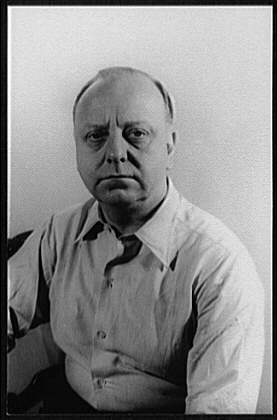
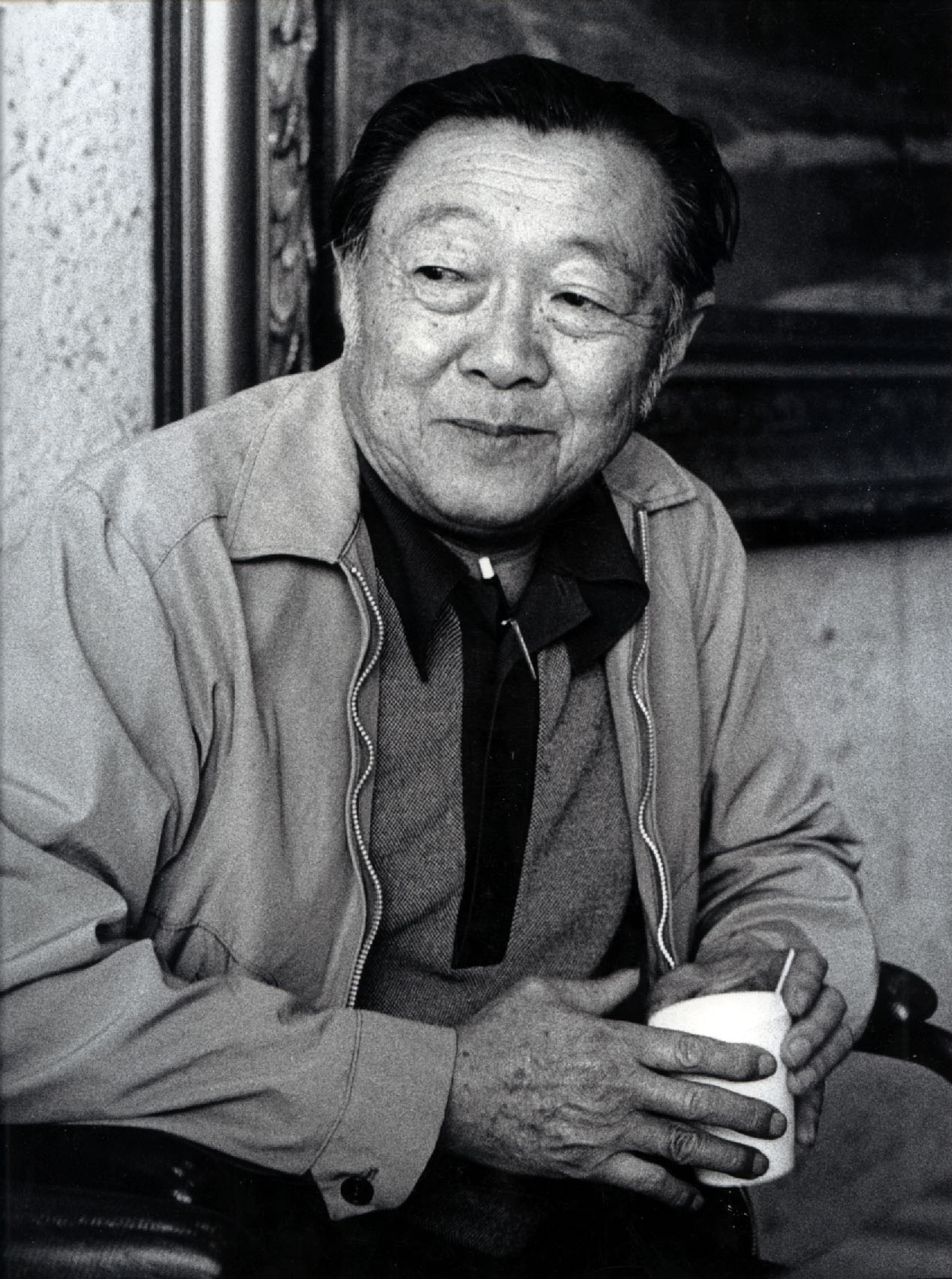
Virgil Thomson portrait, 1947

Virgil Thomson, 1947 (Public Domain, from the Library of Congress via Wikipedia)

There are several reasons why now seemed an opportune time to write my first Library of America (LOA) post for 2015. The first reason is obvious. It’s June and I haven’t featured one yet. The second is because my last post was on music, so writing about an article by American composer Virgil Thomson seemed apposite. The third reason relates to an interesting comment Thomson makes about reviewing, recalling my recent post on the AustLit anthology of criticism.

And then there’s reason why this article, published by LOA back in February, initially attracted my attention. It’s because of Virgil Thomson himself. I first heard of him back in the 1970s as the composer of two beautiful American government sponsored documentaries, The plow that broke the plains (1936) and The river (1938), made by filmmaker Pare Lorents. I won’t reminisce about this now, but I enjoy noting these connections we make over our lives.

In my post on the Austlist anthology of criticism, I quoted the editors as defining criticism as  “interpretation”, something they differentiated from “reviews” which they saw as focusing on “evaluation”. In LOA’s introductory notes to Thomson’s piece, they quote Thomson’s explanation as to why, as music critic and editor for the New York Herald Tribune, he only used composers and performers as reviewers. He said:

It’s a writing job, but the subject is music and you’ve got to know a good deal about the subject in order to be believable. In order to be a reviewer, you have to forget whether you liked it or not and tell your reader what it was like.

Hmmm … a rose by any other name, eh? What Thomson calls “reviewing” is what the anthology editors call “criticism”. Whatever name we give it, I realise that I tend to prefer reviews/criticism that focus on analysing what the work is like, what makes it tick, more than whether the reviewer liked it. “Liking” is such a subjective thing and can depend so much on one’s experiences, preferences, personality even, whereas describing “what it was like” involves knowledge of the art form, the ability to “see” it in context, to understand how it does what it does, and to describe, perhaps, what it “means”. This is not to say that “liking” isn’t important, but that it is not necessarily the most important aspect – for me anyhow.

So, then, Thomson’s “Taste in Music”. He starts by differentiating taste “for” music, which he sees as the ability to enjoy music, pretty much indiscriminately, and taste “in” music, which involves liking certain kinds of music over others. He then discusses admiration versus liking, suggesting that “there are often striking contradictions between what musical people admire and what they like”. Admiration is about “reason” while “liking is an inspiration”. You can’t alter “liking”, he says, “by any act of will”. But “it will frequently alter itself … without warning”. I think we have all experienced that! Loving something, and then suddenly tiring of it, growing out of it perhaps.

Thomson’s main argument is that “development of taste” is not the main objective of music education, that the important thing is “understanding, that whole paraphernalia of analysis and synthesis whereby a piece is broken down into its component details, mastered, restored to integrity, and possessed”. This is true of literature too. How often have you heard people say that studying literature put them off reading, or off the classics. And yet, pulling apart books is the only way you learn to understand them, what makes them tick. Thomson goes on:

Persons unprepared by training to roam the world of music in freedom but who enjoy music and wish to increase that enjoyment are constantly searching for a key, a passport that will hasten their progress. There is none, really, except study.

Oh dear, he’s right, I know he is. And this is why I constantly say that my reports of Griffyn Ensemble concerts do not constitute reviews. They are reports of what I enjoyed, and what I made of the performance. I do not have the skills or training to review music.

Thomson also discusses the familiar versus unfamiliar in music. He writes that “the too old, the too new, the in-any-way strange, we resist simply because we do not know how to take them on”. We enjoy the familiar, he says, and this leads toward “a timid conservatism with regard to unfamiliar music”. He writes that:

The lay public will try anything, but it will be disappointed, on first hearing, in anything it has no method for remembering. We like the idea of being musically progressive, because progress is one of our national ideals; but we do not always know how to conduct a progress.

This is probably true of the new in all of the arts, don’t you think? “To hear music correctly”, he wrote, to “know one’s mind”, we need to be able to “hear patterns in sound”. This is what I feel about all music, but particularly new, unfamiliar work. I might sense patterns but on one hearing, and with almost no musical training, I don’t feel capable of “reviewing” it, of understanding let alone explaining what makes it tick, the same way I can, for example, with a novel. I am experienced at looking for patterns in literature, but not so for music. Thomson suggests that the untrained will “rarely know the difference between their tastes and their opinions”. Hmm … probably true.

His next point is that while professional musicians express “responsible opinions” based on knowledge, it is “lay opinion” which creates the “modes or fashions in consumption that make up the history of taste”.  Interesting. He admits that knowledgeable persons play some role in developing these “fashions” but that they can’t force the public to like what it doesn’t want. He argues that creators cannot behave freely with trendy music. You can’t tinker with what people like. For this reason, he says, unsuccessful or unfashionable music “is sometimes the best music, the freest, the most original”.

What I most enjoyed about Thomson’s essay, though, is that he doesn’t lay down the law. He knows music, like all arts I’d say, is a slippery beast. There “is no rule” that can’t be broken. He writes that:

Those who think themselves most individual in their likings are most easily trapped by the appeal of chic, since chic is no more than the ability to accept trends in fashion with grace, to vary them ever so slightly, to follow a movement under the sincere illusion that one is being oneself.

He then has a dig at intellectuals. “You can always sell to the world of learning” he says, “acquaintance with that which it does not know”!

In other words, the only real answer to understanding and appreciating music, is “labor, much study, and inveterate wariness [because] the pleasures of taste, at best, are transitory”. “Nobody”, he says, “professional or layman, can be sure that what he finds beautiful this year may not be just another piece of music to him next.”

So, having logically argued the meaning of responsible reviewing and the importance of understanding music, Thomson concludes that in the end “the pleasures of taste … are transitory”. The best we can do, he says, is consult our appetite about what we consume and after consuming it “argue about the thing interminably” with all our friends. On that basis, I think, the important thing is to enjoy what we read, hear or see, and when we write about it to be clear about the basis on which we are writing. Our readers can then assess our opinion on the basis of what they understand to be our background, knowledge and prejudices. What do you think?

Virgil Thomson
“Taste in music”
First published: In The musical scene, 1945.
Available: Online at the Library of America

Dymphna Cusack, Jungfrau (Review)

Dymphna Cusack, Jungfrau

Courtesy: Allen & Unwin

Are there some historical periods that particularly fascinate you? There are for me, and one of those is that between the two world wars. It was a complex time encompassing both economic hardship and great social change. A time when many of those Victorian era constraints were being lifted and women, in particular, were starting to enjoy an independence and freedom they hadn’t had before the First World War. Dymphna Cusack’s first novel, Jungfrau, is set in this period and deals with this very subject.

I have written about Cusack before, when I reviewed A window in the dark, her memoir about her time as a teacher. Because of its relevance to this novel, I’ll reiterate a couple of the points I made in that review. Cusack, I wrote, had a finely honed moral and social conscience, and was acutely aware of injustice. She was convinced of the “wickedness of our economic system”, and abhorred the power those with money had over others. She was consequently outspoken on social and economic justice issues, and was particularly critical of the treatment of “that much-maligned creature, the woman teacher”. A window in the dark was written forty years after Jungfrau, and is a memoir, but you can see the genesis of her values and ideas in this, her first novel.

Jungfrau is set in Sydney over a few months in the 1930s. It concerns three young women in their mid to late twenties: the rational, realistic and religious Eve, the emotional, dreamy and vulnerable Thea, and the modern, pragmatic, confident Marc. Eve and Thea have been good friends for several years. Marc is Thea’s friend, but Eve and the free-thinking Marc do not like or understand each other. At the novel’s opening, Eve and Thea are talking about Thea’s interest in a man twice her age, a married university professor. Eve cautions Thea about the risks, but Thea is ready “to take life—use it—now, instead of letting it use me”. Eve gently retorts that “If you leave yourself open to the world, it will rush in on you”.

Indeed, Eve, who has seen first hand in her maternity ward the results of poor, single women taking life, suggests that experiencing life “is much safer in books”. She says to Thea:

When you talk about getting in touch with reality and finding out what life is, all you really mean is following your instincts in spite of the consequence … Only, if you take your friend Marc’s prattling literally, I’d advise you to learn more about physiology than you know at this moment. You can’t safely combine what your modern friends rather euphemistically call ‘experience’ with a degree of ignorance that’s almost mid-Victorian. You’ll need to be practical if you’re going to be a realist. Marc’s evidently both.

The novel, as you’ve probably guessed by now if the title hadn’t given it away, explores what happens when Thea does not heed Eve’s advice and lets this relationship develop. I’d call this a coming-of-age novel but, having been written by Cusack, its themes are as much social as psychological. What did it mean for a woman at that time to have an affair with a married man, and what were her options with the – hmm – consequences?

The trouble is that while obstetrician Eve and social worker Marc are daily faced with the grim realities of life, teacher Thea evades them. Here’s Eve on her ward rounds,

All this rot about reality, this frenzied escape into abstractions, had curiously little to do with life as she knew it. … Here was reality. Tortured bodies, tired minds, birth and death. Nothing vague about this; no escaping from facts; no sheltering behind fancies.

Acerbic Marc has her own view on woman’s lot:

Women are cursed, all right. If you wither on the virgin stem you go all pathological; if you go off the deep end you get some foul disease; and if you marry and have dozens of young you die of exhaustion.

By contrast, here is Thea discussing the real Jungfrau with her professor:

“Yes,” he said almost inaudibly, “white, proud and untouched. But they’ve built a funicular almost to the top of it now, and the tourists swarm all over it like flies.”

“Poor thing! I don’t mind climbers and mountaineers; but it must hate the tourists soiling it—”

“That is usually the fate of the proud and the untouched,” he said, digging his stick in the turf, and she recoiled as though struck, her hands flung out in a gesture of defence.

Oh dear, we readers think – and so would Eve and Marc if they’d heard this conversation. Their lot, though, is to love Thea and to watch in dismay as she takes life to an edge that she is not fit to handle.

The critical thing about this book is that Cusack doesn’t judge these three women for their choices. We might find Marc a more sympathetic, more appealing personality, of the three, but Cusack is even-handed. She understands human psychology and empathises with women. Her ire is focused more on society’s expectations and rules than on any one woman’s decision or behaviour. I described this novel earlier in my review as a coming-of-age novel, but it could equally be called a novel of ideas. In it Cusack exposes “the reckless squandering of human possibilities”, of lives “anaesthetised by half-baked education, political platitudes and doles”. Economic inequities, abortion, women’s independence, and the meaning of freedom are her targets.

I read this book as part of my long-term plan to read classic Australian literature – and I enjoyed it immensely. While the social milieu is very different from now – thank heavens – the emotional truths transcend the particulars of time and place. The language did feel a little overblown at times. It has that DH Lawrence sort of emotional intensity that can sometimes be a little too melodramatic, or declamatory, for my 21st century ears. And yet, paradoxically, one of the novel’s real pleasures came from its descriptions of Sydney. Cusack catches the landscape – the plants, the light, the water – beautifully (but I’ll save sharing a couple of those for a Delicious Descriptions post).

I imagine this was a confronting novel at the time of publication, but I hope it got people thinking, as Cusack surely intended. Cusack, Katharine Susannah Prichard, Miles Franklin, Marjorie Barnard and Flora Eldershaw, to name the best known from that era, were fierce and intelligent writers. We are lucky to have them.

awwchallenge2015Dymphna Cusack
Jungfrau
Sydney: Allen & Unwin, 2012 (Orig. ed. 1936)
ISBN: 9781743431450 (ebook)

Note: I do need to have a little whinge. There were several errors/typos in my kindle edition, which is disappointing and did spoil the read a little.

Monday musings on Australian literature: Debating Australian literature in 1908

Browsing digitised papers via National Library’s Trove yet again, I came across an intriguing 1908 article by Page Twenty-Seven columnist Norman Lilley. I gather that Lilley had made some pronouncements on Australian literature which had garnered some strong opinions. I haven’t searched hard for the original statements but we don’t necessarily need them to enjoy Lilley’s report of the ensuing discussion.

Lilley starts with two specific responses, which seem to be commenting on other opinions besides those of Lilley.

Tidminbilly (primarily a letter-to-the-editor writer I think) feels that 6×8 (pen-name of Dick Holt, about whom I’ll write more another day) was right to criticise “exaggeration” in Australian writing, but argues that the main problem is not in exaggerating “characters and incidents” as 6×8 had apparently said. Tidminbilly argues that the “defect” comes from writers exaggerating the importance of these characters and incidents. S/he says:

I cannot think, as our Australian scribes would have us do, that the harsh caw of the crow, on the top rail of the stockyard impresses the bushman more than the wealth of bird melody which greets him as he faces the early morning’s freshness. It is this diseased hankering after the abnormal which makes Australia, as viewed through its literature, appear more like a camping-ground than a home.

It is, Tidminbilly says, “the multitude of small joys and small sorrows which make up a man’s life”. Perhaps! But, not so exciting to write about methinks!

Talbot’s comments, as reported by Lilley, make me want to find 6×8’s comments. Here’s Talbot (please excuse the large chunk):

‘6×8’ makes himself ridiculous. Is it necessary for Lawson’s characters to exist? Characters do not “exist”: they are created. A story-writer is judged, by his ability to create them, ditto situations and scenery. Collection of fact is but a part, and a small part at that, of the writer’s business. If a writer uses South Pole matter, indisputably he ought to go there for it. Whether a writer spends 30 years or 30 days in the bush isn’t of any consequence. Perfect literal accuracy in small details is necessary to a traveller, but not essential to a story-writer. What is desired is the power to create situations, scenes, characters, and original incidents. … I only get THE WORKER occasionally, for its literary pages. Looking over such of the last few years, I find a considerable number of short stories ”by Phil Fairleigh”, ranging from Kanakadom in the far North to Western copper country and Bairnsdale (Victorian) hop land. The local color may or may not be correct, but of the writer’s power to correctly conjure up striking situations, invent new ideas, there can be no doubt. Let anyone who doubts this read “The Magic Stone,” “The Curse of Copper,” “Wire Netting,” “The Stowaway,” etc. The chief necessity of bush or any other writing your correspondents entirely overlook — style and originality. Can anyone deny in Phil Fairleigh the absence of that introspective egotism, bushranger glorification, and low-down pandering to not the best qualities in human nature which disfigure so much of Lawson’s work? The musical strength of Fairleigh’s sentiment, the melody of his style, the consummate ease of his long sentences — always a good test — will bear out a certain literary University professor’s statement: “He is likely to become the first stylist in Australia. A quality not much in evidence in Australia, which has been Bulletinized into snap sentences, so that the reader feels he is being shot at all the time, instead of passing easily and unconsciously on.”

First stylist? Lawson, whether he deserves it or not, has survived in our literary memory, while Phil Fairleigh hasn’t. Still, I agree with much of what Talbot says about what’s important in literature. Style and originality, the ability to “conjure up striking situations”, are more important than factual accuracy in fiction. (To me, anyhow).

Lilley then continues by discussing other opinions, such as those of “Simple Simon” (SS) and “Town Girl” (these could all be blog names today, don’t you reckon). SS, Lilley tells us, argues that “the secret why many readers are taking a dislike to Australian writing” is that it’s too “stolid”. SS says that Lilley’s own writing is “stolid” (which is defined in Lilley’s dictionary as “dull, foolish, stupid”) too! Lilley counters with:

If under any circumstances readers take a dislike to writings about their own country the fault is very evidently in the readers, not the writers. The writer must first please himself, then the editor, then the public: he could hardly do so by being either foolish, dull, or stupid.

Blame the reader, eh? Anyhow, SS apparently likes “imported reading matter” in which “there is absence of mere individuality”, but Lilley argues that writing, imported or not, that has no individuality is “rubbish”. That doesn’t sound like a “stolid” argument to me! Lilley goes on, presumably continuing to argue against SS, that:

Judging by the literary turnover of a single Australian publishing firm (Messrs. Angus and Robertson), amounting to about twenty thousand volumes per annum, there is no justification for the assumption that bush writers and their writings “fail to please the literary palate.”

He then praises Australian bush writing versus “drab stories … like the work of the Newlyn school of art, of Gissing and Gorky [which have] often proved very popular”. He continues that:

I do not think Lawson’s “handful of followers” (!) will be disturbed at the carping of “Simple Simon.” I have yet to find any “artificiality” or “stolidity” in the writings of Lawson or Sorenson. I should imagine writing of that description had no chance of getting past the eye of an editor.

I love his faith in editors and publishers. Anyhow, he then turns to 6×8,

6 x 8″ considers that no Australian writer has succeeded “in truthfully picturing bush life.” In the widest sense no one man could portray the life of a whole continent, but if he means to imply that Lawson, Barbara Baynton, Sorenson, Miles Franklin, Favenc, Edward Palmer, Gregory, “Nomad,” and a dozen others are incorrect with the section of it they deal with, he simply shows his own ignorance of that particular section. None of these writers “grossly exaggerate, caricature, or burlesque freely.” If any literary qualities are lacking it is those of fancy, passion, imagination, and invention, and Dorrington excels in these qualities.

Some of these writers, like the aforementioned Fairleigh, are no longer well-known to us. Clearly, though, we need to check out Dorrington.

Agreeing with Talbot, Lilley argues against a focus on facts, but says that

writers embellish and enhance on a basis of realism — the very thing they are required to do. It is a pity they do not do so to a greater extent. Editors will not print the simple fact: they want attractive fact. It is original skill, not fact, that is paid for.

There are the editors again!

And finally, he responds to “Town Girl” starting with an aside, “what is the matter with these girls?” Hmm… It seems that she criticised writing of his that had been published elsewhere. After defending himself somewhat and returning once again to praising Lawson, he concludes with, it seems, more references to her criticisms:

Will “6 x 8” particularise? Will “Town Girl” name an over-exaggerated bush character?” Lawson may have been “suckled by journalism”: he does not appear to be any the worse for it. … I did not say the yellow robin, which I know to be a silent bird, had a flute. I have been on the land several times my self; with the assistance of the undertaker I intend to go again. I hope there will be no girl critics there. The girl critic is usually better employed darning her brother’s socks.

Take that “Town Girl”! I guess this was 1908, but “6×8” didn’t come in for such a put-down.

Nonetheless, I found the article elucidating – combining a sense of “it was ever thus” with insight into some specific literary arguments of the times. I’ll continue exploring Trove …

Thea Astley, Drylands (Review, of sorts)

I read Thea Astley’s Drylands many, many years ago now, so what I’m going to share here – inspired by my post earlier this year on confronting Australian novels – are the notes I made when I read it. They are not particularly well-formed, because I wasn’t planning a review at the time, though I must admit that I did spend some time skimming it as I tried to massage my notes into some shape. Too hard not to! It’s her last novel, and it earned Astley her fourth Miles Franklin Award (shared with Kim Scott’s Benang).

Drylands is subtitled “a book for the world’s last reader”. It’s one of those tricky books that looks like a collection of short stories but is, albeit perhaps loosely defined, a novel. Its structure comprises sections titled “Meanwhile” by the so-called writer of the stories, Janet, alternated with stories about inhabitants of, or visitors to, a dying town called Drylands:

a God-forgotten tree-stump of a town halfway to nowhere whose population (two hundred and seventy-four) was tucked for leisure either in the bar of the Legless Lizard or in front of television screens, videos, Internet adult movies or PlayStation games for the kiddies.

[…]

No one was reading anymore.

It’s a town “being outmanoeuvred by the weather. As simple as that. Drought. Dying stock.”

The main subject of these stories are three men (Franzi Massig, farmer Jim Randler and the indigenous Benny Shoforth) and three women (Evie the writing teacher, Lannie Cunneen, and Joss the publican’s wife). This is all quite neat, except that we are thrown somewhat by the fact that the “Janet” character may be a conceit dreamed up by Evie, who says she will “write a story … about a woman in an upstairs room above a main street in a country town, writing a story about a woman writing a story”. Since Janet is an inhabitant of Drylands while Evie is not, it makes sense that this might be Evie’s work, not Janet’s, making Evie both character and observer*. Another spanner in the narrative-voice-works is that two of the stories – those of Franzi Massig and Joss – are told first person. I might be reading too much into it, but I wonder if Astley is using this uncertainty to mirror the disorder she sees in society, if that makes sense.

Drylands explores many of the issues important to Astley. The two overriding ones are words and their importance/power, and the impoverishment of the spirit (often related to our inhumanity). Subsumed in the latter are some of Astley’s recurrent issues – gender and race, dispossession and power imbalances. She rails against the shallowness and small-mindedness that lead to poor treatment of “other” (indigenous people, women, less educated people, the ageing, etc), to “the powerlessness”, as Benny calls it, “of poverty and colour”. Here is a husband coming to drag his wife out of her writing class to get him his lunch:

He was hurling words at his shrinking wife like clods or bricks and she was not dodging but receiving them like a willing saint, enduring abuse like a terrible balm.

I wonder what Astley would have written about our treatment of asylum-seekers had she still been around, but unfortunately she died in 2004.

Thea Astley is, as you’ve probably gathered, an unsettling writer – and one with some very strong viewpoints. Besides being unimpressed by how women, indigenous people, and ‘oddballs’ (or outsiders) are treated, she’s also not too fussed about computers, television, and our sports-mad society. For these reasons I’m inclined to agree with Kerryn Goldsworthy that there’s a dystopian element to her vision. I didn’t pick it at first because I tend to see dystopian novels as being speculative or fable or allegorical, as being, in other words, about what “might be” rather than what “is”. The handmaid’s tale is a dystopian novel that is not specifically set in the future but neither is it set in a recognisable “real” world. Lord of the flies and Animal farm are dystopian views of the world that are not set in the future but, arguably, neither do they present a realistic community/society/place. Drylands, though, is recognisably our world, but a pretty grim version of it, which suggests dystopia. It’s probably worth noting here that Drylands was published in 1999, that is, at the end of the millennium.

Regardless of formal definition, though, Drylands, like dystopian novels, is pervaded by a sense of hopelessness. There are likable people – many – but life isn’t easy or happy for them. There are, however, some positive or redemptive hints, particularly for Clem and Joss. Janet, the linking character, on the other hand, can only glimmer the fact that there might be something out there:

There was something out there, but she doubted she would ever discover. The idiocy of her wasted years made her laugh even more.

There were no endings no endings no

awwchallenge2014The writing in Drylands, though sometimes colourful, is sparer, more restrained than we are used to from Astley – and just right for a bitter tale about lack of literacy, loss of reading skills, and the implications thereof. Janet’s mother tells her that “being unable to read is being crippled for life”. Janet, writing her story, worries whether she’s getting her narrative right, but decides it’s “better for readers to frolic with their own assumptions from the words spoken, the deeds done” – which is, perhaps, the ultimate irony if everyone has lost the ability to read! If you only ever read one Astley, you couldn’t go wrong with this one.

Thea Astley
Drylands
Ringwood: Viking, 1999
294pp
ISBN: 9780670884704

* There is a scene in “Stranger in town”, where Evie briefly meets the eyes of the woman (whom we know is Janet) living above the newsagency.

More on Simone de Beauvoir’s Memoirs of a dutiful daughter

My recent review of Simone de Beauvoir’s Memoirs of a beautiful daughter was a little dry, focusing on some specific ideas or issues that interested me, rather than on her writing. It’s a pretty dense book, containing detailed description of her life and thoughts, but her fearless and often evocative writing carries it. I’d like to share a few examples to round out my review – but of course, in doing so, I can’t help but also discuss the book a little more too!

Nature

Beauvoir and her family would spend their summers with relations in the country – with her father’s sister at La Grillière and her father’s father at Meyrignac. In these places she developed a deep love of nature. Early in Memoirs, from when she is still a very young schoolgirl, she writes that

… I was learning things that are never taught by books or official syllabuses. I learnt to recognise the buttercup and the clover, the phlox, the fluorescent blue of the morning glory, the butterfly, the ladybird, the glow-worm, the dew, the spiders’ webs, and the strands of gossamer; I learnt that the red of holly is redder than the cherry laurel or the mountain ash, that autumn blooms the peach and bronzes the leaves, that the sun rises and sets in the sky though you cannot see it moving. The wealth of colours and scents excited me. Everywhere in the green water of the ponds, in the waving grasses of the fields, under the thorny hedgerows and in the heart of the woods were hidden treasures that I longed to discover.

This love of being in the natural world continues with her – at least until she is 21 when these memoirs end. Indeed, at one point, when she is 19 or 20 years old, she admits to a mystical experience:

… the fact of existing here and now sometimes took on a glorious splendour. During those few days, the silence of nature often plunged me into joy and horror. I went even further. In those woods and meadows undisturbed by man, I thought I touched that superhuman reality I aspired to. I knelt down to pick a flower, and suddenly I felt riveted to the earth, with all the weight of the heavens on my shoulders; I couldn’t move: it was both an agony and an ecstasy which brought eternity within my grasp.

One of the threads running thought the novel is her desire to find “the meaning of life”. With this “mystical” experience, she was tempted, she writes, to “believe that I had attained the Unknown”. However, being the intellectual she was, she continues, “I didn’t want to take myself in” so asked some respected confidantes. Their responses bring her to the conclusion that “one can’t base one’s life on such giddy notions and I did not try to bring them on again”.

“I am alone”

Sartre and Beauvoir

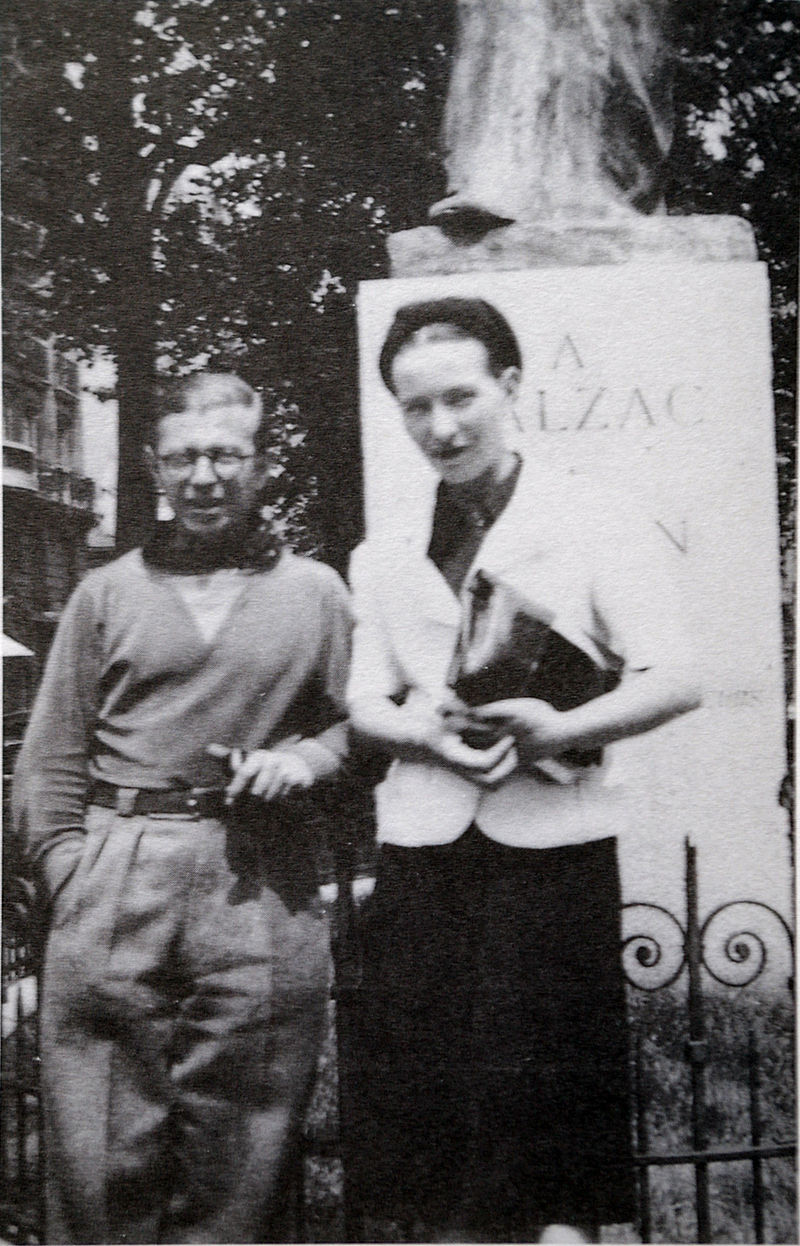
Sartre and Beauvoir, Balzac Memorial (Presumed Public Domain, via Wikipedia)

In my review, I likened her autobiography to a bildungsroman, and nowhere is this more applicable than in her descriptions of what we would now call teenage angst. Sometimes I think I have forgotten my youth, but Beauvoir’s descriptions of her own inner conflicts brought the memories back – reminding me, as if I needed it, of one of the reasons I love to read. What teenager can’t relate to the feeling of being “alone”? Beauvoir certainly could. Being the daughter of a devout Catholic mother and an atheistic but socially conservative father, in a society in which women were (or, at least she felt) “cabined, cribbed and confined”* left her frequently feeling alone, in “exile”.

In today’s discussion of the book on ABC Radio National’s Books and Arts Daily, literary critic Geordie Williamson quoted a heart-rending section from the book (p. 188-9) in which she discusses this issue, when she realises the error of her belief that

it would be possible to rise above bourgeois mediocrity without stepping out of my own class. Its devotion to universal values was, I thought, sincere; I thought I was authorised to liquidate traditions, customs, prejudices, and all kinds of political and theological particularism in the light of reason, beauty, goodness and progress.

She thought she would be praised if she wrote a book that “trampled conformity in the dust”, but she discovers that she’s wrong, that “people did not accept me at all; instead of weaving laurel crowns for me, people were banishing me from society”.  She “would always be ostracised”. Painful, painful.

This sense of aloneness – of “exile” – continues. Part of it is, of course, typical for adolescents. She writes, when she’s 20, that “I would fall into an arid despondency of heart, and then be bounced up into happiness again”. But it’s clear too that she was different from most of her peers. Joining Sartre and his little group brought her, finally, to “her” people, and she knew at last that she didn’t have “to face [the] future all on my own”.

A novelist’s eye

In my review I suggested that Beauvoir’s autobiography has some of the sensibility of a novel – particularly in language and characterisation. At my reading group’s discussion, one member shared her favourite quote. It’s a perfect example of the fiction writer’s ability to capture a moment. Here it is (with thanks to Kate):

On the evenings when my parents held parties, the drawing-room mirrors multiplied to infinity the scintillations of a crystal chandelier. Mama would take her seat at the grand piano to accompany a lady dressed in a cloud of tulle who played the violin and a cousin who performed on a cello. I would crack between my teeth the candied shell of an artificial fruit, and a burst of light would illuminate my palate with a taste of blackcurrant or pineapple: all the colours, all the lights were mine, the gauzy scarves, the diamonds, the laces; I held the whole party in my mouth.

* Roughly quoted from Macbeth.

Simone de Beauvoir, Memoirs of a dutiful daughter (Review)

Courtesy: HarperCollins Australia

Courtesy: HarperCollins Australia

I have only read one other work by Simone de Beauvoir – and I’m ashamed to say that it wasn’t The second sex (which still sits in my long-in-the-tooth TBR pile). It was, instead, one of her autobiographical novels, She came to stay. I enjoyed it as I recollect, but that was a long time ago. Then this year, my reading group decided to choose one of the books being discussed in ABC Radio National’s European classics series – and we opted for the first of Beauvoir’s autobiographies, Memoirs of a dutiful daughter.

Now, the things is, it’s a pretty dense book that can be looked at from multiple angles, too many to explore in one review. Consequently, my plan is to focus here on a few that interest me, and to later post a Delicious Descriptions containing examples of her gorgeous descriptive writing.

First though, as always, a brief summary of its content. Published in 1958, the book chronicles her youth from her birth in 1908 to when she turned 21 in 1929. It deals at some depth with her childhood, school and university days; her relationship with family and friends; her youthful thoughts about and experience, such as it was, of love; and, most importantly, the foundations of the ideas that drove her adult life. It shows the inner conflict she experienced as an independent thinker growing up in a conservative Catholic bourgeois family. I’d describe it as the autobiographical equivalent of a bildungsroman, which sounds silly since autobiography is intrinsically about the development of self. But this particular autobiography ends at the moment when she formally leaves childhood behind, and, like a bildungsroman, is primarily the story of her “formation”.

Autobiography

WARNING: THERE BE SPOILERS IN THIS SECTION – DOES THAT MATTER IN AN AUTOBIOGRAPHY?

BeauvoirMemoirsHarperPerennialThis leads nicely into the first aspect of the book I’d like to discuss, its form. It is a traditional autobiography in that it starts with her birth and moves in a linear way, with the occasional foreshadowing, to her chosen endpoint which is when she turned 21, finished her schooling and left home. Like an autobiography it contains many characters. (There is a comprehensive index if keeping track becomes difficult, though I didn’t find it that hard).

The book also, though, has some novelistic elements. While at times the style is dry and almost diary-like, at other times it is highly evocative, particularly when she describes her experience of nature. More relevant though to my argument is her use of characters, because while we meet many, there are three that she focuses on – herself, her first cousin and first love, Jacques, and her closest friend Elizabeth “Zaza” Mabille. These two significant people provide coherence to the narrative line and a semblance of a plot. Will she or won’t she marry Jacques? And how will Zaza develop?

Beauvoir doesn’t marry Jacques, but while the book ends when she’s 21 and he’s about 23, she briefly describes what happens to him in the rest of his life, which ends, sadly, when he’s 46. Zaza, on the other hand, could be seen as her alter ego. As we read the book, focussing on Simone as “the dutiful daughter”, we become aware that Zaza is also one. The difference between them is that while Simone is dutiful in an obey-the-parents sense, she is an independent thinker and learns to distance herself intellectually from her parents. Zaza, on the other hand, exemplifies the tragedy that can happen to “dutiful daughters” who don’t achieve this. She, in other words, rounds out the theme implied in Beauvoir’s title.

This sense of Jacques being her potential future and Zaza being her alter ego gives this autobiography some of the sensibility of a novel.

Gender

I couldn’t of course write on this book without discussing gender. But first, it’s important to remember when she was born – 1908 – and the community into which she was born – conservative, Catholic, bourgeois. It was intriguing to see how her ideas developed in this early part of her life.

Early in her childhood she saw that mothers had a life of “servitude”, and were “overburdened with a thousand tiresome tasks”. Her response was to decide not to have children but be a teacher. In her teens, she states that “I believed in the absolute equality of human beings” but doesn’t engage with  the idea of universal suffrage. A few pages later, she is a little fuzzy on this idea of equality when she considers her future husband:

I should be in love the day a man came along whose intelligence, culture, and authority could bring me into subjection.

Why, she says, did she think this? She continues

I never thought of myself as a man’s female companion; we would be two comrades [but, she goes on] My education, my culture, and the present state of society all conspired to convince me that women belong to an inferior caste.

She goes on to explain that the man she loved would be “the model of all I wished to become; he would therefore be superior to me”.

Overall then, her thinking was a little confused. Theoretically she believed in equality and demanded independence for herself, resulting in much conflict with her parents in her later teens, and yet she saw her ideal partner as being “superior”. Part of her belief in equality was an absolute rejection of the double standard. She ascribed to the Christian morality of her times but felt “that men should be subject to the same laws as women […] I saw no reason why my future partner in life should permit himself liberties which I wouldn’t allow myself”.

By the end of the book, that is, by the time she turned 21, her thinking hadn’t developed much beyond this. She believed in equality, she didn’t want to be constrained as she saw married women with children were, but she had not developed the ideas that she presented in The second sex, which she wrote around the age of 40Tellingly, Beauvoir-Sartre biographer Hazel Rowley writes in my edition that it was Sartre who told Beauvoir that if she were to write her memoirs she would need to look into “what it had meant to be a woman”. Beauvoir was apparently dismissive, believing that being a woman had never really affected her but, she decided to do some research. What she discovered was “a revelation” and resulted in her putting her memoirs aside to write The second sex.

Literature and truth

The other issue that spoke strongly to me as I read the book was the importance of literature, of books and reading, to her – and, related to this, her search for truth. Reading was, she writes, “the great passion of my life”. If you are well-versed in French literature, as I am not, you could track her intellectual development through her reading. She discusses the books she read as a young school girl, her reaction as a young teenager to Jo in Little women and Maggie in Mill on the floss (both English books, I know!). She talks of engaging in her late teens with contemporary literature of “the disquiet” through writers like Gide (whom I have reviewed here), and of then moving on from them.

She learns much through reading, not only intellectually and morally, but practically. Books, for example, provided her with much of her sex education, so that when her mother finally decided it was time to tell her the facts she could say “I know all about that” – though what she knew about sex and what she understood about the world were two different things!

She learns that literature and reality are not the same thing, saying at one point that

Literature takes its revenge on reality by making it the slave of fiction.

At times she argues that literature is the truth, while at other times she feels its connections with truth are dubious, but this is all part of a portrait of the writer as a young girl. “Real” truths are not found easily, and she, we see, worked hard for hers.

Finally – and how long we readers had to wait for it – it’s her meeting with Sartre, “the dream-companion I had longed for”, that grounds her, as she reaches the end of her formal childhood. He is, she says, her intellectual superior, and she is, she knows, still naive, but

I no longer asked myself: what shall I do? There was everything to be done, everything I had formerly longed to do: to combat error, to find the truth, to tell it and expound it to the world, perhaps to help to change the world.

And so she did.

Simone de Beauvoir
Memoirs of a dutiful daughter
(Trans. by James Kirkup)
New York: Harper Perennial, 2005
(First pub. 1958; Translated 1959)
364pp.
ISBN: 9780060825195

Toshio Mori, Japanese Hamlet (Review)

Toshio Mori (Courtesy: Nancy Wong, via Wikipedia, using CC-BY-SA 3.0)

Toshio Mori (Courtesy: Nancy Wong, via Wikipedia, using CC-BY-SA 3.0)

What I love about the Library of America is the variety of works it features in its Story of the Week program. Because of my interest in Japan and Japanese writers, I was particularly attracted to Toshio Mori’s story, “Japanese Hamlet”, that they published a couple of weeks ago. Toshio Mori was one of the first Japanese-American writers to be published in America – and he was best known for short stories. Two things that make him interesting to me.

According to Wikipedia, Mori was born in Oakland, California in 1910. Like many Japanese-Americans, he was interned in a camp (for him, the Topaz War Relocation Centre in Utah) during World War 2. According to LOA, the story “Japanese Hamlet” was written in 1939, but wasn’t published until 1946 – in a magazine called the Pacific Citizen which was apparently the “leading magazine of the Pacific Asian American community”. It was then titled “The School Boy Hamlet”. It appeared later, as “Japanese Hamlet”, in his collection The Chauvinist and other stories, published in 1979, the year before his death.

The story is told by an unnamed first person narrator. He talks of a man, Tom Fukunaga, who “was a schoolboy in a Piedmont home. He had been one since his freshman days in high school. When he was thirty-one he was still a schoolboy”. This Tom, who “did not want anything in the world but to be a Shakespearean actor”,  visits the narrator regularly to recite Shakespeare to him. He’s a schoolboy because he still lives at the school, and has not got a job because he is perfecting his acting skills. Our narrator is happy to hear the recitation because “there was little for me to do in the evenings”.

Tom’s family is not happy with his decision, calling him “a good-for-nothing loafer” who “ought to be ashamed of himself for being a schoolboy at his age”. He tells his relatives that he’s “not loafing” but “studying very hard”. We learn that an uncle visits him regularly trying “to persuade him to quit stage hopes and schoolboy attitude”. His parents have disowned him, his uncle says, and “pretty soon your relatives will drop you”. But Tom is unmoved. He has his goal and will not be swayed from it. He lives on five dollars a week, plus room and board, presumably covered by his family. He feels no guilt about this.

So, what do we have here? We have the would-be artist persisting with his dream. We also have the suggestion of Japanese culture not understanding the pursuit of an individual goal over one’s responsibility to family and community. Then we add the fact that Tom’s favourite role is Hamlet, the quintessential dreamer and procrastinator. I like the complexity of this criss-crossing themes and ideas. Life, we know and Mori shows, is not a simple this-then-that but a complex web of interacting influences.

In all this it’s not clear who the narrator is – a friend, old teacher, neighbour? Is he American or Japanese? Interesting that Mori has chosen to tell the story through a first person narrator, and yet has told us nothing about this narrator. What is the narrator’s role? He (presumably “he”) mediates between us and Tom’s story but he is also an actor in the story. This complicates our response to Tom, I think, because we see him through the eyes of another, but we don’t know who that other is. Regardless of who the narrator is, he starts to be “afraid that Tom’s energy and time were wasted and I helped along to waste it.” He tries to encourage Tom to contact some theatre people, fearing “we are wasting our lives”. Interesting, here, that the narrator is not only worried about enabling Tom to waste his life but about wasting his own. Eventually, the narrator starts to dread Tom’s presence “as if his figure reminded me of my part in the mock play that his life was”. One night he suggests Tom give it up for a while because it is “destroying” him. Tom simply ceases to come.

The narrator feels “bad” because he knew Tom would “never abandon his ambition”. And, while he knew Tom would never become a great Shakespearean actor, he admired “his simple persistence”. The story ends quietly, with no clear resolution – though we do see Tom once again.

LOA’s introductory notes quote a literary scholar, David Palumbo-Liu, who says that while the story seems to offer a simple message, ‘it masks an underlying tension from “a faith in the power of Art to transcend race, ethnicity, and history.””  Ethnicity is not mentioned in the story, except in the title under which it was eventually published – and it is of course  implied in Tom’s name. However, LOA continues, Palumbo-Liu expands his argument: “In a world of racial difference, to be Hamlet, Tom cannot be Japanese; to be Japanese, Tom cannot be Hamlet. Yet the myth of universal art denies that there is any contradiction since, in being an artist, Tom can do both.” LOA suggests that Tom is much like Mori himself who also persevered with his writing, hoping to reach “a wide American audience”.

Not knowing Mori’s oeuvre, I don’t know whether he intended this story to be what Palumbo-Lui sees. I don’t know, either, whether he intended it to be about Japanese culture’s emphasis on duty over individuality, since many Western families would also look askance at a young person not getting a job. What I do know is that although its “simple” message is about the perseverance of a passionate artist, it’s not a simple story. I’m glad to have been introduced to Toshio Mori.

Toshio Mori
“Japanese Hamlet”
First published: in Pacific Citizen, August 17, 1946
Available: Online at the Library of America

Monday musings on Australian literature: Australian women writers, 1930s

In July I wrote two posts based on Nettie Palmer’s 1920s assessment of great Australian novels. In 1935, another Australian novelist, Zora Cross, wrote an article about Australian women novelists and poets. I enjoy reading these contemporary perspectives, and I think some of you are interested too … do let me know if you aren’t.

I’ve said it before I think, and that is that there were two flowerings of Australian women’s writing in the twentieth century, one in the 1920s-40s and the other in the 1970s-80s. It’s a bit early to tell but I’m wondering whether we are experiencing another one now. Let’s hope so – not at the expense of our male writers, but recognised and read, alongside the men.

I don’t know Zora Cross (1890-1964) as well as I know Nettie (and Vance) Palmer, but she was a recognised novelist, poet and journalist in her day. Her aim in her article, published the Sydney Morning Herald in 1935, was to demonstrate the strength of women’s writing. She starts by naming writers who, at that time, had been writing for twenty years or more – writers still known to us (Miles Franklin and Mary Gilmore), and those far less known, if not pretty much forgotten (Louise Mack, Ada Holman and Dora Wilcox). The only one I know of these last three is Louise Mack – as she is in my TBR pile. Cross then mentions younger writers, of whom only one, Katherine Susannah Prichard, is well-known to me. The others are Dulcie Deamer, Vera Dwyer, Ella McFadyen and Nina Murdoch. When I read these lists, I wonder which of today’s writers readers a century from now will know. Sometimes I wish I did believe in eternal life – or, reincarnation!

Like Palmer, Cross uses headings in her article, so I will again follow.

Success abroad

Nettie Palmer, ten years earlier, also talked about writers succeeding abroad, but Cross writes of two different sorts of successes. One is that achieved by writers who started writing “at home” and then move abroad. She names several, again mostly not well-known now – Helen Simpson, Alice Grant Rosman, Dorothy Cottrell – and one completely unknown to me, and about whom some quick Google searching has revealed nothing, Daniel Hamlyn. Hamlyn, she says, won The Bulletin’s second novel competition, the first one having been jointly won by Katherine Susannah Prichard and M. Barnard Eldershaw. I think I’ll need to actually go to a Library and research The Bulletin to discover more about her! Cross doesn’t mention Christina Stead, but as Stead only published her first book in 1934, that’s not surprising.

The other “success abroad” Cross mentions is that achieved by those who hadn’t left home. One of the most interesting of these is, she says, Eleanor Dark. She does, however, name several others, all unknown to me, so I’ll just mention a couple which stand out because of her comments. One is Georgia Rivers whose novel, The difficult art about a young girl growing up, “is a most unusual book”. She doesn’t elaborate, but this has piqued my interest. Another is Jessie Urquhart who, she says, “will not, I think, do her best work until, like Alice Grant Rosman, she  relinquishes journalism for fiction”. An intriguing comment from a novelist-poet-journalist! It would be interesting to know whether Urquhart needed her journalistic work to survive. The last one I want to mention is Mary Mitchell who achieved London success with the wonderfully titled Warning to wantons. Cross tells us that this book is not Australian so “of little importance to us here. She could write, I’m sure, a good Australian society novel, for which there is a waiting public.” I hadn’t realised until this point that her article is not just about Australian women writers, but about Australian women writers writing about Australia.

Literary competitions

Here Cross mentions Marjorie Barnard and Flora Eldershaw (aka M. Barnard Eldershaw), and another writer I don’t know, Velia Ercole, as writers brought to notice through winning competitions. But, as Palmer did (though under her “abroad” category), Cross focuses her attention here to Henry Handel Richardson who, she says, was introduced to Australia by Nettie Palmer.

Cross, like Palmer, praises Richardson, saying that few “have equalled her in style and form of production”. She says that fame finally came with the last book in her Fortunes of Richard Mahoney trilogy, Ultima Thule, which she describes as “lucid and sincere”. Nonetheless, she does suggest that “there are faults to be found from an Australian point of view” with the novel, “but few with the presentation of it”. She’s not clear about what these faults are, though suggests that many may “question the worth” of such a detailed look at “a failure’s life”.

Ethel Turner

Cross’s last heading is devoted to Ethel Turner, whose juvenilia I plan to review later this year and who is famous for her novel Seven little Australians. Cross again shows that her interest here is writing about Australia when she says:

Too much stress cannot be laid on the fact that Ethel Turner, from the moment she opened the door of an Australian house and showed the world what we were really like, has been a guiding star for the best. She has not been able to give us adults as real as children but the germ is there.

But, the cultural cringe is strong, Cross implies, when she says that Australians do not recognise that Turner’s children are as immortal as Alice [in Wonderland] and much more real than Anne of Green Gables. Fighting words, eh! She names writers who have followed Turner, including Mary Grant Bruce whose juvenilia I reviewed earlier this year.

Conclusion

This is not one of Cross’s headings, but after her discussion of Turner she writes a few paragraphs about other writers and writing. She refers to “imaginative women writers [who] are immersed in journalism”, playwrights, and women who write humorously, such as Miss Lloyd and her book Susan’s little sins. Couldn’t resist mentioning that one!

She then writes, curiously, that:

All of our women writers are well read, none very keen about sport, though golf and tennis and sometimes dancing play a part in their leisure moments. All are earnest, sincere workers.

I wonder why she felt the need to say all this? Anyhow, she follows this by saying she has left one writer to last, Mary Gilmore “whose hobby may well be ‘the finding of new writers'”. Dame Mary Gilmore wrote poetry and prose, though Cross, rightly, believed that it’s for her poetry that she’ll most be remembered.

And here, I’ll conclude with her conclusion because – well, see what you think:

Our women aim at truth in writing just as the men do: and this is characteristically Australian. We do not need to read Russian literature to inspire us to realism. Our country, born of suffering and hardship, has shaped our character, and out of it is coming a literature entirely different from any other. Women are doing their share in the building up of this national literature just as they did their share towards the making and shaping of the nation itself.

So there!

Monday musings on Australian literature: The novel in Australia, 1927-style, Part 2

Today’s Monday Musings is Part 2 of my two post series discussing Nettie Palmer‘s article, “The novel in Australia”, that was published in The Brisbane Courier, 15 October 1927.

As I did in last week’s post, I’ll use her headings to share her view on Australia’s great novels.

A novelist abroad

Here she discusses Australian writers who wrote their novels while living overseas, Australians being, as we know, good travellers. It’s no surprise that her choice of the best known novel written while its writer was abroad is Henry Handel Richardson’sMaurice Guest (1909), which is a “brilliant story of music-student life in the Leipzig of the ‘nineties”. (This is another languisher on my TBR pile).

Palmer then tells us about Richardson’s Australian trilogy, The fortunes of Richard Mahoney, which she wrote mostly from her home in England though she “revisited Australia about 1912 to verify impressions”. Palmer’s article was written before the third book in the trilogy was published, but here she is on the first two:

The writer’s knowledge of the period – costumes, food, and customs – is immense but the “Fortunes” is never a mere costume novel: there is character all through. All Henry Handel Richardson’s novels, even those whose setting is wholly Australian, are better known in Europe than here, and are discussed at length in German and Scandinavian literary encyclopaedias and reviews. In America too, they have received deep attention. Victoria is fortunate to have found such a chronicler, more fortunate than it knows yet [my emphasis].

Cultural cringe, or because Richardson was based overseas? Whatever the reason, recognition of her work did increase through the century. The Australian Dictionary of Biography entry on Richardson, written in 1988, discusses her reputation briefly, and touches on the unevenness of her reputation – overseas and in Australia.

Contemporary novels

Palmer concludes her article by looking at contemporary (to the late 1920s, that is) novels, and names a few she deems significant.

Katharine Susannah Prichard

Prichard, 1927/8 (Courtesy: State Library of NSW, via Wikimedia Commons)

Katherine Susannah Prichard’s works, she says, “are the fruit of an intense devotion to her subject matter. Her gifts are mainly two: first, that of brilliant impressionism, then a rare power of writing group-scenes.” In Black Opal, for example, the opal miners are “standing about chaffing each other and discussing the universe, every man of them alive”. She says there are similarly vivid scenes of groups of timber-getters in Working Bullocks. “Such scenes”, she says, “are too difficult for most novelists, who shirk them: yet they enrich a book immensely and the reader feels that our everyday life is full of unsuspected charm”.

Palmer then writes something rather strange (to me anyhow). She comments that each of Prichard’s books is located in a different place – the tall-timbers of South-east Victoria (presumably The pioneers, which I’ve reviewed), the opal fields of Western New South Wales, and the saw-milling country in the south of Western Australia. She says:

(Reading over this list of regions I can only feel how wretchedly inconvenient our Australian names are: a mere mention of latitude and longitude! Are we too big to think about? It will take many years for many of our names to become easy and vivid.)

What does she mean? Those names are purely geographical descriptions. The pioneers is, yes, set in south-east Victoria but this region does have a name – Gippsland – which it has had since the nineteenth century. I don’t think I’m on Palmer’s wavelength here at all.

Anyhow she concludes this section with the statement that there’s “little space left for some recent Queensland books” (because, of course, The Brisbane Courier is a Queensland newspaper). She names Zora Cross, whose books “put on record the changing years of a South Queensland [ha!] district” and M. Forrest, whose novels “have that special quality which readers of her verse would expect – a power of painting in words the rich details of Queensland’s unexplored landscapes”.

Conclusion

As I read this article I pondered what criteria Palmer was using to define quality novels. Good characterisation, meaningful realism (if that makes sense), and a capturing of Australian identity seem to be what she was looking for. Fortunately, she has a go at answering this question herself in her last two paragraphs.

Firstly, she says that:

the most satisfactory definition of a good novel seems “the revelation of character through narrative,” but the character need not be only human. There is also the character of a country.

She then suggests that good novels break new ground, with the author “giving part of himself away, revealing his personal vision of ‘men, coming and going on the earth'”. On this point of innovation, she quotes Randolph Bedford, who appeared in Part 1 and who, she says, satirised the idea that “the average publisher loves words written to a formula, to please a reading public which dislikes anything new”. Bedford apparently said of this public:

It loves to read some old friend it recognises, so it can say, “How original it must be, because I know it so well”.

Oh dear. Have things changed do you think?

Palmer then presents her own definition of “a more genuine kind of originality” – and it’s to do with the difficulty of making “Australian life and character their theme”. She concludes:

Some day, when a novel about life in Indooroopilly seems as natural as one about Piccadilly, we shall thank those who turned the first sods so fruitfully.

So there it is really. The cultural cringe. This I think has changed.

* Wikipedia tells us she was Iris Murdoch’s second cousin twice removed. A remote relation, perhaps, but interesting nonetheless!

Eleanor Dark’s Juvenilia (Review)

Eleanor Dark's Juvenilia

Courtesy: Juvenilia Press

Eleanor Dark was quite a star in Australia’s literary firmament of the 1930s to 1950s, and has left an important legacy, not only in her most famous book The timeless land but also in the fact that her home Varuna in the Blue Mountains is now one of Australia’s most significant and loved writers’ retreats. It’s therefore wonderful that the Juvenilia Press was able to produce a book on her early work.

Unlike the Press’s volume on Mary Grant Bruce, which comprises works that push their definition of juvenilia, Eleanor Dark’s Juvenilia fits clearly within their guidelines. All pieces were written between 1916 and 1919, when Dark was 15 to 18 years old. Like the Bruce volume, it was edited by secondary school students and their teacher, rather than the Press’s more usual practice of using tertiary students. (The Press is a teaching press). The decision to use secondary school students is particularly appropriate for this volume as the students come from the school, Redlands, which Dark attended, in her childhood name of Pixie O’Reilly. Research for the volume included the school’s own archives, and all the pieces come from the school magazine, The Redlander. A Foundation Day speech given by the (then) school’s archivist, Marguerite Gillezau, is one of the appendices.

Like other Juvenilia Press editions, this book includes useful extra matter such as Pixie O’Reilly’s school report! There is, too, an introduction, this one titled “Pixie to Eleanor: From a spark to a flame”. It is creatively, and entertainingly, organised under headings taken from the school report – “Making fair progress”, “Very promising indeed”, and so on. The volume is also illustrated with photographs and other images from Dark’s school days – and there is also the list of references consulted.

As with most juvenilia, the pieces here provide an insight not only into the author’s childhood but also into the passions and interests they’ll develop later. Dark went to Redlands school in 1914 (an auspicious year) after her mother died. Although it was a girl’s school – why do I say “although”? – the school did not seclude its students. Indeed the school archivist in her Foundation Day speech said that, since its establishment in 1884, the school “has been aware of the world outside its front gates”, including war. One of Dark’s pieces in this volume is a poem about the First World War, “Jerusalem set free”.

For those of you who don’t know Dark, she and her husband were politically radical – or – socialist in leaning, something for which they were often persecuted. Not having read biographies of her, I cannot say how much of this may have come from the family, but the Introduction says that one writer on Dark, Marivic Wyndham, stresses the importance of the school’s ethos on her development. Wyndham writes that the school provided her “not only with flesh-and-blood models of the new woman and the radical intellectual she eventually adopted, but also with models of community and sisterhood that later featured prominently in her vision of a ‘good society'”.

These values are evident in the piece most dear to my heart, “The Gum Tree’s Story”. I loved this little 2-page piece for three reasons: it contains delightful descriptions of Australian flora; it contains a story-within-a-story about that Australian archetype, “the lost child in the bush”; and it’s an allegory about inclusion rather than exclusion. The story concerns Waratah who wants to organise a party to enliven his drooping companions but wishes to exclude the interloper White Rose. (Is it girlish, that the Rose is white not red, do you think?).

The other story in the volume – there are two stories and four poems – encompasses another theme common to classic Australian literature, the bushranger. Titled “‘Thunderbolt’s’ Discovery”, it tells of young boys on a picnic who play bushrangers – Australian readers will be aware that Captain Thunderbolt was a famous bushranger – and come across an unconscious man who, they imagine, is a bushranger. What I love in this is her description of the bush:

It was very deep in the bush. A clear stream trickled down over the rocks, and there was the faint bush smell of damp earth and fallen gum leaves. Maiden-hair grew thickly, and clumps of pale wide violets and pretty, delicate ferns. Where the stream was at its wildest a huge old tree had fallen across it, and the damp bark was covered with soft green moss. Further up the hillside flannel-flowers and Christmas bells grew among the tall bulrushes, and Christmas bush was already nearly in full bloom.

Dark, it is clear from this and “The Gum Tree’s Story” knew her botany – but I think she evokes it well too, without going overboard as young writers can do.

The four poems speak to different aspects of Dark’s girlhood – from the war to hatred of exams. They show someone comfortable with language and with expressing ideas through them. They also show an ability to mix tone, to work in the serious and the light, in the grand and the more personal, in the fanciful and the real.

Not everyone, I know, enjoys Juvenilia but I am thoroughly enjoying these texts, and the insight they provide into the writers to come. I look forward to telling you about the next one in, hopefully, a month or so.

awwchallenge2014Eleanor Dark
(ed. Jane Sloan with students from Redlands, Sydney)
Eleanor Dark’s Juvenilia
Sydney: Juvenilia Press, 2013
26pp.
ISBN: 9780733433733

* The book only costs $12 plus postage, from the Press.

My previous posts on the Juvenilia Press are: Monday Musings and Mary Grant Bruce.