Alice Dunbar-Nelson, Sister Josepha (#Review)

It’s a year since I’ve posted on a Library of America (LOA) story, but I was driven to post on this one for two reasons. I have just posted a review of “The scapegoat” by Dunbar-Nelson’s first husband, Paul Dunbar, and, earlier this year, I reviewed “A carnival jangle”, written by Alice Dunbar-Nelson, before marriage when she was Alice Ruth Moore.

Alice Dunbar-Nelson

In my post on “A carnival jangle”, I provided a brief biography of Dunbar-Nelson, so I won’t repeat that here, except to remind us that she was a poet, journalist and political activist, born to a black mother and white father. She was prominent in the Harlem Renaissance, and lived in New Orleans for 21 years, as well as Boston, New York, and elsewhere.

In that bio, I also wrote that racism was an important issue for her, but that she also took a wider view of human rights. It is this point that I would like to explore further in this post, due to some ideas raised in LOA’s introduction to her story. They focus quite a bit on her relationship with Paul Laurence Dunbar, noting that the two communicated with each other by letter for a couple of years before meeting. Dunbar asked for her opinion on using “Negro dialect in Literature”, which he sometimes did. LOA shares her response, which was that she saw no problem with using dialect if you knew it and had “a special aptitude for dialect work” but that she saw no necessity to do so just because “one is a Negro or a Southerner”, and if, like her, you were absolutely devoid of the ability to manage dialect“. This makes good sense, but the main thing I want to share is what she says next:

Now as to getting away from one’s race—well I haven’t much liking for these writers that wedge the Negro problem and social equality and long dissertations on the Negro in general into their stories. It’s too much like a quinine pill in jelly—I hope I’m not treading on your corns. Somehow, when I start a story, I always think of my folks (characters) as simple human beings, not as types of a race or an idea—and I seem to be on more friendly terms with them.

After detailing more of Dunbar-Nelson’s biography, LOA returns to the issue of subject matter, saying that “the ambiguity of racial identity for the Creole characters” in her stories resulted in several critics in recent decades arguing that

she “camouflaged the issue of race,” that she “spurned that racialized element of her identity,” or that she “shaped her tales of Creole life for white audiences.” In “Sister Josepha,” which we reprint below as our Story of the Week selection, the reader realizes that the lead character is not white only through descriptive hints (“brown hands,” “tropical beauty”) and by what the other nuns do not say about her.

However, continues LOA, another commentator, Caroline Gebhard had noted in a recent article that Dunbar-Nelson

“presumes that readers already read her work as ‘black.’” In the 1890s and early 1900s, most of Dunbar-Nelson’s stories, essays, and poems appeared in Black newspapers and magazines; The Monthly Review, for example, advertised itself as “the only illustrated periodical published by Negroes in this country.” … “Dunbar-Nelson knew she would be read as a Black author and never tried to pass in print,” Gebhard concludes. “To read Dunbar-Nelson’s fictions as addressing only white readers, which the accusation of passing implies, is to dismiss the fact that Dunbar-Nelson’s first and most loyal readers were African Americans.”

This point reminded me of the discussion my American friend Carolyn and I had about “The scapegoat” concerning the fact that it is almost completely set in the black community. White people are not identified, except for the Judge, so we have to work out, between the lines, who else might be white in that story. I think Paul Dunbar assumed we’d know – just as Alice Dunbar-Nelson did, according to Gebhard. It’s a lesson in how difficult it is to read out of one’s own time and culture.

It also reminded me of something more contemporary, a post I wrote in 2021. The focus was memoir, but the point was that ‘diverse writers’ are expected to write narrowly about their diversity, and their frustration that they are not encouraged to write, as Dunbar-Nelson explained, about “simple human beings, not as types of a race or an idea”.

“Sister Josepha”

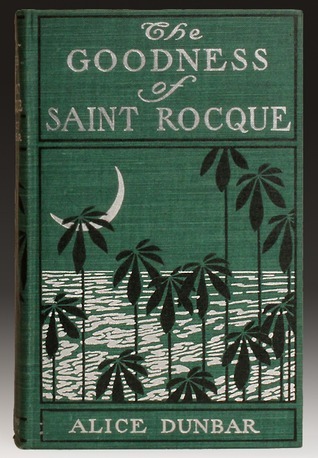
“Sister Josepha” appeared in Dunbar’s 1899 short story collection, The goodness of St Rocque and other stories, and can be read at the link below. It tells the story of a young three-year-old orphan named, Camille, who was left at a convent orphan asylum. The story opens 15 years later when this orphan has just finished her novitiate and is a fully-fledged sister, but she’s unsettled.

Dunbar tells us that when she was 15, and still Camille, she had “almost fully ripened into a glorious tropical beauty of the type that matures early” and had attracted the attention of a couple who offered to take her in. Her Mother Superior calls her in and makes the offer:

Camille stole a glance at her would-be guardians, and de­cided instantly, impulsively, fi­nally. The ­ woman suited her; but the man! It was doubtless intuition of the quick, vivacious sort which belonged to her blood that served her. Untutored in worldly knowledge, she could not divine the meaning of the pronounced leers and admiration of her physical charms which gleamed in the man’s face, but she knew it made her feel creepy, and stoutly refused to go.

To justify her decision to Mother Superior, who did not force her to go, she announces that she loves the convent and sisters, and would like to be one too. However, three years later, the life is palling for this lively young woman. She’s tired, and bored, and plans her escape, but this is a story about the few opportunities available to a young woman in her situation. Should she live the confining but secure life of a nun, or could she make it out in the world where she has no identity, no name other than Camille, and “a beauty that not even an ungainly bonnet and shaven head could hide”.

What lifts this story out of the large body of often cliched stories about young nuns like Camille/Sister Josepha is the situation and Dunbar’s expressive writing that subtly conveys the reality of our sister’s position. Race is never mentioned but there are hints regarding Camille’s background. This is a different story to “A carnival jangle” but no less powerful.

Alice Dunbar Nelson
“Sister Josepha” (1899)
First published: in The goodness of St Rocque and other stories
Available online: Library of America

Charles W. Chestnutt, Uncle Wellington’s wives (#Review)

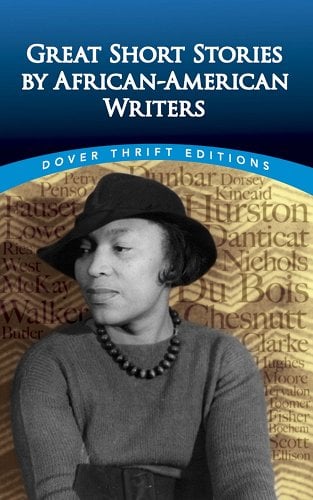
Charles W. Chestnutt’s long short story is the second in the anthology Great short stories by African-American writers sent to me by my American friend Carolyn. I have come across Chestnutt before, in the Library of America’s Story of the Week program, but they haven’t published this one and I haven’t written about him before.

Charles W. Chestnutt

The biographical notes at the end of the anthology provide a brief introduction to Charles Waddell Chestnutt (1858–1932), whom they describe as the “first commercially successful African-American writer of fiction”. Born in Cleveland, Ohio, and growing up in North Carolina, he “became a teacher, married, and moved to New York City, before returning to Cleveland, where he studied law”.

Wikipedia, of course, provides more. They describe him as “an American author, essayist, political activist, and lawyer, best known for his novels and short stories exploring complex issues of racial and social identity in the post-Civil War South”. His racial background is interesting, and I will quote Wikipedia here (without the references/links which cite sources for descriptors we no longer use):

His paternal grandfather was known to be a white slaveholder. He identified as African-American but noted that he was seven-eighths white. Given his majority-European ancestry, Chesnutt could “pass” as a white man, but he never chose to do so. In many southern states at the time of his birth, Chesnutt would have been considered legally white if he had chosen to identify so. By contrast, under the one drop rule later adopted into law by the 1920s in most of the South, he would have been classified as legally black because of some known African ancestry, even in spite of only being one-eighths black.

The anthology says that some of his best-known – and popular-at-the-time – stories, reproduced the dialect of uneducated storytellers, and Uncle Wellington is one such. Like this anthology’s first author Alice Ruth Moore, Chestnutt wrote about the color line, oppression, and themes of racism.

“Uncle Wellington’s wives”

I was rather tickled when I started reading “Uncle Wellington’s wives” because it delightfully pairs with the novel I had just read, Percival Everett’s James (my review). It is set post Civil War and satirically deals with the lure of the freedom of the North. The anthology describes it as ‘one of his fine and wry stories about “the Color Line”, a line that had consequential legal and social repercussions’. It tells of Uncle Wellington who, “living in a small town in North Carolina … yearns for something beyond his comfortable home with his impatient, hard-working wife”.

According to Wikipedia, the collection from which this story has been taken, includes many themes explored by 20th-century black writers. One of these, “the pitfalls of urban life and intermarriage in the North”, underpins “Uncle Wellington’s wives”. The story is built around the trope of a disgruntled, and somewhat lazy, husband – the titular uncle Wellington – of a hardworking, practical woman who keeps the show on the road. It opens with uncle Wellington Braboy returning home from a lecture at a meeting of the Union League (see Wikipedia) on the topic of “The Mental, Moral, Physical, Political, Social and Financial Improvement of the Negro Race in America”. It’s a topic, says the narrator, that is common in “colored orators” because “to this struggling people, then as now, the problem of their uncertain present and their doubtful future was the chief concern of life”. But, there was hope, and this speaker had “pictured in eloquent language the state of ideal equality and happiness enjoyed by coloured people at the North”. Indeed, the “mulatto” speaker had “espoused a white woman”.

Chestnutt tells of how the now inspired uncle Wellington goes about getting to the North to experience this land of milk and honey, this seemingly “ideal state of social equality”. He goes to a local lawyer to find out whether his wife’s money is his to control. It is, and it isn’t, he learns in a wonderful discussion of the finer points of law. Later, this issue of law’s finer points comes into play again when, now up North, he wants to get out of a marriage. The satire on the law is delicious.

Indeed, the satire throughout this story is delicious as uncle Wellington comes to appreciate the truth of that adage that “life is not always greener”. There might be more legal equality in the North, but that doesn’t mean people are equal. People don’t change overnight. White people don’t suddenly all treat coloured people as “equal”, regardless of what the law says. Coloured people can’t immediately achieve “equal” jobs, because they don’t have the skills and/or the education and/or the contacts. This is not all spelt out in the story, but it’s apparent nonetheless through what happens to uncle Wellington.

I mentioned at the start that an underlying trope for this story is the disgruntled, lazy, husband of a hardworking, practical woman. However, there are other tropes, including the prodigal son story. There are also other themes, besides racial equality, including that of the problems of illiteracy and poor education. Uncle Wellington’s not being able to read, for example, lays him open to not understanding his rights, or the law, and so on. It doesn’t play out badly here but we see the pitfalls and the risks he faces.

In the end, this story – without spoiling it too much – is not a tragedy. Chestnutt is generous to his protagonist, and so uncle Wellington learns a lesson without suffering too much. We see the truth in his wife aunt Milly’s response to him early on

“I dunno nuffin’ ’bout de Norf,” replied aunt Milly. “It’s hard ’nuff ter git erlong heah, whar we knows all erbout it.”

For aunt Milly, life with the people you know in the place you know is hard enough. This truth is repeated, in a different way, by the coloured Northern lawyer:

“Well, Mr. Braboy, it’s what you might have expected when you turned your back on your own people and married a white woman. You weren’t content with being a slave to the white folks once, but you must try it again. Some people never know when they’ve got enough. I don’t see there’s any help for you; unless,” he added suggestively, “you had a good deal of money.”

For Chestnutt, I understand, there’s the issue of loyalty to your race or people, or, to look at it the opposite way, of racial treason. The point is that there are no simple answers. Life and living are complex. Equality is the goal, but it doesn’t come easily, and it doesn’t come by denying your own. It comes with mutual respect and equal opportunity. These don’t change overnight. The Chestnutt Archive writes that:

As a young educator in Fayetteville, Chesnutt had remarked on the “subtle feeling of repulsion toward the Negro common to most Americans”; and yet he concluded that “the Negro’s part is to prepare himself for recognition and equality.” 

These ideas quietly, without didacticism, underpin “Uncle Wellington’s lives”.

Charles W. Chestnutt
“Uncle Wellington’s wives” (first published in The Atlantic Monthly, 1898)
in Christine Rudisel and Bob Blaisdell (ed.), Great short stories by African-American writers
Garden City: Dover Publications, 2015
pp. 5-35
ISBN: 9780486471396
Available online at ClevelandStateUniversityPressbooks

Jane Austen, Emma (Vol. 2, redux 2025)

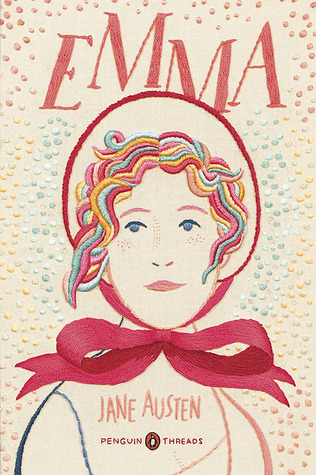
EmmaCovers

In April, I wrote a post on Volume 1 of Emma, sharing the thoughts that had come to me during my Jane Austen’s group’s current slow read of the novel. This month, I’m sharing some ideas that Volume 2 raised for me.

I wrote in my Volume 1 post that, during this read, what popped out for me was the idea of young people lacking guidance. It relates to issues like character development and to themes like parenting (which Austen regularly explores in her novels.) The question with these slow reads always is, will an idea that pops up in one Volume continue in the next? Well, in this case my answer is yes and no.

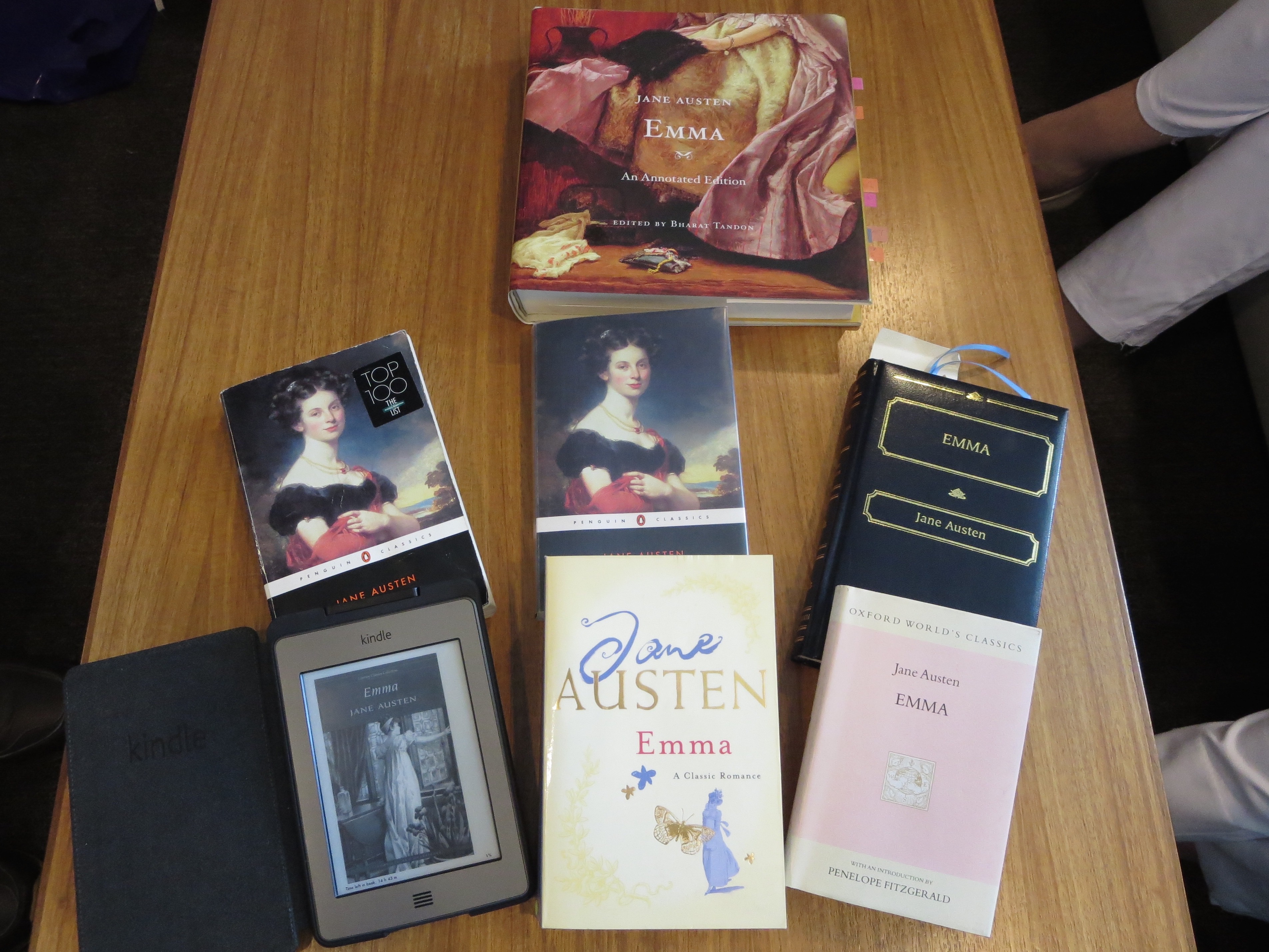
Jane Austen, Emma, Penguin

What I mean by this is that this notion expanded for me in Volume 2 to encompass the idea of “nature versus nurture”. Now, I’m not saying that Austen was specifically engaging in that debate, but that she has a lot to say about both aspects of our character. Before I continue, I will just share that I did wonder when the “nature versus nurture” debate started?

My searches, including via Wikipedia and two AI services, revealed that while ideas about innate (nature) vs. learned traits (nurture) can be traced back to ancient philosophy, the “nature versus nurture” debate, as a formal concept, began in the mid-1800s with Francis Galton, a cousin of Charles Darwin, who coined the term in his 1874 publication, “English Men of Science: Their Nature and Nurture”. In case you are interested, Chat GPT advised that philosophers like Plato and Aristotle debated discussed the role of “heredity and environment in shaping individuals” with Plato leaning towards nature (“innate knowledge”) and Aristotle towards nurture (“experience and environment”). And Wikipedia identifies Chen Seng having asked a similar question in 209 BCE. These aren’t the only people to have thought about the question, and Wikipedia’s article is useful if you are interested. But I’ll move on as the history of the debate is not my focus here.

What kept popping up for me – as I looked to see how my guidance-of-young-people theme was developing – were various comments Austen was making about nature and nurture. I’ll share just a few.

The first one to come to my attention in Volume 2, concerned Jane Fairfax, who was orphaned as a toddler and brought up, at first, by her grandmother, Mrs Bates, and aunt, Miss Bates. Austen describes her as a three-year-old

her being taught only what very limited means could command, and growing up with no advantages of connection or improvement to be engrafted on what nature had given her in a pleasing person, good understanding, and warm-hearted, well-meaning relations.” 

So, “nature had given her” a good start, and her relations had nurtured her as best they could with their “very limited means”. However, soon after, the Campbells (the family of a friend) had taken her in:

“She had fallen into good hands, known nothing but kindness from the Campbells, and been given an excellent education. Living constantly with right-minded and well-informed people, her heart and understanding had received every advantage of discipline and culture”.

And then, Austen seems to make the point that Jane Fairfax’s innate character, her disposition, was such that good nurturing had found fertile opportunity: “Her disposition and abilities were equally worthy of all that friendship could do…” Unfortunately, with no money, her destiny looked likely to be governessing, which the Campbells knew and did their best to prepare her for, but that’s another story …

As for Frank Churchill, in my last post regarding guidance, I noted that Austen suggests that, with his guardian family (his aunt and uncle at Enscombe), he had been left to his own devices with little guidance other than “his own comfort”. In this volume, Austen says more about his nature

“He seemed to have all the life and spirit, cheerful feelings, and social inclinations of his father, and nothing of the pride or reserve of Enscombe.”

It seems that at least some of the Churchills’ nature had not been nurtured into Frank. Ironically, it’s Emma’s father, Mr Woodhouse, who identifies some flaws in his behaviour, calling him “not quite the thing”, though his reasons are fussy.

And then there’s the third character whom we meet in Volume 2, Mrs Elton. These are Emma’s thoughts, and she is a snob, but nonetheless, she hones in on some points relevant to my thinking:

and the quarter of an hour quite convinced her that Mrs. Elton was a vain woman, extremely well satisfied with herself, and thinking much of her own importance; that she meant to shine and be very superior, but with manners which had been formed in a bad school, pert and familiar; that all her notions were drawn from one set of people, and one style of living; that, if not foolish, she was ignorant, and that her society would certainly do Mr. Elton no good.

We don’t know how much of this comes from Mrs Elton’s nature, but Emma does lay a much blame for her behaviour and character on her nurture.

Then there’s sweet Harriet, whom we met in Volume 1, and whom Emma considered, then, “not clever, but she had a sweet, docile, grateful disposition” and only needed to be “guided by any one she looked up to”. In Volume 2, her nature is again referenced, in terms of “the many vacancies of Harriet’s mind”! Poor Harriet. What will happen to her? Wait for Volume 3!

Finally, it’s Emma’s brother-in-law Mr John Knightley, who shows particular sense, when he provides these instructions to Emma on caring for his sons while he’s away:

” .. Do not spoil them, and do not physic* them.” 
“I rather hope to satisfy you both,” said Emma; “for I shall do all in my power to make them happy, which will be enough for Isabella; and happiness must preclude false indulgence and physic.”

[* Meaning, don’t medicate them as their mother, Emma’s sister, is wont to do.]

There’s no reference here to specific moral, or any other education, but we can infer from this, and our knowledge of the man, that he is well aware of the importance of good nurturing to his sons.

Of course, there were other issues that intrigued me in Volume 2, but these ideas are the ones I want to document this go round with Emma.

Any thoughts?

Jane Austen, Mansfield Park (Vol. 3)

Mansfield Park book covers

A year ago, my Jane Austen group did a slow read of Mansfield Park, meaning we read and discussed it, one volume at a time, over three months. I posted my thoughts on volume 1 (chapters 1 to 30), and volume 2 (chapters 19 to 31), but I missed the third meeting, and never wrote up the final volume (chapters 32 to 48). However, this year my reading group scheduled Mansfield Park for our Classic read, so I’m taking the opportunity to share my thoughts on that last volume.

But first, a brief intro. The reading group member who recommended we read Mansfield Park did so because she wanted to see whether she would better like this, her least favourite Austen, on another read. She didn’t. I understand this. Mansfield Park is regularly identified as Austen’s hardest book to like. It feels prudish to modern eyes; its protagonist Fanny isn’t exciting nor is her romance; and it is more serious and certainly less sparkling than its predecessor, Pride and prejudice. Re this latter point, Jane Austen collected opinions on the novel from friends, family and others, and reported that one Mrs Bramstone “preferred it to either of the others — but imagined that might be her want of Taste — as she does not understand Wit.”

Now, my thoughts …

Volume 3 starts the day after Fanny has rejected Henry Crawford’s proposal. As someone in my reading group said, all the novel’s action takes place in the final chapters, and I mostly agree, although significant events do take place in the previous volumes, including the visit to Sotherton and the plan to put on the play, Lovers vows.

I wrote in my first two posts that what was striking me most was the selfishness, or self-centredness, of most of the characters. It suggested to me that Austen was critiquing the selfishness/self-centredness of the well-to-do, and how this results in poor behaviour, carelessness of the needs of others, and for some, in immoral behaviour. (I think we could equate these ideas with today’s concerns about “entitlement”.) This thread continued in volume 3. Indeed, here is where it all comes home to roost, confirming my sense that Mansfield Park is fundamentally about morality.

Fanny is clearly the novel’s moral centre. She quietly observes, and reflects on, what goes on around her. As one of my reading group members said, it is through her eyes, her thoughts, that we see the novel’s world. In the first chapter of volume 3, Sir Thomas speaks to Fanny about Henry’s proposal, explaining why she should accept him. Henry is

a young man … with everything to recommend him: not merely situation in life, fortune, and character, but with more than common agreeableness, with address and conversation pleasing to everybody.

Then he adds pressure. She owes Henry gratitude for his role in obtaining advancement for her brother in the navy, and marrying Henry is her duty to her family as such a marriage can only help them. Sir Thomas is therefore perplexed and shocked at Fanny’s ongoing refusal – despite these persuasions – to consider Henry. He asks:

“Have you any reason, child, to think ill of Mr. Crawford’s temper?”
“No, sir.”
She longed to add, “But of his principles I have” …

However, she feels that to tell Sir Thomas of her observations of Henry’s unprincipled behaviour towards Julia and the engaged Maria would betray them – so, she’s caught and says nothing. She hoped Sir Thomas – “so discerning, so honourable, so good” – would accept her “dislike” as sufficient reason. Unfortunately, not only can he not accept it, but he accuses her of wilfulness and ingratitude. It’s mortifying.

To his credit, however, Sir Thomas backs off, planning to let nature take its course, and, with a little judicious encouragement from the sidelines, he believes Henry will win her round. So Henry continues to press his suit, and Fanny continues to hold steady, reflecting at one point on “his want of delicacy and regard for others”. A few chapters on, Mary Crawford also presses her brother’s suit, but Fanny – she who is called wimpy by many modern readers – pushes back, telling Mary,

I had not, Miss Crawford, been an inattentive observer of what was passing between him and some part of this family in the summer and autumn. I was quiet, but I was not blind. I could not but see that Mr. Crawford amused himself in gallantries which did mean nothing.

While Fanny is coping with this, Edmund is moving forward with his plans to win Mary Crawford’s hand, despite her rather telling hatred of his chosen profession as a clergyman. Fanny – not altogether disinterested it has to be admitted – had observed Mary’s poor values, but it takes Edmund a long time to see her for what she is, for her lack of “principle”, her “blunted delicacy and a corrupted, vitiated mind”. Edmund is convinced that Mary had been corrupted by the influence of others. He talks of “how excellent she would have been, had she fallen into good hands earlier” (instead of those poor influences she had in London. City versus country values is another thread running through this novel.)

I could expand more on this selfishness-leading-to-poor-behaviour-or-immorality theme because examples abound in the volume, but my aim here is to just share some ideas. And, I want to share another one…

I also mentioned another developing theme in my post on volume 1, the education of Sir Thomas. Interestingly, this is related to something I am observing in my current slow read of Austen’s next novel Emma, that of the quality of guidance given to young people and what happens when that guidance is faulty, misguided and/or not grounded in good moral teaching. It’s not a new theme for Austen, as you can see in Edmund’s comments above about Mary Crawford. But, it’s Sir Thomas’s learnings as one of those who does the guiding that I want to focus on.

Like many of Austen’s characters, in fact, Sir Thomas engenders a variety of reactions from readers. Some see him as harsh and uncompromising. It’s easy to argue this when you see the way his children – and niece – fear him. But others, and I am one, see him as a father trying to bring up his children as best he can, with little help from the indolent Lady Bertram. Fanny, our moral centre, talks of his “parental solicitude”. We see hints of his kindness in volumes 1 and 2, but it is in volume 3 that we see what he is really made of. He’s a man of his times, of course, but one who had his children’s best interests at heart and who realised too late that his raising of them had been misguided.

Now, before I continue, I want to make a little comment about style and structure. For most of the book, though there are departures, we are in Fanny’s head, seeing what she sees, thinking what she thinks, but in the book’s final chapter, Austen breaks the fourth wall and talks to us directly. It opens with a favourite quote:

Let other pens dwell on guilt and misery. I quit such odious subjects as soon as I can, impatient to restore everybody, not greatly in fault themselves, to tolerable comfort, and to have done with all the rest.

“I quit”, she says, drawing attention to the fact that she is telling us a story, and she continues this way:

My Fanny, indeed, at this very time, I have the satisfaction of knowing, must have been happy in spite of everything…

The rest of the chapter wraps up the novel and her characters. She devotes a few pages to “poor Sir Thomas”, telling us that he “was the longest to suffer” due to “the anguish arising from the conviction of his own errors in the education of his daughters”. He reflected on the negative impact on Maria and Julia of the “totally opposite treatment” they had lived under

where the excessive indulgence and flattery of their aunt had been continually contrasted with his own severity. […]

Here had been grievous mismanagement; but, bad as it was, he gradually grew to feel that it had not been the most direful mistake in his plan of education. Something must have been wanting within, or time would have worn away much of its ill effect. He feared that principle, active principle, had been wanting; that they had never been properly taught to govern their inclinations and tempers by that sense of duty which can alone suffice. They had been instructed theoretically in their religion, but never required to bring it into daily practice. To be distinguished for elegance and accomplishments, the authorised object of their youth, could have had no useful influence that way, no moral effect on the mind. He had meant them to be good, but his cares had been directed to the understanding and manners, not the disposition; and of the necessity of self-denial and humility, he feared they had never heard from any lips that could profit them.

Just look at those last few sentences … there, I think, is Austen’s driver for this novel. Maria and Julia had been allowed to focus on “elegance and accomplishments” with no attention paid to “the moral effect on the mind”. Mary Crawford is similarly misguided.

Jane Austen, as we know, could be witty and acerbic with the best of them, but in this most serious novel of hers she may have shared the moral and social values dearest to her heart.

Thoughts?

Jane Austen, Emma (Vol. 1, redux 2025)

EmmaCovers

As long-time readers here will know, my Jane Austen group did a slow read of Austen’s novels over several years, starting in 2011. In 2022, we decided it was time to repeat the exercise, and are again reading them chronologically, one each year, making 2025 Emma’s turn.

Our slow reads involve reading and discussing the chosen novel, a volume at a time. We “try” to read as though we don’t know what happens next, to help us focus closely on what we think Austen is doing. Of course, we can’t read like a first-time reader, but it’s a useful discipline.

We always wonder whether this time, after so many reads, we will see anything new or fresh. But, we always do. Just the march of time, with its impact on our knowledge, experience and tastes, means we see the books differently. Take Emma, for example …

Jane Austen, Emma, Penguin

A few re-reads ago, what stood out for me was its beautiful plotting. There’s barely a word or action that doesn’t imply or lead to something telling, even if we are unaware at the time. From my last major re-read, in 2015, I noticed how often the word “friend” or the notion of “friendship” was appearing. The novel starts with Emma losing her governess-then-companion Miss Taylor to marriage. They’ll remain friends but Emma is left alone with her gentle but fussy father. So, she nurtures a friendship with the 17-year-old Harriet. In my post on rereading Volume 1, I explored the idea of friendship, and then watched in Volumes 2 and 3 to see whether the idea continued. It did. This is not to say that what we might identify in a slow read will overtake previous ideas, but that these re-reads enable us to tease out more of the details, which usually results in a deeper understanding of the whole.

So, what would I find this time? I did consider choosing something to look for, like the role of letters or music in the novel, but decided to just see what played out. Sure enough, something popped up, the idea of young people lacking guidance. It relates to issues like character development and to themes like parenting. And, I found it all there in the first few chapters.

The novel begins:

Emma Woodhouse, handsome, clever, and rich, with a comfortable home and happy disposition, seemed to unite some of the best blessings of existence; and had lived nearly twenty-one years in the world with very little to distress or vex her.

This can be teased out in many ways, but, remembering that “very little to distress or vex her”, I’m focusing on where Austen goes next. As explained above, the novel opens with Emma’s governess-then-companion Miss Taylor having just married, so Emma, who lost her mother when she was very young, is left alone with her “valetudinarian” father, “a nervous man, easily depressed”. She indulges him, as only a devoted daughter can, but otherwise, she is untrammelled. Austen describes her life, to this point, in the third and fourth paragraphs:

Emma doing just what she liked; highly esteeming Miss Taylor’s judgment, but directed chiefly by her own.

The real evils indeed of Emma’s situation were the power of having rather too much of her own way, and a disposition to think a little too well of herself.

And there it is, “directed chiefly by her own [judgement]”. Neither Emma’s “nervous” father nor the mildly-tempered Miss Taylor/Mrs Weston question or guide her. However, in the same chapter, we learn that there is one who does, her brother-in-law Mr Knightley, “a sensible man about seven or eight and twenty”. Austen writes that:

Mr. Knightley, in fact, was one of the few people who could see faults in Emma Woodhouse, and the only one who ever told her of them …

We see several examples of his chiding her in Volume 1, including about her interference in Harriet’s response to a marriage proposal. We also see him discussing Emma with Mrs Weston, telling her that she had been a good companion to Emma but had also been better at submitting her will to Emma than in giving Emma the “complete education” he thinks she needed.

Now, moving on to Chapter 2, we hear of another young person, the three or four and twenty, Frank Churchill. His mother, too, had died when he was very young, and, for a number of reasons, he

was given up to the care and the wealth of the Churchills [aunt and uncle], and he had only his own comfort to seek, and his own situation to improve as he could.

The implication here is that he too had been left to his own devices with little guidance other than “his own comfort”. It occurred to me, during this reading, that he is being set up as a parallel and perhaps eventual foil to Emma. But, hold that thought, because Frank does not physically appear in Volume 1. There is, however, a telling discussion at the end of the Volume about his not coming to Highbury to meet his father’s new wife, Mrs Weston. Mr Knightley – note, it’s him again – argues that while Frank’s aunt and uncle are given as the reason:

There is one thing, Emma, which a man can always do, if he chooses, and that is, his duty.

Frank simply needed to use the “tone of decision becoming a man”, and there would have been “no opposition”.

Finally, there is a third example, the aforementioned Harriet Smith, who is introduced in Chapter 4. She

certainly was not clever, but she had a sweet, docile, grateful disposition; was totally free from conceit; and only desiring to be guided by any one she looked up to.

The natural child of an unknown person who had paid for her schooling and now for her boarding at that school, Harriet has no parent to guide her, only school teachers – and now, the flawed Emma. By the end of Volume 1, it is not going well for Harriet, who has lost one real and one imagined suitor due to Emma’s guidance.

So, as Volume 1 progresses through its 18 chapters, we see some of the fallout of Emma’s being a law unto herself and ignoring the wisdom of others. I look forward to seeing if this idea is followed through in Volume 2. Is it important to Austen’s world view? Watch this space …

Alice Ruth Moore, A carnival jangle (#Review)

Over the last two years I worked my way through the anthology Great short stories by contemporary Native American writers that was sent to me by my American friend Carolyn. It introduced me to many writers I hadn’t read before, and, valuably, to the issues and concerns facing some of America’s first peoples. Many of these issues – such as identity, and the long-lasting, all-encompassing fallout from dispossession – overlap with the issues First Nations Australians are confronting. It was an excellent reading project, so I was thrilled when, a year ago, Carolyn sent me another Dover anthology, Great short stories by African-American writers. I’ve read a few more of these authors than I had of the Native American collection, but not many, so I’m looking forward to another worthwhile reading project. Thanks again, Carolyn!

Alice Ruth Moore

The first thing to say about Alice Ruth Moore is that she is better known as Alice Dunbar Nelson, which is the name Wikipedia uses. Born Alice Ruth Moore in New Orleans in 1895, she married three times – Paul Laurence Dunbar (1898–1906), Henry Arthur Callis (1910–1916), and Robert J. Nelson (1916–1935). Poet Dunbar died in 1906, but it had been an abusive relationship and she’d left him before his death. Her marriage to physician and professor, Callis, ended in divorce, and she did not it seems take – or keep – his name. Her final marriage was to poet and civil rights activist, Nelson, and this marriage lasted for the rest of their lives. His name she used, but she also retained Dunbar. Fascinating.

A poet, journalist and political activist, Dunbar Nelson, who had a black mother and white father, was among the first generation born free in the South after the Civil War. She was also one of the prominent African Americans involved in the Harlem Renaissance (about which I wrote in my post on Nella Larsen’s Passing.) She lived in New Orleans for 21 years, and briefly taught primary school there, before moving to Boston and then New York, where she co-founded and taught at White Rose Mission, a school for coloured working girls (in the non-euphemistic meaning of the term!) She also lived in Washington D.C., Delaware and Pennsylvania.

Racism was an important issue for her, but she also took a wider view of human rights. She was an activist, for example, for African American’s rights and women’s rights. By the 1920s, she was concerned about social justice and the struggles of minorities in general. Wikipedia’s article concludes with this:

Much of Dunbar-Nelson’s writing was rejected because she wrote about the color line, oppression, and themes of racism. Few mainstream publications would publish her writing because they did not believe it was marketable. She was able to publish her writing, however, when the themes of racism and oppression were more subtle.

“A carnival jangle”

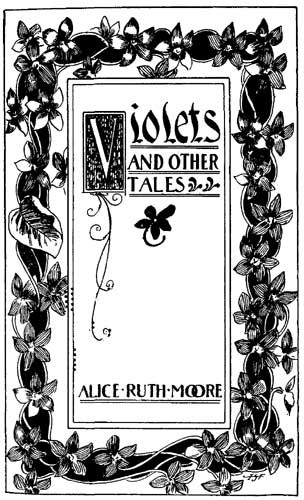
“A carnival jangle” appeared in her first collection of stories and poems, Violets and other tales, which was published by The Monthly Review in 1895, while she was still in New Orleans. She wrote a brief, self-deprecating introduction to the collection, commenting on the number of books being foisted on the market, and then offering her “maiden effort, — a little thing with absolutely nothing to commend it, that seeks to do nothing more than amuse”. Many of “the sketches and verses” had appeared in before, but many others were new.

There is also a preface by Sylvanie F. Williams (d. 1921) whom Wikipedia describes as New Orleans-based “educator and clubwoman“. (Click on the link to find out more about the women’s club movement in the USA.) She says the author ‘belongs to that type of “brave new woman who scorns to sigh”, but feels that she has something to say, and says it to the best of her ability”. However, she is also young, “just on the threshold of life, and with the daring audacity of youth makes assertions and gives decisions which she may reverse as time mellows her opinions, and the realities of life force aside the theories of youth”. Love this.

Williams also writes that “there is much in this book that is good; much that is crude; some that is poor”. I haven’t read any Moore/Dunbar Nelson, so I have no way of knowing where “A carnival jangle” sits in terms of her oeuvre, but it certainly feels like a standout in this collection.

Set during New Orleans’ Mardi Gras festival, “A carnival jangle” is fundamentally a mistaken identity story. It is just 4 pages, but delving into it – as the podcasters at CodeX Cantina did – reveals an impressively complex story offering multiple readings. I don’t usually go looking for analyses before I write my posts, but I came across CodeX Cantina when I was researching who Moore/Dunbar Nelson was. I’m glad I did because they teased out some culturally specific aspects that I didn’t know. For example, I completely misread the use of “Indians” in the story. These are the New Orleans or Mardi Gras Indians – an African-American carnival subculture, not Native Americans.

The story opens:

There is a merry jangle of bells in the air, an all-pervading sense of jester’s noise, and the flaunting vividness of royal colors; the streets swarm with humanity, — humanity in all shapes, manners, forms, — laughing, pushing, jostling, crowding, a mass of men and women and children, as varied and as assorted in their several individual peculiarities as ever a crowd that gathered in one locality since the days of Babel.

It’s tight and short, and tells of a young girl named Flo, who, hovering “between childhood and maturity”, is drawn away from her “unmasked crowd” by a “tall Prince of Darkness”, “a shapely Mephisto”, who promises to “show [her] what life is”. She is swept away to a costume shop and disguised as a “boy troubadour”, before joining the masked dancers – but things don’t turn out the way she is promised.

The two podcasters discussed “the tower of Babel”, which is alluded to in the opening paragraph and which suggests the idea of people coming together, until all falls apart, and the Faustian bargain, which is implied through the narrative and which presages a promise not fulfilled. The masked society can be understood as one in which all are equal, regardless of race or gender. However, masked people can also be invisible, unknown, and this tension between freedom and danger underpins this story.

The language is vibrant and lush capturing the excitement of the carnival, but is also constantly subverted by references and allusions to darker things. Carnivals, after all, tend to encompass opposing ideas – fun versus pandemonium, humour versus derision. The revellers here include “jesters and maskers, Jim Crows and clowns, ballet girls and Mephistos, Indians and monkeys…”, an odd and unsettling assortment which reflects not only traditional carnival characters but the diversity of New Orleans, and the racial tensions developing as Jim Crow laws were being enacted. Moore’s New Orleans is a place in flux, and the carnival motif is a perfect vehicle for conveying that.

The CodeX Cantina podcasters don’t talk much about Flo, and the fact that we don’t know what she wants or thinks. Described as “the quietest and most bashful of the lot” when she is drawn away, she seems to have no choice or agency in what happens to her. Is this because she’s simply a tool in the wider story, or is there a comment on gender, or both? What does it mean that she’s white?

“A carnival jangle” is a sophisticated story about a complex place and time, written by someone who was just starting her writing journey. It warrants more teasing out than I’ve done here, because it has so many angles to think about. Do read it, and, if you have time, listen to the CodeX guys. They don’t have all the answers but they do some good thinking.

Alice Ruth Moore
“A carnival jangle” (1893)
in Christine Rudisel and Bob Blaisdell (ed.), Great short stories by African-American writers
Garden City: Dover Publications, 2015
pp. 1-4
ISBN: 9780486471396
Available online at louisiana-anthology.org

Anton Chekhov, The lottery ticket (#Review)

Back in April I posted on Majorie Barnard’s short story “The lottery” for Kaggsy’s and Simon’s 1937 Year Club. Commenting on that post, my American friend Carolyn said that in looking for Barnard’s story she found Chekhov’s “The lottery ticket”, written fifty years earlier in 1887. Of course, I had to read it too. There are enough similarities to make us think that Barnard very likely had read Chekhov’s story, but had decided to put her own spin on it. Whether we are right or not, the two stories make for an interesting comparison. I will try to discuss them without spoiling them, but there will be hints.

Both stories deal with a married couple and their reaction to the idea of winning a lottery, and both stories are told third person from the husband’s point of view. Marjorie Barnard’s is set in suburban Sydney, and explores what happens when a wife wins the lottery. She doesn’t tell him immediately so he finds out from others who had read it in the newspaper. On his way home from work, he thinks about what it all means, how “he” might spend it, and he then starts to find fault with his wife. She “wasn’t cheery and easy going” and hadn’t aged well (not as well as he had, anyhow), and so on. It ends, however, with the wife having the upper hand. Barnard’s story reflects her interest in gender, in how little agency women had, and how constricted their lives were.

This is not Chekhov’s prime interest. He is writing in a different place and time. In his story, it is also the wife who had bought the ticket, but it’s the husband who checks the newspaper and sees that there’s a “probability” that her ticket had won. However, rather than reading on and confirming whether that’s the case he suggests they wait:

Looking at his wife, Ivan Dmitritch gave a broad, senseless smile, like a baby when a bright object is shown it. His wife smiled too; it was as pleasant to her as to him that he only mentioned the series, and did not try to find out the number of the winning ticket. To torment and tantalize oneself with hopes of possible fortune is so sweet, so thrilling!

The hope of course is that they will have a lovely dream about the possibilities, those dreams we all occasionally have (even if we don’t buy lottery tickets!) But, if you know Chekhov, you’ll know that he is unlikely to be interested in unrealistic dreams, but in how ordinary people traverse life and their relationships. So, he lets Ivan dream – of “a new life … a transformation”. “That’s not money,” he says, “but power, capital!” He imagines paying off debts, buying “an estate”, going abroad. Occasionally, he notices that his wife is also dreaming. But, it comes to a head when he realises she’s dreaming of going abroad too. What? She’d be no fun to go with. She’d just talk about the children, complain about the cost of the food, not to mention want to spend money on looking after her relations,

And for the first time in his life his mind dwelt on the fact that his wife had grown elderly and plain, and that she was saturated through and through with the smell of cooking, while he was still young, fresh, and healthy, and might well have got married again.

So the story continues with this man who was, at the beginning, “very well satisfied with his lot” – including presumably, having his wife at home, cooking his meals, caring for the children – feeling very different about his life by the end.

The irony, in Chekhov’s as well as Barnard’s story, is that the lottery ticket was the belittled wife’s. Barnard, however, gives her wife agency, whereas Chekhov’s focus is on how money and greed can destabilise (or, is it reveal?) one’s values. However, the little point is still there, in the irony, in that early description of the husband with his “senseless smile, like a baby when a bright object is shown it”, and in so many of the husband’s attitudes towards his wife. Gender issues are not so forward in the resolution, but they are part of the picture.

Anton Chekhov
“The lottery ticket”
First published 1887
Available online at Classic Shorts

Jane Austen, Mansfield Park (Vol. 2)

Mansfield Park book covers

As I wrote last month, my Jane Austen group is doing a slow read of Mansfield Park this year, meaning we are reading and discussing the novel, one volume at a time, over three months. This month was Volume 2 (that is, chapters 19 to 31). It starts with the return of the patriarch, Sir Thomas Bertram, from his plantation in Antigua, and ends with Fanny rejecting Henry Crawford’s proposal.

Last month, I said that the thing that struck me most in volume 1 was the selfishness, or self-centredness, of most of the characters. I wondered whether Austen was writing a commentary on the selfishness/self-centredness of the well-to-do, and how this results in poor behaviour, carelessness of the needs of others, and for some, in immorality (however we define that). Having now read volume 2, I’m still on this path – together with a couple of other, somewhat related ideas, education, which I also mentioned last month, and parenting.

But first, the selfishness and self-centredness continues. In this volume, Maria marries and she and Julia leave Mansfield Park, leaving Fanny the only young woman at the Park. Mary Crawford, over in the parsonage, no longer has a young female friend to entertain her, so her sister Mrs Grant thinks Fanny would suffice:

Mrs. Grant, really eager to get any change for her sister, could, by the easiest self-deceit, persuade herself that she was doing the kindest thing by Fanny, and giving her the most important opportunities of improvement in pressing her frequent calls. 

Here is one of the reasons I love Austen. She knows exactly how we justify our actions to ourselves.

Anyhow, as a result, Fanny spends more time with Mary, as a favour to others, resulting in, Austen writes,

an intimacy resulting principally from Miss Crawford’s desire of something new, and which had little reality in Fanny’s feelings.

Examples like this pepper the volume. Lady Bertram doesn’t want Fanny to accept a dinner invitation because it would affect her “evening’s comfort”. After all, as Austen writes, “Lady Bertram never thought of being useful to anybody”. Late in the volume, Lady Bertram rises to the occasion, or thinks she does. She sends her maid to help Fanny dress for her first ball, and says so during the ball when Fanny’s appearance is complimented. “Chapman helped her to dress. I sent Chapman to her.” Yes, she did, but only after she was dressed and too late to help Fanny who was already dressed! Austen adds:

Not but that she was really pleased to have Fanny admired; but she was so much more struck with her own kindness in sending Chapman to her, that she could not get it out of her head.

Mrs Grant, Mary and Lady Bertram aren’t the only selfish, self-centred people in this volume. There’s the egregious Henry Crawford who had played, in volume 1, with the feelings of Maria and Julia, and then leaves Mansfield, in volume 2, with nary a word to either of them:

Henry Crawford was gone, gone from the house, and within two hours afterwards from the parish; and so ended all the hopes his selfish vanity had raised in Maria and Julia Bertram.

That’s not the end of Henry, though, because he’s soon back, telling his sister Mary, “my plan is to make Fanny Price in love with me”. In my Jane Austen group, we discussed that as his frivolous flirtation moved to something more serious – as he started to truly see, we believe, Fanny’s value – he gives no thought to whether Fanny will love him. That’s a given! He’s a catch!

There’s more I could say on this theme – I haven’t even mentioned Mrs Norris – but there are other ideas to talk about. I started to see in volume 2 that Mansfield Park is also about parenting, and, relating to this, I’d argue that in this volume we see the beginning of the education of Sir Thomas.

However, Sir Thomas is a controversial character in my group. Some detest him, rather like Mr Yates who had never seen a father so “unintelligibly moral, so infamously tyrannical” as Sir Thomas. But, along with some others, I see Sir Thomas differently.  Sure, he’s formal, but he loves his children – and he has no support in that wife of his. When he realises how silly Maria’s fiancé is, he wants to give her an out. Unfortunately, Maria wants to escape home and its restraints, so doesn’t take it. Sir Thomas is – admittedly – relieved because it suits his wish “to secure a marriage which would bring him such an addition of respectability and influence”. An example of new money, he’s a product of his times, and a “good” marriage can only help! However, as the volume progresses, Sir Thomas looks out for Fanny, wanting to give her opportunities, despite Mrs Norris’ attempts to keep puttng Fanny down.

For me, a recurring theme in Austen’s novels, in fact, is parenting. Lady Bertram is completely hands-off, letting Mrs Norris (as I mentioned in volume 1) have too big a hand in her daughters’ upbringing, to their detriment. Sir Thomas, on the other hand, is strict and – well, let’s talk about how it all plays out in volume 3. Here, though, he is kind to Fanny and wants well for her.

I have more to say on this, but I’ll leave it here as there are two ideas I’d like to share from my group’s discussion.

One of our members talked about the Australian critic John Wiltshire’s discussion of the disempowerment of women in his book Jane Austen and the body. He argues that caring for servants and the working class is a traditional role for genteel but otherwise disempowered woman, but that “this benevolence has a Janus face” because it replicates the inferior-superior social relationships that characterise the wider society. Mrs Norris, Wiltshire argues, “punishes others for her own dependency and frustration, whilst being able to hide this from herself in the guise of generosity to the recipients and loyal service to the system”.

Similarly, all at Mansfield Park have, through their adoption of poor Fanny Price “basked in the pleasure of benevolence”. But this has let Fanny become Mrs Norris’ victim. Both Fanny and Mrs Norris, says Wiltshire, are outsiders, “fringe-dwellers”; both are single, defenceless females who are “not part of the family except by courtesy. The one lives in the small White House, on the edge of the estate, the other in the little white attic at the top of the house”. Wiltshire argues that Fanny becomes the scapegoat upon whom Mrs Norris can “exercise her frustrations and baffled energies”. By scolding and punishing Fanny, she can “appease her own sense of functionless dependency and reaffirm the strictness of the social hierarchy which gives meaning to her life”. An interesting idea which I plan to think more about. It doesn’t excuse Mrs Norris, but it might explain her!

The other idea I want to share came from a young American visitor to our meeting. While she had read Austen and other classic authors, she said that her main reading, currently, is romance and general fiction. So, as she was reading Mansfield Park, she looked for tropes common to the romance genre. And, she found two significant ones, which could cement Austen’s reputation as the mother of the romance genre! The first trope is the idea of friends (or, here, cousins) becoming lovers, and the other is the romantic heroine’s belief that she’s “not like other girls”. She’s not as pretty, not as outgoing, and so on, as her rivals. Fanny makes this sort of observation in a discussion with Edmund about how she likes hearing Sir Thomas talk about the West Indies. She says she is “graver than other people” and concludes:

… but then I am unlike other people, I dare say.

I loved this insight from a first-time reader of the novel.

So much more to say … but there will be more opportunities to talk Austen, I dare say! Meanwhile, thoughts?

Monday musings on Australian literature: The mysterious 6×8

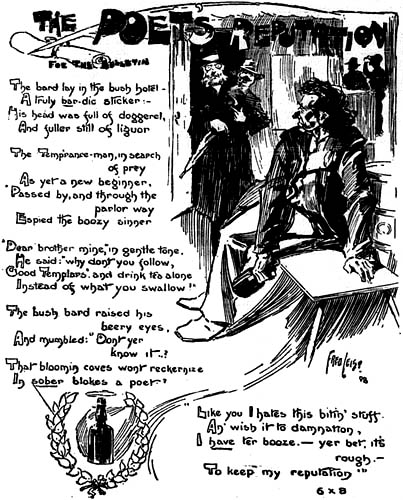
In a long past Monday Musings I mentioned the names of several people who had commented on the state of Australian literature. Many of these were pseudonyms, including the intriguingly named “6×8”. I decided to dig further, and back in 2015, I pretty quickly discovered that his “real” name was Dick Holt. (It’s not always easy to track down pseudonyms used in the newspapers.)

First published, The Bulletin, 29 October 1898, from Middlemiss

I didn’t find a lot about him back then – besides his own writings – but from what I could gather, I ascertained that Dick Holt had travelled the outback doing charcoal drawings and writing articles for the Bulletin and other journals and newspapers of the time. I presume his “6×8″ pseudonym refers to the old (non-metric) picture size of 6″ x 8”, and the fact that he included drawings in his articles. Presumably there’s a metaphorical layer to this pseudonym, too, in that his stories provided little windows on his world.

In the 1890s, according to a 1934-written reminiscence by “Stockwhip”, Holt travelled with Henry Lawson. “Stockwhip” describes him as ‘the jocular writer and “charcoal” artist, Dick Holt” and says he was “a well-known writer to the Sydney Bulletin and Western Herald of Bourke”. He had his own newspaper column “On the Wallaby”. This title references the phrase “on the wallaby track”, which is Australian slang for travelling from place to place looking for work, which is exactly what he and Lawson were doing in Stockwhip’s anecdote. His columns, at least those I’ve seen, ran anywhere from 1500 to 3000 words, and tended to comprise a collection of anecdotes.

I haven’t found a biography for him – he doesn’t appear in the Australian Dictionary of Biography, for example – but returning to my old draft post this week in order to actually post it, I found that AustLit has documented him a little more. They give him as Richard Holt (a.k.a. Dick Holt, and also writing as 6 x 8), and say that he “wrote a weekly column called ‘On the Wallaby’ in the North Queensland Register from January 1899 to August 1920″. So, over twenty years. AustLit says he was born in 1868, and died ca. 1923 in Tasmania (though a reference to him in February 1923 said he was now “living near Melbourne”.) Anyhow, this roughly accords with my research, which had uncovered that he had died by the mid 1920s. The reference came from columnist, Bill Bowyang (pseudonym of Alexander Vindex Vennard, 1884-1947), who wrote the following little anecdote about him in 1926 in his column, “On the track”:

It was the late Dick Holt (‘6×8’) of ‘On the Wallaby’ fame in the ‘N.Q. Register’ who once stated that when he visited a bush township he always gazed into the jail yard to see if there was a load of wood within. If the wood was there it was a certainty that the police would be searching for some inebriated individual to use the axe or crosscut. The sight of that wood was sufficient for Dick Holt, and without wasting any time he always passed on to another town where there was no lone wood piled up in the jail yard.

Holt was, it seems, a character – but one of his time. I’ve only read a tiny proportion of his voluminous output, much of which is in a jocular vein. (Indeed, a 1923 article, identifying Bill Bowyang as his successor, describes them as writing “racy bush yarns”.)

In the post that inspired this one, I shared that “6×8” had criticised Australian literature as being characterised by too much exaggeration of characters and incidents, to which another had replied that the problem was not this sort of exaggeration but a “diseased hankering after the abnormal”. Anyhow, “6×8” clearly didn’t think he was exaggerating character and incident – and perhaps not. But he did like to put a humorous spin on his wanderings about the bush, commenting on anything from a terrible Australian stamp design to what you can read from the newspaper in which the butcher has wrapped your meat. He also saw the poverty that often attended life in the “backblox” noting that country people didn’t like to pay newspaper subscriptions (which affected him), school masters, and parsons. He frequently makes comments like “do these people expect parsons [or whomever] to live without food and clothes?”

However, there’s a problematic side too. Given he’s an outback “wallabist”, he comes across many characters, including non-white Australians. He identifies First Nations Australians with terms like “black fellows” or “dusky brethren” or “dark son of the forest” or, even, “n****r”, and the Chinese are “chows”. In one instance, when listing people of Asian and Islander origins, he adds “and other colored abominations”. I looked for anything that suggested an awareness of the racism implicit in these terms, but I didn’t see it. This makes distressing reading, but for contemporary readers it’s instructive about the attitudes of the day to those they saw as other. Also, by mentioning these “others”, he also tells us about the people who populated Australia and something about their relationships with each other, which I’d argue is better than rendering them invisible.

You can see, perhaps, why I’ve taken a while to write this post, but in the end I thought there was value. Hope you agree …

Jane Austen, Mansfield Park (Vol. 1)

Mansfield Park book covers

This year my Jane Austen group is doing a slow read of Mansfield Park, which involves our reading and discussing the novel, one volume at a time, over three months. This month, we did Volume 1, which, for those of you with modern editions, encompasses chapters 1 to 18. It ends with the return of the patriarch, Sir Thomas Bertram, from his plantation in Antigua.

I’ve said this before, but I’ll say it again. Every time I re-read an Austen novel, I “see” something new, something new to me that is, because I can’t imagine there’s anything really new to discover in these much loved, much pored-over books. Sometimes my “new” thing pops up because in a slow read I see things I didn’t see before while I was focusing on plot, or character, or language, or … Other times, it might arise out of where I am in my life and what experiences have been added to my life since the previous read.

I’m not sure what is behind this read’s insights, but the thing that struck me most in the first volume this time is the selfishness, or self-centredness, of most of the characters. It’s so striking that I’m wondering whether Austen is writing a commentary on the selfishness/self-centredness of the well-to-do, and how this results in poor behaviour, carelessness of the needs of others, and for some, in immorality (however we define that.)

Mansfield Park has been analysed from so many angles. These include that it is about ordination (which Austen herself said was the subject she was going to write about); that it is a “condition of England” novel; and that it is about education. In the first chapter, in fact, Mrs Norris, the aunt we all love to hate, says

Give a girl an education, and introduce her properly into the world, and ten to one but she has the means of settling well, without farther expense to anybody.

The irony of course is that the sort of education that Mrs Norris supplies to the Bertram girls does not do them any favours. That’s not exactly where I’m going now, though we could argue that poor education – or poor upbringing – is behind much of the selfishness we see in the novel. So, maybe, I will end up talking about education by the end of the novel.

For now, however, I will share why I am thinking this way. For those of you who don’t know the plot, it centres around Fanny Price who, at the age of 10, is taken in by her wealthy relations, the Bertrams of Mansfield Park, to relieve her impoverished parents of one mouth to feed. Fanny Price is the Austen heroine people love to hate, but I’m not one of those haters. I believe that if you truly look at her character and her life, within the context of her situation and times, you will see a young girl whose good values and commonsense enable her to make the best of a very difficult situation.

That it is a difficult situation is made clear in several ways, including the fact that we are told in the opening chapter that she is to be treated as a second class citizen in the family. A “distinction” must be preserved; she is not her cousins’ equal. In the second chapter, we are told

Nobody meant to be unkind, but nobody put themselves out of their way to secure her comfort.

As the novel progresses, and the characters are introduced, they are, one by one, shown to be self-centred and/or selfish in one way or another. I won’t elucidate them all, but, for example:

  • Lady Bertram (her aunt) is, from the start, lazy and careless about the needs of others. Her own comfort, and that of her pug, supersedes all.
  • Mrs Norris (another aunt) is judgemental and parsimonious, ungenerous in mind and matter in every possible way.
  • Cousins Maria and Julia show no generosity to Fanny, unless it’s something that doesn’t materially affect them; they are “entirely deficient in … self–knowledge, generosity and humility”.
  • Cousin Tom “feels born only for expense and enjoyment”, and exudes “cheerful selfishness”.
  • Visiting neighbour, Henry Crawford, is “thoughtless and selfish from prosperity and bad example” and amuses himself by trifling with the feelings of Maria and Julia who provide “an amusement to his sated mind”.
  • Henry Crawford’s sister Mary is unapologetic about her selfishness, asking Fanny to forgive her, as “selfishness must always be forgiven…because there’s no hope of a cure”. This surely takes the cake!

And so it continues … the clergyman Dr Grant is an “indolent, selfish bon vivant”; and the self-important Mr Rushworth and the self-centred Mr Yates show no interest or awareness of the needs of others.

There are, of course, some redeeming characters. Cousin Edmund, in the first flush of love, can be thoughtless at times but it is his overall kindness that keeps Fanny going, and Mrs Grant also comes across as sensible and kind.

A couple of significant events occur in this volume – the visit to Mr Rushworth’s place at Sotherton, and preparations for staging a play, Lovers’ vows. These provide ample opportunity for the characters to parade their self-centredness. You can’t miss it. Fanny certainly doesn’t, as she watches those around her jockey for position in terms of their roles in the play:

Fanny looked on and listened, not unamused to observe the selfishness which, more or less disguised, seemed to govern them all, and wondering how it would end.

Fanny, however, also questions her own motives in refusing to take part in the play: “Was it not ill-nature, selfishness, and a fear of exposing herself?” But, in fact, she is the only one who is truly alert to the dangers within.

This “selfishness” theme is not, of course, the only issue worth discussing when thinking about Mansfield Park, as other members in my group made clear with their own discoveries. It is simply the one that stood out for me, during this re-read.

Thoughts anyone?