Canberra Writers Festival 2018, Day 1, Pt 1: A memoirist in conversation

It’s the last weekend August which means it’s the Canberra Writers Festival. This could become a habit. Wouldn’t that be nice – to have a regular writers’ festival here again, I mean. The Festival’s ongoing theme is Power, Politics, Passion, which is particularly appropriate this year, given last week’s shenanigans in Australian politics. (For those of you from elsewhere, we – though I use the term generally – managed to ditch yet another Prime Minister mid-term … but let’s not go into that now. The Festival is far more interesting.)

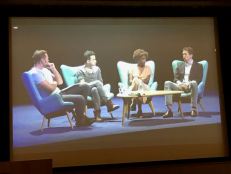
Do oysters get bored: A curious life: Rozanna Lilley in Conversation with Karen Middleton
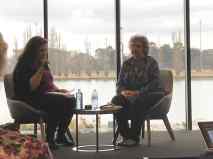
Karen Middleton and Rosanna Lilley

Karen Middleton and Rozanna Lilley (against a bright background)

My first session was a conversation with Rozanna Lilley about her memoir Do oysters get bored: A curious life. The interviewer, political journalist Karen Middleton, has appeared here before when she was the “participating chair” of a panel at the Festival Muse in 2017. It was good to see her again.

Now, this was an interesting session because Lilley’s book caused quite a flurry in the media when it was published. I haven’t read the book – and unfortunately the National Library had sold out of copies – but I understand that it was intended primarily to be about her autistic son Oscar. An interesting topic, and one very much to the moment I’d say given the increased awareness of autism in our time. But, the thing is that Rozanna Lilley was also the daughter of writers Dorothy Hewett and Merv Lilley, who just so happened to live a determinedly libertarian bohemian life, one in which their two daughters, Rozanna and older sister Kate, were actively included. And by actively included, I mean they were “encouraged”, in this pro-free-love household to have sex from a very young age. Given the literary reputation of her parents, and the current awareness of sexual abuse of children and women, this issue captured the interest of commentators and reviewers. The “gutter press”, Lilley said, started talking about pedophile rings, but worse, I think, is that she also became the butt of trolling.

Fortunately, Middleton took a more measured approach to her conversation, and explored the breadth of the book’s subject matter, but she did start by asking whether there was a therapeutic element to writing the book. Lilley said that it wasn’t a “therapy” book, but that she was seeing a psychiatrist at the time she wrote the book, and that that had “opened up the past as a space for reflection”. However, she laughed, she had initially conceived of the book as a gently humorous take on her eccentric family – à la David Sedaris – but that a friend had suggested it was more Augusten Burroughs’ Running with scissors! It did, she admitted, become darker in spots than she’d initially planned.

Middleton also asked whether she felt any pressure to live up to her literary heritage. Lilly agreed there was an element of that, but, she said, it was also an advantage growing up in a literary household. It gave her “good cultural capital.”

Then we got to the original inspiration for the book, her son’s autism. Lilley, who is a social anthropologist and autism researcher, talked about her son’s diagnosis, and her response to this; about the value of diagnosis (saying that clinicians will usually only diagnose autism if they see distress and dysfunction); about mainstreaming; and about the impact of (adjustments you make) living with an autistic person. There was some discussion about the whole labelling issue, particularly given Lilley’s academic work is about “exclusion and stigma.” As she apparently tells in the book, she has sometimes explained her son’s autism when he has behaved inappropriately, which results in a positive change in people’s attitudes to him. The pluses and minuses of labelling!

The conversation then returned to Lilley’s parents and her experience as an exploited young child and teenager. She laughed about going from being a “serially exploited young teen… to a perimenopausal mother … doling out unwanted sexual advice to my son.” Middleton suggested that Lilley doesn’t really describe her feelings in the book about what had happened to her as a young girl. Lilley responded that it was “just the times”, but admitted that “men benefited” from the “strange sexual competition” between the mother and her daughters. She said that she has always stressed her agency, not liking to be seen as victim, but that in working through it with her psychiatrist she’s come to see it a little differently. But, she said, she is perhaps more generous about it all “on the page” than she is in real life.

At this point, Middleton asked her to read a poem, “Coming of age”, from the book. It ends, pointedly, on the line ”tangled in my billowing broken girlhood.” During the Q&A, Lilley said the voice of the book’s memoir pieces is more humorous, while the poetry comes more from pain and reflection.

Middleton asked more about Lilley’s parents and their impact on her. Her parents had, Lilley said, “enormous personalities”. She described her autodidact father as having “an unusual perspective on life”. In other words, he could be enormously kind but he could also be hard and cruel. However, she doesn’t like to see people as heroes or villains. Life is more complex, she said.

There was more, including in the Q&A, about

  • her son’s attitude to the memoir (she had discussed it with him);
  • the writing process (it took 7 years, she grew up in a family looking to for stories in their experiences, and she had kept diaries having being trained, as an anthropologist, in taking field notes);
  • the increase in diagnosis of autism (partly because the definition has been expanded, and partly because past mental retardation diagnoses are now diagnosed as autism, but definitely not because of vaccination, as the questioner wondered.)

She explained that some of the pieces in the book had been published before – including in Best Australian essays – but that these were all pieces about her father, not about her son. Publishers shy away from mothers writing about autistic children, fearing sentimentality – the-autistic-child-is-a gift-that-taught-me-a-lot trope. There’s some of that in her book she said, but she doesn’t believe she’s sentimental!

Finally, explaining why she had written the story of her childhood experience now, she said that she didn’t feel free to talk until her parents had died. Now, I know this is a touchy issue for some. It is of course the stuff of many memoirs, but is it fair or right to “air” such stories about one’s family or friends? I think it can be (with certain provisos), but what do you think?

All in all, a well-moderated, warm-hearted but thoughtful session that got my Festival weekend off to a good start.

Note: One of my blogger mentees attended this session too, and plans to explore another aspect of this “story”. When her post is published, I’ll share it with you.
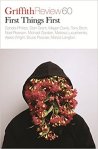
Canberra Writers Festival and the Griffith Review 60: First things first

Yesterday (9 August) was, as you probably know, the UN’s International Day of the World’s Indigenous Peoples. I had planned to get this post completed by then, but, being on the road (again), it didn’t happen. I don’t think that matters a lot, though, as we should be caring about Indigenous Peoples every day until the disparities between us are removed, n’est-ce pas?

So now, my post. The title may look a bit strange. It’s because this post was partly inspired by my wanting to mention the Canberra Writers Festival. This year is its third under its current iteration, and the theme has remained the same: Power, Politics and Passion. Now, some of us literary types, are a little disappointed by the Festival because of this focus. We want more literature, as in literary fiction, but what we get is quite  lot politics. I understand this. We are Canberra, the national capital, and this is a way of positioning our Festival as something different from others around the nation. Fair enough I suppose – it’s just not what I would prefer.

However, there are sessions that I’m very interested in, and two of these relate to indigenous Australian literature and culture. They are:

  • GR60: First Things First: A panel discussion inspired by the recent Griffith Review, the one numbered 60 and titled First Things First. It was inspired by the Uluru Statement from the Heart, and the panel comprises some of the contributors to that edition, Dr. Sana Nakata, Shireen Morris, Paul Daley and Melissa Lucashenko. It is moderated by Dr Sandra Phillips.
  • An Evening with First Nations Australia Writers: Comprises poetry readings by Ellen van Neerven, Yvette Holt, Jeanine Leane and Charmaine Papertalk Green, followed by a panel discussion titled Sovereign People – Sovereign Stories, involving Kim Scott, Melissa Lucashenko, and Alexis Wright, and moderated by Cathy Craigie.

Griffith Review No. 60Now, I’m not always very good at doing homework for writers’ festivals, but I have started reading the Griffith Review in preparation for that panel. I haven’t got very far, having only read editor Julianne Schultz’s introduction “Whispering in our hearts”, indigenous constitution lawyer Megan Davis’ piece “The long road to Uluru”, and Alexis Wright’s poem “Hey ancestor!”

For this brief introductory post, I’m just going to focus on Davis’ piece. Griffith Review’s bio for her says she is “a constitutional law professor and Pro-Vice Chancellor Indigenous at the University of NSW. In 2011 she was appointed to the Prime Minister’s Expert Panel on Recognising Aboriginal and Torres Strait Islander Peoples in the Constitution, and in 2015 she was appointed to the Referendum Council and designed the council’s deliberative constitutional dialogue process.”

This process – the First Nations Constitutional Dialogues – is the one that resulted in the Uluru Statement from the Heart. It was a rigorously defined and executed process that was, she writes, “quite different to the usual tick-the-box consultation.” It had to be, given the diversity of the groups involved, the importance of the work they were doing and the significance of the outcomes they desired – which was essentially to advise the government on a process for recognising the sovereignty of Aboriginal and Torres Strait Islander peoples in the Australian Constitution. Davis writes that

A concrete model of recognition was needed to focus the nation’s attention and move the project forward. Uluru eventually provided the model.

In this article, she describes clearly, and in detail, the recent political history of “the progress toward recognition”, and then the development of a dialogue process aimed at ensuring that the results would be valid and authentic. It involved a Civics education module, so that the participants would understand the western democratic system within which they were working. This is an important point I think. We are not talking revolution here but a willingness to work with the wider Australian people and the government to resolve the ongoing issue concerning constitutional recognition of indigenous Australians – and all that that entails.

The article is excellent, and makes some significant points, including:

  • that recognition of indigenous Australians in the constitution must be more than symbolic – it must be substantive.
  • the importance of truth and justice, of the fact that the truth must be told and understood before justice can be achieved. She reported that “There was an overwhelming view in the dialogues that a nation cannot recognise people they do not know or understand. The Aboriginal experience in Australian history is critical to recognition.” A valid point – and one on which progress is being made but not fast enough.
  • why the Voice to Parliament is so important – which includes that it “could provide a front-end political limit on the parliament’s power to make laws for Indigenous peoples.” In other words, it could head problems off at the pass, avoiding the current situation where inappropriate or ineffective or, worse, discriminatory legislation is enacted, which then costs money and time to challenge.

Indeed, in terms of priorities, she writes:

The First Nations Regional Dialogues ranked the Voice to Parliament as the primary reform priority. The next priority was treaty or agreement-making. The third was truth-telling.

How gut-wrenching then for this priority to have been dismissed so summarily by Prime Minister Turnbull, as it was within four months of the announcement. Many of us are still shaking our heads.

I could say more because this is a rich essay – but this seems to be a good point on which to finish for the moment. I’m sure I’ll be saying more after I attend the session at the end of August.

Sydney Writers Festival 2018, Live streaming (Session 3)

My final live-streamed session of the Festival was even more interesting than I expected. My friend and I chose it partly because it fit our respective busy time-tables, but partly also because, as people interested in language and literature, we are interested in translation.

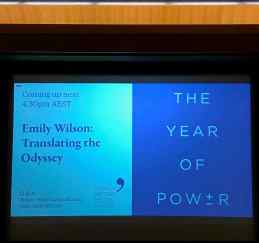
Emily Wilson: Translating the Odyssey, Sunday May 6, 4.30pm

Sydney Writers Festival Emily Wilson bannerThis event was an interview format, with the interviewer being journalist Jennifer Byrne who, for over ten years, hosted the First Tuesday Book Club (aka The Book Club).

Byrne is a cheery, engaging interviewer. However, on this occasion it felt, at times, that her interview agenda was at cross-purposes with what was important to Wilson. This made for a fascinating discussion, with ideas about translation, feminism, and The odyssey itself, jostling between them.

Now, clearly I’m behind in my literary gossip, because apparently Emily Wilson’s translation of The odyssey has made quite a splash, particularly because, of the over 60 translations into English done to date, it’s the first by a woman. It was this point – particularly because of the Festival’s “power” theme – that Byrne wanted to concentrate on, but Wilson, Professor of Classics at the University of Pennsylvania, had other ideas.

Byrne briefly introduced Wilson, noting that the book has had excellent reviews for being a “cultural landmark” and for being lean, clean and fast. To prove this point, she asked Wilson to read the opening lines.

Why another translation?

Given the plethora of English translations of The odyssey, Byrne asked why she did it?

Firstly, Wilson replied, the publisher Norton had asked her. However, her real, and more academic, reasons were:

  • the original has music and rhythm to it. This does not come across in most translations, which are tend to be free verse, so she chose a regular metre for hers.
  • most translations are too long and slow, so she made hers tighter, pacier (and thus, also, more teachable, which is already appealing to academics)
  • most translations simplify the story to only Odysseus’ perspective but there are more in the original, which she worked to bring out.

At this point, Byrne tried to focus Wilson on the gender issue and what she brought to the text in terms of female perspective, but Wilson didn’t really want to be pinned down. She was surprised, she said, by the focus on her being the first woman translator, and said she was more interested in the poetics and narrative perspectives than in a feminist agenda.

She also said that a women’s voice doesn’t necessarily mean a feminist perspective. She argued, logically, that given she’s the only woman English-language translator to date, it’s impossible to assess what a “female” perspective is. Conversely, it is possible to ascertain a male perspective because there have been so many male translators and similarities in their approach can be identified. For example, male translators have, in general, translated a certain non-gendered Greek word into a gendered English word, “man”, while she used non-gendered words, like “human” or “person”.

However, she admitted her gender may have influenced her bringing out other perspectives, such as those of slaves (and other under-class people) versus the more common focus on gods and goddesses. Moreover, she said, most translations downplay abuse of power in the work because Odysseus is a “good guy.” Wilson said she wanted to offer a less heroic image of him, which led to some discussion of double standards. Odysseus had affairs, but Penelope would bring down the house of Odysseus, if she did. His power, in fact, rests on her fidelity.

Wilson then explained that the Greek word “hero” simply means “warrior”, and that in the original, the words frequently used for Odysseus stem from “poly” (“many”) suggesting many layers to his character. Wilson wants readers to question whether there’s something wrong with Odysseus. He sacks a holy city for example. We were given an example of two translations:

He could not save his men from disaster (Robert Hiller, I think)

He failed to keep his men safe (Wilson)

Wilson’s translation more actively suggests failure on Odysseus’ part.

Why this story?

Wilson described her early introduction to it via a play when she was 8, and her later realisation that she’d loved the story because it’s about being lost, about confusion re where home is, and about the meaning of belonging, all of which were issues for her then.

She also said that she loved Greek and Latin languages.

Towards the end of the hour – but I’m time-shifting it to here – Byrne asked about the story’s relevance to now. Wilson believes it’s highly relevant: it’s about strangers, about dealing with people not like you, about whether foreigners are dangerous. She used the word “migrant” at least once in her work.

The challenges of translation and more on the feminist perspective …

Byrne noted that Wilson’s translation had come in at exactly the same number of lines as the original, and Wilson agreed that she’d tightened it up, had made it pacy. The challenge was to identify the essential thing being said.

Regarding translation being the same as the original, which seemed to be what Byrne expected, Wilson said that “if you want the real Homer you need to learn Greek.” Fair point. And how I wish I could avoid the mediation of a translator and read foreign texts myself, but it’s not a feasible things I realise. Anyhow, Wilson said, logically, that it’s not worth doing a translation if it’s the same as the others.

The conversation then turned again to female perspectives, particularly regarding the power theme. Wilson discussed how male translators describe the women, characterising, for example, Helen of Troy as “bitch” and “shameless whore”, Calypso as a “nymphomaniac”, how they avoid using the word “slave” for people who clearly were enslaved. She gave examples of Greek words and her translation of them.

Continuing this theme, she discussed the women who were killed by Odysseus at the end. They were clearly raped by the suitors, but male translators have tended to describe them as “sluts” and “whores”. Wilson commented that the hanging of these women has been seen as “justice”. Given that The odyssey is seen as the starting point of western civilisation, this viewpoint makes this act the foundational moment of misogyny. Male translators do not present these women, she said, as having no choice.

Nonetheless, Wilson said, she couldn’t root out the misogyny in the text, but she could be clear about it.

By this point, Byrne seemed to be cottoning on. She had thought translation should be a close analogy, but “you’re bringing in a viewpoint”, she said. Wilson responded that male translators bring a viewpoint with their “sluts” translation – and then reiterated that …

Translators need to be aware that they are going to have to interpret, have a viewpoint, but they need to be conscious and try to have a better interpretation than previous ones. Theoretically, translation is impossible. It’s a case of how can I describe this word that has no direct meaning? Translators need to be aware she said of three questions: Who am I writing for; what century am I in; and who am I? 

There was some discussion about the institutional barriers to women translators, and then it was the closing Q&A, which was wide-ranging and, nicely, drew from live-streaming sites as well as the venue itself. I’m going to share just two questions. The first asked her about what Margaret Atwood’s Penelopiad (my review) offered. Wilson responded that Atwood does not make Penelope a hero, but a more complex character.

The other was a Year 11 teacher asking, on behalf of her students, whether the killing of suitors at the end is justified. Wilson said this is actually three questions.  Does Odysseus think it is justified: Yes. Does she, Wilson, think it is justified: No. But the harder question is, does the narrative think it is justified: she “thinks not”!

And so ended my 2018 SWF experience. I so appreciated being able to experience a tiny bit of it.

Sydney Writers Festival 2018, Live-streaming (Session 2)

Annabel Crabb, 2014 By Mosman Library [CC BY 2.0], via Wikimedia Commons

I only managed one session a day at the SWF’s live-streaming program at the National Library of Australia, and on day 2, I picked a doozy! It was such fun, I forgot to take a pic!

Annabel Crabb’s BooKwiz, Saturday 5 May, 4.30pm

Panel: Leigh Sales, Richard Fidler, Julia Zemiro, Tim MinchinAnnabel Crabb (MC)

Of the three sessions I attended, this was the best attended (at my venue), and probably the least “worthy” but that doesn’t mean it wasn’t worthwhile. It was engaging, witty, and even informative every now and then – how could it not be with this panel! The topic was all things bookish, all those things readers like to ask each other, such as:

Which section do you gravitate to in a bookshop?

What would you answer? Our panel said:

  • Zemiro: Self-help, none of that Scandi-noir for her, she said. (She may or may not have been serious about this!)
  • Minchin: Self-help and Diet, because he likes to see what scam-artists are selling this time.
  • Crabb: The Sale Bin because she has a special talent for finding gold in sales bins!
  • Sales: New Release Fiction. She thinks about death, and the decreasing time left, so has decided to let go of all those past books she hasn’t read, and try to keep up with the new stuff! (Love it. I once calculated how many books I was likely to read in the rest of my life – and it was very depressing, even though I gave myself a reasonably long life!)

Does there come a point where you decide there are some authors/books you’ll just never read? Are you guilty about them?

(Yes, I would have said if she’d asked me! In fact, coincidentally, a few hours before the session, I “decluttered” some unread books to donate to Lifeline. They included William Faulkner’s Absalom Absalom.)

  • Fidler has tried many times to read Conrad’s Heart of darkness, but just can’t get into his style. This and other worthy books, such as Herodotus, glare at him he said from his bookshelves.
  • Minchin says he aims to read 50:50 Fiction-Nonfiction, but he’s learnt that he just needs to read the first third of nonfiction to get the thesis because the “rest is just firming up the argument”. (I’m thinking of following this theory in future!) His guilty book is Hawking’s A brief history of time. He’d like a briefer history of time! Also, he’s managed 70 years of 100 years of solitude two or three times!
  • Zemiro thinks she should read the Bible. She can’t read Lolita or Elena Ferrante’s novels. She, in fact, had brought these books with her, and set up her own street library on the stage.
  • Crabb said she didn’t love Lincoln in the Bardo (which led to a brief discussion about reading prize-winners.)

Do you have favourite books that are guilty pleasures, that you feel secretly ashamed about?

From the guilt of what they haven’t read, we moved to guilt about what they do read!

  • Sales: spy thrillers, because she wants to be a spy and/or write a spy thriller!
  • Minchin: Lee Child’s Jack Reacher novels, which are formulaic though every now and then you think “wow, this is proper”. He commented that he reads more non-fiction as gets older “because you panic you don’t know enough.” (Hmmm … I commented to my friend that, then again, the older you get maybe the less you need to know!)
  • Fidler: reads way more nonfiction, but the most memorable books he’s read are the novels. Oh, and he’s never read a good active politician’s memoir. (Crabb rejoined that the Alan Clark diaries are excellent).
  • Zemiro: any book about wanting to live in France because they are fake. (The only good one is Sarah Turnbull’s because it’s honest). Fidler rejoined here that he avoids these books too, but out of envy because he’s always wanted to live there.
  • Fidler: superhero comics.

How do you treat and shelve books?

At this point, Crabb said she has some ethical questions too. Good, I thought – and then had to laugh at myself because the question was “is it ever 0k to fold down the corner of a page”. Fidler, a self-confessed book-fetishist, said no, while Michin said yes, because used-looking books are the best. He proceeded to start Fidler’s therapy there and then by forcing him to fold a page corner in one of Zemiro’s street library books!

Sales admitted to not being sentimental about books, either.

As for shelving, Fidler carefully classifies his – the Penguin classics he said look particularly nice – while Crabb shelved hers in the order that she read and acquired them (until a friend kindly tidied up her books for her. She said that where she is when she reads a book affects her reading/appreciation of a book.)

What (if anything) do you reread?

You all know my answer to this question, but what did the panel say:

  • Zemiro: The handmaid’s tale. Atwood is a genius, particularly because of the final chapter which explores how we report on history.
  • Fidler: Wuthering Heights, because it is such a “perfectly strange masterpiece” about twisted humanity; and Anna Karenina, because he reads it differently every time he comes to it again.  (The mark of a great book I think is one that engenders different readings depending on our stage in/experience of life.) Minchin said that Anna Karenina is on his guilty unread list. Fidler commented that Tolstoy had planned to write about an immoral woman, but ended up writing something sympathetic.
  • Minchin finds it hard to reread books because of all those he hasn’t read. He has, though, read Vonnegut’s Cat’s cradle and Lee’s To kill a mockingbird more than once. However, he returned to his anxiety about increasing his knowledge and that his most recent favourite book is Sapiens.
  • Sales reminded me of Daughter Gums when she said she was a bigger re-reader when she was a child. Favourites were Anne of Geen Gables (which caused her to make a pilgrimage to Prince Edward Island) and Enid Blyton. This engendered a big discussion about Enid Blyton. Minchin talked about reading The Famous Five to his children, and about all the “teachable moments” in it.

Are there any adaptations you love?

  • Sales: a television adaptation of, yes, Anne of Green Gables, the one with Megan Follows, and Minchin’s adaptation of Dahl’s Matilda
  • Zemiro: the play adaptation of Tim Winton’s Cloudstreet
  • Fidler: the BBC TV series of Tinker, tailor, soldier, spy, starring Alec Guinness

I know this hasn’t captured the fun, quick-witted, good-natured repartee of the session, but hopefully you’ve got some sense of it? It was all a bit of light-hearted fun from serious booklovers. And we can do with a bit of that every now and then.

I’d love you to answer some of these questions in the comments – if you’d like to!

Sydney Writers Festival 2018, Live-streaming (Session 1)

May is such a busy month for birthdays and anniversaries in the Gums world that I hardly ever get to the Sydney Writers Festival, even though it is not much more than 3 hours drive away. I was consequently thrilled to discover that this year the National Library of Australia, Canberra, would be one of its live-streaming sites (#AWFLiveAndLocal) – and I was determined to support it (as well as attend because I wanted to). Overall, some 15 sessions were streamed over three days to around 35 sites.

This year’s theme is “The year of power”, one which is close to the revived Canberra Writers Festival theme of the last two years, “Politics, Power, Passion”.

Conflicting Narratives, Friday 4 May, 3pm

Panel: Ben Taub, Alexis Okewo, Alec Luhn, Ben Doherty (MC)

Sydney Writers Festival 2018This session was billed as being about “the role of storytellers in a time of ongoing conflict, terrorism and refugee crises.” The panelists, for those of you who don’t know them, were New Yorker writer, Alexis Okewo, who has written about extremism in Africa in her book A moonless, starless sky; the Moscow-based reporter for The Telegraph, Alec Luhn; and another New Yorker writer, Ben Laub, who writes about Syria and the jihadi movement in Europe. The moderator, Ben Doherty, writes for The Guardian.

The discussion started with Ben asking each panelist about his or her recent work. Okewo spoke about the moral complexities faced by people in extreme societies, arguing that the decisions they have to make aren’t simple. Individuals often aren’t all-victim or all-perpetrator and can be forced to commit violence. She talked about the aftermath, about how you live after terrible things (which made me think of Aminatta Forna’s The hired man, my review).

Taub talked about Syria, and how the Rome Statute is clear about what you can and can’t do in conflict. The problem is, however, that Syria isn’t a member of the International Criminal Court (ICC), and that while there is “no ambiguity in international law”, Russia “protects Syria” at the UN Security Council. He noted that although there are currently geopolitical obstacles to pursuing accountability, this doesn’t mean you can’t collect evidence for later.

Luhn clearly confronts similar problems, asking how do you resolve problems when countries don’t agree on fundamentals. It’s more than simply “trying to beat the Russians at their disinformation game.”

Discussion then moved on to processes, such how journalists do their research in such tricky regions. They all agreed that journalists’ main job is to find reliable/trustworthy sources, and that there is a lot of newsworthy material out there “if you know the right people.” Okewo spoke of the difficulty of getting into the remote regions, for example, where Boko Haram is operating. Obtaining good information is particularly difficult in places where “the government is broken” and “resistant to being transparent.” The narrative regarding Boko Haram, for example, tends to be that it didn’t happen, but is a political plot.

Laub talked about the need to use trusted sources, some of which can come via NGOs. However, he did comment that the narrative you get can be “true but not the whole story”.

Related to this, and scattered throughout the conversation, were discussions about what readers can trust. Luhn, in particular, emphasised the importance of teaching media literacy. (My friend and I felt that this is something that’s surely always been taught. Of course, the environment in which we apply assessment techniques keeps changing, but the principles remain the same.) Responding to a question during the Q&A about what readers can trust, Luhn (I think) said that the best thing is to read widely because each media form/outlet has pluses and minuses. It comes back to media literacy, and understanding different outlets.

Another questioner from the Q&A wondered whether it would be possible to have a rating system for journalists, like we have for, say, Uber drivers. MC Doherty was not convinced about this. He wondered who would make the assessment, and worried that ratings could affect freedom of speech. Luhn pondered an organisation like UK’s OFSTED. He also said, though, that we need to trust the professional standards of the traditional newsroom and non-profit journalism centres.

Luhn, I think, quoted Churchill’s “A lie gets halfway around the world before the truth has a chance to get its pants on.”

From here, the discussion moved on to journalists’ safety, an issue of critical importance if we are going to get reporting from the ground. Alexis, the only woman on the panel, had quite a different spin on this: women journalists, she said, can be threatened by their own sources. They must trust that the people they are reporting with won’t hurt them. She also talked about dealing with vigilantes, about writing on people who are doing admirable but also disturbing things! You can’t fully trust them.

Luhn commented that it’s important not to work alone but journalists are increasingly are doing just this. He mentioned the Rory Peck Trust and the “hostile environment” training they offer freelance journalists. (The things you learn!)

Laub, I think, talked about relying on locals – drivers etc. What happens after you leave can be problematic, he said, because these people can face retribution for working with foreign media. Journalists need to continue the relationship after they leave. On the other hand, people, such as your fixers, can turn on you.

The session ended with quite an engaged Q&A, some of which I’ve included above. It ranged from questions about journalism itself – including one asking for advice for young writers – to questions about the regions the journalists are working in and the causes of the problems those regions are facing. The panel talked about Russia’s troll factory, and the future of Syria for example, but I’m going to close here!

It was inspiring to hear this bunch of engaged – and brave – young journalists talk about their work and their profession.

PS: I apologise if I’ve wrongly ascribed the speaker. I mostly captured the speaker’s name, but I slipped up a couple of times.

Robyn Cadwallader in conversation with Catherine Milne

It’s some time since I last attended an author event, not because there haven’t been any but because they’ve clashed with other commitments. I mean, why do organisations choose the same day of the week for events, like, say, Thursdays? Why don’t they get together and agree to share them across all the week days? (Hmm, then they’d only clash with something else, so let’s just recognise that life is busy, that we have too many options, and move on …)

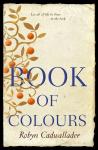
Robyn Cadwallader, The book of colours

Anyhoo … it so happened that our regular Thursday activity was off this week, as was our occasional one that bumps the regular one, so we were free to attend the In Conversation event with local author Robyn Cadwallader. You have met Cadwallader here before: I’ve reviewed her debut novel, The anchoress, and have reported on another event with her when she conversed with Irma Gold. Now, with her second novel, Book of colours, having been published, she’s doing the rounds again, as authors do.

Book of colours is also historical fiction set in mediaeval England, but in the 1320s, some 70 years after The anchoress. Introducing Cadwallader, HarperCollins publisher Catherine Milne commented that in contrast to The anchoress’ small, cramped setting, Book of colours encompasses the world, or, at least, London and Paternoster Row. Its subject is the creation of illuminated books, in particular those little books of hours owned by women; its characters include Mathilda who commissions such a book, and its creators, John Dancaster, his wife Gemma, and a man called Will. (I think that’s right; I haven’t read the book yet.)

The conversation focused on two broad (and obvious) issues – the research and the book itself. So let’s start with the research …

Exploring a gap, a fault-line

Milne began by asking Cadwallader to read from her book, something she did a few times throughout the hour. Milne and Cadwallader then discussed the period. It was a turbulent, often violent, time for London, for England in fact. There’d been famine, the inept King Edward II was on the throne, and tension was rising (though it would be another 60 years before the Peasants’ Revolt).

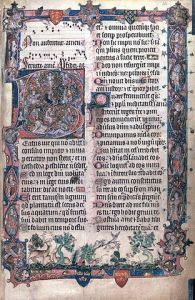
Howard Psalter and Hours (British Library, Arundel 83 I), 1310-20. Public Domain

Cadwallader explained that her inspiration for the novel was her interest in books of hours, and particularly in the strange marginalia that many have. This marginalia often depicts weird creatures, and scenes telling stories, some of them rather bawdy. Sometimes they support/illustrate the content, but sometimes they seem to do the opposite, representing, for example, the wages of sin. These stories told via the illuminations, she said, can operate at different levels. What was behind this practice? No-one knows apparently, so here was her gap, her fault-line to explore.

Cadwallader’s research included:

  • lots of reading, about London, about illumination and art, of court rolls and proceedings, about privies and prostitutes. You name it, she probably read it.
  • walking London with a 14th century map, trying to capture what the place was like.
  • talking to an art historian who told her about identifying the different artists working on a particular book of hours …
  • and spending time with that book of hours until the different artists became apparent to her.

Gradually, she said, she began to see the four different people working on this book and by the time she’d finished looking at it she had a sense of her characters.

Milne then told us that in Book of colours, Cadwallader had written a book-in-a-book. Called “The art of illumination”, it’s written, I think I’m right, by Gemma. Excerpts from this preface many chapters. Milne asked Cadwallader to read one of these, and I’ll share a bit here. It starts by stating that the words must be in an order, in lines, to facilitate reading,

But the requirements of decoration are not so simple. The page needs shape and order, but not so much order that life withers. Consider the beauty of the curve and curl. And, as with a breathing city, let all of life be there in the book, from high to low, animal to monster, story and joke, devotion and dance, for God the Artisan made it all. On some pages, simple vines and flowers may be enough. On others let decoration be lush and bountiful.

“Animal to monster” took us to gargoyles and another reading of a vivid scene in which Will, looking at gargoyles, senses one coming to life … he represents Will’s secret, his shame, said Cadwallader, who loves gargoyles. (Don’t we all?)

Challenging the centre …

Moving on to the core of the book, its meaning, Cadwallader said something interesting about marginalia. It’s on the edge she said, a bit like shadows. Because of this position, it challenges the centre, but in so doing it makes the centre more real. I liked this. She said that there’s something about pictures and stories. They refuse to be bound by convention. They – their meaning, their impact – change depending on the reader, or viewer.

Milne then asked about the main theme of the book. It’s a novel about power, she said, of which women have little. How do they wield what they have?

Cadwallader responded, as she also did about The anchoress if I remember correctly, that she’s interested in ordinary women. Gemma and Mathilda (despite the latter’s privilege) are ordinary women. How do they manage the second-class roles they are assigned by their society? Illuminators, for example, like Gemma, worked alongside their husbands but were never recognised by the guilds, while women like Mathilda have more privilege but are controlled by their husbands. In fact, she has less freedom than Gemma.

Cadwallader is interested in how these women dealt with what they were given, “in how they managed to find value in their lives within the constraints.” Laughingly, she said she’s impressed with the gains her characters managed to make!! She spoke briefly about ensuring these gains, their achievements, are real, that is, believable for the time. She feels, she said, knowledgeable enough about mediaeval times, in which she has a PhD, to be able to strike the right balance. During the Q&A, Cadwallader reiterated this point, and said that she was determined not to “damage the women of the era by presenting them differently from what they are”.

That the audience was enthused by the conversation was evident in the wide variety of questions which concluded the event. The topics included the ownership of books of hours, the education of women, the writing process, and the fact that, for all its historical research, the novel contains a “ripping yarn”! I’m always interested in the writing process, and enjoyed Cadwallader’s answer to a question about Will. She said she was able to “find” him by writing a scene with him, that she discovered more about him as the action developed. For Cadwallader, as for many authors I think, their characters are, in a sense, living, changing beings.

The final reading was another excerpt from “The art of illumination”, near the end of the novel. It concluded with:

All you can do is paint faithfully and well, let the book go.

And so Cadwallader has done. I look forward to reading it and sharing my thoughts with you in the near-ish future.

ANU/The Canberra Times Meet the Author
MC: Colin Steele
Australian National University
26 April 2018

Monday musings on Australian literature: #8wordstory

Do you like writing challenges?

Last year I started a Monday Musings sub-series on Australia’s state writers centres. So far I’ve written on four, and I should be getting on with it. However, I can’t resist returning, today, to the Queensland Writers’ Centre (previous post) to share a wonderful campaign they ran late last year. Called #8wordstory, it asked participants to pen a story in 8 words. The response was astonishing.

#8wordstory ran, officially, from 30 October to 26 November last year, and, as they say on their About page, involved asking “everyone, young or old, writer and non-writer alike, to share a story …”. The project was a partnership with three companies, but most significantly with goa.com, a large Queensland billboard and signage company, who have a Community Partnership Program. Are you getting the picture? Because what happened was that each week 20 8-word-stories were selected by the judge – author Nick Earls – and displayed on digital billboards around Brisbane, and via QWC’s social media, such as Twitter (which is where I discovered it, and add it to my list of ideas for Monday Musings.)

In a Books + Publishing report on 27 November – the day after the campaign ended – the QWC is quoted as saying that it “surpassed all expectations with over 10,000 entries submitted”. This report goes on to say that the entrants included “the entrants were New York Times bestselling authors, Australian award-winning writers, Australian and international publishing houses, the Queensland Police Service and hundreds of school children.” Wow, eh?

So, why 8 words? QWC explains this on the above-mentioned About page. They say that “a billboard gives you a few seconds to read, register, and understand. And 8 words gives you just enough canvas to make an impact. It is the perfect number where storytelling and advertising meet.” They provided Tips for people to help them get started, tips which look generally useful as well as to the goal of writing a story in 8 words. The tips are (and they are further elaborated on their page):

  • Start with a simple idea: this and the next tip, in particular, make me think of haiku
  • One thing should happen
  • Don’t use too many characters: haha, sounds sensible to me, otherwise your story might be all people and no action.
  • Find an emotional tone
  • Use all your senses
  • Write long first, then take out unnecessary words: sounds like my blog post writing! Except I don’t take out enough words, I know.
  • Punctuate or perish: all I can say to this is Yes, Yes, Yes!
  • Make every word count: well, yes.

They also had a special page of advice and resources for schools.

And, of course, they have a page listing ALL the stories, though when I say page, I actually mean 83 of them, presented in reverse order of submission. The stories apparently had to be written to one of four themes – Home, Love, Change, Play. There is a search box at the bottom of each story page, though it doesn’t work as well as I’d like it to.

I’m not sure about copyright, but I’ll share just a few assuming that it’s OK as long as I don’t share them all!

Surrounded by complete idiots. Damn those mirrored walls. (Donny Hawthorne, Change)

I woke with wings, stolen in a dream. (Isobelle Carmody, Change)

Once upon a time there was the earth … (@julescdr, Home)

Holding her fractured cheek she said “I’m sorry”. (Rebecca Hafner, Home)

In the pages, another world is my home. (JWilliams, Home)

You shouldn’t confuse ‘Don’t! Stop!’ with ‘Don’t stop’. (Lynne Lumsden Green, Love)

Your letters in the compost. The roses blooming. (Nike Sulway, Love)

He complimented her smile and then erased it. (jessicalim, Love)

Words can inspire and words can destroy. Choose. (Byron, 12, Love)

Can we all fit in the band wagon? (Jane Meehan, Play)

All seven numbers! Panicked, she swallowed the form. (@KrissyKneen, Play)

With confidence he plays the cards he’s dealt. (@VacenTaylor, Play)

Some are by published authors known to me – Isobelle Carmody, Nike Sulway and Krissy Kneen  – but the others I chose because they attracted my attention in my random browse and offer some variety in terms of tone and intent.

Author Jessica White (whose Entitlement I’ve reviewed here) blogged about her #8wordstory, which was selected for a billboard. Check it out to see the inspiration and how it looked. And Queensland crime author, MT Ellis, also blogged her billboarded story.

If you’d like to make your comment an 8wordstory, I’d love it. But if, like me, you suffer from verbal diarrhoea, don’t let that stop you commenting. I’d love to hear your thoughts regardless …

World Poetry Day 2018

Did you realise that today, March 21, is World Poetry Day? I’m not asking this to catch you out but more because I wonder how well promoted it is – particularly here in Australia? I must say that, as in previous years, I’ve heard very little about it. Perhaps, though, if I went to my local public library, they might be promoting it? You never know.

I have mentioned this day before, including dedicating a Monday Musings post to it in 2016, when I gave a brief explanation of the Day. It was designated for 21 March by UNESCO in 1999, but has been celebrated for much much longer, often in October to align with the birthday of the birth of the Roman poet Virgil. Its aim is to promote the reading, writing, publishing and teaching of poetry throughout the world. There is, as I wrote back in 2016, a Facebook Page for World Poetry Day, but the posts there are an eclectic bunch.

I enjoy poetry, but I don’t write a lot about it here. However, most years I write a few posts and I have a small book by a Tasmania poet on my TBR now that I hope to get to soon.

Now though, I’ll just share a three Australian initiatives I discovered via our good friend Google, and which cover us almost from cradle to grave!

Reading Australia

Leah A, Ten silly poems by a ten year oldThe Australian Copyright Agency’s wonderful Reading Australia, which I’ve mentioned before, is doing its bit. In late February it announced that it would spend “the entire month featuring the diversity and brilliance of our Australian poets, contemporary and classic.” They list five works for primary school students, including a picture book featuring a poem by Australian classic balladist Banjo Paterson, and five for secondary students, including a verse novel I don’t know by Steven Herrick, and works by well-known Australian poets Robert Adamson, Judith Wright, Bruce Dawe and Kenneth Slessor.  For each work, they provide teaching resources, along the lines of this one for Judith Wright’s Collected poems.

They also provide an “extra reading list” for those who want to explore further. This includes a verse novel for primary students, Bully on the Bus by Kathryn Apel, which won the 2015 Australian Family Therapists’ Award in the Young Readers/Picture Book category, and the now classic feminist anthology Mother, I’m rooted from 1975, comprising works from over 150 poets. They say about that that “You’d be hard-pressed to find a collection of poetry that so completely represents the diverse spectrum of being a woman.”

The website doesn’t make clear how they are making this is a month-long focus, but it’s a start – particularly for teachers who are uncomfortable with or unconfident about teaching poetry.

Coffs Harbour Regional Museum

Google also revealed that the Coffs Harbour Regional Museum (up there on the NSW mid-north coast) is celebrating  the day with an event they’re calling Celebrating World Poetry Day with a Rime and an Open Poetic Mic. The word “Rime” comes from their feature poem – Coleridge’s The Rime of the Ancient Mariner – for their. The event, which has a sea theme, comprises an art exhibition named for Coleridge’s poem; a conversation between a poet and the exhibition’s artist; and the open mic session for people “to perform an original or much regarded poem – under 4 minutes please bards” (and sea-themed of course).

What I particularly like about this is that it’s example of the way regional museums and galleries work hard to actively engage their communities in culture, rather than simply present static exhibitions.

Golden Carers

You can probably guess what Golden Carers is – and you’d be right. Based in Brisbane, Australia, its tagline is “Supporting carers of the elderly worldwide since 2007”. The organisation caters for “Diversional Therapists, Recreation Therapists and other caregivers of the elderly, including volunteers”, but to get full access you need to pay. Fair enough.

Wonderfully, they have a page for the 2018 World Poetry Day, and provide a list of activity ideas which look doable for non-experts. The ideas include:

  • Ten Tips for Celebrating World Poetry Day
  • Poetry in Popular Song
  • Poets and Poems Quiz
  • Funny Poems by Roald Dahl
  • Multicultural Poems
  • Share Your Poems

There are resources for all the listed activities, behind the pay wall.

Before I conclude, I’d like to share some lines from a couple of poets* (one Australian, one not). Who would not benefit from thinking and talking about what Emily Dickinson has to say:

If I can stop one Heart from breaking
I shall not live in vain …
(Emily Dickinson)

Or, Judy Johnson:

Listen to which footsteps
placed

on the heart’s risers
produce a squeak

and which treads
are noiseless.

(Judy Johnson, from “Words, after an absence”)

And now, back to the UN and its aims for denoting this day:

One of the main objectives of the Day is to support linguistic diversity through poetic expression and to offer endangered languages the opportunity to be heard within their communities.

The observance of World Poetry Day is also meant to encourage a return to the oral tradition of poetry recitals, to promote the teaching of poetry, to restore a dialogue between poetry and the other arts such as theatre, dance, music and painting, and to support small publishers and create an attractive image of poetry in the media, so that the art of poetry will no longer be considered an outdated form of art, but one which enables society as a whole to regain and assert its identity.

What a comprehensive goal! I wonder if they are doing anything to measure whether or not the Day is achieving anything.

Happy World Poetry Day everyone!

* Emily Dickinson, from The School of Life’s boxed set, 20 poems; Judy Johnson, from Prayers of a secular world.

Festival Muse 2018: Turn me on

Muse Festival

Woo hoo, Muse, which is one of my favourite places in Canberra, is running its second Muse Festival this long weekend in Canberra. As last year, Mr Gums and I went to the opening event, Turn me on, last night -and it was different but also good. Different because last year’s opener, Women of the Press Gallery, was a panel discussion, while Turn me on comprised separate, short, roughly 10-minute talks by five speakers on the given topic, which was how they got turned on to politics or to the passion they have for their field of work. Muse was looking, in particular, for “the lightbulb moments and hidden drivers” behind the speakers’ passions for what they do.

Turn me on

The speakers were a varied bunch, but they had at least one thing in common – they’re “prominent locals”:

  • Michael Brissenden, political journalist and foreign correspondent for the ABC since 1987
  • Zoya Patel, founder of Feminartsy
  • Roland Peelman, director of the Canberra International Music Festival
  • Elizabeth Lee, Liberal MLA in Canberra’s Legislative Assembly
  • Jacob White, staffer for Federal Labor MP Andrew Leigh, and co-ordinator last year of the Australian Marriage Equality group’s postal survey campaign in the ACT

Michael Brissenden

Of the five speakers, Brissenden had the longest-standing Canberra cred having been born here in the 1960s, to parents who were part of the first big wave of academics coming to the ANU in the 1950s-1960s. He provided us with an entertaining picture of a Canberra very different to the one we know now, back when it was “six suburbs in search of a city”. There were few restaurants, so people made their own fun: they had parties. You would, he said, have historian Manning Clark “banging on” in one corner of a room, and poets AD Hope and David Campbell doing the same in another. What fun, eh? You needed, he said, a sense of humour to enjoy Canberra then.

He shared a couple of songs written by his father, RF Brissenden – “Canberra Blues” and “Gough and Johnny were lovers” (with its line “never trust a cur [Kerr]”) commenting on the 1975 dismissal. Being interested in politics, he said, was unavoidable in his house. Canberra is still a small place and can be suffocating at times. But it is also full of inspiring, intelligent people. No wonder, he said, they, like himself, keep coming back. (We know what he means.)

Zoya Patel

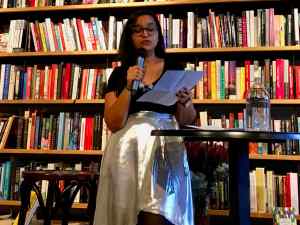
Zoya Patel, Festival Muse

Patel cut right to the chase. What turns me on, she said, is feminism. She then joked that there was a time – her early dating days – when her strong attachment to feminism was a turn off! Clearly though, the dates who reacted like that didn’t last, because her commitment to feminism remained strong.

She gave us a brief history of her trajectory as a feminist. She talked of her upbringing within a Fiji-Indian culture, where it was not considered normal for girls to have strong ideas, particularly political ones, and her staring to write, at the age of 15, for local feminist magazine, Lip Magazine. She spoke of how she’d been told that feminism was irrelevant, that women had won what they’d campaigned for. As a second-wave feminist from the 1970s, I remember being horrified by this attitude in the 1980s and ’90s, and am thrilled to see feminism on the rise again and in hands like Patel’s.

She talked about tipping-points that have kept her strong – such as encountering online trolling when she took Lip Magazine online – and about founding the cleverly named Feminartsy. She sees feminism as being about sisterhood, saying that “as many we are strong”. She’s pleased that feminism has gone from turn off to turn on!

Roland Peelman

Peelman, whom we had enjoyed earlier this week when he gave the pre-concert talk at Musica Viva, felt a little uncertain about his place in the group. He was not a politician, he said, but a musician, and not an Australian or a Canberran, but a Belgian. However, the thing about Peelman, who was also the artistic director of The Song Company for 25 years, is that he’s an engaging speaker.

He talked about attending a secular university in Ghent, which is still today a centre of positivist philosophy. This has informed his life he said. And, in one of those synchronicities we often talk about, he spoke of being on the barricades against missiles in Western Europe in the early 1980s. Regular readers here will remember our recent discussion about the Cold War on my review of Diana Blackwood’s Chaconne.

Peelman talked about the difference between Australia’s adversarial 2-party political system and the Belgian situation where government is made after the election (as has happened in Germany over recent months!) Talking to him afterwards, I suggested that the 2-party system may be breaking down with voters (here and elsewhere) increasingly voting for small parties. Peelman likes this form of “messy” democracy.

Finally, he talked about the politics of a small arts organisation (like The Song Company) battling big bureaucracy, and how they can survive despite the naysayers. Small arts companies do not work well within the constructs of economic rationalism. Music, he said, builds from community. And that’s as political as he’d get he said!

Elizabeth Lee

Local Liberal politician, Lee, started by noting how much we have in common despite our (political) differences.

What turned her on to politics or what encouraged her to chase a political career, she said, was her father. Korean-born, she grew up as the eldest of an all-girl family, so her father, she said, was a feminist from start. He told her that she was the needle, and her sisters the thread. She explained that her moving to Canberra to do Law at 18 years old was unusual for an Asian at that time. It means, though, that she has lived all her adult life here.

Lee then talked about how she went from not being interested in politics at university to working as a lawyer and getting involved in the Law Society, where she realised that she liked organising. Soon after, when she started work as a lecturer at the ANU, she joined the Liberal Party – because she agreed with the classic Liberal values which focus on “individual freedom and responsibility”. She described losing the 2012 election, and her father helping her see that politics seemed to be where she could contribute the most. She stood again in 2016 and won.

She also shared some disturbing examples of racist and sexist attacks she has faced, but said that she is committed to her (unsought for) leadership role as an Asian female politician.

Jacob White

Like Patel, White quickly identified the factors that led him to his political passion. He said an interest in process is something you are born with, and also that as the middle child of a family of five (with two older sisters and two younger) he got early practice as an agitator!

He also remembers being aware of the injustice of his Nana’s struggles. She was a single mum who had brought up 5 children including one with severe Down Syndrome. He described his early experience of activism, writing to local politicians when he was just 8 years old about lantana choking a play area – and succeeding in getting it removed. Finally, he talked about realising, when he was 11 or 12, that women were not for him, and soon seeing the injustices gay people lived with.

White said he was very involved in student politics, and from this experience came to work for Andrew Leigh. However, when they were all caught off-guard by the marriage equality postal vote, he took leave from this job to manage the campaign in Canberra.

He spoke about being from a small industrial town near Wollongong, with a father “in the steelworks”, and mother “at the RSL”. You don’t have to have a political background to do what he does he said, because “everyone’s life is inherently political.”

All in all, an engaging session, not the least because I got to hear and see some of Canberra’s new, young leaders, as well as seeing that some of the older hands still have things to offer!! Win-win, I’d say.

Oh, and the opening party drinks and canapes were great too – as you’d expect from Muse.

Thanks to Muse (particularly Dan and Paul) for another great event. As I’ve said before, what a great addition they’ve made to Canberra’s literary and arts scene.

Angharad at Tinted Edges has also posted on Festival Muse.

NOTE: Check the Muse link above for more Festival events.

Monday musings on Australian literature: Pulp fiction, 1940s to 1970s

This post was inspired by the Pulp Fiction exhibition* at the Canberra Museum and Art Gallery that ran from August to October this year. The exhibition used materials from two collectors, Graeme Flanagan (d. 2015) and James Doig, who also wrote the accompanying booklet. Doig says that Flanagan “amassed one of the most significant collections of Australian pulp fiction paperbacks”. He also collected original cover art, and in 1994 wrote Australian vintage paperback guide, which was apparently the first detailed book about Australian pulp fiction and is still an authority on the subject.

Most of you probably know what pulp fiction is, but if you don’t, it encompasses cheaply produced “mass market paperbacks and digests” in popular genres such as Westerns, crime, romance, adventure, science fiction and horror. Printed on “pulp” paper, they were not made to last and were poorly regarded by the literati of the time. But, of course, they were part of Australia’s reading culture and are now being recognised for the cultural objects they are. Because of their cheap production and disposability, however, they can be tricky to find – and, says, Doig, even Australia’s legal deposit libraries don’t hold complete collections.

Doig starts by referring to an article in the Tribune titled “I spent a week in a literary sewer” by journalist Rex Chiplin who wrote about the “muck” – “the pornography, sex, sadism, brutality and illiteracy” – being sold weekly on Australian newsstands. He wanted to find out where it all came from – but I wanted to find out who Rex Chiplin was. Well, I found out, via a blog called Ethical Martini, that he was a communist, which is not surprising because, as most Australians would know, the Tribune was the Communist Party of Australia’s newspaper.

Apparently Chiplin was called before Australia’s version of the USA’s McCarthy hearings, the Royal Commission on Espionage (1954-55), but the tidbit I want to share is Ethical Martini’s quoting another communist journalist, David McKnight, on Chiplin. McKnight wrote:

One unusual piece of exposure journalism was the pamphlet, “Facts Behind the Liquor Commission”, printed by the Communist Party of Australia at its underground printery which set out to expose capitalism in the shape of the ‘brewery barons’. Written by a journalist (probably Rex Chiplin) who had a racy turn of phrase (‘Bottled beer was as rare as a bankrupt Vice Squad sergeant’) the pamphlet incidentally exposed corruption in the labour movement…

It’s the “racy turn of phrase” that caught my attention, because it is certainly in evidence in the “sewer article” where he describes, for example, the directors of a magazine publishing company, American-Australasian, as “all North Shore pukka sahibs.” A little further on he describes a magazine called Action Detective Stories as “good wholesome literature for homicidal maniacs and similar unfortunates”. He criticises these “sewer” magazines’ forays into political commentary about the Korean War and Soviet behaviour in southeast Asia – but, I’m getting offtrack, so let me just share what he writes about Consolidated Press:

Consolidated Press, Frank Packer’s organisation … publishes a host of crime, sex and violence comics and the Phantom and Star paper-covered novels. Phantoms and Stars are direct reprints, lurid covers and all, of American gutter novelettes which are churned out by the score in “pulp factories.”

By reprinting they apparently circumvented import restrictions. Doig says that “Phantom Books … reprinted more than 300 of the best American crime novels between 1953 and 1961 and is a highly desirable series.”

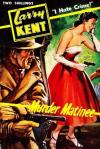
Larry Kent, Murder MatineeAnother company named and shamed by Chiplin was Cleveland, which our mate Doig says is the only pulp publisher still active (in Australia) today – focusing these days on westerns. Cleveland was also known for the Larry Kent I hate crime series which “was named after a 1950s Sydney radio show [preserved at the National Film and Sound Archive] about a hard-boiled New York detective”. The radio series commenced in 1950, and its popularity inspired, says The Thrilling Detective website, Cleveland “to try their hand at some Larry Kent novels”. They were written by American expat Don Haring through “an arrangement” with the radio producer. The first series of these monthly novelettes commenced in April 1954.

The Thrilling Detective explains that:

over 400 Larry Kent novels and novelettes were pumped out under the Larry Kent byline in the next thirty years, and supposedly, as late as the 1990s, the series was still being produced in Scandinavia. The covers usually featured paintings of leggy, full-figured babes and sported such snappy (and often exclamation mark-endowed) titles as Kill Me a Little!, This Way, Sucker!, Cute Heat!, Dig Me a Dame! and Stand Up and Die! Add on the 150 or so radio shows, and our Larry turns out to be one of the hardest working eyes around…

If you, like me, ever give pulp fiction a thought, it is probably for these covers, “lurid” though Chiplin thought they were. As The Thrilling Detective says:

Although the books were decidedly hokey pulp affairs, and by no means great literature, the covers themselves have a gorgeously cheesy flavour, and are now quite collectible. In fact, most of the web sites featuring Kent deal as much with the covers than the contents of the books.

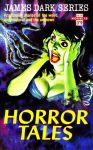
Horror tales, illustrated by Frank Benier

Illus. Frank Benier

Doig says that selling these books, which happened at stalls and newsagents on street corners and railway stations, was a competitive business. So “the cover was all important, the more colourful and garish the better.” He names some of the illustrators who did these covers – Stan Pitt and Walter Stackpoole (for Cleveland), and Col Cameron and cartoonist Frank Benier (for Horwitz). It is these covers as much as anything which now make these books highly sought after – and highly exhibitable!

Have you ever read any pulp fiction – or, even, are you a collector? I’d love to know.

* Images from the exhibition can be seen on Pinterest.