Monday Musings on Australian Literature: Canberra Writers Festival 2019 Recap

Just when you thought it was safe to return to my blog, I’m at it again, talking about this year’s Canberra Writers Festival. However, if you are like me you are intrigued about what other readers and festival goers like, so I thought I’d share what the Canberra Writers Festival sent us subscribers.

But, I’ll start with my 7 posts, and their popularity (by number of hits):

Interesting. The two which specifically featured local authors and/or local subject matter were the most popular, despite my international readership. Maybe some local authors shared the link and a lot of hits were local? Anyhow, these were followed by the two most literary sessions I attended – Tara June Winch and Brian Castro. This doesn’t surprise me, given my “brand” here. And then the last three, which had about two-thirds the hits of the top post, are a mixed bag of, generally, more popular subjects.

Before moving to the Canberra Writers Festival’s report, I’d like to point you to a post written by one of this year’s New Territory bloggers, Shelley Burr. She wrote on the Wonder Women panel (which featured Australian historical fiction novelists.) You’ll have to read her post to find out who they were!

Now, were my most popular posts reflected in the most popular sessions attended? Sort of. The Canberra Writers Festival wrote that the “Top Ten” sessions “include”:

  • Simon Winchester in conversation with Richard Fidler
  • Capital Culture
  • Never Never
  • Defining Moments – True Crime Panel
  • For Whom the Pell Tolls
  • You Daughters of Freedom
  • Best of the Best: Book Club Favourites
  • Women, Men and the Whole Damn Thing
  • Is Hate Our New Normal?
  • David & Margaret

I’m not sure how to interpret this, because they say “the top ten include“, but there are ten here, so I’m presuming these are the top ten? Let’s presume they are, and that they are in order (though I’m surprised that the session featuring Behrouz Boochani from Manus Island is not in the list.)

Anyhow, certainly Simon Winchester was in a 300-seat theatre and was sold out. Capital Culture was sold out too, but in a smaller space. I’m intrigued that three of the sessions I chose were in the top four of the Top Ten, though what that says, I’ll leave to you. It’s interesting, though, that the most popular session, by this list, was not my most popular post. A couple of other sessions listed here – such as Never Never, about “the role that the bush plays in our collective imagination” – were ones I had to miss because of clashes. I didn’t mind missing You daughters of freedom because I had heard Clare Wright speak about her book last year.

It’s clear that the Festival’s “political” slant works well for the organising committee, with sessions on George Pell (including David Marr), Gender (including Gillian Triggs), and Hate (also including Gillian Triggs) all being popular.

The Canberra Writers Festival email also told us the best-selling books at the festival:

  • Capital culture (ed. by Suzanne Kiraly) (I bought this)
  • On disruption (Katharine Murphy) (I have given this as a gift)
  • Cardinal: The rise and fall of George Pell (Louise Milligan)
  • On patriotism (Paul Daley)
  • Brain changer (Felice Jacka)
  • Unbreakable threads (Emma Adams)
  • Just add love (Irris Makler)
  • On indignation (Don Watson)
  • Plots and prayers (Niki Savva)
  • Leading lines (Lucinda Holdforth)
  • You daughters of freedom (Clare Wright) (I have reviewed)

Hmmm … I haven’t heard of some of these, but it’s interesting, given the signing line I saw, that Exactly isn’t listed here. Given there were different booksellers at different sites – including, the NLA bookshop, Harry Hartog and Dymocks – it’s possible that this list does not concatenate across all the booksellers? Anyhow, it’s also interesting that the little “On…” books published by Melbourne University Press are doing well. I recently posted on Stan Grant’s On identity, from the same series.

As for my purchases, I am way out of step. Besides Capital culture, I bought Brian Castro’s Blindness and rage and Simon Winchester’s Exactly (for Mr Gums). I also bought Brian Castro’s After China during the Festival, but at Muse. And, I already had some of the books I heard discussed, including Nigel Featherstone’s Bodies of men, Karen Viggers’ The orchardist’s daughter, and Tara June Winch’s The yield.

All this is fascinating, but the best thing is that the Festival, now in its fourth year, appears to have done well with good pre-sales and, they say, “significant impromptu attendance”. This augurs well for its continuation. And that, of course, is what we want.

Canberra Writers Festival 2019, Day 2, Session 3: In our backyard

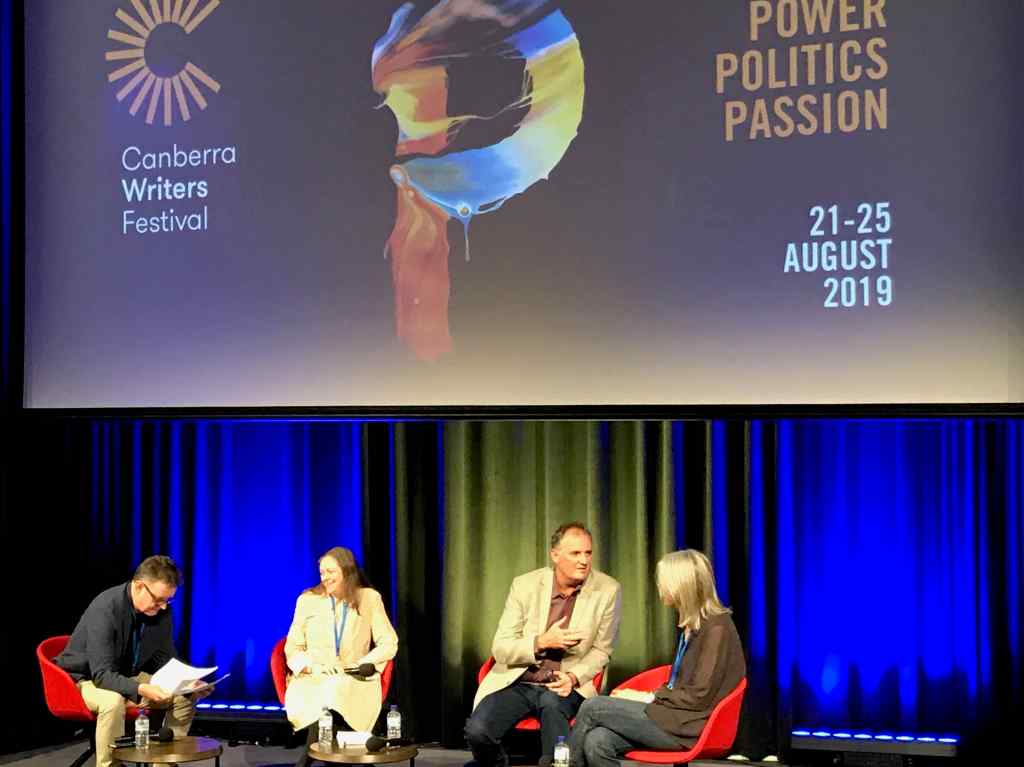
Suddenly it was my last session! How quickly the two days went. The reason I chose In Our Backyard is obvious. It was described as “Get up close and personal with four of Canberra’s literary gems”, and was moderated by ABC journalist, Emma Alberici.

It was a warm-hearted session, characterised by a sense of respect between the writers made most evident in their friendly banter and genuine interest in each other.

Alberici introduced the four writers:

  • Nigel Featherstone, novelist, Bodies of men (my review)
  • Karen Viggers, novelist, The orchardist’s daughter (my review)
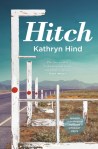
  • Kathryn Hind, novelist, Hitch
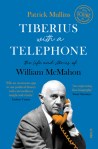
  • Patrick Mullins, political biographer, Tiberius with a telephone: The life and stories of William McMahon.

Four very different books, said Alberici, so she suggested they start with their book’s genesis.

Genesis

Karen Viggers, The orchardist's daughterKaren Viggers: Is passionate about Tasmania, wilderness, freedom, empowerment, forests, and friendship. Her novel is about three outsiders in a small timber town, and explores how people create bonds and belonging in such places.
Patrick Mullins: Did his PhD in political biography at the University of Canberra in 2014, but hadn’t written one. He looked around and Billy McMahon was there for the taking (with “good reason” he added!) Researching McMahon, he became intrigued by the disconnect between the reputation (the derision) and the reality (twenty plus years covering all major portfolios as well as prime minister.) Further, his unpublished autobiography indicated he had a divorced-from-reality view of himself, which suggested themes about the myths we can create about the past.

Kathryn Hind: Enrolled in a creative writing masters in the UK. She had to write something. She looked to her  experience of travelling around the world alone for a year, during which she found that she needed, as a young woman, to be hypervigilant, always. Suddenly, Amelia and her dog by the side of the road appeared to her. Neither she, Amelia, nor she, the author, knew what would happen to her!

Nigel Featherstone, Bodies of menNigel Featherstone: Wanted “to piss off Tony Abbott”. Seriously though (or, also seriously), the book resulted from a “strange decision” to apply for an ADFA (Australian Defence Force Academy) residency in 2013, despite having no interest in war. Of course, the residency did come with $10K! Featherstone’s overriding interest was to explore different expressions of masculinity under military pressure. Eventually, he found two books in the ADFA Library: Deserter, by American Charles Glass, which explored desertion as an act of courage, and Bad characters, by Australian Peter Stanley, which included the story of a soldier who, during World War 1, had been caught in a homosexual act, been found guilty, and never turned up to board the ship to take him home to prison! There’s my novel, he decided. Had he had any reaction from ADFA to the book, Alberici asked. No.
Place

Given the narrow “backyard” framing of the panel, Alberici took it upon herself to broaden the theme to “place” in general. Suited me. I love hearing authors discuss place.

Karen Viggers: All her stories come from a spiritual connection to place. (I follow Karen on Instagram and can attest her love of place!) She gives her place a fictional name, because she, like Tara June Winch said in the morning, didn’t want to impose her views on real towns (but it is set in the Geeveston/Huonville/Hartz Mountain region of southern Tasmania). She wanted to focus on different types of violence, besides physical, including psychological and economic control. In small towns people know this is going on and can’t pretend they didn’t know. She also wanted to bring back park ranger Leon from a previous book. And, most of all, she wants people to visit, love, and support Australia’s places.

Book coverKathryn Hind: Believes her senses were heightened because she started writing in England, when she was missing Australia. She couldn’t do physical research so would “drop a pin on map”. She named real places. She didn’t feel she had to capture exact their reality, but the timings of Amelia’s journey had to be right. I love that she used online traveller reviews to inform herself. For example, a review of a hotel in a little town mentioned being kept awake by trains shaking the walls at night. She used that! She wanted to truly test Amelia to bring out her strength.
Nigel Featherstone: Hadn’t been to Egypt, so had some initial creative concerns. Then he realised that 1940s Alexandria no longer exists, which that freed him to rely on research. He knows very well the other main place in the book, Mt Wilson. He also talked about writing by hand (which astonished journalist Emma Alberici!) He has gradually learnt that writing is a whole of body activity.

Book coverThen it was Patrick Mullins. He was tricky in terms of “place”, so Alberici asked him about the title. Mullins admitted that his publisher chose it – using Gough Whitlam’s description of McMahon’s scheming by telephone. Mullins’ own title is the subtitle. Alberici asked if he had any cooperation from the family. None, said Mullins, though he sent messages and did have coffee with one member. So, he couldn’t access the 70 boxes of McMahon’s papers at the Archives. He understood, he said. Children of politicians have crappy lives, and, anyhow, it freed him from feeling beholden to the family. Silly family, eh? Fortunately, he had access to one of McMahon’s autobiography ghostwriters who had seen the papers. The most startling revelation, he said, responding to another question from Alberici, was that McMahon was “more admirable than we would have thought”. He racked up several significant achievements, including taking us to the OECD, and showed impressive persistence/resilience.

Q&A

It was a quality Q&A. The first questioner asked the writers to share the best part for them about writing:

  • Viggers loves the first draft, the joy of going on the ride, and taking the tangents. She also loves those rare moments when the words start to sing!
  • Featherstone found it a hard question, but said one part is when you feel you have written a good sentence, one that feels alive. (One that sings, perhaps?) This happens about once a month, he said. He quoted novelist Roger McDonald, who says that writing is putting sentence after sentence after sentence.
  • Hind’s favourite moments were making discoveries in her own work, the moments when you forget to eat and drink, the moments when you feel “this is what I’ve done”, and when you know your novel so well you can defend it against an editor (albeit her editor was great, she hastened to say.)
  • Mullins gave a non-fiction writer’s answer: It’s when you get access to material, when you find that special piece of information, the little details.

Another question concerned characters “taking over”. Does this happen, and how did they feel about it? Viggers said that for her it’s less that the characters dictate and more that the publishers want her to go deeper, while Hind said that there were times when she wished Amelia would tell her more! Amelia divulging much, even to her author! Featherstone gave the answer of the session. He said that around draft 20 (of the 40 he wrote), he pretended he was a journalist and interviewed his main characters. He asked them to give him an object that represented them, and to tell him a secret about themselves, which he promised not to put in the book. They did, and he didn’t!

Another asked for the best piece of advice they’ve received. Featherstone said it was “to write about what makes you blush”, while Viggers said it was “to get it down, then get it right.” Her husband also says that writing is not about inspiration but getting “bum on seat” and doing it. Hind said her tutor told her that she writes very plainly, which upset her – until he added, “a bit like Tim Winton”! That’s ok then! Mullins said he’d been told that a book about McMahon would be short. It’s not, it’s nearly 800 pages. So, his response was, don’t follow advice!

A good place to end my report of my Canberra Writers Festival. Phew. To those still with me, thanks for following along!

Canberra Writers Festival 2019, Day 2, Session 2: PM’s Pick (Brian Castro with Genevieve Jacobs)

Book coverPM’s Pick, featuring the multi-award-winning Brian Castro, was another must-attend session. The night before, while dining at Muse, I checked to see whether they had any Castro in their classy little bookshop. They did, including a second-hand copy of his fourth novel, After China. I snapped it up, and as I did, bookseller Dan reminded me that he’s “very literary”. I know, I said! He is also very reclusive, making this a not-to-be missed session. And it was free, my original payment being refunded when they found a sponsor. Woo hoo!

The session was titled PMs Pick in reference to the fact that Castro won the 2018 Prime Minister’s (PM’s) Literary Award for Poetry for his verse novel, Blindness and rage: A phantasmagoria: A novel in thirty-four cantos. Even the title is scary, but Lisa (ANZLitLovers) has tackled it.

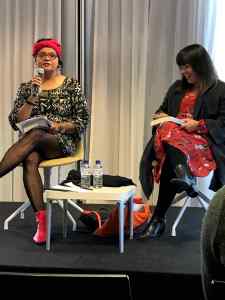
Castro and JacobsCastro conversed with local ABC radio presenter Genevieve Jacobs. It was a smallish audience, and a quiet conversation, but provided some fascinating insights.
Castro, like Gerald Murnane whom he referenced a couple of times during the conversation, is a self-described recluse. This event is the first he’s done, he said, for three years! I didn’t know that when I booked it, but I’m doubly glad now. The worse thing when he’s writing, he said, is having to be “a social gadfly”, so he hides away, except that he needs to talk to his students at the University of Adelaide where he teaches creative writing.

I’m going to focus on what I learnt about Castro and his ideas (not quite in the order in which the conversation went), and end with a reference to Blindness and rage.

Firstly, why does he live in Adelaide? Hong Kong-born, he has been Australian-based since going to a Sydney boarding school when he was 11 years old. He called himself a fringe-dweller, explaining that he doesn’t, exactly, live in Adelaide but in the Adelaide Hills. Before that, he lived in the Dandenongs on Melbourne’s fringe, and before that in the Blue Mountains just west of Sydney.

He likes the provincial life, which he doesn’t see as negative. It’s also something that Lucien Gracq, his fame-seeking protagonist of Blindness and rage, comes to value.

Then, there’s his job. He teaches creative writing, but he’s not convinced it’s a worthwhile thing to do. (Should I be sharing this?!) Universities, these days, he said, are factories. What do you do with a creative writing degree? Maybe get work in publishing? He has had just two writers win awards over the years he has been teaching. Creative writing has become an industry, but it pays his way, given his novels are not exactly best-sellers!

Indeed, he had quite a bit to say about the writing life, some of it in response to the Q&A, including how tough it was to get that first publisher when he was 32. Winning the Vogel award did it. He has been lucky, he said, and is particularly so now because his publisher, at Giramondo, is also his friend. One of the lessons he has learnt over the years is to accept disappointment! Cheery, eh? His early days were very difficult, because if you want to write, you must invest everything in it. However, reality starts to hit when you start to age, and need to shore up something for retirement. It’s difficult for literary writers in Australia, where returns are small. Only five Australian writers, he said, really live off their writing.

Various gems regarding what he likes to write and read came out during the conversation. For example, he thinks we should read for mood not plot. I relate to this, because this is exactly what I most remember about the books I’ve read. I rarely remember the story, or character details, but I remember the tone and/or how the book made me feel. He’s also most interested in metre and rhythm, which makes sense, because these contribute strongly to mood. He talked about hearing Homer in the original ancient Greek. He didn’t understand it, but the rhythms “electrify the brain even if you don’t understand it”.

So, he “always pays attention to the language first. The plot will come, if it comes.”

Castro described himself as a “short writer”. Long novels don’t appeal to him. He quoted WG Sebald who didn’t like 19th century novels because you could see “the engines grinding” in them! He also said, which won’t surprise you, that he’s not interested in linear narratives, though he recognises there are different tastes and preferences.

Interestingly, for someone seen as a “very literary” writer, he also questioned “grandiose notions of high literature”. He loves works you can read on multiple levels.

Jacobs, of course, asked him about winning the Prime Minister’s Literary Award for Poetry, wondering whether he was surprised. Yes, very – though, when he resisted attending the Awards Ceremony, having previously experienced the bad end of such events, he was told-without-being-told that he should be there! Neither he, nor Gerald Murane, who also won that year (for fiction), wanted to attend.

Regarding winning, it shuts you up for a while he said! He’s having a year off, waiting until he retires. On whether winning has an impact on sales, he simply said his books don’t sell well. His publisher told him he was publishing Blindness and rage for posterity! (Hence Castro working as a professor!)

And regarding the mushrooming of literary awards and whether they support literature, he said Yes and No. Some people can win big money and disappear. However, money does help you buy time, which we’ve heard here before. But then you have get back to the desk. How you high jump that desk is the challenge he said.

The issue of translated fiction also came up. I sensed that Castro (like me) has a love-hate relationship with it. Love, because many of his favourite writers (like Sebald, for example) don’t write in English and he’s not fluent in all the languages of the authors he reads. But hate because he misses “the textures, colours, flavors when read in translation”. Castro said there’s a huge swathe of literary works that haven’t been translated. It came out, in the Q&A, that his novel, After China, had been poorly translated into Chinese, and that they had omitted the first chapter because of the sex!

Blindness and rage

Book coverNow, I should say a little about Blindness and rage. Inspired by Virgil, Dante (the 34 cantos of his Inferno), and Pushkin’s Eugene Onegin, it tells the story of writer Lucien Gracq who, told he is terminally ill, goes to Paris to finish the epic poem he’s writing and to die there. He joins a secret writers’ society, Le club des fugitifs, which only dying writers can join. It publishes an author’s last unfinished work, but not in his/her name. This reflects Castro’s own view that the work is all, the writer doesn’t matter! He doesn’t think fame helps anything.
Castro said that he reads a lot of literary biographies for pleasure, but he inserts writers in the novel to mock. He particularly mocks what he sees as the glorification of French intellectuals, which has been “going on for too long”, he said. Lucien finds them, mostly, arrogant and dismissive. Jacobs commented on the many allusions in the book, and asked whether he expects us to leave the written page? No, he doesn’t expect us to go read the authors, but, he’s a “fictioneer”, and doesn’t mind if people check Wikipedia’! (Harumph!)

The novel chronicles Lucien’s gradual recognition of what’s real in life, from his initial desire to seek something “vainglorious”. It does this, I gather, with a good deal of irony and humour, undermining, along the way, various literary traditions and assumptions.

I haven’t read Blindness and rage yet, but I’m now intrigued. Anything that looks at the lives of writers/artists – that questions who they are, what they are about – intrigues me, particularly when in the hands of someone as clearly provocative as Castro. And as humorous! Castro said he didn’t set out to be humorous but the PM judges noted it, and he admitted that gravity needs a touch of lightness. Jacobs suggested that the undercutting of seriousness, such as can be found in the book, is very Australian. Castro seemed to accept that, but added “also democratic”!

And, of course, there was a reading – of Canto XXX, which starts:

It may be a fact that
if you’re dying of thirst
in the desert
you do not call for whisky
and all you want is water
which may drown you
in full irony.

Canto XXXI has a verse which starts “To be able to write is not to say anything/but to put small things together”, which do, in the end, I’m sure, say something!

Q&A

There’s not a lot to share from the Q&A, besides what I’ve included above. One struggling writer of science fiction asked about finding publishers and agents, which didn’t feel quite appropriate for the forum.

Another asked – and this made me smile – how she could find a copy of After China! Luckily, Castro was able to say that Wakefield Press is republishing it. And another asked whether he would consider doing a reading (for audiobooks) of Blindness and rage, like Seamus Heaney did for Beowulf. Castro seemed intrigued and not totally negative about the idea.

The session ended as quietly as it started, but I left feeling glad I’d spent time with such a writer, and wanting to read Blindness and rage.

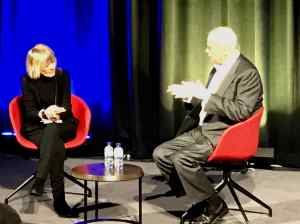
Canberra Writers Festival 2019, Day 2, Session 1: Identity (Tara June Winch with Yvette Henry Holt)

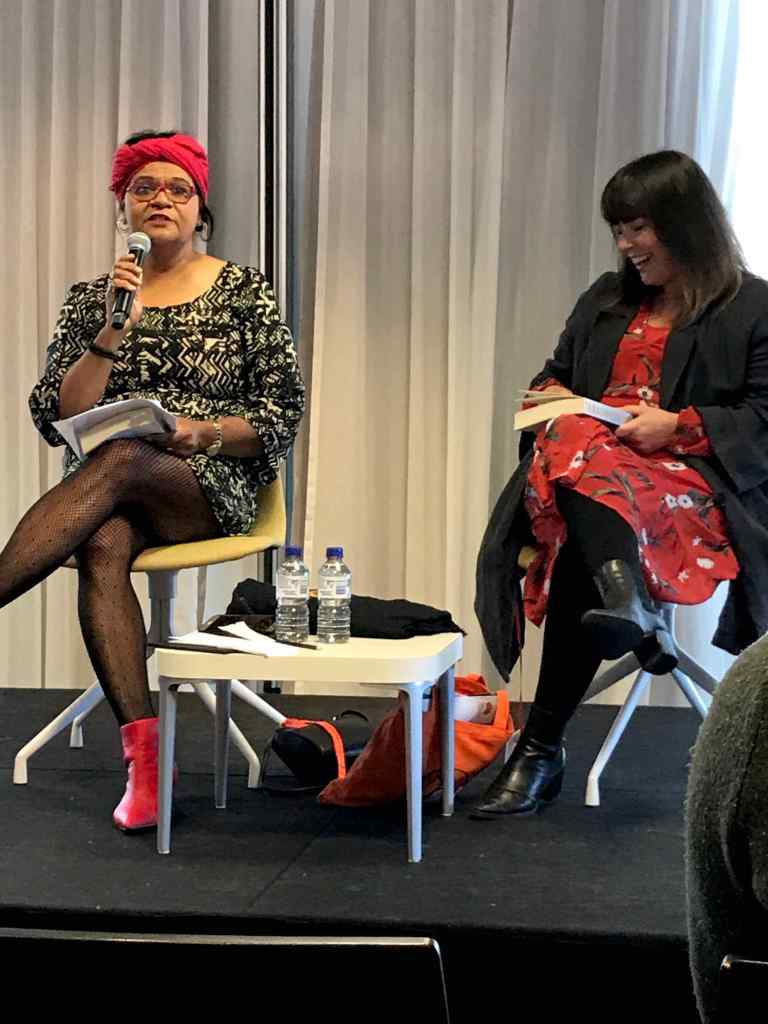
Holt and WinchToday was the day I was able to devote to fiction writers. There were still clashes, but there was never any doubt that I would attend this Tara June Winch session, even though it meant missing a panel featuring Charlotte Wood, Brian Castro, and Simon Winchester. Why were these scheduled opposite each other?! The Festival-goers complaint! Anyhow, fortunately, as you’ll see, I did get to hear Brian Castro too; and I have seen Charlotte Wood before and did see Simon Winchester in a different session.
Anyhow, as I said, I was not going to miss Tara June Winch, and I was not disappointed by my resolve. It was a special session. There was a lightness to it, a joy, a love, a generosity, but also a deep and passionate commitment to indigenous lives and culture.

Poet and current chair of FNAWN (First Nations Australians Writers Network) Holt commenced by jokingly welcoming us to the Boris Johnson Fundraising event at the Canberra Raiders Festival! But she then turned serious, acknowledging the passing of Kerry Reed Gilbert (see my Vale post) whom she called one of “our most imperative voices for treaty in Australia”. She called for a one-minute silence.

Holt then introduced Wiradjuri-born Tara June Winch, who now lives in France. She named Winch’s works to date: the award-winning novel Swallow the air (my review), short story collection After the carnage, script for the VR program Carriberie (which I’ve seen at the NFSA), and her latest novel, The yield. She then handed over to Winch.

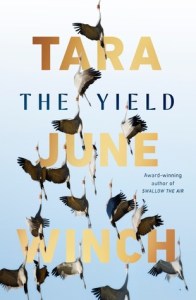
Book coverWinch explained The yield’s genesis. Ten years in the writing, it was inspired by a short course she did in Wiradjuri language run by Uncle Stan Grant Sr (father of Stan Grant whom I’ve reviewed here). Discovering language was transformative. She’s always regretted that she didn’t include more language in Swallow the air.
She then discussed the tussles she had writing the book. She started with too broad a canvas, but her mentor, Nigerian Nobel Laureate Wole Soyinka, encouraged her to focus on 500 acres of land, telling her she could tell her story through that lens. So, she found her 500 acres on the Murrumbidgee and created fictional place names – the Murrumby River, and the towns, Massacre Plains and Broken. These names, Broken and Massacre, which do exist elsewhere in Australia, convey the nation’s brutal colonial history, and thus encompass truth-telling. I appreciated hearing this, because I have started referring to fiction as part of the truth-telling process, and hoped I wasn’t being naive.

She said she wanted her places to be real, but she used fictional names so that she wouldn’t be imposing her story on the specific stories and experiences of people living in a place. I was glad to hear this too, because I think there’s real sense in using fictional place-names, as, for example, Melissa Lucashenko does in Too much lip, Tony Birch in The white girl, and also Karen Viggers in The orchardist’s daughter. It is these sorts of insights that can make attending festivals so meaningful.

Winch then described her three narrators, all of whom tell the story of the same 500 acres:

  • Poppy, first person narrator, dictionary writer and August’s grandfather; he is dying but is also a time traveller, so, Winch said, there are elements of magical realism.
  • August, third person voice; she tells a contemporary story of the 500 acres and the challenges faced, including from mining and river degradation.
  • Reverend Ferdinand Greenleaf, a Lutheran missionary, who’s writing a letter in 1915 about his experiences running the ironically (I assume!) named Prosperous Lutheran Mission from the 1880s. Winch created him to “round” out the story. He’s her villain, but she gives some balance, humanity, to him by sharing his own experience of loss of mother tongue.

At this point, Holt noted that at Hermannsburg, the Lutheran missionaries are remembered more positively than other denomination missionaries tend to be. There was some discussion about religion, and how indigenous people who’ve had positive experiences with Christianity can comfortably straddle the two belief systems.

Winch then did a reading, which was of course special. She read Chapters 1 and 3 – they are short, and in Poppy’s voice. The first paragraph starts:

I was born on Ngurambang — can you hear it? — Ngu-ram-bang. If you say it right it hits the back of your mouth and you should taste blood in your words. Every person around should learn the word for country in the old language, the first language — because that is the way to all time, to time travel! You can go all the way back.

Holt described the novel’s opening, and I think I’ve got this right, as “brushstroked around language”. She then quoted indigenous writer Ellen Van Neerven (whom you’ll find here too) who has said that a recurring theme in contemporary Aboriginal literature is that of returning, which, when I think about what I’ve read, rings pretty true. Holt then said something, and again I think I’ve got it right, about the “circumnavigation of Aboriginal placement” which I guess refers to the way indigenous people, rarely easily, find their way back to their start.

Winch talked about her intentions for the book. She wrote it as a gift for her father who had no language, and for her daughter whom she hopes with grow with language. She wants it to be life-changing for them. She also sees it as a handbook for claiming native title, and for recovering language. She describes her book as “faction”, which of course, with my open-mind to the fact-fiction nexus, I rather like. During the Q&A, she added that she was writing for people who still believe taking children away was a good thing.

She spent some time at Wagga Wagga Writers Writers House (love it!), where she, a coast girl, learnt about Riverina country. She “dragged” the book around with her for years, working on it in various locations.

She worked with indigenous intellectual rights lawyer Terri Janke to make sure all protocols were met, and that she had not included secret/sacred stories. Bruce Pascoe and Eric Rolls helped her with Knowledge about landscape through time. Wiradjuri people, her people on whose land the story is set, have given her good feedback.

Holt shared a favourite quote from the book (at the end of Chapter 2), in which Poppy tells August about memory and history, about the torture of memory versus forgetting. It ends with

He was telling her more – that a footprint in history has a thousand repercussions, that there are a thousand battles being fought every day because people couldn’t forget something that happened before they were born. ‘There are few worse things than memory, yet few things better,’ he’d said. ‘Be careful.’

Holt also mentioned indigenous Australian poet Kirli Saunders who is fostering poetry in first languages at Red Room Poetry.

They talked about the “heartache we carry”. Winch shared the challenge of creating a palatable story, a story with characters “you can root for”. She said she needed to take on the trauma of her research herself. She wanted to be truthful but not dogmatic, not hit readers over the head. She wants the truth to seep into the readers.

Winch conclude with a quote from the Persian poet, Rumi: “Out beyond ideas of wrongdoing and rightdoing there is a field. I’ll meet you there.” This, she said, is her book.

Q&A

The conversation was followed by an engaged Q&A which continued the warm, welcoming, respectful tone set by Holt and Winch. One person, who was only one-third through the book, questioned Greenleaf’s villainhood, but Winch said “read on”! However, she also said that she wanted to take the idea of a villain and turn it on its head. People aren’t black-and-white, she said.

Another question concerned the dictionary, and how good it would be if more indigenous words were everyday parts of Australian language. Winch noted that it’s a sign of respect to use local words when we travel overseas, so why not the same here? Fluency isn’t necessary to show such respect.

There was also a passionate comment from the floor about Adani and the disrespect being shown to indigenous people, particularly to Adrian Burragubba.

Perhaps the most significant question concerned the sense that there is a strong momentum building of indigenous voices. Holt and Winch respectfully, but clearly, responded that these voices have always been there, that the renaissance is not with indigenous people but with non-indigenous Australians. Indigenous writers are now getting an audience which means that Australians have changed! Perspectives, again, eh?

Holt, noting that this Session’s audience comes with an understanding of Indigenous literature, asked what has changed in your (the audience’s) psyche about Aboriginal Australia? There is, she agreed, an explosion of indigenous voices being celebrated, but the voices have always been there! Publishers, though, Winch noted, have played a role. Winch and Holt affirmed their wish for respectful mutual conversations in which we share each other’s skies.

The session ended with more discussion about language. Winch said that she wrote the book for what comes after, that is, to encourage readers to vote well, to get local indigenous languages into local schools. Language heals, and it continues culture. She wants us to have the conversations, to think nationally, act locally. She also commented on the acceptance of apathy in Australia versus France where protest is part of fabric of their nationality.

The last audience question/comment was given to Jeanine Leane (whom I’ve reviewed here), who reiterated the call for more first nations languages and literature in education. It is growing in the tertiary sector, but there is a “sad gap” in primary and secondary education. (Here’s an opportunity for me to donate some books to my son’s primary school.)

Her mantra was: Start reading books and think small picture.

Such a strong but gentle, provocative but gracious, session. (And, I’ve written a lot!)

Canberra Writers Festival 2019, Day 1, Session 4: Bruce Beresford and Ladies in black

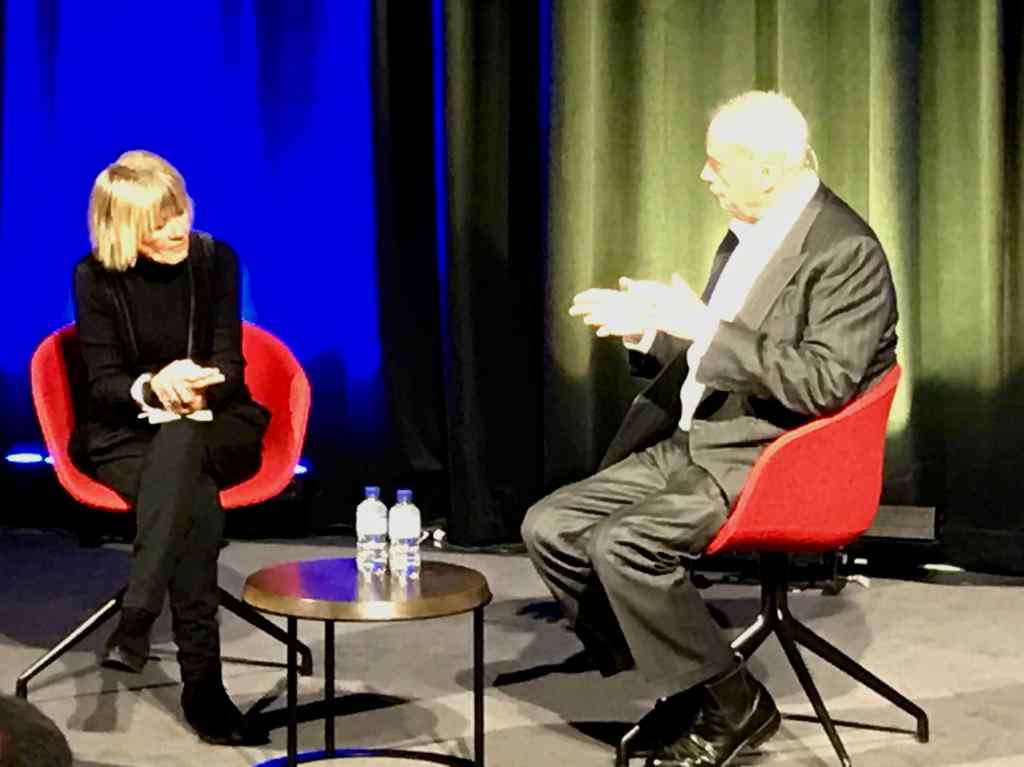
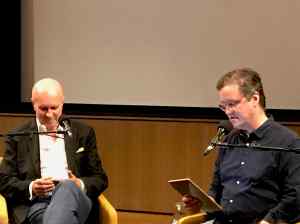
Pomeranz and BeresfordIt’s a curious thing, isn’t it? When I write my book reviews, I spend very little time on the content, focusing mostly on themes, style and context, but when I write up festivals and other literary events I find it hard to be succinct about the content. Perhaps this is because I can always go back to the book to check something, while these events are fleeting. Once they’re gone, they’re gone, so I want to capture all I can. Of course, many events these days end up as podcasts, but you can’t be sure how long they’ll be there. Anyhow, that’s my excuse and I’m sticking to it …
Why I attended this one should be obvious. I have read, loved and reviewed Madeleine St John’s The women in black, and I have been following the story of its adaptation to screen for over ten years, keeping my fingers crossed that Australian director Bruce Beresford would get the money to make it! Finally he did, and Mr Gums and I saw it soon after. An added attraction was that Beresford, whose memoir I have reviewed, was being interviewed by the inimitable Margaret Pomeranz of Margaret and David.

Ladies in Black – A thirty-year obsession: Bruce Beresford in conversation with Margaret Pomeranz

The women in black, Madeleine St John, book coverPomeranz began, it seemed to me, by wanting to focus more generally on book-to-film adaptations, but Beresford focused, not surprisingly I suppose given the session topic, on The women in black/Ladies in black.
Are there some elements that make a book easy to adapt?

Beresford responded that he looks for story rather than adaptability. However, The women in black (my review) was easy to adapt, because it has short chapters, a strong narrative line, and a lot of dialogue. By contrast, many years ago, he was offered The thorn birds, but found it so badly structured that he rejected it.

Later in the conversation, Pomeranz returned to the issue of adaptations, asking him what’s different for him as filmmaker between working on adaptations versus original screenplays. No difference really, said Beresford. His main issue is whether he thinks he can handle the script. Nonetheless, he admitted that he had had flops which David Stratton, he said, had treated mercilessly. That got a laugh, as we knew Stratton was in the audience.

He mentioned working with Horton Foote on Tender mercies, calling him the best writer he ever worked with. He also worked with William Boyd on adapting Joyce Cary’s Nigerian-set novel, Mister Johnson. A challenge, he said, because the novel is anecdotal with no through plotline. He is now working on a David Williamson script about Isaac Newton. He likes doing Williamson, his dialogue is sharp.

Beresford returned frequently through the conversation to the challenge of raising money. He mentioned the Italian producer, Dino De Laurentiis – a pleasure to work with, astute, generous, kind, and able to make all feel they are contributing.

Why change the title from Women to Ladies?

There was a play and a film called Woman in black. Also, some people misunderstood the title, assuming something darker. He found himself explaining that it was about ladies working in a department store, hence the change to “ladies”.

How did it all come about?

Beresford knew St John at university. She was well-read, fun, witty. He lost touch with her until the early 1990s when Clive James recommended a book he’d read, calling it “one of best novels ever written.” Beresford loved it too, describing it as marvellously funny, observant, and with a fluid style . He thought it would be easy to fund. Famous last words! It took 23 years to put the funding together, with producer Sue Milliken (whose memoir I’ve also reviewed).

I liked his clear articulation of the story’s themes: young women asserting themselves, and the clash of immigrant culture. He made very few changes, saying the book is the film and the film is the book. His main change is the last scene bringing the characters together, but this was presaged in the book.

Making the film

Film critic Pomeranz was particularly interested in the filmmaking process – from the intellectual decisions to some of the more practical aspects – and assumed, rightly, I think, that the audience would also be interested in behind-the-scenes stories.

The book, she said, seems to have an acerbic view of Australians, and is also about Australia on the cusp of change (a time when Pomeranz and Beresford were young). How did he handle these? Beresford said that it resonated closely with him, and that he did his best to recreate the time. Madeleine was very observant which made it easy.

There was a question during the Q&A regarding his physical recreation of Sydney. Beresford described using trams at the Sydney Tramway Museum, printers at the Penrith Museum of Printing, and the unrenovated 7th floor of David Jones in Sydney for the first scene at Goodes when the doors are opened. The rest was done at Fox Studios.

Pomeranz asked him how he approaches a screenplay. Is it all structure? No, he said, it’s about dialogue and characterisation. I laughed, really, at how often Beresford said the opposite to what Pomeranz assumed!

Pomeranz also asked how you know what audiences will like. Beresford said you never know but he hoped they’d respond to St John like he did, and then talked about the difficulty of getting funding for Driving Miss Daisy, because potential producers didn’t believe it would interest audiences. An old southern belle being driven around by an old black man!? How then do you know you’ve got it right, Pomeranz persisted? You don’t, he said. However, he runs a rough cut of his films for an audience in an out of the way place, and stands at the back to watch their reactions. He looks for their emotional reactions, and will use that in final cuts.

He storyboards his films (and indeed the NFSA has some of his storyboards). This makes both the filming and editing easier, because he knows what he is doing. He works with editor Mark Warner, and has for over 20 years.

Regarding casting and characterisation, Beresford described the challenges of casting Magda, and his not using a Middle-European. (Middle European Australian actors turned down the role because they thought it was a supporting role! Silly them!) Pomeranz suggested that St John’s view of men is acerbic, and Beresford admitted he softened Lisa’s father because he didn’t want to lose the fact that he loved her. Beresford also talked about Patty’s husband who runs away, embarrassed by his own sexuality, saying that some people, “get” this while others don’t.

The film didn’t have much of a cinema release in the US, but is on Netflix; it is opening in France, but not in England! Say no more!

A bit more about Madeleine

Through the conversation and Q&A, other interesting facts came out about Madeleine St John, such as that she wouldn’t allow translations. She made Beresford her literary executor, and he approved translations after her death! Hmm, that old ethical conundrum for literary executors. It has resulted in money going to her two nominated charities.

However, most of what came out is in Helen Trinca’s biography (my review) so if you are interested, I recommend that.

Q&A

There was quite a lively Q & A, including:

  • various members sharing how closely they related to the story, for themselves or their mothers’ generation. Beresford said he advised the marketers not to promote the film to older women, as they’ll come anyway, but to young women, as it’s all about them. The marketers didn’t listen to him, but the young women came.
  • questions relating to the novel, such as does he require the cast read the novel or prefer they don’t. He doesn’t stop them, but usually they just read the script.
  • a potential contretemps occurring when an audience member commented that the book/film represent an Anglo view of Central Europeans. Magda’s negative comment about the German language, for example, this person said, the feeling of Central Europeans. Some misunderstanding ensued, but Pomeranz, and general goodwill, hosed it down pretty quickly.
  • Beresford naming his favourite directors as including John Ford, Carol Reed, Martin Scorcese, and saying he likes many new films.
  • Beresford believing that while it is always hard to get funding, the Australian industry will continue as long as people want to see their own stories.

It was a lively, warm, light-hearted session, and yet it was also informative about both this film and filmmaking more generally. Mr Gums and I enjoyed it – as we also did a lovely dinner at our favourite Muse afterwards.

Canberra Writers Festival 2019, Day 1, Session 3: Simon Winchester in conversation with Richard Fidler

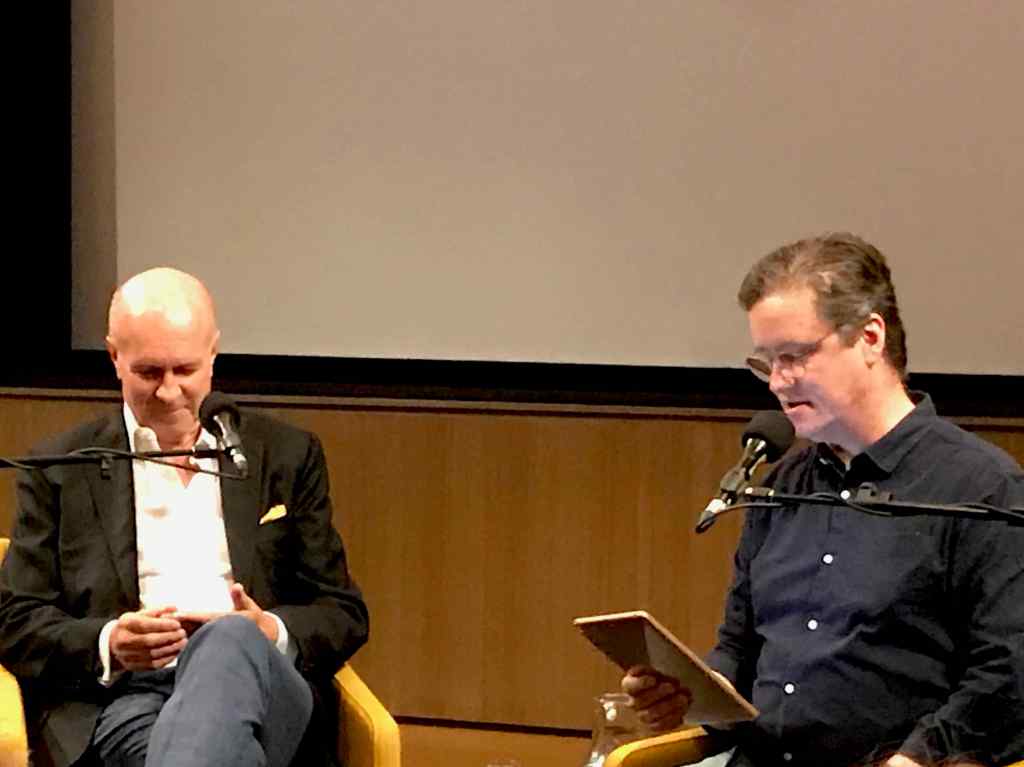
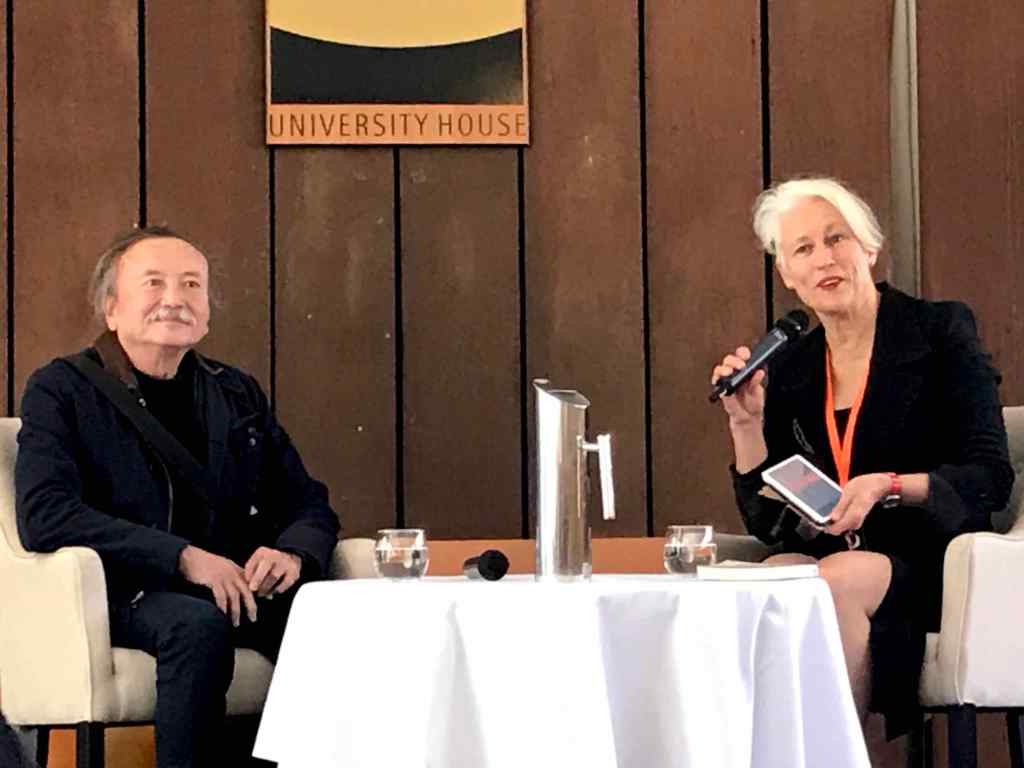
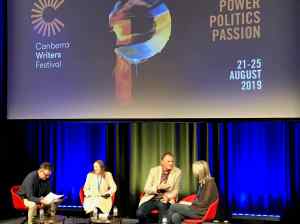
Picture of the two conversantAnd then it was time to hop into the car, and drive over the lake for the sold-out session (as indeed was my first session of the day), Simon Winchester in conversation with Richard Fidler. There was no time for lunch!
Why did I choose this session? Why not? It’s Simon Winchester!

This session was also recorded by ABC RN for Richard Fidler’s Conversations program.

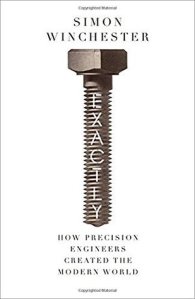
The conversation focused on the prolific historian’s latest book Exactly: How precision engineers changed the world (which was published in the USA as The perfectionists, with the same subtitle). I like our title better, as perfectionism can carry a hint of judgement, don’t you think? Anyhow, the conversation covered a number of topics, including his inspiration for the book, the history of precision, stories about precision, and the impact and future of precision. I’m going to try really, really hard to keep this one short because I don’t think I need to tell you all about the content of the book which was the main focus. I’m going to dot point some of the interesting facts I learnt.

Book coverFirst though – oh oh, will I still be able to keep this short – the book is cleverly (though probably still chronologically) structured according to increasing levels of precision (or, to put it another way, decreasing levels of tolerance.) So, Chapter 1 is Tolerance 0.1, Chapter 2 is 0.0001, right up to Chapter 9, the second last chapter, which is a mind-boggling: 0.000 000 000 000 000 000 000 000 000 000 000 01! We are talking precision after all!
You won’t be surprised that one of the questions Winchester poses is “Are we becoming too focussed on precision?” I’ll leave you to judge.

A propos the book, too, Winchester said that he likes dredging up people overlooked by history (as he did, for example, in The surgeon of Crowthorne and The map that changed the world.)

Now, some interesting, more-or-less random facts:

  • Pioneers of precision engineering were Henry Maudslay (1771-1831), a founding father of machine tool technology, and John ‘Iron-Mad’ Wilkinson (1728-1808), who invented a precision boring machine that helped James Watt get his steam engine off the ground (as it were). Do you know them? They were instrumental in starting the Industrial Revolution.
  • Precision has a precise birth-date! 4 May 1776 (which Star Wars aficionados apparently know for another reason!) This is the day Wilkinson’s cylinder boring machine was delivered to Watt. Its precision was one-tenth (0.1, you see) of an inch.
  • The concept of interchangeability, which is also crucial to the history of precision and modern manufacturing, started in France in the 1780s with a demonstration of assembling a flintlock gun from boxes of identical parts. Attending that demonstration was Thomas Jefferson who took the idea back to America, for arms manufacture. This idea was also taken up later by …
  • Two famous car manufacturers, Henry Royce and Henry Ford, who took the idea of interchangeability to a new level. Both born in 1863, Royce wanted to build the finest car in world, while Ford wanted to build a car that would enable as many Americans as possible to see their amazing country. In roughly the same period, Royce’s company made 8,000 Rolls Royces (Silver Ghosts), of which about 6,000 are still in running order, while Ford made 18 million Model Ts, which are all gone! But, they served their purpose, eh? These two men used the same idea with different ethoses: expensive perfection versus economies of scale.
  • The failure in 2010 of Airbus 380, QF 32 demonstrates the importance of precision, being caused by the mis-machining (by Rolls Royce in fact) of a tiny tube. It was half a millimetre too thin.
  • Precision machines at LIGO (Laser Interferometer Gravitational-Wave Observatory) were developed to detect infinitesimal cosmic gravitational waves predicted by Einstein in 1916. Almost century later (we must be precise!), in September 2015, these machines recorded such waves.

Fidler found the discussion of precision, interesting but also dizzying and troubling, and he had some questions:

  • Are we fetishising the idea of precision? Fidler talked about being in Iceland without mobile access and the pleasure of having to use a map again. Years later he still has the map of Iceland in his head, which you don’t get when use that precise service, GPS on your mobile devices.
  • Is our focus on such precision something we should worry about? Our modern world is based on a knife-edge of precision, driven by commercial factors. Do we need to go 5 mph faster? Should shareholders demand profits that result in pushing precision to risky levels?
  • Are we forgetting the values of craftsmanship? Does our precise environment make us want to seek the imprecise? Japan, said Winchester, keeps its feet firmly on ground, being famous for precision, but also for fine craftsmanship in materials that can’t be so precise. He talked about Seiko and its super precise quartz movement. However, there’s also a section of their factory which hand assembles mechanical watches, the Grand Seiko, which regularly wins horological awards. These don’t have the same precision, losing 5 seconds per day, but do you upbraid someone for being 5 seconds late!! (Fidler joked about the ABC’s precision and how the news fanfare will occasionally overplay him if he runs late with his sign-off. We know, we’ve seen it happen on TV). Winchester introduced us to the Japanese idea of Wabi sabi, which expresses joy in natural lines.
  • Have we reached limits of precision? No, apparently not. There’s quantum engineering and optical engineering which continue to push boundaries. Meanwhile, much is happening in the world of standards – the standard kilogram, metre and second.

Amazing, really, how something so boring sounding as precision engineering can be so interesting! All helped of course by the talents of Winchester and Fidler.

Canberra Writers Festival 2019, Day 1, Session 2: Defining moments – True Crime Panel

The reason for my second choice for the day – a panel discussion on true crime – may not seem quite so obvious as my first, so I’ll explain. I don’t read a lot of crime, but I do watch it, and I have a slightly more than passing interest in true crime. I loved Truman Capote’s In cold blood, I also love Helen Garner’s Joe Cinque’s consolation and This house of grief, and I have watched all of the Underbelly television series (for which one of the panel members, Felicity Packard, wrote). Is that justification enough?

Picture of the panelThis session was recorded for ABC RN’s Big Ideas program, and the host of that show, Paul Barclay, moderated the panel. The panel members were
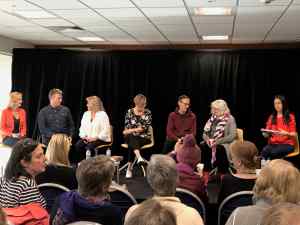
  • Hedley Thomas, investigative journalist who has produced a highly successful podcast The Teacher’s Pet about the disappearance and probable murder of Lynnette Dawson.
  • Felicity Packard, screenwriter on Underbelly and other successful television series.
  • Rachel Franks, academic specialising in true crime, including from Australia’s convict and colonial eras.

Paul Barclay commenced by commenting on our penchant for true crime, and that it can be a “guilty pleasure” for many. These crimes range from the criminal slaughter of indigenous Australians in colonial Australia to twentieth century crimes such as the disappearance of Azaria Chamberlain, the famous Pyjama Girl case, and Canberra’s most famous one, the as yet unsolved murder of Colin Winchester.

Felicity Packard, on what interested her about true crime, said that the story comes first. She loves a good story, but she has also always been interested in crime. She wants to get into the minds of the criminals, not to glorify them, but to represent – and understand – them as people. She also said her aim was not to judge them. Their actions speak for themselves! Fair enough.

Hedley Thomas, on why we love true crime, said that his wife liked it because she wanted to understand crimes against women with a view to identifying how women might protect themselves. More women read, watch and listen to true crime, Thomas said. They tend to empathise more and want to protect themselves. For “the rest of us”, there’s voyeurism, but also an awareness of the fine line, of how easily we could lash out ourselves.

Rachel Franks, on whether our convict origins contribute to our interest in true crime, felt that yes, it was a contributing factor! Everyone back then knew a crook, she said! Crimes broke routines, and people followed them closely in the newspapers.

The conversation then discussed:

  • the role of the pursuit of justice, and of revenge, in our interest in true crime.
  • women as victims: why we are more interested in crimes against the young and the beautiful, and why, even, we see such crimes as more heinous. Packard saw the focus on beauty as a sad indictment on society, and Franks said the focus on the young dying taps into the notion of loss of potential.
  • the fact that some crimes captivate people more than others, such as that of Allison Baden-Clay, whom Thomas knew personally: this story captivated us, he suggested, because they were an ordinary suburban couple (on the surface at least).

Barclay asked Packard what she’d learnt about criminals, given she’d spent time with many during her research for Underbelly. Her answer was enlightening, though, I suppose, not surprising. First, though she clarified that the crimes she dealt with were mercantile, rather than domestic/personal ones, and were from “organised crime” (though she’d call them “disorganised”). These criminals are characterised by lack of impulse control, greed, a sense of entitlement, and a determination to protect their patch. She did not see these criminals as particularly loyal or as part of a brotherhood, as Mafia movies suggest. She saw some loyalties, but these tended to be self-interested and short-lived.

Regarding whether it is easier or harder to write fictional versus true crime, Packard said that with true crime you have the bare bones but huge knowledge gaps. She therefore needs to invent – but in good faith. She’s not making documentary.

Barclay asked Franks about colonial Australia and particularly about the 19th century baby-farmer crimes. Franks explained that baby-farming grew largely as a response to the stigma faced by unmarried mothers. Often these “baby-farmers” would neglect or even kill outright these babies. A particularly heinous couple were Sydney’s John and Sarah Makin from the 1890s. They apparently killed 12-13 babies, and yet few of us know this story. The outcry over the Makins’ case resulted in some changes to legislation, such as banning the paying for babies, but it took much longer to reduce the fundamental cause, the stigmatisation of unmarried women.

Franks said that the main value of true crime is that it forces us to have a conversation about it, including how did the crime unfold, what policies or behaviours supported it or allowed it to happen.

Different true crime spaces (for want of a better word)

Barclay asked whether some crimes are too horrible to adapt for television. Packard said that child murder and sexual abuse (particularly child sexual abuse) are too hard to turn to entertainment, which is the space she works in.

Thomas’s space is different, investigative journalism, specifically in cold case crimes. It’s painstaking work, as journalists don’t have police tools, and difficult because the people involved are elderly or even deceased. His Teacher’s Pet podcast brought more people forward. So, he said, if he used the podcast model again he would start broadcasting it before he finished it (which is something filmmakers/documentary-makers can’t do.) Media, Thomas believes, can play an important role in ensuring justice. It’s incumbent on journalists to try to make a difference.

Regarding the impact of media on fair trial, Thomas said it depended on whether you are talking to defence or prosecuting lawyers! He also said that accused people can apply for a judge-alone trial to avoid prejudicial jury, but overall he believes that jurors are sensible and can be well instructed by judges. Packard talked here about the court process still being in train when the first Underbelly went to air. Free-to-air broadcast of it is still suppressed in Victoria.

Barclay asked about the impact of the series on the criminals. Mick Gatto was concerned and didn’t enjoy the notoriety, Packard said. Those who were played on screen by someone attractive were less bothered, and those on the looser end of illegality enjoyed the notoriety (and did quite well out of it!)  Overall, though, she said it’s a nasty brutish world, in which every male is dead or in gaol by the time they’re 35. There are glamorous moments but they’re brief.

Franks works in the history space. She said that crime shows can teach us to be most frightened of the serial killer but for women the greatest danger is at their front door. These are the stories that need to be told. True crime can be high-jacked for entertainment, but the serious stories – indigenous massacres, and domestic violence for example – can be reframed as history, or documentary.

And, just to make sure we all knew we were in Canberra, we finished with the point that the murder of Colin Winchester is a great story that needs to be investigated and told.

It was a fascinating session. I particularly enjoyed its teasing out the different “spaces” in which true crime operates. It’s a more complex “genre” than I had realised.

Canberra Writers Festival 2019, Day 1, Session 1: Capital culture

It’s Canberra Writers Festival time again. The theme continues to be Power, Politics, Passion, reflecting Canberra’s specific role in Australian culture and history. I understand this. It enables the Festival organisers to carve out a particular place for itself in the crowded festival scene, but the fiction readers among us hunger for more fiction (and, for me, literary fiction) than we get. And, because the Festival is widely spread with venues on both sides of the lake, it was impossible to schedule as many of my preferred events as I’d like! Logistics had to be considered. Consequently, my choices might look a bit weird, but I think I managed to navigate the program reasonably well.

Note: There is unlikely to be a Monday Musings this Monday 26 August, as I’ll still finishing off my Festival posts!

Capital Culture: Panel discussion moderated by Irma Gold

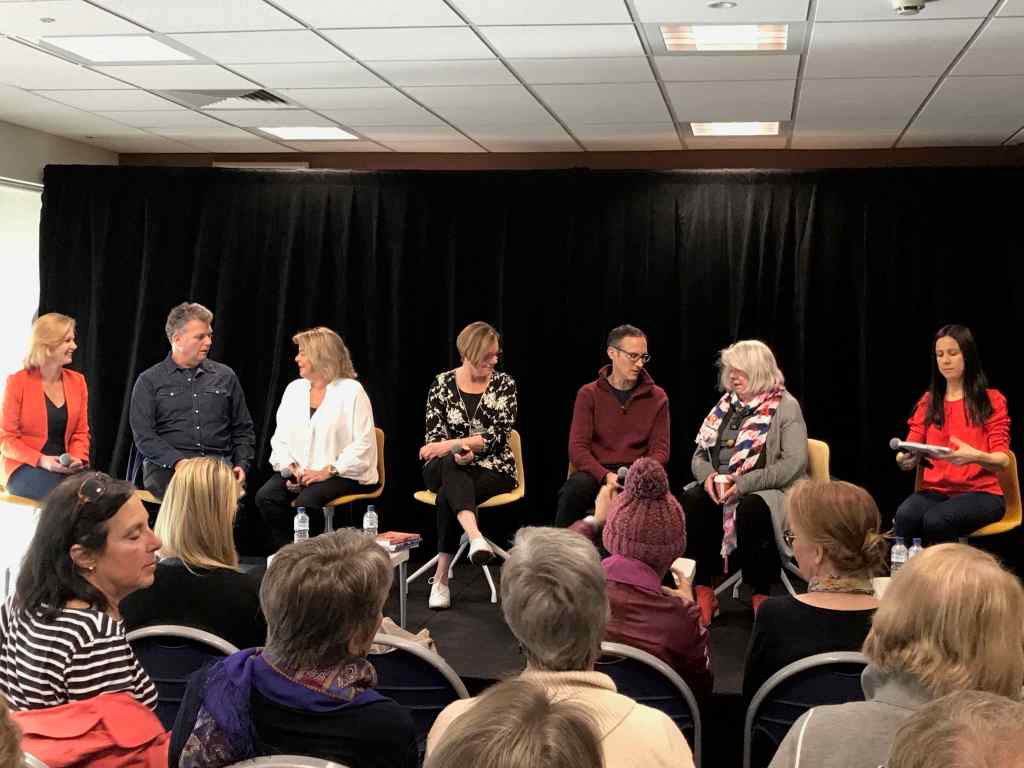
Panel pictureThe session was billed as follows: “Some of Canberra’s finest and most creative writers join forces in this irresistible ode to the national capital. Take a wild ride through a place as described by the vivid imaginations of some of this city’s best talents. Capital Culture brings stories not just of politics and power, but of ghosts and murder and mayhem, of humour and irreverence, and the rich underlying lode that makes Canberra such a fascinating city.”
You can see then why I chose this one – to support our local writing community, and to see writers on the panel who particularly interested me (like Marion Halligan, Paul Daley, and moderator Irma Gold.)

What I didn’t realise when I booked this session was that it was also a book launch. The description says ”Capital culture brings stories …” but oblivious me read that as saying the session called Capital Culture would tell us stories about the capital! The joke was on me, not that it would have affected my decision. Fortunately I discovered my mistake moments before commencement so I was prepared.

The writers were:

  • Paul Daley: journalist and author of Canberra in the Cities series.
  • Andrew Leigh: Australian Labor Party MP, but previously a Professor of Economics at the ANU, and author of several books including the wonderfully titled, Battlers and billionaires: The story of inequality in Australia.
  • Marion Halligan: award-winning Australian writer of novels, short stories, essays and other non-fiction.
  • Tracey Hawkins: award-winning author of children’s and adult non-fiction books.
  • Marg Wade: owner and operator of Canberra Secrets Personalised Tours, and author of three editions of Canberra secrets.
  • Nichole Overall: social historian and author of Queanbeyan: City of champions.

Irma Gold opened the session by referring to the Festival’s theme, Power, Politics, Passion, and saying that Canberra is more than that. This new anthology, which includes fiction, poetry and non-fiction, offers, she said, a nuanced picture of our capital. She also acknowledged country, and noted that it was a privilege to be talking about story on this land that has been full of stories for so long.

Perceptions of Canberra

The discussion started with panel members’ initial response to Canberra. It is a peculiar thing – to me, anyhow, who specifically wanted to come to Canberra – that many who come here hate it at first.

Journalist Daley and police officer Hawkins, for example, found themselves insulated within their professional communities – Parliament House journos for Daley, and police officers, not to mention criminals and dead bodies (!) for Hawkins. It was only when they married and moved into the ‘burbs that they started to enjoy Canberra community life. Daley also discovered the bush (which was something he’d never embraced before as an inner city Melbourne boy.)

Gold also came here not wanting to come, but is now a committed Canberran. Overall’s husband’s family came here in 1958 when his father, John Overall, became the first commissioner of the NCDC (National Capital Development Commission). Although her husband didn’t much like it, his father saw the city’s “unfulfilled potential” and was instrumental in building the capital we have today, including the lake and significant buildings like the National Library of Australia.

Other panelists had slightly different stories. Author Halligan quite liked Canberra when she came here as a student in 1962, but she didn’t expect to stay. Marriage changed that, and she now loves Canberra. She’s on a mission to overturn the ongoing denigration of Canberra through the use of our name as a synonym for the the Government. The whole of Australia elects it (and, in fact, right now the government is not the one Canberra voters would have brought in!) Daley said that this use of Canberra as a synonym for the Federal government is lazy jounralism. We feel abused and misrepresented much of the time, I must say!

MP Leigh talked about his love of the “bush capital”, saying it’s hard to come back from a walk in the bush and not feel good about yourself. Canberra’s bush, he said, is grounding and a leveller, something anyone can enjoy. His responses tended to be those of a politician – not shallow responses, though, but those of someone who sees the city from a certain perspective. He said that

if Canberra was a person, I like to think that it would be an egalitarian patriot, the kind who knows the past but isn’t bound by it.

Tour guide Wade said that her approach to the anthology was to do something fun, so she wrote a story inspired by Canberra’s ghosts, in particular those at the National Film and Sound Archive. She also mentioned ghosts at the Australian War Memorial (the “friendly digger” who opens and closes doors), the Hyatt ghost (who just stands and does nothing), and Sophia Campbell at Campbell House Duntroon (who is a naughty ghost)!

Gold then asked the panelists to comment on the fact that few countries in the world show as much contempt for their capital as Australians do. The term “Canberra bashing”, she said, entered the Australian dictionary in 2013, our centenary year. Of course, Gold was speaking to the converted, but the points were well made nonetheless!

Overall agreed that Canberra is underestimated by others, and that there is more to it than its obvious superficial beauty. Daley commented that Canberra has an intelligent, outward-looking populace. Canberrans are acutely aware of the symbolic nature of place, and the way it encompasses the story of Federation. It’s an egalitarian place, compared, say, to Sydney. Canberra is mostly middle-class with few shows of wealth. He also commented that creative communities can be found all through CBR.

Leigh took up the point about community noting Canberra’s “extraordinary urban design”, including its walkability and plethora of small suburban centres, which facilitates people mixing at local shops, and engaging in community activities at levels higher, apparently, than many Australian cities.

Wade talked about loving to change people’s perception of Canberra, while Hawkins commented on how often, when she travels overseas, people have never heard of Canberra, let alone know it’s Australia’s capital.

Gold asked Halligan about the idea that you shouldn’t set fiction in Canberra. Halligan said that her fiction was not political, but about ordinary people and lives. She talked about her experience of doing book tours with her novel The apricot colonel and the frequent surprised response that Canberrans were normal, just like them. Fiction, she suggested, can help change perception. Overall mentioned the success of Chris Uhlmann and Steve Lewis’ Secret city series.

It’s not all light

Finally, Gold noted that the anthology’s editor Suzanne Kiraly had described hers and Paul Daley’s piece as being the darkest in the anthology. Daley said that while Canberra is egalitarian, it’s not a great place to be poor, and so his second piece in the book is a fiction piece inspired by a young woman busker, the “violin girl”, he used to see. Leigh agreed that there’s no shortage of suffering in Canberra, but also argued that there are many civic entrepreneurs here reaching out to support or help the more vulnerable in the community.

Hawkins added that her story is a murder, that Canberra has crimes like any other community – as she discovered in her early years working here, which took her to, among other places, the old Kingston mortuary.

Gold commented early in the session that Halligan’s piece has a mournful, sorrowful tone. Halligan responded that she was “conscious of the melancholy of things that have been lost” such as the old Georgian vicarage where Glebe Park is now. Overall agreed, saying that we lose our uniqueness and distinctness, our sense of who we are, when we lose our buildings.

Q&A – and some comments

There was a short Q & A, but I’m just going to comment on the one suggesting that Canberra does not have a great depth of multiculturalism, despite our great annual Multicultural Festival. Those panelists who responded generally disagreed, and I could see their point – to a point. However, I had already noted to myself that the panel itself was not diverse. As far as I could tell none had an indigenous nor any other culturally diverse background. And, indeed, I think the whole anthology is the same. A lost opportunity to offer some different voices about our city.

However, the anthology does include contributions from some excellent writers, and I look forward to reading it. I only wish that, like most anthologies I’ve read, the table of contents included the author’s name!

Previous Canberra anthologies I’ve reviewed:

National Bookshop Day 2019

Time for another National Bookshop Day, given my last posts were in 2013 and 2012. In those posts I named some of my favourite Canberra bookshops, particularly the National Library Bookshop, Paperchain and Beyond Q (secondhand booksellers). They are still among my favourites, but, since then, two more excellent bookshops have opened, Muse (which runs Festival Muse about which I’ve written several times) and Harry Hartog Booksellers. Both these stores sell new and secondhand books, making them extra special. What great choice we have in Canberra!

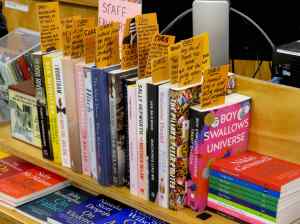
Staff picks shelf
Staff picks at Book Face

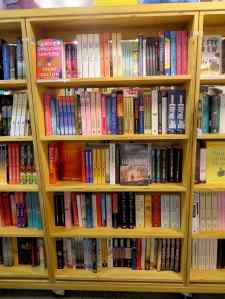
This bookshop day, I may not get to a bookshop, as I’ll be on the road between Sydney and Mollymook, so I’m including pictures from one we visited this week in Port Macquarie. I hadn’t heard of Book Face before, but the website explains that it is “a small group of local, independent bookstores whose first store opened its doors in November 2014. Owned by Paul and Leo Berkelouw”. If you don’t know the Berkelouws, and are interested in them, check out the family’s two-century plus history of bookselling on the Berkelouw website.

Book shelves at Book Face
Shelf section in Book Face, Port Macquarie

Book Face is an inviting smallish bookshop, with a lovely little cafe at its entrance. (You know how I love Muse with its excellent restaurant!) We enjoyed wandering about its bookshelves – and facing out Nigel Featherstone’s Bodies of men while doing so! Never let a chance go by is my motto when seeing Aussie authors in bookshops. Pleasingly, a couple of other Aussies (Trent Dalton and Peggy Frew) were already face out (as you might see in the pic). It was also heartening to see some Aussie authors in the little display of staff picks on the shop’s counter. Good one Book Face.

And now, for something completely different …

Author-owned bookshops

I don’t know of many Australian author-owned bookshops but there are several in the USA. Here’s a list of those I know (in alphabetical order by author name):

  • Judy Blume’s Books & Books, Key West, Fl (opened 2016): Blume, of course, is an extremely popular writer of children’s and young adult books. Her shop is a not-for-profit centre “that provides studio space for local artists, a residency program for visiting artists, galleries, and classes” as well as selling books.
  • Louise Erdrich’s Birchbark Books and Native Arts, Minneapolis, Mn (opened 2010): Erdrich (whom I’ve reviewed recently) opened this small independent bookstore with her daughters. It specialises in Native American literature, has “indigenous-language guides, literature and crafts, alongside the latest best sellers”, and a toy-filled play area!
  • Lawrence Ferlinghetti’s City Lights, San Francisco, Ca (opened 1953): Ferlinghetti, an American poet who turned 100 this year, opened his store and publishing company with college friend, Peter Dean Martin. The shop was aligned with their left-leaning politics and aimed to “break literature out of its stuffy, academic cage”. The current manager says that they don’t sell or publish bestsellers!
  • Jeff Kinney’s An Unlikely Story, Plainville, Mass (opened 2015): Kinney is the author of the very popular Wimpy Kid books. The article announcing his shop’s establishment explains his aim as being to help the book trade. He plans to be somewhat hands-on, including offering cartooning workshops at the store. It has a healthy cafe too!
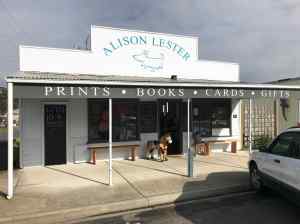
  • Exterior of Alison Lester Gallery BookshopAlison Lester Gallery/Bookshop, Fish Creek, Vic (opened 2014): Lester is a popular Australian children’s picture book author and illustrator. Her shop, unlike the others I’ve included here, only sells her own books and art work, but as she’s the only Australian author-owner I could find, and the only one of the shops that I’ve visited, I’m including it!
  • Jonathan Lethem’s Red Gap Books, Blue Hill, Me (opened 2009): American novelist Lethem is co-owner of this used books shop, which is named for a 1935 film, Ruggles of Red Gap, loved by the shop’s owners!
  • Larry McMurtry’s Booked Up, Archer, Texas (est. orig. in Washington DC, 1970): Bestselling author of Lonesome Dove and other books, McMurtry sells used books. The Archer store is apparently one of the largest used bookstores in the USA. McMurtry is quoted on the site as saying “Few books are rare; we have handled only a handful in 44 years in the trade. But many books are attractive. Customers come to us from wherever the four winds blow.” Love it.
  • Ann Patchett’s Parnassus Books, Nashville, Tn (opened 2011): Award-winning novelist of books like Bel canto, Patchett is co-owner of Parnassus Books, which the two women established when Nashville suddenly lost both its bookstores. You can read the story (with links to more) on the shop’s website. It’s all about two passionate people believing they could do what corporations couldn’t or wouldn’t in Nashville!
  • Emma Straub’s Books Are Magic, Brooklyn, NY (opened 2017): Unknown-to-me novelist and short story writer Straub opened this shop with her husband, largely because their local bookshop had closed. (Rather like Patchett.) Like many of the bookshops I’ve listed, this offers author events and is keen to engage the local community. Straub says that their “bookselling philosophy is that books are magic. And that we are nonjudgmental and we aim to be encouraging.”

I’ll leave you with Ann Patchett’s passionate statement about books bookshops and social change:

Amazon doesn’t get to make all the decisions; the people can make them, by choosing how and where they spend their money. If what a bookstore offers matters to you, then shop at a bookstore. If you feel that the experience of reading a book is valuable, then read a book. This is how we change the world: We grab hold of it. We change ourselves.

Couldn’t say it better myself.

Now, can you add to the list? From anywhere in the world?

Lecture and Book Launch: Australia’s first naturalists

I don’t usually write up book launches, mostly because the speeches are brief, and I hope to eventually read and review the book itself. However, as the title of this post tells, the launch for Penny Olsen and Lynette Russell’s book, Australia’s first naturalists, was also billed as a lecture, hence this exception.

Australia’s first naturalists was published by NLA Publishing, and is subtitled Indigenous peoples’ contribution to early zoology. The event was MC’d by NLA curator Nat Williams, with the first speaker being Rebecca Bateman, who is the NLA’s first indigenous curator. She talked about the NLA’s collections relating to indigenous people, and how, in some cases, they contain information, including language, that can help people regain lost culture. Then it was over to the authors…

The authors

Penny Olsen, Honorary Professor in the the Australian National University’s Division of Ecology, Evolution and Genetics, has worked as a field biologist and ecological consultant, but now mostly writes books about Australian natural history. She started by saying that it feels like there’s been a sea change in awareness and appreciation of indigenous people’s part in Australia’s story (and I think she’s right.)

However, she said, while their roles as guides and trackers, as workers in the cattle industry, in mining, on stations, and in whaling, is well-known, less known is the significant role they played in the advancement of science – particularly in zoological science. She said that researching the contributions made by indigenous people was challenging, because sometimes their help would simply be referenced in a throwaway line. Other times, though, there would be more detailed accounts. Her reading of these relationships between indigenous people and scientists, was that indigenous people were willing, but also that the relationships ranged from exploitative to warm friendships.

Olsen then talked about some of the collecting partnerships she found – chronologically, starting with James Cook in 1770 – illustrating them with powerpoint slides. These partnerships involved activities such as indigenous people locating specimens, and sharing their knowledge about animal behaviour.  Sometimes the indigenous people were named, sometimes not. Sometimes scientists worked with individuals, sometimes with families or whole groups. It was fascinating, and whetted my appetite for the book!

She finished with a quote from geologist Cecil Thomas Madigan’s 1946 book, Crossing the dead heart, which included:

… but I knew the value of natives on trips such as these, real bush natives who know the habits of all bush creatures and catch them. They are of the greatest help to the biologist and botanist in collecting …

(She also made a disclaimer about the terminology – like “natives” – that is used in historical sources.)

Then it was co-author Lynette Russell’s turn.

Lynette Russell, Professor at Monash University’s Indigenous Studies Centre, among other roles, calls herself an anthropological historian who focuses on developing an anthropological approach to the story of the past. She welcomed us briefly in the language of her great-grandmother – and then commenced, not surprisingly, by saying that “stories are important to understanding the past”. She won’t get any disagreement from us on that, will she?

Anyhow, she then shared various stories, also using images to support her points. She explained, for example, how long-lived traditions in indigenous culture contain information about climate change, such as the rise of sea levels, and how rock art provides evidence of indigenous peoples’ understanding of anatomy. She talked about how millennia of fire-stick farming has resulted in many Australian plants being fire resistant. And she commented on the arrival of feral animals, and their impact on indigenous peoples’ ability to sustain their environment.

The book is organised chronologically into 5 chapters, with the first chapter titled “Pre-European: Australia’s first naturalists”, and the last, “Epilogue: Contemporary Aboriginal and Torres Strait Islander Land and Sea Managers”. This last chapter, she said, discusses Indigenous Protected Areas, and indigenous ranger programs, which enable those who so desire to remain living on country and thus to maintain their traditional ecological knowledge and ensure its continuity. Traditional ecological knowledge is, she said, an “attribute of societies having continuous connection to their country”. Aboriginal peoples’ faunal knowledge is still extant; creating these new collaborations, replicates in some senses, those of the 19th century. Now, like then, indigenous people are generous with their time and knowledge.

She referred to Bruce Pascoe’s Dark emu (my review), saying it has managed to make promulgate more widely information about indigenous land management practices that archaeologists have known for a long time.

Finally, she noted that this book is an act of reconciliation.

Q & A

There was an interesting Q&A, with topics being:

  • why indigenous people wear clothing in some pictures and not others: they were interested in clothing, and were often “paid” in clothing.
  • why this information about expeditions has escaped us for so long: Australian history has focussed on squatters, and tragedies (like the Burke & Wills Expedition), but their research has uncovered a different story about real relationships and friendships.
  • whether the names of any indigenous people were used in scientific names for creatures they helped scientists “discover” (good question!): they couldn’t find any!
  • what was the quality of the expeditions in terms of their end-product: most were good for their time but tend to lack information we’d like today, such as animal behaviour, distribution, ecology. Their focus was – surely understandably? – more on identifying, categorising and naming.
  • what motivations did indigenous people have to help, besides being given items like sweets and clothes: friendship, it seems, and a genuine interest in these strange white men.

It’s encouraging to see yet another book furthering scholarship and understanding of indigenous peoples’ lives and culture, and of their very real role in forming modern Australia. A most enjoyable launch.

Lisa (ANZLitLovers) has already reviewed this book!

Lecture and Book Launch: Australia’s first naturalists
National Library of Australia
11 June 2019