Eleanor Catton, The luminaries (Review)

Courtesy: Allen & Unwin

Courtesy: Allen & Unwin

Now here’s the thing … I don’t make a practice of reading mysteries. I really don’t care about who dunnit. When Mr Gums and I watch television crime shows, I rarely concentrate enough to work out the plot intricacies, but I do watch the characters. I’m always interested in the detectives and their relationships. I want to know who they are and what makes them tick. And so, I must say that I got a little tired of the plot machinations in Eleanor Catton’s Booker prize-winning novel, The luminaries. I didn’t really want to expend effort to keep track of the complexities of whose gold went where, who told whom what, and so on. But, I did find the book an interesting read, nonetheless.

Why? Well, first and foremost because of the characters. In the first half of the novel, as the characters were being introduced, I was impressed by Catton’s understanding of human nature.  Her characters, most of them anyhow, are nuanced – if that’s not too clichéd a term. Here for example is Thomas Balfour:

When a restless spirit is commissioned, under influence, to solve a riddle for another man, his energies are, at first, readily and faithfully applied. But Thomas Balfour’s energies tended to span a very short duration, if the project to which he was assigned was not a project of his own devising. His imagination gave way to impatience, and his optimism to an extravagant breed of neglect. He seized an idea only to discard it immediately, if only for the reason that it was no longer novel to him; he started in all directions at once. This was not at all the mark of a fickle temper, but rather, of a temper that is accustomed to enthusiasm of the most genuine and curious sort, and so will accept no form of counterfeit – but it was nevertheless, something of an impediment to progress.

This made me laugh. Not all descriptions did of course, but most are insightful of humanity.

There is also humour in the book – some funny scenes, and wry asides. Since we’re on Thomas Balfour, let’s stay with him. Here he is meeting the chaplain Cowell Devlin:

‘Good morning’, returned the reverend man, and from his accent Balfour knew at once that he was Irish; he relaxed, and allowed himself to be rude.

Thomas, as you might have guessed, is English – and this of course tells us more about him than about Devlin.

Perhaps at this point I should mention the plot, though as a Booker Prize Winner, its basic premise is probably known to most of you. The novel is set in the New Zealand goldfields, Hokitika mainly, over 1865 to 1866. The plot concerns the death of one man, the disappearance of another, an apparent suicide attempt, and the provenance of a gold fortune. There are 20 main characters – 12 described as stellar, representing the 12 astrological star signs; 7 described as planetary, representing, of course, the planets; and one, the dead man, described as terra firma. It’s a lot to keep in your head but Catton does provide a character chart at the front to help.

There is a lot to enjoy while reading this book, in addition to the characterisation and humour. The plot is intricate and fun to unravel if you enjoy mysteries. The goldfields setting is realistic, with its businessmen, publicans, politicians, prospectors, whores, opium dealers and tricksters, not to mention the salting and the duffers. The writing is sure. I enjoyed her use of imagery. Grey and yellow feature throughout as do references to spirits (ethereal, emotional, and alcoholic), ghosts, apparitions, phantoms, fog and mist. These all helped convey a sense of murkiness, and of things shifting before our eyes.

The main themes are to do with truth, lies and fraud, with love, loyalty and betrayal. It’s quite a cynical world that our characters find themselves in. As the not-yet dead man, Crosbie Wells, says to the whore, Anna Wetherell:

There’s no charity in a gold town. If it looks like charity, look again.

There is, of course, but it’s rare – and, as Wells advises, you have to be darned careful about who you trust, because, human nature being what it is, where there’s gold, there’s always greed.

The big challenge of this novel is its structure. I’ve already mentioned the structure of the characters. The astrological theme is carried through into the structure of the narrative. The book is divided into 12 parts which, I learnt at my reading group, are meant to align with the lunar cycle, each part being exactly half the length of the previous part. This didn’t feel artificial, because the increasingly shorter parts provided a rhythm to the unravelling of the plot. The other point to make about the structure is that the novel commences on 27 January 1866, 13 days after 14 January when the critical plot events take place. The novel then moves forward, through the trial and its aftermath, to 27 April 1866 (Part 4). In this part, we also jump back, in alternating chapters, to 27 April 1865, when the major players in the plot start, shall we say, “orbiting” each other, if not downright colliding. The novel then progresses forward again, ending on 14 January 1866, not quite back at the beginning, but on the day that precipitates the narrative.

There is, then, a certain circularity to it all, but what does it mean? Does this structure do anything for we readers? I’m not sure. There are intricate astrological charts at the beginning of each part showing where the 12 characters are positioned, astronomically speaking, on that date. I don’t have the astrological knowledge to know whether these charts added meaning or not. The circularity does, however, suggest another potential theme – which is, as chaplain Devlin says, that:

Some things are never done.

Devlin says something else too, which is reinforced by the way the narrative progresses via the stories of the various players:

never underestimate how extraordinarily difficult it is to understand a situation from another person’s point of view.

So, in the end, where did it all leave me? Wondering, in fact, whether it was just a little too clever for itself or, maybe, too clever for me. Either way, I did enjoy the read, and was impressed by the skill with which Catton executed her tale and the insight she has into human nature. Beyond that, I think it’s best if you decide for yourselves.

Lisa (ANZLitLovers) wasn’t enamoured, nor was the Resident Judge, but John (Musings of a Literary Dilettante) liked it very much.

Eleanor Catton
The luminaries
London: Granta, 2013
832pp.
ISBN: 9781847088765
Monday musings on Australian literature: Here come the men!

Women really have dominated the literary awards season in Australia over the last two years. In 2012, the majority of the awards were won by Anna Funder with All that I am and Gillian Mears with Foal’s bread. Last year it was mostly Michelle de Kretser with Questions of travel and Carrie Tiffany with Mateship with birds. ML Stedman also won an award with her The light between oceans. As well as all this, last year we had, for the first time ever, an all female shortlist for the Miles Franklin Award! Where, you may have been wondering, were the men?

Well, in their writing rooms it seems, beavering away, because by late last year their books started appearing in droves … and nice to see it is. I love reading fiction by women, but I also love reading fiction by men. Let’s face it, I love reading good fiction! Anyhow, I, and others like The Australian’s literary editor Stephen Romei, expect some strong showings by our male writers in this year’s award lists. Books like:

  • Richard Flanagan’s The narrow road to the deep north
  • Tom Keneally’s Shame and captives
  • Roger McDonald’s The following
  • Alex Miller’s Coal Creek
  • Christos Tsiolkas’ Barracuda
  • Tim Winton’s Eyrie

Stephen Romei predicts that Winton and Flanagan will battle it out, though says there are other strong contenders from a bumper year for Australian fiction. I will be reading Tsiolkas and Winton with my reading group over the next few months, and received Flanagan for Christmas. I am greatly looking forward to getting my teeth into these writers, each of whom I’ve reviewed before on this blog, and each of whom I respect and enjoy.

None of these, though, are debut authors. Every one has won and/or been shortlisted for the Miles Franklin at least once, and most, more than once. Of course it takes a little time for a debut to make it into public consciousness. However, you may remember that last year’s Miles Franklin Award shortlist of five titles contained three – yes, three – debut novels (Floundering, by Romy AshThe Beloved by Annah Faulkner, The Mountain by Drusilla Modjeska). That was healthy, and augurs well for the future, but I wonder if we’ll see any debut novels by male authors in the shortlists this year? While I don’t report regularly on awards, I’ll certainly be keeping an eye out for new authors appearing on the scene – or, indeed, for more established authors making their debut on the award lists.

Meanwhile, of course, I’ll continue to read Aussie women for the Australian Women Writers’ Challenge, including Hannah Kent’s debut novel Burial rites which could very well give the men a run for their money this year if the buzz surrounding this book is right.

2014 looks to be another exciting year for Australian fiction. How do you – Aussies and otherwise – see your reading shaping up for the year?

Monday musings on Australian literature: Australia Council Award

Last month the Australia Council announced this year’s Lifetime Achievement Award for Australian Literature. This award used to be called the Writer’s Emeritus Award, which I have written about before. Lifetime Achievement Award sounds better don’t you think? After all, “emeritus” implies retirement but most winners never really retire – at least as far as I can tell.

The award is worth $50,000 and it “acknowledges the achievements of eminent literary writers aged 60 years and over who have made an outstanding and lifelong contribution to Australian literature”. The Australia Council defines this contribution pretty specifically: “Nominated writers must have provided a critically acclaimed body of work with at least five full-length literary works published or performed over their creative life”. Five full-length literary works? I presume that means that if you are a poet or a short story writer, they would expect five published collections?

This year’s winner, though, is a novelist so no worries on the criteria front. The winner is Frank Moorhouse. The Australia Council Literary Strategy Chair, author Sophie Cunningham, said that while it was hard to select a winner:

Frank’s highly influential, intelligent, timely and sparkling contributions to Australian literature over so many years was hard to beat

Frank Moorhouse has an extensive body of work including novels, short stories and memoirs, but he is probably best known for his Edith trilogy, the third of which, Cold light, I reviewed earlier this year. The President of the Australian Publishers Association Louise Adler, who nominated him for the award, said that

Frank’s Edith is one of the great characters of Australian literature, but his career covers a lot more ground than that extraordinary achievement.

and that

His Edith trilogy is a magisterial work that takes Australia to the world and brings the world home to Australia in a hugely original literary endeavour.

Moorhouse is, I agree, a deserving winner. He’s one of the grand old men of Australian culture – and has been a strong advocate for writers and their rights, and for the book industry. He brought with the Australian Copyright Council, for example, a landmark copyright case against the University of New South Wales regarding the photocopying of pages from his work “The Americans, baby”. Controversy is, in fact, often not far from him, such as when in 1994, the Miles Franklin Award judges decided that his Grand days, the first Edith Trilogy book, was “insufficiently Australian” to be considered for the award. And then, there was even a little contretemps over the announcement of this very award. It was supposed to be announced at an event on November 21, but was pre-emptively announced much earlier on November 4. According to The Australian‘s Stephen Romei, in his blog A pair of ragged claws, this was due to Moorhouse who

said he didn’t want a media embargo in place until the announcement because he was opposed to the “cruel” trend towards treating literary awards “like the Oscars” and keeping shortlisted writers in the dark until the envelope was opened.

Clearly, at 75, Moorhouse is not going quietly!

Some past winners are pretty well-known, such as poet Bruce Dawe (200) and novelist Christopher Koch (2007), but others are not so well-known, including Dr Peter Kocan whose win I reported in 2010. Another lesser known winner is last year’s Herb Wharton, the indigenous Australian poet and novelist.

This is a significant award – and worth a decent amount of money – and yet it doesn’t receive a lot of publicity. That’s a shame, not only because the writers deserve recognition, but because better publicity could help inform Australians about their literary culture and about the work of the Australia Council which our taxes support. Anything that raises our literary consciousness would be a very good thing.

Monday musings on Australian literature: The Walkley Awards

The Walkley Awards for Excellence in Journalism are Australia’s premier awards for journalists. Last week the winners of the 58th awards were announced.

According to the Walkley Foundation website, the awards were established in 1956 by Ampol Petroleum founder Sir William Gaston Walkley. Apparently, according to the website, William Walkley appreciated the media’s support for his oil exploration efforts. That’s rather telling of a different time isn’t it? Anyhow, as a result, he wanted to recognise and encourage emerging talent in the Australian media.

Back then the award categories – of which there were five – were all for print, even though radio had been around for a few decades. Television, on the other hand, had only just started – that year in fact – in Australia. Over the years the awards have changed, particularly with new categories added. In 2013, however, more changes were added, in categories and criteria, after a review was conducted of the awards, led by Walkley Advisory Board Chair and well-known Australian journalist, Laurie Oakes. The review recognised that modern journalism “draws on a broad range of interactive tools and multi-media platforms”.  It’s interesting that they needed a review to recognise this, that they hadn’t learnt the lessons from the past when new technologies like radio and television appeared. Anyhow, the aim of the awards is still to maintain and strengthen “commitment to the fundamentals of ‘quality, independent journalism'” but appreciates that quality journalism can appear in many different places.

Here’s what the website says:

For the first time, entry was open to Australian journalists who have self-published, including bloggers and independent operators of online news sites. So too, journalism was invited under the sections of text/print; audio/radio and audio-visual/television to better reflect journalism’s digital evolution as well as specialist All Media categories.

In other words, as Oakes said, “if it looks like journalism and feels like journalism it will be treated as journalism.” According to Oakes, the Walkleys are unique in the world for recognising “excellence across all areas of journalism”.

There are now over 30 categories in which awards are made – and as far as I can see there are no specific categories for blogging journalists. I guess it’s more that blog articles will now be considered in the relevant categories. Anyhow, I’m not going to list all the categories and this year’s winners here. There are some, though that particularly interest me.

  • All Media Coverage of Indigenous Affairs was won by Kathy Marks, Griffith Review, “Channelling Mannalargenna”. I don’t recollect having read Kathy Marks before, but apparently she won a Ned Kelly Award for her book Pitcairn: Paradise Lost and has written a few pieces for Griffith Review. This winning piece is about Aboriginal Tasmania, about “a people who were pronounced extinct in 1896, but a century later re-emerged to proclaim their Tasmanian Aboriginal identity, demand land rights and revive traditional cultural practices”.
  • Print/Text Feature Writing Long (Over 4000 words) was won by Melissa Lucashenko, Griffith Review, “Sinking below sight: Down and out in Brisbane and Logan”. Lucashenko has been a regular contributor to the Griffith Review pretty much since it was established. I have reviewed stories and articles by Lucashenko, and have now read this winning essay about poverty in Australia and some of its identifying features. The research is local and, as she says, not statistical but it is powerful nonetheless. I shall write it up separately.
  • Walkley Book Award was won by Pamela Williams for her book Killing Fairfax: Packer, Murdoch and the ultimate revenge, which is, rather ironically I suppose,  about the decline of one of Australia’s oldest and most respected media organisations. It’s a book I’d like to read. Anna Krein’s Night games: Sex, power and sport (which I reviewed here a few months ago) was one of the three books shortlisted for this award from a long list of nine.

As a fan of the Griffith Review, I’m thrilled to see that it picked up two awards. It has won Walkleys before. It’s good to see that this Griffith University initiative which, in each issue, tackles in some depth and from multiple angles a contemporary issue or concern, is being recognised for the quality of its writers and output.

I was rather hoping that one of the new quality on-line sites would win an award but, as far as I can tell from the list of winners I’ve seen, that doesn’t seem to have happened. However, there is an interesting article at The Conversation on the changes to the Walkleys and in regards to changes in journalism. It looks at the old digital versus analogue debate, the role of user-generated content, and our ongoing need for professional journalists to sift through the available information and present it to us in an intelligent way – because, in the end, it’s not the platform that matters, is it, but the content.

At a time when investigative and long-form journalism is being threatened and when the reputation of journalists for ethical reporting seems pretty low, it’s good to see the Walkley Foundation doing its best to support and encourage the best. I think that’s worth celebrating.

Monday musings on Australian literature: Sisters in Crime

And now for something rather different here at Whispering Gums. Crime literature, as my regular readers know, is not my forte. In fact, I really only read crime if it comes my way for a specific reason – such as Peter Temple winning the Miles Franklin Award a few years ago. That doesn’t mean however that it’s not a relevant subject for Monday Musings. So today I bring you Sisters in Crime.

Sisters in Crime is an Australian organisation which aims “to celebrate women’s crime writing on the page and screen and bring a collective critical eye to the field.” Inspired by the American organisation of the same name, it was launched at the Feminist Book Festival in Melbourne in September 1991. It undertakes a range of activities supporting crime writing by women, including sponsoring two awards:

Because this is a reader’s blog rather than a writer’s one, I thought I’d focus on this awards aspect of their work – but for the record they offer a lot to writers, including workshops, networking opportunities, and promotion.

The Scarlett Stilettos

This year, 2013, was the twentieth anniversary of the Scarlett Stilettos, an award for short stories in the crime and mystery genre. The purpose of these awards is to “support and unearth new talent”. Over the years they have done just that with some of Australia’s top female crime writers having won the award, such as Cate Kennedy and Tara Moss. The Awards have an interesting “two-strikes-and-you’re-out” rule. That is, if you win twice you can’t enter again. I like this. It feels appropriately collaborative for an organisation that calls itself “Sisters”, and it shows they’re serious about the “unearth new talent” goal. Apparently, in its twenty years, four writers, including the inaugural winner, Cate Kennedy, have won twice.

Prizes are offered in multiple categories: First, Second and Third overall-prizes, Malice Domestic, Best Investigative, Cross Genre, The Body in the Library, Best New Talent, Great Film Idea, Funniest Crime, and a Youth Award.

In 2013 there were 175 entries, and an e-book of the 2013 winning stories, Scarlet Stiletto Short Stories: 2013 has been published. It’s available from Clan Destine Press (here), Amazon, Kobo and iTunes. At $4 it is surely a great deal if you love crime and mystery.

The Davitt Awards

These awards are a little younger, with this year being the 13th time they’ve been awarded. They are named for Ellen Davitt (1812-1879) who apparently wrote Australia’s first mystery novel, Force and fraud, in 1865. She was born in England, and married her husband, Arthur Davitt, there. According to the Australian Dictionary of Biography, they emigrated to Australia in 1854 “to take up a joint appointment with the National Board of Education, Davitt as principal of the Model and Normal Schools and his wife as superintendent of the female pupils and trainees”.

As with the Stilettos, several prizes are awarded: Best Novel (Adult), Best Novel (Children and Young Adult), Best True Crime Book, Best Debut Book, and Reader’s Choice (voted by members). In 2013 a new award was added, the Lifetime Achievement Award. Australian crime readers would not be surprised to learn that the inaugural winner of this award was Kerry Greenwood, author of the Phryne Fisher detective novels which have been recently adapted to a popular television series. I haven’t read the novels, but I love the 1920s inspired covers (of the current editions, anyhow) and have enjoyed the television series which beautifully reproduces the era in Melbourne.

Sixty-one books were entered for this year’s awards, which is apparently a record number. The winners are listed on the Sisters in Crime website so I won’t report on them all here. I was interested though to see that a Canberran whom I haven’t heard of, Pamela Burton, won the award for Best True Crime for her book The Waterlow killings: A portrait of a family tragedy. It’s about the murder of art curator Nick Waterlow and his daughter Chloe by their son and brother Anthony, a schizophrenia sufferer, and apparently explores the limits and failures of the mental health system. It’s the sort of crime book I could imagine reading!

There are other Australian awards for crime fiction – notably the Ned Kelly Awards. In fact, Kerry Greenwood won their Lifetime Achievement Award in 2003. I’m thinking I might do a bit of an occasional series on Australia’s literary awards for genre writing, if only to inform myself better on our literary landscape.

Monday musings on Australian literature: MUBA 2013

Last year I reported on the inaugural MUBA – Most Under-rated Book Award. I hoped that it would continue, because it brings to our attention good books that somehow slide under the radar, mostly because their authors are less known and/or their publishers are small.

In 2012, I had read one of the four short-listed books, Irma Gold’s Two steps forward (my review), but it didn’t, unfortunately, win. This year again, I had read one of the four short-listed books, Merlinda BobisFish-hair woman (my review). But, before I announce the winner, here is the shortlist:

  • Merlinda Bobis’ Fish-hair woman (Spinifex Press)
  • Ginger Briggs’ Staunch  (Affirm Press, which published Irma Gold’s book)
  • Annabel Smith’s Whiskey Charlie Foxtrot (Fremantle Press)
  • Anna Solding’s The hum of concrete  (MidnightSun Publishing)

The judges for this year, according to its sponsor SPUNC, included book reviewer/writer Stephanie Campisi, bookseller/poet Ben Walter, and writer/bibliotherapist, Estelle Tang. SPUNC says of the shortlist that:

The shortlisted writers represent four of the original and worthy voices to be published by independent Australian publishers in the 2012 calendar year. These books show excellence in their genre and demonstrate quality of writing, editorial integrity, and production. They have been overlooked for other prizes and have not generated the sales they deserve for any number of reasons other than the great quality of the products.

And the winner is – ta da – Merlinda Bobis’ Fish-hair woman. As I said, I haven’t read the others though I do have Annabel Smith in my reading sights. However, I was highly impressed by Fish-hair woman, which is a challenging but rewarding read, and so am thrilled for her. It’s a timely win too as Merlinda Bobis is a Filippine-Australian. As Spinifex Press director Dr Renate Klein said in their Press Release on the award:

At this time when the Philippines is experiencing a humanitarian disaster on an epic scale, I’m pleased that a kernel of something positive has happened this week. Merlinda is a Philippine Australian writer who has shown how much she cares for the Philippines and its people, and I know this award means so much to her.

It is fantastic, but not surprising, that Fish-Hair woman captured the judges’ attention; it deserves a much wider audience, and this award will definitely assist in attracting more readers to the book.

So, huge congratulations to Bobis and Spinifex – and let’s hope it results in more sales.

Have you read any books in the last year or so that you believe are under-rated? Do let us know in the comments and give them a plug!

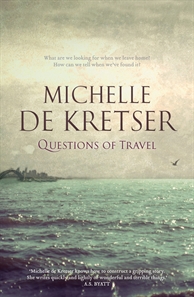
Michelle de Kretser, Questions of travel (Review)

Hardback cover (Courtesy: Allen & Unwin)

Hardback cover (Courtesy: Allen & Unwin)

Every now and then a book comes along that is so sweeping in its conception, that it almost defies review. Such a book is this year’s Miles Franklin Award winner, Questions of travel by Michelle de Kretser. Consequently, I’m going to focus on one aspect that particularly spoke to me – and that is her exploration of place and its meaning/s in contemporary society.

“Soon everyone will be a tourist”

As the title suggests, the novel is about travel – but travel in its widest sense. In fact, without being too corny, it is, really, about the journey of life. As our heroine Laura, thinking about her married lover Paul, ponders:

Perhaps she was an item on the checklist: the wild oats of Europe, the career back home, marriage, mortgage, fatherhood, adultery, the mandatory stopping places on the Ordinary Aussie Grand Tour, with renos*, divorce and a coronary to follow.

That made me splutter in my coffee …

First, though, a brief overview of the plot. The story is told chronologically, alternating between the Australian Laura and Sri Lankan Ravi. Both were born in the 1960s, and the novel chronicles their lives until 2004 when they’d be around 40. Laura, under-appreciated by her family (cruelly described by her father as “the runt of the bunch”) and aimless, travels the world before returning to Sydney in her mid-30s, still rather directionless, but now an experienced freelance travel-writer. Ravi grows up in Sri Lanka, marries and has a son, but a shocking event results in his coming to Australia in 2000 as an asylum-seeker, the same year that Laura returns. You might think at this point that you know where the novel is heading, but you’ll be getting no spoilers from me!

And so we have two significant types of traveller – the tourist (with some business travel thrown in) and the refugee/emigrant. De Kretser explores these comprehensively, and with, I must say, thrilling insight. Thrilling is an unusual word in this context, I suppose, but I can’t think of a better one to describe my reaction to the way de Kretser, point-by-point, unpicks the world of travel, skewering all sorts of assumptions, expectations and pretensions as she goes. I almost got to the point of cancelling my next overseas trip! After all, as Laura discovers, “to be a tourist was always too arrive too late”. How many times have you been told that x place was better in the 80s, only to remember that in the 80s you were told it was better in the 60s!

“Geography is destiny”

So Ravi is told by his teacher Brother Ignatius. This, for all the serious and satirical exploration of travel and tourism, is what the book means most to me. Brother Ignatius tells his students that “History is only a byproduct of geography”. While we could all have fun exploring a chicken-and-the-egg argument, I’d find it hard to deny its fundamental truth.

Laura spends most of the book travelling, or thinking and writing about travel. She’s the quintessential modern person, believing:

What was the modern age if not movement, travel, change?

Living in England she sees the long-standing connections people have to their place, while

Her own people struck Laura, by comparison, as a vigorous, shallow-rooted plant still adapting itself to alien soil.

She returns to Australia, following the death of the gay man she’d loved, hoping for meaning, connection. Geography, place, home had asserted itself … as it usually does. But life doesn’t prove to be much easier. Struggling to find her place, she finds once again that “noone was asking her to stay”.

Meanwhile, Ravi struggles to adjust to his circumstances. Grieving for what he’s lost, he (with his “eyes that had peered into hell”) goes through the motions of living and working. People such as his landlady and her family, and his work colleagues, are kind – enough – but de Kretser shows how skin-deep, how superficial, our practice of diversity and, worse, our humanity is. We do not easily accept people from “other” places. “Otherness”, de Kretser proves, “is readily opaque”. Australians, for example, ask Ravi which detention centre he’d been in because, of course, as an asylum-seeker that’s where he’d been! And, if he hadn’t, was he a “real” refugee. (One of the book’s many other themes, in fact, is “authenticity”.) Ravi, it has to be said, doesn’t help himself. He doesn’t share his history (should he have to?) and, fearing obligations, he resists any help that isn’t essential.

“Place had come undone”

While Laura and Ravi struggle with where they are, they also confront the fact that by the late twentieth century place isn’t only physical. Ravi had discovered, back in Sri Lanka, the world of “disembodied travel”, though his wife Malini had proclaimed “Bodies are always local”. This imagery, seemingly light at the time, carries a heavy weight. Later, finding settling into his new geographical location difficult, Ravi starts to find escape and even solace in virtual places, including visiting people’s homes via real estate sites. De Kretser doesn’t miss any opportunity to explore the ways we “travel” and it never feels forced. It all fits, emulating the way travel fits into our lives.

For Laura, the virtual intrudes mostly through work where she is a commissioning editor for Ramsays, a travel guide company. As the 21st century takes hold, the e-zone division of her company starts to increase in importance. Some of the novel’s best satire is found in the portrayal of corporate culture at Ramsays. It’s laugh-out-loud, sometimes excruciatingly so.

“Time was a magician, it always had something improbable up its sleeve …”

While the novel’s subject matter is travel, in all its guises and in what it says about how we relate to place and each other, the overriding theme is that literal and existential question, What Am I Doing Here? It tackles the big issues that confront us all every day – Time, Truth, Memory, Death and, of course, the most fraught of all, Other People.

Towards the end of the novel, Laura realises that:

… the moment that mattered on each journey resisted explanation … because it addressed only the individual heart.

We could say the same about a great book … and so I apologise for my paltry attempt here to explain de Kretser’s witty, warm and powerful novel. If you have any interest in contemporary literature and its take on modern living, this is the book for you.

For an equally positive perspective, check out Lisa’s (ANZLitLovers) excellent review.

Michelle de Kretser
Questions of travel
Sydney: Allen & Unwin, 2012
517pp
ISBN: 9781743317334

* Aussies commonly abbreviate words with “o” or “ie” endings. “Renos” therefore refers to “renovations”.

Two under-the-radar Australian literary awards announced

A couple of lesser known – but significant to me – literary awards were announced over the last week or so, one national and the other local. I’d like to tell you about them!

ALS Gold Medal 2013

The ALS Gold Medal is awarded by the Association for the Study of Australian Literature. It doesn’t usually get a lot of publicity, partly I suspect because it doesn’t carry a large purse but, rather, well, a gold medal! It is ” awarded annually for an outstanding literary work in the preceding calendar year”. Last year it was won by Gillian MearsFoal’s bread (my review), which also won the Prime Minister’s Literary Award (for Fiction). This year the medal was won by Michelle de Kretser’s Questions of travel, which also won, in May, the Miles Franklin Award. It’s my next read – and I can’t wait. The judges said:

Questions of Travel embarks on an exploration of the present and emerging conditions of late modernity on a scale that could only be successfully achieved by a highly accomplished writer. Through her two central characters, Australian woman, Laura, and Sri Lankan man, Ravi, De Kretser creates an expansive fictional space that both traverses continents while never losing sight of the separateness of individual lives defined by their especial relationships to place and culture, new and old. (AustLit News)

It was selected from a shortlist of five, which included books that haven’t been appearing on many other shortlists: Jessie Cole’s Darkness on the Edge of Town, Robert Drewe‘s Montebello, Christopher Koch‘s Lost Voices and P.A. O’Reilly’s The Fine Colour of Rust.

For reviews of these books, please check out Lisa at ANZLitLovers who’s already read them all!

ACT Poetry Prize 2013

I don’t often report on poetry prizes, and particularly not on local ones, but given my focus on Canberra’s Centenary this year, I figured why not. And, anyhow, I like the winning and shortlisted poems. There were apparently 128 entries, and they were judged by a blind panel of local poets, two male, one female.

The winning poem (and you can read it and the two shortlisted ones online) is “Inside” by Lesley Lebkowicz, whom I only really discovered this year through her short story about her immigrant parents,”The good shoppers”, in The invisible thread. “Inside” is about that invisible disease that afflicts women, osteoporosis, about living with something “inside”. Interestingly, this is also what “The good shoppers” is about, though what the characters are living with inside in that story is their experience of the Holocaust. “Inside” is a short poem, just 15 lines. Its language is accessible and evocative

Inside her, bone sheared off from itself like
limestone in a private landslide – and she fell.

But just when you think that’s all there is, you get the ending. It adds another layer to the story. Read it (using the link in the first line of this para).

The two shortlisted poems are also by women – Libby Porter (“Stabat Mater”, a bittersweet poem about loss, framed through perspectives on age) and Elizabeth Lawson (“Emily Kngwarreye”, a wry poem about indigenous versus non-indigenous attitudes to art). You can read them too at the link.

Canberra is, I think, blessed to have such excellent poets.

Hilary Mantel, Bring up the bodies (Review)

Hilary Mantel, Bring up the bodies

Courtesy: HarperCollins Australia

In her author’s note at the end of her second Thomas Cromwell novel, Bring up the bodies, Hilary Mantel writes that:

In this book I try to show how a few crucial weeks might have looked from Thomas Cromwell’s point of view. I am not claiming authority for my version; I am making the reader a proposal, an offer.

And what an offer it is! In my review of the first novel, Wolf Hall, I quote Cromwell’s statement that “…homo homini lupus, man is wolf to man”. This was related to the theme of the book – the machinations behind the scenes that change the world, something that we Australians are more familiar with right now than we’d like to be. (This is, in fact, a very modern book.) Anyhow, Bring up the bodies continues this theme but with a difference …

That difference is Thomas Cromwell’s motivations, but more on that anon. The plot concerns Henry’s desire to replace Anne Boleyn with Jane Seymour as his wife – and we all know where that led! It’s a much tighter plot – and a somewhat shorter book – than Wolf Hall. It takes place over about 9 months, from September 1535 to Summer 1536, and while the political climate is still evident – the continuing struggle to entrench the Church of England over the Roman Catholic Church and attempts at social welfare reform – politics and political change are not so much to the forefront in this second novel. Why? Well, because ….

Mantel wants to propose a motivation for Master Secretary Cromwell’s engineering of Anne’s downfall: revenge. Now, the word “revenge” is not, at least I don’t recollect it, actually used in the novel, though the softer word “grudge” appears a couple of times. But this is the motivation that Mantel proposes. It’s all to do with which men were and weren’t tried for treason (adultery with Anne) and their role in the downfall of Cromwell’s much-loved mentor, Cardinal Wolsey. Why, for example, was Thomas Wyatt never tried despite his professed attraction to Anne, while Henry Norris was? You’ll have to read the book – although you probably already have, given how late I am coming to it – to see Mantel’s proposition.

It is this revenge “take” on Cromwell that unifies Bring up the bodies in the way that the story of the separation of England from Rome and the Acts of Supremacy unified Wolf Hall even though both are ostensibly about the downfall of a queen. However, I don’t want to write a lot more about the plot and subject matter because I’m guessing many of the reviews before me have done that. What I want to write about is her writing. It’s breathtaking – the way she gets us into Cromwell’s head, the way she makes us feel the times, and particularly the way she uses language to drive the plot and themes.

Appealing to the subconscious, being almost subliminal, is common in fiction, I suppose, but Mantel does it with such aplomb. It’s the dropping of words and ideas that you barely notice or first notice and think they mean one thing only to find they are pointing to another. Take Wolsey for example. When he is first mentioned in the novel, it’s logical, it’s part of filling in the backstory that is common in sequels. But, the thing is, he is dead, long dead before this novel starts, and yet his name keeps cropping up. It’s always logical, but it starts to carry some larger weight – which becomes apparent as the denouement draws near. There are other words too – phantoms, spoils, truth, angels – which start to convey more than their literal meaning or which, through repetition, point us to larger meanings or themes. None of this is heavy-handed. You could almost miss it, but it’s there – drip, drip, drip.

If people had one criticism of Wolf Hall, it was Mantel’s use of the third person “he” for Thomas Cromwell. It seems Mantel took this to heart, so in Bring up the bodies she frequently qualifies the pronoun, using “he, Cromwell”. It does the job, though for one who didn’t find Wolf Hall a problem, it did feel a little clumsy to me at times – but I forgave her that. There’s so much to love.

Towards the end, during the process dissolving Henry VIII’s marriage to Anne Boleyn, the Lord Chancellor says

The truth is so rare and precious that sometimes it must be kept under lock and key.

This is deeply cynical (and ironic). The “council” of men has decided to grant the decree annulling the marriage but to keep the reason secret. Why? Because they really couldn’t agree on a valid one – they just knew it had to be done.

Bring up the bodies is a beautifully constructed but chilling novel in which Cromwell’s character becomes murkier and murkier. What’s to admire and what’s not is the question that confronts us every step of the way. Like many, I can’t wait for The mirror and the light, the next instalment of Cromwell’s story – and would love it if Mantel continued with the Tudors after that. What a fascinating time it was – and what a spin Mantel puts on it.

Hilary Mantel
Bring up the bodies
London: Fourth Estate, 2013
462pp.
ISBN: 9780007315109

Australian Women Writers 2013 Challenge completed – and Miles Franklin Award Winner 2013

Australian Women Writers ChallengeAs regular readers here know by now, last year I broke my non-challenge rule to take part in the Australian Women Writer’s Challenge. It was so satisfying, I decided to do it again this year. After all, it’s really the challenge I’d do when I’m not doing a challenge.

Like last year, I signed up for the top level: Franklin-fantastic. This required me to read 10 books and review at least 6. I have now exceeded this – and will continue to add to the challenge, as I did last year – but one of the requirements of completing the challenge is to provide a link to a complete challenge post. Here is that post.

I have, in fact, contributed 13 reviews to the challenge to date, but decided to wait to write my completion post until I’d read 10 books. I have now done that – with the other three being individual short stories or essays.

Johnston, House at Number 10 bookcover

Courtesy: Wakefield Press

Here’s my list in alphabetical order, with the links on the titles being to my reviews:

Except for the Baynton, Astley and Johnston reviews, they are all for very recent publications. I would like in the second half of the year to read some more backlist, more classics. Will I do it? Watch this space!

Miles Franklin Award winner for 2013 …

has been announced and it is Michelle de Kretser‘s Questions of travel. I’m pretty thrilled as this is the book my reading group decided to do in July (from the shortlist). As much as I enjoyed Carrie Tiffany’s Mateship with birds, it has won two significant awards this year already, and I don’t think it serves literature well for one book to have a stranglehold on a year’s awards – unless there really is only one great book published in a year but that would really be a worry wouldn’t it?!

You can read about the announcement on the Miles Franklin Literary Award site.