Monday musings on Australian literature: Guest post by Dorothy Johnston, writer and Barbara Jefferis Award judge

Literary awards, their role and import, have come under frequent discussion here at Whispering Gums. So, when writer Dorothy Johnston, whose The house at number 10 and Eight pieces on prostitution I’ve reviewed and, more relevantly, who was one of the judges for this year’s Barbara Jefferis Award, suggested a guest post on the Award, I was more than happy to take her up on it.

I have never met Dorothy but I have “known” her for a long time as she was one of Canberra’s famous Seven Writers who published the anthology Canberra Tales in 1988. I became “reacquainted” with her more recently via blogging and her appearance in The invisible thread anthology edited by Irma Gold for Canberra’s centenary last year. It’s been a lovely rediscovery. Dorothy has published nine novels – literary fiction, and crime-mystery novels, mainly. Two of her novels – One for the master and Ruth – have been shortlisted for the Miles Franklin Award. Dorothy blogs at her website Dorothy Johnston.

For those who haven’t heard, this year’s Barbara Jefferis Award was shared by Margo Lanagan’s Sea hearts and Fiona McFarlane’s The night guest. Here is Dorothy’s story about her experience as a judge.

***

The idea of splitting the Barbara Jefferis Award between The Night Guest and Sea Hearts did not come up before the three judges (myself, Margaret Barbalet and Georgia Blain) met at the Australian Society of Authors (ASA) in Sydney, at the end of September.
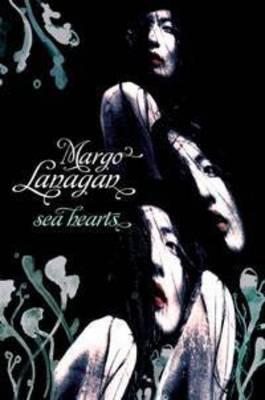
LanaganSeaHeartsI enjoyed working through the 72 entries, making notes, keeping in mind the selection criteria, (a work of literary merit that showed women and girls in a positive light), starring the books I knew I would want to go back to. I had no idea whether my favourites would find favour with Margaret and Georgia.

After about 6 weeks, we exchanged our long lists. One novel was common to all three of us – Fiona McFarlane’s The Night Guest, a brilliant study of a woman who believes there is a tiger in her house. Others on my long list didn’t show up on those of the other two judges, but both had included Margo Lanagan’s Sea Hearts. I went back and re-read it more carefully, and was, as the saying goes, blown away.

These two entries stayed at the top from then on, while we emailed back and forth. Part of the reason for having 72 entries is that the award covered 2 years – 2013 and 2014 – and included self-published titles. By far the greatest number of entries came from the big publishers – Penguin, Allen & Unwin, Random House – though, as it turned out, 4 of the 7 shortlisted book were published by small, or small to medium presses.

We didn’t have to make a firm decision on our shortlist before the meeting; but once in Sydney we only had a morning to finalise it, then choose a winner, and then we had to spend the afternoon writing our report.

I’d had to give up some of the books on my long list because they didn’t find favour with Margaret or Georgia, and the same went for them. One I regretted letting go was Elemental by Amanda Curtin, a terrific story of a young girl growing up in a Scottish fishing village, and what happens to her subsequently. On the other hand, All The Birds Singing, by Evie Wyld, which the others both included, and which, as readers will know, won the Miles Franklin, I thought was over-rated.
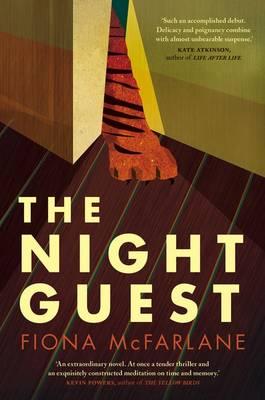
McFarlaneNightGuestIf I had to make one general remark about the books that made it onto the shortlist, I would say that each one is utterly itself. What do I mean by this? I mean that, a few pages in, I recognised the voice as original, distinct, perfect for the narrative; they fitted hand and glove. So often I found that an author began promisingly, but then could not sustain the voice. Or, right from the beginning, the author pandered to one contemporary fashion or another. When you’re reading your way through 2 years of entries, you quickly learn that following the fashion is a bad idea.

There’s no whiff of conformity amongst the shortlist. Amy Espeseth’s Sufficient Grace focuses on two young women and their difficult lives in an isolated religious community. The Life and Loves of Lena Gaunt, by Tracy Farr, introduced me to an extraordinary musician and her instrument, the theremin.

Pilgrimage, by Jacinta Halloran, is about two sisters, one of them a doctor, and what happens when their mother is diagnosed with motor neurone disease.

Margo Lanagan’s Sea Hearts takes ancient selkie legends as its starting point and moves in a wholly original direction. Fiona McFarlane’s The Night Guest is another novel that borders the surreal in an original and quite wonderful way. The First Week, by Margaret Merrilees, is, by contrast, a realist tale that cuts to the bone.

The Mountain by Drusilla Modjeska, an ambitious and far-reaching story of Papua New Guinea in the years since independence.

We also highly commended Laura Buzo’s Holier Than Thou.

But back to that meeting at the ASA. We already knew each other’s preferences. We’d picked the same top two and could not choose between them. There didn’t seem a hair’s breadth, or knife point to tip the balance. We called in Lucy Stevens, who was overseeing the judging process. Lucy sat at one end of the table balancing the two books in her hands while we reached the decision to award the prize to both.

The presentation was held in the renovated foyer of St Barnabas Church, Broadway, a lovely light-filled space. It was a beautiful Sydney spring evening. There was music and champagne. I realized – not that I hadn’t known it before, but it came to me suddenly – that we were here to celebrate books and their authors. Angelo Loukakis, Executive Director of the ASA, welcomed us. David Day, who is Chair of ASA’s Board of Directors, spoke about Barbara Jefferis and the bequest. Tara Moss spoke about women and the arts. I looked around me. Everyone in the room cared about, and many worked hard to foster and promote, Australian literature. When I stepped up to the podium, to give my judges’ speech, I had a big smile on my face.

***

Thanks a bunch Dorothy for giving us your insider’s perspective on awards judging. I can see it wasn’t an easy job and love that you’ve shared your thoughts with us.

Dorothy (I’m sure) and I would love to hear your thoughts – on awards, on judging, on these particular books, or on anything else her post has inspired you to think about.
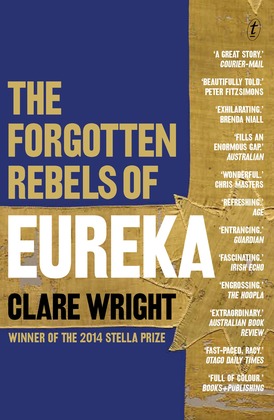
Clare Wright, The forgotten rebels of Eureka (Review)

Book cover, The forgotten rebels of Eureka

Courtesy: Text Publishing

Wah! Once again I delayed reading a much heralded book until my reading group did it*, and so it is only now that I’ve read Clare Wright’s Stella Prize winning history, The forgotten rebels of Eureka. The trouble with coming late to a high-profile book is how to review it freshly. All I can do, really, is what I usually do, and that is write about an aspect or two that particularly interested me. Since other bloggers have already beautifully covered one of these, the history**, I’m going to focus on Wright’s writing and the approach she took to telling her story. I won’t be doing this from the angle of historical theory, as I’m not an historian, but in terms of her intention, and her tone, style, and structure.

If you’re not Australian, you may not have heard of the Eureka Stockade. It was a significant event in colonial Australia’s march to democracy and independence, involving the British army and police attacking a stockade created by miners whose grievances included the payment of a compulsory miner’s licence and the fact that this licence, which they saw as a form of taxation, did not give them the right to vote in the legislature. It has traditionally been framed in masculine terms, but Wright discovered, somewhat by accident while researching another project (as historians do!), a new angle – the role of women in the rebellion. There were, she found, over 5,000 women on the goldfields:

Women were there. They mined for gold and much else of economic value besides. They paid taxes. They fought for their rights. And they were killed in the crossfire of a nascent new order.

Consequently, in her book, Wright draws on extensive primary and secondary sources to explore and expose the lives of these women and the until-now-unheralded role that she believes they played in the goldfields, particularly in the lead up to and aftermath of that fateful day of 3 December 1854.

Wright opens the book with three epigraphs, one of which is particularly illuminating in terms of my subject. It’s by Australian historian Geoffrey Blainey and states that “every history of every country is a mirror of the author’s own interests and therefore selective rather than comprehensive”. Having been interested in historical writing since studying EH Carr’s What is history at university, I like the admission that histories are inherently subjective, regardless of how well researched they are. The historian makes decisions about what s/he will research, what the limits of that research will be, and how s/he will interpret that research. It’s common sense. How can it be otherwise? And so, in this history, Wright’s specific interest in the role of women means that all her research – even research into men’s activities – is viewed through that prism. There’s another implication, too, regarding selectivity: with her focus being specifically the women, we cannot read this book as a comprehensive history of the Eureka Stockade. It complements, or expands, or even jousts with other works.

None of this is meant negatively. I thoroughly enjoyed the read. My point is simply that it’s important, as it always is, to be aware of what we are reading – and I like the fact that Wright recognises this. So, what we have here is, to the best of my knowledge, a thorough but selective history. The text is extensively referenced, with 25 pages of meaningful endnotes and nearly 20 pages of bibliography, and there is a useful index. These are things I look for in a good nonfiction work. The book is logically structured, by theme and chronology, and its (creatively titled) chapters are divided into three main parts: Transitions, Transformations and Transgressions. You can sense a writer’s touch in the alliteration here.

And it’s the writer’s touch I want to turn to now, because Wright has achieved that difficult mix – a well-researched but readable history. It has been written, I’m sure, with an eye on a general, but educated audience. The language is often breezy and even jokey (perhaps a little too much) at times, and yet is replete with classical, Shakespearean, biblical and other literary allusions. She uses metaphor, such as “the cornered lizard bared its frills” to describe the hoisting of the famous Australian flag in the days before the attack. Her descriptions are evocative, and often visceral. You feel you are there in the crowded “tent city” that was Ballarat:

The arrival of the extra troops meant squashing more stinky little fish into an already overpacked tin … From the outside, it seemed like the tightrope was about to snap.

Her stories of the childbirth experiences of Sarah Skinner and Katherine Hancock are devastating to read.

Indeed, I would place this book in the narrative non-fiction tradition. It has a strong narrative drive, with a large cast of characters, some of whom stay with us, some of whom pass through. They include Ellen Young whose poems and letters in the Ballarat Times articulate the mining community’s distress and sense of injustice; hotel-keeper Catherine Bentley who, with her husband, earns the ire of the diggers by consorting with government officials; theatre-owner and actor Sarah Hanmer who donated more to the rebels’ cause than anyone else; and newspaper publisher Clara Seekamp who takes the helm when her husband is arrested for sedition. These women provide significant evidence for Wright’s thesis that women played more than a helpmeet role in the intellectual and political life of Ballarat.

In addition to “developing” these characters, Wright uses other narrative techniques, such as:

  • plot cliff-hangers (much like a screenwriter, which she also is, would do) and pointed aphorisms at the end of chapters
  • foreshadowing to suggest causation: “Even female licence holders expected a modicum of representation for their taxation—as dramatic events would later demonstrate”
  • repetition of ideas and motifs to propel her themes. Take, for example, the Southern Cross. It functions as “a hitching post for existential certainty when all else was in mortal flux” during immigrants’ sea journey from the northern hemisphere to the south (Ch. 3, “Crossing the line”) and is later picked up as a symbol for the rebels’ flag “as the one thing that united each and every resident of Ballarat” (Ch. 11, “Crossing the line (Reprise)”).

As an historian, Wright is confident and fearless, expressing clear opinions, either as direct statements, or indirectly through her choice of language. She calls the Bentleys’ murder trial, for example, a “morality play”. She asks questions; she offers close analysis of her sources, such as noting that the use of the word “demand”, rather than “request” or “humbly pray”, conveys the diggers’ frustration with authority; and she makes considered deductions by testing textual evidence against her understanding of the times and the work of other historians. She discusses discrepancies in reportage, such as the different witness reports of the fire at the Bentleys’ hotel. But she also, as other bloggers and my own reading group have commented, draws a long bow when she suggests the full moon and menstrual synchrony may have been a factor in so many men leaving the stockade on the night of the attack. She provides some evidence for this synchrony as a phenomenon, and offers other reasons for the desertion, but it feels a little out of left field.

At times her nod to the popular and her push for dramatic effect jars, but Wright’s argument that women played an active role at the diggings and in the stockade is convincing. I’m not surprised she won the Stella Prize, because this is engaging reading that is underpinned by extensive scholarship and clear thinking. It’s exciting to see a work that doesn’t just explore the role of women in history but that puts them right in the action.

awwchallenge2014Clare Wright
The forgotten rebels of Eureka
Melbourne: Text Publishing, 2013
539pp.
ISBN: 9781922182548

* I bet you can hardly wait until next month now!
** Do check out historian bloggers, the Resident Judge and Stumbling Through the Past, and litblogger Lisa of ANZLitLovers.

Monday musings on Australian literature: Literary awards back then

A comment by blog-reader Ian Darling on a recent Monday Musings post that he supposed literary prizes existed back in 1927, followed by the tardy announcement a couple of days ago of the shortlist for this year’s Prime Minister’s Literary Awards (see Lisa ANZLitLovers’ post), got me thinking about the history of literary awards.

I’ve long been aware of The Bulletin’s prize for fiction which was inaugurated by its editor, SH Prior, in 1928. The inaugural prize was won jointly by M. Barnard Eldershaw’s A house is built and Katherine Susannah Prichard’s Coonardoo. The next year, it was won by Vance Palmer for The passage. I’m not sure what happened to the prize except that, according to the Oxford companion to Australian literature, The Bulletin’s next editor, John Webb, established the SH Prior Memorial Prize for Fiction, and it was awarded 1935 to 1946. But, were there other awards? Trove and the Oxford companion came to my rescue.

What I discovered was something that confirmed my understanding of the fundamental raison d’être for awards – to support writers and literature. I know some writers question the value of awards, and we’ve had some good discussions about the issue here, but putting aside some very valid concerns, it’s clear that the impetus is usually to support the writing endeavour. And so, the article on Literary Awards in the Oxford companion starts with this:

The rewarding of Australian writers began soon after the establishment of the first colony when in 1818 Lachlan Macquarie, governor of NSW, awarded Michael Massey Robinson two cows from the government herd for his services as an antipodean “poet laureate”. Macquarie’s decision inaugurated government patronage of Australian literature.

The article continues to tell us that the government at times found jobs for writers – such as a government inspector of forests job for poet Henry Kendall in 1881! This is supporting literature? (The article also says that the government gave his widow a job as superintendent of cleaners in a government office in 1884!) Interestingly, via Trove, I found a reference to this employment practice in the Albury Banner and Wodonga Express, in 1916The writer of the article, which was about government encouraging literature through a prize as it was already doing for music and painting, introduced his/her argument with the comment thatPositions in the Government service had in the past been found on two poets — Kendall and Daley — but the positions were unsuitable”.

The Oxford companion continues, saying that it wasn’t until the twentieth century that Australian writers began to receive prizes and awards on a regular basis. It divides these awards into two categories, those that:

  • support creative activity by supporting a writer during the creation of a work (fellowships and writer-in residence programs, being examples); and
  • reward a finished, usually published work.

We all know of current examples of both these categories so, in the rest of this post, I’m going to share (in chronological order) a rather random grab-bag of awards from the first half of the twentieth century:

  • 1908-1972 Commonwealth Literary Fund. According to the Oxford companion, this fund, established by Alfred Deakin’s government was “the first systematic federal government initiative in support of the arts”. For the first 30 years it focused on providing pensions to sick authors and their families or families of authors who’d died poor or “literary men doing good work but ‘unable on account of poverty to persist in that work'”. However, from 1939, as the result of lobbying, the Fund was increased and started to offer annual fellowships and grants to writers, publishers, literary magazines. Through Trove I found articles identifying winners of fellowships in various years. In 1952, for example, fellowships were given to Judah Waten for “a novel dealing with a Jewish migrant family”, Kylie Tennant for “a novel about travelling beekeepers”, Victor Kennedy for “an interpretative biography of [poet] Bernard O’Dowd”, and Xavier Herbert for “the completion of a novel dealing with feminine behaviour in time of war”.
  • 1908 Australian Exhibition of Women’s Work Literary Prizes. Apparently, the First Exhibition of Women’s Work was held in Philadelphia in 1876, but the first Australian one was held in 1907. What intrigues me about these awards is the categories: Story of not less than 100,000 words (with the first prize being £50); Play of three acts, scene laid in Australia; Temperance novel; Esperanto essay; Best historical sketch of Exhibition (Illustrated). Temperance novel? Esperanto essay? Signs of their times, eh?
  • 1909 Tasmanian Literary Awards. I’m not sure exactly of the provenance of these awards as the article is very brief, but again, it’s the categories that intrigue: Essay, open to residents of Tasmania, any age, not to exceed 3000 words, subject, ”Modern Patriotism”; Original poem, not to exceed 100 lines, subject, lines written for “Foundation Day, 1910”; Original tale, not to exceed 3000 words, subject, any connected with some incident of Australian history.
  • 1943 United Nations Literary Competition. This prize is clearly not related to the United Nations, given that body didn’t exist in 1943, but was created by the English publisher, Hutchinson and Co. Presumably its title comes from the fact that entry was open to international writers. It sounds like several prizes were offered, with the overall purse being £10,000. The article gives a range of topics: “Fiction, detective stories and thrillers, autobiography, war experiences and travel, history and biography, essays and belles lettres, poetry, children’s literature, philosophy of religion and general philosophy, scientific and technical literature”. I’m presuming these are not specifically award categories but subjects the publisher knows will sell well and would like to receive?
  • 1946-1951 “Herald” Literary Competition. In 1946 (as far as I can ascertain), the Sydney Morning Herald instituted a literary competition for novels, short stories and poetry. In 1947, Jon Cleary won for his social realist novel You can’t see ’round corners, which spawned a popular television series in 1967 (albeit reset in the Vietnam era). In 1949, however, the judges did not feel any submissions met their expectations, so did not grant first prize in either the novel or short-story categories. They did award second prize to T. A. Hungerford for his novel Sowers of the wind, and third prize to D’Arcy Niland for his Gold in the streets. Niland also won second prize for his short story. The awards were discontinued in 1951 on the recommendation of judges, who felt that “the succession of competitions has been too rapid to allow competitors sufficient time for proper preparation and revision”.

Hmmm … we might continue this discussion another day.

Richard Flanagan, the Booker Prize, and Books

Lisa at ANZLitlovers has posted on Richard Flanagan’s (exciting-to-us) Booker Prize win for The narrow road to the deep north, and has provided links to reviews by several bloggers. So, I thought I’d do something different. In my review and follow-up post, I discussed the role of poetry in the novel. Reviewer (and novelist) Romy Ash suggests that there are two love stories in the book, the second one being a “love letter to literature”.

And certainly, there are many references to literature and books, besides the specific references to poetry that I’ve previously discussed. Early in the novel, on what we later realise was Dorrigo’s last sentient night, he’s in bed with his lover:

On the night he lay there with Lynette Maison, he had beside their bed, as he always did, no matter where he was, a book, having returned to the habit of reading in his middle age. A good book, he had concluded, leaves you wanting to reread the book. A great book compels you to reread your own soul. Such books were for him rare and, as he aged, rarer. Still he searched, one more Ithaca for which he was forever bound. He read late of an afternoon. He almost never looked at what the book was of a night, for it existed as a talisman or a lucky object — as some familiar god that watched over him and saw him safely through the world of dreams.

I was intrigued by the distinction he makes between a “good” book and a “great” one. There are many reasons why I want to reread books. Most of them, I’d say, have to do with the “joy” those books bring me. I don’t mean “joy” in terms of “happiness” but in terms of “inspiration”. This inspiration can take many forms – spiritual, intellectual, emotional, cultural, linguistic. And it usually springs from the two things I mostly read for – insights into human behaviour and great prose. Jane Austen is a good example of this. I’m not sure that I think about it in terms of my soul. Have you thought about why you reread?

Anyhow, there’s one other quote I wanted to share regarding books. This one occurs before the war, in the bookshop where Dorrigo meets Amy, the love of his life:

It wasn’t really the great poem of antiquity that Dorrigo Evans wanted though, but the aura he felt around such books — an aura that both radiated outwards and took him inwards to another world that said to him that he was not alone.

And this sense, this feeling of communion, would at moments overwhelm him. At such times he had the sensation that there was only one book in the universe, and that all books were simply portals into this greater ongoing work — an inexhaustible, beautiful world that was not imaginary but the world as it truly was, a book without beginning or end.

What I particularly like about this quote is the idea that books can make you feel you are not alone. I love it when I read a book and think “I know that feeling” or “That’s me”. Of course, I also love it when I gain insight into how others think or feel too, but it can be reassuring to feel that someone else understands your particular neuroses or dark thoughts or sense of the ridiculous or whatever it is that sometimes makes you feel alone. Books can be such cheap therapy can’t they? I also like the second part of this quote, and its suggestion that there is only one book, one story that encompasses all stories. If only we could all see the world that way …

Monday musings on Australian literature: Poetry awards

Over recent months, I’ve devoted several Monday Musings to exploring various Australian literary festivals and awards. I was inspired to write this one on poetry awards by two things. The first is that during my recent exploration of Australian literature in the first few decades of the 20th century, and particularly of the 1927 plebiscite conducted of Argus readers in Melbourne in 1927, I became aware that as much if not more of the discussions about the results focused on the poets. It seems – but of course, my research is somewhat serendipitous – that poetry played a greater role in literary (and perhaps ordinary) life then, than it does now. I’d love to hear what others think – or know – about this (in Australia or their other countries).

And then, following close on the heels of my these ponderings, I received an email from Five Islands Press announcing their new poetry award, the Ron Pretty Poetry Prize, and asking me to spread the word through my blog. Now, my problem is that while I’m a big supporter of Australian literature, I don’t see myself as part of a formal publicity machine. I want to maintain some level of independence. However, given my recent thoughts about poetry in Australia and the fact that I haven’t yet written on poetry awards, I decided I could include this prize in a Monday Musings post on these awards. Make sense? I hope so!

The interesting thing about poetry prizes in Australia is that many of them are named for poets – far more so than the other specialised literary awards. I wonder why this is? Like other awards, though, they vary in their establishment and management, some being part of larger awards such as premier’s literary awards, some sponsored by writers’ organisations or festivals, and some by magazines or publishers.

I’m structuring this post a little differently to my other awards posts because they can be logically divided into fairly distinct categories. As always, of course, the list comprises just a selection. Here goes:

Lifetime achievement award

The best-known (and perhaps only) award in this category is the Christopher Brennan Award which is given annually to “a poet who has written work of sustained quality and distinction”. It is administered by the Fellowship of Australian Writers (Victoria), and has been awarded since 1974. The award is a plaque, rather than money. Previous winners include the big names of modern Australian poetry, such as Judith Wright, Les Murray, Bruce Dawe, Dorothy Porter and Geoff Page, some of whom I’ve reviewed on this blog.

Awards for poetry in book form

(Presumed Public Domain, via Wikipedia)

CJ Dennis, ca 1890s (Presumed Public Domain, via Wikipedia)

Some awards are made for individual poems (see below) while others are for poetry collections, or long poems that are published in book form. These awards include:

  • Anne Elder Award for a first book of poetry: established in 1977 and administered by FAW (Vic). The prize is currently $1,000.
  • CJ Dennis Prize for Poetry (part of the Victorian Premier’s Literary Awards): established in 1985. The prize is currently a cool $25,000.
  • Grace Leven Prize for Poetry for a volume of poetry by an Australian writer or a naturalised Australian of at least 10 years’ residence: established in 1947, so is one of the oldest awards. Its monetary prize is small, but it’s apparently highly regarded by poets and has been won by many of Australia’s best known poets.

Awards for poetry, limited by length

  • Gwen Harwood Poetry Prize for a single poem or “linked suite of poems” of up to 80 lines: established in 1996 and administered by Island Magazine. First prize is currently $2000, with two prizes of $500 able to be awarded at the judges’ discretion.
  • Peter Porter Poetry Prize for a poem of up to 100 lines: established by ABR (Australian Book Review) in 2005, and renamed to honour Peter Porter in 2010. There is a cash prize and publication in the ABR.
  • Ron Pretty Poetry Prize for a single poem of up to 30 lines, not limited by nationality: established in 2014 by Five Islands Press in the name of its founder, the poet Ron Pretty. The inaugural prize will be $5,000. There is an entry fee, and submissions are made online.

Awards for unpublished poetry

  • Thomas Shapcott Poetry Prize for an unpublished manuscript by a Queensland author: established in 2003 by Arts Queensland. The prize is currently $3,000 plus a publishing contract with UQP.
  • Val Vallis Award for an Unpublished Poem for a poem or suite of poems of up to 100 lines by an Australian writer: established around 2000 by Arts Queensland. The first prize is  $1,000, one week at the Writers’ Retreat at Varuna, and publication in Cordite Poetry Review.

And something a little different

Rather different to the above awards, and others of their ilk, is the Vincent Buckley Poetry Prize. It is a biennial award that is offered alternately to enable an Australian poet to visit Ireland and to facilitate the visit of an Irish poet to Melbourne. Interesting, huh? Established in 1992, it commemorates the life and work of Buckley who was a poet, critic and Professor of English at the University of Melbourne and who loved both Australian and Irish poetry. The prize includes a return airfare, a contribution towards living expenses and an honorary fellowship at the University of Melbourne. The winner in 2002 was Cate Kennedy, well-known for her short stories and, as I’ve discovered, her poetry. She has also won the CJ Dennis Prize for Poetry.

More awards are listed at Wikipedia. It’s not complete either, but it’s a start.

Monday musings on Australian literature: Nature Writing Prize

You know what they say, too much of a good thing is bad for you, so, to save you dear readers from bad things, I thought we’d take a break this week from my historical survey of Australian literature. And, since I received this morning an email containing a call for submissions for Nature Conservancy Australia’s Nature Writing Prize, I thought it would provide the perfect interlude.

Back in May I wrote a post about non-fiction literary awards and listed a few of them, mostly already well-known. Nature Conservancy Australia’s Nature Writing Prize is not well-known. It’s a biennial prize and the 2014/15 prize will be the third one awarded. The prize, which offers $5000 and publication in the Australian Book Review, is for an essay of 3,000-5,000 words “in the genre of ‘Writing of Place'”. According to the press release, the award will go to:

an Australian writer whose entry is judged to be of the highest literary merit and which best explores his or her relationship and interaction with some aspect of the Australian landscape.

The award was created, the press release also says

to promote and celebrate the art of nature writing in Australia as well as to encourage a greater appreciation of Australia’s magnificent landscapes.

I’m intrigued by the language: it’s called the “Nature Writing Prize” but it’s for the genre “Writing of Place”. The two do overlap but, in my head anyhow, they also differ. However, this statement just quoted above mentions nature and landscape, so it seems that by “place” they essentially mean “landscape”. But then, isn’t landscape part of nature? I suppose I’m being a pedant … I expect that it’s quite likely that writing about nature/landscape will often end up addressing notions of “place”.

The inaugural prize was won by Annamaria Weldon for “Threshold Country” and the second prize, for 2012/2013, was won by Stephen Wright for his essay “Bunyip“. In evocative language, drawing on the mythical bunyip, the native eucalypts and, pointedly, the introduced lantana “which replicates itself industriously, efficiently and will cover everything except shadow”, he explores the impact of the early European settlers on indigenous communities in South East Queensland and its legacy today. He makes the disconcerting point that:

We do not understand where we are, or what we have done. A landscape is not a sense of place for the non-Indigenous inhabitants of the continent. It is just somewhere we happen to be.

Note the distinction he makes between “landscape”, something physical, and “place”, which is something far more abstract. Anyhow, towards the end of the essay, he suggests that

It is as if, beneath the ordinary miseries of life, there is a current of displacement that allows us no rest. Our thought is always dislocated and perhaps this is the inevitable outcome of our attempts to consider ourselves at home in a landscape we have so spectacularly devastated.

While this is rather negative for optimist me, it does capture the uneasiness I, and I think many of us, feel about our relationship to the land of our birth that we know has an ugly history. We have a long way to go …

In a sad little postscript, the The Nature Conservancy commemorates Liam Davison and his wife Frankie who died in Malaysian Airline MH17 disaster in the Ukraine. Davison was one of the five writers shortlisted for the 2012/2013 Nature Writing Prize for an essay titled “Map for a Vanished Landscape”. Lisa at ANZLitLovers wrote a tribute to him soon after his death, and is now reading and reviewing his novels.


Monday musings on Australian literature: National Biography Award

I have mentioned the National Biography Award before, but have never dedicated a post to it. Since this Monday musings coincides with the announcement of the 2014 award, I thought it would be a good time to write a little about this award.

The National Biography Award was initially endowed by Geoffrey Cains, with support a little later by Michael Crouch, and is managed by the State Library of NSW. Its aim, says its website, is “to encourage the highest standards of writing in the fields of biography and autobiography, and to promote public interest in these genres”.  As of 2013, the winner receives $25,000, with each shortlisted book receiving $1,000. I like the fact that more and more awards are providing a monetary prize for the shortlisted works. Associated with the award, since 2003, has been an annual lecture on the subject of life-writing. The list of lectures, and papers if available, can be found on the State Library of NSW’s website.

The shortlist for 2014 was:

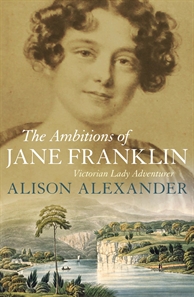
    Alison Alexander, The ambitions of Jane Franklin
    Courtesy: Allen & Unwin
    • Alison Alexander’s The ambitions of Jane Franklin (Allen & Unwin). This one intrigues me as Lady Jane Franklin, about whom I’ve written before, was one of those amazing 19th century woman who came to my attention through contemporary novels, including Richard Flanagan’s Wanting and Andrea Barrett’s The voyage of the Narwhal, and a book of poetry titled Jane, Lady Franklin by Tasmanian Adrienne Eberhard. The biography is subtitled, Victorian lady adventurer. I don’t know Alexander, but she is apparently a Tasmanian historian.
    • Steve Bisley’s Stillways: A memoir (HarperCollins Publishers). Steve Bisley is an Australian actor and this book, the website says, is “a classic memoir of an Australian childhood in the sixties”. That in itself gives it some appeal to me.
    • Janet Butler’s Kitty’s war (University of Queensland Press). This one is on my TBR. It is based on the war diaries of World War 1 army nurse Sister Kit McNaughton. In 2013 it won the NSW Premier’s Prize for Australia. Butler works in the History department at La Trobe University.
    • John Cantwell & Greg Bearup’s Exit Wounds: One Australian’s War on Terror(Melbourne University Publishing). Cantwell was a Major-General in the army who served in Iraq and Afghanistan, and ended up with post traumatic stress disorder (PTSD). He has written this with Walkley Award winning journalist, Greg Bearup.
    • Sheila Fitzpatrick’s A Spy in the Archives (Melbourne University Publishing). Historian Sheila Fitzpatrick lived in the Russia during the Cold War, while researching for her doctoral thesis. She apparently felt at home in Russia, but, as a foreigner, was always seen by Soviet authorities as potentially a spy. The book explores this part of her life. Fitzpatrick is regarded as an expert in the field of Soviet/modern Russian history.
    • Gideon Haigh’s On Warne (Penguin Australia). Australians will know immediately the subject of this biography, the flamboyant, controversial but highly-talented cricketer Shane Warne. Gideon Haigh is a journalist who has written several well-regarded and award-winning books on sport, media and the automotive industry (among other topics).

    All books I’d willingly read … though Alexander’s and Butler’s would be my top priority.

    And the winner is: Alison Alexander’s The ambitions of Jane Franklin! Now I really do want to read this book … It was a little tricky to find who won via a normal Google search several hours after the announcement, so I turned to Twitter and there it was (of course). Will it be reported on Australian television news tonight? I wonder!

    Anyhow, once I knew the winner, I was able to search on that and found a Sydney Morning Herald article which quotes chair of the judging panel (and a previous winner), Jacqueline Kent, as praising the book for its detailed portrayal of a “highly intelligent, vital and strong-minded woman” She said that “This is a biography that drew on a huge amount of research but is also very light on its feet”. Apparently Franklin, according to the Herald, had left behind “8 million words in journals and correspondence”. Alexander is reported as saying that the biography would have been impossible without a “Find” key to search documents. Isn’t modern technology grand – though the “find” function can’t completely replace in-depth reading during which you can find all those wonderful serendipitous details that make research such fun.

    Tara June Winch, Swallow the air (Review for Indigenous Literature Week)

    Tara June Winch

    Tara June Winch (Courtesy: Friend of subject, via Wikipedia, using CC-BY-SA 3.0)

    Tara June Winch’s Swallow the air is another book that has been languishing too long on my TBR pile, though not as long as Sara Dowse’s Schemetime. For Swallow the air, it was a case of third time lucky, because this was the third year I planned to read it for ANZLitLovers Indigenous Literature Week. Like the proverbial boomerang, it kept coming back, saying “pick me!” Finally, I did.

    Winner of the 2004 David Unaipon Award for unpublished indigenous writers, Swallow the air made quite a splash when it was published in 2006, winning or being shortlisted for many of Australia’s major literary awards. (See Tara June Winch’s Wikipedia entry). I believe Winch is working on another novel, but it hasn’t appeared yet.

    Now, though, to the book. The first thing to confront the reader is its form. It looks and even reads a little like a collection of short stories*, but it can be read as a novella. There is a narrative trajectory that takes us from the devastating death of narrator May Gibson’s mother, when May was around 9 years old, to when she’s around 15 years old and has made some sense of her self, her past, her people. May’s mother is Wiradjuri, her father English. At the novel’s opening, she is living in coastal Wollongong, which is not her mother’s country, in a single-parent household with her mother and her brother, Billy, who has a different and indigenous father. Absent fathers are, I should say, disproportionately common in indigenous families.

    In fact, one of the impressive things about this debut novel is how subtly, but clearly, Winch weaves through it many of the issues facing indigenous people and communities. Poverty, loss of connection to country, the stolen generations, mining and land rights, alcoholism, drug addiction, racism, rape, child abuse by the church, imprisonment and the tent embassy are among the concerns she touches on during May’s journey. Listing them here makes it sound like a political “ideas” novel but, while Swallow the air is “political” in the way that most indigenous writing can’t help but be, its centre is a searching heart, for May has been cast adrift by the suicide of her mother. Life, which was tenuous anyhow, becomes impossible to hold together as her brother and aunt, both loving, struggle with their own pain.

    This is where I become a little uncomfortable as a non-indigenous person making a generalisation about indigenous literature, but I’m going to do it anyhow, because I think I’m on firm ground. I’m talking about story-telling and what I understand to be its intrinsic role in indigenous culture. It imparts – or can do – a different flavour to the writing. Marie Munkara’s David Unaipon Award winning Every secret thing (my review) has some similarities in form to Swallow the air, and covers some similar thematic territory, but is very different in tone. Munkara’s novel also presents as a bunch of stories, with a uniting narrative thread. Swallow the air is more subtle, but nonetheless it’s the idea of stories that underpins the narrative.

    What particularly impressed me about Winch’s writing is the way she manages tone and structures her story. She understands the Shakespearean imperative to offer some light after dark. For example, there’s a lovely little chapter/story called “Wantok” about family closeness which occurs after a story about a difficult work experience. In another situation, with just one word at the end of a story (“Mission”) – “Seemed [my emphasis] all so perfect, so right” – she prepares us for the opposite in the next (“Country”).

    This flow – with shifts in tone that are sometimes subtle, sometimes dramatic, and with a narrative that is mostly linear but with the occasional flashback – kept me reading and engaged until the end. As did the writing itself. It’s deliciously poetic. Sometimes it is tight and spare, as in:

    I do not cry, my eyes are hardened, like honey-comb, like toffee. Brittle, crumbling sugar. He puts his hand out toward me; we shake hands, a pact that I won’t be here digging up his past when he gets back.

    And I’m not.

    And in this description of life in the city: “Suits and handbags begin to fill the emptiness of the morning”. Other times it is gorgeously lyrical (a review buzz word, I know, but sometimes there’s no other word):

    The river sleeps, nascent of limpid green, tree bones of spirit people, arms stretched out and screaming. And at their fingertips claws of blue bonnets, sulphur-crested cockatoos and the erratic dips and weaves of wild galahs, grapefruit pink and ghost grey splash the sky.

    But back now to the story. As May makes her journey, we meet many characters – her brother, aunt, women like Joyce who care for her but also know when to push her on, men with whom she hitchhikes, to name a few. None of these characters are developed to any degree, but we learn what we need to know about them by how they relate to May. Most are kind, generous, nurturing. May’s journey, in other words, is not challenged so much by human barriers, but by emotional, social, political and historical ones. It is a generous thing that when she starts to understand her place, it’s an inclusive understanding, one that encompasses all of us who occupy this land:

    And it all makes sense to me now. Issy’s drawing in the sand, boundaries between the land and the water, us, we come from the sky and the earth and we go back to the sky and the earth. This land is belonging, all of it for all of us.

    However, while May comes to a better understanding of the land and her relationship to it, there is no easy resolution to the ongoing struggle of living in a place in which there is still “a big missing hole” created by the loss of connection to culture. It will take a long time to refill that hole, if indeed it can be done, but books like this will help communicate just what it means, and how it feels, to be so disconnected.

    awwchallenge2014Tara June Winch
    Swallow the air
    St Lucia: UQP, 2006
    198pp.
    ISBN: 9780702235214

    * One chapter/story, “Cloud busting” was published in Best Australian Stories 2005.

    Miles Franklin Award 2014

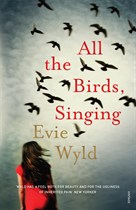
    Evie Wyld, All the birds, singing

    Courtesy: Random House Australia

    Well, the Miles Franklin Award judges have announced the winner of the 2014 award, and it is Evie Wyld’s All the birds, singing – the only shortlisted book I’ve read! How lucky am I? Check my review, if you are interested.

    I loved All the birds, singing, and agree with the judges that it is  “spare, yet pitch perfect”, and both “visceral and powerfully measured in tone”. It’s a story about coming to terms with the past, about redemption. As I said in my review, it’s not the first book to deal with this subject but it is tight, powerful, evocative.

    From my understanding of the award, Wyld, now apparently permanently resident in England, meets the requirements which are that, to quote the press release, the work must be “of the highest literary merit” and present “Australian Life in any of its phases”. Wyld is a dual national with an Australian mother*, and does, I understand, return to Australia from time to time. However, I don’t believe the rules state that the winner must be resident in Australia, or be Australian. They do state that the book must be in English and must represent Australia in content. Wyld’s book, set partly in Australia and partly in England, meets both these requirements.

    The other shortlisted titles were:

    • Richard Flanagan’s Narrow road to the deep north (on my TBR, and to be read late this year)
    • Fiona McFarlane’s The night guest
    • Cory Taylor’s My beautiful enemy
    • Alexis White’s The swan book (on my TBR)
    • Tim Winton’s Eyrie (on my TBR – unfortunately I was away when my reading group did this)

    * I initially wrote here that she was born in Australia. I’ve seen so many stories about her origins and her relationship with Australia, but I understand now that she was born in England, has lived here, still has family here, and visits here. All this though is not relevant to the award, as I understand it.

    Monday musings on Australian literature: Red Room Poetry Object Competition 2014

    Just a quick Monday Musings today but an interesting one I hope.

    Red Room Poetry Object is a poetry-writing competition for Australian students in Years 3-10. It was created by The Red Room Company, which is a not-for-profit organisation that was established in 2003. It apparently grew out of the Red Room Radio Show. The company’s aim is to create “unusual and useful poetry projects which transform expectations of, and experiences with, poetry.” They want to make poetry more accessible,  especially to “those who face the greatest barriers to creative opportunities”. They run a wide variety of, mostly, public poetry projects of which the Red Room Poetry Object is just one.

    The Red Room Poetry Object was first held, I think, in 2013. It involves young writers and their teachers submitting poems of 20 lines or less about objects that are special to them. What a great idea – it provides some level of structure and framework, while being very open as well. According to the website, the 2013 project involved 72 schools from Australia and New Zealand, and they published 1200 poems by students and teachers. You can read the students’ poems here. The winning poems were exhibited from November 2013 to February 2014 at Customs House in Sydney. Submissions for this year’s project are now open, and poems can be submitted until 19 September.

    Can this Snow Gum in the Snowy Mountains be my object?

    Can this spirit-moving Snow Gum in the Snowy Mountains be my object?

    While, formally, a “talismanic object” is “an object that brings a person protection or good luck” (like coins, a ring or other piece of jewellery), for this project Red Room is looking for objects that are special to individual people, objects that “may not be worth anything to anybody else”,  that may only be precious or important to the writer (like a favourite teddy bear). The winning Secondary Student poem last year was “My book” while the winning Primary Student poem was “Nitro car”. It’s just ten lines, and concludes:

    You have an engine in your head,
    and wheels in your shoes
    that’s why I love you.

    (James, Year 6, Holy Saviour School, NSW, Winning Student Poem (Primary), 2013)

    “Making the objects sing in a new way” is how one judge apparently described it.

    The teacher’s resource book includes exercises for handing out to students. I particularly like the one on “Overcoming clichés and using specific imagery”. It encourages students to think of a clichéd image, such as “as blue as XXX” and to then replace it with a more apposite image. I was only thinking about clichés the other day, about the struggle to find fresh words to use in reviews. So hard … I think I’ll go off now and have a go at that exercise …

    PS the Red Room Company ran an event at the Sydney Writers’ Festival this year, the culmination of a project, which received funding from the Australia Council, and which they coordinated with ARTAND Australia.