Monday musings on Australian literature: On what women write about

I had planned another topic for today, but a tweet from Australian novelist Jessica White this morning sharing a link from The Conversation changed my mind. The link was to an article by Natalie Kon-yu, a lecturer in Creative Writing and Gender Studies at Victoria University. This article explores Nicola Griffith’s statement that “when women win literary awards for fiction it’s usually for writing from a male perspective and/or about men”. Griffith, a British-American novelist based in Seattle, surveyed the winners of multiple awards, including the Pulitzer Prize and the Man Booker Prize, from 2000 to 2015. Kon-yu says that Griffith’s findings accord with her own. She writes:

It is, sadly, unsurprising that male writers win more prestigious literary awards than female writers, but what is interesting is that when women do win these awards, it is typically because they write about male characters, or “masculine” topics.
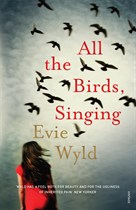
Evie Wyld, All the birds, singing

Courtesy: Random House Australia

The “because” is a bit of an assumption, I suppose, but is an assumption based on a strong correlation noticed by these researchers. Kon-yu then gives examples, which you can read in the article I’ve linked to above.

Now, before you say “but, but…”, it’s true that women have won literary awards here in Australia over the last decade, and in fact have done comparatively well in the last couple of years, but Kon-yu asks us to look at what they’ve written about. Many of our women winners of the Miles Franklin award in the last 20 years, she suggests – Anna Funder, Alexis Wright, Shirley Hazzard and Helen Demidenko – “focus almost exclusively on capital-H ‘History'”. Other wins, like those by Evie Wyld and Thea Astley, were for books set in “the rugged landscape of the Australian bush”. The situation is particularly stark when you look at the Man Booker and the subject matter of recent women winners, Hilary Mantel and Eleanor Catton. Kon-Yu’s conclusion? Well,

It seems that, as a culture, we are still predominantly concerned with the lives of men or in themes that we view as “masculine” or “wordly”. We still relegate women’s work to the domestic, the interior, the personal.

You’ve probably heard VS Naipaul’s statement a couple of years ago that he couldn’t see any woman writer, even Jane Austen (what!?), being his literary equal. He “couldn’t possibly share her [Austen’s] sentimental ambitions, her sentimental sense of the world”. You may also have heard commentary* about schools, co-educational ones anyhow, tending to choose “set” books on the basis of what boys will read, because girls will read widely while boys will only read within a narrow range.

Kon-yu looks into the recent past, the 1970s to 1980s, and finds that a greater percentage of the books by women which won awards then (Man Booker, Miles Franklin, in particular) did focus on female characters. Two Miles Franklin winners in this period, for example, were by Jessica Anderson, Tirra Lirra by the River (1978) and The impersonators (1980). Both are set domestically and deal with family relationships. Around this time, too, writers like Elizabeth Jolley (here) and Anita Brookner (in the UK) were focusing closely on women’s experience and were receiving significant recognition. Kon-Yu reminds us that this was the period when feminist criticism was gaining ground, and publishers like Virago and The Woman’s Press were being established. A coincidence? Not likely.

Anyhow, back in the present, Kon-Yu’s conclusion is that:

It’s not enough to publish books by women, we need to focus more on telling women’s stories.

Kon-Yu, perhaps for reasons of space, doesn’t explore in detail what she means by telling “women’s stories”, but she does quote male American writer, Pankaj Mishra, as saying that:

Novels about suburban families are more likely to be greeted as microcosmic explorations of the human condition if they are by male writers; their female counterparts are rarely allowed to transcend the category of domestic fiction.

The overall point, of course, is not that women can’t, or shouldn’t, write about anything. They sure can – and clearly do. No, it’s more complex. It’s that writing on the domestic, and on the “interior” of women, particularly if it’s by women, does not receive adequate literary recognition; it’s the too-frequent assumption that this is the only sort of writing women can do; and/or it’s the belief that this sort of writing is only of interest, and value, to women. Such tosh! A healthy, vibrant culture needs to hear, and respect, diverse views on diverse subjects. We are, I believe, making gains across the whole diversity spectrum, but we have a way to go yet.

* Sorry that I can’t find a source for this now, so argue with me if you will.
Monday musings on Australian literature: First winners of The Bulletin Novel Prize

“Once again women have proved that they can triumph over men”! So starts a 1928 newspaper article announcing the winners of the first Bulletin Novel Prize. Hmmm … fascinating to read this the week we heard that eight of the ten books longlisted for the 2015 Miles Franklin Award are by women. I don’t like to think that today we are talking about one gender triumphing over another, but about equality of opportunity to be published and considered for awards. However, I suspect there was an element of competition back in those more gender-divided days.

The Bulletin Novel Prize was announced in 1927, and was first awarded in 1928. The first First Prize was shared between three women writers – the previously published Katharine Susannah Prichard for her novel Coonardoo, and the debut collaborators, Majorie Barnard and Flora Eldershaw, writing as M. Barnard Eldershaw, for their A house is built. Third prize went to Vance Palmer, husband of Nettie Palmer. (He went on to win the prize in its second year with his most famous novel, The passage).

I’ve mentioned this prize before in a post on early literary prizes. Today I thought I’d share some of the reporting on the first award because – well, because I found it interesting. And I found it interesting for two main reasons, besides that opening salvo. One is that most of the reports I found via the National Library of Australia’s Trove focus more on Prichard than on M. Barnard Eldershaw, presumably because she was a well-respected, award-winning, previously published author, while they were unknowns. My other reason relates to how her winning book was described.

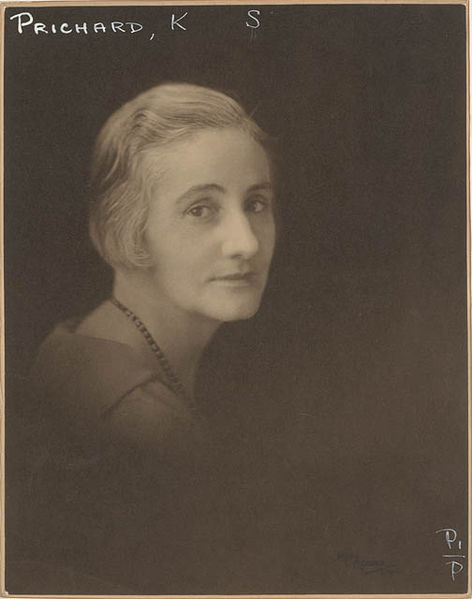
Katharine Susannah Prichard

Prichard, 1927/8 (Courtesy: State Library of NSW, via Wikimedia Commons)

The main article announcing the award – the one starting with the words with which I opened this post – appeared in city and regional newspapers throughout Australia. It tells us nothing about A house is built, but has this to say about Coonardoo, which was a ground-breaking and controversial novel for its depiction of “the sexuality of white men and black women” (ADB). The article describes it as follows:

‘Coonardoo’ is thoroughly typical of her penmanship, frank, vigorous, full of life and movement. Its setting is a station in the north-west of Western Australia, where a widow brings up her only son. Its men and women, made to live in her pages with remarkable reality, are typical of those who are everywhere making the real Australia — the Australia that is outside the cities. The relationships of the white settlers and the blacks, dealt with   firmly and quite frankly, supply the main theme of the story. Coonardoo from whom the novel takes its title (the word means “the well in the shadow”), is a little black girl of unusual type. In the background is the pioneering life; and woven through the story are the strange superstitions of the aboriginals and their weird customs. ‘Coonardoo’ is unquestionably one of the most powerful and absorbing novels ever written in Australia.

I love what this tells us about the times. There’s the idea that “real” Australia is “the Australia that is outside the cities”. It’s taken us a long time to accept, in our literature, that we are and always have been, in fact, a highly urbanised nation. And then there’s the description of Coonardoo as being “a little black girl of unusual type”. What does this mean? The writer doesn’t explain, and it’s too long since I’ve read the book for me to identify whether indeed she was of “unusual type” or whether this is the white writer’s assumption that any indigenous person mixing in a white world was unusual?  The writer also tells us that the story is woven with “the strange superstitions of the aboriginals and their weird customs”. How far we have come since then (I hope) to the point where we now see indigenous customs as not being “superstitions” or “weird” but an alternative world view, and one that we non-indigenous Australians not only respect but can learn from. Articles like this provide such rich pickings for researchers looking for values and attitudes of past times, but also for more casual readers like me interested in seeing where we have come from.

There are several brief articles announcing the prize, and a few advising that Coonardoo would start being serialised in The Bulletin forthwith, but I’ll just share one other. Its headline is: “PRIZE NOVELISTS: VANCE PALMER’S SUCCESS”! Why does third prize-getter Vance Palmer get the headline? We could jump to the conclusion that it’s because he’s a man, but the more likely answer is implied in the opening sentence: “Much satisfaction was expressed in Brisbane yesterday at the announcement in the “Courier,” in a message from Sydney, that Katherine Susannah Prichard, of Western Australia, and Vance Palmer, of Caloundra, had achieved success in the “Bulletin” prize novel competition”. The newspaper from which this article comes is The Brisbane Courier, that is, the main newspaper for the state in which Palmer was born. We’re not parochial! Poor old joint winners Flora S. Eldershaw and Marjorie Barnard don’t get a mention until the second paragraph.

I wonder what people reading our papers a hundred years hence will think of the assumptions and values we express!

Stella Prize 2015 Shortlist

I rarely write longlist, shortlist and winner posts, but for the Stella Prize I don’t mind making an exception. Last month, I posted on the longlist, and yesterday, the shortlist was announced.

  • Maxine Beneba Clarke’s Foreign Soil (Hachette): short story collection that I really must read, a debut book
  • Emily Bitto’s The Strays (Affirm Press): another debut book, this a novel that’s been garnering excellent reviews, and I’m keen to read this.
  • Christine Kenneally’s The Invisible History of the Human Race (Black Inc): the only non-fiction in the list, about her research into DNA and humanity’s origins.
  • Sofie Laguna’s The Eye of the Sheep (Allen & Unwin): second adult novel by an award-winning playwright and writer for children, about an individual young boy who may be, though it’s apparently not stated, on the autism spectrum.
  • Joan London’s The Golden Age (Random House): the only shortlisted book by a well-established novelist. I love her writing so need to read this. All these “must reads” make me wonder what I have been reading!
  • Ellen van Neerven’s Heat and Light (UQP): another debut book, and an intriguing collection of short, long and interrelated stories. I reviewed it last month.

It’s great seeing so many smaller publishers in the mix. Reminds us again that we should not overlook them when we are seeking quality books! This Stella Prize link will give you all the gen on the shortlist, including excerpts.

I was disappointed not to see Helen Garner’s The house of grief shortlisted, but not having read all the books, I’m in no position to pass judgement.

PS Apologies to those who saw it for the early incomplete posting of this post. I’m on the road and, against my better judgement, stupidly tried to use WordPress’s app. I like most things about WordPress, but detest the iPad app, so I tediously finished this in the browser on the iPad. Not a fun thing to do.

Fiona McFarlane, The night guest (Review)

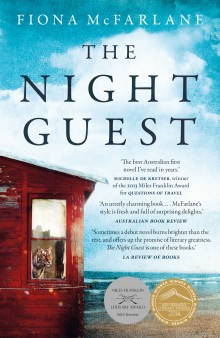
McFarlaneNightGuestPenguinThose of you who followed the literary award season in Australia last year will have seen Fiona McFarlane’s debut novel The night guest pop up several times. The more it popped up, the more I wanted to read it – but also the more I thought it would be good to read with my reading group. So, I bought it, and held onto it until this year, as we did, in fact, schedule it for our end of February meeting.

The first thing to say about this book is that it’s an easy, quick read, a page-turner in fact. But, it is not a simple read. It’s a read that keeps you guessing right to the end, even though you are pretty sure you know what is going on. It’s about Ruth. She’s in her mid-seventies, and recently widowed. She lives in the family’s old holiday house to which she and her husband had retired a few years previously. And, she’s “reached the stage where her sons worried about her”.

Then, along comes Frida, from the government she says, to be Ruth’s carer, because Ruth, as we’d suspected, has dementia, albeit in early stages. She is, she feels, “still self-governing”. Apparently, both of McFarlane’s grandmothers had dementia which helps explain why McFarlane has been able to present Ruth’s state of mind so convincingly. I say “helps explain” because there’s clearly a perceptive and skilled writer at work here too. It’s one thing to experience family members with dementia, but it’s quite another to be able to present it with such authority and authenticity.

How does McFarlane do this? The most important decision a writer has to make I think – and I’ve certainly heard many say this – is the voice. For this book, McFarlane chose third person subjective, that is, it is told third person but almost completely from Ruth’s perspective. A good decision, because we can feel Ruth’s uncertainty as she slides between confidence and uncertainty, between independence and neediness, between reality and a strange world that doesn’t always make sense. Because it’s from her point of view – and not an omniscient author’s – we are kept on our toes, not always sure, as Ruth is not, of where she is on any of those spectrums at any given time. Sometimes it’s patently obvious, but other times it’s not so clear.

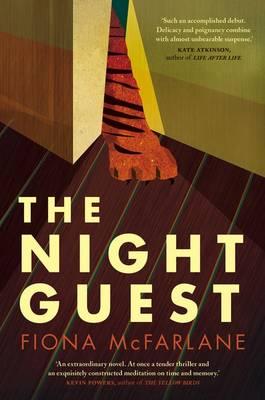
Ruth has a few guests during the course of the book – including Frida (of course) and a man called Richard Porter. But there is another one, a tiger! The tiger appears in the opening sentence of the novel:

Ruth woke at four in the morning and her blurry brain said, ‘Tiger’.

She was of course dreaming, except that now she’s awake, she starts to hear noises, “something large … rubbing” against her furniture, and “the panting of a large animal”. These noises are too big to be coming from her cats. The tiger is ongoing “character” in the novel. More on this anon.

The second guest to arrive is the aforementioned Frida. She appears out of the blue one day – “You don’t know me from Adam” she says – to start caring for Frida. The question though is, is she “out of the blue” or is it that Ruth didn’t remember that someone was coming. Questions like this recur throughout the novel, keeping us in a sort of readerly vertigo. One minute we believe we know, and the next we are uncertain again. By the half-way point, though, I suspect most readers are pretty confident of what’s really going on, but even then there are uncertainties about how it will actually play out. All this makes the book an engrossing challenge.

Then there’s the third guest, Richard Porter, who was her first, and unrequited love, when she was a young woman living in Fiji with her missionary parents. Ruth invites him for a visit, hoping that “things could still happen to her”.

It’s hard to know how to write more about the book though because this is one of those stories in which the plot and the meaning are intertwined. However, I can say that it’s broadly about ageing, grief, love and loss. It’s also about trust, honesty and the responsibilities we have for each other.

The tiger

The tiger, as I’ve already indicated, appears on the first page. He’s a complex figure, alluding partly, I’m sure, to Blake’s “The Tyger”. But, and here perhaps I’m drawing a longer bow, he also reminded me of the tiger (aka Richard Parker, which is very close to Richard Porter, but that might be a bridge too far!) in Yann Martel’s Life of Pi. Both tigers reflect a duality: they are both fearsome (and perhaps representative of evil, though I like to avoid that word), but both can also be seen positively. Blake’s tiger was made by the God who also made the lamb, and so by extension can be seen to encompass both forces. Martel’s tiger needs to be kept at bay, but his very presence also gives Pi the strength and focus he needs to survive.

So, too, in The night guest does the tiger play a complex role. He appears when Ruth is at her most uncertain, most fearful, most disoriented, disappearing when she’s calm. In that sense he represents the negative. But, there’s something grand, and perhaps even reassuring about him. In his first appearance, Ruth thinks:

A tiger! Ruth, thrilled by this possibility, forget to be frightened and had to counsel herself back into fear.

A little later, when she is feeling comfortable, the tiger is “safely herbivorous”. But, he comes back, and Ruth is irritated “because there was no point to him now that she had Frida and Richard; the tiger had prepared the way for them and was no longer needed”. I’m tempted to suggest that Frida and Richard could represent the tiger’s duality, but the book isn’t simplistically conceived, so I don’t want to take that line of thinking too far.

Towards the end, when the tiger is fighting for his existence,

Ruth felt for a moment on the verge of understanding exactly what the tiger was saying when he roared. He wasn’t concerned for his safety, but for his dignity …

I’ll leave the tiger there, but I think you can see how McFarlane uses him in the novel.

There are other images and symbols which run through the book, some of them biblical, like lilies (“she was safe behind her lilies”), which makes sense given Ruth’s missionary upbringing. And, of course, Ruth’s name itself is biblical. None of this is heavy-handed though, or suggests a slavish adherence to symbolism. It just adds to the depth with which we can contemplate this book – at least, I think so.

In the end, this is a book about people – and how we treat each other. Several people, besides those I’ve mentioned here, are involved in Ruth’s life, such as her sons and a young mother who’d found her husband as he was dying. The book asks us to consider how far do we – should we – take our duty of care? How do we decide when we should intervene in another’s life and when we should not. I did enjoy this book.

Lisa at ANZLitLovers didn’t enjoy it as much as I did. I agree that it doesn’t really work as a psychological thriller, which is how some of the blurbs on my edition describe it. But, as I was reading it, I wondered whether that’s what McFarlane intended … or just how it’s been promoted?

awwchallenge2015Fiona McFarlane
The night guest
Melbourne: Penguin Books, 2014 (orig. ed 2013)
275pp.
ISBN: 9780143571339

Ellen van Neerven, Heat and light (Review)

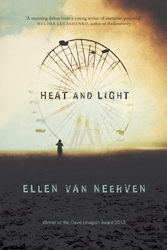
Ellen van Neerven, Heat and light, book cover

It’s silly I know, but I had a little thrill at the end of Ellen van Neerven’s Heat and light, because not only was the last story set in a place where I spent six of the formative years of my childhood – Sandgate on the northern edge of Brisbane – but one of the characters learnt to swim in the same pool there that I did, and her brother has a beagle, just as we did. Ah, childhood. Enough, though, of readerly nostalgia. Time to properly discuss the book.

Heat and light won the David Unaipon Award for Unpublished Indigenous Writer in 2013, and has been on my TBR for several months. I hadn’t prioritised it for reading, but its longlisting for the Stella Prize last week convinced me to squeeze it in before two works I had to complete by 21 and 24 February. I hope I won’t regret it. No, let me rephrase that: I know I won’t regret having read it, but I hope I don’t regret my decision to read it right now!

The first thing to say is that Heat and light isn’t a novel. It has, in fact, an intriguing form, something that’s not unusual with writers from an Indigenous background. Simplistically speaking, it comprises short stories organised into three sections titled Heat, Water and Light. However, each of these sections is quite different. Heat comprises interconnected short stories (5) about three generations of the Kresinger family, while Water is longform short fiction (54 pages in my edition) in the speculative fiction genre. Light, on the other hand, is more like a “traditional” collection of short stories (10). Together, the three sections, including the future-set Water, create a rich picture of contemporary indigenous life and concerns.

And here I confront again the challenge of being a non-Indigenous Australian reviewing a work by an Indigenous Australian featuring Indigenous people. It always makes me a little anxious: I fear sounding earnest or, worse, patronising; I fear making what’s different sound exotic; and, I fear missing the point. And yet I love reading Indigenous writers, because their perspective is different and because they (see, I’m generalising, aren’t I?) tend to be adventurous in their story-telling, often taking risks with voice, form, chronology, genre, and more. Van Neerven, as I’ve already implied, is such a writer.

The titles of the three sections – Heat, Water, Light – make me think of the elements. They are not quite the classical elements (fire, air, water, earth) but they convey, it seems to me, the essence of what’s needed for life. The focal character in Heat, though we don’t see a lot of her, is Pearl, the grandmother of the narrator of the first story which is titled, in fact, “Pearl”. Pearl is a bit of a free spirit – earthy, hot (in its sexual meaning, with “her siren eyes”), and likely to appear or disappear with the wind. Over the five stories in this section we learn about Pearl, her sister Marie, and the two succeeding generations. Van Neerven’s writing is confident, moving comfortably between first and third person narrators, all of whom are members of a complex extended family. Loyalties – to their indigenous background and to their blood relationships – are tested. As the narrator of “Pearl” says:

So much is in what we make of things. The stories we construct about our place in our families are essential to our lives.

And this is true, whether or not the stories so constructed are “true”. The implication is you need to know what you are doing. Colin, for example, finding himself, through his own actions, disconnected from his Indigenous heritage, wants to return, but

she told me if I was going to make my way home I’d better do it soon before the dust had covered my tracks.

The third section, Light, explores similar issues to those in Heat, but through ten separate stories, ranging from 2 pages to 30. The characters in both sections both move between city and country, but, while Heat is set in southeastern Queensland, the stories in Light are set in Sydney, Western Australia and Queensland. The protagonists tend to be young, and female. They also tend to be in formative stages of their lives, or at crossroads; they are sorting out their relationships, their sexuality, their identity. They confront racism and face conflict, but they also experience and give love. There’s humour, some of it wry, such as the young girl noticing that the tag on her pants states that “this colour will continue to fade”.

Water, the longform story that occupies the middle of the book, is very different. For a start, it’s set in the near future, the 2020s, when Australia is a republic with a female president. There’s a new flag and Jessica Mauboy’s song “Gotcha” is the national anthem. There’s also a social media ban! I reckon Van Neerven enjoyed imagining this. However, life isn’t perfect. Our narrator Kaden has a new job as a Cultural Liaison Officer and was initially pleased because she thought she’d be working with “other Aboriginal people” which would provide a “way of finding out about my culture and what I missed out on growing up”. But, she discovers she’ll be working with “plantpeople” who are sort of mutant plants with human features created during “islandising” experiments. Kaden’s job is to evacuate them in preparation for the Australia2 project.

I don’t want to give any more of it away, but you’ve probably guessed that it’s a story about how we treat other, about segregation, discrimination and dirty politics. It’s also about connection to country and about the importance of controlling one’s own art. Artist Hugh Ngo says:

I don’t make art for galleries. Or for money. I make art that speaks the truth.

This is a clever (and true!) book. The bookending sections Heat and Light present stories of Australian people going about their lives, and most of them happen to be indigenous. Their indigeneity is evident, and it affects the issues they confront, but there’s no specific advocacy. The middle section, on the other hand, is more overtly political. It picks up issues that appear in the shorter stories and provides a coherent, ideological context for the whole.

Heat and light is one of those really satisfying reads: it combines engaging writing with stories that make you feel you’ve got to the things that matter. So no, regardless of whether I meet my other deadlines, I’m not sorry I bumped this book up in my reading priorities.

awwchallenge2015

Ellen van Neerven
Heat and light
St Lucia: UQP, 2014
226pp.
ISBN: 9780702253218

Note: One of the stories in Light, “The Falls”, is available on-line at Kill Your Darlings

Monday musings on Australian literature: New prize for experimental NON-fiction

We’ve all heard of prizes for experimental fiction, I’m sure, such as the new(ish) Goldsmith’s Prize won by Eimear McBride’s A girl is a half-formed thing in 2013, but have you heard of a prize for experimental non-fiction? I hadn’t until I read about Lifted Brow’s new prize recently.

The Lifted Brow is a Melbourne-based publisher, which publishes, “excellent writing and artwork”. They publish in print quarterly, in digital monthly, and online every other day. They have, they say, “eyes all over the world”. This last point is important because their The Lifted Brow Prize for Experimental Non-Fiction is not limited to Australia. They describe the prize as “looking to unearth new, audacious, authentic and/or inauthentic voices from both Australia and the world”. The prize is AUD1000, plus publication in The Lifted Brow’s redesigned/reformatted magazine (edition 25, due out in March 2015). Submissions, which closed at the end of January, had to be no more than 5,000 words, and there was a small entry fee. The judges are (somewhat) international too: Australian author-academic Rebecca Giggs, and US writers John D’Agata (essayist) and Mallory Ortberg (author of Texts from Jane Eyre).

Anyhow, here is the longlist which was announced earlier this month:

  • Sophia O’Rourke’s “Flaming June – Still Life and the Anthroposcene”
  • Scott Sandwich’s “Music Begins Where the Possibilities of Language Ends”
  • Jocelyn Hungerford’s “Don Quixote, Which Was an Essay: A Plagiarism for Kathy Acker”
  • Kelly Neal’s “The Ax and the Ex: Texts and Contexts”
  • Harry Saddler’s “Thought Experiment”
  • Ilan Oberon’s “A Holiday with Space Hippies”
  • Mattie Sempert’s “Navel Gazing”
  • Ben McLeay’s “The Lake”
  • Oscar Schwartz’s “Humans Pretending to be Computers Pretending to be Human”
  • Sian Campbell’s “Bleach”
  • Caroline Crew’s “Slipcover”
  • Rachel Hennessy “Kristeva’s Blood”
  • Sam Cha’s “Why I Am Not A Pianist”
  • Kimberley Starr’s “The Caged Bird Speaks”

I’ve listed these in their order, restraining myself from alphabetising to keep with the spirit of the prize. But, oh dear, I would like some sort of order to facilitate locating particular names any time I come looking at this page again. Just me, I suppose. (You can take the girl out of the library, but you can’t take … well, you know the rest!)

Anyhow, at first glance, I only recognise one of the authors listed here, Rachel Hennessy, whose novel, The heaven I swallowed, I’ve reviewed here. Of course, The Lifted Brow folk did say that were looking for writers they’ve never heard of before as well as ones they know, so some of these could be new. I wonder how many are international? Here’s what a superficial Google search revealed:

  • Not found (or not with reasonable confidence): Sophia O’Rourke, Kelly Neal, Ben McLeay
  • Found (with reasonable confidence): Scott Sandwich (Australian performance poet whose “real” name is Tom Hogan); Jocelyn Hungerford (Australian author/editor); Harry Saddler (Australian author born in Canberra); Ilan Oberon (Australian writer-artist based in Queensland): Mattie Sempert (Australian writer and acupuncturist based in Melbourne); Oscar Schwartz (Australian writer-poet based in Melbourne, currently researching whether computers can write poetry); Sian Campbell (Australian “freelance writer, student, wannabe bassist and lit nerd” based in Melbourne and Brisbane); Caroline Crew (American writer-poet); Rachel Hennessy (Australian writer, born in Canberra); Sam Cha (American writer-poet, based in Massachusetts); Kimberley Starr (Australian novelist and teacher)

So there you have it. Most are Australian, as I suppose you’d expect given the sponsoring magazine is Australian. And the gender spread looks pretty even (albeit exact numbers aren’t clear given that a couple of the names are gender-neutral).

I love the idea of experimental non-fiction. I’ve read (and reviewed here) some non-fiction that has played with voice and structure, or that has straddled, for want of a better description, the fiction-non-fiction divide, but not a lot, and probably not as “out there” as I suspect this prize is seeking. I look forward to seeing who wins it and just what the winning entry entails.

What do you understand by experimental non-fiction, and have you read much?

Stella Prize 2015 Longlist

As a team-member of the Australian Women Writers’ Challenge, I’m particularly interested in the Stella Prize, which, as you probably know, is a prize limited to Australian women writers. The great thing about it, though, is what it isn’t limited to – and that is form and genre. The first winner in 2013 was a novel, Carrie Tiffany’s Mateship with birds (my review), and the second, last year, was a history, Clare Wright’s The forgotten rebels of Eureka (my review). What will it be this year?

Well, it could be a book of short stories or a memoir, or it could be true crime or, yes, a novel, or it could even be a young adult novel or a book about the human race. Here, if you are interested, is this year’s longest (the shortlist to be announced on March 12):

Helen Garner, This house of grief book cover
  • Maxine Beneba Clarke’s Foreign Soil: a collection of short stories which has been receiving positive reviews.
  • Emily Bitto’s The Strays: a debut novel set around the 1930s and published by small publisher, Affirm Press
  • Ceridwen Dovey’s Only the Animals: a collection of short stories giving, I understand, a animal’s-eye-view of humans, at our best and worst.
  • Helen Garner’s This House of Grief: a sort-of true-crime-cum-courtroom story which I reviewed last year.
  • Sonya Hartnett’s Golden Boys: novel by one of our well-established well-regarded writers
  • Christine Kenneally’s The Invisible History of the Human Race: non-fiction about the development of the human race, looking at DNA and historical factors.
  • Sofie Laguna’s The Eye of the Sheep: second novel from an author whose first novel was longlisted for the Miles Franklin Literary Award and shortlisted for the Prime Minister’s Literary Award.
  • Joan London’s The Golden Age: I loved London’s Gilgamesh, and also enjoyed her The good parents (which I’ve reviewed here) so why haven’t I yet read this one?
  • Alice Pung’s Laurinda: debut novel, for young adults, by acclaimed memoirist Pung whose second memoir I’ve reviewed here).
  • Inga Simpson’s Nest: second novel by an author proving to be popular with AWW Challenge reviewers. She’s on my radar.
  • Ellen van Neerven’s Heat and Light: debut novel which won the 2013 David Unaipon Award, and it’s on my TBR.
  • Biff Ward’s In My Mother’s Hands: memoir by the daughter of historian Russell Ward, which I’ll be reading in March, as it’s been scheduled for my reading group.

This year’s stellar (couldn’t resist that) judges are critic and writer Kerryn Goldsworthy (chair), journalist and broadcaster Caroline Baum, writer and lecturer Tony Birch, singer–songwriter Sarah Blasko, and author Melissa Lucashenko. You can read the judge’s full report on the Stella Prize website.

Monday musings on Australian literature: The challenge of literacy

Today’s topic may be a bit serious for Christmas week, but I’ve decided to go with it anyhow. I was inspired to write it by an article in the online journal, The Conversation. The article, by Deakin University academic Lyn McCredden, was itself inspired by the Prime Minister’s Literary Awards at which one of the winners, Richard Flanagan, donated his $40,000 prize to the Indigenous Literacy Fund. A good thing, nest-ce pas? McCredden goes on to mention the creation by Prime Minister Tony Abbott that night of the Australian Book Council, and quotes publisher Louise Adler as stating that this Council “declares that Australian writing matters and that building future generations of writers and readers is vital to a civilised and free society”. So far so good, but …

Then she quotes American literary critic Michael Bérubé who wrote in 1996 that:

… it has been some decades now since George Steiner and Thomas Pynchon reflected, in their different ways, on the phenomenon of Nazi officers with a fine appreciation of aesthetic excellence. (Bérubé)

In other words, the importance of literacy is a given but

what is so often occluded or skimmed over in many of the prize-giving activities of the book industry is that literacy on its own [my emphasis] is not necessarily a good. (McCredden)

Are you getting the picture? Sure, she says, not being able to read is a bad thing – it usually implies or leads to powerlessness and lack of privilege – but being able to read per se is not automatically good in itself, as Bérubé implies.  (Though, of course, what is “good” is a judgement isn’t it?). Anyhow, McCredden goes on to refer to Flanagan’s winning novel, The narrow road to the deep north, and the fact that “the figure of the vicious and violent prison guard is also notable for the way he quotes the exquisite poetry of Basho, even as he inflicts maniacal harm on prisoners”. If I understand her correctly, she suggests that for reasons like this, she doesn’t find Flanagan’s book (see my review), “satisfying or cohesive”. However, my reading is that Flanagan addresses the ambiguity contained in the Japanese officers’ love of poetry when he says:

They recited to each other more of their favourite haiku, and they were deeply moved not so much by the poetry as by their sensitivity to poetry; not so much by the genius of the poem as by their wisdom in understanding the poem; not in knowing the poem but in knowing the poem demonstrated the higher side of themselves and of the Japanese spirit … (Flanagan, The narrow road to the deep north)

This, to me, clearly expresses Flanagan’s awareness of the questionable or complicated nature of our relationship to literature. McCredden and I could argue this specific point, but it’s not the essence of her article, so let’s continue.

Books, she argues, do not always “unite” us. In fact, the controversies they sometimes generate show that culture is “always contested, and always ideological”. The best kinds of books she therefore suggests might be those that challenge our assumptions about ourselves – like Christos Tsiolkas’ Barracuda (see my review) – rather than those that “please us with myths about ourselves”. She argues that:

if we are, like Dorrigo, privileged enough to be able to read, we are opening ourselves to a world of pain, as much as entertainment. (McCredden)

Literacy, in other words, carries responsibilities as well as rights. As citizens we have a right to be able to read and to therefore conduct the business of our lives, but, there’s more to it than that, and therefore

Learning how to read – that is, how to think, analyse and challenge prevailing ideas (including those appearing in many works of literature, many histories) needs to be considered more coherently alongside the mechanics of book distribution, book marketing, learning the alphabet. (McCredden)

A very good point – and much needed methinks in our rush-to-judgement world. Do you agree? And if so, how do we teach this sort of reading without turning people off?

Monday musings on Australian literature: Prime Minister’s Literary Awards

I’ve written about the Prime Minister’s Literary Awards before – more than once in fact, as you will see if you click on my link. They were created in 2007 by our then new Labor Prime Minister, Kevin Rudd. What heady days they were. These were, at the time, Australia’s most lucrative literary awards, and were among the first of the major awards, when they instigated this in 2011, to provide a cash prize for shortlisted books. Awards were initially made in two categories – fiction and non-fiction – but gradually other categories have been added for poetry, children’s fiction, young adult fiction, and Australian history.

I do wonder though about the ongoing support. In 2010 the winners were announced on 8 November, then in 2011, it was 8 July, and in 2012 it was 23 July. Last year the winners were announced on 15 August, and this year they were announced tonight, 8 December. Why such inconsistency? Most major literary awards keep pretty much to a schedule, but this one is all over the place. Does this suggest a lack of commitment? I had started to think this year that they weren’t going to happen – until the shortlist was suddenly announced on 19 October.

I enjoy following these awards – and I’m primarily talking fiction here – partly because there is often something left field about them. Three winners – The zookeeper’s war by Steven Conte (2008), Eva Hornung’s Dog boy (2010) (my review) and Stephen Daisley’s Traitor* (2011) – didn’t win any other major award (as far as I’m aware). And the shortlists have included books that scarcely, if at all, popped up elsewhere, such as Sophie Laguna’s One foot wrong (2009) and Alan Gould’s The lakewoman (2010) (my review). Given that the arts is a subjective business, I like seeing different works being recognised. I can’t believe that there are only 6 or 7 books worth highlighting each year – and yet that’s what often seems to be implied when you look at the shortlists in any one year. (I suppose, though, if you are one of those 6 or 7 you hope that multiple listing will result in your winning at least once?)

Anyhow, it’s now time to announce this year’s winner of the fiction award – and it’s a joint award: Steven Carroll’s A world of other people and Richard Flanagan’s The narrow road to the deep north (my review).

And I can’t help giving a special mention to a couple of other winners:

  • Poetry award: Canberra’s gorgeous Melinda Smith with her collection Drag down to unlock or place an emergency call (published by the lovely little poetry press, Pitt Street Poetry). I haven’t read this, but I have heard Smith speak and mentioned her in my post on Capital Women Poets.
  • Non-fiction award: another joint award – Gabrielle Carey’s Moving among strangers (on my TBR) and Helen Trinca’s Madeleine: A life of Madeleine St John (my review).

The Australian history award was also made to two books. I have no idea what the authors think about all these joint awards, but as you can imagine, I like that the love was shared.

I do hope these awards continue, and hopefully on a more routine schedule.

Congratulations to all the authors, and their publishers, who won this year.

* I have been wondering about what has happened to Daisley, but I read just today in a catalogue from Text Publishing that he has a new book out in 2015, Coming rain, set in Western Australia in 1955, the year he was born! I’ll be looking out for it.

Monday musings on Australian literature: The Voss Literary Prize

Did the title of this post grab your attention? It grabbed mine so dramatically when I came across it that I immediately abandoned my plans for today’s post – they can wait – to tell you about it.

The first thing to say about it is that it’s not what you think, if indeed like me you immediately thought of Patrick White’s Voss. I was impressed. We have prizes named for authors and sponsors but I hadn’t come across one named for a literary work. Have you? Well, as it turns out, I still haven’t because this award was named for its benefactor, Vivian Robert La Vaux Voss, who conceived it in 1955 – two years before Patrick White’s Voss was published. Hmmm … 1955 and I’ve only heard of it now? This is where the story becomes even more interesting.

I read about this award in one of my favourite on-line journals, The Conversation. The author, and one of the prize’s judges, Anthony Uhlmann, describes its genesis. Vivian Voss, according to Uhlmann, had a “an early career of brilliant promise”. He apparently won many prizes at the University of Sydney and the University of Rome but died in 1963, when he was just 33 years old. His grandfather, Frances Henry Vivian Voss, and mother, Harriette Martha Voss, were both medical practitioners and both appear in the Australian Dictionary of Biography (ADB) for their medical and community work. According to ADB, his grandfather “indulged his love of literature in his fine private library”. The family was wealthy, which must be why Vivian Voss was able to create the Voss Literary Prize in the will he wrote in 1955. In this will, he envisaged the prize being overseen “by five professors at his alma mater, the University of Sydney: the Professor of Latin, the Professor of English, the Professor of French, the Professor of Italian, the Professor of German”. They were to grant the prize to the best novel, “published or unpublished”, in the world! He clearly wasn’t thinking small!

Uhlmann says that the prize was offered to several major universities, all of whom turned it down. It was then offered to the Association for the Study of Australian Literature (ASAL), but they already had a literary award*. So, it was offered to the “newly formed Australian University Heads of English” (AUHE) who “gratefully accepted it”.  Uhlmann doesn’t explain over which time period all this occurred, but it sounds like this last offer was made fairly recently. And, in fact, an AUHE press release seems to explain the timing, stating that “a life tenant in Vivian’s Estate received estate income until his death in 2012”. Ah, so the money, it seems, was tied up, which is why the first award is only now being made. The prize in 2014, this same press release says, will be $6,500.

There is now a website for the award, which describes it as:

a new award dedicated to the memory of Vivian Robert Le Vaux Voss (1930-1963), an historian and lover of literature from Emu Park in Central Queensland who studied History and Latin at the University of Sydney and modern languages at the University of Rome.

As far as I can tell, the award seems to be now limited to Australian publications.

Now to the first awarding of the prize. Uhlmann names his co-judges: Brenda Walker (novelist whose Poe’s cat languishes in my TBR, University of Western Australia), Philip Butterss (whose An unsentimental bloke I recently reviewed, University of Adelaide), Brigitta Olubas (University of New South Wales), and Amanda Nettlebeck (University of Western Sydney). They shortlisted the following novels:

  • Hannah Kent’s Burial rites (my review)
  • Fiona McFarlane’s The night guest (my review, added in 2015)
  • Christos Tsiolkas’ Barracuda (my review)
  • Tim Winton’s Eyrie
  • Alexis Wright’s The swan book

(You can see the longlist on their site).

McFarlaneNightGuestAnd the winner, announced on Wednesday November 19, 2014, at the annual meeting of the AUHE, is Fiona McFarlane’s The night guest. I have had this novel on my radar since I saw the first reviews start to come through for it at the Australian Women Writer’s Challenge. I now have it in my possession – and just need to find time to read it.

I have spent quite a bit of time, I know, on this award – but I thought it was an interesting story and hoped you would think so too. It will be an interesting one to follow – but, I know I will always do a double-take when I see its name!

* The ALS Gold Medal, which was awarded this year to Alexis Wright’s The swan book.