Alexis Wright‘s Carpentaria won the Miles Franklin Award in 2007 and I read it back around then but it’s a book that keeps coming back to me so I thought it was time I shared why. This won’t be my usual review, but rather random comments on the ideas that float around my head.
First though, you do need a bit of an idea of what it’s about. It’s a wild novel and the plot is complex with its interwoven stories of the inhabitants of a fictional town called Desperance (great name!) in northwest Queensland. The local Indigenous people, the Pricklebush mob, are engaged in a number of disputes – amongst themselves (the Westend and Eastend groups) and with various non-Indigenous people and groups including local police, government officials, and the large multinational mining company operating on their sacred land. But it’s also about personal soul-searching as some of the main characters work to resolve their place in the world. There’s a large array of colourful characters, including Normal Phantom (the ruler of the family), Mozzie Fishman (religious zealot), Will Phantom (activist and Norm’s son, who undertakes a spiritual journey with Fishman), Elias Smith (mysterious outcast saviour), Bruiser (by-name-and-nature town mayor), to name just a few.
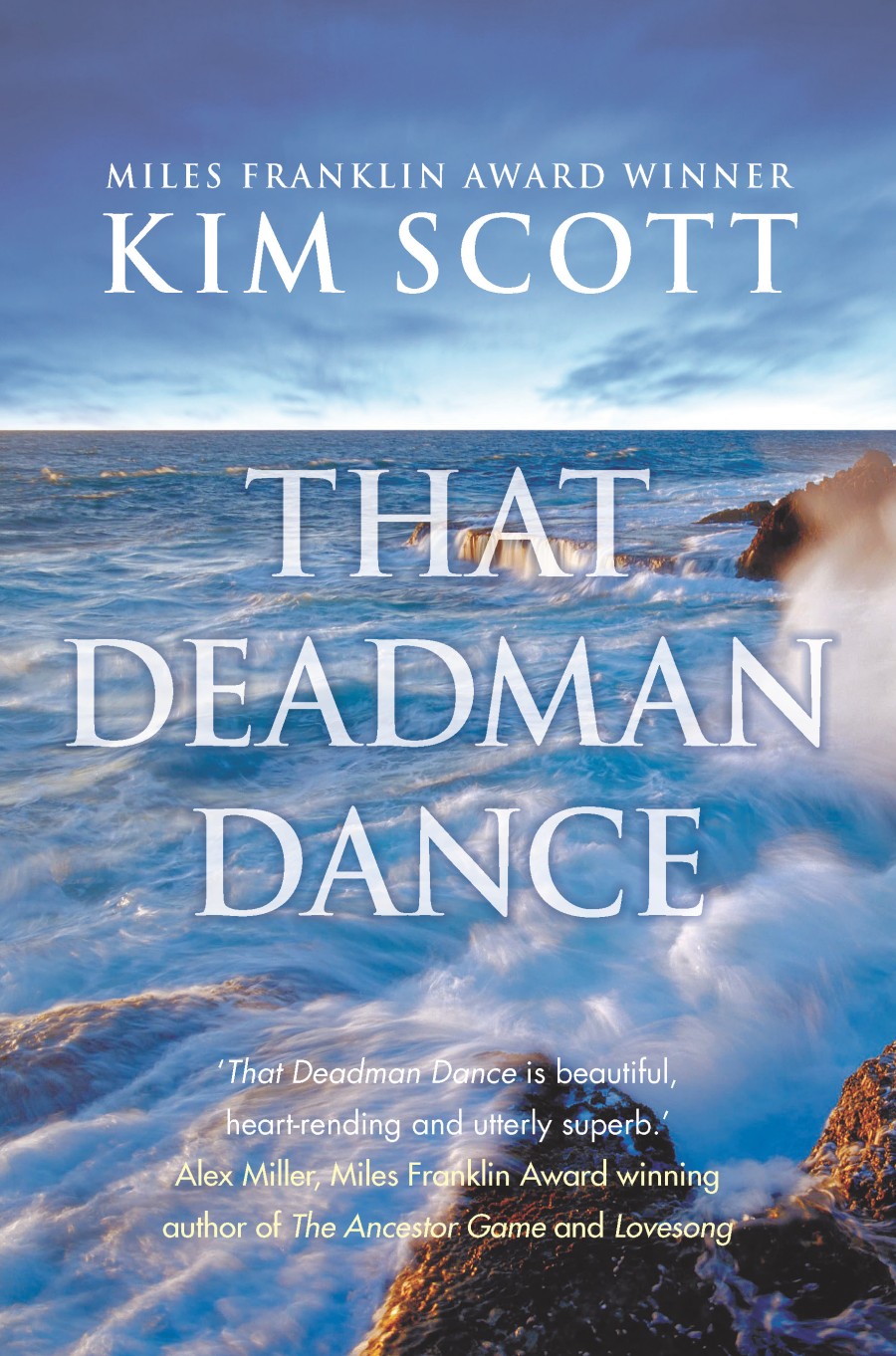
It is fundamentally, but not only, about black-white relations in a small town. It doesn’t polarise the issue the way books dealing with this topic often do. The whites are presented pretty negatively, but the Indigenous people are not painted as saints either. They are flawed, and have conflicts within their own community as well as with the white occupants of the town. I like the honesty of this. Some of the problems within the Indigenous population are due to the European invasion and the impact of dispossession, but some are clearly just because they are human with all the normal arguments, jealousies, power plays etc that are found in any family or community. Wright is most interested in conveying the complexity of black culture: its struggles to cope with the colonisation, and the conflict within black communities about how to respond. Consequently, the novel touches on many contemporary issues – land rights, deaths in custody, mining rights, boat people, petrol sniffing to name just a few. It could almost be seen as the contemporary corollary of Kim Scott‘s That deadman dance.
Towards the end of the novel comes this:
Old stories circulating around the Pricklebush were full of the utmost intrigues concerning the world. Legends of the sea were told in instalments every time you walked in the door of some old person’s house. Stories lasted months on end, and if you did not visit often, you would never know how the story ended.
It’s from Will who is sitting on top of the pub, waiting for the cyclone to do its damage. I like it because it rather describes the way the novel is told – circularly more than linearly, and certainly rather disconnectedly. I am always interested in structure, and structure is one of the main challenges of the book. I suspect the structure has something to do with the Aboriginal world view and way of seeing stories – and that understanding this structure better might help better understand the book. It’s both circular and multilayered.
The centre or heart of the novel comprises Elias’ burial at sea and Norm’s being tested. The notion of ‘trespass’ is introduced specifically here. It’s a critical notion in Christian religion. It also alludes to European civilisation trespassing on Indigenous land and culture. And, of course, Indigenous people have their own sense of trespass. In some (many?) ways, trespass is a core theme of the book:
Pausing momentarily, he [Norm] tried again to recite the prayer, before stopping to linger once more on the perplexing word trespass. Trespass had been a big word in his life. It protected black men’s Law and it protected white men. It breathed life for fighters; it sequestered people. The word was weightless, but had caused enough jealousies, fights, injuries, killings, the cost could never be weighed. It maintained untold wars over untold centuries – trespass.
What makes the book special is its language, which is often playful. I chuckled many times as I read it: the wordplay, and the comic set pieces in particular were well done. The set pieces include Angel Day’s retrieval of a Virgin Mary statue from the town dump, and Elias Smith’s emergence from the sea. Popular culture and language (such as clichés) are incorporated, both through allusions and simply as part of the rather colloquial text. Added to this, is the mix of biblical (parting of the waters/mist, big flood, feeding with fish) and traditional imagery and symbolism. I don’t completely understand the meaning of the traditional imagery/symbolism, but it’s there, and can be felt even if it can’t be fully articulated by us who are not part of the culture: water (sea, lagoons, rivers), fire, fish, birds (seagulls, pelicans and others), serpents, land, music, and so on. It’s interesting how many of these images work in both cultures. The novel teems with imagery, most of it worthy of further exploration.
And while I’m talking of language, the names are highly evocative: Desperance, Uptown and Pricklebush, Normal Phantom, Angel Day (Agnus Dei?), Truthful (the cop), Bruiser (the town mayor), Mozzie Fishman, Joseph Midnight, Will (a very wilful young man), and Hope.
There is also surrealism (or is it magical realism?) mixed with the real, which adds to the challenge and fun of reading this book: it is sometimes hard to tell what is ‘real’ and what is ‘dream’ or ‘myth’ or ‘imaginings’. Much of this aspect of the novel explores connections between Indigenous and Christian religions and cultures, which makes sense given the strong role missionaries played in the first century or more of contact.
This is one of those novels that begs comparison with others and yet it is so itself that any comparison does neither it nor the other book justice. However, I’m going to throw a couple of ideas out there anyhow: Tim Winton‘s Cloudstreet, and Gabriel Garcia Marquez’s One hundred years of solitude. All three deal with family on an epic scale and with a level of inventiveness that can make you high.
Without giving the conclusion away, I will say it ends on a positive image for Indigenous people, on the idea of “singing the country afresh”. There is no simple solution, and many unanswered questions are left hanging, but there is hope – which is just about how a book like this should end.
Alexis Wright
Carpentaria
Melbourne: Giramodo, 2006
519pp.
ISBN: 9781920882174





 Whispering Gums