Monday musings on Australian literature: Place

Place. It’s a complex thing isn’t it?

Arti (Ripple Effects) commented on my recent post on Gerard Manley Hopkins‘ “Spring and Fall” that

… while spring may be a welcome sight, for some strange reasons, I miss winter’s snow. (not the temp. just the beautiful snow scenes).

Would I miss winter and snow? Not on your nelly! Meanwhile, Nigel Featherstone (Under the counter or a flutter in the dovecot) wrote in response my comment on a recent post of his:

As to the drive to and from Canberra: most of my trips are through Lake Bathurst; so amazing – all that sky!

But arriving in the ACT is always a good feeling. Though almost immediately I miss my home town.

Isn’t place interesting? So difficult to capture accurately…

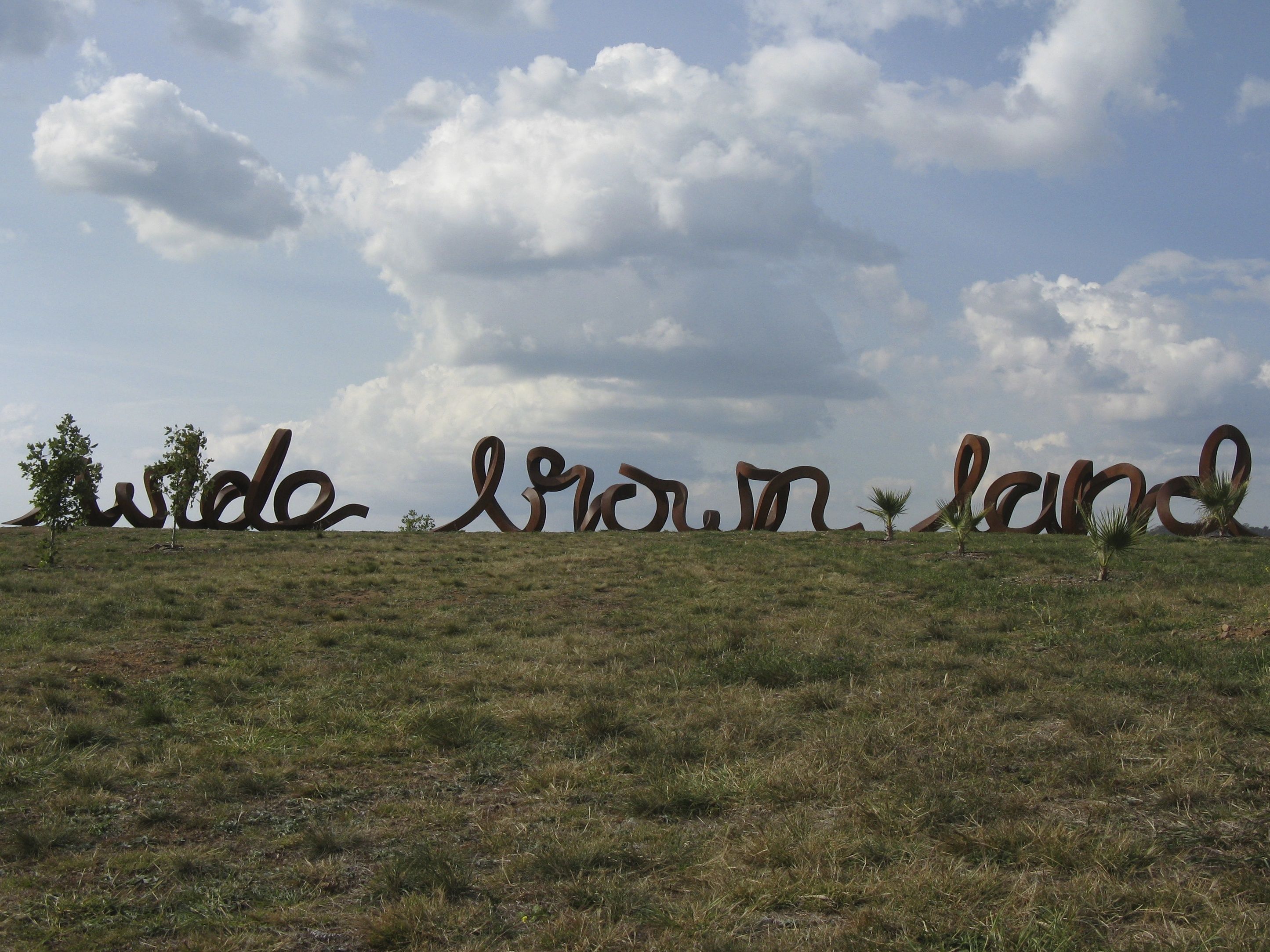
Wide Brown Land sculpture

Wide Brown Land (National Arboretum)

These comments got me to thinking about my sense of place – and then about place in literature. First me. My love of the Australian landscape came home to me when we returned in 1985 from a two-year posting in Virginia, USA. Like most Aussies, I’d read a lot of fiction from the northern hemisphere and had somehow been imbued with the idea that the loveliest landscape is lush and green and the best houses are two-storey. After enjoying two years in such a place, I wondered how I’d feel about returning home. I needn’t have worried. We drove back into my city and it felt wonderful. I knew then that here, this  browner place with its scraggly vegetation, was my place.

Now for literature. I can think of two main uses of place in literature. One is the obvious one, place as setting, as background for the action. I enjoy reading good descriptions of place, and have shared some in my reviews. My favourite descriptions are sensory, enabling me to “feel” and “see” the place and its impact on the characters. A favourite example is the opening paragraph of Charles Dickens Bleak House. It’s hard to forget London and its fogs after that.

The other use, though, is more complex. It’s to do with our relationship to place – the way we interact with place, the way we feel about it, the way it interacts with us.

But here’s the rub. Relationship to place is complicated in colonial/settler societies like ours, societies which have taken over someone else’s place. How do we reconcile that? There’s a fundamental conflict between our two different experiences of place, and it’s discomforting. We want to respect and better understand the original owners’ values while validating our own. Literature (and the arts in general) can help us work through these issues –  by directly exposing and exploring the conflict, and more subtly by sharing our respective experiences. For literature to be effective, of course, we need universal literacy – but that’s another story.

Fortunately, more indigenous writers are being published and we are hearing their voices about land, about country. We need to hear it, we need to share and talk. In That deadman dance, Kim Scott tackles head on the issue of land and ownership, of competing values and different understandings, in the early days of settlement. Killam, the soldier, has to give up to the Governor a place he’d taken:

Mr Killam was learning what it was to have someone move in on what you thought was your very own home. He thought it was the last straw. The very last.

Meanwhile, Skelly tramps about the land with a gun in his hand, explaining:

Well, it’s not our home is it?

And entrepreneur Chaine decides, at one point, to give up his farming goal for whaling:

Whaling was better than attempting to work this land with its topsy-turvy seasons  and poor soil, and there’d be trouble with the natives, farming. The best land was their land, too.

For our indigenous narrator, Bobby, land is something known, felt:

And then Bobby found a sheet of granite, and a small rock hole covered with a thin stone slab and filled with water. He crouched to it, he touched the stone, and sensed home.

In the end, of course, the “settlers” win and we descendants are left with the legacy of loving land that was not ours. Kim Scott has made an intelligent contribution to the conversation about this complex business of land.

Some years before Kim Scott’s book (2011), Andrew McGahan, a non-indigenous writer, wrote The white earth (2004), a contemporary story set on the eve of Native Title. It’s about the love of land, by both indigenous and non-indigenous people, about greed and putting money and land ahead of spiritual and emotional values. It’s a little melodramatic, but it’s a powerful read. The old grazier believes that:

Ownership could not be shared. Not the power of it, not the weight of it either. It could be crushing that weight, encompassing all the history that the land had ever witnessed, the summation of the lives and deaths of all those who had walked it before. But William [his great nephew] barely even knew the station – he hadn’t smelled it or touched it or felt the terrible age in its bones …

The irony is that this is a man who loves his land, but selfishly and greedily. There are indigenous people who own this land and Native Title is being enacted. His daughter says:

This law is brand new, it has to be interpreted by judges. Maybe the Kuran people haven’t kept up their presence, but if they argue that eighty years ago their entire male population was killed off while trying to – then what? What humane person isn’t going to consider that a reasonable excuse, no matter what the letter of the law might say?

This is a complex novel with no easy ending …

And I have ranged far from what inspired me to write this post but it comes down to this: we have a long way to go before we (non-indigenous people) can feel comfortable about our love of our place. We need the arts to help us through it … I suspect Nigel would agree.

Monday musings on Australian literature: Inaugural First Nations Australia Writers Workshop

I had planned another topic for today’s Monday Musings, but when I heard via AustLit News about the inaugural First Nations Australia Writers Workshop to be held in May this year, I decided to write about it sooner rather than later …

The workshop aims to bring together established and emerging writers of Aboriginal and Torres Strait Islander backgrounds with a view to further developing indigenous arts practice. It is being presented by the First Nations Australia Writers Network (FNAWN) and is to be held at the State Library of Queensland, in Brisbane, from 9th-10th May, 2013. The Network was apparently established last year and its Chairperson is Canberra-based Wiradjuri poet, writer, activist Kerry Reed-Gilbert.

The workshop has an impressive line-up of presenters, including writers I have reviewed here:

  • Alexis Wright whose Carpentaria (see my review) won the Miles Franklin Award in 2007. It has been published in many countries and been translated into multiple languages. She has written several other works, and has a new novel coming out this year.
  • Melissa Lucashenko who won the Dobbie award for her first novel Steam pigs. Her latest novel is Mullumbimby (2013). (See my review for her short story “The silent majority).
  • Anita Heiss about whom I’ve written several times on this blog. Her most recent book is her memoir, Am I black enough for you?, which I plan to read and review in a couple of months. Heiss also co-edited The Macquarie PEN Anthology of Aboriginal Literature. (See my review of her Paris dreaming.)
  • Kim Scott whose novel That deadman dance (see my review) won multiple awards including the Miles Franklin Award in 2011. Like Wright, Scott has had several novels and short stories published.
  • Marie Munkara whose Every secret thing (see my review) won the David Unaipon Award in 2008 and whose next novel will be published this year.

Exciting list, eh? Other presenters are Kerry Reed-Gilbert, Bruce Pascoe, Sam Wagan Watson and more, including some new names to me. AustLit News also mentions Tony Birch whose novel Blood was shortlisted for the Miles Franklin Award last year, but I can’t find him on the Workshop’s website. Sharon Shorty, a Canadian First Nation writer, will also be presenting.

The program is broad-ranging with an emphasis on practical issues – copyright, preparing your manuscript, the future of the book, “writing our stories” – which is what you’d expect for a workshop. Creative Partnerships Australia puts it this way:

With the rapid and seemingly constant changes in the publishing and literary sectors it is imperative that Australia’s Indigenous writers embrace the knowledge, technology and global context for the sustainable development of their livelihoods and their art.

If you would like to keep in touch with the Workshop:

Tax-deductible (for Australians anyhow) donations are welcome to support attendance, particularly by writers from remote areas. Click this link if you are able to help.

Monday musings on Australian literature: Indigenous writing and Canberra

This is going to be a difficult post to write because, really, my knowledge is superficial, but I figure that if I put out some feelers, I just might learn something from those who read this and, hopefully, comment. I was inspired to write it by – yes, you’ve probably guessed it – Canberra’s centenary, because at last Monday’s “Very Big Day Out” celebration, we were given a beautifully produced program titled Centenary of Canberra: Celebrating First Australians. It describes the major events that are/will be occurring in Canberra over the centenary year involving indigenous Australians. Many of these events involve indigenous people from other parts of Australia – but given Canberra’s role as the nation’s capital it seems right that we don’t narrowly focus on ourselves. There’s a big Australia out there.

To today’s topic though … the first thing I need to say is that the history of indigenous culture in the Canberra region is a complicated one, and is still being researched. It appears that several groups are associated with the area, representing several languages, with the Ngunnawal, Ngambri and Wiradjuri people having the closest association. I don’t intend to write more on these groups and what connections they may or may not have with each other and the land, as it’s not relevant to my main concern here. The important thing is, I think, the conclusion in Our Kin Our Country report published in August 2012 by the ACT Government’s Genealogy Project:

the verification of a distinct regional Aboriginal population that survived, resisted and adapted to European occupation and settlement in the areas surrounding what is now known as Canberra.

Indigenous writers associated with Canberra include the late activist Kevin Gilbert, Jennifer Martiniello who established the ACT Indigenous Writers Group, and Jeanine Leane whose David Unaipon award-winning book, Purple threads, I reviewed last year. Kevin Gilbert and Jennifer Martiniello are represented in both the ACT Centenary anthology, The invisible thread, and the Macquarie PEN anthology of Aboriginal literature.

Kevin Gilbert and Oodgeroo Noonuccal (or Kath Walker) were the first indigenous writers I became aware of, back in the late 1960s. They were both activists who exposed the devastating effect dispossession had on indigenous people. In 1992, Gilbert, a Wiradjuri man, made a speech at the Aboriginal Tent Embassy (in Canberra), stating:

You cannot build a vision, you cannot build a land, you cannot build a people, on land theft, on continuing apartheid and the denial of one group of Aboriginal people … (from the Macquarie PEN anthology of Aboriginal literature)

He was a prolific writer of poetry, plays and non-fiction.

Jennifer Martiniello‘s piece in The invisible thread is also highly political, speaking particularly of the impact of loss of language:

I could tell you about growing up in a voided space. What it is like as a child to be an echo, a resonance of something unnamed in the silence. I could tell you about my grandmother’s and my father’s first three languages – Alyerntarrpe, Pertame, Arrernte – and about my own eliminative reduction to one, English. My father’s fourth language, and the supreme evidence of colonial obsession with an abstracted literacy that could not read the forms and expressions of our multiple literacies. I could show you the void of two hundred blank white pages of history unmarked with the black ink of our lives … (from “Voids, Voices, and Stories without End”).

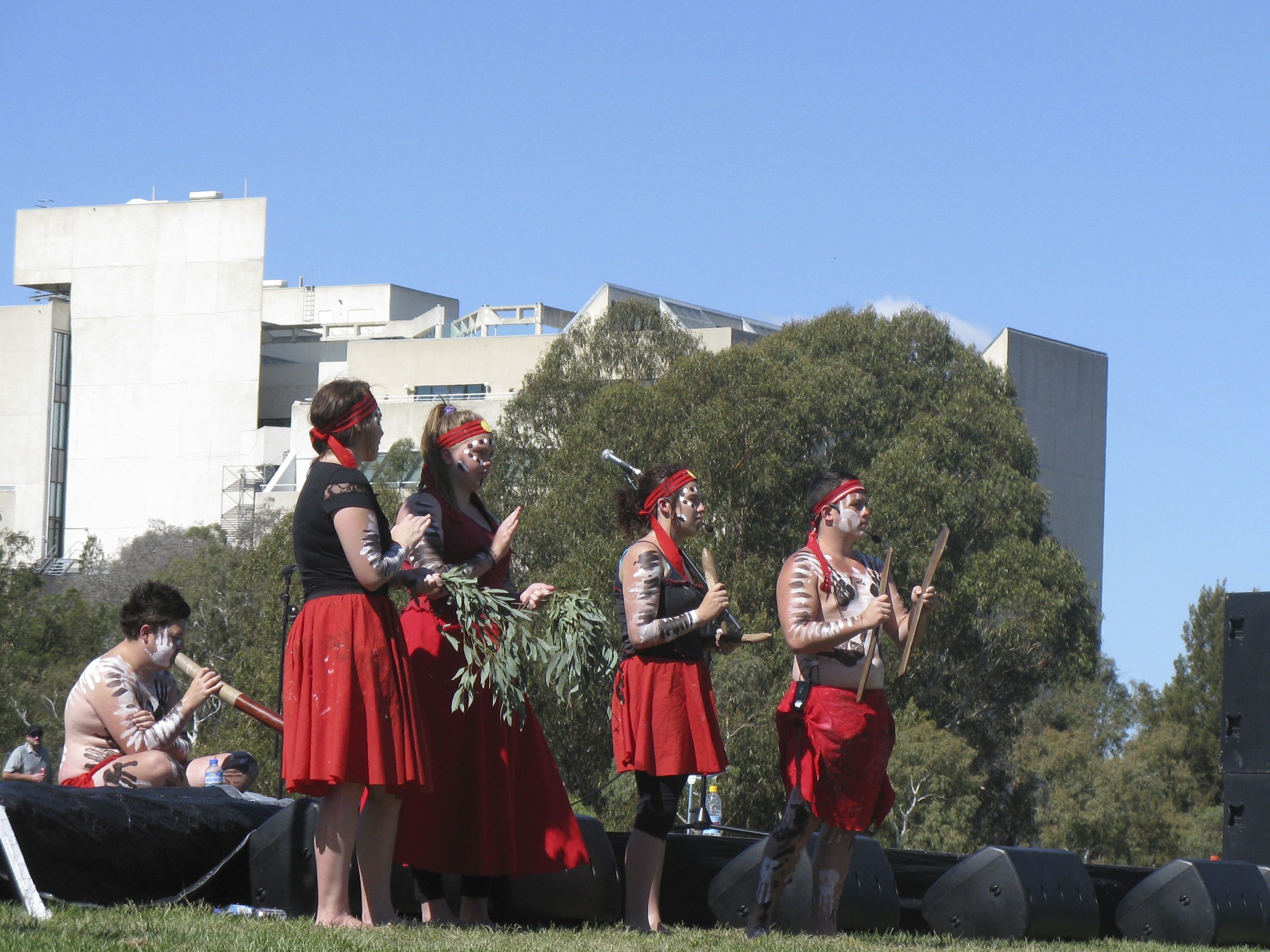
Wiradjuri Echoes

Wiradjuri Echoes, at “The Very Big Day Out”, 11 March 2013

Martiniello is of Arrente, Chinese and Anglo-Celtic descent.

Jeanine Leane‘s Purple threads also has an activist element, albeit couched in stories which are warm and funny as well as sometimes dark. They are set in a world where, she says, “black was not the ideal colour”. (By the way, when I reviewed this work I wasn’t sure what to call it but I have since seen it described as a “story cycle”. That sounds good to me!). Leane, a Wiradjuri woman, has also written and published poetry.

There are, I’m sure, other indigenous writers associated with Canberra, but these are the three best known to me. Identifying writers as belonging to a group – indigenous, migrant, women, gay, and so on – is an uncomfortable thing. It would be good to simply see writers as writers, people as people, but when you are a minority, when recognition doesn’t come easily to your “group”, there is value I believe in overcoming my discomfort … to help bring other ways of being and seeing to the attention of us in the majority culture.

As I was researching this post I came across a comment made by Cara Shipp, a local teacher of secondary English, at the Dare to Lead Conference: Leading indigenous perspectives in the national curriculum (Sydney, November 2010):

I think there is a danger in concentrating too much on the traditional cultural stuff. In terms of the way it is delivered, that can play into the stereotype that Aboriginal culture is dead and past. The only texts suggested for teaching in the draft National Curriculum are Dreamtime stories and I am not sure this is a good thing.

Really? Only Dreamtime stories in 2010? She has a point. I sure hope the final National Curriculum includes some of the great indigenous writing we know is out there.

Anita Heiss, Paris dreaming (Review)

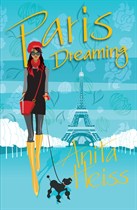
Anita Heiss Paris Dreaming

Paris Dreaming (used by permission of The Random House Group Ltd)

Late last year I wrote a post about the inaugural Canberra Readers’ Festival. One of the speakers was indigenous Australian author, academic and activist, Anita Heiss. I wrote then that I bought one of her books. It was her fourth (I think) chick lit novel, Paris dreaming. This might surprise regular readers here, as chick lit is not really my sort of thing, however …

There are reasons why I was happy to read this book. First was that my reading group chose it as part of our focus on books featuring Canberra for our city’s centenary year. Yes, I know, it’s called Paris dreaming, but the heroine starts in Canberra and Canberra is mentioned (not always positively I must say) throughout the book. The other reason is the more significant one, though, and that is Heiss’s reason for writing the book. I said in the first paragraph that she is an activist and her chick lit books, surprising though it may sound, are part of her activism. In fact, I think pretty much everything Heiss does has an activist element. In her address at the Canberra Readers’ Festival she described herself, an educated indigenous Australian, as in the top 1% of the bottom 2.5% of Australia. She feels, she said, a responsibility to put her people on the “Australian identity radar”.

Does this book do it, and if so how? Well, one of her points is that 30% or more of indigenous Australians are urban and this book, as its genre suggests, is about young urban indigenous women. Anita Heiss manages I think (though I’m not the target demographic so can’t be sure) to present characters that both young indigenous and non-indigenous women can relate to. Our heroine Libby and her friends are upwardly mobile young professionals. They care about their work; they love fashion, drink and food (this is chick lit remember!); and they wonder how to marry (ha!) their career goals and romance.

Indigenous design vase, on hall table, Governm...

Indigenous art vase, Government House, Canberra

So what’s the plot (besides the obvious chick lit formula which this book certainly follows)? At the start of the novel  30-year-old Libby, manager of the education program at the National Aboriginal Gallery, is on a man-fast. She’s been bitten one too many times and has sworn off men, much to the dismay of her tiddas (her “sisters”). She is, though, keen to develop her career and wants a new challenge – all part of the chick lit formula – and so pitches a proposal to her boss that she mount an exhibition of indigenous Australian art at the Musee du Quai Branly in Paris. Of course, her boss approves and off she goes to Paris where, following the formula, she falls for hunky, sexy Mr Wrong while Mr Right watches on, spurned (and spurned and spurned). But, of course, I don’t need to tell you how it comes out in the end do I? This is not subversive chick lit because that would not serve Heiss’s purpose …

Did I enjoy it? Yes, but not so much as a piece of literature because my reading interests lie elsewhere, but as a work written by a savvy writer with a political purpose. This purpose is not simply to show that young, urban, professional indigenous Australians exist but, as she also said in her address, to create the sort of world she’d like to live in, a world where indigenous Australians are an accepted and respected part of Australian society, not problems and not invisible. She is therefore unashamed about promoting indigenous Australian creators. She names many of them – artists, writers, filmmakers – and discusses some of their work, educating her readers as she goes. Most of the people, works and places she mentions are real but there’s an aspirational element too. The National Aboriginal Gallery does not exist but she presents it as a significant player in the Canberra cultural institution scene. Good for her!

I’ll probably not read another of Heiss’s choc lit (as she, tongue in cheek, calls it) books, but I’m glad to have read this one – and I’ll certainly look out for works by her in other genres (including her memoir Am I black enough for you?). Heiss is a woman to watch.

Anita Heiss
Paris dreaming
Sydney: Bantam, 2011
313pp.
ISBN: 9781741668933

Monday musings on Australian literature: Indigenous Australian literacy

I feel a little uncomfortable being a white person writing on indigenous issues. It’s difficult in situations of such immense power imbalance as currently exists between indigenous and non-indigenous Australians not to come across as patronising or a self-congratulatory do-gooder. However, I’m also aware that consciousness needs to be raised and good programs promoted, so here I am. I just hope I don’t offend those who really know what they are talking about.

I’ve been aware of a number of initiatives for some time now – such as the Indigenous Literacy Foundation – but this post was inspired by a small article I saw in my city’s newspaper about an initiative called the Indigenous Reading Project. So, I thought it might be time to talk about some of the things that have been happening in recent times. Indigenous literacy rates in Australia are at scandalous levels, which I find incredibly embarrassing for a so-called first-world nation. The situation is particularly bad in remote areas. According to a National Indigenous Literacy Day press release, “only one in five children living in a remote Indigenous community can read or write to the accepted minimum level”. One in five and only to the minimum level! This really isn’t acceptable.

Here are some activities/organisations that I’m aware of, but there are more, many at local community levels:

  • Indigenous Literacy Foundation: A not-for-profit charity established, I believe, with the support of the Australian Book Industry and other private sponsors. It doesn’t receive government funding. Its aim is “to make a positive difference in the lives of Australian Indigenous children by focusing on ways to improve their literacy levels”. It is a broad ranging organisation that sponsors or supports a wide variety of events and activities. According to its website, it raised $600,000 in 2012, and over the course of its existence has supplied some 85,000 books to over 230 remote communities.
  • Indigenous Reading Project: The project that finally inspired me to write about this issue. The article I read – here – describes a project developed by a Canberra-based public servant. It aims to “improve indigenous reading standards by giving students a Kindle in an effort to boost their interest in reading”. The project, very new still, has had significant success, in terms of the measures they’ve devised. It is geared to 10-15 year olds who are independent readers but “at or below national benchmarks in literacy”.
  • Australian Literacy and Numeracy Foundation: Describes itself as “the first independent charity in Australia dedicated to raising national language, literacy and numeracy standards, especially in remote and marginalised communities.” Its tagline is, simply, “being able to read and write is a basic human right”. It targets literacy and numeracy throughout the Australian population, but indigenous people clearly form a major part of its constituency. It supports a variety of literacy projects at the individual, family and community level.
  • National Indigenous Literacy Day: Organised by the Indigenous Literacy Foundation, and now 6 years old, the Day has two main aims: to encourage Aboriginal and Torres Strait Islander children to read; and to raise money to buy books for children living in remote Australia. A wide range of organisations are gradually getting behind this initiative including literary organisations like the Wheeler Centre, public libraries, schools, broadcasters like the ABC. I hope it becomes a universally recognised event on the Australian literary calendar.

There are also indigenous writers who are working hard to support literacy programs. Two whom I’ve heard speak (live) are Anita Heiss and Boori Monty Pryor. They are (of course!) both passionate about their cause, and are effective (and entertaining) public speakers.

Anita Heiss is an Indigenous Literary Foundation ambassador. She is actively involved in all sorts of literacy initiatives, from grass roots activities like writing books collaboratively with school children to lobbying and working at organisational levels. Boori Monty Pryor is one of Australia’s first two inaugural Children’s Laureates. He has made sharing and promoting indigenous culture his life’s work, with his main focus being, as I understand him, to encourage cultural pride and literacy skills in indigenous Australians and awareness of and respect for indigenous culture in non-indigenous Australians.

I’ll close with a statement by Heiss, taken from the ILF website:

Literacy is essential to Aboriginal people’s self-determination. If we cannot read we cannot make the decisions that inevitably impact on our lives …

Reading, as we all know, is that important!

If you believe in the cause of indigenous literacy, and have some money to spare, please click on the organisational links above and consider donating.

Oh, and if you know of successful literacy organisations, programs and/or campaigns, I’d love to hear about them.

Kate Grenville, The lieutenant (Review)

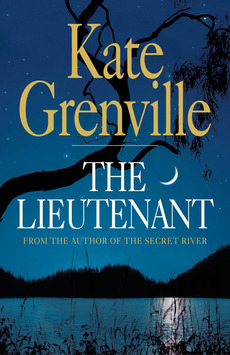
Kate Grenville, The lieutenant book cover

Bookcover (Courtesy: Text Publishing)

I first came across William Dawes, the inspiration for Kate Grenville’s The lieutenant, in Inga Clendinnen’s award-winning history, Dancing with strangers (2003). But this is not the only book that Grenville’s novel brought to mind, as it also reminded me of Kim Scott’s That deadman dance. (Intriguing that both these books use a dance motif, but it’s an historically valid one).

However, before I talk more about these connections and their relevance, I should briefly describe the plot. The novel is set during the first years of the white settlement of Australia. (The very fact that I write the “white” settlement says something about how far we have come in the last two centuries, though we still have some way to go). Daniel Rooke, the protagonist, is a young astronomer. He has been chosen for the First Fleet on the recommendation of the Astronomer Royal who believes that a significant comet will appear in the southern hemisphere in late 1788-early 1789. With this role in mind, Rooke manages to largely separate himself from the day-to-day hurly burly of the first year or two of settlement by creating an observatory, of sorts, for himself, on a hill (now called Dawes Point) overlooking Sydney Cove. Here, in his isolation, he is visited by a group of indigenous people, mostly women and children, and develops a particular relationship with the young 12-13 year old girl, Tagaran. They learn each other’s language, which Rooke chronicles in his journals. All this generally reflects the story of William Dawes whose journals Grenville (and Clendinnen) read, but, as Grenville writes in her author’s note:

Although I made use of historical sources, I departed from them in various ways. This is a novel; it should not be mistaken for history.

Meanwhile, back in 2003, Clendinnen wrote of Dawes, bemoaning his earlier-than-wished-for departure from the colony:

His departure cost us access to the local language as it was spoken at the time of contact. It possibly also cost us a brilliant ethnography, although his tender conscience  might not have allowed him to open the people to easier communication, and to more disruptive exploitation.

Grenville does a good job of imagining the Dawes described by Clendinnen as an “introspective, scholarly type” in her characterisation of Daniel Rooke. She introduces him as a socially awkward but sensitive and thoughtful young man who joined the military not for love of war but because it provided the best chance for a poor young man to make a life for himself. From this supposition she develops a credible character whose final actions in the book pretty closely mirror what we know of Dawes.

I will leave Rooke here for a moment, though, to talk a little more about the conjunction between the three books I mentioned in my introductory paragraph. The significant point they all make is what Clendinnen calls “acts of kindness” by the indigenous Australians in the early days of settlement (in the east, in the case of Grenville and Clendinnen, and the west in the case of Scott). All three writers describe a willingness to be generous that was not recognised or accepted by the colonial invaders. Now, I know that here I am speaking of history and fiction in the one breath and I know that, as Grenville wrote, novels should not be mistaken for history. However, modern readers can, I think, glean the truths, regardless of form or genre, if the writers provide the appopriate signposts.

Take The lieutenant. In it, Grenville is still smarting I think from the criticism she received from historians regarding her claims about the historical value of The secret river. The book contains many rather sly allusions to facts, reality and truths. I particularly liked Rooke’s contemplation about the value of his journals in which, as well as documenting the language he was learning, he described his interactions with indigenous Australians, telling stories that actually happened but whose meaning, he discovered, could be distorted. He considers omitting all but the dry documenting of language, but then realises:

Making an expurgated version of the notebooks would kill them. Like a stuffed parrot, they would be real, but not true.

With a little sleight of hand, Grenville uses a fictional character and his fictional journal to talk about the use of historical sources and the telling of stories from them. Do you simply present the “facts” or do you tell a story –  either factual as in history or fictional as in novels – from those facts in which you aim to draw out the truths as best you see them. Am I drawing too long a bow? I don’t think I am.

And so, as you can probably tell, I enjoyed the novel. It suffers from a little earnestness in tone but that doesn’t get too much in the way of a good story about how first contact in the first settlement played out. It’s not the only story about first contact but it is a valid one – and it helps us understand how an all too human inability to walk in the shoes of the other resulted in a catastrophe of major proportions that we are still working through today.

Kate Grenville
The lieutenant
Melbourne: Text Publishing, 2008
307pp.
ISBN: 9781921656767

(Review copy supplied by Text Publishing. An unsolicited review copy received in 2010 so I’m afraid I’ve taken my time to get to it.)

Monday musings on Australian literature: Guest post from Marilyn of Me, You and Books

I first “met” Marilyn earlier this year when she decided to take part in the Australian Women Writers Challenge 2012. There aren’t many non-Australians who have signed up for this challenge so Texas-resident Marilyn stood out. She is a retired professor of a small liberal arts school in the USA, where she taught women’s history, black history, US social history, and women’s studies. We started “talking” about the similarities and differences in our respective settler nations, and discovered that we share some interests in the intersection between literature and history. She seemed a perfect person to ask to do a Guest Post for Monday Musings. Luckily for me she said yes … thanks Marilyn! Here is her post:

Writing about Indigenous Peoples: Grenville and Clendinnen

I never set out to become a critic of Australian writers. When I started blogging last January, I joined the Australian Women Writers challenge because I wanted to read more globally. Then I read Anita Heiss’s guest post on Australian Indigenous Women Writers and started reading books by and about Indigenous women. I was hooked.

In the past, as a white scholar, I have researched and taught about African American, Native American, and Hispanic peoples in US history. In Women’s Studies, I also have explored the differences between the stories that women and men typically tell about women. With an African American colleague I researched and wrote about Black Women’s Clubs in Kansas. In my own mind, I have played with questions of how those from the dominant culture can write with authenticity about those our culture has defined as Other. Reading books by and about Australian Aboriginals put me back into those issues.

Kate Grenville and Inga Clendinnen have both written about the original encounter between British settlers and Australian Aboriginals. Both have strong views about how to approach the subject. In 2006, after the publication of Grenville’s The Secret River and in the context of the Australian “History Wars,” the two publicly debated their different viewpoints. Having recently read several books by each, I see their debate as crystallizing the issues for all of us who seek to read and write those who are different from us in essential ways.

Grenville writes as a novelist and Clendinnen as an historian, making some of the differences between their writing predictable. As an historian, I may be biased in favor of Clendinnen. But their initial perspectives on Indigenous people are even more divergent and more critical. Clendinnen speculates equally about the British and the people they found in Australia. Grenville explicitly immerses herself in the characters based on her ancestors and views the Indigenous people as “too different” to attempt to understand.

As many of you know, Grenville is a superb writer, in part because she literally puts herself into the landscapes and characters of her stories. For her Thornhill books, she sailed along the rough Australian coast and stepped into the wilderness just off the path to try and discover how her ancestors would have experienced those places. And she is able to convey what she has experienced to her readers. In part, her method works because people, past and present, share basic human thoughts and feelings. Clendinnen points out, however, that the British whose experiences Grenville seeks to know and describe are really not like those of us who read her novels today. Grenville is able to make people from the past seem real, but she can not know them more accurately than historians, as she may have claimed to do. She later retracted comments which implied that fiction was superior in telling what really happened. It may indeed be better at conveying the feelings, but it cannot prove their reality.

Clendinnen is very aware of the rules that historians agree to follow in their writing. She sometimes chaffs at those rules, describing herself as Gulliver held down by all the little ropes of the Lilliputians. Historians are limited by the “evidence.” They don’t write oral dialogue into their books, and they state the sources of their information, for example. In the end, Clendinnen accepts her identity as an historian. But her discipline is changing as historians, like others, face the implications of shifting understandings of “memory” and “truth.” With some assistance from anthropology, Clendinnen seeks to squeeze out clues to the larger cultural significance of human actions, and she is more willing to speculate than historians have traditionally been willing to do. Looking very carefully at the accounts written by British officials about their first contact with the Australian Aboriginals, she analyzes both groups and the values held by each, revealing both the cultural misunderstandings and the confusion on both sides. She points out how initially both groups were hopeful, even willing to “dance with the strangers.” Gradually, however, each side misread the other and tension between them grew. The British could not conceive of the rituals the Australians were enacting, and the Australians could not grasp why the British lashed and hung members of their own community.

What is unusual here, and in sharp contrast to Grenville’s first and third Thornhill novels, is that Clendinnen explicitly gives the Australian Aboriginals and the British equal treatment. Deeply aware that societies define “truth” differently, she sees both groups as equally human. She explicitly rejects any assumptions that the British accounts are objective rather than filled with their own value judgments. In contrast, Grenville stops at the surface of the Indigenous people, portraying them as if they were objects, not as she treats her fully developed Anglo characters. In doing so, she does recreate her own ancestors’ probable perception of them. However, this approach encourages her readers to go on thinking of Aboriginals as silent and thus less than human.

In The Lieutenant, the second of the Thornhill books, Grenville is able to write with an authenticity and feeling about the Indigenous people not present in the other books. Grenville does a fine job of using history as a starting point for this novel. She uses some of the same source material that Clendinnen used in her historical work, Dancing with Strangers, but she goes in a difference direction. First, she creates the character, Daniel Rooke, the fictional version of William Dawes, who kept the notebooks which Grenville used in researching the novel. She envisions him as a boy and young man with a prodigious mathematical ability but no social skills. When Rooke comes to Australia as the astronomer for the First Fleet, one of task he sets himself is that of learning the language of the people already living there. He realizes that learning individual words, as others are doing, is not enough. He wants to grasp the structure and feel of the language. A bright, young Indigenous girl agrees to help him learn in exchange for his teaching her English. Grenville says she is ten or twelve years old, the age that Rooke remembers his dearly loved sister as being. A delightful exchange develops between the two, not romance but the shared excitement of discovery and learning which Grenville describes wonderfully. In the process, Rooke becomes sharply aware of the native peoples’ humanity and, with joy and pain, of his own. As events unfold, he is forced to realize that these human bonds conflict with his duties as a military officer.

Despite their previous disagreements, Grenville follows Clendinnen’s approach to conceptualizing Indigenous people in The Lieutenant. Her major character is British and his changing thoughts and feelings are the focus of the book. When he gets to Australia and begins to work with the people there to learn their language, however, he is increasingly aware of them as real people, not as the silent shadow figures that appear in her other books. Native and British are equals; in fact he realizes that at times the girl is quicker than he is to figure things out. Perhaps Grenville is capable of doing this in this particular book because she stayed so closely to the actual words written in Lawson’s notebooks. She notes, in something approaching a footnote, that the conversations between Rooke and he young girl were not imagined but taken directly from the notebook. She only creates the feelings and thoughts that might have accompanied those words. Clendinnen and any other historians would be impressed. As I read, I didn’t care whether or not Grenville’s descriptions had actually happened because she stayed so close to what we can know in her imagining.

Grenville shows us in The Lieutenant that an author need not be Indigenous to write authentically about them. Using the notebooks left by William Dawes seems to have helped her achieve this. Sadly, she was not able to do the same thing in her next novel where the documents she used were written by those who did not honor and listen to those unlike themselves. Perhaps listening is the key; listening to documents, listening to voices that are unfamiliar. It is hard work, however, for an author to understand and write from the perspective of the Other. But it can be done, as Grenville shows us in The Lieutenant.

I agree that is easy to expect too much of novelists who write historical fiction. But I believe that the most basic requirement of the genre is that authors not treat any group of characters in their books as empty stereotypes. For years male authors treated women in this way until, finally, women began to introduce women characters that were as fully human as their male ones. Now we seeing fuller and more authentic women in men’s writings as well as women’s. We need to make the same change in how we write about other groups which have been subordinated in the past. That is what it means to move beyond colonization and assumptions of white superiority.

Relevant writings. Links to my reviews and online articles.

Grenville, Kate. The Secret River (2006), The Lieutenant (2008), Sarah Thornhill (2012) and “Unsettling the Settlers.” I tried to obtain her Searching for the Secret River, but no libraries in the US have a copy to loan.

Clendinnen, Inga. Tiger’s Eye (2001), Dancing with Strangers (2005), and her online essay, “The History Question: Who Owns the Past” (2006).

And now Marilyn and I would love to hear your thoughts on the books and/or issues she raises here.
Canberra Readers’ Festival 2012: For the love of reading

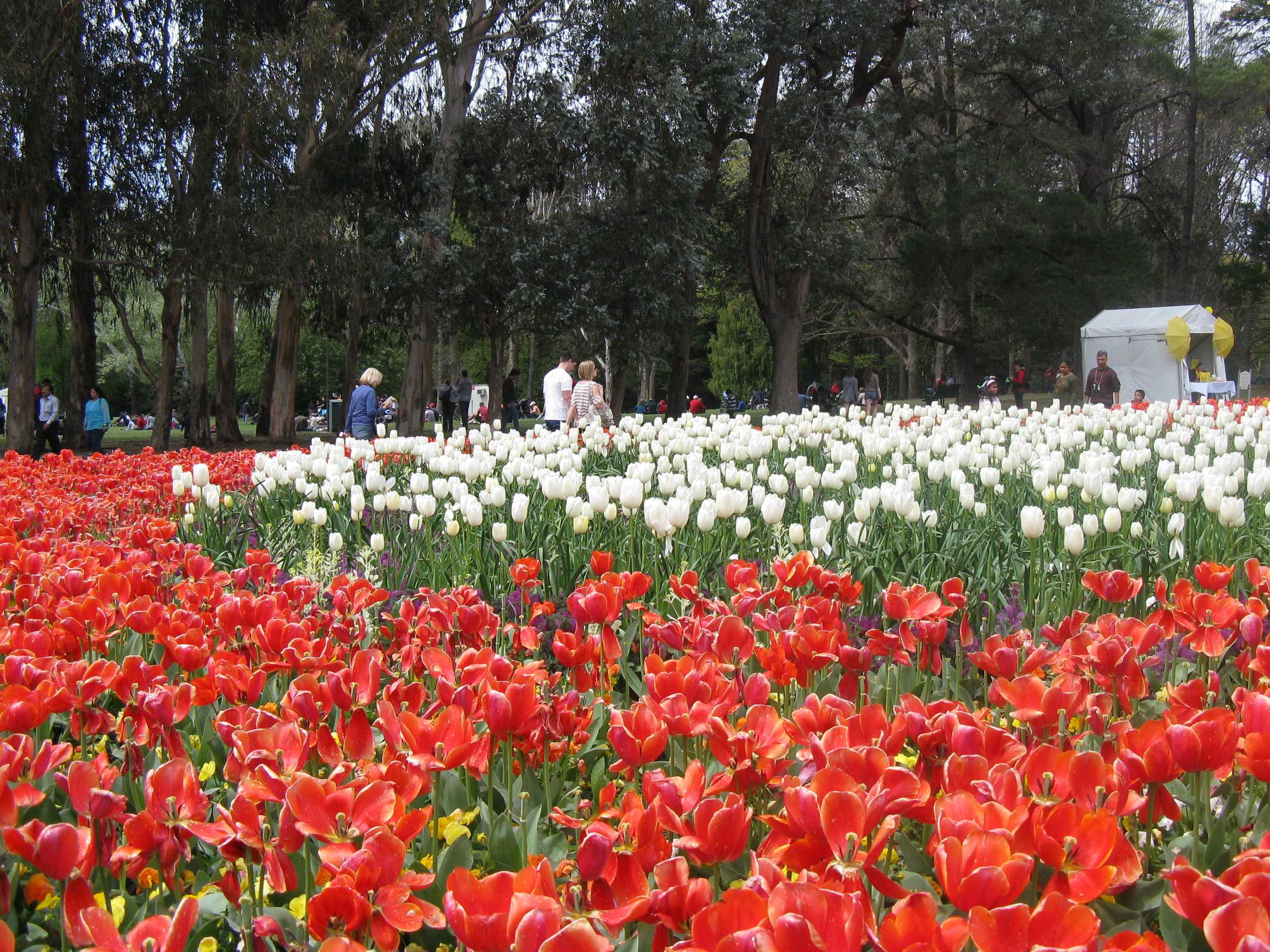
Floriade 2011

Small corner of Floriade 2011: tulips among the gum trees

You could all be looking at tulips …

said Kate Grenville, the first speaker at today’s Canberra Readers’ Festival. She was referring to Floriade, Canberra‘s popular, crowd-drawing annual spring festival, and the fact that today was a glorious day. Just right, in fact, for tiptoeing through the festival’s stunning tulip beds. But instead, we keen readers were in the Playhouse listening to our favourite authors talk about writing and  reading. After all, like Scarlett O’Hara, we all knew that “tomorrow is another day”!

Session 1: Kate Grenville: “Family Stories”

After a generous welcome to country by the local representative of Australia’s original story-tellers, Ngunnawal elder Aunty Agnes Shea, Kate Grenville took the floor – and presented a passionate argument for the importance of capturing and keeping stories. She blessed her mother for insisting on repeating the family stories that eventually inspired her to research and write The secret river – and thence The lieutenant and Sarah Thornhill. She read excerpts from stories written by the 97-year-old John Mackie, and argued that “you can’t make up” the experiences of people from the past, that only by reading what they felt and experienced can you manage to turn them into convincing fiction. Sure, you can do research, she said, but you don’t know what to research if you don’t have the stories to guide you. She wouldn’t have known, for example, to research “a scuffler” if Mackie hadn’t written about one.

Grenville concluded by quoting Australian poet Dame Mary Gilmore who argued for preserving the things of the past. Gilmore wanted to write about people, not events; she wanted to show “not the miles walked but the feet that walked them”.

Session 2a: Anita Heiss: Writing Aboriginal Australia into the literary landscape

What an inspiring and entertaining speaker. Heiss commenced by describing what inspired her to write: she was on an international plane flight and overhead a passenger, whose neighbour had said he’d met “a fourth generation Australian”, responding with “you can’t get any more Australian than that!” This interchange showed Heiss that Aboriginal Australians did not appear on “Australia’s identity radar” and she set about correcting that gap in our awareness. Being tertiary educated, Heiss says she’s in the top 1% of the bottom 2.5% of Australians and consequently believes she has a responsibility to “voice our truths”, to show the commonalities as well as the differences in the lives of indigenous and non-indigenous Australians. She clearly takes this responsibility seriously and has published a significant body of work, encompassing children’s and adult fiction and non-fiction.

Heiss was very clear about wanting to provide a resource for people to understand indigenous experience and identity in Australia. What’s good about fiction she said, is “you can create the world you want to live in”. Having not yet read Heiss, I bought one of her books!

Session 2b: Melina Marchetta: The role of travel in establishing setting

Marchetta’s talk was a more practical one about how she needs to visualise a place before she can describe it. I found this intriguing, particularly as she was talking about her Lumatere fantasy series. She needs to travel to see real places that she’ll describe in fantasy? You can tell I’m not a fantasy reader! It all made sense though when she showed photographs from her travels in France, Turkey, and so on, and read excerpts from her books to show how she used her knowledge of places like the rock villages in France to create her fantasy mediaeval world. She, a little sheepishly, read one excerpt which contained quite a bit of geological data, telling us that the general rule is that your reader should not see your research, but in this case she felt it was justified.

Session 3a: Hazel Edwards: Non-boring anecdultery

Self-described author-preneur (and hippopotamus lady*), Hazel Edwards took us on a lively ride through her writing life, which spans multiple forms and approaches from children’s picture-books to adult non-fiction, from writing on her own to collaborative writing. She loosely structured her talk using the letters from ANECDULTERY – as in A for Anecdote, E for e-Books, N for Non-boring, L for Literary Terrorism, and so on, ending in Y for Why! Her talk was full of the wisdom of an experienced writer, delivered with warmth, confidence and humour. She had some great turns of phrase. For example, she told us that her initial reaction to one research subject was that he’d suffered “a charisma bypass” but she grew to love him. She defined history as “high gossip not boring facts”. Edwards believes research is critical, stating that if “you don’t get something right, your reader is no longer going to trust you”.

She said her most significant book is the coming-of-age novel, f2m: the boy within, about a young woman who transitions to being a man. She co-wrote this, using email and skype, with the New Zealand-based ftm writer, Ryan Kennedy.

Session 3b: Kel Robertson: In defence of (trying desperately to be) popular fiction

Kel Robertson? Who is Kel Robertson? Well, I’m embarrassed to say that he’s a local writer who shared the 2009 Ned Kelly Award for Best (Crime) Fiction with Peter Corris for his latest novel, Smoke and mirrors. This same book also won the ACT section of the National Year of Reading competition which is why, he said, it was he addressing us and not one of Canberra’s other writers.

Robertson was in turn entertaining, realistic and provocative about the role of so-called popular, or accessible, fiction – what he calls “entertainments” – in the reading firmament. He told us that it is the popular writers – the Matthew Reillys, for example – who make it possible for publishers to take a risk on new writers, who pay the bills of literary fiction. Having made this point, he then went on to argue that a good reading diet needs its fast food as well as muesli in order to “feed the intellect and satisfy the hunger for diversion”. Many readers, he believes, move to and fro between simple and complex reads. He said that when he is feeling down he grabs “something that is accessible to nourish my psyche” and that he’d like to see a correlation done between “light recreational reading” and “the happiness index”. I’d like to think he has a point … wouldn’t it be good if books could take the place of prozac! I bought Smoke and mirrors for Mr Gums and may, you never know, dip into it myself.

Section 4: Frank Moorhouse: Memoir Writing and Ethics

Frank Moorhouse** is one of the grand old men of Australian literature, best known for his Edith trilogy. The third in this series, Cold light, recently won the Queensland Literary Award for fiction, which he described as “now probably the most noble prize to win because it’s the citizens’ prize, not the Premier’s prize”. Moorhouse didn’t fully speak to the announced topic of his talk – Memoir Writing – but ranged over a variety of issues to do with contemporary reading and culture. He argued that diaries, books on how to garden, weave and so on, make important contributions to culture, to documenting how we live and to shaping an Australian aesthetic. Some of these books, he argued, are written with flair and can survive into the future just as have, say, Samuel PepysDiary and Izaak Walton’s The compleat angler (1653). He spoke of the relatively recent rise of literary (readers’) festivals and author events, suggesting that they demonstrate a recognition of the importance of the arts in contemporary Australia. He teased out some of the implications of the e-revolution in books, saying, perhaps a little tongue-in-cheek, that e-books make lending books a little harder and “that’s good for writers”.

Moorhouse is not, I’m pleased to say, a grumpy old man. He sees the internet as a positive thing which encourages writing.  He is a judge of a major short story competition in Australia and said that the number of entries is increasing as is the quality of the writing. Wow! He concluded with Samuel Johnson’s statement that writing and reading help us endure life***.

While I’d like to think they help us do more than “endure”, this seemed a good note on which the Festival could end, and end at this point it did. I do hope this Festival – beautifully emceed by Louise Maher – becomes a permanent part of Canberra’s cultural calendar.

* Edwards wrote the hugely popular children’s picture book, There’s a hippopotamus on our roof eating cake.
** Bryce Courtenay was the originally listed author for Session 4 but clearly withdrew after his announcement that he has been diagnosed with terminal cancer.
*** The actual quote is, I think, “The only end of writing is to enable the readers better to enjoy life, or better to endure it.” That sounds more like it.

Monday musings on Australian literature: Australia’s pioneer novelists

David Unaipon

David Unaipon (1924) (Presumed Public Domain, via Wikipedia)

One of the reasons I started this Monday Musings series was to encourage me to read, think and/or learn about my country’s literature, but in doing so I mostly write about books and authors I know and have read. Occasionally though I explore authors and works that are not so familiar to me. Today’s post is one of these.

A few months ago I wrote posts on two books on Australian literature written by Colin Roderick in the late 1940s. As I researched these posts, I came across a reviewer who wondered how many Australians knew about “the first Australian-made novel”. The unidentified reviewer was writing in The West Australian in 1950. I suspect the same question could be asked now … and so today’s post will name some of our novelistic firsts (as best I’ve been able to identify them) in case there are others like me whose knowledge of our history is a little vague.

  • First Australian-made novel: Quintus Servinton, by convict (forger) Henry Savery (1791-1842). It was published in Hobart in 1830. The West Australian reviewer writes that “apart from being the first novel written, printed and published in Australia, [it] has several other noteworthy features. It was the first novel to give a participator’s impressions of life on a prisoner’s transport”. In fact it is a fictionalisation of Savery’s life.  (An etext is available from the University of Sydney’s SETIS project).
  • First Australian-born novelist: John Lang (1816-64), who was apparently born at Parramatta. He went to Cambridge in 1838 where he become a barrister, and returned to Sydney in 1841, before leaving again a few years later to live in India and England. According to The Oxford companion to Australian literature, “the enigma surrounding the life and personality of John Lang has not, even a century later and in spite of considerable literary research, been completely solved”. It is, however, believed he wrote the fiction work, Legends of Australia, which was anonymously published in 1842. The Oxford companion suggests that authorship of this “would entitle Lang to the distinction of being the first Australian-born novelist”. There is a biography of Lang by Victor Crittenden. Its title says a lot: John Lang: Australia’s larrikin writer: barrister, novelist, journalist and gentleman. I was interested to read that he was also a contributor to Charles Dickens’ periodical Household Words.
  • First Australian-born woman novelist to publish a novel in Australia: Louisa Atkinson (1834-1872), who was the subject of a previous Monday Musings. Her novel Gertrude, the emigrant girl: A tale of colonial life was published in 1857. (An etext is available from the University of Sydney’s SETIS project.) I should say that The Oxford companion (mentioned above) is a little less categorical about her place in Australia’s literary history, stating instead that she is “one of the earliest Australian novelists and the first native-born woman to fictionalise Australian domestic, pastoral and bush life”. Did, I wonder, another Australian-born woman fictionalise something else before Atkinson’s work?
  • First indigenous Australian writer to have a book published in Australia: David Unaipon (1872-1967), who was born at a mission in the Tailem Bend area of the Murray River. (His father was our first Aboriginal preacher.) Unaipon’s best-known work, Native Legends, was published in 1929. He wrote, apparently, in a classical style, much like Milton. I should say that Unaipon was not, technically, a novelist, but his pioneering role in Australian literature warrants his inclusion here, I think, particularly since the David Unaipon Award for Unpublished Indigenous Writers is often awarded to a fiction writer.

I wonder if there are Australian (or other) readers of this blog who have read any of these authors or their works? And if you’re not Australian, what do you know about your country’s pioneer novelists?

Dame Mary Durack, Lament for the drowned country (Review)

Lake Argyle with Crocodile

Freshwater crocodile heading into Lake Argyle

Near the end of her book True north about Mary and Elizabeth Durack, biographer Brenda Niall writes of Mary Durack‘s poem, “Lament for the Drowned Country”, which she says “has been judged her finest poem”.  Of course, with such a statement, I had to read it. I could have Googled* it, but I decided to check my Penguin Book of Australian women poets and, hallelujah, it was there. (Once again this book didn’t let me down!)

“Lament for the drowned country” is a long poem and is presented in the voice of an Aboriginal woman, Maggie, mourning the drowning (for the Ord River Irrigation Scheme) of her “born country”. It’s a poignant poem – for obvious reasons – as it’s about the loss of country (for the indigenous people) and home (for the Duracks, whose Argyle homestead went under the water). But, there’s something else too – an irony, because the idea of damming the Ord River was first proposed by Mary’s brother Kimberley Durack in the 1940s. Mary supported her brother** at the time … but the reality many years later, after her brother’s death, was sad for her.

The interesting thing about the poem is that Durack chose to write it in the voice of an Aboriginal woman. Niall writes of this that:

At a later time, her creation of a first person voice for Maggie Wallaby might have been questioned. In 1972 it was taken as she intended it, as a work of empathy and imaginative identification.

This made me think of Thomas Keneally‘s The chant of Jimmie Blacksmith which was shortlisted for the Booker Prize in 1972. It was written in the voice of the Aboriginal protagonist, but Keneally has since said that he wouldn’t presume to do that now, and would tell the story from a white point of view. This says something, I think, something positive, I hope, about Australia’s cultural development. In the 1970s and before, indigenous voices were hard to find. This is less so now – and will hopefully only get better bringing us more voices, and a greater variety of story representing the diversity of indigenous experience.

Anyhow, back to the poem. According to Niall, the poem was inspired by Mary seeing Maggie “catching fish and unaccountably throwing them back into the [new] lake”. Mary saw this – realistically or romantically, who’s to say? – as signalling hope. She has Maggie saying:

I sit along river coming down from my born country.
That heart place! I got to talk to that water.
I got to tell that fish: ‘You go back – you go back now –
talk strong my country. You tell him that spirit can’t leave ’em.
You tell him – Wait! Hang on! This is not the finish!
…’

Later in the poem, Maggie talks of the land drying, the sun coming once again to warm it, and the animals and birds returning. Maggie also makes a reference to the Durack homestead:

You go back up there, that old station – Argyle station –
(poor fella my old boss, my old missus. Nothing left that
house, where I sweep’m every day!) You look out that house,
you look out
windmill, tank, garden, kitchen, saddle shed.

The remarkable thing about the poem is how well – or so it seems to me – Mary Durack captures the cadence, the intonation even – of Aboriginal speech and story-telling. I shouldn’t be surprised though, because Durack spent much of her childhood playing with Aboriginal children and spent her adult life, when she could, not only arguing for but working with indigenous people in their fight for equal rights. According to Niall, as Mary Durack left the north for the last time, “the Aboriginal women, knowing they would never see her again, began to beat their heads and wail inconsolably”. We all know the psychology of master-servant/white-black relationships is a complex one, but that doesn’t deny the fact that amongst it all there can genuine feelings and mutual respect.

I’ll be writing more on the Duracks, and particularly on Mary whose love for the land of her birth was, like Maggie Wallaby’s, absolute:

she can’t forget ‘im, my country, she all day heart-crying.

Meanwhile I recommend this poem …

Mary Durack
“Lament for the drowned country”
In Susan Hampton and Kate Llewellyn (ed)
The Penguin Book of Australian Women Poets
Ringwood: Penguin, 1986
pp. 65-68.

* I did Google it too, to provide a link for this post, but I only found excerpts rather than the whole poem. Hence no link here. I guess it’s too recent to be in the public domain.

** Kim Durack was an agricultural scientist. He apparently loved the land and was committed to improving it after the damage caused by years of over-grazing.