Delicious descriptions from Down Under: Elizabeth Harrower on Circular Quay

When I reviewed Elizabeth Harrower‘s The watch tower the other day I wanted to fill it up with quotes from the book because her writing is so delicious. And that means, of course, that it is perfect for a Delicious Descriptions post. The one I’ve chosen occurs at the end of Part 2 (of three parts). I like it because it, albeit briefly, describes place – central Sydney in the mid 1950s – as well as one of the characters – Clare. It’s quite a long quote but here goes:

… The well-dressed, prosperous crowds pushed off the ferry, slipped coins into the ancient turnstiles and clanged through, out onto the concourse of the Quay.

Even as early as this, the small shops were busy – the bread kiosks, milk-bars, dry-cleaners and delicatessans. And he was at his usual post. He recognised her as she went towards him. Every week he looked smaller in his loose navy-blue uniform, and frailer and dustier; every week she thought he would be missing.

The morning breeze that lifted her hair and flapped the old man’s uniform was seaweedy and salty. Traffic rumbled. People ran. Clare stood before the old man and let some shillings drop into his box. The small Salvation Army soldier watched her and she watched his lips and weak blue eyes, waiting, determined. (Yet she might be rebuffed.)

‘God bless you,’ he said simply, looking at her like a child.

Oh! — Clare relaxed. ‘Thank you,’ she murmured. She was blessed, who was most in need of blessing. Blessed.

Having received what she had paid for, she moved on.

I love what this says about Clare’s desperation … and how Harrower conveys it through such a normally mundane scene. She shows how a typical, simple transaction becomes something way more while busy, purposeful Sydney life goes on around it, unaware, reflecting the world’s oblivion to what Laura and Clare are submitted to, day in and day out. I also like the sense of the giver being desperate to receive. Finally, it shows how Harrower can build up tension. Who is he? Why is she going towards him?

Delicious descriptions from Down Under: Willa Cather’s landscape

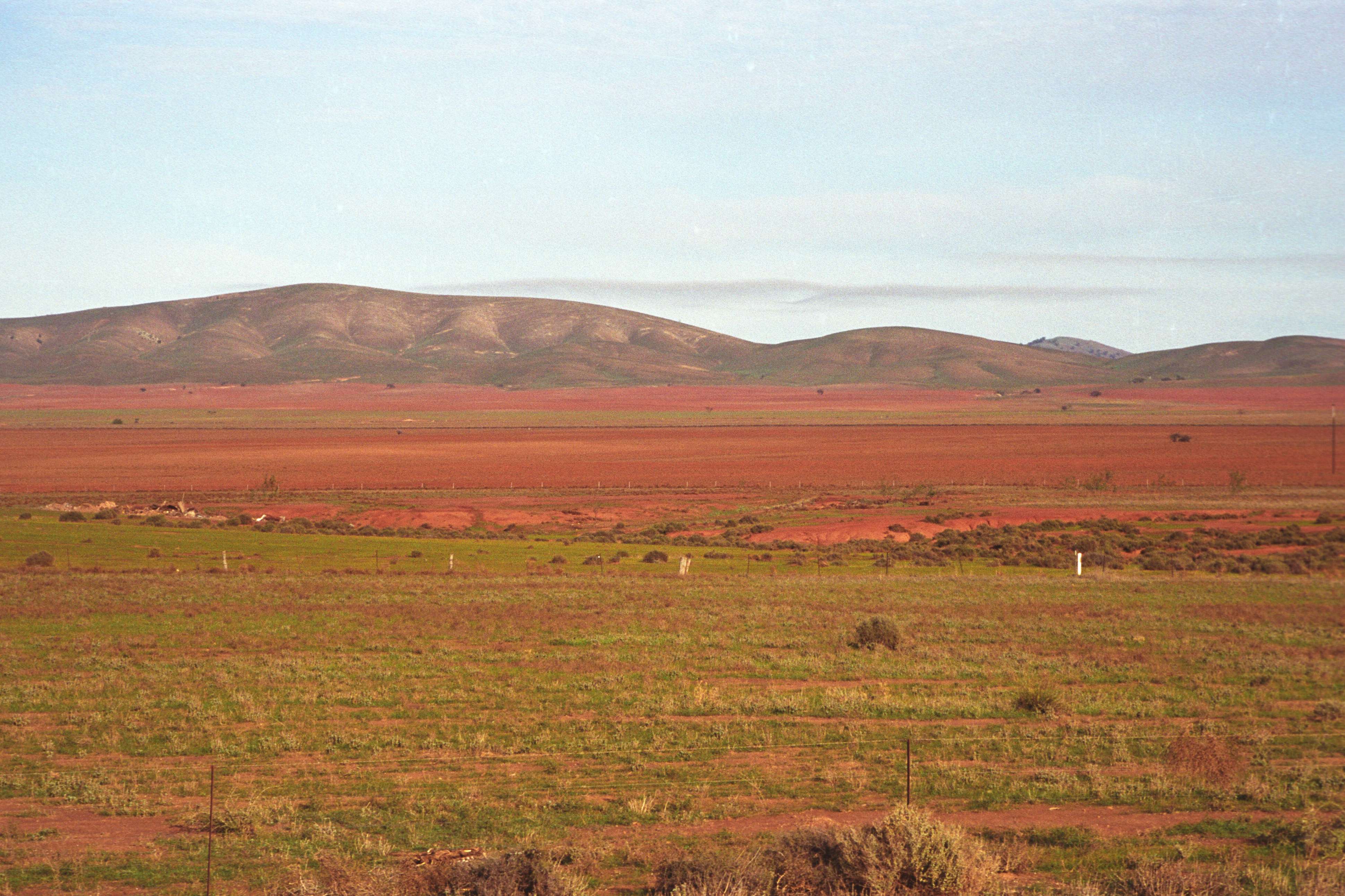
In my review earlier this week I mentioned that Willa Cather‘s description of pioneer life in My Ántonia could apply pretty closely to Australia, but I didn’t say that her description of the landscape could too. Again, the details are different, but the sense is the same. The expansive blue skies and the preponderance of yellows and reds in a vast landscape are all very familiar to Australians. The book is full of gorgeous descriptions featuring the sun and sky, and with the colours of red, rosy, and yellow dominating.

Here is Jim in Book 1 describing a landscape that is still new to him:

I wanted to walk straight on through the red grass and over the edge of the world, which could not be very far away. The light air about me told me that the world ended here: only the ground and sun and sky were left, and if one went a little farther there would be only sun and sky, and one would float off into them, like the tawny hawks which sailed over our heads making slow shadows on the grass.

Outback Australia, near Burra, SA

Outback Australia, near Burra, SA

And here he is in the 5th and final book some 30 or so years later:

Out there I felt at home again. Overhead the sky was that indescribable blue of autumn; bright and shadowless, hard as enamel. To the south I could see the dun-shaded river bluffs that used to look so big to me, and all about stretched drying cornfields, of the pale-gold colour, I remembered so well. Russian thistles were blowing across the uplands and piling against the wire fences like barricades. Along the cattle-paths the plumes of goldenrod were already fading into sun-warmed velvet, grey with gold threads in it.

If I think wheat instead of corn, and spinifex and wattles instead of Russian thistles and goldenrod, I could be reading about Australia. Not that I need to apply my reading to Australia, of course, but in this particular book it struck me again what similarities there are between the two New Worlds of Australia and America. For both our countries, Jim’s description that “there was nothing but land: not a country at all, but the material out of which countries are made” rings true.

Delicious descriptions from Down under: Julian Barnes on ageing and memory

This is the second Delicious Description I have written about ageing. It probably won’t be the last because, being a woman of a certain age, I am starting to connect with authors who explore the impact of ageing. I loved Barnes’ description of failing memory in his The sense of an ending (which I recently reviewed):

When you start forgetting things – I don’t mean Alzheimer’s, just the predictable consequences of ageing – there are different ways to react. You can sit there and try to force your memory into giving up the name of that acquaintance, flower, train station, astronaut … Or you admit failure and take practical steps with reference books and the internet. Or you can just let it go – forget about remembering – and then sometimes you find that the mislaid fact surfaces an hour or a day later, often in those long waking nights that age imposes. Well, we all learn this, those of us who forget things.

They say you should write about things you know about. It sure feels like Julian Barnes knows about this!

Delicious descriptions from Down Under: Chris Flynn (or Billy) on yoga

It’s been a couple of months since my last Delicious descriptions – life has been particularly busy – but I can’t resist stopping for a moment to share this one. It comes during one of my favourite set pieces in Chris Flynn’s A tiger in Eden which I reviewed a couple of days ago. This piece tells of a 10-day Buddhist retreat that the protagonist, Billy, attends. It’s one of those retreats where you remain silent for 10 days, meditate, do yoga, eat vegetarian food, and so on. Since I have taken up yoga (again) over the last few years, his description tickled me:

Golden Bow yoga pose
Golden Bow (Courtesy: OCAL, via clker.com)

Some of the moves were hard even though I was fit as f*ck sure I couldn’t do them, stretching dead far till you thought your tendons would snap I was sweating so I was. I always thought the yoga was a load of aul hippy shite, no one told me it was a workout. After a couple of days I was dead into it though and practising in my cell sure I could near get my legs behind my head flexible as f*ck it turns out, who knew sure I could always find work as a stripper if nothing else worked out.

This little excerpt gives you another look at Billy’s voice and how Flynn has gone about achieving it. I liked the sound of it in my head as I read (notwithstanding the liberal use of expletives!)

Delicious descriptions from Down Under: Jahnavi Barua on reading

In my recent review of Jahnavi Barua’s Rebirth I quoted the following line: “No, I will not buy a book today. I will try and live in my life instead”. I really wanted, though, to quote the entire preceding paragraph, but it didn’t really suit the direction of my review. And so, instead, I’m posting it today.

The protagonist, Kaberi, is in a bookshop (as you will have guessed):

I begin with the As and work my way down the bookshelves. I stop at C; I have not read Disgrace yet and would have liked to have browsed through it but somehow today my heart is not in it. Still, I wander down the aisle looking at the familiar names; I am compelled to stop at K, Kawabata. I caress the spine of the book as if stroking the hand of an old and beloved friend. I cannot forget the girl in his book, The sound of the mountain. Her relationship with her father-in-law haunts me; is it possible that there can be only friendship between a man and a woman unrelated by blood? I had been so deeply unsettled by the book when I first read it; your father had only laughed. He said I had lived so little in the real world that the fictional appeared so significant to me.

I love this paragraph for so many reasons. Let me count the ways! No, let’s not be quite so mechanical but I will say that I like it for personal and structural reasons. Personal because I’ve read and loved the two books she describes, and because I can relate to her need to caress a loved book and her being unsettled by a great book.  And structural because this paragraph contains several clues to character and even plot in the book … but I won’t give those away (beyond of course what you’ve already gleaned from this piece of text itself).

Delicious Descriptions from Down Under: Francesca Rendle-Short on writing

In my recent review of Francesca Rendle-Short’s fiction-cum-memoir, Bite your tongue, I concluded on the suggestion that for Rendle-Short the act of writing, as well as of reading, “changes things”. Today I thought I’d share two excerpts from her novel that confirm this, one from her fictional persona of Glory, and the other from her writing as herself.

First, Glory:

Glory decides writing is a way of thinking: to think, to write, is dangerous. Transgressive. It is no small thing for Glory to tell this story in Glory’s way, to put into words things that until now have been left unspoken, to pin her heart to the page. Writing changes things, changes everything. It’s a risky business. (end Ch. 9)

And then, Francesca:

Looking at photographs is a bit like reading books; they invite acute feeling. You reveal yourself in the most intimate of moments. They elicit desire; illicit desire. Because in my family desire was illicit, like alcohol, like dancing. If you pay enough attention to small things, there is a chance for connection, a chance for transformation and transfiguration to occur. Writing grows skin, grows bones, a new heart. Just watch. D. H. Lawrence knew this. He attests that Lady Chatterley’s lover* was a beautiful book, that it was tender like a naked body. (end Ch. 25)

This is pretty raw stuff … and it tells us a bit about what sort of writer Rendle-Short is, about why she writes, about what literature means to her. It also, by-the-by, gives a good sense of her rhythmic, evocative style. I did like this book.

* Lady Chatterley’s lover was, of course, on her mother’s “burn a book a day” death list.

Delicious descriptions from Down Under: Andrew O’Hagan’s Maf meets some bedbugs

I can’t not share at least one humorous little treasure from Andrew O’Hagan’s The life and opinions of Maf the dog and of his friend Marilyn Monroe, because I think my review focused a little too much on the serious.

Some of the delights of the book, if you suspend your disbelief, can be found in the conversations Maf has with other critters, such as squirrels, spiders, bedbugs, ants, flies, cats, and of course other dogs. There are some gems, with their point usually being how much more together, or knowing, these critters are than the humans around them. Take, for example, the bedbugs Maf meets while Marilyn is in the Columbia-Presbyterian hospital:

There were bedbugs. I saw them and immediately assumed they were little Karamazovs. I don’t know whether it was the general environment, or the condition of the people they’d been close to, but the bedbugs had a perfectly Russian attitude, seeming to doubt the reliability of everything. ‘We admit it is our time,’ said one of the bugs in a mournful way. ‘Russian values, if we may speak of anything so nebulous and bourgeois as values, are understood, in America as elsewhere, to be a central feature in what we might call the great duality and contradiction of the age.’ He meant the Cold War. ‘The Americans envy us. They are fascinated by Russian literature’.

‘And what has that to do with you?’ (Sorry to have been so rational, but on these visits I’d spent a lot of time around very rational young doctors. And the times were paranoid: I thought they must be spies.)

‘We are weaned in hospitals. In flop houses. In asylums. In cheap hotels and in housing projects. Our soul is Russian.’

‘But you are Americans, right?’

‘No,’ said a tiny voice, ‘we are bedbugs’.

That punch-line says it all! There’s more to unpack in this little interlude … some of which makes more sense in the context of the book. Still, there’s enough here to give you a sense of this kinda-out-there book which, as Maf tells us, continues the tradition, established in prose fiction by Cervantes, of animals speaking about humans.

Delicious descriptions from Down Under: Alice Pung and Haruki Murakami

Regular readers here may know that I like Haruki Murakami and so will understand that I was tickled when, out of the blue, Alice Pung alludes to Murakami in her book, Her father’s daughter, that I reviewed earlier this week. It appears in her description of a prostitute who has come into her father’s Retravison store with a pimp. Pung writes:

It was summer and the girl, Diep, wore a long white smocked dress. She looked like a Murakami heroine – there was an anaemic delicacy to her face and a butterfly clip in her hair.

If you’ve read much Murakami, you will immediately have a picture of this girl, and you will think, too, that she may be a little lost, a little, shall we say, not of this world. But, hmm, maybe not. She does speak to Alice before she leaves with her pimp:

‘You have a good smile. You don’t have to sell phones, you know.’

Pung has a lovely sense of humour!

Delicious descriptions from Down Under: Ada Cambridge on the “bare necessities”

In her novel Sisters, Ada Cambridge describes the plight of one sister who is suddenly left penniless (more or less) and has to move out of her home. The scene is set … the character is packing to move, with the house and her life in disarray:

Deb sat amid the ruins of her home. She occupied the lid of a deal-packing case that enclosed a few hundreds of books, and one that was half-filled stood before her, with a scatter of odd volumes on the floor around.

[…]

‘That cottage you talk about,’ he said, ‘will not hold all those.’

‘Oh, books don’t take any space,’ she replied brusquely. ‘They are no more than tapestry or frescoes. I shall have cases made to fit flat to the walls.’

‘That will cost money.’

‘One must have the bare necessities of life …’

You can tell that Deb is going to be one of the more interesting characters in the book, can’t you?

Delicious descriptions from Down Under: Albert Camus on world peace

How’s this for a bit of communication across cultures: an Australian biographer reporting a French writer commenting on the death of an American president. It comes from the book I’ll be reviewing in the next couple of days, Hazel Rowley’s Franklin and Eleanor: An extraordinary marriage. In it Rowley quotes Albert Camus on the death of Franklin Delano Roosevelt in 1945:

‘His face was the very image of happiness,’ Albert Camus wrote in the French Resistance newspaper, Combat. ‘History’s powerful men are not generally men of such good humour … There is not a single free human being who does not regret his loss and who would not have wished his destiny to have continued a little longer. World peace, that boundless good, ought to be planned by men with happy faces rather than by sad-eyed politicians.’

Somehow I didn’t expect something quite so sunny-sounding from Albert Camus, but perhaps I don’t know him as well as I thought I did. We are, I think, more cynical these days about the concept of “world peace” but we can still hope, can’t we? Does anyone know of any happy-faced world leaders out there that we can call on to promote the cause (besides the current Dalai Lama that is)?