How many ways can you ask Google a question?

Just over a year ago I wrote a review of the film (and book) Red Dog. In it I avoided talking about how the film ends, but that hasn’t stopped people asking. My Red Dog post is one of my top five posts and it’s there largely because of the following searches:

  1. does red dog die in the movie : 444 times
  2. red dog movie : 246
  3. does the dog die in red dog : 199
  4. does red dog die : 93
  5. red dog book review : 59
  6. does the dog in red dog die : 56
  7. red dog does the dog die : 54
  8. how did red dog die : 46
  9. does the dog die in red dog movie : 43
  10. red dog book : 32
  11. red dog movie music : 31
  12. how does red dog die : 30
  13. red dog the movie : 29
  14. red dog movie does the dog die : 26
  15. what happens at the end of red dog : 26

… and so on …

It seems that many people, like one of my favourite bloggers Stefanie of So Many Books, like to prepare themselves for sad movies – and so she asked in her comment whether red dog dies. If she hadn’t asked her question, would all of those searches have found me? Does Google look in the comments for search terms as well as the post itself? I’m guessing it must.

Do those of you with blogs have searches that surprise, entertain or even mystify you?

Monday musings on Australian literature: National Bookshop Day (Belated)

Saturday 11 August was National Bookshop Day here down under but I decided to delay writing about it until this week’s Monday Musings as it seems a worthy subject. However, Lisa of ANZLitlovers and Louise of A Strong Belief in Wicker did their posts in a more timely way.

National Bookshop Day is a new concept here. In fact this was its second year, having been inaugurated last year by the Australian Booksellers Association. Its logo is “celebrating bookshops in the community” and its aims are, I think, both celebratory and promotional, regarding bookshops, literature and, more generally, culture. I guess it doesn’t take much thought to work out why they feel the need to have such a day, what with the internet ‘n all?

I like this comment from Bite the Book, the blog of Pages and Pages* bookshop in Mosman, Sydney:

The internet makes it easier for everyone to find what they are looking for but what a boring place the world would be and how uninteresting our lives would be if we only ever found what we were looking for. As much as I enjoy reading the next book from one of my favourite authors there is nothing quite like that feeling of reading a book you found from left field through a recommendation or the serendipity of finding it on a shelf.

I like this because it recognises that there’s no turning back the clock. Technologies change. The three-volume book gave way to the single volume, paperbacks brought book-buying to a new level, and now e-books are on the rise. The point is they are all books and one thing remains the same: People continue to read. A day that celebrates this while also promoting one of the places that we readers love the most can only be a good thing. Browsing an online store, while possible and getting smarter, is nothing like browsing a bookshop surrounded by other booklovers and by books of all shapes, sizes, colours and contents.

I’m embarrassed to say that, unlike Lisa and Louise, I did not get to a bookshop on THE day, but I do go to bookshops regularly. Bookshops have had a tough time in the national capital over that last few years with significant chain stores disappearing view: Collins, Angus and Robertson and Borders. Just two chains survive, Dymocks and QBD. It’s good to see them survive. Chain bookshops** have their place after all, but they are not my bookshops of choice. My favourites tend to be independent stores, particularly:

  • Paperchain – has the best remainder table I know, as well as other great books of course, and many author events
  • Electric Shadows – has a particular focus on film, media and the performing arts as well as a good selection of Aussie lit, and also has author events
  • Smiths Alternative – has books you don’t always find elsewhere including a good selection of translated fiction, and in line with its alternative, socially-conscious vibe, holds a variety of events in fiction, poetry and music
  • National Library of Australia’s Bookshop – is the one I frequent the most. It’s in a beautiful building belonging to our premier literary institution, specialises in Aussie literature,  and offers a generous discount to Friends of the Library. And there’s a gorgeous cafe across the foyer. What’s not to like?

Just for the record, I have recently bought books from a bookshop (the National Library one): Luke DaviesInterferon psalms (book of poetry, for me), Robert Newton’s When we were two (YA novel, for my nephew), and one I won’t name because it is a gift that hasn’t been bestowed yet.

Did you, if you’re Australian, attend a bookshop on National Bookshop Day? I’d love to hear about it. And, if you’re not Australian, is there something similar where you are? Are bookshops in your area thriving?

* On National Bookshop Day, Pages and Pages donated $1 for each book sold to the Indigenous Literary Foundation. Many bookshops held events, offered discounts and prizes. Let’s hope, for all their hard work, they attracted some new customers to their fold.

** My favourite chain in Australia has to be Kinokuniya. Its depth of fiction, from many nations, is simply hard to beat – but we don’t have a store in my city.

Apostrophes amok

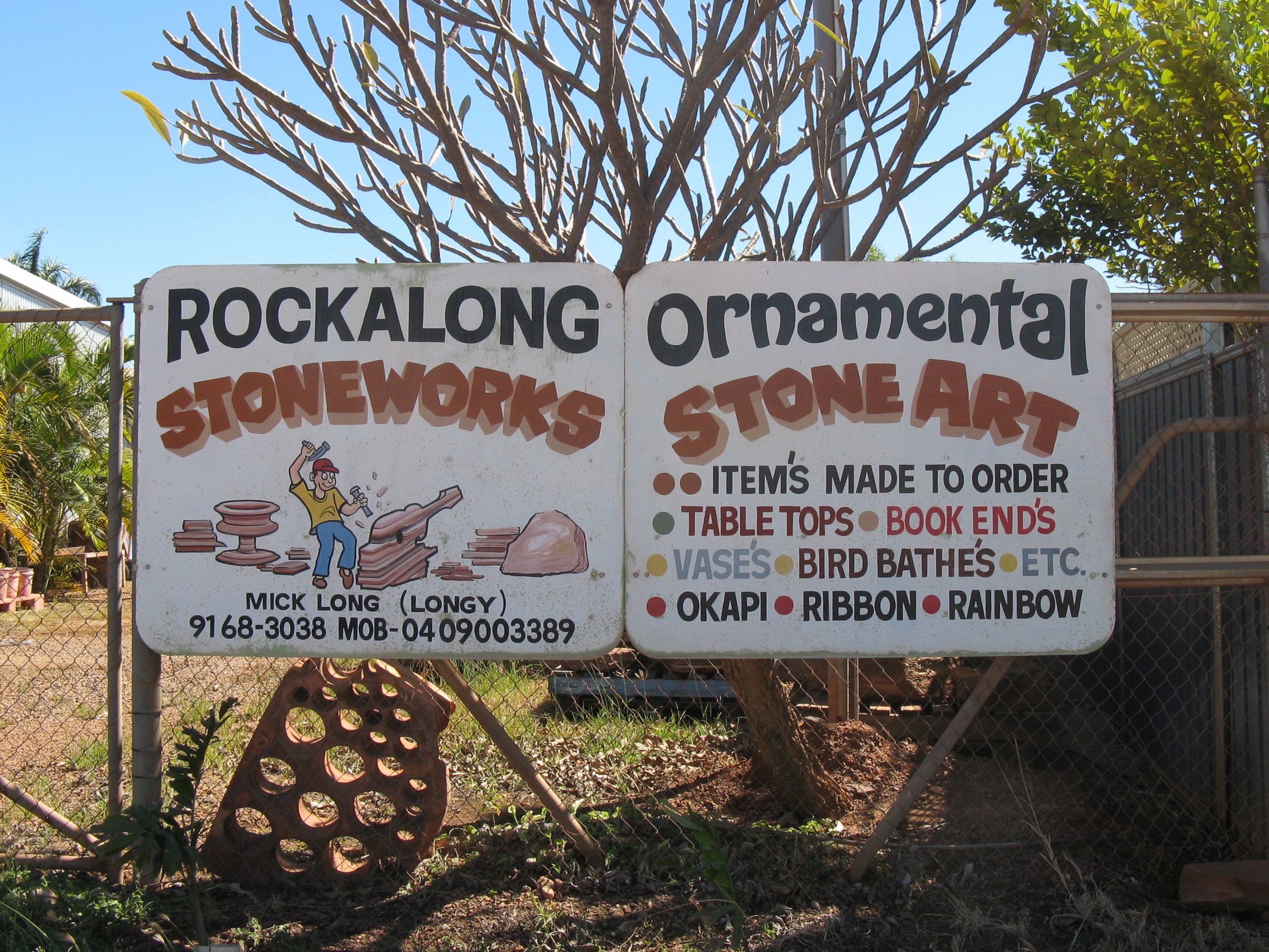
Seen on our recent holiday in Kununurra, in the Kimberleys:

Rocks. Apostrophes. They're all here for the taking.

Don’t you feel sorry for the “table tops”? They look rather lonely in there.

My philosophy regarding apostrophes is a simple one: When in doubt, leave them out. I find the odd missing apostrophe far less distracting than the opposite – but perhaps that’s just me. What say you?

(In lieu of Monday Musings which will return next week.)

Monday musings on Australian literature: The other David Campbell and the sin of misattribution

Much to my chagrin, the “other” poet named David Campbell drew to my attention recently to the fact that I had twice, in my blog, (mis)attributed a poem he’d written to the wrong David Campbell. The poem is “The Last Red Gum” and I first wrote about it in my post on The magnificent River Red Gums and then again, because it seemed relevant, in my post on Richard Allen and Kimbal Baker’s book Australia’s remarkable trees.

The David Campbell to whom I thought I was referring is the one who lived much of his life in my neck of the woods, that is, in the Australian Capital Territory and neighbouring areas of New South Wales. He did write a lot about nature and the landscape. In fact, his Wikipedia article (to which I’ve linked his name at the beginning of this paragraph) includes quotes from two poems about trees – “In summer’s tree” and “Snow gums”. It’s not surprising really that, at first glance, I thought I knew who I was quoting. This David Campbell wrote many volumes of poetry, edited anthologies and won some of our top poetry awards. He died in 1979.

However, the “other” David Campbell is very much alive – and just as well, because he was able to ensure I righted my wrong. He lives in Victoria and is a member of the Federation of Australian Writers. He too has won several poetry awards and has published volumes of poetry. While he also writes in free verse, his first love he says is bush poetry. As a lover of Banjo Paterson, I can relate to that. This Campbell is keen, he writes on his website, “to promote traditional poetry, particularly in terms of the assistance that a mastery of rhythm and rhyme gives to any form of writing”. He argues that this form of poetry “is accessible to all”. Like the first David Campbell, he has also written short stories (and appeared in Black Inc’s Best Australian stories, 2005).

In 2011, Campbell won the Bronze Swagman award for his poem about dementia, called Wasteland. You can read it on the ABC’s Western Queensland website. It’s a simple, accessible and moving poem.

And so, I apologise to this later David Campbell and hope he doesn’t mind if I quote another verse from “The Last Red Gum”, because I do like this poem and its environmental message:

Dead gums in Lake Mulwala

Dead gums in Lake Mulwala, on a late autumn afternoon

At Mulwala and Chowilla there are remnants of our kind
in a place where verdant floodplains used to be.
Now a ghostly red gum graveyard is the only thing you’ll find
and a desert is the only sight you’ll see
(from “The Last Red Gum”)

Oh, and I haven’t even mentioned “another” Australian David Campbell, the singer and son of rocker Jimmy Barnes! It clearly pays to be careful in your research – something I with my librarian-archivist background should have been well aware of!

Have you ever been guilty of misattribution – and how did you handle it?

Vale Jerome

In living there is always
the terror
of being stung

of something
coming for you
on the unavoidable wave

(from “Bluebottles” by Dorothy Porter in her collection The bee hut)

I have not posted since last week’s Monday musings, and there will be no Monday musings this week, but I will resume in a day or so. In the meantime, my heart is just a little too sore for reading and reviewing.

Last week, the 26 year-old son of good friends died, just over three years after being diagnosed with cancer. It goes without saying that he was too young. He had so much to give and so much to live for.

I have bothered and worried about whether to write this post. After all this is not my story – I am just one of the bit-players on the side – but in the end I decided that for we who like to write, writing is cathartic, and so here I am. But I am not going to tell the story. It is for those closer to tell. I simply wish to say that no matter how much you prepare for a death like this, it is still devastating when it comes.

I will leave you with Jerome’s own words written in January this year in his raw, honest, beautiful blog:

What is wrong with this world. How is it that so few spend their lives doing things they love and so many do [what] they hate for something they do not need. I want to shout to the masses but [s]o few would listen. I would not have listened.

This is it. Do it now. You will not be here again.

And with Dorothy Porter, because … well, you’ll see why:

talking
and climbing
with this
glimmering
young man
who was talking to me
about death
how
a good dose of death
if you truly drink it
is a gift

a gift
a fresh cold
slap
a fresh dark
creek
you’ll never sleep-walk
through your life
again

(from “The snow line”, also in The bee hut)

Thank you Jerome for sharing your pain, ideas and hard-earned wisdom so generously and openly over the last year. I am proud to have known you.

Raising my consciousness: Thoughts of a reader on International Women’s Day

Australian Women Writers Challenge 2012 Badge

Australian Women Writers Challenge (Design: Book’dout – Shelleyrae)

I am not, and never have been, scared to use the “F” word – that is, I call myself a Feminist. My philosophy is a simple one: women are not the SAME as men, but women deserve EQUAL rights and respect as men. This is not to say that the interpretation and application of this philosophy is simple but it is to say that all our thinking on how we live, how we (as humans) should be treated and how we should treat others needs to start from this fundamental principle.

Books and reading have of course fed my thinking on this issue … and so today I’m listing a few books that have meant something to me. They are not, all anyhow, the usual suspects, but they are books that have remained in my consciousness years after I read them.

Germaine Greer‘s The female eunuch (1970)

I read this a year or so after it was published. It provided an underpinning to my thoughts from that point on. Greer’s analysis of how women are objectified fundamentally changed how I viewed myself and it informed how I have dressed and presented myself ever since. She politicised my decisionmaking and gave me permission to not spend time and money (that I could better spend elsewhere) on unnecessary grooming and uncomfortable, or demeaning, clothing. She said much more besides about women’s self-actualisation but it all stemmed for me from this basic premise …

Margaret Atwood‘s The handmaid’s tale (1985)*

Most of the books I’m going to list here are non-fiction but we litbloggers know the value of fiction in presenting and analysing human thought and behaviour, in showing us how we are and/or how we could be. Atwood’s The handmaid’s tale depicts with horrific clarity how we could be. It’s a dystopian novel, a cautionary tale; it describes with horrendous, gob-smacking clarity what could happen if we don’t remain vigilant about women’s right to equality. If you haven’t read it and you wonder whether Feminism’s for you, read this book before you make up your mind!

Diane Bell‘s Generations: Grandmothers, mothers and daughters (1987)

I recently read an article written in 1905 about Jane Austen, in which the author, William James Dawson, wrote:

It is often deplored that professional historians, who are capable enough of describing the pageantries of a court, the contests of politicans, the sumptuous lives of the rich, or even the miserable conditions of life among the disinherited and the criminal, appear incapable of producing any accurate picture of the average kind of life lived by those distinguished by neither great  wealth nor great poverty …

Lives, for example, lived by women. Dawson goes on to say that Jane Austen provides “a picture of England itself”. I love his recognition that fiction can provide us with social history … even though the rest of my list is non-fiction.

Anthropologist Diane Bell describes objects in women’s lives and how women pass them down from generation to generation. If I tell you that one of the chapters is titled “Darryl got the farm and mum got the pearls” you’ll get the picture. The book draws from interviews she conducted with several families of women. The women talk about pianos, sewing machines, textile crafts, jewellery, china, books, and so on, describing not only how they are passed down through the female line but also the memories these objects invoke – and what they tell us about women’s lives then and now. It’s a beautiful book, that I’d love to quote from if I had the time. I read it when it came out, and I think of it often.

Katie Holmes’ Spaces in her day: Australian women’s diaries, 1920s-1930s (1995)

Holmes is an historian and this book, like Bell’s, provides an insight into women’s lives – but through their diaries rather than through interviews. The book, also like Bell’s, is organised thematically but instead of by type of object hers is by women’s roles and life stages. The descriptions of women’s work (in the days before labour saving devices) are exhausting!

Start work 8 o’clock finish 11pm, feel awfully fed up, this life is much worse than the farm was even if I didnt have any clothes, here I do not have time to wear them, so it is worse, dont know what to do about it, but I am fed up. (Mabel Lincoln, 21 January 1930)

She also describes the way women were expected to give up their dreams to help others – to take over a family when a sister dies or becomes sick, for example. Unmarried women, in particular, were only “allowed” a life of their own for as long as someone else in the family didn’t need them. Another book I haven’t easily forgotten.

Helen Garner‘s The first stone (1995)

This is, probably, a strange book for me to include, mainly because Garner made me so MAD. Garner is a feminist but her response to the incident at Ormond College did not sit well with many feminists, me included. As I recollect, the incident involved the master of the College, the man in power that is, making untoward (read, unwanted) sexual advances to two students at a College party. When the students complained to the College hierarchy, they did nothing, so the two young women went to the police. Garner argued they should not have done that, that they should have simply, literally or metaphorically, “slapped” the man and got on with their lives, leaving him and his reputation secure. She felt their reaction was not mature and was taking the issue of harassment to unnecessary levels. But, for me, there were two significant issues that made me disagree vehemently with Garner. Firstly, the young women tried to complain within the College system and got nowhere. Had the College taken their complaint seriously, the situation could very well have been handled quietly and with a rationality that could have worked for all parties. But, the College didn’t. And secondly, this was a situation of power. It’s (depending on the situation) one thing to receive an unwanted advance at a party from a peer. Garner’s suggested response could very well be the appropriate one BUT, and I think it’s a big BUT, it’s quite another thing to receive such an advance from someone with real power over you. I’ve listed this book, though, because Garner is a great writer and so very honest about her views and feelings. We need more honesty like this, and more willingness to confront the issues and tease them out … and that, of course, is the other reason I’ve listed it. It got some issues teased out, albeit, for some, in an emotionally charged and hurtful way.

… and that, as they say, is that. I’d love to know what books have contributed to your thinking on women’s rights (or, indeed, on any issue of importance to you).

* Most of the books I’ve listed here are Australian but, given the topic is International Women’s Day and given the significance (to me) of Atwood, I had to include her here.

Delicious Descriptions from Down Under: Francesca Rendle-Short on writing

In my recent review of Francesca Rendle-Short’s fiction-cum-memoir, Bite your tongue, I concluded on the suggestion that for Rendle-Short the act of writing, as well as of reading, “changes things”. Today I thought I’d share two excerpts from her novel that confirm this, one from her fictional persona of Glory, and the other from her writing as herself.

First, Glory:

Glory decides writing is a way of thinking: to think, to write, is dangerous. Transgressive. It is no small thing for Glory to tell this story in Glory’s way, to put into words things that until now have been left unspoken, to pin her heart to the page. Writing changes things, changes everything. It’s a risky business. (end Ch. 9)

And then, Francesca:

Looking at photographs is a bit like reading books; they invite acute feeling. You reveal yourself in the most intimate of moments. They elicit desire; illicit desire. Because in my family desire was illicit, like alcohol, like dancing. If you pay enough attention to small things, there is a chance for connection, a chance for transformation and transfiguration to occur. Writing grows skin, grows bones, a new heart. Just watch. D. H. Lawrence knew this. He attests that Lady Chatterley’s lover* was a beautiful book, that it was tender like a naked body. (end Ch. 25)

This is pretty raw stuff … and it tells us a bit about what sort of writer Rendle-Short is, about why she writes, about what literature means to her. It also, by-the-by, gives a good sense of her rhythmic, evocative style. I did like this book.

* Lady Chatterley’s lover was, of course, on her mother’s “burn a book a day” death list.

Whither literary manuscripts in the digital age?

Have you experienced the thrill of seeing original manuscripts by your favourite author or of a favourite book? I certainly have … the most memorable for me, of course, being some pages from Jane Austen‘s Persuasion. But such personal thrill isn’t the only value to be gained through having access to original manuscripts. Scholars love to analyse the progress of a writer’s work to better understand the work and/or the writer. Where would Charles Dickens or TS Eliot scholars be, for example, without the manuscript of, say, Oliver Twist or The wasteland? Marie-Thérèse Varlamoff and Sara Gould writing for UNESCO say

As a visit to the manuscript department of any of the great national libraries of the world will testify, the hand-written manuscript can reveal much more about the life and state of mind of the writer than any electronic document can ever do. Marcel Proust’s “paperoles“, the small pieces of paper which his servant wrote under dictation because he was too ill to write himself, contain many handwritten corrections in the margins, and are of major importance for all those who study the genesis of Proust’s literary creation. Victor Hugo’s splendid handwriting and the amazing and powerful drawings he used to draw in the margins of the pale blue paper he favoured, are similarly full of historical significance.

But, things are changing … we are now in the age of electronic (or digital) communication … and it’s not all bad …

Digitisation has been a boon for scholars. Sure, the ideal will always be to see an original manuscript, but that’s not always possible … and in these cases a digitised (scanned) version will often do the job. I love the fact that I can see Ezra Pound’s annotations on TS Eliot’s original manuscript (typescript) of The Wasteland on my app. For a scholar, a digitised version of an author’s manuscript will often suffice at the start of his/her research even if later on the original must be sighted. Digitised versions of manuscripts are regular features now of museum displays with touch screen and other technologies added in to enhance the experience. We take all this for granted. We expect to have access to anything we want in digital version …

But, along with the pluses come the minuses as Marie-Thérèse Varlamoff and Sara Gould continue:

How can the successive versions of a novel for example, or the progression or changes in an author’s thoughts, be studied in future, when the only permanent record may be a diskette containing the final version. No draft, no hesitation, no drawings or doodles. No doubt either that those who will study literary history or the genesis of a book will be at a loss.

Enter Max Barry. On his blog recently, he described how he has retained the whole edit history of his novel Machine man, which means readers can “browse to any particular page and see how it evolved from something to nothing”. He gives examples on his blog of how he worked on this novel and how the edit history looks. Click on this link to go to an example page. In the date bar above the text you’ll see a little arrow pointing to V2 (that’s Version 2 of course). Click on that to go to Version 2, and you will see a similar little arrow for V3 … and so on. Once you’ve mastered that, you can read the final serial version of the novel on the blog and, whenever the spirit moves you, you can click on a tiny icon at the top of the page to bring up and explore the entire version/edit history.

This is what libraries (archives/museums) now need (want) to collect … and this is what they’ll be challenged to preserve into the future. No longer will the challenge be to stop the ink from fading and the paper from deteriorating. No, it will be migrating the file so that no information is lost and so that the hardware and software of the day will be able to read documents produced under obsolete technologies. The principle is the same: collect, preserve and make available a writer’s work and process. The practices for achieving this with electronic/digital documents, though, is a whole new ball-game, and one that libraries (et al) are facing right now.

Max writes:

I’m not sure what use this is to anybody, other than for exposing my writerly fumblings in an even more humiliating manner than I’ve already done. But it was POSSIBLE, so I have DONE IT.

Librarians and researchers know what use this is … and we thank writers like Max Barry who take the management of their work so seriously.

Monday Musings on Australian Literature: Pondering Meanjin’s Tournament

My recent post on the semifinals of Meanjin‘s Tournament of Books engendered some comments on the value or validity of the tournament itself – so I thought, having dedicated myself to reporting on the tournament, I should comment on what I think about it as an event.

I’ll start by saying that I don’t take literary competitions overly seriously. Literature (like any creative pursuit) just cannot be fit into a neat set of criteria against which to judge it. We could (should we so desire) judge the longest book, or the book with the most characters, or, well you get the drift, but judging the “best” book that, for example, depicts “Australian life in any of its phases” (the Miles Franklin) or that represents “literary excellence” (Prime Minister’s Literary Awards) is patently not a cut and dried thing. But, awards have value, the two main ones being that they:

  • raise awareness and bring not just the winners but also short and longlisted books to wider attention, and that is never a bad thing;
  • often involve MONEY for the winner, and that, too, is never a bad thing!

And so to Meanjin. Here is the Wheeler Centre’s announcement launching the tournament:

The inaugural Meanjin Tournament is a literary stoush like no other. The venerable literary journal pits classics against each other to determine one true candidate for the Great Australian Novel.

The Meanjin Tournament of Books is not your typical literary prize. It’s a sports tournament for people who don’t like sports, a literary smackdown that pits book against book in a bloody battle for ultimate victory. Join us as we launch the Tournament for 2011, announce the shortlisted 15 books, and ask you the audience to vote for a 16th contender. This year the shortlist is limited to novels by Australian women, of any era. The Meanjin Tournament of Books is certain to be the year’s bloodiest, most ruthless literary event.

“Literary smackdown”, “bloody battle”. That rather sets the tone, don’t you think?

Shared Reading Sign

Shared Reading (Courtesy: Amy via Clker.Com)

This is not to say that the tournament doesn’t have intellectual or cultural value – as well as a promotional one. Lisa Dempster, Emerging Writers’ Festival director, said in a guest post on Kill Your Darlings that she was going to readalong with the tournament, and wrote on the value of shared reading. This made me think of “water cooler” television programs. You know, those programs that people like to watch in real-time so they can talk about it at work the next day, something that media fragmentation is undermining big time. But, for Dempster, it’s a bit more than this. She says:

I don’t just enjoy talking about books I have read; I also love the idea of having a shared reading experience, discovering new books, and being one of a community of people reading the same books at the same time …

She’s keen on ideas like One city, One book which encourages everyone in a city to read and discuss one book. I like the idea too … as long as it’s a book I’d like to (or, should I saw, be happy to) read!

But, back to the Tournament itself. Here is what they at Meanjin say it is about:

The Tournament is a literary prize… kind of. Finding a winner is less important in the Meanjin Tournament of Books than the arguing and debating of the competition. It’s about reading books you’ve always meant to read but never quite got around to, and about re-reading dog-eared favourites…

And that, I think, encapsulates perfectly the way I see this and other literary competitions. What do you think?

All that holding, lifting and turning … the future of the book

Sense and sensibility book covers

Printed and e-Books for Jane Austen's Sense and sensibility

Back in May while I was travelling in Japan, Jennifer Byrne (host of The First Tuesday Bookclub) convened one of her special Jennifer Byrne Presents panel discussions, this one on “The future of the book”. I finally got around to watching it this week. Her panelists were Richard Watson (writer and strategist on the future!), Kate Eltham (writer and Executive Officer of the Queensland Writers Centre) and Richard Flanagan (award-winning novelist). You can read the transcript or watch the show on the ABC website.

I’m not going to analyse it in-depth, but Byrne kicked off the discussion by asking the panel for their response to “the theory that our connectedness with the net is actually impacting on our capacity to read and think deeply”. In exploring this and related questions, the panel talked about:

  • the pros and cons of distractions: do they, for example, encourage creativity or destroy our ability to concentrate?
  • the nature of writing and book production: will the novel (as we now know it!) survive in the new digital, web-based, more interactive environment?
  • the nature of reading: is it a social activity or a private act?
  • writing: will the (apparent) democratisation of writing and publishing make it impossible for writers to make a living out of writing – and if that happens what will happen to the novel (literature)?

But, the most entertaining point came late in the program from Jennifer Byrne:

I’d like to read from the Institute for the Future Of The Book. This is someone who wrote in last month and I think gives us an idea of the problem that does face print ahead. ‘Cause this is a guy… He says he reads almost exclusively on screen, he’s got a kindle, an iPad, an iPhone, a Blackberry, a laptop… ‘But this weekend I did something radical and old-school. I checked a big, thick book out of the library.’ This is the bit I love. ‘The physicality of the book, having to hold it open then lift and turn each page…’ (Laughs) ‘..was a lot more exhausting than I remembered.’ ‘That holding, lifting and turning distracted me from the book.’ What’s happening to modern people?

I’m not sure that we can generalise from this comment to “modern people” but this did make me laugh. And then I thought, hmmm, I do like to read on my Kindle. It is easy to hold (very much like a book), but it is the same (light) weight whether I am reading Ford Madox Ford‘s novella The good soldier or Leo Tolstoy‘s War and peace. I no longer need to have multiple books on the go: the one to read at home because it’s too heavy to lug around, and the smaller, lighter one that I can carry in my bag. Perhaps the comment is not quite as silly as it first sounds?

The program provides no answers. How could it?  And some of the opinions presented are, really, just that, opinions, based more on personal preferences and anecdote than research. But for those of us interested in the future of the book – of the novel, of the experience of reading – it’s yet another interesting discussion to ruminate on.