Six degrees of separation, FROM Shopgirl TO The natural order of things

Steve Martin, ShopgirlHere we are again at the first Saturday of the month – and you know what that means don’t you! Yep, the Six Degrees of Separation meme. As most of you know, it’s currently hosted by Kate (booksaremyfavouriteandbest). This means she has the power – though she will take requests – to nominate the book from which we create a chain of six more books, linking one from the other on whatever basis we can justify. After the excitement of having a book last month that I’d read, this month is back to situation normal – one I haven’t! It’s Steve Martin’s Shopgirl. As always, I have read all the books I select for my chain.
Steve Toltz, A fraction of the wholeThe obvious link would be Madeleine St John’s Women in black as it’s all about shopgirls, but I used it recently so have come up with a more fun link! The first thing I thought when I saw this month’s choice was that we currently seem to have many authors named Steve or Stephen in Australia. There’s Steven Carroll, the New-Zealand-born-but-now-Australian-resident Stephen Daisley, Stephen Orr, and Steve Toltz. I’m choosing Steve Toltz since he’s known as Steve (like Steve Martin) and because I’ve reviewed his book, A fraction of the whole. I think that’s a good enough reason.

Alex Miller, LovesongAnother interesting thing about Toltz’s A fraction of the whole, besides the fact that I enjoyed it, is that it won the inaugural NSW Premier’s Literary Awards People’s Choice Award in 2009. Two years later, in 2011, Alex Miller won it with his beautiful novel Lovesong (my review). So, my first link was on first names, and my second one is on an award won by both books, but my next is on style, specifically narrative technique.

Debra Adelaide, The women's pagesLovesong is a metafictional work about a novelist writing the story of other characters in the book. I enjoy novels which play with the idea of fiction, which remind us that we are reading fiction not reality, which draw attention to the art of storytelling. As Miller’s novelist Ken says, “I had her story now, but it is one thing to have a story and another to write it.” Another metafictional novel teasing us about the art of storytelling is Debra Adelaide’s The women’s pages (my review). Here is Adelaide’s novelist-character, Dove:

What, Dove wondered, had she done? Or had she done it? Maybe it had happened exactly like this and she was merely recording the facts.

Valeria Luiselli, Faces in the crowdMy next link – Mexican writer Valeria Luiselli’s tricksy Faces in the crowd (my review) – continues the metafictional theme. In this novel we see our writer-character trying to make something interesting out of her life, and her husband, looking over her shoulders, is not very happy:

Why have you banished me from the novel? What? You wrote that I’d gone to Philadelphia. Why? So something happens.

But this is just one of the layers in this complex little (but big) novella.

Mario Vargas Llosa, The feast of the goatI’ve probably done the metafiction thing enough for this round, so let’s move on to something else – translated fiction. I don’t read as much translated fiction as I’d like, but I have read some and am going to link to another translated work by another Latin American writer, Mario Vargas Llosa’s The feast of the goat (my review) If Luiselli is about exploring the meaning of, value of, boundaries of, fiction, Vargas Llosa is all about using fiction to tell a very serious story set during the end of Trujillo’s dictatorship in the Dominican Republic.
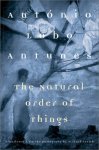
Antonio Lobo Antunes, The natural order of thingsMy final book is another translated work but that’s not the reason I’ve chosen to link it. My reason is that it’s another story which explores a political event, in this case Portugal’s Carnation Revolution. The book is António Lobo Antunes’ The natural order of things (my review). This one, however, is less overtly political than Vargas Llosa’s book, being about how people cope when the world around them is anything but “natural”.

Last month I said that next time we’d need to travel more widely than just England and Australia – and we sure have. This is also my first #6degrees meme which has more male writers than female, and an equal number of non-Australian books to Australian. What’s come over me!

Have you read Shopgirl? And whether or not you have, what would you link to? 
Six degrees of separation, FROM The slap TO Persuasion

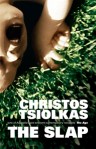
Christos Tsiolkas, The slapAnother month, another Six Degrees of Separation meme. My how quickly the months are passing! The meme is, as most of you know by now, currently hosted by Kate (booksaremyfavouriteandbest). Each month she nominates a book from which we try to create a chain of seven books, linking one from the other on whatever excuse, flimsy or otherwise that we can come up with. And, guess what, this month I have actually read the nominated book, Christos Tsiolkas’ The slap (my review). As always, I have read all the books I select for my chain.

Hanif Kureishi, The buddha of suburbiaTsiolkas’ The slap is about an extended family, of migrant background, and friends, living in suburban Melbourne. Its author, Tsiolkas, is Australian-born of Greek immigrant parents. This reminded me of Hanif Kureishi’s The buddha of suburbia (my review) to which I admit I’ve linked in this meme before. Kureishi is English-born of a Pakistani father and English mother, and his book is about the life of a multicultural family in a London suburbs. More satirical than Tsiolkas’ The slap, and more closely focused on the challenges of race and ethnicity, but both reflect the experience of immigrant generations in the ‘burbs.

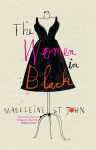
The women in black, Madeleine St John, book coverLinking now on content more than author similarity, The buddha of suburbia’s exploration of multiculturalism took me back to Australia and Madeleine St John’s The women in black (my review). It is set in the ladies fashion section of a classy department store in the 1950s, a time when the post-war influx of European refugees saw Australian society challenged by new foods not to mention new values and attitudes to life and family.

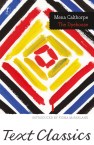
Mena Calthorpe, The dyehouseMy next link draws on multiple aspects – content, location and period. I’m talking Mena Calthorpe’s The dyehouse (my review) which is also set in 1950s Sydney, and which, like The women in black, deals with the lives of workers in one business. However, Mena Calthorpe’s intention is more strongly focused on labour conditions. Her business is the textile industry, a dyehouse, and she exposes how workers are poorly cared for, poorly paid, and have little power to do anything about it. Towards the end of the novel, though, there are intimations of the workers starting to organise.

Wendy Scarfe’s Hunger town (my review) is set a little earlier, from the mid 1920s to late 1934, in Adelaide’s port district. It tells of the struggles of wharf labourers to survive as unemployment and hunger took hold. It explores the ensuing political unrest and the growing attraction of leftist political ideologies like communism and anarchism, alongside unionism, in such a volatile environment. It is also, like the books by St John and Calthorpe, historical fiction.

Tracy Chevalier, Remarkable creaturesAnd so, my next link is on form (genre) rather than content. I’m going to change country and era, and pop over to early 19th century England in Tracy Chevalier’s Remarkable creatures (my review). You’ll realise soon why I’ve chosen this particular piece of historical fiction, but first a little about its content. It tells the story of two women who were fossil hunters in Lyme Regis in the first half of the nineteenth century: Mary Anning (1799-1847), a poor working class woman whose fossil finds helped change the course of paleontology, and Elizabeth Philpot (1780-1857), a gentlewoman who befriended Anning and who was particularly interested in fossil fish.

Jane Austen, PersuasionAnd now, for the first time since I started doing this meme, I get to link to one of my very favourite authors, Jane Austen (1775-1817). I could link to any of her books because they are all set in early 19th century England, and I’d love to link to one I’ve reviewed here. However, I’m choosing one that I haven’t posted on yet, Persuasion, though I expect to write on it later this year. If you know your Austen, you’ll know why I’ve chosen this one: she set a critical scene in Lyme Regis for that novel. In fact, the Lyme Regis connection is the main reason I read Remarkable creatures.

And so, I started with an unruly, messy family in The slap and ended with another one, albeit of a different sort, in Persuasion. In between we went to England, back to Australia, before returning to England again. We must travel elsewhere next month!

Have you read The slap? And whether or not you have, what would you link to? 

Book Buying Habits (Another meme)

I really don’t like doing memes – except for the Six Degrees of Separation to which I’ve become addicted. But when I came across this Book Buying Habits one via Lisa (ANZLitLovers) and Karen (Booker Talk), I decided it would be a good opportunity to explain myself, so here goes …

1. Where do you buy your books?

Muse bookshop

Muse (Cafe and Bookshop)

I prefer independent bookshops, of which we have a few in my city, including Muse (a wonderful bookshop-cum-cafe-cum-literary event venue), Paperchain and the National Library of Australia bookshop. When I travel, I like to visit independent bookshops. These shops can usually be guaranteed to have the sorts of books I like to read, and staff who love to talk books.

I do some online purchasing, but less so than I did a few years ago, and I spread myself around a bit. Fishpond, Booktopia, Bookworld, Book Depository and AbeBooks (particularly for out-of-print books) are the ones I’ve used.

2. Do you ever pre-order books and if so do you do this in store or online?

No. I have enough to read without seeking out books before they come out.

3. On average, how many books do you buy a month? 

I used to buy four or more a month (including books as gifts), but these days I have reduced that rate because I am trying to catch up on reading books I have for review and books on my TBR. So, over the last year or so I’d say I only buy a couple a month. If it’s an Australian book I want to read, I’ll buy it in print, and if it’s non-Australian I prefer e-version. This is my little attempt at decluttering – or at reducing the clutter!

4. Do you use your local library?

Rarely these days. I’m a librarian by training, and I love libraries, but I also love to own the books I read – and, yes, you can yell at me, I also write in my books (in pencil). This is the main reason why I prefer to buy books – not borrow them from friends or libraries.

5. If so – how many books can you/do you borrow at a time?

I only borrow if it’s the only way I can locate a book I really want to read, which means I usually only borrow one at a time.

6. What is your opinion on library books?

Libraries are essential to a free, democratic society. I would fight for their existence. I have no problems reading library books. I just have problems keeping my pencil away from them, so … see q. 4 above!

7. How do you feel about charity shop/second-hand books?

I regularly donate to charity bookshops which, here in my city, means to Lifeline. I occasionally offer books to secondhand bookshops for sale but I don’t really find it worthwhile. They never take all I offer, and the money I’m offered (not that I’m complaining, they have to make a living) makes it not worth the effort. So, I’ve decided recently that when I declutter books, I’m donating them.

I will buy secondhand books if the book I want is out-of-print and I can find it in one of these shops. I do enjoy browsing Australiana sections of those secondhand shops which specialise in older literature. I tend to avoid those focusing on contemporary genre/bestseller books.

8. Do you keep your read and TBR pile together/on the same book shelf or not?

Book stacks

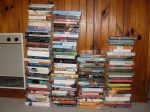
Part of an old TBR pile before they were sorted and weeded of books I’ll never read.

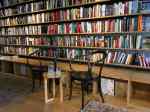
On the same bookshelf. Shelf? Not shelves? Hmm, no, they are separated, and they occupy their own bookcases, with Australian TBR books separated from non-Australian. My review copies are in a shelf of their own, with a little notebook in which I list them when they come in, and tick them off when I read them.

9. Do you plan to read all the books that you own?

What I plan and what I expect are two different things …

10. What do you do with books that you own and that you feel you’ll never read/felt you didn’t enjoy?

If they’re fiction and I’ve read them, I keep them, as they are part of my reading life and history. One day, though, I will weed them, starting with the non-Australian books. Oh dear, it rather sounds like I’m a nationalist. I’m not really, but it’s all part of my desire to support our small but wonderful industry here.

However, if I haven’t read them, and I really don’t think I’ll get to them, I have just recently started to move them on – by offering them to people who I think will enjoy them or by donating them. See under q. 7 above!

11. Have you ever donated books?

Yes, see under q. 7 above, again!

12. Have you ever been on a book buying ban?

No. Sometimes I go-slow, which I am doing now for the reasons I’ve given under q. 3. I see no reason for having a ban. If I want to read a book – if I need to read a book, say for my reading group – I’ll buy it. I am lucky enough, I know, to be able to afford this. Reading, after all, is my prime hobby so of course I’m going to support that hobby in whichever way best suits me at the time – and this means reading books I have, or buying a book I “need”. Some people like going to the gym or love skiing. Do we ever ask them about going on a gym- or skiing-ban?

13. Do you feel that you buy too many books?

Yes – and no. Yes, because my eyes are at times too big for my stomach (hmm, that’s a cliché that would horrify George Orwell) and because I have bought books in the past that I realise now I will not manage to read. No, because I’m not sorry about supporting authors, publishers and booksellers.

Six degrees of separation, FROM Room TO The children’s Bach

I’m going to take you on a bit of a wild ride this month, bouncing from title to genre, from setting to risk-taking, and more, so hang onto your hats, because here we go …

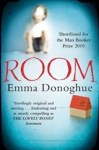
Emma Donoghue, RoomExcept, oops, I do need to tell you what this is all about. It’s the Six Degrees of Separation monthly “meme” again, of course, and it’s currently hosted by Kate (booksaremyfavouriteandbest). Each month she nominates a book from which we create a chain of seven books, linking one from the other as the spirit moves. Yet, again, I haven’t read the starting book, Emma Donoghue’s Room. However, as usual that didn’t daunt me. At least I can promise to have read all the books I select for my chain.

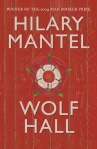
Hilary Mantel, Wolf HallSo, my first link is on the title, and I’m choosing a title with a “room” in it, in this case a “hall” as in Hilary Mantel’s Wolf Hall (my review). It was, as I recollect, a somewhat controversial Booker Prize win because it was, shock! horror!, a so-called genre book. To confirm my memory of this I did a bit of a Google search and found this wonderful commentary from The Guardian at the time of its win:

She’s also, by the by, managed to sneak a ‘genre’ novel into the Booker winners’ notoriously literary paddock – and recalibrated the arena of historical fiction in the process. The accusation that this year’s shortlist was weighted too heavily towards the historical has dogged the debate surrounding it, but even those who found Wolf Hall mannered or boggy …  agreed that Mantel’s novel was a far more exciting proposition than the usual ladies-and-lances epics that the genre turns out.

Kate Grenville, The lieutenant book coverHaha, I’ve always called them “bodice-rippers”, but I love commentator Sarah Crown’s “ladies-and-lances”.

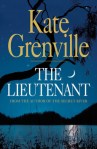
Anyhow, moving right along, it is genre – historical fiction about a real historical figure – that I’m using for my next link, Kate Grenville’s The lieutenant (my review). It’s the second book in Grenville’s Secret River early-contact trilogy and was inspired by astronomer Lieutenant William Dawes, who came to Australia on the First Fleet. He befriended a young indigenous girl and took interest in the local language, which he documented in his notebooks. A good read.

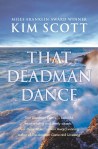
Kim Scott That Deadman DanceAs, it would be unjust to include a non-indigenous writer on first contact without also giving voice to an indigenous author, my next link is to Kim Scott’s Miles Franklin Award winning That deadman dance (my review). While Grenville’s book is set in the first years of the Sydney colony, Scott’s novel is about the establishment of the British colony in southwest Western Australia in the 1820s-1840s. It’s a significant and unforgettable book.

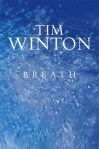
Tim Winton, BreathMy next link is to another Miles Franklin award-winning book, though that’s not the reason I’m linking it. The link is the setting, Western Australia, and the book is Tim Winton’s Breath (my brief review). I loved this book. I loved its evocation of surfing, which is something I have no desire to do but Winton helped me understand its thrall. I also loved its exploration of male risk-taking behaviour. Tim Winton knows his subject so well.

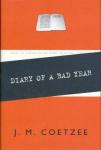
JM Coetzee, Diary of a bad yearAnd now, I’m going to draw a long bow, and move from a book about risk-taking to a book in which the author took big risks, JM Coetzee’s Diary of a bad year (my review). It’s a strange book to read, because it has three (two to begin with) concurrent strands running across the top, middle and bottom of the page, with each strand representing different voices. How do you read such a book? Coetzee is a writer who seeks new ways of confronting us with ideas that he thinks matter. Oh, and note that even though South-African born Coetzee now lives in Australia, he is this month’s non-Australian contribution, because I always like to have at least one.

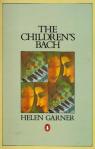
Helen Garner, The children BachMy last link is perhaps even more spurious. Late in Diary of a bad year, Coetzee refers to his love of Bach. I suggested in my review that the book itself could be seen as pæan to Bach, because its three-part structure, in which each part counterpoints the others, could be seen as a textual representation of Bach’s polyphony. This brings me to Helen Garner’s novella The children’s Bach (my review). There are references to Bach’s music in the book. However, I’m linking again on the structural element because, even though Garner’s narrative is not so formally divided as Coetzee’s, she tells her story about Dexter and Athena and their family tightly, through multiple vignettes which also reflect Bach’s contrapuntal, polyphonic approach to music.

And so, here we are at the end – and somehow, although I’ve linked via various concepts and strayed a few centuries in time, we’ve returned in the end to a story about parents and children.

Have you read Room? And whether or not you have, what would you link to? 
My literary week (7), adaptations

With Ma and Pa Gums in the process of selling house and preparing for a downsize move, my time has been taken up with many things besides reading – but I did get out at night in the last week to see a couple of adaptations of novels I’ve enjoyed in the past.

There’s still time … brother

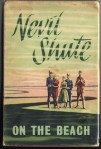
Nevil Shute, On the beachOne of my favourite novelists when I was a teen – when my friends were reading Georgette Heyer – was Nevil Shute. He wrote more than 20 novels, and I sought every one out over a period of years until I’d read them all. His best-known novels are probably No highway, A town like Alice and On the beach, all of which were made into films (as were others too, I know). This post is about the last I mentioned, On the beach, which was his dystopian (or post-apocalyptic) Cold War novel about the end-of-the-world due to nuclear war. Something I didn’t know on my first reading is that on the title page of the first edition are lines from TS Eliot’s poem “The hollow men”. Makes sense, and you can read about it in the Wikipedia article I’ve linked to above.

I hadn’t read Shute for a few decades until the early 2000s when one of my online reading groups decided to read On the beach. How disappointing I found it. The story was still powerful, but the writing seemed so wooden and the characters so stereotyped. I was therefore uncertain about seeing the original Stanley Kramer movie last week, when it was shown at the National Film and Sound Archive as part of its season of atomic age films.

I needn’t have worried. It was great – and must have been a work of passion given how quickly Kramer got onto the story. The novel was published in 1957, and the film released in 1959. The Wikipedia article on the film adaptation provides a useful introduction to the film and discusses where the adaptation departs from the novel. Apparently, Shute was not happy with the changes, but it’s too long since I read the novel for me to comment on that. One of the changes, Wikipedia says, is that the film doesn’t detail who was responsible for the conflagration. There could be various political reasons for this, but it could also be because Kramer had a very clear message he wanted his audience to take home – one that he didn’t want diluted by people thinking it had nothing to do with them. He wanted everyone to take the dangers of nuclear weapons seriously – and wow, did the film make that point …

Towards the end, as the radiation is reaching Melbourne, the film shows crowds of people in a Melbourne street attending a Salvation Army service. Above them is a banner reading “There is still time … brother”, reminding the attendees, of course, that there is still time to “find God”. The final scene of the film shows the same street – now empty of life – and closes on the banner “There is still time … brother”. It floored me. It so neatly, so confrontingly, shifted the meaning from the religious to the political. And, the message (either narrowly or broadly interpreted) is as relevant today as it was then. That’s the scary thing.

From the Cold War to Cold Light

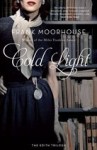
Frank Moorhouse, Cold LightIn the last novel of Frank Moorhouse’s Edith trilogy, Cold light (my review), Edith Campbell Berry, star of the League of Nations (well, in her mind), comes to Canberra, hoping to make her mark. It’s fitting, then, that an adaptation – in this case a play not a film – should be made in Canberra. However, it’s a big book – over 700 pages of it – with many themes. Two that grabbed my attention when I read it were the failure of idealism and the challenge of aging, so I wondered what playwright Alana Valentine would choose. The main promo line for the play’s advertising was “How far can a woman of vision go?”, which encompasses I’d say the idealism angle.

It was a daring adaptation, which used song, verse and, occasionally, dance to transition between scenes. The verse was particularly intriguing. It all came from Adam Lindsay Gordon’s The Rhyme of Joyous Garde and was recited by Edith herself. I grew up with some of Gordon’s more sentimental bush poetry, but I’d never come across this one. However, a Google search uncovered that the whole poem is a soliloquy by Lancelot after Guinevere and Arthur are dead. It’s about heady days, grand passions and big ideals, guilt and regret. I don’t believe it was referred to in the book, so Valentine’s using it reveals her desire to convey those grand but murky themes which closely mirror Edith’s colourful, passionate life.

I’m not going to review the play, as there are links to some excellent reviews on the Street Theatre’s site. I’m just going to comment on what I took away. The overriding theme was Edith’s indefatigable spirit, but another was its exploration of human rights – women’s rights, and freedom of expression, in particular. Edith refers regularly to the Universal Declaration of Human Rights which Australia helped draft back in 1948, but hadn’t (and still hasn’t) fully enshrined into national law. For Edith, it represents ideals she wants (us all) to live by.

Cold light is set from 1950 to 1974, but the significant thing is that its concerns are still relevant: freedom of expression is being attacked right now; women’s rights are not safe; the nuclear threat is not over; and so on.

At the end of the play – and some of these specific words are in the novel too – Edith says

I have witnessed great events and participated in great events. I have met and talked with fascinating people who have made history. But it is only, here, now that I am in it, however briefly, making history, participating in it. One must give everything to participate. To be in it. So many, so many will want you to observe, to commentate, to support those who are in it. But you must open your palate to the right stuff. You must stare down the world and see it in a clear, cold light … It’s not what the world hands you, but what you try to wrest from it. That is all that is valuable. To act, to speak, to make. To live, to live, to live it. Your allegiance must be to the republic of the mind, not to any country or state… (from Cold light, adapted by Alana Valentine, Currency Press, 2017)

See? Relevant, right now – which made a thoroughly engaging and creatively produced play a meaningful one too.

Cold Light 
Based on the novel by Frank Moorhouse
At the Street Theatre, Canberra, 4-10 March 2017
Script: Alana Valentine
Director: Caroline Stacey
Cast: Sonia Todd, Craig Alexander, Nick Byrne, Gerard Carroll, Tobias Cole and Kiki Skountzos

Do you enjoy adaptations? And if so, do you have any favourites?

Six degrees of separation, FROM Fever pitch TO Please look after mom

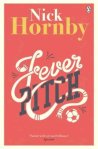
Nick Hornby, Fever pitchYou probably know all about the Six Degrees of Separation monthly “meme” by now, but here’s the gen for newbies. It’s currently hosted by Kate (booksaremyfavouriteandbest), who, each month, nominates a book from which we players create a chain of seven books, linking one from the other as the spirit moves. Unfortunately, once again, I haven’t read the starting book, Nick Hornby’s football fan-book Fever pitch, but our host Kate said (somewhere) that she thought it would be interesting to start with a book about sport – and I’m up for the challenge! As always (to date), I promise I’ve read all the books I select for my chain.

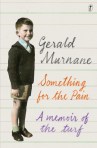
Gerald Murnane, Something for the painWhen I said above that I’m up for the challenge I meant it, because I immediately knew what my first link would be, Gerald Murnane’s delightful Something for the pain: A memoir of the turf (my review). It’s another memoir from a writer with passion for a sport. I enjoyed it for two reasons. I learnt a lot about Murnane, and I learnt about a sport I know nothing about – which is one of the joys of reading, isn’t it, learning about subjects you know nothing about?

Christos Tsiolkas, Barracuda

A sport I know a little about – more as spectator than exponent – is swimming, and it is to a novel about swimming that I’m linking to next, Christos Tsiolkas’ Barracuda (my review). It tells the story of a young potential swimming champion from the “wrong” side of town being offered a scholarship to attend an elite school where he can be coached by a top swimming coach. The book is not so much about swimming as about the meaning of success and failure, and about what makes a good man.

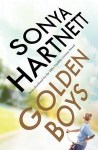
Sonya Hartnett, Golden boysMy next link sees me leaving the sport theme to draw on Barracuda’s idea of a boy from the wrong side of the tracks finding himself among the well-to-do. Sonya Hartnett’s Golden boys (my review) is about the reverse. A well-to-do family moves to a poorer neighbourhood and the two sons find themselves having to mix with the sons of a very different world. But, their real challenge is their father, who is the reason the family needed to move. It’s a disturbing book.

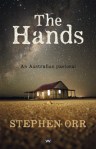
OrrHandsWakefieldMy next book is also about fathers and his sons. It was one of my favourite discoveries last year, Stephen Orr’s The hands (my review). Its evocation of a father’s relationship with his sons, and of the relationship between the two brothers, particularly through wonderfully authentic dialogue, impressed me greatly. It is set on a remote South Australian farm and deals with the stresses of modern farming in a dry land, stresses that are exacerbated by the spectre of climate change.

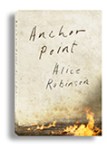
Alice Robinson, Anchor PointAnother novel about farms and climate change that I enjoyed was Alice Robinson’s Anchor point (my review). This one, though, was more about a daughter and her father. Interestingly, in both The hands and Anchor point the mother is absent – albeit for different reasons. And now, because I really should, as I’ve said before, link to at least one non-Australian work, I’m going to conclude with another novel about a missing mother …

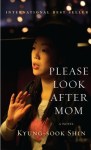
shinpleasemomKyung-sook Shin’s 2011 Man Asian Literary Prize winner, Please look after mom (or mother) (my review). Set in South Korea, it tells the story of a mother who goes missing. I loved it for a number of reasons: it’s set in a country whose literature I don’t know; it is told from multiple points of view and in different voices (first, second and third person); and it explores some themes that interest me including city versus country values, the importance of literacy and education, and those universal emotions of guilt and regret.

And so, here we are at the end. This is the first time that all my links have drawn on the content of the books. I don’t think I can link at all back to the first book, but we have played some sports along the way, visited a couple of farms, and got to know a few parents and their children. That’s pretty interesting – at least, I think so.

Have you read Fever pitch? And whether or not you have, what would you link to? 
Six degrees of separation, FROM Fates and furies TO The Buddha of suburbia

grofffatesYou probably all know the Six Degrees of Separation monthly “meme” by now, but here’s the info for those of you who haven’t caught up with it yet. It’s currently hosted by Kate (booksaremyfavouriteandbest). Each month, she nominates a book, from which “players” create a chain of six more books, linking one from the other as the spirit moves. Unfortunately, for the third time in a row, I haven’t read the starting book, Lauren Groff’s Fates and furies, but …

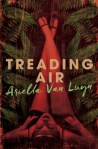
Arielle Van Luyn, Treading airDaughter Gums has, so I asked her choose my first link. Her first suggestions were books I haven’t read – and that’s no good because my commitment is to having read all the books I choose for the chain. So then, after some to-ing and fro-ing, she came up with a book I lent her, Ariella Van Luyn’s Treading air (my review). There’s a problem, however, because the best linking point apparently relates to a “reveal” part way through Fates and furies, so I can’t use that. The other link is that both books, writes Daughter Gums, “track a couple’s relationship history from early on (particularly when the woman was quite young) through to the demise (in different forms, though …), both track the relationship through up and down …”. I liked this suggestion not only because it enabled me to highlight a debut Aussie author, but because it lets me link to …

Thea Astley, The multiple effects of rainshadowOne of my favourite Aussie authors, Thea Astley. Treading air is set in Brisbane and Townsville, and Thea Astley was born in Brisbane, moving to Townsville for a teaching job in her early twenties. Her first novel, Girl with a monkey, is set there, but I’m linking to The multiple effects of rainshadow (my review) which explores the longterm effects of a tragic event which occurred in 1930 on Palm Island, just north of Townsville. This island was where the Australian government “sent” problematic (from the “white” point of view) indigenous Australians, but the tragedy was enacted by the “crazed” white superintendent. It did, however, involve indigenous people in the ensuing “resolution” of the superintendent’s actions, and resulted in a surprisingly just court decision.

Chloe Hooper. The tall manMy next link is probably obvious, Chloe Hooper’s The tall man (my mini-review), which is about another tragedy on Palm Island. Hooper’s book, though, is a true crime non-fiction work. It chronicles the 2004 death in custody of an indigenous man, Cameron Doomadgee, and the subsequent riot and ongoing unrest concerning the official response through criminal courts, appeals and coronial investigations. Here, though, is not the place to unravel, if we could, the truth of this situation, but Hooper’s book is an excellent read both for her coverage of the subject and as an example of a genre which we, in Australia, see as being championed by Helen Garner.

Kim Scott That Deadman Dance

And now, you probably think that I’ll link to Helen Garner, but that would be poor form I think because, having linked to two books by white (non-indigenous) writers exploring black-white relations in some way, I should (and would like) to link to an indigenous author. So, I’m going to go back, back, way before 1930, to the early nineteenth century settlement by the British of Western Australian – that is, to Kim Scott’s wonderful That deadman dance (my review). In it Scott tells the story of first contact from the local people’s, the Noongar’s, point of view.  His thesis, supported, apparently, by historical evidence, is that the Noongar were willing to work with the newcomers, but of course they were the losers in the end.

Marie Munkara, Every secret thingI’m going stay with this idea of contact, and link to another indigenous author’s book, Marie Munkara’s Every secret thing (my review). This book, which is more a collection of interconnected stories than a novel, is set in northern Australia and explores the relationship between indigenous people (the “bush mob”) and white people (the “mission mob”). The “bush mob” think they can keep the upper hand, or, at least, maintain their pride and independence. This is a very funny book, but its humour has serious bite. In the end, of course, it’s not the “bush mob” who have the power.

Hanif Kureishi, The buddha of suburbiaAnd now, partly because I really should include at least one non-Australian book, I’m going to link to another comic-satire, Hanif Kureishi’s The Buddha of suburbia (my review). It’s a more than appropriate link, in fact, because not only does it have over-the-top humour, like Munkara’s book, it is, also, partly about “other”, in this case about immigrants trying to make their way in England. As narrator Karim says, “to the English we were always wogs and nigs and Pakis and the rest of it”. However, unlike Munkara’s “bush mob”, Karim and his friends do manage to make some self-determining way in the world they find themselves in.

And so, this time I’ve linked mostly on content, with a nod along the way to setting and style. Not knowing Fates and furies, I can’t say whether we’ve ended up anywhere near where we started. Can anyone enlighten me?
And, if not, there’s always my usual question for this meme: where would Fate and furies take you – your first step at least?

My literary week (6), this and that

Life is a bit busy at present, but I am still reading – this and that, here and there, as you do!

First, there’s politics

I’m not a political blogger so I don’t want to focus too much on politics, but I did enjoy some of the signs carried by people attending the various women’s marches held around the world last weekend. Librarian-trained me, for example, loved “Librarians for Facts”. And “We shall overcomb” appealed to baby-boomer, not to mention wordplay-lover, me. But my favourite of all was “I know signs/I make the best signs/They’re terrific/Everyone agrees”. That one’s so clever it made me laugh … or would have if it weren’t so serious.

And, talking about clever commentary, here’s one I found in the latest issue of the Jane Austen Society of Australia’s members’ magazine, Chronicle. Scattered through the magazine are what they call “Austen citings”. I loved this one from a letter in the Sydney Morning Herald back on 29 June 2016:

To explain Brexit in literary terms: 48 per cent of Britons voted for Sense and sensibility while 52% voted for Pride and prejudice. (John Bailey, Canterbury)

And that’s all I’ll say about politics because I reckon you either have to say a lot or not much … so let’s leave it at the latter.

Except, there is one issue closer to home I should mention given today is Australia Day, now also known as Invasion Day or Survival Day. It’s becoming increasingly uncomfortable for many of us to celebrate a day that is the anniversary of the beginning of our dispossession of Australia’s original peoples. Calls are being made for it to be celebrated on a different day. Would that be so hard I wonder, particularly if it would help heal wounds? There are other meaningful days that could be chosen. Daughter Gums shared a link on Facebook promoting one idea – and here again you’ll see my enjoyment of wordplay – because the date is “May 8”, as in “maaaate”! Hmmm, only trouble is that this one could be seen to disenfranchise women, but it still made me laugh. For a useful broad history of “the day” you can read historian Kate Darian-Smith at The Conversation.

Online connections

Help Books Clker.com

(Courtesy OCAL, via clker.com)

The Australian Womens Writers (AWW) Challenge has a new Facebook Page titled Love Reading Books by Aussie Women, and I visited it a few times last week. All sorts of discussions were happening, from people announcing their latest AWW read to convenor Elizabeth posing questions like what we’d like to ask authors of a new book coming out. She is preparing to interview, for our website, a new bunch of authors. Quite coincidentally, American blogger Stefanie (So Many Books) made a comment about this on a recent post titled “Where do you get your ideas?” She believes that authors don’t like to be asked this question, but I’m not so sure. So, while we’re here, let me ask you what you’d like to ask authors.

Many moons ago, before we were married, Canberra-based Mr Gums and I went to the wedding in Adelaide of a good friend of his. Later, that friend (and his wife) moved even further away – to Perth on other side of the continent, in fact. We have stayed in contact through our Christmas letters, and now, with improved technology, Mr Gums and his friend occasionally Skype. Somewhere along the way, this friend also discovered my blog and has started commenting on it because, like all of us here, he’s a keen reader. Unfortunately, he has been coping for some years with a chronic health condition which will require him to go under the knife again tomorrow. So, this is a big shout-out to NeilAtKallaroo, who, commenting the other day from his hospital bed, wrote “thank heavens for wifi and tablets”. Hallelujah to that. As I say to my less technologically-keen peers, do try to keep up with communications technology. It is likely to be a godsend one of these days. Meanwhile, all the best, Neil, for tomorrow.

And of course there have been books

Rebellious daughtersIt’s very unlike me, because I don’t like having my attention split too many ways, but I’m currently reading three books – my next reading group book, which is a biography of Freya Stark, and two review books from publishers, one of which is the anthology Rebellious daughters and the other a cheeky offering from local independent publisher, Finlay Lloyd. One day, in the not too distant future, you’ll see reviews for these!

So, you see, while I haven’t completed a book/book review for several days, my life hasn’t been devoid of literary content. A life without literary content would not be a life worth living, nest-ce pas?

How has your week gone, literarily (ha!) speaking?

Six degrees of separation, FROM The girl with the dragon tattoo TO The natural way of things

Stieg Larsson, The girl with the dragon tattooOk, I admit it, I’m hooked on this meme, not only because it’s a fun intellectual challenge to find links between books, but also because it gives me an opportunity to revisit books I’ve read, which helps keep them fresh in my mind. For those who haven’t caught up with this meme, it’s the Six Degrees of Separation monthly “meme”  and it’s currently hosted by Kate (booksaremyfavouriteandbest). Each month, she nominates a book, and then we who play create a chain of seven books, linking one from the other as the spirit moves. Unfortunately, like last month, I haven’t read the starting book, Stieg Larsson’s The girl with the dragon tattoo but I promise I’ve read all the books in my chain!

The bee hut, by Dorothy Porter

Now, you might expect me to link Larsson’s The girl with the dragon tattoo to another crime/mystery novel or, perhaps, to another novel by a Swedish author or one set in Sweden, but I’m not going down these paths. This novel, as you may know, was published posthumously – and this is the tack I’m going to take. It has led me straight to Australian poet Dorothy Porter’s collection, The bee hut (my review), which was published after she died from breast cancer. This is one of those books that I don’t need to be reminded of, because its ending is so powerfully generous. She wrote, just two and a half weeks before her death, the following lines: Something in me/despite everything/can’t believe my luck. Now that’s inspiring!

Izzeldin Abuelaish, I shall not hateGenerosity of spirit – a willingness to view the world positively – is something I prize. If we were all only a little more generous to each other, surely the world would be a better place, or am I naive? Anyhow, one of the most generous books I’ve read since starting this blog was Izzeldin Abuelaish’s memoir I shall not hate (my review). If anyone had a reason to hate, it’s he – he lost three daughters and a niece in an attack on Gaza by the Israeli Defence Forces  – and yet he chose the “path of light” over that of “darkness” because he believes in “co-existence, not endless cycles of revenge and retribution”. If he can do it, surely the rest of us can?

Albert Camus, The plagueNow Izzeldin Abulaish also happens to be a medical doctor, which reminds me of a fictional doctor, Rieux in Albert Camus’ The plague (my review), who, albeit in a different circumstances, evinces generosity of spirit or selflessness. This is a book I’ve read a few times, and will very likely read again, because it’s about people being prepared to take a stand, people who put themselves at risk. Rieux himself talks of people who, by “refusing to bow down to pestilences [whether these be natural or man-made, like, say, Nazism], strive their utmost to be healers.”

Pierre Lemaitre, The great swindleAnd now, to get off this generosity/selflessness bandwagon, albeit it’s a worthy topic to discuss, I’m going to do the more obvious thing and link via the author’s nationality. I haven’t read a lot of French authors on this blog, but one I did read one fairly recently, Pierre Lemaitre’s The great swindle (my review). Its story of France in the aftermath of the First World War is a powerful one, but one of the issues that my reading group discussed when doing this book was its translation. Some felt it was a bit uneven. I didn’t feel that – I felt the author intended an unevenness or jerkiness – but I am always a little bothered about reading translations because there’s a mediator between me and the text.

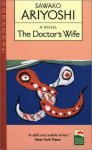
Sawako Ariyoshi, The doctor's wifeHowever, this doesn’t stop me reading translations because they are the only way, given I’m not fluent in multiple languages, that I can read works from non-English writers. Hence, my next link is to another translated work, Sawako Ariyoshi’s The doctor’s wife (my review), which is historical fiction about the Japanese doctor, Hanaoka Seishū (1760-1835) who is purported to be the first to use general anaesthesia to perform surgery. However, as the book’s title suggests, the Ariyoshi’s main concern is not him, but the women in his life, his wife and controlling mother. She explores the competition that occurs between these two women who play a secondary role in the life of the important man.

Charlotte Wood, The natural way of thingsA recent book which explores the secondary role of women to men is Charlotte Wood’s The natural way of things (my review). It’s a very different book, which takes as its starting point the way women’s sexuality is used against them in the support if not furtherance of male power. But it does have a subtext, that we also see in Ariyoshi, to do with ways in which women can be their own worst enemy.

And so, quite unintentionally as I just followed my nose, I see that I have come almost full circle from a novel set in Sweden which reflects misogynistic behaviour to an Australian novel which confronts such behaviour head on! In between we’ve travelled to Australia, the Middle East, France and Japan, and explored, in some at least, the best in human behaviour! Such is the reader’s lot.

Where would The girl with the dragon tattoo take you – your first step at least?

Blogging highlights for 2016

It seems that I’ve established a bit of an end of year trifecta with my Australian Women Writers’ Challenge wrap-up post, followed by posts on Reading highlights and Blogging highlights. This post, obviously, is the Blogging one. I do it as much for my own record, because I enjoy tracking trends on my blog, so please don’t feel obliged if you’ve had enough!

Top posts for 2016

Hannah Kent, Burial Rites bookcover

Courtesy: Picador

For the last three years, my most “hit” post has been Virginia Woolf’s short story “The mark on the wall“. This year, finally, an Aussie book topped the list, Hannah Kent’s Burial rites, which ranked 3rd last year. However, while last year, four Australian works appeared in my Top Ten posts, only three did in 2016:

Tenth in the list was, interestingly, my page on Australian Literary Awards. I must make sure I keep it up to date! My Red Dog post has proved consistently popular since I posted it. With a follow-up movie, Red Dog: True Blue, about to be released into cinemas, I presume it will continue to receive hits this year.

In 2014, Barbara Baynton’s short story “The chosen vessel” (posted November 2012) ranked 5th, and last year it ranked 9th. It’s still ranking well, but dropped again this year to 12th. Some of my other posts on her short stories also feature in the top twenty or so. It’s wonderful seeing such a strong, original voice from the past being still read.

What I find particularly interesting, in fact, is that short works, including Baynton’s above, continue to rank well, several appearing in the Top Ten:

Sarah Kanake, Sing Fox to meMy most popular 2016-written post – ranking 66th – was, unlike last year, for an Australian work, Sarah Kanake’s debut novel Sing fox to me. And it’s closely followed by another Australian work, Stephen Orr’s The hands.

So, once again, my top-performing posts are older ones, which suggests that litblogs are contributing, hopefully usefully, to wider literary culture.

Finally, there is a surprising post in my Top Ten, but you’ll have to read on to see what it is.

Random blogging stats

I love sharing some of the searches that find my blog, so here are some of this year’s more interesting ones:

  • freemasons secret magnify glass: what the?
  • ginger gits: ditto.
  • what pages are the best quotes on in red dog: haha, was this someone trying to short-cut writing an essay?
  • whispering gums means: I’d love them to tell me if they found out!
  • write a short note on the picturesque: presumably a homework question but I love that s/he seems to have typed in the whole question.

And then there were multiple searches relating to my 8th most popular post this year, What do you say when you order food at a restaurant (posted November 2014). The search terms included what else can i say in place of orderin restaurent, to place order in a restaurant what we say?, fine some expression ordery meal ins the restaurant, and when ordering food restaurant may i have. What a hoot, particularly when, quite coincidentally, the topic of what to say in restaurants became a bit of a family joke over Christmas!

Other stats tell the story of my year. This year was rather frenetic for me with some major family commitments but I managed to write more posts, 164 in fact, than last year’s paltry 133. My blog visitors came from 172 countries, and while Australia, the USA, Britain and Canada filled the top four slots, I love that India, the Philippines and Germany followed them. My most active commenters this year were: Lisa (ANZLitLovers), Stefanie (So Many Books, So Little Time), Ian Darling, Bill (The Australian Legend), and Meg. A big thanks to them, and to everyone who reads and/or comments on my blog. Whether or not you comment, it is a joy to share books and reading with you.

Challenges/Memes

awwchallenge2016As I wrote in my AWW Challenge wrap up, I will participate in the Challenge again this year. I won’t set a formal goal but expect to read around 30. (See here for the Sign Up page). I will also probably do the AWW Bingo Card challenge again, though, as with this year, I expect to do it more by serendipity than by design. It was fun seeing whether my reading was varied enough to slot into the set categories.

Late last year, I started doing the #sixdegreesofseparation meme, currently run by Kate (booksaremyfavouriteandbest). I enjoyed the way it made me look back at past reading, thereby refreshing my memory, so I plan to join in again when I can this year.

And to wrap up my wrap-ups …

I’ve already said it in my Reading Highlights post, but I’ll reiterate it: thanks to everyone who read, commented on and/or “liked” my blog last year – and thanks to all the other wonderful bloggers out there, even though I don’t always manage to visit everyone as much as I’d like. You prove that cyberspace can be a positive place. I wish you all happy reading in 2017.

And finally, a big thanks to the authors who wrote the books that we love to read and talk about, and to the publishers and booksellers who get the books out there. May 2017 be a great one for you all.