Meanjin’s Tournament of Books 2011, Zombie Rounds

Just one round of Meanjin‘s tournament of books to go … after this one, that is.

The Zombie round comprises the winners of Semifinals 1 and 2 being pitted against the books returned to the fray by reader vote in the Zombie poll (on which I reported at the end of the Semifinals post).

Zombie Round 1: Joan London’s Gilgamesh defeated Alexis Wright’s Carpentaria

Well, hmmm … I don’t have a particular problem with the winner here as they are both very fine books. I love Gilgamesh and would not be sorry to see it win, though I did have a slight preference for Carpentaria because of the “bigness” (to use my best litcrit terminology) of its idea/s and language. It is a larger than life novel that takes you on a very wild ride. And it explores some of the conflicts and challenges faced by contemporary Indigenous Australians, something we need to see more of in our contemporary literature. But, this judging was odd. Firstly, the judge was First Dog on the Moon, the pseudonym of Andrew Marlton, the cartoonist for the independent electronic magazine Crikey. This is fair enough, but he got his facts wrong. He described the two books he was judging as “zombie” books. However, only one is. And then, the judging took the form of a cartoon. It was just a little too light-hearted, a little too minimal … but perhaps, really, he took just the right tack. We’ll get a winner in the end but we all know, don’t we, that all the books are winners!

Zombie Round 2: Helen Garner’s The children’s Bach defeated Miles Franklin’s My brilliant career

Ah well, the grand old dame of Australian literature, the bequeather of our (arguably) most important literary prize, has been toppled off her perch by the zombie! Just shows it’s never over till it’s over, eh? Lorelei Vashti, the judge, uses some rather odd criteria to make her decision – she likes the old-fashioned (or, is that, oldfashioned) way Garner’s book used “ear-rings” for “earrings”; she believes (and gives examples) that men called Harry always get the girl but Franklin’s Sybylla rejects her Harry for a career! In the end, being (semi-) serious, she gives it to Garner because, and I’ll quote:

So, in conclusion: near the end of The Children’s Bach, Philip instructs a girl who is trying to write pop song lyrics: ‘Make gaps. Don’t chew on it. Don’t explain everything. Leave holes,’ and that there is a Garner masterclass; it’s precisely what her book does. You never find her doing something so obvious as, for example, rhyming Harry with marry; this book is all about the gaps and holes.

I do think Garner is a very fine writer, so I won’t argue – though I probably wouldn’t have argued with the alternative either. It’s that sort of tournament after all.

Next …

The Final. Who will win? Gilgamesh or The children’s Bach? Which would you vote for?

Monday musings on Australian Literature: Guest post from Louise of A Strong Belief in Wicker

This week’s Monday Musings is my second Guest Post in the series. It comes from the lovely Louise of A Strong Belief in Wicker. I first “met” Louise through an online bookgroup and we quickly discovered that we lived within a few hours’ drive of each other. Consequently, we have also “actually” met several times (always, to date, through her visiting my city. I must reverse the direction one day.) Louise is a warm and generous soul. She picked up (funny that!) on my love of Jane Austen, and so over the years I have been the lucky recipient of Jane Austen related gifts and of links to things Austen, the most recent being to a review of a children’s book about Mr Darcy, the duck! I value her friendship … and so was thrilled when she was thrilled to be asked to write a guest post. Her blog is wide ranging, but has a focus on children’s literature, and so that is what she has brought us today:

Five Australian Children’s Literature Authors/Illustrators

I was so incredibly excited to have Whispering Gums ask me to write a Guest Post that I immediately had No Ideas! After all Aussie kids lit is so vast! There is such a broad range of picture books, books for young readers, and YA, that it’s hard to know where to start. Of course there are some internationally known superstars writing books for young Aussies and kids around the world. But you don’t really need my help to find your way to Mem Fox, Sonya Hartnett, Shaun Tan or Markus Zusak. Not that their work isn’t worth highlighting. Of course it is.  It’s just that they are justifiably already very famous. In Australia, and around the world.

So I thought I would highlight some authors and illustrators who I’ve read and loved recently – and who deserve to be much more well-known.

Freya Blackwood

A local favourite for me as Freya lives in my town in NSW. I’ve been aware of her work for several years now and love her soft, warm illustrative style. She has an artistic heritage – a few years ago our local art gallery had a wonderful exhibition on her artist grandfather, Harold Greenhill’s work. Freya initially worked in film production and worked on Peter Jackson’s The Lord of the Rings films, and then started off illustrating classic Australian works such as Waltzing Matilda and The Man from Snowy River. She has since worked with many of the biggest names in children’s picture books – Australians such as Libby Gleeson and Margaret Wild, and international authors like Roddy Doyle. In 2010 she won the incredibly prestigious Kate Greenaway Medal. The book she illustrated with Roddy Doyle, Her Mother’s Face, is just perfect, so incredibly moving, I think it is one of my favourite picture books ever. The story of a young girl whose mother died when she was 3. Her father is immobile within his grief and the girl wonders if she has forgotten her mother’s face. Cover blurbs are rarely correct, but I think this book is indeed “a balm to the heart, and a feather in the knickers.” Freya’s current book is the equally fabulous Look, A Book written by Libby Gleeson.

Gary Crew

Is a prolific, highly regarded, critically acclaimed Australian author who doesn’t get nearly enough mainstream recognition. He has written picture books (mainly for older children due to their content and themes) and YA books. I’ve only read his picture books so far, but there are so many gems to be found. He has written two books that were illustrated by Shaun Tan – these are extraordinary. Memorial about a tree planted to mark the end of World War I, and The Viewer, a rather grim view of world history, masterfully illustrated by Tan. Gary Crew has written a brilliant series of books dealing with endangered or extinct animals such as I Saw Nothing: The Extinction of the Thylacine and I Did Nothing: The Extinction of the Paradise Parrot. His books for older readers are apparently even darker still, and some horror titles, which isn’t really my genre of choice, but I would still trust Gary Crew to take me there. Gary lives and works in Queensland, and is an Associate Professor of Creative Writing at the University of the Sunshine Coast. Next year he will be a State Ambassador for the National Year of Reading.

Jackie French Waltz for Matilda

Bookcover for A waltz for Matilda (Courtesy: HarperCollins Australia)

Jackie French

She really is quite a big name. Her subject range is vast. Picture books about wombats and royal underwear. Nonfiction books about keeping chooks in your back yard. And a rapidly increasing range of amazing children’s fiction. She really is extraordinarily prolific. She has written more than 140 books, there really has to be something for everybody. I devoured her most recent book Nanberry a month or two ago. An incredible book that brings the first years of white settlement in Sydney to vivid life. It’s a cracking read, and a fascinating glimpse into our past. My son’s teacher has been reading his Year 5 class her Waltz for Matilda as part of their Australian history studies this year. It has taken the better part of the school year, but has held the children’s interest throughout. Jackie French lives and works in the Araluen Valley in Southern NSW.

John Heffernan

I came across John Heffernan’s extraordinary first book Spud accidentally a few years ago. And I’m so thankful that I did. It’s a remarkable, compelling page turner that I picked up after midnight one night on a whim, and couldn’t put down until it was finished, sometime after 1.30 am.  A tremendously powerful story of a blue heeler called Spud. Spud starts out her life in the city when blue heelers are fashionable pets, but she chewed too much and blue heelers fell out of fashion and she was sent to an animal shelter where a kindly old farmer buys her. Spud’s life changes when she travels into the country to go the farm and become a working dog. There are some graphic acts of both human and canine violence in this book, making it suitable for older, sturdier kids. Just thinking about the book makes me want to reread it, and this time get to read the whole series. John Heffernan is an author and farmer, working and writing in Northern NSW. He has written 24 books from picture books to YA. His picture book My Dog is a powerful, sad and very moving book for the older child dealing with ethnic cleansing.

Martine Murray

I have no idea how Martine Murray escaped my gaze until this year – but she did. Until I came upon The Slightly True Story of Cedar B. Hartley. I love books written in a quirky first person voice, and Cedar B. Hartley gives us that in spades. Cedar’s is a wonderful, observant funny tale of a young girl growing up in Melbourne and doing some circus tricks. There is a great followup book too – The Slightly Bruised Glory of Cedar B. Hartley. Interestingly, I read that Martine Murray feels another of her books, How to Make a Bird, to be her best. I haven’t read that one yet. There is always something more to look forward to. Martine Murray is an author and illustrator who lives in Melbourne.

Alice Pung, Her father’s daughter

Pung Her Fathers Daughter Black Inc

Bookcover for Pung's Her father's daughter (Courtesy: Black Inc)

Her father’s daughter (2011) is Alice Pung‘s second memoir – if you can quite call this book a memoir. Unpolished gem (2006), her first, established Pung in the eyes of both critics and readers as a writer to watch. I agreed with them, but with some minor reservations. She certainly demonstrated the ability to write and tell stories – plenty well enough for me to be happy to read more of her – but, it was a young person’s memoir about a family that had experienced things (such as the Pol Pot regime) that most of us couldn’t imagine. And Pung, born in Australia, didn’t seem to quite have the maturity then to fully appreciate this fact in the way she wrote of her family. Five years, though, have made the difference and I would happily apply my favourite Marion Halligan quote to this book:

Read a wise book, and lay its balm on your soul.

Because, this book is the whole package.

The first thing that stands out is the voice. The book is, in a way, a hybrid, a memoir-cum-biography, and Pung has chosen to write it in third person. This decision reminded me of Kate Holden’s The romantic: Italian nights and days in which she too chose third person to tell her story. But, these are very different stories, and the reason for using third person reflects the difference rather than suggesting a similarity. The difference is that this is not just Alice’s story as Unpolished gem was, but also her father’s story. It is Alice’s attempt to understand the things that clearly frustrated her in Unpolished gem, such as the over-protectiveness of her parents. In this book, her father has a voice. In fact, the book’s chapters see-saw between those labelled “Father” and “Daughter”, so that it reads almost like a conversation.

This conversation style is one part of the narrative structure. Another is the movement in geographic setting from Alice’s time in China, to her return to Melbourne, to her father’s life in Cambodia and then her much later visit to Cambodia with her father, and finally back in Melbourne again. This geographic movement is overlaid with the third significant aspect of the structure, its chronology. The book moves back in time from the present, from when Pung’s family is well-established in Australia with a successful business, with, that is, the life Pung wrote about in her first memoir. At the beginning of this book, Pung, in her late 20s, goes overseas for the first time and her father, as is his wont, is fearful:

It panics him whenever any of his children are far away.

He can’t understand why she must go away to write. After all, she can see these other places on Google Maps, so

why couldn’t she just see the world through these satellite pictures. It was safer.

Alice, being Australian-born, doesn’t understand the full extent of his fears but, as she writes the book, she learns why her father believes that

To live a happy life … you need a healthy short-term memory, a slate that can be wiped clean every morning.

We’ve all read and/or seen about the killing fields of Cambodia so I’m not going to detail here her father’s story of survival through one of the world’s terrible genocides. I will say, though, that for someone looking from the outside (me, the reader), Pung seems to have captured her father’s story authentically and conveys it in a way that we can understand why he expresses his love for his family in the fearful and sometimes controlling way he does. The result is a greater understanding from daughter to father, and, if Pung has got it right, from father to daughter too.

There are some lovely touches in the book about the business of writing memoir. Pung refers briefly to her parents’ reactions to Unpolished gem. Her father is proud but says that if he’d seen it pre-publication “there would have been parts we wouldn’t have let her include”. Pung continues:

She waited for more reproaches, even excoriation. It seemed impossible that this would be the extent of it, but it was. She started to see her mother and father in a new light. They had a sense of humour! They knew their private lives were completely separate from the world their daughter had described in another language.

Then, on different tack, comes this one, late in the book, on the writing of Her father’s daughter:

‘Do you think [says her dad] there’s too much suffering in the Cambodian part? Maybe white people don’t want to read about too much suffering. It depresses them.’

Ouch! There are a few ways to think about this one. Anyhow, Pung’s reaction is:

She didn’t know what to say about that. She knew exactly what he meant though. Her first book had been filled with the sort of sardonic wit that came easily to a person whose sole purpose in life was to finish university and find her first graduate position, knowing she was well on the way to becoming comfortably middle-class …

She decides that the time has come to look back and confront this part of her/their identity that her father had wanted to hide but that had heavily affected his parenting … In fact, it was around this point that I started to realise that my uncertainty about Unpolished gem might be more due to her father’s desire for “dismemory”, that is, to deliberately forget, than to her youthfulness. And the astonishing thing is, through all the description of people who did unimaginable things to other people, of people who suffered horrendously, of people who’d “lost their minds and did not bother to retrieve them”, the overriding emotion she conveys is that of love:

There’s no vocabulary
For love within a family, love that’s lived in
But not looked at …
(Epilogue, quoted from TS Eliot‘s “The elder statesman”)

 This is a fine, fine book and I’d recommend it to anyone – for its story, its writing and its humanity.

Alice Pung
Her father’s daughter
Collingwood: Black Inc, 2011
238pp.
ISBN: 9781863955423

(Review copy supplied by Black Inc)

Monday Musings on Australian Literature: Pondering Meanjin’s Tournament

My recent post on the semifinals of Meanjin‘s Tournament of Books engendered some comments on the value or validity of the tournament itself – so I thought, having dedicated myself to reporting on the tournament, I should comment on what I think about it as an event.

I’ll start by saying that I don’t take literary competitions overly seriously. Literature (like any creative pursuit) just cannot be fit into a neat set of criteria against which to judge it. We could (should we so desire) judge the longest book, or the book with the most characters, or, well you get the drift, but judging the “best” book that, for example, depicts “Australian life in any of its phases” (the Miles Franklin) or that represents “literary excellence” (Prime Minister’s Literary Awards) is patently not a cut and dried thing. But, awards have value, the two main ones being that they:

  • raise awareness and bring not just the winners but also short and longlisted books to wider attention, and that is never a bad thing;
  • often involve MONEY for the winner, and that, too, is never a bad thing!

And so to Meanjin. Here is the Wheeler Centre’s announcement launching the tournament:

The inaugural Meanjin Tournament is a literary stoush like no other. The venerable literary journal pits classics against each other to determine one true candidate for the Great Australian Novel.

The Meanjin Tournament of Books is not your typical literary prize. It’s a sports tournament for people who don’t like sports, a literary smackdown that pits book against book in a bloody battle for ultimate victory. Join us as we launch the Tournament for 2011, announce the shortlisted 15 books, and ask you the audience to vote for a 16th contender. This year the shortlist is limited to novels by Australian women, of any era. The Meanjin Tournament of Books is certain to be the year’s bloodiest, most ruthless literary event.

“Literary smackdown”, “bloody battle”. That rather sets the tone, don’t you think?

Shared Reading Sign

Shared Reading (Courtesy: Amy via Clker.Com)

This is not to say that the tournament doesn’t have intellectual or cultural value – as well as a promotional one. Lisa Dempster, Emerging Writers’ Festival director, said in a guest post on Kill Your Darlings that she was going to readalong with the tournament, and wrote on the value of shared reading. This made me think of “water cooler” television programs. You know, those programs that people like to watch in real-time so they can talk about it at work the next day, something that media fragmentation is undermining big time. But, for Dempster, it’s a bit more than this. She says:

I don’t just enjoy talking about books I have read; I also love the idea of having a shared reading experience, discovering new books, and being one of a community of people reading the same books at the same time …

She’s keen on ideas like One city, One book which encourages everyone in a city to read and discuss one book. I like the idea too … as long as it’s a book I’d like to (or, should I saw, be happy to) read!

But, back to the Tournament itself. Here is what they at Meanjin say it is about:

The Tournament is a literary prize… kind of. Finding a winner is less important in the Meanjin Tournament of Books than the arguing and debating of the competition. It’s about reading books you’ve always meant to read but never quite got around to, and about re-reading dog-eared favourites…

And that, I think, encapsulates perfectly the way I see this and other literary competitions. What do you think?

Meanjin’s Tournament of Books 2011, Semi-finals

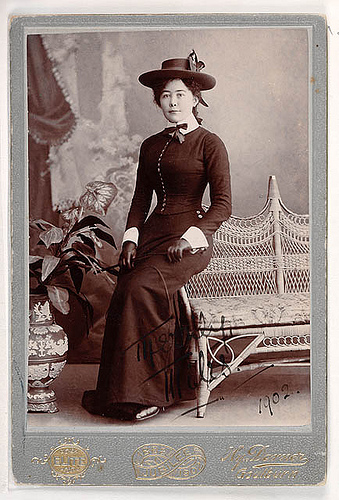
Miles Franklin, 1902

Miles Franklin, 1902, by H.Y. Dorner (Presumed Public Domain)

So now we are getting to the business end of Meanjin‘s tournament of books … and it’s getting exciting. Since I’ve been posting a little more frequently lately, I’ll keep this one short and, hopefully, sweet … after all, there’s still more to come.

Semifinal 1: Joan London’s Gilgamesh defeated Kate Grenville’s The secret river

It is at this point in the tournament that you start to feel really sorry for the losing book (and author). These are both contemporary authors, and both deserving of accolades, but if we are talking specific book and not body of work (as indeed we are) then I agree with the judge. The secret river is a brave book, and a well-written one. Kate Grenville is an excellent writer. But, London’s Gilgamesh has something special – a tone, a conception, a je ne sais quoi – that gives it the edge in this pairing. This seems to be what the judge, Robyn Annear, thinks too:

If Joan London sketches with a few bent lines and the suggestion of shade, Kate Grenville colours-in right to the edge of the page. Coming to The Secret River after Gilgamesh’s shrugged conclusion is startling, like plunging from sepia into vivid 3-D technicolour.

Semifinal 2: Miles Franklin’s My brilliant career defeated Henry Handel Richardson’s The fortunes of Richard Mahony

Well, if Semifinal 1 was a battle between two living writers, the second semifinal was between two dead ones! I’m a little surprised by the result, mainly because Career is generally regarded as the less “polished” of the two, but it was judged by none other than Hilary McPhee so who am I to argue? McPhee recognises Richardson’s achievement and, like the judges before her, finds the judging hard, but in the end she goes for the visceral. And I see no reason to argue against a reader judging on the basis of passion and feeling!

As always, the critical and the visceral response to powerful writing are in play — the tournament is located in my head. Right now, I’m with Sybylla, full of life, bouncing along in her boots made for sparring, outrageous, curmudgeonly, railing against fate. Fortunes is a masterpiece which has had its day and will have it again and again. My Brilliant Career might just be having it now. Go Miles.

Next up … the Zombie Round

I discovered, too late (why wasn’t I told?!), there’d been a poll on the Meanjin Facebook page for the two books to be returned in the Zombie round. They are Helen Garner‘s The children’s Bach and Alexis Wright‘s Carpentaria – but which book will be pitted against which semifinal winner we still don’t know. Keep watching this space …
Meanwhile, I could comment on which books did and didn’t make it to the final four … but I won’t, as I did say I’d keep this short! However, I’d love to hear what you think on the matter …

Monday musings on Australian literature: the AWGIES (for film)

Last week I finally saw the (excellent) film adaptation of Patrick White‘s The eye of the storm (which I may – or may not – separately blog about). I was intrigued to notice that the scriptwriter was one-time actor, Judy Morris, and this reminded me of the AWGIE awards.

The AWGIES are annual awards organised by the Australian Writers’ Guild. They recognise excellence in screen, television, stage and radio writing. I want to post about them because so often the scriptwriter is forgotten when films are spoken of – we talk most of the directors and the stars, and sometimes of the producers and cinematographers, but far less frequently of the scriptwriter. And yet filmmaking is truly a team activity and the script is a critical component. Scriptwriters are recognised, I know, in other awards – the Oscars, BAFTA, AFI etc – but the AWGIES are devoted to them.

The AWGIES have multiple categories, grouped under Film, Television, Stage, to name some – and they now have one for Interactive Media too. For Feature Film there are two main categories, though they aren’t always both awarded: Original and Adaptation. The awards have been going since 1967 – too long for me to list all the winners – so, yes, as usual, I will pick out some that particularly interest me!

Currency Press

In the 2011 awards, Currency Press won the Dorothy Crawford Award for Outstanding Contribution to the Profession. Established in 1971, Currency Press is a specialist performing arts publisher and, apparently, Australia’s oldest still active independent publisher. They are the first place you look (in Australia) if you want a published screenplay, but they also publish more widely in the performing arts arena. And they are, of course, a member of SPUNC, about which I wrote some months ago. Go small publishers!

Christos Tsiolkas

Like many writers, Tsiolkas (of The slap fame) doesn’t only write novels, though they are his main claim to fame. He has, in fact, won two AWGIES. The first was in 1999, for being co-writer of a stage play, Who’s afraid of the middle class? His second was in 2009, again as a co-writer, for the multi-story feature film, Blessed. It’s not hard to see Tsiolkas’ hand in this film which confronts us with the challenges of mothering from multiple angles. It’s gritty, but sympathetic rather than judgemental.

Luke Davies

Davies is another contemporary Australian novelist who tends to confront the seamier side of life. He’s also an award-winning poet and a screenwriter, and he won an AWGIE in 2006 for his feature film adaptation of his own (somewhat autobiographical) novel, Candy. Candy was one of Heath Ledger‘s last films and explores the world of a couple caught up in heroin addiction. I have seen the film, but have yet to read any of Davies’ work, something I must do.

David Williamson

It would be impossible to write about the AWGIEs without mentioning the prolific David Williamson. Primarily a playwright, he has also adapted many of his plays for film, and has won multiple AWGIEs for both his plays and his screen adaptations. His film AWGIEs include adaptations of his own plays, The removalists (1972), Travelling north (1988) and Emerald City (1989). He also won an AWGIE for an original screenplay, for the (now classic Australian) film Gallipoli (1981) on which he collaborated with the director Peter Weir. Williamson’s work tends to be satirical, and he has targeted most things that make up contemporary Australia, including football, party politics, the Melbourne-Sydney rivalry, university ethics and the police force.

Helen Garner

And now, just because I can, I’m going to include Helen Garner, who not only writes novels, short stories, literary non-fiction, and essays/articles, but also screenplays. She hasn’t won an AWGIE but she’s sure to have been considered because the films based on her scripts have all been well-reviewed (and won or been nominated for other awards). She adapted her own novel, Monkey Grip, for film, and she has written two original screenplays, Two Friends and The Last Days of Chez Nous (for which she was nominated for an AFI award). Two Friends is particularly interesting. It’s a teleplay directed by Jane Campion, and was shown in the Un certain regard section at Cannes in 1986. I like its narrative structure, which starts in the present, when the two friends had drifted apart, and moves backwards to the beginning of their friendship. If you know Campion and Garner, you have an idea of what a perceptive little treasure this feature film is.

At the bottom (currently anyhow) of the Australian Writers’ Guild website is a quote from Tom Stoppard. I like it and think you might too:

Words are sacred… If you get the right ones in the right order you can nudge the world a little. (Tom Stoppard)

How often do you think of the scriptwriters of the movies you like – or don’t like?

Nigel Featherstone, Fall on me

Featherstone, Fall on me
Fall on me bookcover (Courtesy: Blemish Books)

Nigel Featherstone is nearly a local writer for me – he lives in the country town an hour down the road – but I haven’t read him before, even though he has published a goodly number of short stories and short fiction. How does this happen? Anyhow, Fall on me is his second novel, or novella, to be exact. It is, in a way, an age-old story. The protagonist has experienced something in his past that has stalled his life, made him lose his way. From pretty early on, you know that this is what the story is about, but Featherstone tells it in such a way that it doesn’t feel old, that makes you want to keep on reading to find out exactly what did happen, and how (because you assume he will) our protagonist is “unstalled”.

How does Featherstone achieve this? I’ll explain soon, but first I’ll flesh out the plot just a little more. There are three main characters – Lou, our protagonist, who’s 38 and owns a small cafe in Lonnie (Launceston, for the non-locals); Luke, his son, who is 17 (and, significant to the plot, therefore not quite an adult yet); and Anna Denman, their boarder, who’s in her late 20s and works in a bookshop. As the back cover blurb says, the plot revolves around a decision by Luke “to risk all by making his body the focus of an art installation” which forces Lou “to revisit the dark secrets of his past, question what it means to be a father, and discover …”. Well, you’ll have to read the book – or at least find the back cover – to discover what Lou discovers!

The title of the book comes from the R.E.M. song, “Fall on me”, which is, says songwriter Stipe, a song about oppression, about the things that “smash us”. For Lou, a big R.E.M fan, what’s smashing him is his inability to move on from what happened in the past, when Luke was one month old. It is Luke’s art installation, of course, which finally precipitates Lou’s “unstalling”. Featherstone’s plotting is sure; he drops clues to what had happened, without telling us too soon but not dragging it out too long either. We realise fairly quickly that it involves a loss (after all he’s a single father) but how this occurred and who might be involved is not immediately made clear. The past is gradually filled in, through flashbacks, and the picture is slowly built up – though only sometimes in the expected direction. Where, we wonder, for example, does his old schoolfriend, Fergal, fit in?  Meanwhile, in real-time, the art installation plot runs its course.

A number of themes run through the novel, besides the “unstalling” one. One relates to art. I like the way the plot, without specifically mentioning it, reminds us of the Bill Henson “is it art or pornography” controversy which caused a furore in Australia in 2008. What happens when art pushes the edges, particularly when children are involved? Lou is shocked by Luke’s “My Exposure for You” installation and fears for his son. He wonders about “laws” that might come into play, and whether some sort of “‘artistic licence'” might apply. Luke, though, gets to the point: “But my body – ultimately – means nothing. It’s my heart that counts”. Another theme relates to parenting. Lou worries about the “installation”:

He can’t allow the exhibition to happen. He won’t – he could never – allow his son to put himself in the sort of danger that might now be coming his way, their way […]

Hang on. Is that really his responsibility, stopping his son from getting in the way of danger? Isn’t a greater responsibility encouraging his son to be all that he can be?

The writing is direct, straightforward. It’s not wildly innovative, but that doesn’t mean it’s uninteresting. There’s the occasional word-play and irony, some effective description, and apposite allusions including a sly reference to Lou reading Patrick White‘s The Twyborn affair. The characterisation is good. This is a novella, so only the main characters are developed and, even then, Anna is a little shadowy. We know what we need to know – but perhaps not as much as we’d like to know!

I enjoyed this book. It’s warm and generous, and it feels real. Around the middle of the book, when Lou expresses his desire to protect his son, Luke responds that “safety doesn’t always equal life”. Some risks need to be taken … as each of the characters realise, some later rather sooner. The end result is a story with heart … and that is a lovely thing.

Nigel Featherstone
Fall on me
Canberra: Blemish Books, 2011
130pp
ISBN: 9780980755633

(Review copy courtesy Blemish Books)

Monday musings on Australian literature: Asian Australian writers

Brian Castro

Brian Castro (Public Domain, via Wikipedia)

Australia is an immigrant country, with the first immigrants, the original Aboriginal Australians, believed to have arrived 40-60,000 (there are arguments about this!) years ago via the Indonesian archipelago. They established what is now regarded as one of the longest surviving cultures on earth. Today, though, I’m going to write on some of our more recent immigrants – those from Asia. The first big wave of Asian immigrants came from China, during the Gold Rush in the mid 19th century. Since then people from all parts of Asia have, for various reasons, decided to call Australia home – and have enriched our culture immeasurably.

I’m not going to focus on the political issues regarding acceptance, promotion and encouragement of Asian Australian writers because, like any stories to do with immigration, it’s too complex for a quick post here. I hope that things are improving, but only the writers and communities themselves can really tell us that.

As has been my practice in these sorts of posts, I’m going to introduce 5 Asian Australian writers to get the discussion going. After that, I’d love you readers to share “immigrant” writers you know and love …

But first, a definition. My focus here will be on writers who emigrated from Asia, rather than those from subsequent generations. I will not therefore be discussing writers like Shaun Tan and Alice Pung.

Brian Castro (Hong Kong born in 1950, emigrated 1961)

Castro is one of the most prolific and most awarded writers among those I’m listing today. He came here as a child, and started writing short stories in 1970. He has, to date, published 9 novels, many of them winning major Australian literary awards. Lisa at ANZLitLovers suggests he is a contender for Australia’s next (should we ever have another one) Nobel Prize for Literature. In 1996, in the Australian Humanities Review, Castro said this about Australia and Asia:

The situation currently is that Australia needs Asia more than Asia needs it. While the West seems to have run out of ideas in the creative and cultural fields, relying on images of sex and violence, reviving old canons and dwindling to parody and satire in what can already be seen as one of the dead ends of postmodernism, the Asian region is alive with opportunities for a new hybridisation, a collective intermix and juxtaposition of styles and rituals which could change the focus and dynamics of Australian art, music and language.

Strong words – but they make you think! My sense is that Australia is now seeing (accepting?) some of this hybridisation that he speaks of – not only from Asia but also from our indigenous authors like Kim Scott and Alexis Wright. I wonder if Castro agrees?

Yasmine Gooneratne (Sri Lankan born, emigrated 1972)

Gooneratne is one of the first Asian Australian writers I read. I have chosen her for that reason and for some sentimental reasons: she holds a Personal Chair in English at my alma mater, Macquarie University, and she is the patron of the Jane Austen Society of Australia! Long ago I read her first, appropriately named, novel, Change of skies (1991). Like many first novels, it has an autobiographical element and explores the challenges of changing skies, of migrating to another place. It was shortlisted for the Commonwealth Writers Prize. She has, in the last decade, received a number of awards here and in the South Asia region for her contribution to literature.

Michelle de Kretser (Sri Lankan born, emigrated 1972)

Like Castro, de Kretser emigrated to Australia in her youth (when she was 14) and made quite a splash with her debut novel set during the French Revolution, The rose grower. Her second novel, The Hamilton case is set in Sri Lanka and represents she says her “considered” farewell to her country of birth. Her third novel, The lost dog, is set in her home-city (now) of Melbourne, but its main character migrated to Australia from Asia when he was 14 and struggles to find his identity. Her books are not self-consciously migrant but tend, nonetheless, to be informed by the experience of dislocation.

Nam Le (Vietnamese-born, emigrated 1979)

Nam Le is our youngest migrant in this list, arriving here when he was less than 1! His debut book, the short story collection, The boat (2008), won multiple awards and is remarkable for its diversity of content (setting and subject matter) and voice. I, like many others, am waiting to see what he produces next.

Ouyang Yu (Chinese born, emigrated 1991)

To my shame I hadn’t heard of Ouyang Yu until relatively recently, but I do have an excuse. He has only written three novels in English and two of them very recently: The eastern slope chronicle (2002), The English class (2010), and Loose: A Wild History (2011). He is, however, a prolific writer, of, apparently, 55 (yes, 55!) books of poetry, fiction, non-fiction, and translated works in English and Chinese. He’s translated Christina Stead, no less, and even Germaine Greer’s The female eunuch. If this is not contributing to cross-cultural understanding I don’t know what is.

I’ll close with some words from an interview with Michelle de Kretser in which she articulates rather nicely I think the experience of being a migrant (using the character Tom from The lost dog):

But I think that like a lot of people who come to Australia, Tom is trying to escape something. You know, people come here often because they’re trying to get away from war, or poverty or persecution — or merely from perhaps difficult family situations. And I think Tom coming here as a child simply delights in the kind of freedom and anonymity that Australia offers him, which is a classic experience of people moving countries, or indeed if you go back to the 18th century people moving from the city to the country; the city at once offers this kind of blissful possibility of inventing yourself anew, a kind of wonderful freedom from inherited ways of thinking and being identified and categorised. On the other hand that is also simultaneously — can be — a very lonely and disconcerting experience, again.

Meanjin’s Tournament of Books 2011, Round 2

For those interested in the continuing story of Meanjin‘s Tournament of Books, which I introduced in late October, Round 2 has now been played. Here are the results … with a little additional commentary by me.

Match 1, Joan London’s Gilgamesh defeated Helen Garner’s The children’s Bach

Oh, such a hard one. I feel for judge Michaela McGuire, a self-0uted Helen Garner fan who gave the match to Joan London. That takes bravery. I’m sure she had her heart in her mouth when she put those fingers to her keyboard. Anyhow, in the end, she gave it to London for the lovely single sentences (she’s right there) and, as I understand her, the expansiveness of the conception. She admires Garner’s “characteristic elegance and wryness” but “was left wanting”. She decides not to give it to Garner based on her love for the body of Garner’s work but to London based on this work. Fair enough. It would have been a hard call for me, too, and I would like to see London’s beautiful, mesmerising book receive wider exposure.

Match 2, Kate Grenville’s The secret river defeated Christina Stead’s The man who loved children

This may be the shock of the round, methinks. Admittedly the judge, Michael Williams, like McGuire above, bemoaned his lot. He calls them both masterpieces. He argues that both writers have a significant body of quality work. He says literary comparisons are b******t. And so, in a sense, he cops out. He tells us that in 1967 The man who lived childrenwas declared ineligible for the Britannica Australia Award because Stead had “ceased to be Australian”, though he also admits that it took only 70 years for it to assume a strong place in the Australian canon. But, he concludes, “Canonisation is for the dead. Tournaments are for the living. I’m giving this to Grenville“, and then declares his conflict of interest as having been involved in promoting The secret river at Text Publishing on its publication. Not having read Man yet and being a big defender of The secret river as excellent and valid historical fiction, I must, in fairness, stand on the sidelines, but I find this outcome an interesting one.

Match 3, Miles Franklin’s My brilliant career defeated Melina Marchetta’s Looking for Alibrandi

Sorry, Melina, I did love your book but I feel this is the right and proper decision. Judge Sarah L’estrange discusses the similarities in subject matter between these two books – “strong willed and independent” teenage girls fighting to find their own life against a background of familial and societal expectations. However, she gives the match to Franklin because Looking for Alibrandi is “just too straight-forward in the telling, there isn’t the dazzling dance of words across the page that My Brilliant Career has in spades”. I think she’s right. Alibrandi is locked pretty firmly into the Young Adult genre while Career has a more universal appeal, largely because of its writing and conception.

Match 4, Henry Handel Richardson’s The fortunes of Richard Mahoney defeated Cate Kennedy’s The world beneath

Another judge complaining about comparing literature! Makes me wonder why they signed up for the job! Anson Cameron makes me laugh though. Of Richardson‘s big book he says “Fat books, like fat people, die young unless they have huge hearts” and concludes that “only very good books age this well. Only very good books have the architecture to withstand great changes in the world. Of Kennedy‘s book he writes that it is “a Garnerish, (Garneresque? Garnery? Garnerly?) type novel in that it is imbued with a the kind of everyday insufferable domestic pressure Helen Garner excels in and it’s rendered in a spare, accurate prose reminiscent of her”. Not that he says it, but perhaps that’s a good enough reason for it to lose, perhaps it is too “Garner” rather than something original. I’m afraid I wouldn’t know as this one’s still in my TBR pile. Richardson would, I think, have the body of opinion behind her so Cameron has probably chosen well … and anyhow, if Garner was going to win, I’d rather it be Garner (if you know what I mean).

Now onto the Semi-finals …

In three of the four matches in this round, a classic was pitted against a contemporary, and the classic won two of them. I’m surprised the third one didn’t win too. Does this mean I’m a reactionary, old fuddy-duddy of a reader? Or does it simply mean that the classics have proven themselves as stayers over time? I prefer to think the latter … which suggests that if a contemporary novel wins the tournament, it will surely move one step higher on its climb to classic status.

I will be reporting again …

PS: I planned to list the semi-final matches here, but the numbering of the matches above does not accord with the numbering on the initial tournament plan, so I’m not sure which book will be pitted against which. Has some match-fixing been going on? Surely not!

Monday musings on Australian literature: Christina Stead

I have mentioned Christina Stead several times on this blog – and yet she remains the guilty gap in my reading. I thought 2011 would be Stead year, but things have conspired to restrain the rate of my reading this year. Maybe 2012! I have also written several posts inspired by articles in The ABC Weekly, and I’m returning to this paper for today’s Monday Musings, this time to an article by novelist-journalist Florence James. It’s titled “Young Australian Wins Fame Abroad” and was published on 7 December 1940, at which time Stead would have been 38. This was the year her most famous book, The man who loved children, was published, but James does not mention it by name in her article. (She does though refer to Stead “correcting the galley proofs of a new book”).

James commences her article with a telling comment:

A Sydney girl [girl?] whose name and work are much more widely known and appreciated in England and the United States than in her native Australia is the writer Christina Stead.

I can’t help thinking that little has changed 7 decades on, at least in terms of her recognition here. She is certainly known, but she is not on the tip of everyone’s tongues the way I suspect she ought to be.

James then documents some of this acclaim:

  • English critic John Squire who, on reading her short stories The Salzburg tales (1934), said he’d discovered a “second Sappho”;
  • Poet, and publisher’s reader, T. S. Eliot, who wrote that The Salzburg tales was “a work of genius – but doubtful as a popular success”; and
  • New Yorker critic, Clifton Fadiman, on reading House of all nations, claimed Stead and Virginia Woolf were “the two most important women writing in the English language”.

James, who shared “digs” with Stead for a time in London while she was writing Seven poor men of Sydney, outlines how Stead supported herself in the late 1920s and early 1930s. She started as a private secretary for a firm of grain-brokers. She then worked in a private bank in Paris rising to an important confidential position, and she did “some special financial work in London [which] was regarded with astonishment by conservative London financiers”. A young colonial, and a woman, no less! That would probably never do! Her third novel, House of all nations (1938), is about high finance and has been described by Kate Jennings as one of the best novels ever written about banking.

James describes Stead as follows:

At first shy and reserved, with her friends she is wonderful company. Her talk is as witty as her writings, and although she has a masculine [masculine?] grasp of business and is a scholar and linguist, her simplicity of manner and directness of approach immediately put people at their ease.

I do like reading contemporary articles (or reviews) like this … not only do we learn about the subject but we learn, unintentionally on the part of the writer we are reading, so much about the thinking of the time. Thank goodness for libraries and archives, eh?