Elliot Perlman, The street sweeper (Review)

Elliot Perlman‘s latest novel, The street sweeper, is a complex book with a pretty simple message. It’s complex because of its multiple interconnecting storylines that move back and forth between World War II, the American Civil Rights era, and contemporary times. It has multiple themes, about which I’ll write further, but the underlying message is simply this: history is important. Related to this is the idea that all things are connected. Let me explain …

The original characters in the novel, those from whom the connections flow, are two lawyers, the Jewish Jake Zignelik and African-American William McCay. Both were active in civil rights in the 1960s. However, as the novel starts, Jake has been dead for some time, and William is in his 80s. The baton, in a way, has been passed to their sons, Charlie and Adam who are historians at Columbia University. It is around 2008, and both men have lost their way somewhat. Charlie is a successful academic, so successful that his administrative duties are not only tearing him away from his main love, research, but also from the important relationships in his life, those with his father, wife and teenage daughter. Adam’s problem is different. His career has stalled. He hasn’t published anything for so long that he will not get tenure – and Charlie, who has been his mentor, but who has let that relationship slide too, can’t help. Adam, believing it’s the honourable thing to do, breaks up with his long-standing girlfriend, Diana, on the basis that he’s unable to be the husband and father that he believes she wants.

None of these characters, though, is the street sweeper of the title, because there is another significant character, the one who opens the novel. This is Lamont Williams, an African-American who has just started work as a janitor at a cancer hospital in a pilot program for ex-convicts. He, like Adam, is close to 40 years old. Lamont, we soon learn, is a good man to whom bad things happen, just like the hero in Perlman’s first novel, Three dollars. He is, in fact, innocent of the crime that put him in jail but his colour and poverty meant he didn’t have a chance – just like the Jews in war-time Europe.

The novel focus primarily on these two men – Adam and Lamont – as they struggle to get their lives on track. Lamont’s story sees him getting to know hospital patient and Holocaust survivor Henryk Mandelbrot who tells Lamont over a period of nearly 6 months of his experience under Nazism, particularly in Auschwitz. Mandelbrot wants his story known, and insists that Lamont learns and remembers it. Meanwhile, Adam, initially reluctantly, looks into a research project suggested by Charlie’s father William, one that sees him also learning about the horrors of the Holocaust. As the novel progresses, and more characters – from the past and present – are introduced, the connections and links between people multiply, rather like a Dickensian novel. There is, though, a point to these connections. Early in the novel, Perlman writes that

you never know the connections between things, people, places, ideas. But there are connections.

And these connections, whether we know it or not, can direct the trajectory of our lives – as they do for the characters in The street sweeper. There is also a central ideological connection in the book, and this is that there are “parallels between the situation of blacks in the United States and the Jews in Germany”.

A major theme of the novel – one of Perlman’s pet themes in fact – is that of moral responsibility, of what makes a “good” person. As so often happens, those who have the least but, paradoxically, the most to lose, are quickest to take the moral path. Early in the novel, and four days into his 6 months probation, Lamont is accosted by Mandelbrot who asks a favour. This favour is something Lamont is not supposed to do – it’s not his job – but, seeing the old man’s distress, he risks losing his job to do the right, the moral, thing. Late in the novel, a professional woman who has nothing to lose but a bit of her time is asked to do a moral thing. She experiences a jolt when, after a passage of time, she realises that she’d been prevaricating about an issue of justice. Not all characters though come to this realisation regarding their moral duty.

I said in my opening paragraph that the underlying message of the novel is that history matters. This is conveyed throughout the book by discussions about history and the role of historians, by showing historians going about their business, by reference to the “long causal chain” and to the importance of remembering, and most of all, by the refrain, “tell everyone what happened here”. You won’t be surprised to know that I loved the fact that Perlman explicitly and implicitly explores the theory and practice of history here, but it deserves a post of its own so watch this space … I’ll simply say now that Perlman explains in his author’s note which characters are based on “real” historical figures, and he provides an extensive list of the sources he used.

The question I always ask when reading historical fiction is why has the author decided to tell this story from the past? In Perlman’s case the answers are obvious. First it’s the one made explicitly in the novel, and that is to “tell everyone what happened here”. Then there’s the more implicit one to do with why we need to know what happened, and that is to ensure that the horrors visited upon the Jews in the Holocaust and the African-Americans in the US don’t happen again. And finally it’s to remind us of our basic moral responsibility which is, as William says to his son, to “Do what’s right here, Charlie”.

I could pick some holes in the novel. It’s big and a little baggy around the edges. It can verge on didacticism at times. And, to make the necessary connections, Perlman relies a lot on coincidence, which could seem contrived if you haven’t bought into the story. But, here’s the thing. I have read many good, even excellent, books this year. However, The street sweeper, like Rohinton Mistry‘s A fine balance and Margaret Atwood‘s The handmaid’s tale, is one that will stay with me long after I’ve forgotten the name of the characters, long, even, after I’ve forgotten how the plot falls out. And that, for me, is the best sort of read.

Lisa of ANZLitLovers also liked this novel.

Elliot Perlman
The street sweeper
Kindle edition
Random House, 2011
ASIN: B005LV7O4S

Monday musings on Australian literature: Canberra’s centenary

The invisible thread, by Irma Gold

Cover (Courtesy: Irma Gold and Halstead Press)

In 2013 Canberra, Australia‘s national capital, will celebrate its centenary. A whole raft of events and activities has been planned to keep us busy and buzzing all year – and I look forward to them – but for me, a reader, one of the most exciting projects inspired by the centenary is The invisible thread. It’s an anthology of fiction, non-fiction and poetry by writers, past and present, who have had an association with Canberra.

Some 75 writers are represented. Seventy-five! Even I, with my now rather long history in the capital, am surprised by the number, which perhaps gives you a hint to the meaning of the title. Robyn Archer, the Creative Director of the Centenary, writes in the foreword that much about Canberra is hidden or invisible but, she says, “just because you don’t see it, it doesn’t mean it isn’t there”. Like, for example, service stations! We do have them, contrary to popular opinion, we just like to keep them tucked away a little! Bill Bryson also noticed this feature of Canberra in his book Down Under. He wrote:

It’s a very strange city, in that it’s not really a city at all, but rather an extremely large park with a city hidden [my emphasis] in it. It’s all lawns and trees and hedges and a big ornamental lake [Lake Burley Griffin] – all very agreeable, just a little unexpected.

Hence The invisible thread!

Now, I haven’t yet read the book, having only acquired my copy last week, but I’ve given it a good look. And within its pages I’ve found many friends – personal and literary. Some are writers I have reviewed in this blog over the last three years or so, namely Francesca Rendle-Short, Alan Gould, Geoff Page, Alex Miller, Nigel Featherstone and Marion Halligan. Others are classic writers I’ve mentioned in various posts, particularly the Monday Musings series. These include some wonderful women, Judith Wright, Rosemary Dobson, Kate Grenville, Miles Franklin and the collaborative team M Barnard Eldershaw. There are writers I’ve known for reasons external to their writing, like Michael Thorley and Sarah St Vincent Welch. There are young writers like the internationally published Jack Heath and rap artist Omar Musa, and older writers like historian Bill Gammage whose The biggest estate on earth won this year’s Prime Minister’s Literary Award and the Victorian Premier’s Literary Award. And there are some of the grand men of Australian letters, like the poets AD Hope and Les Murray and the historian Manning Clark. If all these don’t tempt readers, I’m not sure who will, except perhaps those I haven’t mentioned!

The book is divided into four sections: Looking Backwards, Looking Forwards, Pts 1 and 2, and Looking In, Looking Out, Pts 1 & 2. Editor Irma Gold*, whose collection of short stories I reviewed earlier this year, describes the breakdown as “open-ended and kaleidoscopic”, and says that while Canberra features in the writings,

it is not the headline act. Rather, it supplies the invisible thread that links writers to each other, as one-time or full-time Canberrans, and to everyone who call Australia home. Like writers everywhere, the writers showcased here are looking both in and out, backwards and forwards, conveying the world through the lens of their experience.

Each of these sections is introduced with a delightful cartoon by Judy Horacek, one of my favourite cartoonists.

I plan to return to this book, when I’ve had time to digest it more, so I’ll finish here on a little anecdote. In 1988, some good friends and I started a reading group, one that will celebrate its 25th anniversary next year. Our initial focus was Australian women writers, and so in those early years we read Marion Halligan, Kate Grenville and more. We were Canberra women readers. However, also in 1988, a group of Canberra women writers (which included Marion Halligan and was known as the “Seven Writers”) produced a collection of short stories titled Canberra Tales. Several of those writers are included in this anthology, including Dorothy Johnston. Johnston’s story in that collection, “The Boatman of Lake Burley Griffin”, is also in this anthology. Its opening sentence is:

To look at the lake, you’d think nothing dramatic, scarcely anything human happened there.

But how wrong you’d be …

Irma Gold (ed)
The invisible thread
Braddon: Halstead Press, 2012
256pp.
ISBN: 9781920831967

* To hear interviews with some of the anthology’s authors, check out Irma Gold’s You Tube page

Monday musings on Australian literature: Some thoughts on specialised literary awards

Did you hear last week that the Man Group is, after the current award, withdrawing its support for the Man Asian Literary Prize? I heard it via a tweet from a member of our prize team for the 2011 prize. This, in the same year that the Queensland premier cancelled the Queensland Premier’s Literary Awards. What is happening? Is there something in the international waters? Has climate change somehow blown the winds in the wrong direction?

And yet, fortunately, other awards keep appearing. Late last week I reported on the shortlist for a new award here, the Most Underrated Book Award (or MUBA). In the same week the people behind the new Stella Prize finally called for nominations for the inaugural award. Winners will be announced in April next year. This award, appropriately named for Miles Franklin – her full name was  Stella Maria Sarah Miles Franklin – is “for the best work of literature [fiction and non-fiction] published in 2012 by an Australian woman”. Fiction and non-fiction! This will be interesting.

All this ground-shifiting raises the question, yet again, regarding whether new (in fact any) prizes are warranted, particularly prizes targeted to special groups. Author Chris Flynn, writing on the Meanjin Blog regarding the Stella Prize, said, in support of a prize for women writers:

At this point in the process the argument over whether or not a dedicated prize for women is needed is moot. We can, after all, have as many prizes as we like in literature and even if the Barbara Jefferis Award already exists, so what? Men are eligible for that anyway, as the $35K goes to ‘the best novel written by an Australian author that depicts women and girls in a positive way or otherwise empowers the status of women and girls in society.’ Frank Moorhouse was shortlisted this year, and Anna Funder won. If I came into some moolah and announced I was starting up The Flynn Prize for, say, the best first novel of the year, would anyone seriously be shouting me down and saying it was unnecessary, that there are already plenty of prizes out there and debut novelists should just suck it up and hope for the best? Yeah, I don’t think so, somehow.

I like his point that “We can, after all, have as many prizes as we like in literature”.

This brings me back to the Man Asian Literary Prize, which started in 2007. The executive director of the prize, David Parker, thanked the Man Group for its support and argued for the value of the prize:

We look forward to the future with a new partner, confident that Asian fiction is now beginning to secure the global readership and recognition it deserves. Our most recent winner, Please Look After Mom by South Korean writer Kyung-sook Shin, has recently sold its two millionth copy worldwide – an amazing achievement. One third of the shortlisted writers for this year’s Man Booker Prize are from Asia, and international publishing houses such as Pan Macmillan and Hachette have recently opened offices here in Hong Kong. Clearly, Asian literature is on the march.

I don’t know what part the Man Asian Literary Prize played in these encouraging results, but have to assume that the increased international profile it provided for Asian writers played at least some part.

Not all awards, of course, can hope to bring about such high profile change. Some certainly carry more weight (read “status”) than others, but I’d liken it to the Olympics versus national and state championships. This network of championships all play a role in the development and recognition of athletes – and so surely do the international, national, state, local and specialised awards for writers.

For writers and publishers, then, I think awards – both general and specific – have value. What about for me as a reader? I’m not a close follower of literary awards. That is, I don’t aim to read all the long- and shortlists in specific awards, or even all the winners, but I do like to keep an eye on awards and they do help inform my reading choices. I find them particularly useful as a guide in specialised areas that are out of my comfort zone – and hence my involvement in this year’s Man Asian Literary Prize. I was introduced to the literature of countries I’ve never read before. I’m hoping MUBA and Stella will do the same for the writers (and readers) they are targeting.

The Most Underrated Book Award 2012

A short post! I have just read on the SPUNC site that Kobo is sponsoring an award to highlight books that were released by independent publishers and members of the Small Press Network (SPUNC) and that did not receive wide recognition.

The shortlist for the inaugural award was announced this week, and the titles are:

The award apparently recognises both the publisher and author. The winner will be announced, the SPUNC announcement says, on 8 November at the opening of the Independent Publishing Conference during a special gala night and literary debate at the Wheeler Centre.

Good on Kobo I say. Books published by smaller presses are often overlooked in the major literary awards partly, I presume, because the authors usually aren’t well enough established to be noticed and partly because small publishers don’t have the marketing clout and distribution networks to get their books out to enough readers and reviewers. I hope this new award will help raise the profile of the authors and their hardworking publishers.

* I have a soft spot for Irma Gold, and not just because I’ve read and enjoyed her book. She lives in my city, and is currently coordinating the production of, and editing, The invisible thread, an anthology of works “by writers who have an association with the Canberra region”. The book represents a major literary contribution to Canberra’s 2013 Centenary Celebrations, and is planned to be the focus of many literary events over the coming year. Watch this space!

Monday musings on Australian literature: Guest post from Marilyn of Me, You and Books

I first “met” Marilyn earlier this year when she decided to take part in the Australian Women Writers Challenge 2012. There aren’t many non-Australians who have signed up for this challenge so Texas-resident Marilyn stood out. She is a retired professor of a small liberal arts school in the USA, where she taught women’s history, black history, US social history, and women’s studies. We started “talking” about the similarities and differences in our respective settler nations, and discovered that we share some interests in the intersection between literature and history. She seemed a perfect person to ask to do a Guest Post for Monday Musings. Luckily for me she said yes … thanks Marilyn! Here is her post:

Writing about Indigenous Peoples: Grenville and Clendinnen

I never set out to become a critic of Australian writers. When I started blogging last January, I joined the Australian Women Writers challenge because I wanted to read more globally. Then I read Anita Heiss’s guest post on Australian Indigenous Women Writers and started reading books by and about Indigenous women. I was hooked.

In the past, as a white scholar, I have researched and taught about African American, Native American, and Hispanic peoples in US history. In Women’s Studies, I also have explored the differences between the stories that women and men typically tell about women. With an African American colleague I researched and wrote about Black Women’s Clubs in Kansas. In my own mind, I have played with questions of how those from the dominant culture can write with authenticity about those our culture has defined as Other. Reading books by and about Australian Aboriginals put me back into those issues.

Kate Grenville and Inga Clendinnen have both written about the original encounter between British settlers and Australian Aboriginals. Both have strong views about how to approach the subject. In 2006, after the publication of Grenville’s The Secret River and in the context of the Australian “History Wars,” the two publicly debated their different viewpoints. Having recently read several books by each, I see their debate as crystallizing the issues for all of us who seek to read and write those who are different from us in essential ways.

Grenville writes as a novelist and Clendinnen as an historian, making some of the differences between their writing predictable. As an historian, I may be biased in favor of Clendinnen. But their initial perspectives on Indigenous people are even more divergent and more critical. Clendinnen speculates equally about the British and the people they found in Australia. Grenville explicitly immerses herself in the characters based on her ancestors and views the Indigenous people as “too different” to attempt to understand.

As many of you know, Grenville is a superb writer, in part because she literally puts herself into the landscapes and characters of her stories. For her Thornhill books, she sailed along the rough Australian coast and stepped into the wilderness just off the path to try and discover how her ancestors would have experienced those places. And she is able to convey what she has experienced to her readers. In part, her method works because people, past and present, share basic human thoughts and feelings. Clendinnen points out, however, that the British whose experiences Grenville seeks to know and describe are really not like those of us who read her novels today. Grenville is able to make people from the past seem real, but she can not know them more accurately than historians, as she may have claimed to do. She later retracted comments which implied that fiction was superior in telling what really happened. It may indeed be better at conveying the feelings, but it cannot prove their reality.

Clendinnen is very aware of the rules that historians agree to follow in their writing. She sometimes chaffs at those rules, describing herself as Gulliver held down by all the little ropes of the Lilliputians. Historians are limited by the “evidence.” They don’t write oral dialogue into their books, and they state the sources of their information, for example. In the end, Clendinnen accepts her identity as an historian. But her discipline is changing as historians, like others, face the implications of shifting understandings of “memory” and “truth.” With some assistance from anthropology, Clendinnen seeks to squeeze out clues to the larger cultural significance of human actions, and she is more willing to speculate than historians have traditionally been willing to do. Looking very carefully at the accounts written by British officials about their first contact with the Australian Aboriginals, she analyzes both groups and the values held by each, revealing both the cultural misunderstandings and the confusion on both sides. She points out how initially both groups were hopeful, even willing to “dance with the strangers.” Gradually, however, each side misread the other and tension between them grew. The British could not conceive of the rituals the Australians were enacting, and the Australians could not grasp why the British lashed and hung members of their own community.

What is unusual here, and in sharp contrast to Grenville’s first and third Thornhill novels, is that Clendinnen explicitly gives the Australian Aboriginals and the British equal treatment. Deeply aware that societies define “truth” differently, she sees both groups as equally human. She explicitly rejects any assumptions that the British accounts are objective rather than filled with their own value judgments. In contrast, Grenville stops at the surface of the Indigenous people, portraying them as if they were objects, not as she treats her fully developed Anglo characters. In doing so, she does recreate her own ancestors’ probable perception of them. However, this approach encourages her readers to go on thinking of Aboriginals as silent and thus less than human.

In The Lieutenant, the second of the Thornhill books, Grenville is able to write with an authenticity and feeling about the Indigenous people not present in the other books. Grenville does a fine job of using history as a starting point for this novel. She uses some of the same source material that Clendinnen used in her historical work, Dancing with Strangers, but she goes in a difference direction. First, she creates the character, Daniel Rooke, the fictional version of William Dawes, who kept the notebooks which Grenville used in researching the novel. She envisions him as a boy and young man with a prodigious mathematical ability but no social skills. When Rooke comes to Australia as the astronomer for the First Fleet, one of task he sets himself is that of learning the language of the people already living there. He realizes that learning individual words, as others are doing, is not enough. He wants to grasp the structure and feel of the language. A bright, young Indigenous girl agrees to help him learn in exchange for his teaching her English. Grenville says she is ten or twelve years old, the age that Rooke remembers his dearly loved sister as being. A delightful exchange develops between the two, not romance but the shared excitement of discovery and learning which Grenville describes wonderfully. In the process, Rooke becomes sharply aware of the native peoples’ humanity and, with joy and pain, of his own. As events unfold, he is forced to realize that these human bonds conflict with his duties as a military officer.

Despite their previous disagreements, Grenville follows Clendinnen’s approach to conceptualizing Indigenous people in The Lieutenant. Her major character is British and his changing thoughts and feelings are the focus of the book. When he gets to Australia and begins to work with the people there to learn their language, however, he is increasingly aware of them as real people, not as the silent shadow figures that appear in her other books. Native and British are equals; in fact he realizes that at times the girl is quicker than he is to figure things out. Perhaps Grenville is capable of doing this in this particular book because she stayed so closely to the actual words written in Lawson’s notebooks. She notes, in something approaching a footnote, that the conversations between Rooke and he young girl were not imagined but taken directly from the notebook. She only creates the feelings and thoughts that might have accompanied those words. Clendinnen and any other historians would be impressed. As I read, I didn’t care whether or not Grenville’s descriptions had actually happened because she stayed so close to what we can know in her imagining.

Grenville shows us in The Lieutenant that an author need not be Indigenous to write authentically about them. Using the notebooks left by William Dawes seems to have helped her achieve this. Sadly, she was not able to do the same thing in her next novel where the documents she used were written by those who did not honor and listen to those unlike themselves. Perhaps listening is the key; listening to documents, listening to voices that are unfamiliar. It is hard work, however, for an author to understand and write from the perspective of the Other. But it can be done, as Grenville shows us in The Lieutenant.

I agree that is easy to expect too much of novelists who write historical fiction. But I believe that the most basic requirement of the genre is that authors not treat any group of characters in their books as empty stereotypes. For years male authors treated women in this way until, finally, women began to introduce women characters that were as fully human as their male ones. Now we seeing fuller and more authentic women in men’s writings as well as women’s. We need to make the same change in how we write about other groups which have been subordinated in the past. That is what it means to move beyond colonization and assumptions of white superiority.

Relevant writings. Links to my reviews and online articles.

Grenville, Kate. The Secret River (2006), The Lieutenant (2008), Sarah Thornhill (2012) and “Unsettling the Settlers.” I tried to obtain her Searching for the Secret River, but no libraries in the US have a copy to loan.

Clendinnen, Inga. Tiger’s Eye (2001), Dancing with Strangers (2005), and her online essay, “The History Question: Who Owns the Past” (2006).

And now Marilyn and I would love to hear your thoughts on the books and/or issues she raises here.

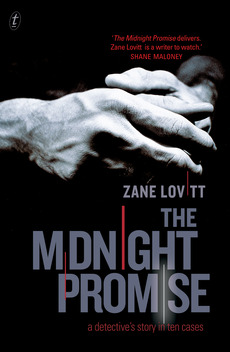
Zane Lovitt, The midnight promise (Review)

Zane Lovitt, Midnight Promise

Book cover (Courtesy: Text Publishing)

Zane Lovitt’s debut book, The midnight promise, is one of those books for which I can’t decide how to start my review. I could go with the point, previously made in this blog, that I’m not a reader of crime and so cannot speak with authority on the subject. Or, I could write about the fact that one of the chapters in the book, “Leaving Fountainhead”, won the SD Harvey Short Story Award in Australia’s top crime awards, the Ned Kelly awards*. I could start with how Melbourne-based Lovitt joins the growing number of lawyers who write fiction. Or, I could start with the topic that interests me most, its form.

Because, if you haven’t noticed, I didn’t use the word “novel” once in my opening paragraph. There’s a good reason for this: The midnight promise is, if I can draw from the main media through which I consume crime, more like a detective series than a movie. I could have described it as a book of short stories, but that would be misleading. The ten chapters or stories all feature the one detective or “Private Inquiry Agent”, John Dorn, and they are told chronologically. Moreover, even though the book comprises ten separate cases, rather than one main case as would be expected in a novel, there is an overarching, albeit not immediately obvious, plot, defined by “the midnight promise”.

This form may, in fact, be one of the reasons I liked it. Each story is complete in itself while also forming part of a greater whole if you keep reading. The form is also, however, responsible for my only real criticism, which is that, almost without exception, the stories are structurally the same. They follow a present-flashback-present-flashback (and so on) structure. In a “true” book of short stories, I like things to be mixed up a bit; I like to see variety in style, in voice, structure, tone, language. That’s not the case here – but neither, I suppose, would it be the case in a television detective series, so perhaps my criticism isn’t valid. Still, a couple of times, I felt myself saying “here we go again …”.

John Dorn is not, I think, a particularly original character, for the genre. Like many crime protagonists, he’s somewhat of an outsider, a loner with a broken engagement behind him. He’s also a man of some principle which is why his is pretty much a hand-to-mouth existence. In the early stories his fee ranges from $400 a day to $250 a day to nothing depending on whether he wants (or believes in) the job or not. The higher the charge the less he wants it! For this reason we like Dorn, and want things to work out for him, but somehow, more often than not, he manages to shoot himself in the foot.

Being a private eye, his cases are varied, from marital spying to finding missing people to protection (of the innocent or the guilty). But the theme is consistent. It’s “the shitty things people do to each other” or, as he puts it more colourfully when describing roadkill in the final story:

We drive over two foxes, parallel, like one of them couldn’t bear to live without the other. Though what’s more likely is one fox was eating a dead fox and got hit by a car because he didn’t see it coming because he was distracted because the other fox was so delicious.

Not a grammatically beautiful sentence but appropriate and effective in the context. In fact, I liked Lovitt’s writing. The voice is first person, and the writing is generally direct and spare with the occasional well-placed image which works partly due to its rarity. Like this, for example:

I’ve heard rumours about his shady GST schemes, but everything I know about tax offences wouldn’t rouse a chihuahua from its beauty sleep.

The dialogue is realistic. There is humour – mostly in Dorn’s sardonic view of the world – which varies the tone. There is irony, as in the name of the character, Comedy, who is anything but funny, and in the story “Grandma’s House” whose title belies the horrors within.

And this brings me back to the form, to the fact that while each story is complete there is a trajectory in the book, heralded by the occasional bit of foreshadowing. We know something is going to happen that will change Dorn’s life, and probably for the worse. The crisis occurs in the seventh story, “The Crybaby Technique” – and it’s ironic because he was, in this particular case, only a bit player. Things change gear from here, leading to the final crisis in the tenth story which is significantly titled “Troy”. It’s a gripping read with a beautifully controlled out-of-control last page. You’ll have to read it to see what I mean.

So, would I recommend this book? Yes, to non-crime readers, like me, who look for character and good writing, and to crime readers who, I’m presuming, like intriguing cases with a detective who keeps you guessing. If I were a crime reader, I’d be saying I hope this isn’t the last we see of John Dorn, or of Zane Lovitt. In fact, I’ll say it anyhow …

Zane Lovitt
The midnight promise
Melbourne: Text Publishing, 2012
283pp.
ISBN: 978192192230

(Review copy supplied by Text Publishing)

*In 2010. It also appeared in Scribe’s New Australian Stories 2, that same year.

Paddy O’Reilly, The salesman (Review)

I’ve been wanting to read Paddy O’Reilly for the longest time but somehow haven’t managed to get to her so, as is my wont, I decided to read a short story of hers in the Griffith Review. She made her name, I think, with her short stories, but has also written novels/novellas and a screenplay, and is a regular contributor to Australia’s best literary magazines.

I know you wouldn’t expect this of me, but I’ve just told a lie – just a white one, your honour – because I have read a couple of articles by Paddy O’Reilly, and I did read her opening story in Scribe’s New Australian Stories 2, published in 2010. The story was titled “How to write a short story”. It’s a very short piece, just over a page, but it was my first, albeit very short, introduction to O’Reilly. The piece is presented as a recipe, with a list of steps, such as:

Test whether the story is done by inserting a reader. If the reader comes out clean, the story is done. If the reader comes out sticky, place the story back into the situation for another 500 words.

This story suggested to me that O’Reilly is not afraid to let women’s experience underpin her writing. But, this doesn’t mean that she wants her writing to be labelled “women’s fiction”. As she asks in her recent post for the Australian Women Writers Challenge 2012, what is women’s fiction? Writing for women? About women? By women? I’m inclined to agree with her that it’s not a useful distinction. What after all is “men’s fiction”? Categorising works as “women’s fiction” has the potential to (and in fact does already) marginalise, trivialise even, women writers and readers. So, like Paddy O’Reilly, I tend not to think in terms of “women’s fiction”. I do, however, and I’d argue this is quite different, like to focus on “women writers”.  Hence, here I am, reading (more) Paddy O’Reilly …

“The salesman” is set in a working class suburb of Melbourne where there’s 80% unemployment. It features a salesman (obviously), a young woman named Marly, and her boyfriend and his mate. The story opens with the young woman alone at home. It’s hot and life is clearly not much fun. Her boyfriend Shaun and his mate, Azza, spend their days working on cars, their heads “under the bonnet like stupid long-necked emus”. And, the fridge is “moaning”. Such language in the first paragraph makes it pretty clear that Marly is not a happy woman. In fact, we learn a little later on that she has lost part of a leg, creating an effective metaphor for a life that is missing something critical. Pran, the salesman, appears in the fourth paragraph. He’s a Hindu from Delhi but Marly, and later Shaun and Azza, persist in calling him a Paki.

Pran insists he’s not selling anything, but after Shaun and Azza return, we finally learn that what he is “selling” is a free offer! Shaun and Azza, as (stereotypically) men often do in these situations, lead Pran on while Marly is conflicted. Shaun is an “attentive” boyfriend. “She would not do better than this”, not better, she thinks, than a man “who had not once in eleven months raised a hand to her”. But, she’s attracted to Pran, to his “rich burnt-toffee” coloured skin and his “runny dark brown” eyes. It’s not just the physical though.  She senses through him, through her questions about his beliefs, that there could be more to life than hanging around waiting for the men to bring home beer and pizza. She does not want his visit to end in violence as, we are told, has happened before.

I’ll say no more about the plot. This is a story about the underside of modern Australia. It’s about poverty and deprivation and how these result in an arid, goal-less life in which there is little empathy for other. It’s about racism, about how, if you are the wrong colour, years of study can lead you to peddling “free offers” to people who can’t afford them. The ending is clever. While we are told the general outcome, we have to guess what really went down. What we do know, though, is that no-one ended up a winner. This is just the sort of story I like – it’s accessible, it has a clear vision with a tight focus, and it raises more questions than it answers. You can read it online at the link below.

Paddy O’Reilly
“The salesman”
Published in the Griffith Review, Edition 29, August 2010
Availability: Online at the Griffith Review

Monday musings on Australian literature: Australian women’s non-fiction writing

Today’s Monday Musings was inspired by a post last month in Overland literary journal’s blog. The topic – Women and non-fiction writing – is a big one, bigger really than I have time for now, but I figured it wouldn’t hurt to make a start.

In the Overland post, which comprised an interview with writer, Rebecca Giggs, Giggs discusses the issue of authority in non-fiction and the notion that “nonfiction writing is supposed to have a fidelity to the real world. Disgrace comes to the author who adds too much of the unreal to their mix”. She talks of how it is believed that “things must be stated, accounted for, and settled. Declared. The unknown turned into the known” and sees this view very much as a gendered thing. As male, in other words. And then she continues

But of course, this is not how the world actually is. Inner and outer worlds are not so easily divided! And permitting that fact – allowing such things as the corporeal, the uncertainty, the experiential in – doesn’t just make clear that falsity, it also lets in other modes of authority. It questions the role of women’s interior lives in our political discourse.

So much to unpack here that I fear getting bogged down, so will just keep to the surface (more or less). I have always been intrigued by the subjective in history, ever since I read EH Carr‘s What is history in which he argued, convincingly for me, the interpretive basis of history, that the role of the historian is significant in terms of what we come to know as “history”, as “fact”. I have no idea how Carr is viewed now as I’m not an historian but it would take a good argument to shake my belief in Carr’s basic premise.

And so, I like the changes I’m starting to see in non-fiction writing. I like the fact that the role of the historian – or, let’s broaden this to non-fiction writer – is becoming more transparent in the (in some anyhow) writing. And it seems that a lot of this is being driven (championed, even) by women writers (although my impression could be skewed by the fact that I’ve read more non-fiction by women over the last decade or so. I would love to hear whether you agree). In the rest of this post I’ll discuss a few of the writers who have come to my attention, in roughly the order I’ve read them.

Helen Garner

Garner was the first to confront me with a new personal way of writing non-fiction. She put herself in the picture and told us exactly what she thought about the subjects she was writing about: college master-student harassment in The first stone, murder/manslaughter and duty of care in Joe Cinque’s consolation. Garner caused quite a furore with these books, particularly the former, but I’m not going to go into that here. Google if you are interested. My point is that she was fearless in putting herself in the frame, and in documenting her process. It’s exciting writing – and it’s honest. I like that, whether or not I agree with her views and conclusions. I like the fact that she allows us to see her thinking and to engage in the discussion – and engage we surely did.

Chloe Hooper

Chloe Hooper.

Chloe Hooper (Public Domain, via Wikipedia)

In a way, Chloe Hooper in her Tall man did for Cameron Doomadgee‘s death-in-custody what Garner did for Joe Cinque. Chloe Hooper is less emotional, less heart-on-sleeve, than Garner but she does also put herself into the story, taking us with her as she researches the situation, and admitting her sympathies. She specifically raises at one point the issue of “historical relativities” which I read as meaning that the facts can be seen from different angles depending on where you are in the spectrum – in many often overlapping spectrums in fact, the historical one, the black-white one, the power one, to name a few.

Anna Krien

Krien’s book Into the woods and essay Us and them work very much like Hooper’s book. She’s there in the story she is investigating. She researches all sides as best as she can. She makes her sympathies clear as they become clear to her, taking us, like Hooper, on her journey.

Francesca Rendle-Short

The Garner, Hooper and Krien books I’ve mentioned above are all pretty straightforward. They put the “I” in their nonfiction writing, something that was once a no-no. But they still focus on the “facts”, albeit recognising the subjective and/or interpretive aspect to them. Francesca Rendle-Short’s memoir-cum-fiction, Bite your tongue, though, is quite a different matter. And it is, I think, a good example of what Giggs is talking about when she talks about “letting the experiential in”. Rendle-Short’s story is powerful and no less valid or true because she has chosen to write most of it through a fictional voice. It’s a clever book. Most of it is told in the voice of the fictional Glory because “some stories are hard to tell, they bite back … [so] I’ve had to come at it obliquely, give myself over to the writing with my face half-turned” but the “real” Francesca has the odd chapter which comments on, validates, Glory’s experiences. The truths in this book are palpable.

Anna Funder

Funder has said that she initially planned to write Stasiland as fiction but for several reasons turned it into non-fiction. One was that she wanted to honour the people whose stories she was telling, that in fact “it didn’t feel right” to turn those stories to another purpose. But, another reason was that she felt the stories were so far-fetched at times (such as the story of the “smell samples”) that they would not be believed in fiction. And so Funder wrote Stasiland as non-fiction and she, too, put herself in the book. When she interviews her subjects we don’t get a dry reportage of the results of the interviews, nor do we get a simple interviewer-interviewee style presentation. What we get is her in the room – reacting to the person as a human being while also reacting to, and reporting on, the facts being presented. The result is something rich in which the particulars lead to a complex universality (or truth) that encompasses both sympathy and horror.

Oh dear, I have gone on haven’t I … so I will close here on Giggs’ point about these new approaches letting in “other modes of authority”. I’m not 100% sure what she means by that, but what I take from it is a recognition that this new “authority” can encompass something beyond the mere “declaration” of facts, something that encourages us to empathise, something that might force us to confront the moral dimension to the stories being told. And this is, to me, a good thing. What’s more, in the right hands, it can make for darned good reads.

I’d love to know whether you read non-fiction and what you look for in it, particularly in terms of “authority” or, dare I say it, “truths” …

Monday musings on Australian literature: Martin Boyd, Writer or Potter?

Martin Boyd Pottery

Martin Boyd Pottery

Last week my reading group discussed Martin Boyd’s A difficult young man, which I read and reviewed a couple of years ago. This weekend, Mr Gums and I went, with another couple, to the Grand Opening and River Music Fair at Australian Pottery at Bemboka. Why do I mention this? Because, in another one of those synchronicities, pottery by Martin Boyd was on display in Australian Pottery’s exhibition which, this season, features commercial pottery of, primarily, the 1950s-1970s.

I had to buy a piece of course – but I was a little intrigued because while I knew some of the Boyds were potters, I hadn’t realised that Martin Boyd was. There, however, his name was – clear as day – on the bottom of the pot. Well, I was right to be a little intrigued because Martin Boyd was not a potter … but his nephew Guy was! As Judith, of Australian Pottery, wrote in her blog:

… Merric’s younger brother Martin (1893-1972) was a writer not a potter, but his name lives on in the Sydney-based Martin Boyd Pottery set up by [Merric’s son] Guy with partners Norma and Leonard Flegg in 1946. Guy was training as a sculptor at the East Sydney Technical College (ESTC) after the war and needed an interim source of income. He returned to Melbourne in 1951 but the Fleggs continued to operate the Martin Boyd Pottery as a successful venture until overseas imports put it out of business in 1963 (Dorothy Johnston, The Peoples’ Potteries, pp. 87-91).

So there you have it … nephew Guy Boyd set up a pottery. But, of course, this begs the question: Why did he call it Martin Boyd Pottery? Well, it’s a complicated business. Guy Boyd’s full name was Guy Martin à Beckett Boyd (and, in fact, Martin’s was Martin à Beckett Boyd). According to Kathryn Chisholm in the June 2007 issue of the Friends’ Magazine of National Museum of Australia, “the name was chosen from Guy Boyd’s middle name ‘Martin’ as he preferred to keep his first name for his sculptural work”. However, Chisholm continues, his uncle Martin Boyd was “never happy having his name also associated with pottery, as he found it embarrassing”. David, co-owner of Australian Pottery at Bemboka, told us that the official line is that Martin, who was overseas at the time of the pottery’s establishment, was “bemused” but that in truth his feelings were somewhat stronger. (I think it’s time I read Brenda Niall’s biographies Martin Boyd and The Boyds: A Family Biography.)

Martin Boyd Pottery ramekin

Martin Boyd Pottery ramekin

Anyhow, back to the pot I bought. I chose a ramekin, partly because it reminded me of my 1960s childhood and partly because it is a lovely little piece. As Judith wrote in her blog, ramekins were

… a mainstay of the Guy Boyd and AMB Potteries. This form was simple to throw and decorate. The handle also lends aplomb, particularly when incorporated seamlessly into the form and decoration. We haven’t been able to resist setting up a ramekin collecting sideline …

And, there is something about a ramekin, isn’t there? Ramekin is a word (and object) I grew up with but, until now, I’d never thought about the derivation of the word. So, I looked it up and this is what I found:

French Ramequin from Low German ramken, diminutive of cream, circa 1706. middle Dutch rammeken (cheese dish) dialect variant of rom (cream), similar to old English ream and German rahm. Ancient French cookbooks refer to ramekins as being garnished fried bread.

From here the word came to describe a small heatproof bowl, sometimes with a handle, used for a single serving of a hot dish. They were usually sold in sets of 4 or 6. (Mr Gums and I received a couple of ramekin sets as wedding gifts in the late 1970s). I will not, however, be putting my new ramekin in the oven … but next time reading group comes to my place, they will be served nuts in a bowl signed by Martin Boyd. Or not, as the case may be! But why spoil a story for the sake of the truth …

Australian Pottery at Bemboka

Looking out from Australian Pottery at Bemboka

Thanks Judith and David for a lovely day … and for inspiring this somewhat different Monday Musings.

Monday musings on Australian Literature: Australian Literary Festivals

I’ve been thinking for some time about writing a Monday Musings on Australia’s Literary Festivals but I have finally been spurred to do it after attending the Canberra Readers’ Festival last weekend. This is partly because I actually managed to attend a festival and partly because the last speaker was Australian literary doyen, Frank Moorhouse, who caught my attention with his statement that literary festivals are really a thing of the last 10-15 years.

Hmm, I thought, is that right? I’ve been aware of literary (and arts) festivals for way longer than that, and I recently read that the Brisbane Writers’ Festival is celebrating its 50th anniversary this year. However, I think his main point was that over the last decade or so they have started to make their presence felt. They are multiplying in number, and attendances are increasing significantly. Moorhouse said that last year over half a million people attended literary festivals in Australia and that this number had increased by 10% on the previous year. The Melbourne Writers’ Festival had around 50,000 attendees this year, and around 80,000 have been attending the Sydney Writers’ Festival since 2007. Wow!

Of course, as a librarian, I wanted to know the source of his information, so I went looking. I didn’t find all the figures I wanted, but I did find find some interesting things to share with you:

  • there is an excellent website (which I have seen before) for Australian Literary Festivals, and they have an associated Facebook page. It’s not foolproof – our Canberra Readers’ Festival was not on it – but it’s a start. It has a calendar, which is always useful for holiday planning!
  • bloggers (of course) blog about festivals they attend – which helps spread the word about how great they are (or can be) to attend. And some bloggers provide lists of festivals, such as writer Jason Nahrung, whom I discovered through the Australian Women Writers Challenge 2012.
  • authors, at least some anyhow, like attending festivals*. Not only do they get to promote their books and engage with readers (through Q&A sessions and book-signings) but they get to meet and talk with other writers! Earlier this year Thomas Keneally said about going to a festival in the USA that “It will be particularly delightful to walk in the presence of other writers in the same streets and districts that formed Tennessee Williams’s sensibility.” Nick Earls has likewise commented on how the Brisbane Writers’ Festival aims “to unite local writers with those from abroad”.
  • literary festivals are about as diverse as literature is itself. There are the big city festivals and the regional festivals (like the now well-known Byron Bay Writer’s Festival which started in 1997); there are festivals devoted to general literature and those that are genre-based; there are festivals which focus on big names and those which foster local writers; there are festivals designed specifically for children and young writers and those for poets; there are those – well, you get my drift. Check the links in my second dot-point above and you’ll see what I mean.
  • literary festivals can rejuvenate dying country towns. Just look at Clunes for example. Who had heard of Clunes, Victoria, 5 years ago? Now every reader worth his/her salt will heard of Clunes and its annual weekend book and literary festival. It started 5 years ago specifically to revive the town and this year earned “a coveted international Booktown listing”. First-day attendance this year “smashed” previous attendances.

The value and role of these festivals is supported by the Federal Government’s major arts funding arm, the Australia Council which, in its Literature Sector Plan for 2012-2014, lists the following under its Sector Issues of Concerns:

The Literature Board welcomes the fact that each year more and more regional towns in Australia are establishing their own writers’ festivals. These, along with the major capital city festivals, form a vibrant infrastructure for Australian literature and provide increased opportunities for writers to earn performance fees and promote their work. However, within the limited financial resources available to the Literature Board, it is not possible to offer support to every applicant.

Ah, money … there’s the rub. Festivals, even small ones, aren’t cheap but they are “a good thing” – for the attendees (wh0, as Moorhouse said, demonstrate by their attendance, a hunger for ideas and discussion) and for the health of the arts and therefore society as a whole.

Do you like literary festivals? Why or why not? And, if so, I’d love to hear which ones you attend, and what makes a good festival for you.

* But they do, funnily enough, like to be treated well. I like this post from an English author on “how not to run a literary festival” from an Author’s point of view.