Nigel Featherstone, I’m ready now (Review)

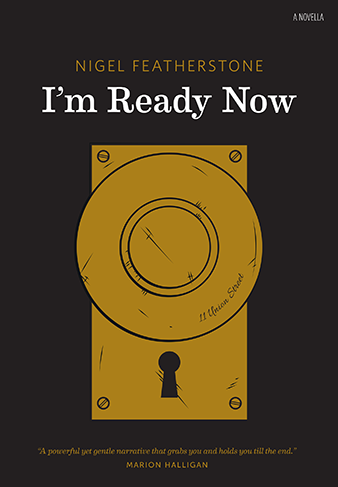
Featherston, I'm ready now, book cover

Book cover (Courtesy: Blemish Press)

Way back in my youth when I started studying literature, I thought I had to get the “right” interpretation. It made reading a little scary, I must say. However, as I gained confidence, I discovered that there are as many responses to a novel as there are readers, something I was reminded of when I attended this week’s launch of Nigel Featherstone’s novella, I’m ready now. And here’s why…

The book was launched by Canberra journalist and biographer, Chris Wallace. She spoke eloquently about the book telling us that it’s about how you can make a change in your life no matter how old you are – whether you’re 30 as Gordon is in the book or 50 as his mother, Lynne, is. She said too that it promotes the idea of living an imaginative life. I thought, yes, she’s right, it does do these things. And then Nigel spoke, and he said that for him the book can be summed up in one word, liberation. And I thought, yes, I can see how it’s that. But I had framed it a little differently from my reading.

Before I give you my different-but-on-a-similar-track take, I’d better tell you something about the plot. It has a small cast of characters, which is pretty much what you’d expect in a novella. They are Gordon, a gay man turning 30 who lives in Glebe and works as a photographer; his old schoolfriend Shanie, who followed Gordon to Sydney; Levi, Gordon’s boyfriend of a year or so; and Gordon’s mother Lynne who, recently widowed, comes up from Hobart to stay with Gordon for a short while. Lynne has put the large family home on the market, and the auction will be held while she’s away. Meanwhile, Gordon is almost at the end of his Year of Living Ridiculously, which is a year of rather self-destructive high living that he designed, and is doggedly keeping to, for his 30th year. He plans to crown this year with something he calls The Ultimate. But then Mum, Lynne, arrives, and puts The Ultimate at risk. What Gordon doesn’t know is that his mother has a grand plan herself, now that she’s free. (Ha! Liberation you see.)

This sounds pretty simple, really, doesn’t it? However, there are complications. Lynne’s husband, Eddie, was not Gordon’s father. Gordon’s father, Patric Finn, walked out on him and his mum when he was around a year old, and neither has completely resolved the abandonment. It’s not that Eddie wasn’t a good husband and father, because he was, but he never fully understood Gordon, and for Lynne he was “a head kind of love, not a heart kind of love”.

What is lovely about Featherstone’s writing – as I also found in his Fall on me – is that he manages to build tension and mystery around his characters’ behaviour without undermining their realness or humanity, and without alienating us readers. We warm to them even while we wonder about the wisdom of their decisions and motivations. Featherstone also uses imagery and allusions lightly. Water, for example, can be a cliched symbol in stories of change and growth, but here it’s appropriate and not laboured. What more logical thing is there to do on a hot night in Sydney than to go for a dip in the sea?

Besides the characterisation, I also like the novella’s voice and structure. It’s told first person in the alternating voices of Lynne and Gordon, and is effectively paced, largely through varying the length of the chapters*. The book opens with a mere half-page chapter in Lynne’s voice, and then moves to mostly longer ones in the main part of the book. They shorten towards the end as the pace builds, keeping us involved and wondering what these two will finally decide to do and what role Shanie and Levi might play in it all.

Now though to how I would describe the novel – and for me it is about coming to terms with the past. Both Gordon and Lynne have not had unhappy lives but both have in some way been damaged by their abandonment. Almost half way through the novel, they both say something significant. Lynne, reflecting with real generosity on Patric’s unheralded departure, says

I think he wanted to be free, a free young man. There have been times – many times – when I’ve found myself actually admiring his audacity to grab life, to run with it, to run as far as he could.

She then tells us that her plan is to leave Australia to live in “a farmhouse on a hill in the beloved country [Ireland] of my mother”. In the next chapter, Gordon’s, we learn in a flashback why he commenced his Year of Living Ridiculously. It’s to discover “what it is that makes me feel most alive”. He wants to “to lean over the cliff, figuratively speaking … to live as vividly as possible” – but his chosen method is clearly not working. The idea, though, reminded me of Fall on me in which the son tells his dad that “safety doesn’t always equal life”. Both these novellas, in a way, explore what Wallace described as “living an imaginative life”.

They are both, too, about something Lynne says towards the end, which is that “life must move forward; anything else is sacrilege”, and yet, paradoxically, her wish for Gordon could be seen to be the opposite: she wants him to go back to find what “hurt him all those years ago”.

And so for me, the book is about “living imaginatively” and about liberation, but it is also about how the past can stall us if we don’t get it in the right perspective. Featherstone opens the book with two epigraphs, one being TS Eliot’s “Home is where one starts from”.  I think that, in a way, says it all.

Nigel Featherstone
I’m ready now
Canberra: Blemish Books, 2012
156pp.
ISBN: 9780980755688

(Review copy supplied by Blemish Books)

* for want of a better word for the numbered parts.
MUBA and Patrick White awards for 2012 announced

I don’t make a practice of reporting on awards  – many of the big ones get pretty good media coverage anyhow – but every now and then something catches my fancy … and so here I am today …

Most Underrated Book Award

Apologies to those of you waiting on the edge of your seats to hear the winner of the MUBA, or Most Underrated Book Award, that I heralded a few weeks ago. It was announced on November 8th, the day after I returned from eight days away, and I simply missed it.

The winner is (was!) Wayne Macauley’s The cook.

Congratulations to Wayne Macauley and the three runners-up, Peter Barry, Irma Gold, and Jess Huon. Please check the SPUNC page which lists the books and how you can purchase each one in both print and electronic format. As SPUNC says, they would all make worthy additions to your Christmas shopping list.

Patrick White Award 2012

Patrick White (if we exclude JM Coetzee who received his award when still a South African resident) is Australia’s only Nobel Laureate for Literature. He won that award in 1973, and in 1975 he used the proceeds to establish the Patrick White Award. His goal was to advance ‘Australian literature by encouraging the writing of novels, short stories, poetry and/or plays for publication or performance’. It tends to be given to writers who have made a significant contribution to Australian literature but whom the judges feel deserve further recognition. Recent winners include poet Robert Adamson (2011); multiple award-winning novelist, David Foster (2010); novelist and short story writer Beverley Farmer (2009), a favourite of mine but I haven’t read her for a while; and poet and translator Geoff Page (2001), whom I have reviewed here.

This year’s winner is Amanda Lohrey. I have read her but not since I started this blog. The judges praised the quality of her fiction – the most recent being her novel Reading Madame Bovary – for the moral and ethical dilemmas she explores and for her prose style which ‘has developed a distinctive grace and lucidity in expressing these complex issues’. The judges also commended her role in developing the creative writing program at the University of Technology Sydney, and her work as an essayist.

Thanks to the AustLit blog for information on the Patrick White Award.

Monday musings on Australian literature: Literary Awards for Short Stories

Since we’ve been currently talking about short stories – or, at least, I have been doing so here in my little corner of the litblog world – I though it might be a good time to list some of the literary awards dedicated to short stories in Australia. It’s a bit of a lazy post I know, but we are getting to that time of the year and life is getting busy.

There are, in fact, a goodly number of opportunities in Australia for short story writers to win awards, so in this post I am just going to list the ones that seem best known or that have a reasonably broad coverage. Most of the competitions define short stories as those 3,000 words or less. Here goes:

  • The Age Short Story Award has been awarded since 1979. I believe it was the award that kick-started Elliot Perlman’s writing career when he won in 1994. It has also been won by some of Australia’s currently best regarded short story writers like Cate Kennedy and Paddy O’Reilly.
  • Steele Rudd Award for Australian Short Story Collection was part of the recently cancelled Queensland Premier’s Literary Award and was continued this year in the Queensland Literary Awards when it was won by a favourite writer of mine, Janette Turner Hospital, for her collection Forecast: Turbulence.
  • Elizabeth Jolley Short Story Prize, which started life as the Australian Book Review award, has been offered under its new name since 2010. It honours the late Australian author, Elizabeth Jolley, who is one of my favourite writers and to whom I was introduced back in 1988 via her short story “Five acre virgin”.
  • Hal Porter Short Story Competition which in 2012 is in its 19th year, and which commemorates the Australian novelist, poet, short story writer and playwright.
  • Awards for short stories offered by state chapters of the Fellowship of Australian Writers, including the Marjorie Barnard Award from NSW (commemorating Barnard whose collection The persimmon tree and other stories* is one of my favourites) and the Henry Savery National Short Story Award from Tasmania (commemorating Savery who wrote the first “Australian-made” novel)
  • Locally offered awards such as the Alan Marshall Short Story Award, the Margaret River Short Story Competition, and the Stringybark suite of short story awards.
  • Genre-based awards for short stories, such as the Aurealis Awards for speculative fiction which include awards for short stories in fantasy, horror, science fiction and young adult; and the Scarlett Stiletto awards for crime and mystery short stories written by women. Cate Kennedy won the first Scarlett Stiletto in 1994.
  • And, of course, the Commonwealth Short Story Prize, which is part of the Commonwealth group of literary prizes and is open to all members of the (British) Commonwealth.

There are many more awards, but this list indicates that the short story is pretty well supported down under. However, short stories can always do with more recognition because, despite all the awards, they are still under-recognised and, I think, under-appreciated. I have heard chat around various traps that electronic publishing may be raising the profile of short stories with new audiences … I’ll be watching with interest.

Meanwhile, I’ll close with Australian novelist and short story writer Jennifer Mills who was a regional winner in the Commonwealth Short Story Prize in 2008. In an interview on the Spineless Wonders website, she explained why she likes the short story form:

It’s very flexible. I love its capture of pivot points, its nearly mathematical tidiness, and its risk. I can pull off imaginative feats in short stories which I would struggle to hold together in a novel. I like the adaptability of short fiction to different delivery modes, like podcasting. As a novelist, I like the gratification: the end of the job is in sight.

Are you aware of short story competitions in your neck of the world?

* I was thrilled when Tony of Tony’s Book World reviewed this collection a few years ago.

Barbara Baynton, The chosen vessel (Review)

I’m blaming author and blogger Karen Lee Thompson again for this post, because she wrote a wonderful comment on my post on Barbara Baynton‘s short story “Squeaker’s mate”, and I’m going to quote it pretty much in full (I hope that’s ok from a copyright point of view – tell me if it isn’t Karen Lee):

Barbara Baynton wrote some wonderful stories and, had literary politics been a little more inclusive in the days of the Bulletin, I’m sure she would have received wider recognition. Many of Baynton’s short stories, like ‘Squeakers Mate’, turn ‘The Australian Legend’ on its head and, perhaps because of this, the male literary elite (A.G. Stephens, A.A. Phillips for example) chose to modify or explain her work in various ways.

An interesting example of this editorial intrusion is the politics surrounding Baynton’s ‘The Chosen Vessel’ (Baynton’s preferred title was ‘What the Curlews Cried’) which I have read, in its various forms, a number of times. Stephens published it as ‘The Tramp’. It is believed he wanted the title to shift the focus away from the central woman and it allowed for clarity between a ‘tramp’ (an isolated individual) and a ‘swagman’ (a virtuous kind of everyman of the bush). Stephens also cut a significant part of the story before publication.

For anyone who enjoys ‘Squeakers Mate’, I’d suggest a reading of ‘What the Curlews Cried’ (aka ‘The Chosen Vessel’ or ‘The Tramp’), preferably in its unabridged form.

“The chosen vessel” and “Squeaker’s mate” are Baynton’s best known and most anthologised short stories. However, I hadn’t read “The chosen vessel” before and so decided, on Karen Lee’s recommendation, to read the version in Bush studies. According to my brief research, and Karen Lee can correct me if I’m wrong, The Bush studies version is the final complete version Baynton presented for publication. However, it is not the same as the original version which was submitted as “What the curlews cried” and then significantly edited by the Bulletin.

Anyhow, if I thought “Squeaker’s mate” was tough, then this one is tougher. The female protagonist is left alone with her baby, rather like Lawson’s wife in “The drover’s wife”, but this woman faces a double whammy. Left by a cruel husband, she is terrorised by a “swagman” (not a “tramp” despite its first published title). She’s a town girl unfamiliar with bush life, but that’s not what scares her. I won’t detail the plot more because it’s a short story (around 8 pages) and you can find it in the online link below. The shorter Bulletin version, I understand, did not change what happened to the woman, but excised a whole section and thereby effectively changed the meaning of the story to suggest an isolated instance rather than something more systemic.

In the introduction to my Sydney University Press edition, Susan Sheridan confirms my statement in my “Squeaker’s mate” post that Baynton’s main concern was not the harshness or terrors of the bush and the land, which contemporary critics tried to argue, but male brutality to woman and, more significantly, “the impossible position that male culture constructs for ‘woman’ in the abstract”. She writes that woman is glorified as the Madonna, God’s “chosen vessel”,  but “at the same time the capacity for motherhood is regarded as confining her to the animal level of existence”. In “The chosen vessel” religious imagery – the mother and her baby are both mistaken for a ewe and a lamb and as a vision of the Madonna and child – is used to devastating ironic effect.

I’m not surprised that those late nineteenth century men found her writing confronting and that the Bulletin only ever published one of her short stories, but, for me, Baynton’s writing presents an alternative view of life in the bush that I’m glad we have available today.

Barbara Baynton
“The chosen vessel”
in Bush studies
Sydney University Press, 2009
ISBN: 9781820898953

Available online: in Bush studies at Project Gutenberg

Barbara Baynton, Squeaker’s mate (Review)

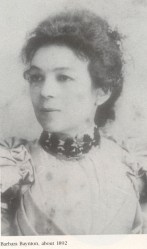
Barbara Baynton 1892

Baynton 1892 (Presumed Public Domain, via Wikipedia)

My last post was about this year’s Meanjin Tournament of Books which is pitting short stories against each other. One of the short stories is Barbara Baynton‘s “Squeaker’s mate”, which I’ve read before but a long time ago. I decided, though, to read it again, since I have easy access to a copy, on my shelves and online.

Author and blogger Karen Lee Thompson commented on my tournament post that she’d like to see a bout comparing “Squeaker’s mate” (1902) with Henry Lawson’s “The drover’s wife” (1892), and it would be delicious. I was tempted to do it here but I won’t. However, I did think of commencing this post with “Only a woman …” because, despite their broad similarities in subject matter and setting – the harsh life faced by pioneer women in the outback – there is a big difference in tone. Both stories chronicle the bravery and perseverance of bush women,  but Lawson’s story has an heroic, even somewhat romantic, tone. Not so with Baynton.

Squeaker’s mate, “the best long-haired mate that ever stepped in petticoats”, is a hardworking, taciturn woman whose mate, Squeaker, is a good-for-nothing. Here’s paragraph three:

From the bag she took the axe,  and ring-barked a preparatory circle, while he looked for a shady spot for the billy and the tucker-bags.

It’s not that there’s anything wrong with Squeaker, other than laziness, but “she knew the man, and her tolerance was of the mysteries”. However, things change dramatically early in the story when a tree falls on her, putting her out of action. Squeaker’s initial reaction is chilling – “he was impatient, because for once he had actually to use his strength” – and, a little later

he supposed he would have to yard them [the sheep] tonight, if she didn’t liven up. He looked down at unenlivened her.

It’s only in the last few paragraphs of the story that we learn “her” name. Significantly, it’s Mary.

The rest of the story chronicles his self-centred callous treatment of her, sometimes leaving her for days with no sustenance. All she has is her loyal dog which, for we readers, relieves, albeit slightly, our despair at her situation. There is no heroism in here, very little kindness even – but there is, on the part of Squeaker’s mate, resilience and, without giving away the story, a triumph of sorts.

Baynton is critical of men’s attitude to women – and this is a major theme of the story, though it’s not that simple either. Early on, a few men do show kindness to Mary – let’s dignify her with her name now – but their women put a stop to that. Mary had not been one for “yarnin'”, making her “unlikely” to be popular with them. Baynton writes:

It is in the ordering of things that by degrees most husbands accept their wives’ views of other women.

And so Mary is left alone.

The writing is compelling. It is told third person, but the perspective swaps between hers, his, and, later on, that of the woman he brings into their home. In some circumstances this narrative approach could provide an even-handed view of the characters, but here it only serves to reinforce our early opinion of them. In other words, Squeaker does not improve on acquaintance. Baynton plays effectively with the “word” mate, contrasting the roles, responsibilities and rights of mates as partners, alongside those of the Australian “mateship” tradition, with Squeaker’s un-mate-like, in all senses of the word, behaviour.

Imagery is used sparingly, but it’s pointed when it’s there. It is a tree that brings Mary down, and then late in the story Squeaker decides to clear some land:

So that now, added to the other bush voices, was the call from some untimely falling giant. There is no sound so human as that from the riven souls of these tree people, or the trembling sighs of their upright neighbours whose hands in time will meet over the fallen victim’s body.

A little melodramatic in that 19th century way maybe, but Baynton’s suggestion that there’s more solidarity among trees than the humans below is well made. In fact, while life is harsh, it’s not an unforgiving environment that is the main problem for Baynton’s characters.

It’s a grim but effective story that focuses mostly on gendered callousness in a world where survival would be best ensured by cooperation. In confronting gender issues, Baynton is part of a tradition of Australian women’s writing of the late nineteenth to early twentieth century that has, to a large degree, been forgotten a century or so later. It’s time to revive these early writers – and hopefully recent initiatives by Sydney University Press, Text Publishing and others, will do the job.

Barbara Baynton
“Squeaker’s mate”
in Bush studies
Sydney University Press, 2009
ISBN: 9781820898953

Available online: in Bush studies at Project Gutenberg

Meanjin Tournament of Books: Short stories in 2012

Last year I wrote a series of posts on the first Meanjin Tournament of Books. Responding to the discussions that had been raging at the time, that tournament was devoted to books written by women. I’m pleased to say that the Meanjin team has decided to run the tournament again this year and the focus is another rather unsung aspect of Aussie literature – short stories. Will Meanjin, perhaps, do poetry next year? Watch this space!

Anyhow, the tournament is off and running with Angela Meyer of Literary Minded judging the first round. More of that anon, because first I’d like to list the stories. A few weeks ago, Meanjin called for suggestions through, was it Facebook or Twitter or? How can we ever keep track of what we learn where and when these days? Never mind, by whatever method I heard, I did make some suggestions – of specific titles and authors. A few of the authors I nominated are included, as is at least one title, Elizabeth Jolley‘s “Five acre virgin”. I’ll be cross if it doesn’t do well! The final list is:

  • ‘Squeakers Mate’, Barbara Baynton
  • ‘The Promise’, Tony Birch
  • ‘Five Acre Virgin’, Elizabeth Jolley
  • ‘Love and Honor and Pity and Pride and Compassion and Sacrifice’, Nam Le
  • ‘A,B,C,D—Z’, Murray Bail
  • ‘American Dreams’, Peter Carey
  • ‘Static’, Cate Kennedy
  • ‘The Annual Conference of 1930 and South Coast Dada’, Frank Moorhouse
  • ‘Hunting the Wild Pineapple’, Thea Astley
  • ‘Today on Dr Phil’, Tom Cho
  • ‘Darling Odile’, Beverley Farmer
  • ‘Any Dog’, Sonya Hartnett
  • ‘The Drover’s Wife’, Henry Lawson
  • ‘In the Mornings We Would Sometimes Hear Him Singing’, Josephine Rowe
  • ‘It’s Too Difficult to Explain’, Tara June Winch
  • ‘Happiness’, Katherine Susannah Prichard

It looks to be a good list to me. It covers gender and time well, and includes writers from diverse cultural backgrounds. I have read some of these stories – those by Baynton, Jolley, Le and Lawson.

Regular readers might have noted that it includes two of my favourite writers, Elizabeth Jolley and Thea Astley. It also includes other writers whose novels or short stories I’ve reviewed in the last three years or so, Murray Bail, Peter Carey, and Katherine Susannah Prichard. In fact, I’ve read most of the listed authors in some form and am happy to see their short stories being recognised through the tournament. On the other hand there are  – as there always are – omissions. No Helen Garner for example, no Patrick White, but I’m not going to be churlish about that. The list is a perfectly fine one that makes a good fist of representing breadth and quality.

But now to the tournament. The first two rounds have been held, with the following results:

Match 1: Katherine Susannah Prichard’s “Happiness” versus Tom Cho’s “Today on Dr. Phil”. Meyer gave it to Cho’s story saying “Happiness’ was definitely interesting enough to make me want to read more of Prichard’s work, but Cho’s distinct, clever and funny story ‘Today on Dr Phil’ is the winner of this round.” Not having read either, I have no comment.

Match 2: Nam Le’s “Love and Honour and Pity and Compassion and Sacrifice” versus “Darling Odile” by Beverley Farmer. Judge Anna Heyward gave it to Nam Le’s story “because this story was slightly better written”. She held the two stories up to the Isaac Babel test. I’ve never heard of him but she says he’s a “master story writer of last century”. She quotes Isaac Babel as saying “In ‘Guy de Maupassant no iron can enter the human heart as chillingly as a full stop placed at the right time.” I know what he means when it comes to de Maupassant, who was my first short story love. I have read and liked Farmer, but don’t know this particularly short story (as least as I remember!). However, I have read Nam Le’s story and liked it. As I recollect, he quotes in it that recommendation to writers that you should write what you know about – but then, the rest of the short stories (until, tellingly, the final one) in the collection from which this story comes, are anything but that. Instead they are about people like Colombian assassins, Hiroshima orphans, and New York painters with haemorrhoids! It’s a sly story, and I like that.

I won’t write on this tournament, match by match, but I will be back soon with a progress report.

Monday musings on Australian literature: What’s in a street name?

Street names may be an unusual topic for a post on literature, but I think it could be argued that names of things are part of our wider literary culture. It can certainly be argued so for my city because street names here are serious business. None of your 5th Avenues and 61st Streets for us! I know, I know, New York’s a great place, and very easy to navigate compared to Canberra with its reputation for going round in circles, but we have our reasons …

I was inspired to write this post because this past weekend Prince Charles and the Duchess of Cornwall were in town as part of their Diamond Jubilee Tour downunder. One of their duties was to take part in the renaming of Parkes Place to Queen Elizabeth Terrace. This has special meaning for me because the address of my first library employer was Parkes Place, which was named for Henry Parkes, the “father” of our Federation. Queen Elizabeth now joins Queen Victoria, King Edward, and King George in being commemorated by a street in what we call our Parliamentary Triangle. I’m pleased to say that poor old Henry is not being completely brushed aside: the little roads that circle Old Parliament House will now be called Parkes Place.

Enough about my inspiration though, and back to the main point, which is that in 1928 the Canberra National Memorials Committee of the Australian Parliament presented a “Report in Regard to the Naming of Canberra’s Streets and Suburbs” which laid down principles for Canberra’s official nomenclature. Early in the document comes this:

… the commission divided the Canberra City District into 23 divisions. It devolved upon the National Memorials Committee to find names for these divisions, which will eventually become the suburbs of the capital. It was felt by the Committee that patriotic and national sentiment would be best met if the names of those men who have contributed most to Australia’s existence as a unified nation, be used in the most important places, that is, for the names of the divisions or suburbs of Canberra.

The patriotism of a nation is often expressed by memorials to its benefactors, so it is deserving and right that the names of those great statesmen who laboured in the cause of the federation of the Commonwealth should be perpetuated as place names to be used in the mother-tongue by all Australians for all time.

A map of inner Canberra showing the Parliament...

Inner Canberra early suburb names. (Photo credit: Martyman, using CC-BY-SA 3.0, via Wikipedia)

Now isn’t that a great piece of bureaucratic literature! I particularly love the reference to “mother-tongue” after the preceding references to “men” and “statesmen”. It then lists the names of these men, and explains that “a suffix has been added, similar to some of the Anglo-Saxon names of towns in Great Britain, where the name is thought not to be very euphonious”. So, while Braddon gave rise to the suburb of Braddon, and Barton Barton, Lyne became Lyneham and Fysh Fyshwick. Ingenius eh?

The Report then goes on to note that other suburbs would be based on names connected with Canberra’s early days and its pioneers, and that “the use of aboriginal names has not been overlooked.” They stated that much knowledge of indigenous naming in the Canberra region had been lost but those known would be retained, and so they are – with most rolling off the tongue beautifully (euphoniously, even), like Narrabundah, Yarralumla, Pialligo, Jerrabomberra, Mugga, and Canberra itself.

All this is probably pretty common in cities elsewhere but the committee went on to set down principles for the naming of streets:

The Committee has adopted the idea of grouping together various classes of names in separate areas. Sections of the City have therefore been set apart for Governors, Explorers, Navigators, Scientists and others, Foresters and others, Pioneers and others, Founders of the Constitution, and euphonious Aboriginal words.

I wonder whether the names of the scientists, foresters, “and others” had to be “euphonious”?

I won’t go on with more of the report, but I will say that this plan has continued to the present. One of our newest suburbs, still in the making, is Wright – named for the poet Judith Wright. Yes, we do now have a handful of suburbs named for women, including the writers Miles Franklin, Dame Mary Gilmore and Henry Handel Richardson. Moreover, some of our street names, says ACTPLA, our current planning authority, are named for “quiet achievers”. Things do change in the corridors of government – eventually. As for the theme for Wright’s streets, it’s a somewhat diverse one, “Environment, Poets and Butterflies”. Maybe there’s a connection there; Wright was a poet and a conservationist so perhaps the latter covers the “environment” and the “butterflies”!

I like that fact that such thought has been put into Canberra’s urban (or is it suburban) nomenclature, and I’m glad that while the spirit of the early planners has remained our nomenclature has broadened to encompass women, quiet achievers, the arts and increasing usage of indigenous names. The end result is, for we capital residents, a fascinating literature of suburb and street names. Do you have such literature where you live?

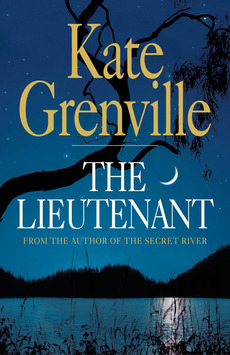
Kate Grenville, The lieutenant (Review)

Kate Grenville, The lieutenant book cover

Bookcover (Courtesy: Text Publishing)

I first came across William Dawes, the inspiration for Kate Grenville’s The lieutenant, in Inga Clendinnen’s award-winning history, Dancing with strangers (2003). But this is not the only book that Grenville’s novel brought to mind, as it also reminded me of Kim Scott’s That deadman dance. (Intriguing that both these books use a dance motif, but it’s an historically valid one).

However, before I talk more about these connections and their relevance, I should briefly describe the plot. The novel is set during the first years of the white settlement of Australia. (The very fact that I write the “white” settlement says something about how far we have come in the last two centuries, though we still have some way to go). Daniel Rooke, the protagonist, is a young astronomer. He has been chosen for the First Fleet on the recommendation of the Astronomer Royal who believes that a significant comet will appear in the southern hemisphere in late 1788-early 1789. With this role in mind, Rooke manages to largely separate himself from the day-to-day hurly burly of the first year or two of settlement by creating an observatory, of sorts, for himself, on a hill (now called Dawes Point) overlooking Sydney Cove. Here, in his isolation, he is visited by a group of indigenous people, mostly women and children, and develops a particular relationship with the young 12-13 year old girl, Tagaran. They learn each other’s language, which Rooke chronicles in his journals. All this generally reflects the story of William Dawes whose journals Grenville (and Clendinnen) read, but, as Grenville writes in her author’s note:

Although I made use of historical sources, I departed from them in various ways. This is a novel; it should not be mistaken for history.

Meanwhile, back in 2003, Clendinnen wrote of Dawes, bemoaning his earlier-than-wished-for departure from the colony:

His departure cost us access to the local language as it was spoken at the time of contact. It possibly also cost us a brilliant ethnography, although his tender conscience  might not have allowed him to open the people to easier communication, and to more disruptive exploitation.

Grenville does a good job of imagining the Dawes described by Clendinnen as an “introspective, scholarly type” in her characterisation of Daniel Rooke. She introduces him as a socially awkward but sensitive and thoughtful young man who joined the military not for love of war but because it provided the best chance for a poor young man to make a life for himself. From this supposition she develops a credible character whose final actions in the book pretty closely mirror what we know of Dawes.

I will leave Rooke here for a moment, though, to talk a little more about the conjunction between the three books I mentioned in my introductory paragraph. The significant point they all make is what Clendinnen calls “acts of kindness” by the indigenous Australians in the early days of settlement (in the east, in the case of Grenville and Clendinnen, and the west in the case of Scott). All three writers describe a willingness to be generous that was not recognised or accepted by the colonial invaders. Now, I know that here I am speaking of history and fiction in the one breath and I know that, as Grenville wrote, novels should not be mistaken for history. However, modern readers can, I think, glean the truths, regardless of form or genre, if the writers provide the appopriate signposts.

Take The lieutenant. In it, Grenville is still smarting I think from the criticism she received from historians regarding her claims about the historical value of The secret river. The book contains many rather sly allusions to facts, reality and truths. I particularly liked Rooke’s contemplation about the value of his journals in which, as well as documenting the language he was learning, he described his interactions with indigenous Australians, telling stories that actually happened but whose meaning, he discovered, could be distorted. He considers omitting all but the dry documenting of language, but then realises:

Making an expurgated version of the notebooks would kill them. Like a stuffed parrot, they would be real, but not true.

With a little sleight of hand, Grenville uses a fictional character and his fictional journal to talk about the use of historical sources and the telling of stories from them. Do you simply present the “facts” or do you tell a story –  either factual as in history or fictional as in novels – from those facts in which you aim to draw out the truths as best you see them. Am I drawing too long a bow? I don’t think I am.

And so, as you can probably tell, I enjoyed the novel. It suffers from a little earnestness in tone but that doesn’t get too much in the way of a good story about how first contact in the first settlement played out. It’s not the only story about first contact but it is a valid one – and it helps us understand how an all too human inability to walk in the shoes of the other resulted in a catastrophe of major proportions that we are still working through today.

Kate Grenville
The lieutenant
Melbourne: Text Publishing, 2008
307pp.
ISBN: 9781921656767

(Review copy supplied by Text Publishing. An unsolicited review copy received in 2010 so I’m afraid I’ve taken my time to get to it.)

Josephy Furphy and the Australian scrub

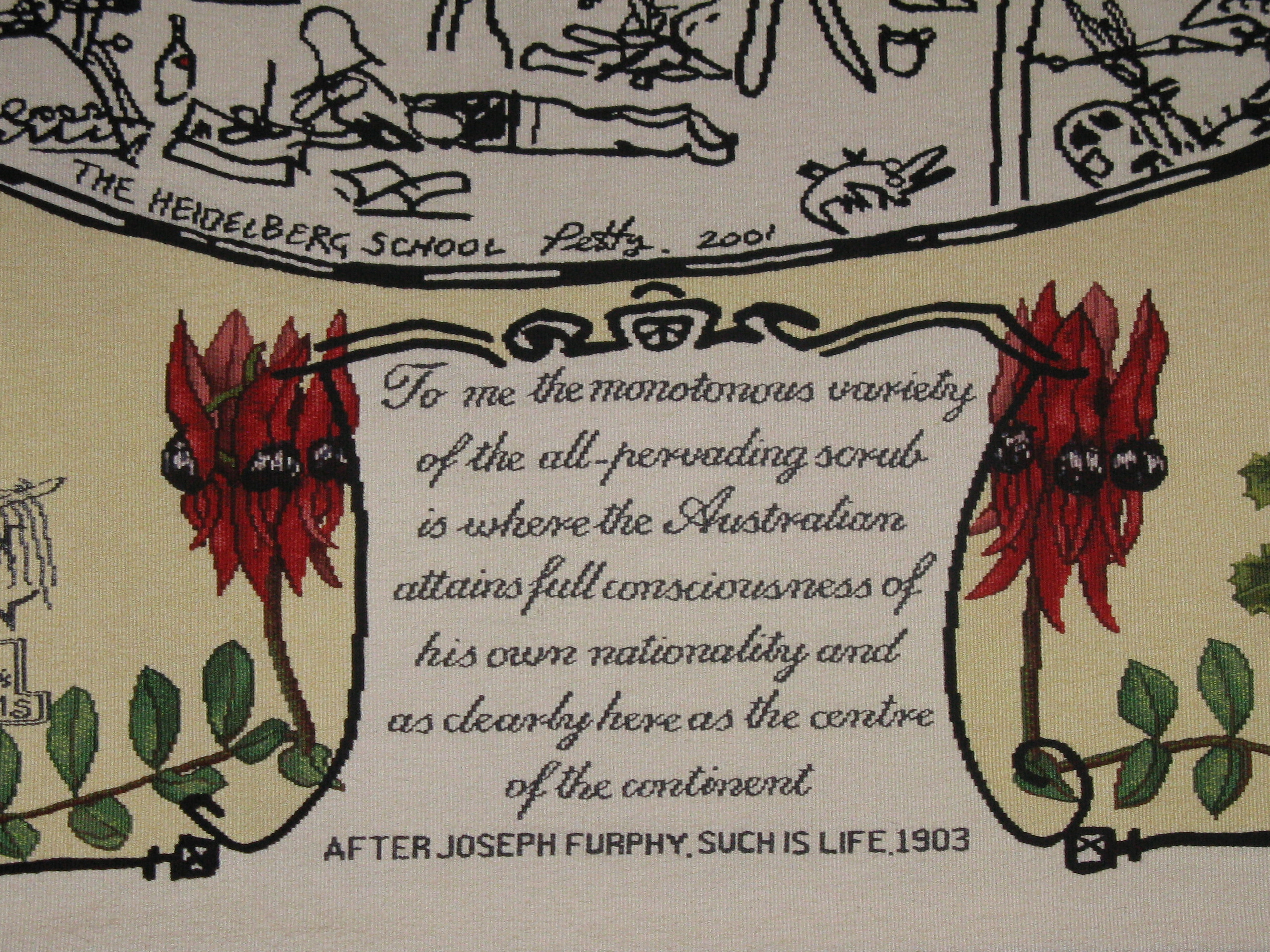
Section of Panel 7 of the 10-panel Federation tapestryLast weekend I ran across Joseph Furphy, whom I’ve mentioned before in my blog, in the strangest of places – on a tapestry in the Melbourne Museum. It’s not strange of course to find Furphy, one of Australia’s pioneer novelists, in the museum, but I was surprised to find him quoted on a tapestry. Except, of course, it was no ordinary tapestry. It was the Federation Tapestry which was designed and made by the Victorian Tapestry Workshop to commemorate the 2001 centenary of Australia’s federation.

The tapestry comprises 10 panels, with Furphy appearing in the 7th one titled “The Heidelberg School“. Its focus is “the creative outpouring of national sentiment in the last two decades of the nineteenth century”. At the bottom of the panel, in the centre, is a quote from Furphy, writing as Tom Collins in his best-known novel, Such is life. The quote comes from his description of the Riverina area of remote Victoria-New South Wales.

It’s not in our cities or townships, it is not in our agricultural or mining areas, that the Australian attains full consciousness of his own nationality; it is in places like this, and as clearly here as at the centre of the continent. To me the monotonous variety of this interminable scrub has a charm of its own; so grave, subdued, self-centred; so alien to the genial appeal of more winsome landscape, or the assertive grandeur of mountain and gorge.

I like the fact that the tapestry designers chose a quote like this to incorporate into their panel because, although it feels almost cliched to say, I believe it captures the paradoxical nature of Australia and Australians that still, I think, informs much of our cultural landscape.

A couple of paragraphs on, Furphy writes that:

For though history is a thing that never repeats itself–since no two historical propositions are alike–one perennial truth holds good, namely, that every social hardship or injustice may be traced back to the linked sins of aggression and submission, remote or proximate in point of time.

There’s an irony here (not to mention an unconscious prescience, to our 21st century eyes) because Furphy, like most of his day, was not thinking of “aggression and submission” in relation to Australia’s indigenous populations – in fact he saw Australia as “a virgin continent” that had been waiting “in serene loneliness” for things to happen – but in terms of working people and their struggles. Both issues (and others to do with “aggression and submission”) are important today …

One day I will have to read (all of) Such is life.

Monday musings on Australian literature: Guest post from Nigel of Under the counter or a flutter in the dovecot

This is embarrassing but I really can’t remember how and when I first met Nigel. Actually let me rephrase that: I do remember when I met him in person because I’ve only met him once (at a literary event earlier this year), but who stumbled across whose blog first I have no idea. I’m glad we did though, because in Nigel I’ve discovered not only a lovely writer (see my review of his novella Fall on me) but an active supporter of Australian literature through such activities as the online creative arts journal VerityLa and the arts forum, the Childers Group. I also enjoy his reflective blog, Under the counter or a flutter in the dovecot. And so I was thrilled when he said yes without apparent demur to my request for a guest post. Thanks Nigel …

Real or imagined, raising children makes a great story

The game now finished and the speeches in full swing, the camera panned left to take in the players who were standing off to one side and looked worn-out and knocked around, a few with mud on their faces, a bit of blood too, but smile they did because they’d won and were elated. After a moment, the camera went back to whoever it was that hadn’t yet finished his speech (why is it that a man with a microphone will always go on too long?). For the first time in my life I was grateful when the TV channel cut to an ad break.

When the NRL grand final coverage resumed – I’d not watched the actual game, and had only stumbled on the closing minutes of the concluding celebrations by lazy accident – the victorious players were wandering around the field, or ‘paddock’ as it’s apparently called, many with their young children in hand. It’s this that struck me: rugby league boofheads wanting to be with their kids in these lingering moments of sports elation.

It looked – it felt – amazingly non-sensical.

I’m not one for children; never have been, never will be. I am, in fact, the least paternal person on Earth. At no point in my life have I ever wanted children. Which is, now I examine my life with precision (the process of writing does that), a bit of a lie. I remember that as a teenager I did have day-dreams of raising children, except in those day-dreams my wife was always absent, to be accurate she was dead, which left me to be a hip young single father, and I was very good at fathering, and my kids adored me and I adored them back. Once I was old enough to understand why my wife was always cactus, my mind – my conscious mind – turned to things closer at hand, and much more real. Which is why, aged forty-four, I’m blissfully childless. When on the rare occasions something good happens to me (though for some reason these events are never televised), I reach for a bottle of nicely chilled verdelho and a slice of blue cheese on a cracker.

Not having children, not wanting children – now that I have a fine appreciation of the opportunities and constraints of my life, I desire children as much as I desire the idea of a car-alarm going off in the middle of the night, and if ever I find myself day-dreaming, which is, I should say, a lot, it’s about having a crumbling hut in some far-flung place that you can only access by barging a rusty old four-wheel-drive across seven creek-crossings – is problematic for someone like me, a writer of all things, that ridiculous trade that’s getting more and more ridiculous as each day goes by. For family is the guts of the contemporary Australian story – it is, to throw into the mix some suitably highfalutin French, its raison d’etre.

I’ve just finished having a private Australian literature festival, reading some blisteringly powerful novels by our nation’s finest (who too don’t get to parade their children in front of TV cameras). Kate Grenville’s Sarah Thornhill, Craig Silvey’s Jasper Jones and Gillian Mears’ highly distressing but remarkable Foal’s Bread. All three novels explore family and the impacts on children, but also the desire for children, that procreating is the usual path, the standard, the predictable, how it is just what you do. How the desire to continue your bloodline is simultaneously overwhelming and underwhelming. It is refreshing that both Foal’s Bread, which is largely set between the world wars, and Sarah Thornhill, which has as its backdrop our morally bankrupt colonial times, explore women who aren’t just mothers, whose dreams are bigger and wider and deeper.

*

In my own writing, my own attempts at making words come to life on the page – it always seemed so easy as a boy: you wrote what happened and that was that – I too explore family. My main characters are usually men and women (always a good start!) who have children, who want to be parents, who struggle to cope, who feel the pressure of internal and external expectation, who fail and fall into a heap but pat themselves down and have another crack at it.

Featherstone, Fall on me

Fall on me bookcover (Courtesy: Blemish Books)

My novella Fall on Me (Blemish Books, 2011) is about a single father who has to cope with his precocious seventeen-year-old son who insists on turning his naked body into an art exhibition. Lou and Luke: how through writing their story I’ve gotten to know them well, so well, despite everything how they created a family for themselves, and the addition to that family, Anna Denman, their housemate who became much more. To the point that I still think about them. And it’s always gratifying – and humbling – when readers say they think about them too.

In my forthcoming novella, I’m Ready Now, to be launched in Canberra on 22 November by Blemish Books, I write about a very different family. The story is a simple one, but it’s told from two points of view: a mother’s and a son’s. Lynne Gleeson is a fifty-year-old ‘corporate wife’ (that’s how she describes herself) whose husband Eddie, a man who inherited his family’s property-development business, has died of a heart-attack. Theirs was a perfectly functional if not loving relationship, one of considerable wealth and privilege – the family home is a daunting historic mansion called Gleeson House in Battery Point, Hobart. Now that Lynne is alone, she has decided to sell this property, and the family’s other houses, including an architect-designed getaway on Magnetic Island, Queensland. Effectively homeless, she leaves Tasmania to spend a fortnight in Sydney, staying with her son Gordon. But Lynne has plans. Big plans.

Nigel Featherstone, I'm ready now

Cover (Courtesy: Blemish Books)

Meanwhile Gordon, a professional freelance photographer, is thirty now, and despite being in a relationship of five years’ standing, is having what is described as a ‘Year of Living Ridiculously’ – it involves spending his weekends out in Sydney’s bars and clubs, taking drugs, and having promiscuous sex. For his thirtieth birthday, which his step-father’s death prevented the family from celebrating, Gordon has secretly arranged ‘The Ultimate’, which threatens to tear everything and everyone apart. It sounds heavy, it sounds grim, but it’s just about family. So it’s the truth. And, yes, I really think I can say that: the truth.

Family: there are plenty of other things to write about. Fighting wars amongst far-flung stars. Cornering yellow-teethed bad-guys. Hacking up zombies. Sex, which as I know better than anyone, doesn’t always have to result in something altogether gruesome nine months later. But still it’s family that I write about, the desire to raise someone in your own likeness, to have your best go at doing a decent job of it, to leave something worthwhile behind. All I’m going to leave behind is a handful of stories in the flickering fluorescent-light basement of the National Library of Australia.

*

Last month my older brother and his fourteen-year-old son dropped in on their way to the snow-fields. We went down to a café in the mainstreet for lunch and caught up on all that was happening in our various worlds. An hour later it was time for them to continue on their way south. The day was cold and blustery, the sort that makes my hands turn blue and my mood turn a similar colour. Dust was being flung around and as my brother and his son got into their brand-new four-wheel-drive I began to cough and splutter wildly.

My nephew, who’s not big on conversation and his favourite thing ever is his skateboard, wound down the window and stared at me fair-square in the face and said, ‘Are you sick?’ He looked genuinely concerned. ‘No,’ I said, ‘there’s a typhoon going on out here and it’s hit the back of my throat.’ His eyes brightened right up and he laughed. As my brother drove the two of them away, I sent my nephew a text message: ‘Have a great time on the slopes.’ He wrote back: ‘Have a good week.’ When was the last time someone had wished me a good week? I couldn’t remember. But I loved those words. They moved me. And they still do.

If I have a motivation to write, it’s to move people.

So, despite everything I know about myself, after forty-four years of determined self-direction, to the point that I’m now, to put a twist on something Quentin Crisp once said, one of the stately homos of Goulburn, I watch the dying moments of a rugby league season and can’t take my eyes off the men – proud, probably even gentle men (when they need to be) – who lead their children around a football field; it’s not the men who fascinate me, but the big hands holding the little hands. And I read great Australian novels about family and generations and personal history amongst the maelstrom that is the bigger political and social context. And I write stories about people who do their utmost to raise the best of kids. And I keep in my mind a simple text-message from my nephew.

But I also recall something the US poet and civil rights activist June Jordan once wrote: ‘In the name of motherhood and fatherhood…we threaten and suffocate and bind and ensnare and bribe and trick children into wholesale emulation of our ways.’ My unborn children should be grateful that they had me as a father. Hopefully the ones that live on the page are much more optimistic about their chances in the world.