Meanjin’s Tournament of Books 2012, Matches 7-8

With this post, we finish the first round of this year’s Tournament of Books, so here goes … next post will look at Round 2.

Match 7: Henry Lawson’s “The drover’s wife” defeated Cate Kennedy’s “Static”

Book cover

Like most Australians I’ve read Lawson’s “The drover’s wife”. It’s probably one of Australia’s most anthologised stories so it was, really, a no-brainer for inclusion in the tournament. It would have been interesting to have seen this pitted against Barbara Baynton’s “The chosen vessel” but it is Baynton’s other well-known story, “Squeaker’s Mate”, that was chosen for the tournament.

Anyhow, the judge of this match, Canberra-based Indian poet Subhash Jaireth, gave the match “hands down” to Lawson’s story for, it seems, its power. He says Kennedy’s story is “a wonderful story composed by a writer who knows her craft, but I doubt if it would stir someone’s imagination to make a painting, a movie or a song” (as “The drover’s wife” has). I guess this is as good a criterion as any to choose between two respected pieces of literature but, as you would expect, the tournament’s comic commentators, Jess McGuire and Ben Pobjie, did poke fun at this judgement. As Jess wrote:

Sadly … the lack of a tie in with a celebrated paintbrush jockey [like Russell Drysdale for “The drover’s wife”] has quite possibly cost Cate Kennedy more than she could’ve possibly imagined when penning her work of fiction…

To which all I can say is, Such is life!

Match 8: Peter Carey’s “American Dreams’ defeated Tony Birch’s “The promise”

The final match of the first round pitted one of the grand men of Australian literature, Peter Carey – he whom many love to hate – against the up-and-coming Tony Birch, whose book Blood was shortlisted this year for the Miles Franklin Award. Again, I’ve only read the older story, which was published in 1974 in the collection A fat man in history. Lucky me, eh, that yet another story I’ve read has progressed to the next round. The judge, Melbourne-based poet, Sean M Whelan, writes that “American dreams” deals with “themes of globalisation, cultural cringe, and that old chestnut ‘be careful what you wish for'”. We probably wouldn’t have described it as “globalisation” in 1974 but that’s what it is – and is part of what makes this story still work nearly 40 years after it was written. Moreover, the concept of “American dreams” still works as a metaphor for dreams of wealth and success, even though the real America these days may be a little tarnished.

I’m not sure that Whelan makes perfectly clear why he chose Carey over Birch except by saying “I love this story”. I understand why. It is a well-constructed story that gets you in from the opening line and has you guessing, has you expecting big drama, only to turn out quieter, subtler than that, but no less hard-hitting. An effective, satisfying story. In a strange twist, Carey ended up moving to America in 1990 where he remains still. Life imitating art perhaps?

Recap

And so, we are left with eight stories for Round 2:

  • Thea Astley’s “Hunting the wild pineapple”
  • Barbara Baynton’s “Squeaker’s mate”
  • Peter Carey’s “American dreams”
  • Tom Cho’s “Today on Dr Phil”
  • Elizabeth Jolley’s “Five acre virgin”
  • Henry Lawson’s “The drover’s wife”
  • Nam Le’s “Love and honour and pity and pride and compassion and sacrifice”
  • Josephine Rowe’s “‘In the mornings we would sometimes hear him singing”

With several favourites of mine in the mix, this will be interesting. Watch this space …

Fridays with Featherstone, Part 1: Thoughts on literary form

What do writer Nigel Featherstone and the now sadly defunct literary magazine Wet Ink have in common? An unpublished interview, that’s what! When Nigel approached me, with the agreement of his interviewer Susan Errington, asking whether I would like to run the review on Whispering Gums, I of course said yes – for several reasons. Over the last year I have reviewed two lovely novellas by Nigel Featherstone, Fall on me and I’m ready now. Nigel also wrote a guest post for Monday Musings on the relationship between family and children in some recent Australian fiction, including his own. And, yesterday, Nigel won the fiction section of this year’s ACT Writing and Publishing Awards for Fall on me. Then I read the interview – and I enjoyed it. Not only does it provide insight into Nigel’s writing, but he speaks on a range of issues regarding literary style and form and, of course, divulges some of his favourite writers. How could I not take up the offer?

It’s a long interview – magazine essay-length – but it breaks neatly into some thematic sections, so with Nigel’s agreement I am running the interview over a few weeks, followed by an updating interview between Nigel and me. So, with thanks to Nigel Featherstone and Susan Errington, here is Part 1 …

Featherstone, Fall on me

Fall on me bookcover (Courtesy: Blemish Books)

INTERVIEWER

You describe your latest work, Fall on Me, as a novella, but many current novels are not much longer. What is it about this story that makes it a ‘novella’?

FEATHERSTONE

Perhaps the best way to answer this question is to briefly talk about how Fall on Me came into being. In early 2010 I spent a month in Launceston as part of the Cataract Gorge Artist-in-Residence Program. Up until that point I’d spent five years working on a major project that had gone close to publication but in the end it got the red-light, not the green-light. More than a little wounded, I took the opportunity of the Launceston residency to return to where I’d started my writing ‘career’ back in the early 90s: creating short stories. I set myself a goal of writing the first draft of six stories. But there were other goals, too: write by hand, as in pen to pad; write what I wanted to write and what I’d like to read; and take creative risks, meaning don’t censor myself.

At the end of the first week I had the sketchy draft of what I supposed was a very long story, something around the 30,000-word mark. The second week I again tried to write a short story, but at the end of that week I again had the sketchy draft of a very long story around 30,000 words. And so it went until, after a 28-day mad storm of writing, I had the sketchy drafts of three of these very long stories. What had happened to me in that dark, dark Launceston gorge? I remember jumping on the plane to come home and thinking, what on earth am I going to do with these? What I did was keep working on them – editing, rewriting, polishing, editing some more – until, damn the bloody things, they grew in length; I’d had hoped they would go in the opposite direction. But there was something about the length that I really liked: story concentration, but also character expansion, and it intrigued me.

Thankfully Blemish Books, a Canberra-based independent press, was looking for fiction manuscripts up to 40,000 words so I submitted the first two of my novellas. And here we are. In the end, I think, that time in Launceston was all about psychology: I conned myself into believing that I was only writing short stories, and I certainly didn’t want to attempt another novel, so somehow I decided to write in that halfway space that novellas like to inhabit. Of course, there’s more to it than that: as a reader I love a book that can be gobbled up in one sitting, for example Hemingway’s The Old Man in the Sea, or The Sense of an Ending by Julian Barnes. What these two books achieve with a minimum of words is astonishing.

INTERVIEWER

You have also published a large number of short stories, at least forty I think, as well as two collections. What attracts you to the short story?

FEATHERSTONE

Short stories are closer to poetry than novels: they’re great at suggesting, rather than explaining every crinkle in the forehead. And they have focus – amazing focus, the focus of poetry. A well-structured short story is exquisite. Although it’s at the longer end of the spectrum, Annie Proulx’s ‘Brokeback Mountain’ is mind-blowing. Or Chekhov’s ‘Gusev’ – what that man achieves with this story, which is one of his shortest works, is truly miraculous. The making of short stories is interesting, too. Sometimes I’ll have an idea logged in my journal for months, if not years. Then something happens – the stars align – and I’m ready to write the thing. I like to write the sketchy first draft in a day, type it up the next day, and then there’ll be months, if not years of rewriting, editing and polishing; one story took five years to find a home in a journal. In terms of short stories, I always come back to that word: miraculous. Short stories are indeed almost inexplicable, especially those that do so much with so few words. Take Hemingway’s classic six-worder: ‘For sale: baby shoes, never used.’ Or Margaret Atwood’s: ‘Longed for him. Got him. Shit.’ See? Miraculous.

INTERVIEWER

What for you is the critical difference between short stories and novels, or novellas for that matter?

FEATHERSTONE

I wish I knew. That sounds off-hand, and for that I apologise. But every short story is different, every novella is different, every novel is different – in the writing, in the reading. Every story has its own internal logic, its own ecology, if you will. Established writers say that each time they start a new story they have to relearn the craft, and they’re speaking the truth. However, perhaps we can define the categories, just for the heck of it. If short stories are about brevity, novels are about complexity. So that’s what I might love about working with the novella: they offer the best of both worlds: succinctness and sophistication. Thomas Mann’s Death in Venice and George Orwell’s Animal Farm are cases in point. Of course, these definitions of story form are ultimately meaningless: some short stories are about complexity, while some novels use up 200,000 words by saying not much about anything. A story must find its natural length, that’s the beginning and end of it.

INTERVIEWER

Which short story writers are important to you?

FEATHERSTONE

I mentioned Chekhov before, and Tolstoy is a hero, too – what he does in The Death of Ivan Ilyich is almost hard to believe. (At heart I’m a melancholic, and the Russians know all about melancholia, don’t they.) Proulx, of course, needs a second mention. I much prefer Peter Carey’s short stories to his novels – ‘The Last Days of a Famous Mime’ has had a huge influence on me because of its playfulness. Speaking of playfulness, the last collection I read that I fell in love with was Shooting the Fox by Marion Halligan – she really knows how to put words and sentences and characters together so sparks fly. But if my house was burning down and I had only a nano-second to make a decision, I’d clamber for my Chekhov and Tolstoy books. These two men strip back life until the truth is almost too much to bear.

Look for Part 2 next Friday …

Monday musings on Australian Literature: Social micro-story telling on Drabbl.es

Have you heard of a Drabble? Besides Margaret that is? It is, according to Wikipedia, “an extremely short [but complete] work of fiction of exactly one hundred words in length”. The concept was developed in the UK science fiction and fan fiction communities in the 1980s, with the word itself coming from a Monty Python sketch. Where else I suppose?

There are, I’ve discovered, websites out there for drabblers* (is that what you call the person who writes a “drabble”) but the reason for this post is a new Australian site – drabbl.es – which was recently launched in Canberra by writer Ellen Harvey. The site is in alpha testing phase so looks a little unfinished, particularly in terms of the Home Page and its navigation, but it looks like fun.

Harvey developed the site because she believes that

the idea of humans being storytellers is cemented in history, when cavemen told stories around fires. It’s part of our DNA to do this.

Her concept is a little more relaxed than the official definition. Her drabbles can be “up to” rather than “exactly” 100 words. She describes it thus:

Our site provides users the ability to write creative stories, document and record memories, create a life-stream, and participate in storytelling and creative challenges. Each story (which has a maximum of 100 words) is called a drabble.

As with other drabble communities, the site hosts challenges. For example, she recently asked contributors to write about anger. The project has other aspects too. She wants to encourage people to share and comment on each other’s writing. Authors, she says, have posted snippets of their novels, including works in progress. She is also developing a children’s app and would like to attract promoters to offer prizes to challenge winners.

In another departure from the tradition, entrepreneur Harvey is encouraging non-fiction drabbles. “Perhaps use it [the website] as a blog that gives you a 100-word limit”, she suggests. In fact, on the Home Page (today, anyhow) is a review of Melina Marchetta’s fantasy novel Finnikin of the rock. Now here’s an idea for we litbloggers: write a 100-word review and free up more time for reading. Or, will compressing our ideas into 100 words take as much time as writing an 800 word review? Somehow I think it might.

Regardless, all hail to 22-year-old Harvey I say … it’s exciting to see social media being harnessed in such a creative way.

Have you heard of drabbles before? Have you written one? (I considered writing this post as a drabble but decided I needed more words!)

* Just search on “drabbles” – unless you are already well across the form – and you’ll see what I mean.

Tim Flannery, After the future: Australia’s extinction crisis (Review)

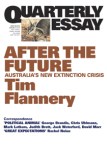
Quarterly Essay No 48 Cover

Quarterly Essay 48 cover (Courtesy Black Inc)

Tim Flannery is an Australian palaeontologist-cum-environmentalist who has been on the public stage for a couple of decades now. He has published several books on environmental issues, some best-sellers, including The future eaters and The weather makers. He was Australian of the Year in 2007, has starred in three television documentary series with comedian John Doyle, and is currently Chief Commissioner of Australia‘s Climate Commission.  With the environment being his passion, he is used to controversy, but many of us regard him as a national treasure. There, I’ve shown my hand!

Needless to say, I enjoyed his current Quarterly Essay titled After the future: Australia’s new extinction crisis. In it he analyses the causes of the second wave of extinctions, and suggests solutions.

The essay is divided into 8 short sections. Near the end of the second section, Flannery writes

I hope the message is loud and clear. Australian politics, and the bureaucracy that supports it, is failing in one of its most fundamental obligations to future generations, the conservation of our natural heritage.

It’s scary stuff. On the preceding page he discusses public ignorance, arguing that most people are unaware that a new wave of extinction is happening, and that those who are aware “commonly believe that our national parks and reserves are safe places for threatened species”. I fall into this latter camp, I’m afraid. I knew it wasn’t all hunky-dory but I had assumed that the parks and reserves were working. Apparently not. The reasons are complex. Funding is of course one aspect and underpins some of the issues he raises, such as the lack of resources and support for effective planning and management, and a decrease in scientifically trained staff able to research and monitor the situation.

However, Flannery argues there are more systemic issues, mostly relating to “politics”. One is the increasingly risk-averse behaviour of governments, resulting in their being prepared to do nothing rather than risk failure. Another is the fact that the environment is no longer the bipartisan issue it once was, with the right increasingly seeing the environment as a left issue. The conservatives are, paradoxically, losing interest in conservation! Environmental stewardship, Flannery argues, once inspired leaders of the right, like Theodore Roosevelt and Ronald Reagan in the USA, and Malcolm Fraser in Australia. It was Malcolm Fraser “who first used federal powers to prevent sand mining on Fraser Island, who proclaimed Kakadu a national park, and who ended whaling in Australia”. However, the rise of green parties (here and in other first world nations) is alienating the right, and yet are not always friendly to conservation. “Animal rights issues, such as opposition to the culling of feral species”, for example, “can sometimes get in the way of environmental stewardship”. The result of environmental issues being seen through the lens of party politics and ideology is that the effort to discredit conservation has resulted in the rejection of science as “a guide to action”. This, says Flannery, is dangerous territory.

While Flannery spends around a third of the essay setting out the problem and discussing the causes, his main thesis is that the current focus of environmental programs on preserving ecosystems is not working – and he presents some convincing arguments for changing the focus to saving individual species. He describes programs in the Kimberleys which are managed by the Australian Wildlife Conservancy (with which he is connected) in partnership with indigenous groups, using their fire management techniques. But his most impressive example is a privately managed program in Papua New Guinea, the Tenkile Conservation Alliance, focused on saving a tree kangaroo. He argues that it “is a prime example of saving an ecosystem by concentrating on saving a species”, and asks:

How is it that one Australian couple has almost single-handedly transformed the fortunes of a people and the biodiversity of a mountain range while trying to save  an endangered species of tree kangaroo? The answer is simple: the Thomases [zoologists] set clear goals, used scientific methods to monitor their progress, and reported back to the people.

I’m not sure I’d call that simple. Or, perhaps I’d say the process is simple, but deciding on environmental priorities and finding the right mix of people/organisations to manage it is not so simple. Flannery’s solution is there needs to be:

  • a legislative commitment to zero tolerance on further extinctions;
  • the establishment of a Biodiversity Authority [yes, I know, another bureaucratic body] that is independent of government, that has “unequivocal targets”, and which faces strong consequences [what, I wonder?] on failure to deliver; and
  • the acceptance and formal involvement of non-profit organisations in managing biodiversity programs.

The Conversation, an Australian academic and research sector blog, is currently running a weekly series on endangered species. A commenter on last week’s post suggested outsourcing the listing of endangered species to peak groups, pretty much mirroring Flannery’s argument regarding partnerships between the government and non-government sectors.

Overall, the essay is clearly argued, but occasionally Flannery makes a statement that jars. One is his statement that “even under Labor governments with a strong green bent, national parks are not always safe” which he supports using the example of the Bligh Government’s starting the process of de-gazetting a part of the Mungkan Kaanju National Park with a view to returning it to its traditional Aboriginal owners. He doesn’t elaborate on this. I wrote in the margin, “Is this wrong”? Not surprisingly, at least one indigenous leader, Marcia Langton, took offence. I suspect it was a case of Flannery finding a poor example to support his argument regarding national parks being threatened even by supposedly sympathetic governments, but I don’t know.

Despite odd moments like this, I did find his argument convincing. However, as I’m sure he’d say himself, it’s not a guaranteed solution. Early in the essay he makes a point of discussing scientific method, arguing that “science is not a search for the truth” but about “disproving hypothesis”.  The hypothesis he proposes here is surely worth testing given the failure of current methods. It begs his early questions, though, regarding political and social will, which may in fact be the critical variables that we need to resolve.

Tim Flannery
“After the future: Australia’s new extinction crisis”
in Quarterly Essay, No. 48
Collingwood: Black Inc, November 2012
107pp.
ISBN: 9781863955829

(Review copy supplied by Black Inc.)

Meanjin’s Tournament of Books 2012, Matches 3 to 6

As I promised in my first post on this year’s tournament – whether you wanted it or not  – I’m back with a progress report on the tournament. And, I must say, I’m rather thrilled with the results to date. I haven’t read all the contenders so my reaction is more than a little subjective but my favourite authors and some favourite stories are doing well.

Match 3: Thea Astley’s “Hunting the wild pineapple” defeated Tara June Winch’s “It’s too difficult to explain”

Thea Astley, as I’ve said before, is one of my favourite writers. I have read several of her novels, but she had a long and prolific career and so there’s still a lot for me to read. Her short story collection, Hunting the wild pineapple, is one I’ve yet to read. I also haven’t read the Tara June Winch story so I’m flying completely blind. I’d like to support the young, up and coming writer, but in my heart I’m glad Astley is through to the next round. I want to see her better recognised!

I loved the fact that the judge of this round, John Hunter, recognised (not that it’s relevant to this particular competition) Thea Astley’s Miles Franklin achievement when he says that she “single-handedly kept up the women’s quota of Miles Franklin Awards for decades. Even today I think not many people know this. Anyhow, he describes Astley’s short story as “social observation written with a razor blade”. I couldn’t describe Astley better myself.

Match 4: Elizabeth Jolley’s “Five acre virgin” defeated Sonya Hartnett’s “Any dog”

Of all the matches, this is the one that mattered most to me, not only because Elizabeth Jolley is another of my favourite writers, but because this short story is one of the few I nominated in Meanjin‘s call for nominations on its blog. Estelle Tang, who judged this one, starts by commenting on the humour. This is one of the reasons I love Jolley, her wit, satire and irony. She’s dark but she makes you laugh despite yourself. “Five acre virgin” was my first Jolley. It introduced me to her interest in and empathy for the underdog, the marginalised and the outsider in our society, issues that she explores regularly in her fiction. Tang describes the story as “the classic swimming duck, an unassuming facade masking the maelstrom beneath” which could be a good description for Jolley herself. On the outside, she looked like a sweet little old lady but underneath was something far sharper. She was one funny, cluey woman.

Match 5: Josephine Rowe’s “In the mornings we would sometimes hear him singing” defeated Murray Bail’s “A.B.C.D-Z”

Of the four matches I’m reporting on today, this is the one I have least vested interest in because I’ve read neither of the short stories. However, I have read a couple of novels by Murray Bail and like his writing so on a purely subjective basis, I’d have been happy to see him win. However, the judge Jo Case calls Rowe’s prose “exquisite”, describes the story as “a mood piece” and says it’s “a seductive read”. I must locate a copy.

Match 6: Barbara Baynton’s “Squeaker’s Mate” defeated Frank Moorhouse’s “The Annual Conference of 1930 and South Dada”

Regular readers of this blog will probably remember that I reviewed “Squeaker’s Mate” last month. It’s a great story and offers such a different perspective on the “bush myth” that, although I haven’t read Moorhouse’s probably very worthy story, I am very glad to see Baynton win. Patrick Pittman who judged this match said that Baynton was new to him, and that the piece came as “a complete surprise”. He comments on its “sparse and unrelenting prose” and on its gender politics which “is radical and unsettling, if not always pin-downable”. I know what he means. Baynton is not simplistic – and should be better known.

Recap

Did you notice that these four rounds, which involved 6 female and 2 male writers, were all won by women? This is not a gender war … but it’s good to see some under-appreciated women gaining recognition.

Monday musings on Australian literature: ACT Writers Showcase

It’s been a good week for literature in the ACT. Not only was the UC Book Project announced but on Thursday, our centenary anthology The invisible thread was launched.

Irma Gold, The invisible thread

Irma Gold, editor, at the launch of The invisible Thread

The launch was a well-organised event: it found the perfect balance between formality and informality, and didn’t run too long! The book was launched by writer Felicity Packard, best known as one of the award winning writers on the Underbelly series. She spoke entertainingly about the invisible threads – people, places, events – between her and the book. It was nicely and appropriately done. She was followed by four readings from the book, three by authors Blanche d’Alpuget, Adrian Caesar and Francesca Rendle-Short, and one by Meredith McKinney, daughter of Judith Wright. Being of a certain age, I related to the fact that Wright’s and Caesar’s poems both dealt in some way with age. Editor Irma Gold concluded the launch with the usual thanks … and the whole was emceed by local radio announcer Alex Sloan. The venue – the New Acton courtyard – was perfect for the warm spring evening. It was a treat to be present.

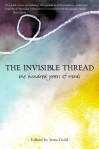
The invisible thread, by Irma Gold

Cover (Courtesy: Irma Gold and Halstead Press)

Irma has also been interviewing many of the still-living authors included in the anthology. The interviews – and the stylish book trailer – can be seen on her You Tube channel. Well worth checking out during those hazy lazy post-Christmas days if you don’t have time now. Nigel Featherstone whom I’ve reviewed is there, as is the exciting poet and rap artist Omar Musa, as is the new-to-me poet Melinda Smith, as is … well you get the point. More interviews are to be added weekly over the next couple of months.

But, these are not, really, the point of today’s post. At the launch Irma announced another initiative associated with the book – wow, that woman has worked hard. It’s the ACT Writers Showcase, a website dedicated to, obviously, showcasing writers from the ACT. Irma explained at the launch that the anthology includes only 70 of the 100 plus writers considered for it. The showcase is an attempt to ensure that all writers are noticed, promoted and, most importantly, receive the due they deserve. Irma, herself, for example, is not in the book – but she is in the showcase.

Authors can be located via the search box or the writers’ index. There is a brief bio and list of publications for each author, and an excerpt of their work. I’m told this is a pretty unique site – but, whether it is or not, it’s not only a great resource for readers but also makes a significant contribution to documenting “all that’s past and what’s to come”* in ACT literary culture.

Are you aware of any similar initiatives in your corner of the world?

* from “A Valediction”, by Adrian Caesar

Impressive reading initiative from the University of Canberra

How proud am I? Not that I had anything to do with it, but the University of Canberra, in my city, has launched an inspiring initiative which it calls the UC Book Project. This is a project whereby every student (yes every student) who commences a course (yes any course) at the University of Canberra in 2013 will be given the same book, in print or electronic form, and will be required (yes required) to read it!

The aim of the project is, according to the University’s website, “to enhance the first-year experience of students, increase their knowledge of contemporary and global issues, and foster a sense of community among students”.

Have you ever heard of such a thing? I hadn’t, but apparently, according to the project’s major proponent Professor Nick Klomp*, many universities around the world have a “freshman or common reading program”. How can a university manage to ensure that every student in every course read one particular book? Well, the website says that:

Different courses will incorporate the concepts and content of the book in different ways, and there are several activities planned for the year for which students will need to have read the book.

The University will also encourage students to engage in an online discussion about the book. Anyone will be able to read the discussion but only staff and students will be able to post comments. Fair enough.

Ok, so what’s the project’s inaugural book? Just wait, it’s coming, but first I want to tell you that it was selected by a panel comprising Deputy Vice Chancellor Nick Klomp, Professor of Arts and Humanities Jen Webb, Director-General of the National Library of Australia Anne-Marie Schirtlich, Patron of the National Year of Reading William McInnes, and local award-winning author (whom I’ve reviewed twice in this blog) Nigel Featherstone. What fun they must have had trying to choose one book!

Anyhow, enough rabbiting on. It’s time to tell you the book: Craig Silvey‘s Jasper Jones. This Western Australian novel made quite a splash when it was published in 2009 and is, I think, a great fit for the purpose. It’s readable and not too long; it has a good plot that draws you along, and some wonderful dialogue; it’s a coming-of-age novel but is not specifically young adult; and, without it or me being crass, it ticks some boxes relating to multicultural and indigenous Australia. In a word, it’s real in a way that should appeal to a wide range of students. I read and reviewed Jasper Jones here (early in my blogging career).

Congratulations to the University of Canberra for a truly wonderful initiative and many thanks to Nigel Featherstone for bringing it to my attention. I can’t believe how hard Nigel works for literature in the ACT region (and Australia) while still managing to write himself. I dips me lid to ‘im!

* And, readers, would you believe that Professor Klomp is a scientist!? I dips me lid to ‘im too!

Gerald Murnane, The plains (Review)

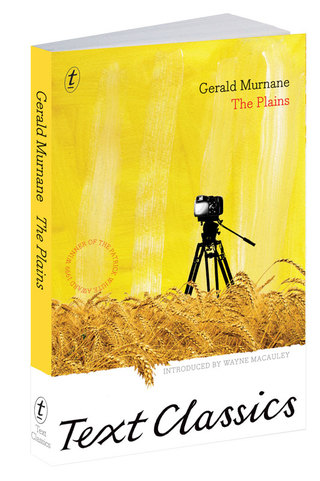
Gerald Murnane, The Plains, bookcover

Bookcover (Courtesy: Text Publishing)

Wayne Macauley, he of the Most Underrated Book Award fame, wrote in his introduction to my edition of Gerald Murnane‘s The plains that “you might not know where Murnane is taking you but you can’t help being taken”. That’s a perfect description of my experience of reading this now classic novella. It was like confronting a chimera – the lower case one, not the upper case – or, perhaps, a mirage. The more I read and felt I was getting close, the more it seemed to slip from my grasp, but it was worth the ride.

The plains was first published in 1982, which is, really, a generation ago. Australia had a conservative government. We still suffered from cultural cringe and also still felt that the outback defined us. All this may help explain the novel, but then again, it may not. However, as paradoxes and contradictions are part of the novel’s style, I make no apologies for that statement.

I’m not going to try to describe the plot, because it barely has one. It also has no named characters. However, it does have a loose sort of story, which revolves around the narrator who, at the start of the novel, is a young man who journeys to “the plains” in order to make a film. It doesn’t really spoil the non-existent plot to say he never does make the film. He does, however, acquire a patron – one of the wealthy landowners – who supports him in his endeavour over the next couple of decades. It is probably one of Murnane’s little ironies that our filmmaker spends more time writing. He says near the end:

For these men were confident that the more I strove to depict even one distinctive landscape – one arrangement of light and surfaces to suggest a moment on some plain I was sure of – the more I would lose myself in the manifold ways of words with no known plains behind them.

Hang onto that idea of sureness or certainty.

The book has a mythic feel to it, partly because of the lack of character names and the vagueness regarding place – we are somewhere in “Inner Australia” – and partly because of the philosophical, though by no means dry, tone. In fact, rather than being dry, the novel is rather humorous, if you are open to it. Some of this humour comes from a sense of the absurd that accompanies the novel, some from actual scenes, and some from the often paradoxical mind-bending ideas explored.

So, what is the novel about? Well, there’s the challenge, but I’ll start with the epigraph which comes from Australian explorer Thomas Mitchell‘s Three expeditions into the interior of eastern Australia, “We had at length discovered a country ready for the immediate reception of civilised man …”. Bound up in this epigraph are three notions – “interior”, “country” and “civilised”. These, in their multiple meanings, underpin the novel.

Take “interior”. Our narrator’s film is to be called The Interior. It is about “the interior” of the country, the plains, but it is also about the interior, the self, and how we define ourselves. While there are no named characters, there are people on the plains and there’s a sense of sophisticated thinking going on. Some plainspeople want to define the plains – their country, the interior – while others prefer to see them almost as undefinable, or “boundless”, as extending beyond what they can see or know. The plainspeople are “civilised” in the sense that they have their own artists, writers, philosophers, but it is hard for we readers to grasp just what this “civilisation” does for them. Is it a positive force? Does it make life better? “Civilised”, of course, has multiple meanings and as we read the novel we wonder just what sort of civilisation has ensconced itself on the plains.

These concepts frame the big picture but, as I was reading, I was confronted by idea after idea. My notes are peppered with jottings such as “tyranny of distance” and boundless landscapes; cultural cringe; exploration and yearning; portrait of the artist; time; history and its arbitrariness; illusion versus reality. These, and the myriad other ideas thrown up at us, are all worthy of discussion but if I engaged with them all my post would end up being longer than the novella, so I’ll just look at the issue of history, illusion and reality.

Towards the end of the novel we learn that our narrator’s patron likes to create “scenes”, something like living tableaux in which he assembles “men and women from the throng of guests in poses and attitudes of his own choosing and then taking photographs”. What is fascinating about this is the narrator’s ruminations on the later use of these “tedious tableaux” which have been created by a man who, in fact, admits he does not like “the art of photography”, doesn’t believe that photographs can represent the “visible world”. The landowner contrives the photos, placing people in groupings, asking them to look in certain directions. Our narrator says

There was no gross falsification of the events of the day. But all the collections of prints seemed meant to confuse, if not the few people who asked to ‘look at themselves’ afterwards, then perhaps the people who might come across the photographs years later, in their search for the earliest evidence that certain lives would proceed as they had in fact proceeded.

In other words, while the photos might document things that happened they don’t really represent the reality of the day, who spent time with whom, who was interested in whom and what. They might in fact give rise to a sense of certainty about life on the plains that is tenuous at best.

Much of the novel explores the idea of certainty and the sense that it is, perhaps, founded upon something very unstable. Murnane’s plainspeople tend to be more interested in possibilities rather than certainties. For them possibilities, once made concrete, are no longer of interest. It is in this vein that our narrator’s landowner suggests that darkness – which, when you think about it, represents infinite possibility – is the only reality.

The plains could be seen as the perfect novel for readers, because you can, within reason, pretty much make of it what you will. If this appeals to you, I recommend you read it. If it doesn’t, Murnane may not be the writer for you.

Lisa at ANZLitLovers, a Murnane fan, has reviewed The plains

Gerald Murnane
The plains
Melbourne: Text Publishing, 2012 (orig. published 1982)
174pp.
ISBN: 9781921922275

Monday musings on Australian literature: Writing across the fiction-nonfiction divide

Last week, a conference called the NonfictioNow Confence 2012 was held in Melbourne. It went for four days! It sounds right up my alley but I didn’t get to it. Fortunately the site says that panel discussions will be online in 2013.

Anyhow, it got me thinking about writers who write both fiction and non-fiction because, while I mainly read fiction, I enjoy non-fiction immensely and would read more if I could find the time. I started to wonder whether this phenomenon of writers spanning both forms was a new one that was somehow indicative of new ways of thinking about fiction and non-fiction, about writing from the imagination versus from reality. (Is this – has it ever been – a real dichotomy?). But, I quickly realised that it has been ever thus, that while there have always been writers who specialise in one form, there have also always been those who dabble (and I don’t mean that pejoratively) across multiple forms and genres. Think Charles Dickens, for example, or George Orwell.

For some writers, I suspect, writing like that was (still is) about making a living. Novelists, for example, might write journalism and/or other non-fiction to survive. But, for others, it’s a matter of the right form for the right subject. I’ve written in this blog about Kate Grenville and her decision to write The secret river as fiction, when her plan had been to write a non-fiction work about her ancestor. And, I’ve written about Anna Funder, who had planned to write Stasiland as fiction but changed her mind and wrote it as non-fiction. Grenville and Funder had well-articulated reasons for their decisions and these reasons had something to do with being “true” to the subject matter they’d chosen.

Funder said that having interviewed people for Stasiland, she felt it would dishonour them and their lives to turn their stories to fiction. So, she wrote a non-fictional work, but one with a certain novelistic sensibility. She is a “character” in the book providing a narrative coherence to the stories being told, and the book is structured in such a way that it can almost be said to have a plot. Funder then went on to write a novel, All that I am, which, like Stasiland, has been nominated for and/or won multiple awards. Her decision regarding form clearly seems to be about aesthetics and ethics, rather than about practicalities.

As a blogger for NonfictioNow wrote, Helen Garner who has written across almost all forms*, is the Australian poster girl for talking about “the similarities, differences, cross-overs and relationships between fiction and non-fiction writing”. Her fiction – particularly her first novel Monkey Grip and her most recent The spare room – has been panned by some for being “just” about her life as if, somehow, that wasn’t valid. But, as Garner said at the time of her first novel, whether it is about her life or not, she still had to select and frame the story and think about the language she would use to convey her feelings and ideas. Writer Tegan Bennet Daylight recently visited Garner in The Australian. She wrote of Monkey grip:

For me, at least, Garner had cracked narrative open. She had written, in a way, the kind of fiction Virginia Woolf had aspired to in novels such as The Waves and, indeed, achieved in her own diaries. She had followed a consciousness that did not bend easily into the more traditional shape of a novel. She had written a women’s novel.

Ah … I don’t think I’ll go there right now – there’s too much to unpack in terms of “the narrative” and “a woman’s novel” though I’d love to ask Daylight whether she means a novel written for women or in a style that speaks to some sort of women’s view of the world.

I’ll simply say, because I haven’t time to write more, that there seems to be a flourishing of Australian writers – particularly, it seems, women – writing – and writing successfully – across the divide. They include, in addition to Garner and Funder, Chloe Hooper and Charlotte Wood. While, as I said at the beginning, this is not a new phenomenon, my sense is that many of these writers are in fact forging a new way of writing non-fiction and, conversely, a new approach to fiction.

Do you read much non-fiction? Are you seeing new ways of writing non-fiction that seems to be informed by the techniques, and aesthetic even, of fiction – and do you think this is risky business?

* Garner has written novels, short stories, film/play scripts, essays and non-fiction books.

Nigel Featherstone, I’m ready now (Review)

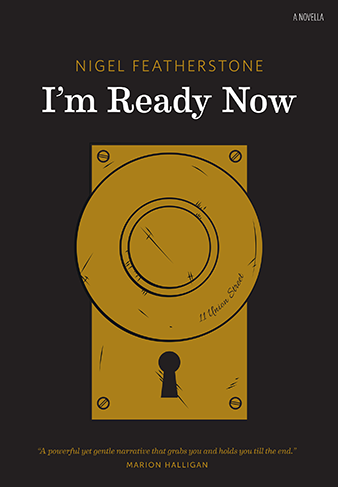
Featherston, I'm ready now, book cover

Book cover (Courtesy: Blemish Press)

Way back in my youth when I started studying literature, I thought I had to get the “right” interpretation. It made reading a little scary, I must say. However, as I gained confidence, I discovered that there are as many responses to a novel as there are readers, something I was reminded of when I attended this week’s launch of Nigel Featherstone’s novella, I’m ready now. And here’s why…

The book was launched by Canberra journalist and biographer, Chris Wallace. She spoke eloquently about the book telling us that it’s about how you can make a change in your life no matter how old you are – whether you’re 30 as Gordon is in the book or 50 as his mother, Lynne, is. She said too that it promotes the idea of living an imaginative life. I thought, yes, she’s right, it does do these things. And then Nigel spoke, and he said that for him the book can be summed up in one word, liberation. And I thought, yes, I can see how it’s that. But I had framed it a little differently from my reading.

Before I give you my different-but-on-a-similar-track take, I’d better tell you something about the plot. It has a small cast of characters, which is pretty much what you’d expect in a novella. They are Gordon, a gay man turning 30 who lives in Glebe and works as a photographer; his old schoolfriend Shanie, who followed Gordon to Sydney; Levi, Gordon’s boyfriend of a year or so; and Gordon’s mother Lynne who, recently widowed, comes up from Hobart to stay with Gordon for a short while. Lynne has put the large family home on the market, and the auction will be held while she’s away. Meanwhile, Gordon is almost at the end of his Year of Living Ridiculously, which is a year of rather self-destructive high living that he designed, and is doggedly keeping to, for his 30th year. He plans to crown this year with something he calls The Ultimate. But then Mum, Lynne, arrives, and puts The Ultimate at risk. What Gordon doesn’t know is that his mother has a grand plan herself, now that she’s free. (Ha! Liberation you see.)

This sounds pretty simple, really, doesn’t it? However, there are complications. Lynne’s husband, Eddie, was not Gordon’s father. Gordon’s father, Patric Finn, walked out on him and his mum when he was around a year old, and neither has completely resolved the abandonment. It’s not that Eddie wasn’t a good husband and father, because he was, but he never fully understood Gordon, and for Lynne he was “a head kind of love, not a heart kind of love”.

What is lovely about Featherstone’s writing – as I also found in his Fall on me – is that he manages to build tension and mystery around his characters’ behaviour without undermining their realness or humanity, and without alienating us readers. We warm to them even while we wonder about the wisdom of their decisions and motivations. Featherstone also uses imagery and allusions lightly. Water, for example, can be a cliched symbol in stories of change and growth, but here it’s appropriate and not laboured. What more logical thing is there to do on a hot night in Sydney than to go for a dip in the sea?

Besides the characterisation, I also like the novella’s voice and structure. It’s told first person in the alternating voices of Lynne and Gordon, and is effectively paced, largely through varying the length of the chapters*. The book opens with a mere half-page chapter in Lynne’s voice, and then moves to mostly longer ones in the main part of the book. They shorten towards the end as the pace builds, keeping us involved and wondering what these two will finally decide to do and what role Shanie and Levi might play in it all.

Now though to how I would describe the novel – and for me it is about coming to terms with the past. Both Gordon and Lynne have not had unhappy lives but both have in some way been damaged by their abandonment. Almost half way through the novel, they both say something significant. Lynne, reflecting with real generosity on Patric’s unheralded departure, says

I think he wanted to be free, a free young man. There have been times – many times – when I’ve found myself actually admiring his audacity to grab life, to run with it, to run as far as he could.

She then tells us that her plan is to leave Australia to live in “a farmhouse on a hill in the beloved country [Ireland] of my mother”. In the next chapter, Gordon’s, we learn in a flashback why he commenced his Year of Living Ridiculously. It’s to discover “what it is that makes me feel most alive”. He wants to “to lean over the cliff, figuratively speaking … to live as vividly as possible” – but his chosen method is clearly not working. The idea, though, reminded me of Fall on me in which the son tells his dad that “safety doesn’t always equal life”. Both these novellas, in a way, explore what Wallace described as “living an imaginative life”.

They are both, too, about something Lynne says towards the end, which is that “life must move forward; anything else is sacrilege”, and yet, paradoxically, her wish for Gordon could be seen to be the opposite: she wants him to go back to find what “hurt him all those years ago”.

And so for me, the book is about “living imaginatively” and about liberation, but it is also about how the past can stall us if we don’t get it in the right perspective. Featherstone opens the book with two epigraphs, one being TS Eliot’s “Home is where one starts from”.  I think that, in a way, says it all.

Nigel Featherstone
I’m ready now
Canberra: Blemish Books, 2012
156pp.
ISBN: 9780980755688

(Review copy supplied by Blemish Books)

* for want of a better word for the numbered parts.