Monday musings on Australian literature: Confronting Australian novels

Recently I wrote a post about reading difficult novels and proposed categories for different sorts of “difficulties”. One of those categories was “emotionally confronting”, but I realise now that a better category would have been “emotionally and/or intellectually confronting”. By intellectually confronting I don’t mean challenging in terms of style, language, structure, but in terms of ideas. Many books which confront us with difficult ideas can, of course, evoke an emotional response in us, but I didn’t explore that in my original post. However, having just read Tsiolkas’ Barracuda (my review) I now plan to.

An intellectually confronting book is, I’d say, one that shocks us out of our complacency. This is what Christos Tsiolkas wants to do. In a conversation with Heather Taylor Johnson in Meanjin‘s Canberra issue, he expressed his concern that:

We are reading for confirmation of ourselves rather than to challenge ourselves and I think that is a real danger.

And said, in response to a question regarding mixed reactions to The slap, that

I want to pose questions that are unsettling or troubling.

He certainly does that. I’d love to hear what you think about novels that confront you – that unsettle your mind, shake your world view, disturb your core. Meanwhile, I’m going talk about some of the authors whose novels have surprised or challenged me over the last 2-3 decades.

Thea Astley could hardly, I think, be said to write to confirm ourselves. Her books face head on the ugliness in our culture – between white and black, rich and poor, city and country. The first book of hers that I read, the ironically titled A kindness cup, deals with racism and violence in a country town. The multiple effects of rain shadow (my review) explores the impact on a group of people of a violent episode on Palm Island. Interestingly, given my recent post on the subject, one of the voices telling the story is indigenous. Drylands is concerned with the impoverishment of the spirit as she sees it in late 20th century Australia. I wonder what she’d think now! One of her characters in The multiple effects of rainshadow says:

There must be a million readers out there who crave boredom! Who love the dangling participle! Who wallow in truisms and fatuous theorisings! … Slap in your popular aphorisms, buddy, but don’t make ‘em think!

Helen Garner has to be one of our bravest writers. Her nonfiction books, The first stone and Joe Cinque’s consolation, and her novel, The spare room, in particular, demonstrate her willingness to explore ideas that may be unpalatable, that run against the status quo. Somehow, she’s managed to confront the resultant criticism – which she’s faced since her first critically acclaimed but also slammed first novel, Monkey grip –  and keep on going. I’ve said it before – and will probably say it again – I don’t always agree with Garner, but I like that she confronts us with ideas that we need to think about in our dealings with others. Whether you agree with her take on the Ormond College sexual harassment case or whether you relate to her frustration with her terminally-illl friend, you have to admit that she doesn’t let us get away with “soft” thinking.

Elizabeth Jolley unsettled readers from the beginning with her willingness to expose the soul’s darkness in ordinary people and to have them enact that darkness in often shocking ways. It was Weekly’s ruthless action at the end of The newspaper of Claremont Street, the second or third Jolley book I read, that sold me. Really! I soon learnt not to be surprised by anything her characters thought or did. Jolley is more about the interior, the psyche, than the other writers I’m mentioning here but she’s no less confronting to our comfort.

Andrew McGahan‘s first two novels Praise and 1988 are examples of Grunge Lit or Generation X literature. I found them, particularly Praise, confronting because of the nihilism, hopelessness of the characters. They have no goals, they immerse themselves in sex, drugs and alcohol rather than “honest work”.  According to Wikipedia, Grunge Lit, a term not necessarily accepted by those it’s been applied to, did not last long. But, in these two books, McGahan did present Australian readers with something that made us sit up and take note – not just for the writing, but for the unappealing lifestyles he presented.

Kim Scott‘s That deadman dance (my review) is an historical novel, so we could perhaps tell ourselves that things are different now, but any honest reader would realise that Bobby’s statement in the novel that –

We learned your words and songs and stories, and never knew you didn’t want to hear ours

– continues to have ramifications today, and that, in fact, we are still not very good at hearing their story. Scott is just one of several contemporary indigenous writers, such as Alexis Wright, Melissa Lucashenko and Jeanine Leane, who are starting to confront us with their story, with their perspective of what living in Australia today is like for those who have been disenfranchised.

Christos Tsiolkas needs little introduction if you’ve been reading my recent posts. He has been shocking readers pretty much since his first novel, Loaded, which I’m embarrassed to say that I haven’t read. I did, though, hear about it! His books are firmly urban/suburban and tend to be set within immigrant subcultures. As far as I understand, most if not all traverse similar subject matter, the cultural conflict, social mobility, sexual identity confusion, racism, that often lead to aggression if not actual violence. His language is raw, and unapologetic, but his characters are real. You may not like them all, you may feel you aren’t like them or that you don’t know people like them, but they seem to be part of contemporary Australia, an Australia in which ridicule of and violence against people who are different seems to be getting worse. At least, I fear it’s not getting better. Tsiolkas wants us to think about this, to not sit in our comfortable middle-class suburban homes and worry about nothing more than our generally self-serving concerns.

Australian feminist, Anne Summers, said in a lecture that “I found [Helen Garner’s] The First Stone to be brave and honest and quite confronting–the hallmarks of a very good book.” I think she’s right. There’s nothing wrong with reading books that reflect ourselves and explore our concerns, but surely our reading has the most value when we are shaken out of the familiar and made to face other worlds and different ideas.

Now, over to you …
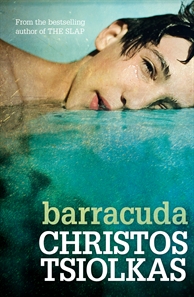
Christos Tsiolkas, Barracuda (Review)

Christos Tsiolkas, Barracuda

Courtesy: Allen & Unwin

The best way I can describe Christos Tsiolkas’ latest novel Barracuda is to liken it to what Tsiolkas would define as a “good man”, tough on the outside, but tender within. I don’t know how Tsiolkas does it, but he manages to reach into your heart while at the same time confronting you to your core.

On the surface, Barracuda is about success and failure, specifically in sport. The plot concerns Danny Kelly aka Psycho Kelly aka Barracuda who is a talented swimmer. He receives a scholarship to attend one of Melbourne’s elite private schools and be coached on the swim team. Danny, with his Scottish truck-driving father and Greek hair-dresser mother, is not the normal demographic for the school and feels an outsider from the start, but he knows – or believes, at least – that he can be “the strongest, the fastest, the best”. However, things don’t go according to plan and Danny, who had poured his all into a single vision for his future, is devastated. The novel explores how a young man copes with such a major blow to his self-image, what happens when his expectations for his future are destroyed. Tsiolkas examines the social, political and economic environment in which Danny lives and the role they play in what happens to him, but he also delves deeply into the psyche, because what happens to Danny can only be partly explained by external forces. In the end we are, as Danny comes to realise, responsible for ourselves and our actions.

Contemporary writers annoyed him

Barracuda is quite a page-turner, but it bears slow reading, because it is a carefully constructed novel and some of its joys come from considering what Tsiolkas is doing. There is an amusing moment in the book when Danny, now in jail, becomes an enthusiastic book reader – primarily of 19th century novels. When the librarian asks:

‘Why are you always buried in those old farts?’ Danny would accept the teasing good-naturedly for he knew it was apt. Contemporary writers annoyed him, he found their worlds insular, their style too self-conscious and ironic.

I say amusing because there’s a self-consciousness in Tsiolkas’ style and I can only assume that he is having a little dig at himself. The novel’s structure reminded me somewhat of Evie Wyld’s All the birds, singing (my review) because both start at a point in time and then, in alternating chapters (sections), radiate forwards and backwards from that point. Tsiolkas, though, follows this structure a little less rigorously than Wyld, and he combines it with a change in person. In the first half of the novel, the sections moving backward are told in third person (limited) through the eyes of Danny, while the sections moving forward are told in first person through the eyes of Dan. This effectively enables the growing, maturing Dan to disassociate himself somewhat from his old self, although the dissociation – or perhaps the reintegration – of the two selves have a long way to go when the book opens. In the second part of the novel the point-of-view is reversed with the third person used for the older Dan, and first person for the younger, perhaps suggesting some progress towards the realignment of the selves? I need to think about this a bit more! Not only does this book warrant slow-reading, but rereading wouldn’t hurt either.

He couldn’t bridge the in-between

A significant issue for Dan is managing the two worlds he finds himself in:

It’s like two worlds were part of different jigsaw puzzles. At first, he’d tried to fit the pieces together but he just couldn’t do it, it was impossible. So he kept them separate: some pieces belonged to this side of the river, to the wide tree-lined boulevards and avenues of Toorak and Armadale, and some belonged to the flat uniform suburbs in which he lived.

When the two worlds conflict, Danny feels split open, cracked apart. “No one could ever put him back together”. And so, he starts to occupy what he calls “the in-between” but that leaves him silent, and alone. This dissection of worlds, of  “class”, and of anglo-Australia versus immigrant Australia, is an ongoing concern for Tsiolkas. We came across it in his previous novel, The slap (my review) and we see it again here. Tsiolkas is not the only writer exploring this territory, but he’s one of the gutsiest because he’s not afraid to present the ugliness nor does he ignore the greys, the murky areas where “truth” is sometimes hard to find (though he doesn’t use the word “truth”).

While Danny is the main conduit for teasing out the tensions in society between two worlds, other characters also reflect it. There’s Danny’s childhood friend, Demet, whose working class migrant background is challenged when she goes to university, and his school friend Luke, a nerdy ostracised boy at the elite school who, with his Vietnamese mother and Greek father, is also “half and half”. These characters manage to traverse their worlds more easily than Danny, but Tsiolkas shows that it isn’t easy.

His father was a good man

Barracuda is about a lot of things. It’s not an exaggeration to say that Tsiolkas taps into the zeitgeist of contemporary suburban Australia. But I might explore that in another post, because this post is getting long and I do want to end on the theme that struck me the most, that of defining “a good man”.

Throughout the novel, Danny meets many men – his father, grandfather and coach, in particular, when he’s a boy, and his lover Clyde, old schoolmate Luke and brain-damaged cousin Dennis when he’s an adult. As an adolescent, and somewhat typically, Danny loves his grandfather, rejects his father, and dotes (until he “fails”) on his Coach. Adult Dan is more circumspect about men, but sees good qualities in Clyde and Luke, while still rejecting his father. None of these men, though, seem able to break through his destructive self-absorption. However, late in the novel, living a self-imposed lonely life, albeit one now committed to helping others, Dan has an epiphany. In a confrontation with his father, he suddenly realises:

His father was a good man. It struck him with a force of revelation, exultation, light flooding through him. His father was a good man. His father was the hero of his own life.

At this moment, he realises he wants to be a good man. He also starts to get a glimmer of what a good man is, and it has nothing to do with being the strongest, fastest and best.

I have more to say about this book, and so will do a follow-up post rather than write a longer essay here. Meanwhile, I know there are readers of this blog who do not like Tsiolkas. He is, I agree, a confronting writer. His characters are not aways easy to like, and he doesn’t shy away from their grubbiest (that is, unkind, violent, sexual) thoughts, but for me he has some valid concerns to share and I want to hear them.

Christos Tsiolkas
Barracuda
Sydney: Allen & Unwin, 2013
515pp.
ISBN: 9781743317310

Christos Tsiolkas on success and failure

I will soon post my review of Christos Tsiolkas’ latest novel Barracuda, which is about a young man who fails in his quest to become an Olympic swimmer. It tears him apart. In tonight’s news, here in Australia, we heard that one of our successful Olympic swimmers is going into rehab for addiction to Stillnox. Another recently went into treatment for depression.

Tsiolkas’ Danny didn’t make it the way these Olympians did, but I wonder whether their (apparent) suffering has the same roots as Danny’s – the loss of a future. Danny lost it because he “failed” (in his eyes) at a crucial moment. For post-Olympians (as I’ll call them), it seems to be more about what to do after they’ve achieved the goal. Danny thought that his future was set, but even if he had achieved his goal, would it have been?

Here’s Danny:

He flexed his right hand, opening and closing it, stretching his fingers till he could feel the tingle, then clenching them in tight. Sometimes in the garden he came across dried-up plum kernels from fallen fruit that had been buried all winter and then resurfaced. He’d pick up a kernel, it would be shrivelled, the colour of the soil, and it would disintegrate into dust in his hand. That was the future, that’s what had become of it.

His hand open and closed.

He’d had a future. It had been as hard and as strong as the stony heart of an unripened plum, so strong it would have taken a hammer blow to crack it. He’d had that future for years but it too had crumbled into dust. His theory was that you only got one future to dream. He’d f****d it up. He’d failed and now it was gone.

Only one future to dream? Therein lies the rub, perhaps, regardless of whether you succeed or fail (in sport or other single-minded endeavour)?

Monday musings on Australian literature: The Bread and Cheese Club, again

I promise that this, my third post on Melbourne’s now defunct Bread and Cheese Club will also be my last, but it was such an interesting club that I can’t resist one more post. Just to remind you, it was formed in 1938, with the following goals:

To promote mateship and fellowship among persons of mutual interests, to foster a knowledge of Australian Literature, Art and Music and to cultivate an Australian sentiment … (from H.W. Malloch’s Fellows all, p. 17)

My first post introduced the club, and particularly one of its founders, John Kinmont Moir (1893-1958), who was clearly the Club’s leading light, while my second post focused on some of the ways in which the Club supported indigenous Australian culture. In this post I want to give a flavour of how widely their activities and, probably, influence extended. To keep it simple, I’m just going to list a few of the activities I came across while researching the Club in the National Library of Australia’s Trove database for newspapers. Here goes:

  • Children’s Poetry Competition. Reported in The Argus, 1939
  • Exhibition of art and literature at the Velazquez Gallery. The writer in The Argus, 1940, saw it as a “mixed bag” (I love the language here!):

If the club had a selection committee to deal with the art side of the show, it was doubtless a committee more anxious to obtain a wide representation than a particularly high standard. It is doubtful whether a more mixed lot of pictures has ever been hung on the walls of any gallery in Melbourne. They range from admirable examples of the work of some of Australia’s most capable artists to hopeful (or despairing) efforts by the veriest tyros.

  • Publication of Frank Clune’s book, Chinese Morrison, about George E Morrison who, as many Australians will know, became an influential political adviser to the Chinese Republic in the early 20th century. Reported in The Argus, 1941
  • Short story competition, judged by Mrs Vance (aka Nettie) Palmer. Reported by the Courier Mail, 1942
  • First art exhibition by members of the Bread and Cheese Club Art Group. Reported in The Argus, 1946
  • Publication of naturalist David Fleay’s book, Gliders of the gum trees. Reported in the Queensland Times, 1947
  • Junior Art Competition. Reported in the Cairns Post, 1948
  • Surprising Dame Mary Gilmore with a bouquet of flowers on her 84th birthday. Dame Mary apparently said that “I had forgotten it was my birthday, but I’m so happy that my friends all over Australia remembered”. Reported in The Daily News (Perth), 1949
  • Organising significant people to address its meetings, such as Chief Justice of the High Court, Sir John Latham. (I liked this one because Latham is a mentor of the fictional Edith in Frank Moorhouse’s Edith trilogy). Reported in Barrier Miner (Broken Hill), 1951
  • Awarding annually the Australian Natural History Medallion. According a report in The Argus, 1956, the award was instituted by J.K. Moir in 1938 and was the most coveted natural history award in Australia. The 1956 award was given to Stanely Mitchell “for work on the artefacts of the Australian aborigines”.
  • Erecting a memorial in Darwin to commemorate Northern Territory pioneer Jessie Litchfield who, when she died in 1956, left “most of her estate for the encouragement of Australian literature”. Reported in The Canberra Times, 1964

Besides the variety of the Club’s activities evidenced in this (pretty) random selection, one of the most interesting things about these newspaper reports is where they are from. While the Club was Melbourne-based, albeit with some interstate members, its activities were clearly national, and were reported nationally. Sir John Latham’s talk in Melbourne, for example, was reported in a Broken Hill newspaper, and the Jessie Litchfield monument in a Canberra one. Is it just that these papers were desperate for copy or was the Club widely influential?

I will end my mini-series on the Bread and Cheese Club with a report on one more activity, because the report made me laugh. In The Argus of 14 September, 1951, Christina Mawdesley wrote an article titled “Nothing is new about prefab. houses”. She shares information from a reader who advised that Governor Latrobe’s cottage was an early prefab home, dating to 1839, and therefore earlier than the 1853 home that the paper had written about. She then goes on to quote Sir Thomas Mitchell writing from London, in 1830s-40s, about one “Manning of Holbourn” who was building wooden houses in sections for use in Australia. Mawdesley concludes her article with:

Could we discover the remains of one such pioneer prefab?

I am sure the Bread and Cheese Club would mark the spot with an engraved plaque, commemorating the good old days and “Manning of Holbourn”.

Is there anything, I wonder, that the Bread and Cheese Club didn’t do?

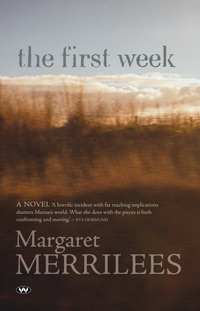
Margaret Merrilees, The first week (Review)

Margaret Merrilees, The first week

Courtesy: Wakefield Press

Having discussed in this week’s Monday Musings Margaret Merrilees’ essay on white authors writing about indigenous Australians, I’m now getting to my promised review of her debut novel, The first week, in which she does just this. It also, according to Wakefield Press’s media release, won the Adelaide Festival’s Unpublished Manuscript Award in 2012. I can see why it did.

The plot is simple. It chronicles the first week in the life of Marian, after she hears shocking news about something her adult son Charlie has done, news that would chill the heart of any parent. Marian is a middle-aged, widowed countrywoman who jointly manages a farm with her oldest son, Brian. She holds the conservative views that would be typical of her demographic. The setting is south-west Western Australia, the Noongar country of Australian author Kim Scott whose That deadman dance (my review) tells of early contact in that very region, but Marian understands little of that. She’s about to learn though, because, standing at a fence that she used to clamber through, she realises

… it was different now. There was a claim on it. This fence, a fence she’s ignored for years, had taken on new meaning. Where she stood was her land. The other side was theirs. Someone’s. Those Noongars from town.

What would they do with it? Any more clearing would be a disaster. The salt was already bad down there.

This comes early on day one, Monday, before she hears the news about Charlie, but already Merrilees has introduced us to Marian, the land she works and her attitudes. She clearly has little respect for “those Noongars from town” and yet she knows the land has been damaged. Merrilees also describes other aspects of Margaret’s life that will help inform our understanding of the week to come – guns, the family’s dynamics including her relationship with her troubled late husband, a dependence on a more savvy friend. It’s all lightly, naturally done through a well controlled third person voice.

By day two, Tuesday, Marian is in Perth, where the first order of the day is to attend Charlie’s arraignment in court. Here she meets Charlie’s housemates and is invited to their home to talk about what has happened – and there she meets Charlie’s neighbour and friend, the indigenous woman, Lee. In addition to the reference to “those Noongars” on Monday, Merrilees leads us up to this meeting with other suggestions of Marian’s prejudiced attitudes to “other” (to Asians and Aboriginal Australians). Needless to say, her meeting with the educated, political Lee does not go well.

This is where Merrilees confronts the issue she addresses in her essay, because for Marian to develop she needs to hear from indigenous characters. Marian meets Lee cold, that is, she doesn’t know Lee is indigenous: “No one had mentioned that. They wouldn’t think it mattered, probably. But it did.” Lee tells her about the Reserve in her region, about the treatment of indigenous people there and in the town. Marian doesn’t want to know – or believe – what she hears. She uses those patronising words “you people” and leaves in rancour. However, she is a woman still in shock and, knowing that all this has something to do with Charlie’s actions, her better self starts to realise that “she had to know whatever there was to know”. She reads Lee’s paper, attends Lee’s talk, and converses again with Lee. Lee is presented as fair but determined. She doesn’t go easy because Marian’s in pain, and when Marian admits that Lee has made her think, and that she’s ready to learn, Lee tells her:

Then you owe me … I won’t forget. Salvation doesn’t come cheap.

To my white Australian mind, Merrilees handles her indigenous characters well. They ring true to what my experience and reading tell me, but, as Merrilees also says in her essay, “it is not for a white writer or critic to decide what is appropriate.” I would love to know what indigenous readers think.

And this segues nicely to what I most enjoyed about the book – its humanity and lack of judgement. Merrilees lets her characters be themselves, warts and all. Lee, for example, is rather fierce but open to discussion and sad about the direction Charlie took. Marian is conservative, in great pain and feeling a failure as a mother, but is open to change. I particularly liked the way Merrilees captured the physicality of Marian’s pain – she can’t eat, or sleep, or remember her son’s phone number, her chest tightens, her heart races. From my own experience of an awful shock, I related to the point where she really has to face her changed circumstance:

Getting out of the car and leaving it behind suddenly seemed difficult. Her last tie with home and normal.

If my review has seemed a little vague about detail, that’s partly because the book is too. There’s a lot we aren’t told about what exactly happened, about why Charlie did what he did, but that’s because he is not the book’s main subject. Early in my reading, I was reminded of Lionel Shriver’s We need to talk about Kevin. This, though, is a different book. Yes, both books are about a mother and a terrible act by a son, but Merilees’ compass is broader. It’s both personal and political. And so, on the personal level, Marian realises that she can – she will – survive. But it’s the political lesson that is dearest, I think, to Merrilees’ heart, and it is simply this, “that she, Marian, was ready to listen” to Lee’s story, to listen to it “wherever and in whatever way” suits Lee. The first week is a compelling read with, dare I say it, an important message. I hope it gets out there.

Lisa (ANZLitLovers) also recommends this debut.

awwchallenge2014Margaret Merrilees
The first week
Kent Town: Wakefield Press, 2013
225pp.
ISBN: 9781743052471

(Review copy supplied by Wakefield Press)

Wrapping in the rain

Mr Gums and I spent last weekend in the lovely historic town of Beechworth staying with two other couples in the gorgeous 1890s Indigo Cottage (owned by one of the couples). Quite coincidentally, we discovered that this weekend was Beechworth’s WRAP Festival. That’s Writers, Readers and Poets, an annual event that has been sponsored by the Beechworth Arts Council since 2011.

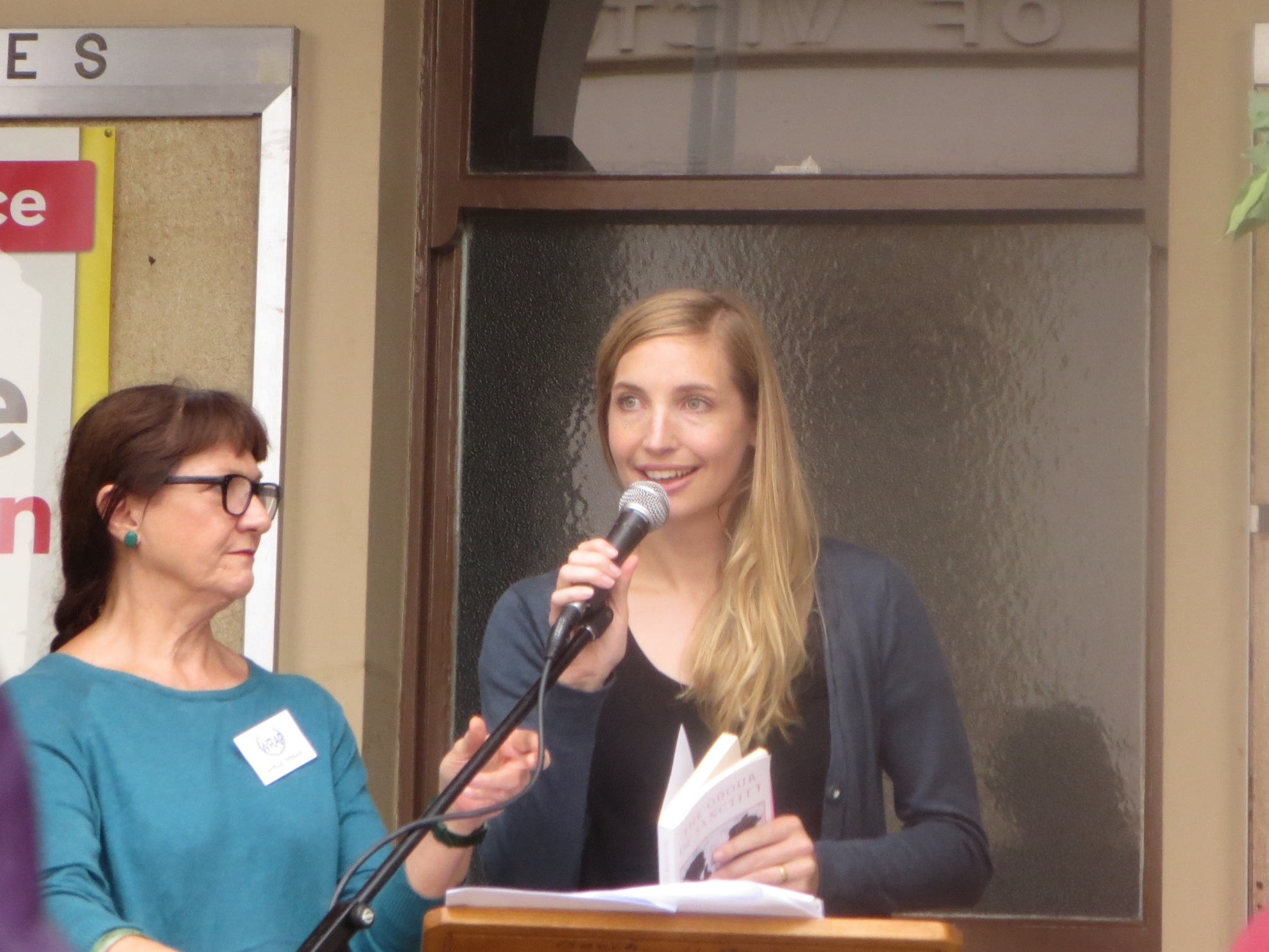
Amy Brown

Amy Brown

Of course, some of us wanted to check it out. I didn’t manage to get to sessions with Tony Birch, author of the Miles Franklin short-listed novel Blood. However, Eric, of Canberra Jazz blog, and I did get along to Poetry at the Post Office where, under umbrellas protecting us from the welcome drizzle, we heard several, mostly local poets read from their work.

They were a varied bunch, some more experienced readers than others, but they all gave us something to think about, from Geoff Galbraith’s political pleas to Lisa Ride’s satires on modern living, from Jean Memery’s tribute to janitors to Amy Brown’s moving poem in the voice of the infant saint Rumwold from her epic poem, The odour of sanctity (published by New Zealand’s Victoria University Press). The odour of sanctity sounds intriguing. She explores “six candidates for sainthood” from the 300s to the 1990s. What a fascinating topic! Anyhow, the session was relaxed, nicely em-ceed by Estelle Paterson, and showed what a local Arts Council can do to support and encourage literature in country towns.

Eric, who juggled note-taking in the rain better than I, has written up the event in more detail on his blog – with photos. Do check it out. Thanks Eric for doing the write up and for standing in the rain with me!

Monday musings on Australian literature: White writers on Indigenous Australians

Over the years I’ve read many books written by white Australian writers on indigenous Australians*, including Mrs Aeneas Gunn’s We of the Never Never, Nene Gare’s The fringe dwellersThomas Keneally’s The chant of Jimmie Blacksmith, Kate Grenville’s The secret river, Peter Temple’s The broken shoreand several books by Thea Astley. Later this week I’ll be reviewing another, Margaret Merrilees’ debut novel The first week. I avoid reading reviews of books before I write my own, but I did want to find out about Merrilees, who is new to me. My research uncovered an essay written by her in 2007 titled Tiptoeing through the spinifex: White representations of Aboriginal characters.

In it, as the title implies, Merrilees tackles the dilemma faced by white writers in Australia:

To write about Australia, particularly rural Australia, without mentioning the Aboriginal presence (current or historical) is to distort reality, to perpetuate the terra nullius lie. However, for a non-Aboriginal writer to write about Aboriginal people is to run the risk of “appropriating” Aboriginal experience; speaking on behalf of … There’s been too much of that already.

I don’t think this dilemma is confined to writers, but writers occupy a particularly visible and influential position which heightens the challenge for them. Thomas Keneally has said that if he wrote his 1972-published The chant of Jimmie Blacksmith today he would not write in the voice of Blacksmith but from a white perspective, because “the two cultures are so different in their maps of the world that it was reckless to do it”’. Kate Grenville, whose The secret river was published in 2005, wrote in Searching for The secret river that:

I’d always known that I wasn’t going to try to enter the consciousness of the Aboriginal characters. I didn’t know or understand enough – and felt I never would. They – like everything else – would be seen through Thornhill’s eyes.

Fair enough. However, as Merrilees realises, it’s not always that simple. She looks broadly at the history of white representation of indigenous Australians in literature, suggesting it has often been well-intentioned but fraught nonetheless. She “listens” to what indigenous writers such as Jackie Huggins, Melissa Lucashenko and Kenny Laughton have said about “whites writing on blacks” and the resultant distortions and misconstructions. She explores some examples of fraud and theft of indigenous stories and culture by white Australians, such as Elizabeth Durack painting as Eddie Burrup and Patricia Wrightson using Aboriginal mythology. And she discusses the dangers of the opposite of appropriation, that is, the complete absence of indigenous people. She recognises that the situation hasn’t been helped by the paucity of indigenous writers, although this has started to slowly improve in recent decades.

So what are white Australian writers to do? Merrilees argues that

a novel which attempts to capture the Australian consciousness, and in particular a novel with a rural setting, or in which landscape plays a part, is impoverished if it does not address in some way the question past and current Aboriginal presence.

The question is how to do this. Taking herself as an example, Merrilees suggests that while she would decide not to write in the voice of an Aboriginal character, she wouldn’t want Aboriginal people to be silent. However, as soon as she made her indigenous characters speak, she writes, she’d be “tramping about” inside their heads “even though I said I wasn’t going to. A character who speaks is generally doing so in first person. So speech is just a form of first-person narrative after all … How am I going to explain this to all those Aboriginal writers who don’t want me speaking for them?”

Australian academics Kenneth Gelder and Jane Jacobs, she says, state that appropriation is implicit in fiction. If we accept this, we are then confronted with assessing the authenticity of the representation, but this raises more questions:

In the present political climate it is not for a white writer or critic to decide what is appropriate. Only Aboriginal people can decide. And of course, there is never going to be a unified Aboriginal view, any more than there is a unified white view. There is no such entity as “the Aboriginal people” to provide answers.

She therefore argues that “questions of appropriation become issues of personal ethics, conscience issues” and that there can be no definitive conclusions. She’s right, I believe. The only answer, I think, is something she says very early in the essay:

the best thing I [we] can offer Aboriginal Australians is to shut up and listen to them, actually find out what they think.

Genuine, thoughtful trial-and-error seems to be the way to go. Listen, give it a go, and listen again. What do you think?

* I will primarily use the term indigenous Australians to refer to Australia’s Aboriginal and Torres Strait Islander people.

Stella Prize 2014 longlist

I’m not going to write a long post on the Stella Prize longlist because Paula Grunseit has written a good rundown of the books on the Australian Women Writers’ challenge website. Do check it out if you are interested to know more about the books (which I’ll list below).

The Stella Prize, regular readers here will know, is a new Australian literary prize for women writers, this being only its second year. One prize is awarded for a book that can be fiction (literary or genre, novel or short stories, poetry or prose) or non-fiction.

This year’s longlist was announced yesterday. It includes three books I’ve read and reviewed. (An improvement for me on last year when I’d read none at the time of longlisting, though by the end of the year I had read a few!) As last year, it’s a diverse collection, which includes debut novels, novels by indigenous authors, a short story collection, memoirs, a biography, and social analysis non-fiction (I have no idea what else to call books like Night games and The misogyny factor).

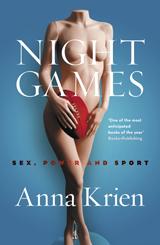
Anna Krien, Night Games

Courtesy: Black Inc

Anyhow, here is the list, in alphabetical order by author:

  • Letter to George Clooney, by Debra Adelaide (Picador): fiction, short story collection
  • Moving among strangers, by Gabrielle Carey (UQP): non-fiction, memoir
  • Burial rites, by Hannah Kent (Picador): fiction, debut novel
  • Night games, by Anna Krien (Black Inc): non-fiction, see my review
  • Mullumbimby, by Melissa Lucashenko (UQP): fiction, novel
  • The night guest, by Fiona McFarlane (Penguin): fiction, debut novel
  • Boy, lost, by Kristina Olsson (UQP): non-fiction, memoir
  • The misogyny factor, by Anne Summers (New South): non-fiction
  • Madeleine, by Helen Trinca (Text): non-fiction, biography, see my review
  • The swan book, by Alexis Wright (Giramondo): fiction, novel
  • The forgotten rebels of Eureka, by Clare Wright (Text): non-fiction, history
  • All the birds, singing, by Evie Wyld (Random House): fiction, novel, see my review

Three books published by UQP (University of Queensland Press)! Good for them.

For those of you who are interested, this year’s judges are:

  • Kerryn Goldsworthy, critic and writer (chair, and on last year’s panel)
  • Annabel Crabb (journalist and broadcaster)
  • Brenda Walker (author and academic)
  • Fiona Stager (bookseller, and on last year’s panel)
  • Tony Birch (writer and lecturer )

The winner will be announced on March 20.

Poetry at the Gods … with Les Murray

What can I say but that it was wonderful to be in the presence of the man who is arguably Australia’s greatest living poet, Les Murray. Poetry at the Gods is a monthly event which has been run for many years by local poet Geoff Page*. (The Gods is a cafe-bar attached to the Australian National University’s Arts Centre.) I have only managed to get to a few readings over the years but, having had to miss Murray in the past, I was darned sure I was going to make it this time. Not only did I get there, but I got my copy of his Selected poems (Black Inc, 2007) signed. Woo hoo!

Before continuing, I should briefly explain Murray for non-Australians who may not have heard of him. His career has spanned over forty years. He has won multiple awards, has published many volumes of poetry (not to mention verse novels and prose works), is on the National Trust of Australia’s 100 Living Treasures, and is often spoken of, here at least, as a Nobel Laureate contender. I must admit that I don’t always get his poetry – but I enjoy the challenge. That’s poetry isn’t it?

Les Murray, Best 100 poems

Courtesy: Black Inc

Now to the evening. Murray read in two “sets” both lasting around 30 minutes. The first set comprised unpublished (I believe he said) poems written in recent years, while the second came from The best 100 poems of Les Murray published by Black Inc in 2012. (I am currently reading their Best 100 poems of Dorothy Porter).

I’m afraid I can’t tell you much about the reading. As much as I love attending poetry readings, because it is special to hear poets read their own poems, I find it hard to report on them. No sooner is one poem read, than the next one starts. It’s impossible – for me anyhow – to process the poems and say something meaningful about them as a whole. I will however make a few scattered observations.

I’m not sure how much Murray, now 75 years old, had planned in advance what he was going to read, but it looked pretty impromptu. In both “sets” he simply (simply?) flicked through the book he was reading from and chose poems he seemed to feel like reading. Sometimes he provided a few words of introduction to the poem, sometimes he didn’t. Sometimes he gave a little chuckle before or after, and sometimes he didn’t! In the first half, the poems ranged across such diverse subjects  as an apartment block in Beijing, English as a second language, and the challenge of writing haiku. I wish I had them before me. The variety spoke to an active, curious mind, to the poet’s ability to draw something beautiful, meaningful, from pretty well anything, which is what we want our poets to do, isn’t it? Oh, for such a mind.

In his second set, he read some poems that I do have before me, poems such as “The future”, “Postcard”, Lyrebird” and “Dead trees in the dam”. One that has stuck in my memory is the poem about his son who has autism. Titled “It allows a portrait in line scan at fifteen”, it was written when his son was fifteen, and perfectly conveys what I understand to be the experience of living with autism:

Giggling, he climbs all over the dim Freudian
psychiatrist who told us how autism resulted
from refrigerator parents

The poem conveys the split between the person and “it”, the condition. There’s humour, frustration and anger, as much the son’s as the parents’. Murray conveys the fascination with facts and rules, the focus on objectivity, the prodigious memory, that can be typical of autism. The final lines are heart-rending:

He surfs, bowls, walks for miles. For many years
he hasn’t trailed his left arm while
running.
I gotta get smart! looking terrified into the
years. I gotta get smart.

Religion is important to Murray. In fact, the two books of his that I have are dedicated “To the glory of God”. However, his poems are not, overall, self-consciously religious, are not dogmatic but many are informed by a faith in and an understanding of religion. In this context and as one who likes thinking about words and truths, I enjoyed poem “Poetry and Religion”. Here are the opening lines:

Religions are poems. They concert
our daylight and dreaming mind, our
emotions, instinct, breath and native gesture

into the only whole thinking: poetry.
Nothing’s said until it’s dreamed out in words
and nothing’s true that figures in words only.

And that, I think, is as good a place as any to end on, don’t you think?

*I’ve reviewed his verse novel The scarring.

Monday musings on Australian literature: Bread and Cheese Club and Indigenous Australians

Since last week’s Monday Musings post on Melbourne’s curious, but now defunct, Bread and Cheese Club, I’ve been doing further research into its various activities, and have found it to be an amazingly vibrant organisation. The club’s motto was “Mateship, Art and Letters” and a major focus seemed to have been Australian writers. Certainly its first Knight Grand Cheese, JK Moir, was a significant book collector, and it did publish around 40 or so books. However, its activities spread widely across what they would have described as Australiana. I might come back to them again, but today I want to write about their relationship to indigenous Australian culture.

Publishing

The club was quite an active publisher and among its publications were some rather significant works, for the time in particular, to do with Australian Aboriginal culture:

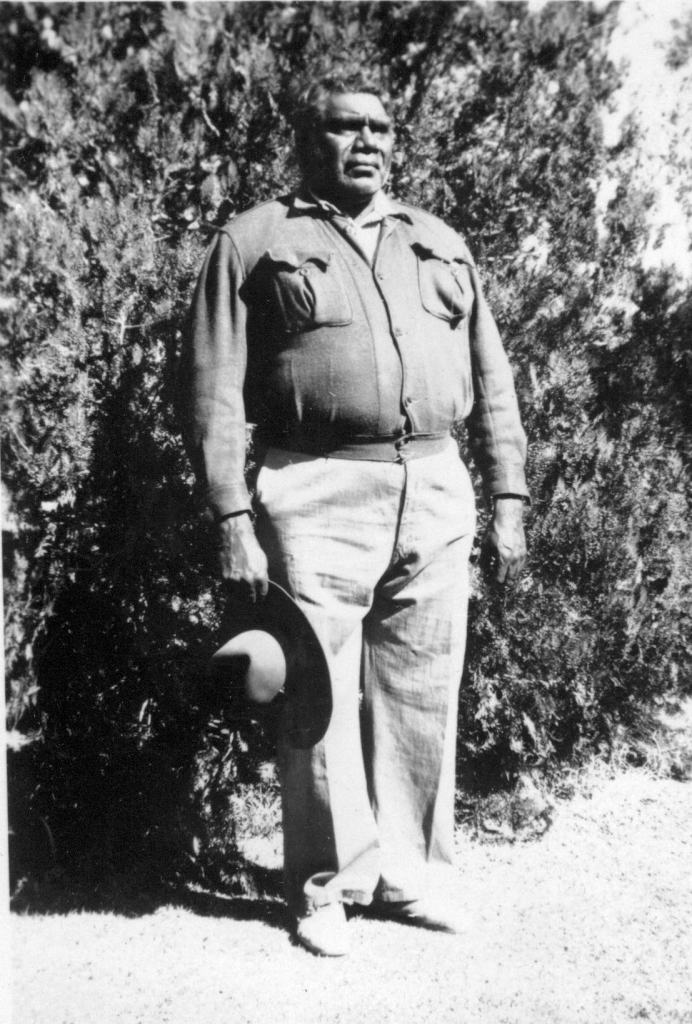
Albert Namatjira, 1949 (Public Domain, via Wikipedia)

Albert Namatjira, 1949 (Public Domain, via Wikipedia)

  • Art of the Australian Aboriginal by Charles Barrett and Robert H. Croll (with a foreword by anthropologist AP Elkin), in 1943. Charles Barrett was a naturalist and journalist, and R.H. Croll an author and public servant. Both travelled widely throughout Australia. Barrett was passionate about protecting ancient Aboriginal art, writing that its protection “should be a national concern: white morons have already disfigured many”.
  • The art of Albert Namatjira by C. P. Mountford, in 1944. Albert Namatjira is one of Australia’s best known Aboriginal artists, a pioneer. Mountford was a mechanic and public servant turned anthropologist who, by the 1920s, was developing the interest in indigenous Australian culture that stayed with him the rest of his life. He was particularly interested in art, but I was intrigued to read in the Australian Dictionary of Biography that “in 1935 he was appointed secretary of a board of inquiry to investigate allegations of ill-treatment of Aborigines in the Northern Territory, at Hermannsburg and Ayers Rock”. He also travelled with Norman Tindale who is famous for his detailed map of indigenous Australia.

Interesting, I think, that it was this “little” club which published these books.

Donation to the Adelaide University’s fund for Aboriginal research

This one intrigued me, and is what inspired this post, in fact. I read in The Argus, 19 May 1951, that Albert Namatjira had donated £1000 to the Adelaide University’s fund for Aboriginal Research. But, apparently, the story goes, he did not make the donation himself because “as Australian law now stands, an aborigine cannot control an income of his own”! Enter Bread and Cheese Club founder JK Moir who made the donation on Namatjira’s behalf out of the proceeds of the book by CP Mountford. Moir is quoted as saying:

Albert, as an aborigine, cannot control his affairs, but I know what we have done has his enthusiastic endorsement. There is no precedent for this anywhere. An aborigine raising £1000 through his work for the cause of his own people is unique. I can assure you it will not be the last donation if we can help it.

Coranderrk and the Barak Grave

The final story activity I want to share is more in the style of those working bees that groups like Rotary and Lions have often done. It concerns the cemetery at Coranderrk. Coranderrk was an Aboriginal reserve established by the government for dispossessed indigenous Australians. It operated from 1863 to 1924. It’s quite a story that I won’t detail here, but in 1950 the land was handed over to the Soldier Settler Scheme. The cemetery, which of course contained graves of the previous indigenous residents, was by then in disarray. In a letter to the editor of the Healesville Guardian on 19 May 1951, naturalist David Fleay wrote of being “shocked at its state of absolute neglect and ruin”. Only two graves, one being that of, Barak, the last king of the Yarra Yarra tribe, were distinguishable he said. He also refers to the marble monument to Barak that had been in a significant position in the town of Coranderrk but was now in a depot. He argued that money should be put aside to renovate the cemetery and that the Barak monument go to its “rightful place”. He also suggests that “it is possible that the Melbourne Bread and Cheese Club, champions of Australiana would take a decided interest”.

And so, in fact, they did. A Healesville Guardian column by Oswald C Robarts on 11 November 1955 writes of their contribution. They seem to have become involved in 1952 and carried out at least one working bee in 1955. It’s not clear what else they did. A report in the Club’s journal, Bohemia, states that “we did a good day’s work and those who remember the terrible state of the Cemetery when we saw it on our first visit would be surprised. Much remains to be done.”

I will conclude though with Oswald C Robarts:

On January 23 this year, several members of the Club travelled from Melbourne, bringing with them the necessary materials and equipment for handling the heavy parts of the memorial. Working throughout the day in near-century heat, they completed the job. It should be scarcely necessary to add that these men, like others who have previously urged that something should be done about Coranderrk, were not concerned with public kudos nor material gain.

Basically, interest in the “old” Australians who have gone, and wise, firm and considerate care for those that remain, are matters of public conscience. There is by now fairly wide general agreement that far too often in the past, as well as today, they have been handed the seamiest side of Western civilisation. Here is a paradox to be removed, for Australia today is spending millions on the Colombo Plan, and bending over backwards to assure our Asian neighbours that there is no such thing as a “White Australia” policy in a racial sense.

There is an element of paternalism in “the wise, firm and considerate care for those that remain” but this seems to be to be pretty strong stuff for 1955. Thanks once again to Trove for making these papers available.