Monday musings on Australian literature: Specialist literary festivals

Are you a reader of crime or science fiction or fantasy? Or, perhaps of poetry? A few weeks ago I wrote a post on regional literary festivals in Australia. I focused then on festivals for general and/or literary fiction. But, if you have specialist reading inclinations, there are also likely to be festivals for you. And so today I thought I’d post a selection – just to whet your appetite.

While I was researching that last post, I came across a couple of websites: literary festivals.com.au, which lists Australian festivals, andVampires in the Sunburnt Country, which publishes a literary festival calendar for Australia. They are worth checking out if you want to know whether a festival is coming to a town near you – or, better still, your own town.

As last time, I’ll list a randomly selected few – representing a variety of specialty and location – in the order of their establishment, starting with the oldest.

  • Australian National Science Fiction Convention. Established in 1952, and run each year in different cities by different groups. This year’s festival will be held in Melbourne and run by a group called Continuum.  Arthur C Clarke was a guest at the fourth convention held in 1955.
  • Romance Writers of Australia Conference. Running now for 23 years, this is a big affair. It’s a 4-day event and will be held in Sydney this year, but moves around a bit I believe. It is, really, more conference for practitioners than festival for readers, but with “350 published and aspiring romance writers, editors, agents and other industry professionals” attending, I figured it’s worth mentioning. Romance is, clearly, serious business. And, anyhow, the conference will include a Literacy High Tea, which they describe as a networking event “for librarians, booksellers, authors and readers” that will also be a fundraiser the Australian Literacy and Numeracy Foundation.
  • StoryArts Festival Ipswich. Established in 1995, and originally called the Ipswich Festival of Children’s Literature. It takes place biennially and is organised primarily by the Ipswich Teacher-Librarian Network (in Queensland). Good for them. Their aim is broad: “to increase an awareness of the value of the arts in relation to writing and illustration and help build and maintain increased audiences for children’s literature. We plan to inspire young people to buy and read more books and gain an appreciation of the processes involved in writing and illustrating. We also aim to enthuse teachers and parents about the value of stories and encourage them to promote literature to young people.”
  • Perth Poetry Festival. Established in 2005 as the WA Spring Poetry Festival, and now run by WA Poets Inc. It is one of many poetry festivals held around Australia, including some dedicated to bush poetry and other poetry forms, which suggests that poetry is alive and well(ish) even if poets can’t make a living from their art!
  • Jane Austen Festival Australia. Established in 2008 in Canberra, this is a 4-day Regency Festival which explores the world of Jane Austen. It includes a wide variety of activities and events including dancing, archery, historical costume making, a Jane Austen book club and lectures on literary and historical subjects. The 2014 conference included a half-day symposium on Mansfield Park.
  • Reality Bites. Established in 2008, and run by the Sunshine Hinterland Writers’ Centre (in Queensland). (It may alternate with another festival titled Reality Writes, but the website doesn’t yet have its “About” page functional). It describes itself as “Australia’s premier literary nonfiction festival” and takes place on the last weekend in October each year. It sounds right up my alley but is rather far away.
  • Death in July Festival. Established in 2014 – yes, this is its first year. In my last post I only selected festivals that had some longevity behind them but, Ballarat Writers Inc, which is organising this festival with Sisters in Crime, tweeted me about it. I reckon that deserves a guernsey. It celebrates women’s crime writing and will be held in Ballarat, Victoria, in July. Guests at this first festival will include Angela Savage whose The dying beach I reviewed earlier this year.

As you can see, most of these are pretty recent – though there are some longstanding ones. I haven’t included any play/theatre festivals but there are several of those too. It does seem that literary festivals of all sorts are popular at present – not only in cities but also in regional towns, which clearly hope that festivals will be part of their survival in our economically tough world.

Have you attended any speciality literary festivals? If so, what specialty has taken your fancy!
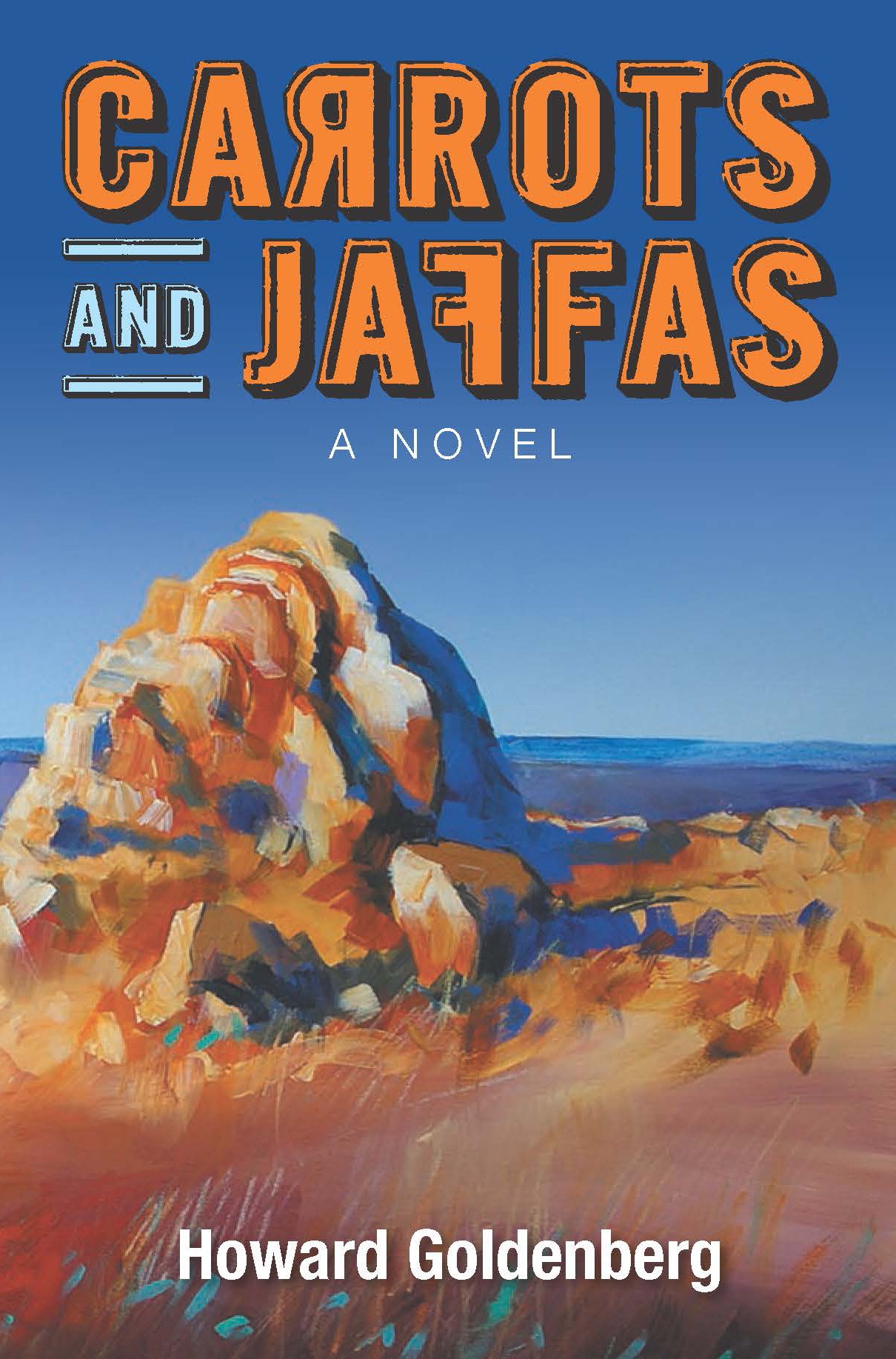
 

Howard Goldenberg, Carrots and Jaffas (Review)

Howard Goldenberg, Carrots and Jaffas

Courtesy: Hybrid Publishers

Howard Goldenberg, we are told in “About the Author” at the back of his debut novel Carrots and Jaffas, is the sole practitioner of a literary genre – the rhyming medical referral letter! Wouldn’t I love to see some of those! Anyhow, you’ve probably guessed now that Goldenberg is a doctor, and you’d be right. But he’s a doctor with some very specific experience. Earlier this year I wrote about white writers writing on indigenous subjects. It resulted in quite a discussion. While the overall opinion was that there should be no taboos in subject matter for writers, we agreed that such writing is most effective when done from a standpoint of knowledge (and, it goes without saying, sensitivity). Howard Goldenberg, whose novel Carrots and Jaffas I’ve just completed, has such knowledge*, as he has and still does practise for part of his time in outback Aboriginal communities. Beats me how he could also find time to write a novel, but like all passionate writers, he has!

I hadn’t heard of Howard Goldenberg before, but apparently he was featured in one of the sessions at this year’s inaugural Melbourne Jewish Writers festival, about which (the festival, not Goldenberg) Lisa (ANZLitLovers) and Jenny (Seraglio) have posted on their blogs. Goldenberg writes on his blog of his session with Martin Flanagan. He says that Flanagan “led a conversation about the book, about my choice to turn from serious non-fiction to the novel, about stolen children – the ultimate wound, about twinness, about the problems and pitfalls of the whitefella writing about blackfellas.” Oh, wouldn’t I have loved to have been there!

This novel, Carrots and Jaffas, is pretty ambitious. It covers a lot of ground, asking us to make the right connections between different experiences of suffering and loss. It uses parallel stories and a frequently shifting narrative perspective to do this. It has the odd awkward moment – a coincidence pushed a little far, an irony that doesn’t quite ring true, an earnestness that gets in the way – but these are minor in a story that totally got me in from the first page. Goldenberg has written two works of non-fiction – a memoir about his father, My father’s compass, and a book of stories about his experiences as a doctor in outback Aboriginal communities, Raft. These non-fiction works have clearly honed his narrative skills.

The main action of the novel occurs around 2004, with the setting split between suburban Melbourne and the Flinders Ranges in South Australia, in Adnyamathanha country. The plot starts with the abduction of 9 year-old Jaffas, one of identical twins, by an ex-drug addict, ex-con, who plans to deliver him to an old indigenous woman, Greta, who had two sons stolen from her in the 1960s. Clean now, but with a brain damaged by PCP, he (Jimmy aka Wilbur) sees himself as Golem or the Redeemer. He is going to right a wrong. He planned to take the two boys but it goes wrong and he ends up with just Jaffas, leaving behind a distraught Carrots. The story then flashes back to the story of how Carrots and Jaffas came to be, to the meeting and subsequent marriage of their parents, Bernard, an IT specialist who had lost his father when young, and Luisa, an immigrant from Buenes Aires who, we gradually learn, had suffered significant trauma and loss in her youth. Later, we meet Doc who works in the Flinders Ranges, but who has experienced a loss of his own, a sibling through divorce.

From here the story alternates between Carrots at home, and Jaffas in the outback in a neighbouring state. As Carrots starts to fall apart, Jaffas, who was threatened with the death of his twin if he tells, is introduced to indigenous culture. He is not happy, is biding his time for an opportunity to go home, but in the meantime, over a period of a couple of months, he starts to hear different stories about life – indigenous ones from Greta and scientific ones from Doc – and learns another way of living. I will leave the story at this point … except to say that there is drama alongside reflection. It’s quite a page turner, in its quiet way!

There is humour here, despite the serious subject matter. I particularly loved the chapter on the kindergarten fancy dress parade. It brought back such memories. Even in this lighthearted scene, though, there’s seriousness. One child is particularly diminutive, and Goldenberg writes:

No one in his class considered him abnormal. But already behind him, forever past, were the years of parity with his classmates. This would be his last year of unselfconsciousness, the last year before he entered the big school, where bigger kids would be free with unkind comparisons. Luisa gazed at him, concerned; she realised the child did not suffer from dwarfism – not yet.

Oh, the power of labels!

The characters are engaging, each clearly individualised – from Luisa’s bible-learnt English and understandable fearfulness to Greta’s confident, nurturing nature, from Bernard’s practical approach to life to the Doc’s passionate if somewhat eccentric one.

There are many losses explored in this novel – parents “lose” children, and children their parents, siblings lose siblings – and they are mostly needless, human-induced. Goldenberg examines what happens to the soul, the spirit, when it experiences such pain. Not everyone responds in the same way – some start to disintegrate, some go into problem-solving mode, others respond with increased generosity of spirit – but all suffer.

Carrots writes letters that he clearly can’t send to the abducted Jaffas. In one of them he writes “I am not me without you”. They are of course twins, but most people, Goldenberg shows, are irrevocably changed when they experience loss. For all this, the novel is redemptive. I’d love to know how indigenous people respond to the novel but, for me, it’s a novel written with love from the heart. I enjoyed it.

Howard Goldenberg
Carrots and Jaffas
Melbourne: Hybrid Publishers, 2014
242pp.
ISBN: 9781925000122

(Review copy courtesy Hybrid Publishers)

* Read, for example, his powerful, heartfelt blog post on the current Budget recommendations regarding co-payment for medical treatment.

Barbara Baynton, Bush church (Review)

awwchallenge2014“Bush church” is my sixth and last* story from Barbara Baynton’s Bush studies, and it presented a rather pleasant change in tone from most of the others in the book. I’m sorry in a way that I read these stories quite out-of-order. “Bush church” is the fifth story in the collection, appearing after “Billy Skywonkie” and before the very grim “The chosen vessel”. It would work well in this position I think.

Like “Billy Skywonkie”, “Bush Church” contains a lot of dialogue in the vernacular of that particular place and time, making it somewhat of a challenge to read. However, I didn’t find it off-puttingly so. This may be because I’ve developed a bit of an ear for it (and you do have to use your ear when reading it) or perhaps because there is less dialogue. The story concerns a motley group of graziers and selectors gathered together at a grazier’s property to attend a church service delivered by a travelling parson. It becomes clear early on that attending a church service is a very rare occurrence in this neck of the woods. There are couples not married, children not christened, and people, indeed, who have never been to a church service.

It is, in many ways, a comic piece. But, here’s where I should take back that word “pleasant” in my first sentence because, while it doesn’t have the violence that several of the other stories have, the comedy is bitter. Baynton’s people here, as in her other stories, are not the noble sufferers we meet in Henry Lawson’s “The drover’s wife” or those two stories by Mary Grant Bruce that I recently reviewed. They are, with few exceptions, jealous, self-centred and/or mean-spirited.

The story, divided into two parts, starts with the parson on a horse en route to the grazier’s property. It’s not a good horse. The story opens:

The hospitality of the bush never extends to the loan of a good horse to an inexperienced rider.

The implication, of course, is that the bush is hospitable. You know, country hospitality and all that! However, as the story progresses we see little if any evidence of bush hospitality. Early in the story, our unnamed parson, is joined by “flash” Ned, who is desperate for a smoke, but gets none from the non-smoking parson, nor from “hairy Paddy Woods of eighteen withering summers” whom they meet along the way.

Perhaps because of this or just because he’s who he is, Ned decides, mischievously, that the parson is there as an Inspector, and spreads this news to all and sundry, so that they start hunting for:

land receipts, marriage lines, letters from Government Departments, registered cattle brands, sheep ear-marks, and every other equipment that protects the poor cockey from a spiteful and revengeful Government, whose sole aim was “ter ketch ’em winkin'” and then forfeit the selection. All of these documents Ned inspected upside down or otherwise, and pronounced with unlegal directness that “a squint et them ‘ud fix ‘im if thet’s wot ‘e’s smellin’ after”. He told them to bring them next day. Those of the men who had swapped horses with passing drovers, without the exchange of receipts, were busy all afternoon trumping up witnesses.

No wonder Ned, who, we also discover, is a wife-beater, “was no favourite” among his neighbours!

This is where the first part ends. The second part comprises the church service which takes place on the grazier’s verandah. The attendees, we are told, are “ten adults and eighteen children”. Baynton provides us with colourful descriptions of these people as they arrive, and then the service starts:

For a few minutes the adults listened and watched intently, but the gentle voice of the parson, and his nervous manner, soon convinced them that they had nothing to fear from him. Ned had been “poking’ borak” at them again; they added it to the long score they owed him.

Not surprisingly, with a couple of exceptions, they all gradually lose interest. The adults bicker, while the children find the food the hostess had prepared for a post-service lunch for the parson, herself and her husband. Her hospitality was not extending any further, but she’s one-upped by the children and one of the mothers! When the service is over, she has a problem to solve!

This is not a story with a strong plot, but is, rather, a slice of life, presented with a good deal of humour peppered with bite and irony. Susan Sheridan, in her introduction to my edition, suggests that Baynton’s writing belongs to the naturalist tradition of writers like Zola and Gorky. Naturalism, she says, is a style that “was crafted to express the view that the uncontrollable forces of the natural world had their equivalents in human nature, and that the values of civilisation were a mere crust over an underlying struggle to death among various life forms”. In this style, she suggests, violence and cruelty are expressed in a detached way. That doesn’t mean, I think, that we readers react in a detached way. Rather, the detached tone adds to our feeling of horror.

Barbara Baynton, I’ve decided, was a very interesting woman. I plan to do a Monday Musing on her soon to share a little more about who she was.

Barbara Baynton
“Bush church” in Bush studies
Sydney University Press, 2009
ISBN: 9781820898953
Available online: in Bush studies at Project Gutenberg.

*For my previous reviews of stories in this book, click the appropriate title: A dreamerScrammy ‘and, Squeaker’s mate, The chosen vessel, and Billy Skywonkie.

Monday musings on Australian literature: ABR’s first laureate

While I was gallivanting in the northern hemisphere in April, ABR (the Australian Book Review) announced its first ever laureate. I missed it at the time, but heard of it soon after my return, and am now sharing it with you. For most Aussie readers, though, it’s probably a bit old hat!

ABR’s concept of a laureate is somewhat different to, say, Britain’s poet laureate who is called upon to produce poetry for special occasions. ABR’s idea, says editor Peter Rose, is “to highlight the work of our greatest writers”. However, the laureate will have one job, and that is to nominate (and possibly mentor) a “laureate’s fellow”, a younger writer who will receive $5000 to support “a work of poetry, fiction, memoir or criticism” that will be published in ABR.

So, who is ABR’s first laureate? Rose said that deciding the first laureate was easy – David Malouf. With David Malouf turning 80 this year, it seemed obvious, he said, to mark his many achievements. Makes good sense to me, particularly given the breadth and depth of those achievements. But, I’ve already written about Malouf turning 80, so won’t repeat what I said then.

However, to commemorate Malouf’s laureateship (is that a word?), ABC Radio’s Mark Colvin conducted a brief interview with Malouf for PM  Colvin asked him a few well-targeted questions concerning the development of Australian literature. Malouf was his usual thoughtful, measured self – and made his usual sense. He talked of the change in Australian literature from the 1980s to now, suggesting that in the 1980s and 90s, defining our identity, our Australian-ness “was a big thing … I think writers themselves had a more self-conscious notion of their Australian-ness and what the particular subject matter of Australia might be. I think that moment has more or less passed”. In response to Colvin’s question regarding why that might be, he said:

I think the question of Australian identity has become much more open and flexible and more complex. I think younger writers don’t necessarily think of themselves as being Australian writers; they really want to be global writers or international writers. But you know, like all writers, the thing that they are aware of is that you’re a writer for yourself. It’s something very, very personal.

And I think we’ve reached the kind of sophistication when we think about Australian-ness to understand, which I think is absolutely true, that for anybody who is writing and has grown up in Australia with Australian language and Australian education and Australian interests, your Australian-ness is something you can pretty well take for granted. You don’t have to work on it.

I think he he’s right – and it is probably part of the natural maturation of a nation. It’s perhaps a bit like moving from adolescence to adulthood in that we are becoming comfortable in our own skins. This is not to say that we won’t continue to write about some of the issues that define us, issues like our indigenous/colonial/settler history, or our physical distance from much of the world (which might be mitigated somewhat by technology but not completely – the kilometres are still there). But it does suggest that we are less likely to fuss about who we are, to feel that we have to explain or justify ourselves. Books like Malouf’s own Ransom (my review) is a perfect example – an Australian writing about classical Greeks (as he did earlier about ancient Romans in An imaginary life).

If Malouf is right and we do, and can, take our Australian-ness for granted, what does this mean for our interpretation of the Miles Franklin Award’s stipulation that the winner must be about “Australian Life in any of its phases”? How do we interpret that in 21st century Australia? In other words, what does an “indigenous literature” (Franklin’s words) look like in a mature nation?

Anyhow, the other main question Colvin asked him concerned the difficulty of being a writer today and the future of the novel. Malouf said that, while there may be some questions regarding the impact of new formats like reading on a screen,

my belief would be that there will always be readers because I think reading is for some people something they can’t do without. It’s a bread and butter matter, it’s an addiction. And I think those people will go on reading. I think they’ve always been a fairly small number; I think they’ve always been pretty much the same number.

So I’m optimistic really about the survival of the novel and the survival of the reader.

His final point – and it’s a writer’s point – was that “the question really would be about what happens to publishing rather than what happens to writing.” Once a writer, always a writer, obviously!


Monday musings on Australian literature: Reading Matters’ ANZLitMonth

ReadingMattersANZLitLogoThis is the third year that expat journalist Kim has hosted an Australian Literature month on her blog Reading Matters – except that this year, for the first time, she has included New Zealand literature in her scope. As she writes in her introductory post, her aim is to celebrate and “raise awareness of the amazing range of literature produced by these two countries, much of which never gets publicised beyond their shores”. 

Over the month, which is nearly over, she has reviewed several books from the antipodes, highlighted some current award winners and interesting shortlists, used Australian bloggers for her Triple Choice Tuesdays, and published some specific suggested readings posts (including two guest posts). 

With Kim’s permission, I’m providing links to the suggested readings posts in today’s Monday Musings. As a reader of my blog, you’ve already shown an interest in Aussie literature, and so it’s likely the most of you will probably have heard of many of the books listed in these posts, but you never know …

Kim’s Triple Choice Tuesdays are always worth checking out. In them she asks her chosen blogger to name three books: a favourite, one that changed his/her world, and one that deserves wider recognition. The Aussie bloggers featured (so far) this month are:

  • Kirsten Krauth, author of just_a_girl (my review)
  • Book to the Future (Michelle McLaren), whose plan is to read (and review) a book from every year of the 20th century in chronological order
  • Alan Carter, crime novelist who was born in England but emigrated to Australia in 1991

These links provide just a sample of what has been happening over at Reading Matters this month. To see more, check out this link to all posts for the month …

Thanks Kim for hosting another month promoting our literature – and for the opportunity to write a guest post. I look forward to next year’s event!

Deborah Sheldon, 300 degree days & other stories (Review)

Sheldon, 300 Degree Days, book cover

Courtesy Ginninderra Press

What I found particularly interesting about Deborah Sheldon’s short story collection, 300 degree days & other stories, is that the stories deal almost exclusively with a particular type of family relationship, the one to do with children, parents and, sometimes, grandparents. I’m not sure I’ve read a short story collection before that has been quite so tightly focused, but that’s not to say that it is boring. Far from it, because Sheldon explores these relationships from multiple, and sometimes surprising, angles.

There are eleven stories in the collection, most told from a third person point of view. They vary in length from two or three pages to eight or so. This produces an effective change in pace which nicely counteracts the impact of a similarity in tone across the stories, a tone which tends to be on the melancholic end of the mood meter. This tone is not unusual in short stories about families and relationships because writers are, not surprisingly, most often drawn to the challenges people face. Sheldon certainly was. Many of her stories deal with fractured relationships in which resolution seems unlikely or with relationships in which there is a sadness – such as childlessness in “Closed for Renovations”, or the after-effects of illness in “Bull Rider”, or ageing in “Thy Way, O God, is in the Sanctuary” – that tests deeply loving relationships.

Sheldon has the ability to make you sit up with her insight. “First and Last Words” is a devastating, tight little vignette about a single mother giving birth. And the other tiny story, “Little Yellow Hat”, contains a shocking – almost unbelievable – display of lack of compassion from those who should know better, leaving the young people gasping for air. The title story, “300 Degree Days”, is the longest, and explores a first-time pregnant woman’s fears, her lack of confidence in facing the change coming, even though she knew “she was a good worker and a good wife”. There’s nothing to suggest that she won’t be a good mother, but emotions run high in late pregnancy and Sheldon captures this nicely through a very Australian image, a plague of blowflies!

Sheldon’s language is clear and direct. She has, I understand from her website, written scripts and plays, which suggests that she’s not likely to over-indulge in description – and she doesn’t, but neither does she overdo the dialogue. It’s just that there’s little that’s wasted here. She uses imagery sparsely, but effectively. I’ll give just one example of her writing. It comes from her story, “The Birthday Present”, in which a mother takes her son to visit his cranky, unwelcoming grandfather on the grandfather’s birthday:

‘Josh, go on, he won’t hurt you,’ she said.

But the kid didn’t look too sure. He advanced across the rug, brandishing the present as if it were a shovel and Don was a tiger coiled in the shade. Don flung out an arm and gestured hurry up, hurry up, hurry up, but the kid faltered and stalled in the middle of the rug.

Not all the stories are hopeless, as I may have implied, and this is where order in the collection plays an important role. In “Bull Rider”, the opening story, the love and care are palpable as the son puts himself out for his frail mother. He finds her relaxed attitude to risk mystifying, given the risk-averse way she’d raised him. It’s not for nothing that his job involves “contributing to the financial security of the country”. The already mentioned “300 Degree Days” occurs in the middle of the collection, and then couple of stories later is “Closed for Renovations” about a couple forced to accept childlessness. Their sadness, particularly the wife’s, pervades the story. Their love is strong but will the husband cope with her grief? And then there is the last story which departs dramatically from the preceding ten, in that parents and children don’t feature, although a grown-up brother does. It is about a sixty-something gay man facing life after prostate cancer. It is a warm story about uncertainty and fear of loneliness, but ends on a note of hope, which makes it a perfect conclusion for the collection.

I enjoyed 300 degree days for its authentic portrayal of how people behave and respond to challenges in their relationships. It’s not always pretty, but it’s real, and that made it a winner for me.

awwchallenge2014Deborah Sheldon
300 degree days & other stories
Port Adelaide: Ginninderra Press, 2014
74pp.
ISBN: 9781740278577

(Review copy supplied by Ginninderra Press)

Monday musings on Australian literature: Regional literary festivals

With the Sydney Writers’ Festival kicking off today, I thought it might be interesting to turn our thoughts briefly to the regions. We (well, Aussie readers anyhow) know the big well-established city festivals, in particular Sydney, Melbourne, Adelaide and Perth, but there are also many smaller festivals, some rural, some suburban. In this post I plan to write about some of the rural/regional festivals. You never know, there might be one near you – or one in a location you’d like to visit for your next holiday. Perhaps we can even lure some people from overseas to our interesting smaller towns and regions!

I’m going to list a randomly selected few in the order of their establishment, starting with the oldest. Most of these festivals are shorter than the big city ones, and usually run over a weekend.

  • Byron Bay Writers Festival. Established in 1997, this festival is on my bucketlist, partly because it is well-established now but mainly because Byron Bay, on the northern coast of New South Wales, is also a great place to visit. In fact, it apparently started, the website says, when a few locals wondered “whether authors might accept an invitation to spend a winter’s weekend in Byron Bay”. They did! It is now well enough established that it can attract significant Australian and overseas writers. This  year’s festival will be held 1-3 August, and one of the featured authors will be Stella Prize winner, Clare Wright.
  • Clunes Booktown Festival. Established in 2007 as a one-day event, converting to a two-day festival in 2008. Clunes in a small town in, roughly, central Victoria. It became the 15th accredited member of the International Organisation of Booktowns in 2012, and is the only booktown in the southern hemisphere. (It’s somewhat of a joke, that we Aussies like to claim the biggest, first, only, etc “something” in the southern hemisphere!). This year’s festival was held over the first weekend in May. It is a little different to the others I’ve listed here in that while it has author talks and events, its main focus is the buying and selling of books. However, it does include a literary program which this year included a special feature on book art, and speakers like novelist Alex Miller and historian Henry Reynolds.
  • Margaret River Readers and Writers Festival. Established in 2009, this festival is Arts Margaret River’s flagship event. The 2014 festival was held last weekend, 16-18 May, with scheduled speakers including Joan London, Peter Goldsworthy and Graeme Simsion. Associated with the festival is a Short Story Competition, which is run in conjunction with Margaret River Press and results in the publication of an anthology of winning and selected stories. Last year, I reviewed the 2013 anthology, Knitting and other stories, and will review this year’s anthology in the next few months. Margaret River, in southwest Western Australia, is also a beautiful location, famous for wine (among other attractions). 
  • Bellingen Readers and Writers Festival. Established in 2011, this festival very specifically frames itself as a “readers” and “writers” festival. It has several aims, including the aspiration to be “unique among other literary festivals in using the region’s rich environmental and cultural heritage and the passions of local writers and readers”. Apparently, Peter Carey is its patron. Like Byron Bay and Margaret River, Bellingen on the New South Wales’ mid-coast, is a gorgeous part of the world, making it yet another one I’d love to attend. This year’s festival will be held over the New South Wales long weekend, 6-9 June, and speakers include Alex Miller, Kristina Olsson and, wonderfully, Yolgnu authors from Arnhem Land.
  • Batemans Bay Writers Festival. The new kid on the block, this festival is being held for the first time this year on the same long weekend as the Bellingen Festival, but for just two days, 7-8 June. It’s only 2-hours drive from my home but unfortunately I don’t think I’ll be making it. It has a good lineup of speakers, though, including Clare Wright, Debra Adelaide and Marion Halligan, which hopefully augurs well for its becoming a regular event.

These are just a few of the plethora of regional literary festivals in Australia. It may be a product of my random selection, but did you notice that four of these five festivals started in the 2000s? Is this indicative of an increasing interest in and support for books and reading? The answer is probably a little more complex than a simple equation, but I hope there’s something in it!

I haven’t included in the list what I would call a subgroup of these which comprises the festivals devoted to a particular writer, such as the Banjo Paterson Festival (in Orange, NSW), Jane Austen Festival Australia which celebrates all things Regency, and surely the grand-daddy of them all, the Henry Lawson Festival (Grenfell, NSW), which is holding its 57th festival this year. There are also festivals devoted to specific literary forms (such as poetry) and genres (such as romance). I may do a post on them another time.

As I was researching this post, I was sorry to discover that the Kimberley Writers’ Festival, which was to have been held for the 10th time this year, will not be going ahead due, says the organiser Jo Roach, to “changes in government grant funding criteria and reduction in spending by local companies”. She hopes, however, to hold it next year. Such is the difficulty of holding specialised festivals, particularly in remote places like Kununurra.

Finally, there is a festival that is not held in Australia but that has strong Australian associations, the Ubud Writers and Readers Festival, which will be held for the 11th time this year. Ubud is in Bali and this festival was established by Australian-born Janet DeNeefe “in response to the 2002 Bali bombings”. She says on her website that “it has been named by Harper’s Bazaar, UK,  as ‘one of the top Festivals in the world’ and by ABC’s Asia-Pacific network as ‘the next Edinburgh Festival of Asia’.” (The “next” Edinburgh Festival of Asia? Is there another one?). Anyhow, this year’s festival will be held 11-15 October. I first heard of it through blogger Bryce Alcock’s 8-post report on the 2011 festival. 

Phew, this ended up being longer than I intended.

Are you a keen attender of literary festivals? And if you are, what makes a good festival for you?


Mary Grant Bruce, The early tales (Review)

Mary Grant Bruce, Early Tales

Courtesy: Juvenilia Press

Around a month ago I wrote a Monday Musings post on the Juvenilia Press, and said that I would read and post on some of its publications. Well, here is the first of those posts.

While I discovered the press through its Jane Austen juvenilia, the books I ordered were those for juvenilia by Australian authors. My first reading choice was the Mary Grant Bruce volume. You probably haven’t heard of Bruce if you are not Australian, and perhaps not, even if you are. She is best known as the author of the children’s series, the Billabong books (1910-1942). They were published way before my time, but my mum knew them and gave them to me to read when I was a child. I loved them. They probably contributed to my early love of and identification with the Aussie outback.

However, the Juvenilia Press’s book, The early tales, contains two stories that Bruce wrote for an adult audience when she was working for The Leader newspaper in MelbourneThese stories push the envelope in terms of the Press’s criteria for juvenilia, which is that the works should be written when the author is 20 years old or younger. Bruce was born in 1878, and the two stories in this volume were published in 1898 (“Her little lad”) and 1900 (“Dono’s Christmas”). I’m glad though that they stretched their definition. Rules, after all, don’t always need to be slavishly followed.

I will get to the stories soon, but first, I want to comment on the quality of the publication. It might be juvenilia but it is thoroughly scholarly, as the Press aims. It contains an in-depth introduction, which, in the way of academic introductions, contains spoilers, so beware that if you don’t like spoilers. It also explains the source of the text, and the text itself is comprehensively annotated with notes explaining editorial decisions, linguistic features, and points of literary interest. There four appendices on a range of topics, including how Bruce represented the Australian voice/speech patterns in her writing. And, of course, there is a list of references.

Now to the stories. They are an interesting pair. Both were published as Christmas Supplements of The Leader. And both are stories about families – the first a poor selector family and the second a more comfortable squatter family. However, despite their difference in means, both families experience the challenge of living isolated lives in the harsh Australian bush. Money, it seems, may provide a more comfortable house, an extra room or two, but it can’t protect you from the dangers of a life lived in isolation.

The stories belong to the tradition that includes Henry Lawson’s The drover’s wife (1892) and Barbara Baynton’s The chosen vessel (1896). In both, the father must leave his family for a day or so (wife and toddler son in “Her little lad” and wife and two young sons under ten in “Dono’s Christmas”) – and, of course, a crisis ensues that the family must cope with alone. I don’t want to give the stories away but both stories involve snakes (as does also The drover’s wife). One also involves dangerous illness, and a child and a horse lost in a storm. In both stories, too, characters find themselves short of water. These are all common motifs in Australian bush literature. The introduction explores them, and refers us, for example, to other works, like Banjo Paterson’s poem “Lost” and Frederick McCubbin’s painting of the same title. (Longstanding readers here might remember my post on the lost child motif. I wasn’t making it up!)

What, though, is it all about? With so many stories – of which the four mentioned above are just a few – dealing with such similar subject matter, it’s clear that what is being portrayed is the Australian character, and what is being developed is a sense of national identity. The introduction defines this character as comprising “independence, resourcefulness and resilience”. The fiction, poetry and art of the period portray the hardship and the failures. Citing another McCubbin painting, the introduction suggests that these works don’t idealise, but they nonetheless convey a sense of nobility. (This is a generalisation, of course. Nobility can be hard to find in many of Baynton’s stories!)

I won’t write much more here because I’d love you to read them yourselves*: they are well-told stories that have an emotional punch alongside their historical interest. Rather, I’ll leave you with a couple of short excerpts describing the bush, starting with the opening of “Her little lad”:

Across the clearing fell the first rays of the sun, each laying a path of living gold upon the long, withered grass. They lit up the giant gums, and lingered lovingly in the tangle of clematis and convolvulus which wreathed their great branches; and as they fell the night wanderers of the bush – the awkward wallaby, the giddy possum, and the shy bandicoot – started in affright and fled every one to his hole. Then the sunbeams penetrated still further, through the wild scrub tangle, down to the quiet creek, and there they lay upon its surface, forming, with the reflection of the over-hanging trees, a delicate mosaic of shadow and gold. They opened the buds of the wild orchids, the swaying bluebells, and kindled into flame the orange clusters of the grevillea; and, on the hut in the midst of the clearing, they spread curiously, as who should ask by what right man, with this ungainly excrescence, so marred the face of nature.

The introduction doesn’t discuss whether Bruce also had an environmental agenda, but she clearly recognised “man’s” impact. But for now, here is the sun, in “Dono’s Christmas”:

The sun was already up, and seemed to be climbing quickly into the cloudless sky; it was going to be a real scorcher, Dono thought, and he resolved to push on as fast as he could before the great heat commenced, when he hoped to be in the shade of the bush. So he cantered sharply over the hard-baked plain, where the sun had split big gaping fissures in the dry earth …

Reading these stories reminded me why I so enjoyed her children’s novels way back when. What a thrill to have discovered this little book at the Juvenilia Press.

awwchallenge2014Mary Grant Bruce
(ed. Pamela Nutt with students from the Presbyterian Ladies College Sydney)
The early tales
Sydney: Juvenilia Press, 2011
90pp.
ISBN: 9780733429415

* The book only costs $12 plus postage, from the Press.

Monday musings on Australian literature: Non-fiction literary awards

This will probably be my last post on specialised literary awards, but it is an important one to cover, not least because while I was away a non-fiction work, Clare Wright’s The forgotten rebels of Eureka, won the Stella Prize in its second year. This is notable because while most awards seem to be specially targeted to a particular form of literature – fiction, poetry, short stories – there are a small number of awards that do not specify form. The Stella Prize is one of these. I like Helen Garner’s way of putting it:

I hope that the Stella Prize, with its graceful flexibility about genre, will encourage women writers to work in the forms they feel truly at home in, instead of having to squeeze themselves into the old traditional corsets.

Similarly, the Nita B Kibble Literary Award and Dobbie Literary Award, which are both limited to women writers, do not specify form. They do, however, specify “subject matter”. Entrants must be recognisable as ‘life writing’, and can be novels, autobiographies, biographies, or other forms of literature that meet this definition.

The currently suspended The Age Book of the Year was somewhat similar: it was chosen from the winners of its sub-categories, which included non-fiction. The latest winner – in 2012 – was, in fact, a non-fiction work, James Boyce’s 1835: The Founding of Melbourne & The Conquest of Australia. 

However, there are several awards that are specifically for non-fiction, albeit some of them being subsets of larger awards. Here are a few:

  • Australian History Awards/Australian Historical Association Prizes. Awarded biennially. Comprises several awards, including the Allan Martin Award, the Jill Roe Prize, the Kay Daniels Award, and the WK Hancock Prize. Awarded to works by members of the Australian Historical Association, but each has its particular slant and eligibility conditions beyond that.
  • Calibre Prize. Established in 1997. Awarded to an “outstanding essay” in any non-fiction subject. Offers $5,000 to the winner.
  • Ernest Scott Prize. Established through a bequest to the University of Melbourne. Awarded for works by a resident of Australia or New Zealand about the history of Australia or New Zealand or on the history of colonisation. The work must be based on original research. Offers approximately $13,000 to the winner.
  • National Biography Award. Established in 1996. Awarded to “the best published work of biographical or autobiographical writing by an Australian”. Offers $25,000 to the winner.
  • New South Wales Premier’s History Awards. Established in 1997 to promoteexcellence in the interpretation of history, through both the written word and non-print media”. Comprises a suite of five or more awards, including the Australian History Prize, the General History Prize and the Young People’s History Prize. In 2014, a special Military History Prize is being offered in commemoration of World War 1. Offers $15,000 to the winner of each category.
  • Chief Minister’s Northern Territory History Book Award. Established in 2004. Aims to encourage documentation of the history of the Northern Territory. Offers $1,000 to the winner.
  • Prime Minister’s Literary Awards*. Established in 2007. Comprises several awards, including one for Non-fiction. In 2012 the separately established Prime Minister’s Prize for Australian History also established in 2007 was incorporated into this award. Awarded to works written by Australian citizens or permanent residents and published in the previous calendar year. Offers $80,000 for the winner (in each category) and $5,000 each for up to four short-listed works.
  • Queensland Literary Awards University of Queensland Non-fiction Book Award. One of the suite of awards established in 2012 to replace the cancelled Queensland Premiers Literary Awards.
  • Walkley Awards. Established in 1956. Awarded to works demonstrating excellence in journalism, with categories for books, articles, essays and other media. (See my previous Monday Musings on this)
  • Western Australian Premier’s Book Awards. Established in 1982. Includes awards for Non-fiction and Western Australian History, with winners of these being eligible for the overall Premier’s Prize. Awarded to works by Australian citizens or permanent residents or, and this is interesting, with Australia as the primary focus. Offers $15,000 for Non-fiction winner, $10,000 for Western Australian History winner, and $25,000 for the overall winner.

This is, again, not a comprehensive list, and is rather “messy” because these awards come in a variety of guises and structures. What it shows, though, is that there seems to be significant support for non-fiction writing, particularly for history. They get little publicity but the winners lists show that many of our significant historians, biographers and journalists in particular are winning them.

* These awards ran late last year, and the same is happening this year. There are fears for their survival, which tomorrow night’s budget (Tuesday May 13) will hopefully answer.

Monday musings on Australian literature: If I were going to the Sydney Writers Festival

I’m afraid I don’t have a real Monday musings today. I’m in the process of packing up to leave Toronto later today, so thought I’d just share with you the program from this year’s Sydney Writers Festival. Once again, I don’t expect that I’ll manage to attend. Its timing is always slap-bang in the middle of family celebration time. You know, birthdays, anniversaries and so on.

I was interested to note, in Festival Director Jemma Birrell’s welcome in the program, that she focuses on international guests, such as Vince Gilligan who wrote the television series Breaking bad and the wonderful African-American writer, Alice Walker. That’s great, and I’d particularly love to see Walker. Perhaps it’s polite to mention the guests first, but you have to read quite a way in to discover any of the headline Australian authors who will be appearing. Cultural cringe? Or, just good marketing? Or, good marketing based on our cultural cringe? Or, am I being over-sensitive?

Anyhow, if I were going to the festival, I’d be particularly keen to see the Aussie authors I’ve reviewed here, including:

  • Michelle de Kretser
  • Richard Flanagan
  • Chris Flynn
  • Anita Heiss
  • Hannah Kent
  • Kirsten Krauth
  • Melissa Lucashenko
  • Alexis Wright

… not to mention others I’ve read before or plan to read. And, yes, of course I’d go see some international writers too. After all, they would have come a long way to be here, and the Festival has lured some great people to our shores.

I hope that John at Musings of a Literary Dilettante and Jonathan of Me Fail, I Fly will blog about the Festival as they have in the past. I’ve always enjoyed their takes.

Apologies for today’s quick post, but a travelling litblogger’s life is not an easy one.