Monday musings on Australian Literature: Lansdowne Press’s Heritage Books

Just as some contemporary publishers, like Text, have decided to publish Australian Classics, so did publishers in the past attempt such projects. One such publisher was Lansdowne Press which, according to N.B. in the Canberra Times in 1963, began “a series of reprints from Australiana” which they called Heritage Books.

N.B. discusses two books in the series, Anthony Trollope’s Harry Heathcote of Gangoil* and Mrs. Charles Clacy’s A lady’s visit to the gold diggings of Australia in 1852-53*. Unfortunately, it doesn’t seem that Lansdowne used “Heritage Books” in their imprint because I can’t find this series in library catalogues. I therefore have no idea what other books were published in the series, or how long it lasted. I did find other Lansdowne books that might have been in the series, such as The felonry of New South Wales: being a faithful picture of the real romance of life in Botany Bay: with anecdotes of Botany Bay society and a plan of Sydney by James Mudie (first pub. 1837), and Reflections on the colony of New South Wales by George Caley (first pub. 1829).

The Canberra Times article is headlined “Contemporary accounts of the good old days”, and you can see from the titles that “accounts” is the operative word. They are not all novels. In fact, of the four I’ve listed, only Trollope’s is a novel.

Trollope’s “Slight Plot”
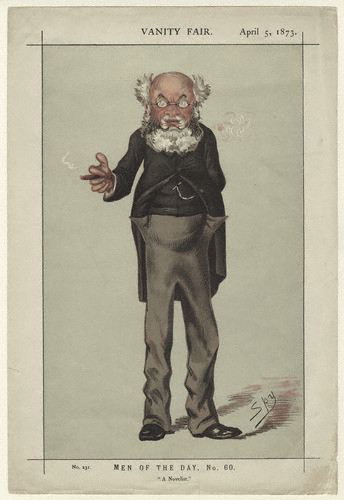
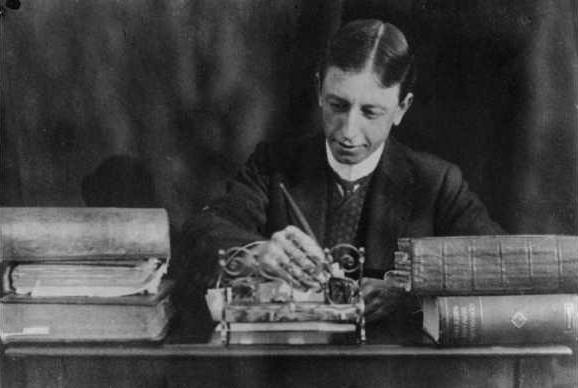
Trollope, 1873, in Vanity Fair (Public Domain, via Wikipedia)

Trollope, 1873, by Sir Leslie Ward, in Vanity Fair (Public Domain, via Wikipedia)

N.B. starts by discussing Trollope who visited Australia in 1871 and stayed with his son who apparently ran a sheep-station in the Queensland outback. Trollope ended up writing a travel book, Australia and New Zealand (1873), and two novels, Harry Heathcote of Gangoil (1874) and John Caldigate (1879). NB clearly knows Trollope well. I laughed at his/her statement that Trollope, “even at his best, which is very good indeed, tends to be careless and to use three words where one would do.”

So to Harry Heathcote. It has, s/he, says a slight plot about rivalry between free selectors and sheep farmers in Queensland. N.B.’s assessment is that Trollope’s portrayal is authentic and that the book

is still well-worth reading for its entertainment value for anyone who can dispense with the slicker techniques and concise prose of modern popular novelists.

And then, having a bet both ways, s/he also says, it

is short and dramatic, virtues which will commend it to modern readers who shrink from the traditional Victorian three-decker.

It’s for assessments like these that I so enjoy delving into old newspapers. They provide such insight into the thinking of another time (if 50 years ago is another time!). Anyhow, N.B. continues that Trollope, not a sentimentalist, presents in Heathcote “a real person with faults of personality as well as the representative virtues of an English gentleman …”.

In case you are interested, here* are paragraphs 2-4 from Chapter 1:

“I’m about whole melted,” he said, as he kissed her. “In the name of charity give me a nobbler.** I did get a bit of damper and a pannikin of tea up at the German’s hut; but I never was so hot or so thirsty in my life. We’re going to have it in earnest this time. Old Bates says that when the gum leaves crackle, as they do now, before Christmas, there won’t be a blade of grass by the end of February.”

“I hate Old Bates,” said the wife. “He always prophesies evil, and complains about his rations.”

“He knows more about sheep than any man this side of the Mary,” said her husband. From all this I trust the reader will understand that the Christmas to which he is introduced is not the Christmas with which he is intimate on this side of the equator–a Christmas of blazing fires in-doors, and of sleet arid snow and frost outside–but the Christmas of Australia, in which happy land the Christmas fires are apt to be lighted–or to light themselves–when they are by no means needed.

Trollope clearly cottoned on to Australia’s hot summers and the serious risks of bushfire. If this is a good example, N.B. is right about its authenticity.

Lansdowne’s “Real Service”

However, it seems that Lansdowne’s real service in N.B.’s eyes, was republishing A lady’s visit. Once again the issue of length is raised, this time by Patricia Thompson in her introduction to Clacy’s book. She says it’s not “too long, too dull, too pompous for the taste of the 20th century” like many early books of Australia. Thompson describes Clacy’s book as both interesting historically and a good read.

Clacy came to the Australian goldfields, “those auriferous regions” as she calls them, with her brother. N.B. says that Clacy’s book

should not be missed by anyone who appreciates a racy record which catches the flavour of what it was like to be there in Australia’s most rumbustious era.

Again, to give us a taste, here* is the second paragraph of Chapter 3, which describes their arrival in Australia:

The first sounds that greet our ears are the noisy tones of some watermen, who are loitering on the building of wooden logs and boards, which we, as do the good people of Victoria, dignify with the undeserved title of PIER. There they stand in their waterproof caps and skins–tolerably idle and exceedingly independent–with one eye on the look out for a fare, and the other cast longingly towards the open doors of Liardet’s public-house, which is built a few yards from the landing-place, and alongside the main road to Melbourne.

You can see what N.B. means, can’t you, about her style?

But what of Lansdowne now?

According to their website, Lansdowne is:

a leading independent book publisher and packager. We produce high-quality books and book-related products for publishers, retailers and distributors around the world.

We specialize in the subject areas of cooking, new age, interior design, gardening, health, history and spirituality for the international market.

Hmmm … a “packager”? They say they won the American Independent Publisher’s Award in 2000. An American independent publisher’s award? Intriguing. However, I can’t see any evidence of activity since 2006.

* Both books can be read at Project Gutenburg Australia: Harry Heathcote and A lady’s visit to the gold diggings of Australia in 1852-53.
** Nobbler is a small shot glass of hard liquor.
Monday musings on Australian literature: Who is publishing THE interesting books?

I had another post planned for today, but it can wait, because this morning writer-artist-feminist and out-of-the-box-thinker Sara Dowse made a provocative comment on my review of Australian love stories, which was edited by Cate Kennedy and published by the well-known Inkerman & Blunt. Oops, did I say well-known? Perhaps that was overstating the case. The fact that they are not particularly well-known is, I presume, what prompted Dowse to ask:

are the interesting books being published by small publishers now? I know this is entering dangerous generalisation territory but I think it’s worth discussing, don’t you?

Well, let’s enter this dangerous territory – and let’s not be afraid to generalise a bit. How, though, to approach it? Perhaps we should start with definitions. What do we mean by “the interesting books?” and what is a “small publisher?”

I’ll start with the easier one, “small publishers”. We have, in Australia, an organisation called the Small Press Network or SPN (about which I wrote a couple of years ago). They define themselves as being “a representative body for small and independent Australian publishers”. They don’t specifically define what this means on their site but they do provide a link to a report they sponsored from Kate Freeth in 2007. Titled “A lovely kind of madness: Small and independent publishing in Australia”, this report aimed to come up with a usable definition. Here is what Freeth presented:

Based on survey data collected, other organisations’ definitions of small press, SPUNC’s [now SPN] current membership and the SPUNC working group’s discussion of how they judge membership applications, potential guidelines for ‘small press’ are independent publishers who:

  • Have published at least one book title or journal issue (in hardcopy)
  • Have an annual turnover of $500 000 or less
  • Have print runs of usually less than 2000
  • Have published more than one author
  • Publish fewer than 10 book titles per year, and
  • Usually do not charge authors fees for production, editing or distribution.

As an outsider, I can’t really assess which publishers that I think are small meet these criteria, but I suggest we be flexible as SPN is. For example, Text Publishing is a member but I’d be surprised if they fully meet these criteria. Most of SPN’s members probably do, though – so I suggest their membership could form the basis of our discussion here.

Now, the trickier question: how do we define “the interesting books”? For me, and I’d guess Sara Dowse, this would mean books that innovate, that take risks and break existing moulds, either in terms of style, form or subject matter, or that are by writers who aren’t from the mainstream culture.

So, let’s look at who’s publishing what? If we look at authors shortlisted for Australia’s best-known literary prizes in recent years, we see a mix of those published by the big publishers like Penguin (Tim Winton and Fiona McFarlane), Random House (Richard Flanagan and Evie Wyld), and Picador (Hannah Kent), and those by small publishers like Giramondo (Alexis Wright), Text (Cory Taylor) and Scribe (Cate Kennedy).

What about smaller prizes? Readings bookshop has created a new award called the Readings New Australian Writing Award. It’s for “an Australian author’s first or second book of fiction, and recognises exciting and exceptional new literary talent”. I’m going to assume that “exciting” implies “interesting” by our definition. The shortlist comprises six books by the following publishers: Giramondo (2), Hachette, Penguin (2, if we included Hamish Hamilton), and Allen & Unwin (a large but independent publisher). Again, there’s a mix.

But prizes aren’t necessarily the arbiter of “interesting” (particularly, if we use my definition above). Nonetheless, Alexis Wright’s Carpentaria won the Miles Franklin and must surely be described as interesting with its unique, slippery and exciting evocation of indigenous reality. It was published by small publisher Giramondo. If you look at Giramondo’s website, you will see a catalogue of what they call “innovative new fiction”, including by well-established and well-regarded writers, like novelists Gerald Murnane and Brian Castro. Murnane and Castro are not known for being “easy”, but they are interesting! You will also see novels, poetry and short story collections by newer writers like Maria Takolander (also published by Text), Alice Melike Ülgezer, Michael Mohammed Ahmad.

I could continue in this vein picking out examples of publishers and looking at who publishes whom. My sense from my brief survey and my own reading is that when it comes to novels, larger and smaller publishers are both publishing “interesting” work. I would, though, add the proviso that if you want novels by writers of diverse backgrounds (who are, for example, indigenous, non-Anglo, or LGBT) you are more likely to find them at the smaller publishers. UQP, for example, has published many indigenous writers, Spinifex Press specialises in “controversial” writing, Transit Lounge is expressly interested in “creative literary publishing that explores the relationships between East and West, entertains and promotes insights into diverse cultures and encompasses diverse genres”, and so on.

But, where small publishers particularly stand out, I think, is in “taking risks” with less popular forms – with short stories, novellas and poetry. While the novels I’ve read on this blog come from the gamut of publishers, large and small, the short stories, poetry and novellas I’ve read have been published almost exclusively by small publishers.

I’m not sure that this rather off-the-cuff discussion has gone in the direction that Sara Dowse was thinking, but it does lead to the important question: Does it matter? What are the implications for authors of being published by small publishers? I suspect there’s a complex web of pros and cons, with the balance varying from author to author, publisher to publisher. For readers? I fear that small publishers may not be able to reach as wide a readership as the works (and their authors) deserve. And for our literary culture in general? I’d like to think that variety and diversity in publishing is healthy – but it has to be sustainable (and, dare I say, “fair”). Is it?

Let the discussion begin …

Cate Kennedy (ed), Australian love stories (Review)

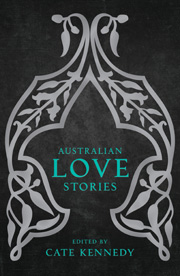
Cate Kennedy, Australian Love Stories cover

(Courtesy: Inkerman & Blunt)

Four hundred and forty-five stories! She read four hundred and forty-five of them! I’m talking about Cate Kennedy, the editor of Australian love stories. These stories were the response to Inkerman & Blunt’s call for Australian writers “to share their love stories, fictional or true”. Having no experience in these things, I don’t know what they expected, but 445 sounds like a good response to me! The final anthology contains just 29, and they are all, not surprisingly, good reads. This is not to say that I loved them all equally, but certainly none jarred for being ordinary or clichéd. Not only is the writing high quality, but Kennedy’s selection has produced a collection that is diverse in subject matter and style. It wasn’t hard to read four or five in a sitting.

If you’ve read my previous reviews of short story collections, you’d know that I’m always interested in the order of the stories. Well, this anthology has been overtly structured, with “like” stories grouped under headings. Each heading, cutely I suppose but nonetheless effectively, draws from a story within the group. So, for example, the heading “A sweetly alien creature” comes from the second story in its group, Susan Midalia’s “A blast of a poem”. I’m easily amused, I know, but I did look forward to spotting the heading-title as I read each group. There are seven of these groups, each containing four stories, with one exception that had five. In her Introduction, Kennedy, herself an award-winning short story writer, says that “Donna Ward [the publisher] and I arranged the stories into a kind of narrative arc of the way love comes, creates its own disorders, then transforms itself and us [in] the process.” This arc, though, isn’t an obvious one, like, you know, young love, broken love, old love. It’s more fluid than that.

And so, the first story, Bruce Pascoe’s “Dawn”, is about an older couple who have been together for a long time. The narrator, the man, clearly still adores his wife, and watches her, caresses her, in the early hours of the morning. While the birds come to life and sing in the day, she sleeps on. He knows her well, knows what he can do, how far he can go, before he will irritate her and break the spell:

So I don’t touch that bone. It would be over. She presses in closer to me and her breasts slide heavily against me and a thigh rises over mine and she squirms again, adjusting, moulding herself to me, fidgeting this limb and that, this foot against that, settling. It is not yet over.

This is a beautifully observed piece. It thrilled and inspired me – and gave me confidence that if the collection started like this, I was going to be in good hands.

What I particularly enjoy about an anthology like this is that it can give me a taste of writers I’ve been wanting to read for a long time (such as Bruce Pascoe, Tony Birch and Lisa Jacobson), or reacquaint me with writers I have read before and enjoyed (such as Irma Gold, Leah Swan, and Carmel Bird), or, perhaps most excitingly, introduce me to writers I don’t know at all (such as  J Anne DeStaic, Sally-Ann Jones and Sharon Kernot). But, here’s the thing. How to write about a collection in which pretty well every story moved me? I don’t want to simply generalise and tell you that they covered the whole gamut of love – from straight to same-sex, from romantic love to parental, from lasting to broken love, from supportive love to betrayal and revenge, from love across nations to love at home – though the anthology does do all these. And I can’t really describe every story in the book. So, I’ll just choose one from each section to give a flavour.

I’ve already mentioned Bruce Pascoe’s “Dawn” so will leave it at that for opening group titled “A sensuous weight”. The second group, “Why cupid is painted blind”, includes stories about love that can be passionate, obsessive, overwhelming. J Anne deStaic’s “Lover like a tree” is a devastating story about a woman in love with a man in love with his drugs (and yes, also with her). DeStaic conveys this two-edged love, his need for the drug as strong as her need for him, with sensitivity and without judgement. It is what it is.

The next four stories, in “Adrift in shards and splattered fruit”, explore same-sex love. They are not the only stories to touch on this issue, which was pleasing to see. Confining them all to one section would have insulted today’s reality. Debi Hamilton’s “The edge of the known world” is about missed opportunities, about the one who loves and the other who doesn’t see it:

Carmelita. Carmelita. There. I like to think her name. If you want to hear a love story I can write you one. If you want a story in which someone breaks someone else’s heart, this is the story for you.

We are warned early in the story, and yet the end still saddens.

From this group we move to “There are tears, there is hubris, there is a damnation and regret”. These stories are about difficult loves, sometimes past loves. It’s a powerful and varied group, but I’ll choose Sally-Ann Jones’ “Hammer orchid” to represent it. It spans thirty odd years in the lives of a young woman and an indigenous man. It starts “when she was eight and he was sixteen” and ends when they are fifty and fifty-eight. Set in Western Australia, it tells the story of a young girl’s crush and a young man’s recognition of the boundaries that need to be maintained. It gently encompasses issues like the patronising “naming” of indigenous workers (“Bill” is called “Biscuits” by his employers), knowing country, and environmental protest, all tied together by Levis and a silver belt buckle – but, beyond that, my lips are sealed.

“A sweetly alien creature”, as you might guess from this group’s title, explores parental love. Of course, like all love, this doesn’t run smooth. There’s a story about a false pregnancy (Rafael SW’s “Small expectations”), and another in which Lola promises to marry Henry and give him a baby if he’ll let her have a cat (Caroline Petit’s clever “The contract”). There’s Irma Gold’s only-too-believable story about “The little things” that can bring it all asunder, and Natasha Lester’s succinct piece about losing the language of adult love, postpartum (“It used to be his eyes”).  And then there’s Susan Midalia’s “A blast of a poem”, a bittersweet story about what happens when conception doesn’t happen on demand. What then?

I hope I’m not boring you, but we are nearly there! The penultimate group, “Firm as anchors, wet as fishes”, looks at how health issues can challenge or get in the way of love. There’s cancer of course, and I had to laugh at Sharon Kernot’s resourceful wife in “Love and antibiotics” when she tells her husband she has chlamydia. Allison Browning’s “These bones” is, we learn from the biographies, an excerpt from her current novel-in-progress. It’s about Enzo, a gay man with dementia. He’s in a care facility and misses waking up next to Nev. He might have dementia, but he still manages to escape the facility, despite its security-coded doors:

Today is a gardening day, the kind where no gloves are needed because the earth is warm and kind to the skin and the dirt feels soothing on the flesh.

We do meet Nev at the end, and he is as tolerant and loving as Enzo remembers and deserves. I’m intrigued now about the novel.

The last section, “The unbroken trajectory of falling” is – and you’ve probably been waiting for this – about love gone very wrong. There’s adultery of course, and breakups. There’s even a murder. Kennedy clearly decided that there would be no whimpering at the end of her anthology. No, we would go out with a bang. And so, if Pascoe opened the collection with a lyrical evocation of mature love, then Carmel Bird’s “Where the honey meets the air” brings it to a close with a breathless piece that barely stops for a comma, let alone a full-stop. Here, Sugar-Sam, in a stream-of-consciousness featuring word-play galore and “mincing metaphors”, chronicles his relationship with Honey-Hannah. It’s wickedly funny, with allusions high and low, little digs at our modern ways of communicating (“the merrymedia, social and anti-social”), and pointed references to contemporary issues. It is surely not a coincidence that Tasmanian-born Bird’s character marries into a family called Gunn. He describes the family’s taking over their wedding:

when Her Family swept in and tied us up in knots, ribbons, bows and a certain amount of barbed wire, and whirled us up the aisle …

Lurking in the language, behind its breezy tone, are, as you can see here, hints of something else. “I should have warned you”, he says at one point, “about how this narrative will tie itself in the knots of several metaphors and coincidences and things”. It certainly does that. By the end we are left fearing that Sugar-Sam has indeed tied us up in knots. A clever, satisfying, not definitively resolved story. What a way to finish.

All in all, a wonderful read. If you don’t want to take my word for it, do check out reviews by John at Musings of a Literary Dilettante and Karen Lee Thompson.

awwchallenge2014Cate Kennedy (ed)
Australian love stories
Carlton South: Inkerman & Blunt, 2014
275pp.
ISBN: 9780987540164

(Review copy supplied by Inkerman & Blunt)

Murray Bail, Arthur Boyd, Art and Landscape

Last year, I attended the National Library of Australia’s two-day seminar, Writing the Australian Landscape, and wrote three posts about it, here, here and again here! In the first post, I wrote about Murray Bail’s somewhat provocative keynote speech. What I didn’t mention in my post was Bail’s reference to Arthur Boyd’s painting, titled “Interior with Black Rabbit” (which you can see at the National Gallery of Australia: BOYD, Arthur | Interior with black rabbit.)

I was reminded of this reference when I visited the Gallery’s Arthur Boyd: Agony and Ecstasy exhibition prior to the Griffyn Ensemble Concert because, on the label for this artwork was a quote from Murray Bail, which I recognised as being from his address at the seminar. I’d like to share it with you now. Bail introduced the painting, which he showed on a screen (presumably with copyright approval), by telling us that its subject is “the difficulty of being an artist in this new, largely empty place, Australia”. He then described the painting, thus (and this is the quote on the National Gallery’s label):

It shows the dilemma of the painter. It could just as well be the dilemma of the novelist in Australia, or the poet, or somebody composing a piece of music. Perhaps above all the dilemma faced by the painter and the novelist.

The painter is wearing a European ruff representing some sort of distant sensibility. Outside is the Australian landscape – glaring, pitiless, empty, uncultivated. That’s here. That is us. Landscape is always viewed through culture. And here culture is represented by chicken wire. Utilitarian, crude, provisional. And in the darkened room the artist is on his knees, trying to capture something of this, via the rabbit – and the rabbit is an animal that is always out of reach.

This view of the landscape is, of course, the view of a “distant sensibility”. I don’t imagine that the traditional owners of the landscape see it as “glaring, pitiless, empty”. One of the concerns in the audience that day was Bail’s Euro-centric focus. That was fair enough, in a way – he is, after all, like most of us were in that audience, descended from distant sensibilities – but some greater recognition of indigenous sensibilities would have been appropriate. Putting this aside, however, Bail is right about one thing, which is that landscape “is always viewed through culture”. This is particularly evident in Australia, where responses to landscape can vary immensely depending on your origin – indigenous, “settler” or settler ancestry, or recent immigrant. Certainly, landscape is a powerful – and complicated – force in both Bail’s and Boyd’s work.

Hmm ... what about Literature? (Boyd Label at NGA)

Hmm … what about Literature? (Boyd Label at NGA)

So, how does it play out in their work? For Bail, there is still clearly a tension between his (our) European heritage and this place we are in. Indeed, in the talk I attended he said that

I hadn’t quite realised my novels are centred around journeys, all of them….. My people are instinctively hot-footing it out of here, turning away from the apparent barrenness.

He’s right … at least there are elements of this, surprisingly so at times, in the three novels of his I’ve read, Eucalyptus (less so), The pages and The voyage.

I’m not sure how much Bail himself hotfooted it out of here, but Boyd sure did. He lived in London from 1960 to 1971. On his return, he bought a place, Bundanon, in the Shoalhaven region (only a couple of hours from where I live). The Wikipedia article on Boyd suggests that at first he found the landscape “rugged and wild” but that he gradually “befriended the formidable landscape”. In fact, he befriended it so much that, as I wrote in my Griffyn Ensemble post, he donated the property to the Australian people. In Zara Stanhope’s Arthur Boyd: An active witness (Bundanon Trust, 2013) he is quoted:

I want it to be accessible to any Australian whose life can be enriched by the beauty, the history, the landscape, the environment and by the energy and stimulation from social interaction with Australian creative artists.

In the book, Stanhope says that Boyd wrote in a handwritten letter that he want the property to be used as “a base for research by practitioners in music, drama, literature, visual arts and science”. Phew … that answers my question in the caption above! Stanhope also discusses briefly in the book Boyd’s engagement in the natural world, saying that:

From being a compositional vehicle and a carrier of emotions, the landscape came to offer multiple meanings.

Those meanings include spiritual or abstract ones dealing with our relationship with or connections to the environment, metaphorical ones to do with our attitude to the natural world (including his series on animal research), and practical ones about preserving the environment. Boyd did also paint a series – the Bride paintings – expressing his concerns about conditions of indigenous people and the need for reconciliation, but these were earlier in his career after a visit to outback/central Australia.

I have no conclusion to all this – but just wanted to share some thoughts I’ve been having, connections I’ve been making. It just reminds me that in Australia at least, we can’t divorce ourselves from considerations of landscape, no matter what Bail said in his talk. Not only is it a presence that demands notice, but it defines our relationships – indigenous-nonindigenous, east-west, national-international, inland-coast, mainland-island – which in turn define our culture, who we are, how we see ourselves. No wonder we keep talking about it, writing about it, painting it, composing about it …

Monday musings on Australian literature: Poetry awards

Over recent months, I’ve devoted several Monday Musings to exploring various Australian literary festivals and awards. I was inspired to write this one on poetry awards by two things. The first is that during my recent exploration of Australian literature in the first few decades of the 20th century, and particularly of the 1927 plebiscite conducted of Argus readers in Melbourne in 1927, I became aware that as much if not more of the discussions about the results focused on the poets. It seems – but of course, my research is somewhat serendipitous – that poetry played a greater role in literary (and perhaps ordinary) life then, than it does now. I’d love to hear what others think – or know – about this (in Australia or their other countries).

And then, following close on the heels of my these ponderings, I received an email from Five Islands Press announcing their new poetry award, the Ron Pretty Poetry Prize, and asking me to spread the word through my blog. Now, my problem is that while I’m a big supporter of Australian literature, I don’t see myself as part of a formal publicity machine. I want to maintain some level of independence. However, given my recent thoughts about poetry in Australia and the fact that I haven’t yet written on poetry awards, I decided I could include this prize in a Monday Musings post on these awards. Make sense? I hope so!

The interesting thing about poetry prizes in Australia is that many of them are named for poets – far more so than the other specialised literary awards. I wonder why this is? Like other awards, though, they vary in their establishment and management, some being part of larger awards such as premier’s literary awards, some sponsored by writers’ organisations or festivals, and some by magazines or publishers.

I’m structuring this post a little differently to my other awards posts because they can be logically divided into fairly distinct categories. As always, of course, the list comprises just a selection. Here goes:

Lifetime achievement award

The best-known (and perhaps only) award in this category is the Christopher Brennan Award which is given annually to “a poet who has written work of sustained quality and distinction”. It is administered by the Fellowship of Australian Writers (Victoria), and has been awarded since 1974. The award is a plaque, rather than money. Previous winners include the big names of modern Australian poetry, such as Judith Wright, Les Murray, Bruce Dawe, Dorothy Porter and Geoff Page, some of whom I’ve reviewed on this blog.

Awards for poetry in book form

(Presumed Public Domain, via Wikipedia)

CJ Dennis, ca 1890s (Presumed Public Domain, via Wikipedia)

Some awards are made for individual poems (see below) while others are for poetry collections, or long poems that are published in book form. These awards include:

  • Anne Elder Award for a first book of poetry: established in 1977 and administered by FAW (Vic). The prize is currently $1,000.
  • CJ Dennis Prize for Poetry (part of the Victorian Premier’s Literary Awards): established in 1985. The prize is currently a cool $25,000.
  • Grace Leven Prize for Poetry for a volume of poetry by an Australian writer or a naturalised Australian of at least 10 years’ residence: established in 1947, so is one of the oldest awards. Its monetary prize is small, but it’s apparently highly regarded by poets and has been won by many of Australia’s best known poets.

Awards for poetry, limited by length

  • Gwen Harwood Poetry Prize for a single poem or “linked suite of poems” of up to 80 lines: established in 1996 and administered by Island Magazine. First prize is currently $2000, with two prizes of $500 able to be awarded at the judges’ discretion.
  • Peter Porter Poetry Prize for a poem of up to 100 lines: established by ABR (Australian Book Review) in 2005, and renamed to honour Peter Porter in 2010. There is a cash prize and publication in the ABR.
  • Ron Pretty Poetry Prize for a single poem of up to 30 lines, not limited by nationality: established in 2014 by Five Islands Press in the name of its founder, the poet Ron Pretty. The inaugural prize will be $5,000. There is an entry fee, and submissions are made online.

Awards for unpublished poetry

  • Thomas Shapcott Poetry Prize for an unpublished manuscript by a Queensland author: established in 2003 by Arts Queensland. The prize is currently $3,000 plus a publishing contract with UQP.
  • Val Vallis Award for an Unpublished Poem for a poem or suite of poems of up to 100 lines by an Australian writer: established around 2000 by Arts Queensland. The first prize is  $1,000, one week at the Writers’ Retreat at Varuna, and publication in Cordite Poetry Review.

And something a little different

Rather different to the above awards, and others of their ilk, is the Vincent Buckley Poetry Prize. It is a biennial award that is offered alternately to enable an Australian poet to visit Ireland and to facilitate the visit of an Irish poet to Melbourne. Interesting, huh? Established in 1992, it commemorates the life and work of Buckley who was a poet, critic and Professor of English at the University of Melbourne and who loved both Australian and Irish poetry. The prize includes a return airfare, a contribution towards living expenses and an honorary fellowship at the University of Melbourne. The winner in 2002 was Cate Kennedy, well-known for her short stories and, as I’ve discovered, her poetry. She has also won the CJ Dennis Prize for Poetry.

More awards are listed at Wikipedia. It’s not complete either, but it’s a start.

Nigel Featherstone, The beach volcano (Review)

Courtesy: Blemish Books

Courtesy: Blemish Books

Back in 2010, Featherstone spent a month, on a writer’s retreat, at Kingsbridge Gatekeeper’s in Cataract Gorge, Launceston. He writes on his blog that he left Launceston with sketches for three novellas. The beach volcano is the last of these, the other two being Fall on me (my review) and I’m ready now (my review). Before I talk about the novella, though, I must compliment Blemish Books on the production of these three books. They are gorgeous – they have appealing, stylish cover designs; they are a perfect size, fall open easily and have lovely, clear print; and together they look like a set. Well done Blemish, I say.

Now, to the book itself. Featherstone has appeared a few times on this blog, via my reviews of the first two novellas, a guest post in 2012, and a five-part interview that I ran over the summer of 2012-2013 when the magazine it was destined for, Wet Ink, folded. Through all of these, one particular idea or theme has been consistent – and it is, as he formally stated in his guest post, that “family is the guts of the contemporary Australian story”. He mentioned several writers, such as Kate Grenville, Craig Silvey and Gillian Mears, for whom this is clearly true, and then turned to his own work:

My main characters are usually men and women (always a good start!) who have children, who want to be parents, who struggle to cope, who feel the pressure of internal and external expectation, who fail and fall into a heap but pat themselves down and have another crack at it.

And so, Fall on me centres on father and teenage son, Lou and Luke, while I’m ready now is about a fifty-something mother and thirty-year old son. In The beach volcano, we’ve moved on again in age. The father here is 80 years old, and the son 44. I’m not sure whether this age progression drove the order in which the books have been published, but it does have a certain neatness. Luke, the teenager in the first book, is pretty wise for his age but he is still a young man sorting out his identity and his separation from his father. Thirty-year-old Gordon, on the other hand, is confronting turning 30 and, not comfortable with what this implies, embarks on a risky “Year of living ridiculously”. This brings us to 44-year-old Canning (aka successful rock musician Mick Dark) who has returned home for the first time since he was 17 to celebrate his father’s 80th birthday. He has come primarily because he wants to discover the “full” truth about a story told to him by his aunt, the estranged sister of his father. I should add here, in case I’ve given the wrong impression, that the first two books don’t focus solely on the son, whereas The beach volcano is very definitely Canning’s story.

The thing about Featherstone’s books – at least these three – is that there’s potential in each for high drama, or, to put it more crudely, for violence and/or death. But, Featherstone is not a writer of crime or thrillers. He’s interested in family and human relationships, and so, while dramatic things happen, the drama never takes over the story. In The beach volcano, terrible things involving abuse of boys by men have happened before the novel starts. They resulted in family secrets to do with a false alibi – and who knows what else, we wonder as we read. This is what Canning has come home to discover.

The story is told, first person, through a traditional linear narrative, with flashbacks to fill us in on relevant background. It starts with Canning’s arrival on Friday, late, for the pre-birthday dinner for the immediate family, and continues to the end of the weekend when all has been revealed, to Canning at least, and he is able to make some decisions about where to from here. Throughout the weekend, Canning has one-on-one conversations with different members of his family, his parents, his two older sisters, a brother-in-law, and a nephew. We to-and-fro between love and hate, welcome and aggression, as this family tries to keep conflict at bay, while threatened by a secret that they refuse to openly confront. Family secrets, gotta love them! But, Canning wants truthful relationships with his family now:

I’d come to Sydney to tell the truth, but it was important to be selective about the truth, and to have good timing in the telling, to be cautious. Because the truth, I thought, was a disturbance. The truth took things apart and put them back together in a different but better shape. But what exactly was a better shape?

This is the question Canning needs to answer, and is why he bides his time. He needs (and wants) the truth to be a positive force, not a destructive or simply life-sustaining one.

Featherstone’s language is clear and evocative, with lovely descriptions of coastal Sydney and realistic dialogue. Canning’s voice feels genuine, if a little inclined at times to over-explain. The “beach volcano” of the title works on both the literal level as an activity that Canning and his father share, and that he then wants to pass onto to his newly-met nephew, and as a metaphor for simmering tensions that threaten to erupt. You’ll have to read the book though if you want to know what erupts and how. It is, in its measured way, quite the page-turner.

In a sense, this is a reworking of the prodigal son story, except that in this version the son returns as a success and is, perhaps, the one who extends the greatest generosity. Like the original, it is about love and acceptance, but has the added theme – one that Featherstone explores in the three novellas – of the need to face the past before you can truly progress into your future.

The beach volcano makes a fitting conclusion to Featherstone’s novella set. I have enjoyed the time I’ve spent with his unique but real families and look forward to seeing what he comes up with next.

Nigel Featherstone
The beach volcano
Canberra: Blemish Books, 2014
140pp
ISBN: 9780980755695

(Review copy courtesy Blemish Books)

Monday musings on Australian literature: Whither Australian literature in 1927?

Last week’s Monday Musings focused on a plebiscite conducted in 1927 on Australian and New Zealand authors and poets. It was conducted in August as a lead up to September’s Australasian Authors’ Week. I found several articles about this week. Some were primarily descriptive, but a few took the opportunity to comment on the state of Australian literature.

I particularly enjoyed reading the unnamed writer in The Catholic Press. S/he starts:

We hardly know whether the Australian* Authors’ Week, proclaimed by the Booksellers’ Association, to begin to-morrow, is intended as a tribute to the merits of Australian writers, or as a demonstration of remorse, or as merely a gesture, like the Shopkeepers’ ‘Country Week,’ to indicate the stuff that is to be avoided for the other 51 weeks of the year.

Hmmm … this writer continues that it’s not a very original idea, but may divert “the minds of book readers from the notion that Ethel M. Dell, Zane Grey and H.G. Wells are the pillars of the present day literature in the English language and its American offshoot”. I wonder if that “American offshoot” comment is a dig at the language or reflects a prevailing view of the period that they are separate? I’ve never heard of Ethel M. Dell but the Zane Grey comment makes sense. However, I was surprised by H.G. Wells. Maybe his star has risen in the years since 1927?

A young culture

The writer argues against the view that “Australian literature has been an unconscionably long time developing”. S/he suggests that Australia was still a very young country (in terms of white settlement, as we moderns would qualify), at just 14o years old – and that it did not have a significant population for the first half of that period, that is, not until the gold rush of the 1850s. S/he argues that there was little or no American literature for its first 300 years. Hmm … I guess this depends a bit on your definition of “literature”. Later in the article, s/he says that most people narrow the term to “poetry and fiction”, but clearly believes it can encompass more, including history and essays. There was, in any event, political and religious writing in America from its early days but, according to Wikipedia, the first American novels didn’t appear until the late 18th to early 19th centuries.

In Australia, the earliest writings were journals of the early Governors; verses by Judge Barron Field; “the superficial historical work of W.C. Wentworth, an Australian native”; and “dry-as-dust chronicles” by historians. Australia’s bookstalls now, s/he writes, “are flooded with the cheap trash of England and America, which are neither literary nor instructive”.

Literarily … Australian

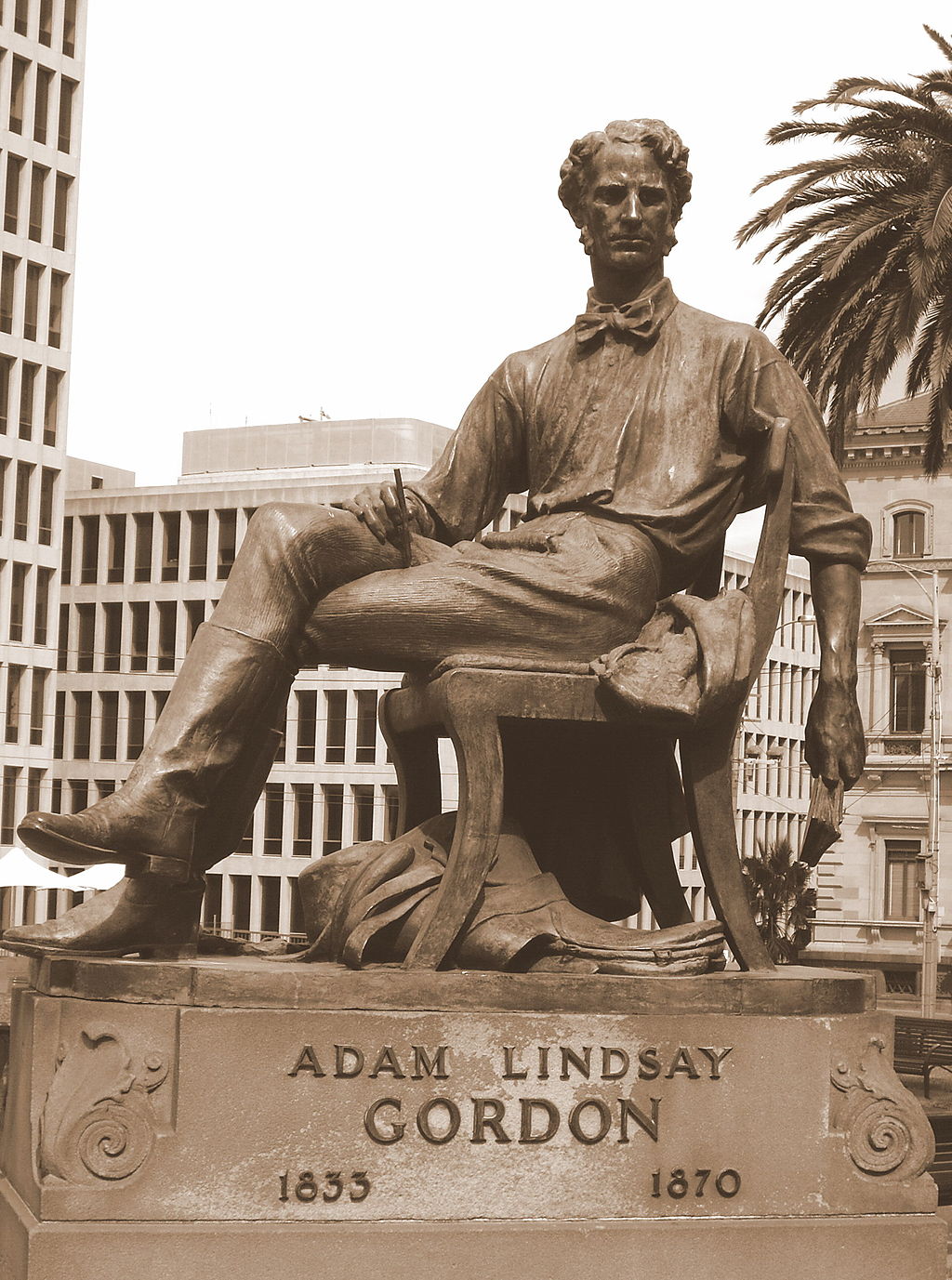
Adam Lindsay Gordon monument (Courtesy VirtualSteve, using CC-BY-SA 3.0, via Wikipedia)

Adam Lindsay Gordon monument (Courtesy VirtualSteve, using CC-BY-SA 3.0, via Wikipedia)

The writer then discusses the plebiscite. S/he states that “it would be too much to expect that such a vote could be considered critical”. “Subconsciously, many honest voters would follow the crowd”, s/he suggests. Very likely, I’d say, given that members of the sponsoring Society had provided their selections in the newspaper at the start of the plebiscite! The writer is not particularly keen on the poet who “won” the plebiscite, Adam Lindsay Gordon, and who, s/he says “had an affection for the ‘gee gees'”. S/he also doesn’t approve of the leader of the prose section, Marcus Clarke, with “his inartistic stuff”, but doesn’t explain this further. Another writer on the week, in The Australasian, reports that Percival Serle**, addressing the Australian Literature Society, said that “the worship of Gordon had done a very great harm to Australian literature”, and that English lecturer F. Sinclaire was similarly critical of Gordon, calling him “pernicious as an influence socially and artistically, besides being in no sense Australian”.

Back now, though, to our Catholic Press writer who argues that “much of Australian literature prior to the so-called ‘Bulletin‘ school has little distinctive character”. S/he suggests that writers like Gordon, Clarke, Rosa Praed, Guy Boothby “may have laid plots in Australia, but failed to get the atmosphere”. I wish s/he’d elaborated a bit more on this, because s/he goes on to name writers s/he sees as “Australian” without defining what s/he means.

Who are they? Well, they include poets Roderic Quinn, Charles Harpur (who wrote “the first genuine Australian verse”), and Henry Kendall. S/he does have a little dig at Kendall’s style – quoting his “notes that unto other lyres belong” – but argues that he is “Australian in sentiment”. Other writers – poets and novelists – s/he names include Rolf Boldrewood, “Banjo” Paterson, Mary Gilmore, Ethel Turner, CJ Dennis, Bernard O’Dowd, Dorothea Mackellar. (F. Sinclaire also names O’Dowd, but adds Furnley Morris***, whom I don’t know at all, and J. Shaw Nielson). As an aside, I can report that all the poets mentioned here – including the maligned Gordon – appear in 100 Australian poems you need to know, published in 2009. It’s not the arbiter of quality, but is a fair indication of the longevity of these writers’ reputations.

S/he then argues that on Henry Lawson’s death, it was argued that “he was the last of the school which began with Gordon”, but s/he believes that “he was the first of the new school, the Hawthorne of Australian literature”. Does s/he mean Nathaniel Hawthorne? I haven’t heard that before.

Overall, s/he is positive about the state of Australian literature. The list, s/he says, “is not unworthy of the first century in a nation, which even now holds less (sic) people than the single cities of London, New York or Paris”. S/he concludes:

If young writers seek characters and episodes in the life around them and avoid imitating the style, decadence and false sentiment of the ‘best sellers’, Lawson, Quinn and Kendall will have worthy successors in a field that still has room for exploration.

The point of all this for me is that while assessments might vary in the particular, most if not all of the writers mentioned in the articles are still known today – some very well, others in more specialist arenas. It reassures me that Australian literature is deepening, as well as broadening.

* Some called it Australasian, some Australian, and others Australian and New Zealand …. Authors’ Week!
** Serle could conceivably be the Catholic Press writer, but I didn’t find any evidence for this.
*** Furnley Maurice, I believe.

Olivera Simić, Surviving peace: A political memoir (Review)

Olivera Simic, Surviving peace

Courtesy: Spinifex Press

I hadn’t heard of Olivera Simić when Spinifex Press offered me her book, Surviving peace: a political memoir, to review, but her subject matter – the Bosnian war, to put it broadly – was of particular interest to me, so I said yes. You see, I worked for several years with a woman who, like Simić, was also “survivor” of that war, and while she’d talked a little about it, I was hoping this book would fill in some of the gaps. It sure did – and then some.

Simić was born in the former Yugoslavia, and lived through the Yugoslav Wars (1991-1999). She was nineteen years old and living in Banja Luka in Bosnia and Herzegovina (BiH) when the Bosnian War (1992-1995) broke out. To keep her safe, her parents sent her to friends in Serbia for the duration of the war. She was living in Serbia* in 1999 when NATO bombed it –  Operation Merciful Angel** (really!) – as part of the Kosovo War (1998-1999). These aren’t her only traumatic experiences, but I won’t give her whole biography here.

According to her Spinifex author page, Simić is now “a feminist, human rights activist and academic at the Griffith Law School, Australia”. She teaches international law and transitional justice, suggesting that her personal experience of war and peace is underpinned by thorough academic grounding. The book has an extensive bibliography, which not only substantiates her arguments, but provides an excellent resource, both fiction and non-fiction works, for further reading on the subject.

So, how does an academic, working in an area in which she has been personally involved, write and teach about it? Surviving peace is described as a memoir so, as she says in her Preface, “the personal ‘insider’ perspective assumes the lead” in this book, but she also wants to increase understanding of war trauma and its impact on people’s lives. She’s a feminist, and brings a feminist sensibility to her academic work, one which accepts that personal experiences provide legitimate evidence in research. She believes, as I do, that there is no such thing as “objective knowledge”. Consequently, this “memoir” can also work as a scholarly study of the consequences of war, of the challenge of living post-conflict, of, as she describes it, surviving peace.

One of the features that makes this book more than “just” a memoir, is that it’s not told in a simple linear chronology. She does start with the beginning of the war in 1992, and end pretty much with the present, but in between she structures the book more thematically, so I’ll do that too, roughly aligned with her themes.

Where are you from?

In Chapter One Simić describes how within a decade of Tito’s death, Yugoslavia had changed from a place of “collective identity” in which ethnicity was not an issue to being an ethnically divided society that descended into war and genocide. She now “identifies”, reluctantly, as a Serb (Bosnian Serb/Orthodox Christian), formally separated from her old compatriots, Bosniaks (Muslims) and Croats (Roman Catholics). “The war”, she says,”erased my country, my language, my youth”. Her discussion of how language has played out in this breakdown of society is fascinating – but her description of the impact of having an identity “forcibly attached” to her, is painful:

The ethnic identity that I have been reduced to in peacetime has become a chain around my neck that threatens to choke me. It determines everything I do, say and write … Every time someone starts to enquire about my ‘ethnic identity’ I find myself walking a minefield of people’s judgements and closed-mindedness.

Of course, she’s not the only one caught in this trap – and she supports her discussion of the issue with academic writings and the personal experiences of others. Later in the book she describes how her father changed from communist to “ultra-right nationalist”. He now mixes only with Serbs, and has “nothing to discuss” with Bosniaks and Croats, among whom he’d had close friends pre-war. It’s impossible not to generalise, and draw truths, from the “stories” she tells, truths about constructing ethnicity which extend far beyond Bosnia and the Balkans.

Speaking the truth – and moral responsibility

In Chapter Two, titled “Traitor or truthseeker”, Simić discusses why she is driven to write about atrocities – particularly the Srebrenica massacre – committed in “my name” by her people. It has brought her into direct conflict with her father. “Truth” she shows is a relative thing – if we didn’t know it before. Each ethnic group has its own truths about what happened, making it “almost impossible to have respectful conversations about politics and war in today’s BiH”.

I found this section particularly interesting, because its generalities extended, for me anyhow, beyond the Bosnian War to indigenous relations in Australia. She discusses her feelings of “moral responsibility” for acts committed in her name, and argues

Of course, I cannot be held accountable for atrocities perpetrated by members of my ethnic group; that is their burden. However, I can and do feel a responsibility to demand justice and examine crimes committed by ‘my clan’.

That makes perfect sense to me. Simić quotes Hannah Arendt as saying that every government should assume “political responsibility for the deeds and misdeeds of its predecessors, and every nation, for the deeds and misdeeds of the past”. She also quotes Bernard Schlink (of The reader) who wrote that the past can “cast a long shadow over the present, infecting later generations with a sense of guilt, responsibility and self-questioning”. Oh yes! I do hope we here in Australia are finally recognising this … (Interestingly, she also raises the issue of survivors feeling they have sole ownership of their experience and that only they have the right to talk about it. This reminded me of our discussion on this blog earlier this year about whether white writers can write indigenous characters.)

Simić talks of “dirty peace”, which she defines as a time when killings have stopped but ‘war’ is still being fought. In BiH, for example, those who speak uncomfortable truths – and she gives examples – are ostracised and threatened. She talks about forgiveness (which I discussed earlier this year in another post) and argues that real peace is unlikely to be achieved until once-warring parties can sympathise with each other. Reconciliation, she says, means something more than simple co-existence.

“The answer to violence can never be more violence”

Simić is a pacifist and abhors violence. She details in the memoir her own painful experience of post-traumatic stress syndrome (PTSD). It is the most personal, intimate part of the book. Her PTSD primarily stemmed from her experience, as a civilian, of the NATO bombing. She is particularly bitter about NATO’s actions. She discusses it at some length, including both her personal experience, and the “facts”. She doesn’t excuse what the Serbs did in Kosovo, but argues “there must be other ways”. What those other ways might be, however, is not the subject of this book.

Her discussion of modern warfare, in fact, is chilling – and reminded me of Andrew Croome’s inspiration for his novel Midnight empire. The more remotely war is conducted, the easier it is for those conducting it to not see the real people, real lives, being affected. In this new warfare, the number of “ungrievable lives”*** multiplies.

The ramifications of war, then, are enormous, besides the loss of life and destruction that occur during the violence, besides the PTSD suffered by combatants and civilians afterwards. She writes of her own life as a refugee, of dislocation in the lives of others, of a “peace” that for many is no life at all. Some of this she conveys in Chapter Four through letters between three women, including herself, which bear direct witness to violence and its aftermath.

Incorporating truth into history

You’ve probably gathered by now that I found this a deeply engrossing book. It is unapologetically written from the point of view of a survivor. Quoting academic Elizabeth Porter, Simić believes that stories provide the basis for incorporating truth into history. I like this because for me history is more than facts and events, more than great men and their actions. It comprises the truths drawn out of – generalised from – people’s lived experiences. Nonetheless, there were times when I wondered if Simić were pushing her personal barrow a little too far, but then remembered that this is, first, a memoir.

I’m never one to say you must read a book. However, if the subject interests you, then Surviving peace would be well worth adding to your pile!

awwchallenge2014Olivera Simić
Surviving peace: A political memoir
North Melbourne: Spinifex Press, 2014
188pp.
ISBN: 9781742198941

(Review copy courtesy Spinifex Press)

* I mistakenly wrote Sarajevo in my original version of this post.
** The name reported to Simic by a pilot, but this name, used briefly in Yugoslavia, was a misnomer.
*** Janet Butler’s term for whole populations “barely considered as human” by those conducting or reporting on war.

Monday musings on Australian literature: Plebiscite on Australian poets and novelists, 1927

Pottering around old Australian newspapers on Trove, I came across reports of a “plebiscite” on Australian poets and authors. Suggested by the Australian Literature Society, it asked readers of Melbourne’s The Argus newspaper to send in the names “of those whom they regard as the six leading poets and the six foremost writers of fiction of Australia and New Zealand”. Their aim was to discover which writers are held in esteem by their own people, and to gain some understanding of how interested the public is in the work of Australian and New Zealand writers.

I’m not going to focus on the “winners”, so before I continue, I’ll list the top six (with their “vote” count in brackets after their names). I understand about 4000 entries were received:

Poets

  1. Adam Lindsay Gordon (459)
  2. Henry Lawson (421)
  3. Henry Kendall (412)
  4. “Banjo” Paterson (393)
  5. C. J. Dennis (308)
  6. Bernard O’Dowd (189)

Prose

  1. Marcus Clarke (393)
  2. Rolf Boldrewood (315)
  3. Mrs Æneas Gunn (292)
  4. Henry Lawson (272)
  5. Roy Bridges (242)
  6. Ethel Turner (234)

They include two names I don’t know – poet Bernard O’Dowd and prose-writer Roy Bridges. It’s interesting to see no women among the poets, but two under prose. A woman, Mary Gilmore, did appear as the 7th poet, with 165 votes.

Dirty voting

How reliable though are these results? We aren’t told much about the source of the votes, but presumably most came from Melbourne and Victorian readers of The Argus. This plebiscite, like any, needs to be interpreted with regard to how it was conducted. There is, however, a complicating factor, as the unnamed author of the results announcement explains. S/he writes that:

in three instances concerted efforts were made to swing the voting … without regard to the merits of the writer for whom the votes were cast. These movements were entirely opposed to the spirit of the plebiscite, in which it was expected that the lists submitted would reflect the personal opinions of individual voters. These attempts were too obvious to escape notice, especially during the last few days, when several hundred lists were received bearing the same names with but slight variation. Had these votes been accepted the insult would have been that the names of writers who are comparatively obscure would have appeared at the head of each section.

Votes received via these “unfair” tactics – and we have to trust the administrators here – were not counted. The writer tells us they may not have identified all such votes, but believes the results give “a fair indication of public opinion”.

It was ever thus?

As we’ve discussed before in these historical reports, it is interesting, comforting even to some, that not much has changed over the decades. The unnamed author of the plebiscite announcement said that the aim of gauging interest in local writers

is of no little importance, in view of frequently repeated complaints that Australian authors do not receive the recognition that their work merits. Whether this feeling is justified or is the result of only an apparent indifference, there is some ground for the charge that Australians do not know as much about their own writers and their work as they might.

Sound a little familiar? Anyhow, because of this concern the Society was organising an Australian and New Zealand Authors Week in September 1927, the month after the plebiscite, to increase public awareness of its writers, to show “that we have a literature that is worthy of serious consideration”.

Have we made progress in this area? I’d like to think we have, and suspect we have, but we could still do better.

The dangers of prophecy

There were of course several articles discussing the results. One I’m saving for another post, as it contains a broader discussion of the state of Australian literature, but another by the Western Mail’s pseudonymous “Fairfax” is worth discussing here. He (I’m assuming) says that Katharine Susannah Prichard was the highest ranking Western Australian, appearing 12th in the prose list with 89 votes. He expresses surprise at Guy Boothby’s listing – for two reasons. First, he didn’t realise Boothby (who had lived much of his short his life in England) was Australian. And secondly, he was surprised at Boothby’s low vote, just 39. Boothby, though, had died in 1905, and according to Wikipedia was most noted for “sensational fiction”. Perhaps the voters knew what they were doing? Still, “Fairfax” calls him, seriously I think, “A Rare Talent” – and he was apparently mentored by Rudyard Kipling and appreciated by George Orwell.

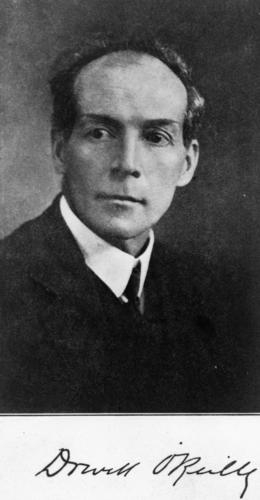
Dowell O'Reilly (Courtesy: State Library of Queensland)

Dowell O’Reilly (Courtesy: State Library of Queensland)

Then “Fairfax” turns to poet and prose-writer Dowell O’Reilly who does not appear in the list of poets, and scored a mere 14 votes under prose. O’Reilly, a Sydney-based writer, teacher and politician, had died more recently than Boothby, in 1923. “Fairfax” admires him immensely, and devotes over three paragraphs, or half his article, to him. He discusses several of O’Reilly’s works, stating

There is feeling and a quick sense of beauty in his verse. In the best of his short stories and sketches … is a psychological penetration in understanding of character, actions, and emotions, a masterly economy and eloquent directness, in the presention of his matter a deep and understanding sympathy …

I love his description of O’Reilly’s short story titled “Crow”, in which, he says, “the horrors of a drought have moved O’Reilly to three pages of graphic pictorial quality akin to a sharp etching”. I found, via Google Books, a discussion of it, with excerpts, by Tom Inglis Moore (in a book titled Social patterns in Australian literature). It sounds powerful and bitter, and a little reminiscent, despite different concerns, of Barbara Baynton.

Anyhow, my point is that “Fairfax” argues:

I hazard that the volume containing The prose and the verse of Dowell O’Reilly which Angus and Robertson published in 1924 will survive when a great deal of work placed higher in these lists has been forgotten.

Hmmm … many of those higher in the list have been forgotten but so – at least to my knowledge – has been O’Reilly. “Fairfax” exhorts his readers to buy the book during Australasian Authors Week. I admire his enthusiasm if not his powers of prophecy!

Monday musings on Australian literature: Nature Writing Prize

You know what they say, too much of a good thing is bad for you, so, to save you dear readers from bad things, I thought we’d take a break this week from my historical survey of Australian literature. And, since I received this morning an email containing a call for submissions for Nature Conservancy Australia’s Nature Writing Prize, I thought it would provide the perfect interlude.

Back in May I wrote a post about non-fiction literary awards and listed a few of them, mostly already well-known. Nature Conservancy Australia’s Nature Writing Prize is not well-known. It’s a biennial prize and the 2014/15 prize will be the third one awarded. The prize, which offers $5000 and publication in the Australian Book Review, is for an essay of 3,000-5,000 words “in the genre of ‘Writing of Place'”. According to the press release, the award will go to:

an Australian writer whose entry is judged to be of the highest literary merit and which best explores his or her relationship and interaction with some aspect of the Australian landscape.

The award was created, the press release also says

to promote and celebrate the art of nature writing in Australia as well as to encourage a greater appreciation of Australia’s magnificent landscapes.

I’m intrigued by the language: it’s called the “Nature Writing Prize” but it’s for the genre “Writing of Place”. The two do overlap but, in my head anyhow, they also differ. However, this statement just quoted above mentions nature and landscape, so it seems that by “place” they essentially mean “landscape”. But then, isn’t landscape part of nature? I suppose I’m being a pedant … I expect that it’s quite likely that writing about nature/landscape will often end up addressing notions of “place”.

The inaugural prize was won by Annamaria Weldon for “Threshold Country” and the second prize, for 2012/2013, was won by Stephen Wright for his essay “Bunyip“. In evocative language, drawing on the mythical bunyip, the native eucalypts and, pointedly, the introduced lantana “which replicates itself industriously, efficiently and will cover everything except shadow”, he explores the impact of the early European settlers on indigenous communities in South East Queensland and its legacy today. He makes the disconcerting point that:

We do not understand where we are, or what we have done. A landscape is not a sense of place for the non-Indigenous inhabitants of the continent. It is just somewhere we happen to be.

Note the distinction he makes between “landscape”, something physical, and “place”, which is something far more abstract. Anyhow, towards the end of the essay, he suggests that

It is as if, beneath the ordinary miseries of life, there is a current of displacement that allows us no rest. Our thought is always dislocated and perhaps this is the inevitable outcome of our attempts to consider ourselves at home in a landscape we have so spectacularly devastated.

While this is rather negative for optimist me, it does capture the uneasiness I, and I think many of us, feel about our relationship to the land of our birth that we know has an ugly history. We have a long way to go …

In a sad little postscript, the The Nature Conservancy commemorates Liam Davison and his wife Frankie who died in Malaysian Airline MH17 disaster in the Ukraine. Davison was one of the five writers shortlisted for the 2012/2013 Nature Writing Prize for an essay titled “Map for a Vanished Landscape”. Lisa at ANZLitLovers wrote a tribute to him soon after his death, and is now reading and reviewing his novels.