Back in February, the online journal, The Conversation, about which I’ve written before, started a occasional series they call The case for …. They described it simply as …
If you had to argue for the merits of one Australian book, one piece of writing, what would it be?
That’s very open-ended and I did think the intention might have been for contributors to argue for a book of controversial standing or, perhaps, one that has not received the recognition the casemaker thinks it deserves. But neither of these work for the first book, which was …
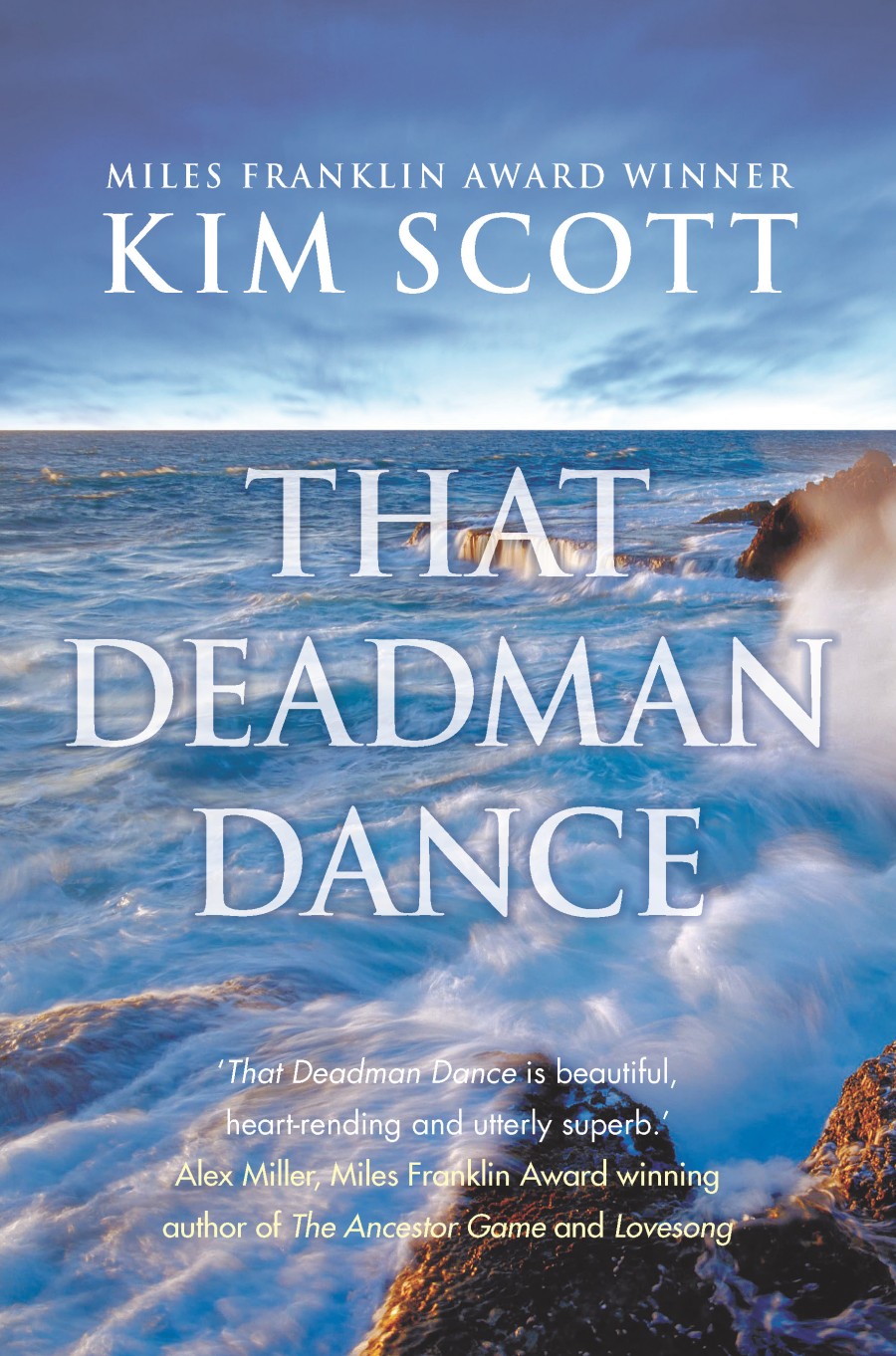
(Courtesy Picador Australia)
Kim Scott’s That deadman dance, chosen by Tony Hughes-D’Aeth, Associate Professor, English and Cultural Studies, University of Western Australia. (See my review). It is not controversial, though some readers found it a little hard to read, and it won a swag of awards, as Hughes-D’Aeth tells us at the start of his case. However, he makes a case on the basis of its importance and relevance to the ongoing discussion in Australia about the facts and implications of first contact. And his case has to do with what he calls Scott’s “bold wager” that “he wanted to write a novel from the point of view of Aboriginal confidence” and that he was “inspired [to do so] by history”. Hughes-D’Aeth discusses his surprise at this idea of “confidence”, given that the history is one of “decimation” and “cultural annihilation”. You can read his “case” if you’d like.
I should clarify, before I continue, that The Conversation also says that the work can be “fiction or non-fiction, contemporary or historical”.
So far there have been eighteen cases put. Several are for books I know or have read (often before blogging), such as (links are to the “case”):
- Jessica Anderson’s The commandant (my review)
- David Malouf’s An imaginary life
- Gerald Murnane’s The plains (my review)
- Henry Handel Richardson’s The fortunes of Richard Mahony
- Randolph Stow’s To the islands
- Peter Temple’s The broken shore: this one does meet my “controversial” expectation. What, many asked, was a crime novel doing being longlisted for the Miles Franklin Award (which Peter Temple went on to win with his next crime novel, Truth)?
But some cases are for books, I don’t know at all (which probably just demonstrates my ignorance). These include:
- Anthony Macris’ Capital, vol 1
- Paddy Roe’s The case for Gularabulu
- Johnny Warren’s Sheilas, wogs and poofters: an incomplete biography of Johnny Warren and Soccer Australia
- Mark Willacy’s Fukushima: I do remember some articles on the disaster by Willacy, who was based in Japan at the time, but was not aware of this book.
Of the eighteen cases listed on the site, the one that stands out as a bit odd to me is Johnny Warren’s book, published in 2002. Warren was a legendary Australian footballer. Casemaker Lee McGowan (Senior Lecturer, Postgraduate Coursework Studies, Queensland University of Technology) admits that the book has its weaknesses, but argues that it’s important nonetheless. He says that “the book’s title refers to what Warren described as a ‘mentality’ that exists around football in its early days in Australia, a mentality he implied was borne of fear.” McGowan suggests this seems outdated now – though I’m not sure exactly what he’s saying is outdated. The words in the title? The mentality? The fear? He doesn’t explore this further, but moves on to say that the book’s main value is that it “remains the best, most insightful account of the Australian game’s contemporary development”. I guess I wouldn’t see the development of football as a critical issue warranting my attention, but to each their own I suppose.
I’m intrigued – though not surprised – to note that several of the books for which cases have been made are by indigenous writers or confront indigenous issues (including Kim Scott, Randolph Stow, Peter Temple, Paddy Roe, and Gail Jones’ Sorry). The cases, in other words, reflect the zeitgeist of our times. Suzie Gibson from Charles Sturt University, arguing for Stow’s To the islands (1958), for example, writes that in it
contemporary readers are confronted with the fruits of Australia’s racist policies concerning Aboriginal peoples.
She argues that, in addition to its literary merit, it is relevant to modern Australia
which tends to function in ignorance of the ongoing cultural disenfranchisement of Australia’s first peoples.
Literature, as we all know, comes in and out of fashion, sometimes for reasons that aren’t immediately obvious. I love this initiative by The Conversation – and hope further academics and researchers take up their offer to present cases.
Anyhow, I’m sharing this series for a couple of reasons. One is that it provides yet another list to look at when considering what to read next. And the other is, as you’ve probably guessed, to ask, What book* would you make a case for – and why? I will make a case for a book in a future Monday musings!
* Preferably from your own national literature.

 Whispering Gums