Monday musings on Australian literature: Capital men novelists

It’s been a year since I wrote my post on Capital women novelists, the third in my series on Canberra’s writers. (The other two were Capital women and Capital men poets.) Today I am finally getting to the male novelists.

I’ll start in a round-about way with a local controversy. Last year, the ACT government changed the eligibility requirements for its ACT Book of the Year awards, narrowing location to ACT residents only. As the City News reported at the time, this contradicted “the principle enunciated in artsACT’s arts policy framework of ’embracing Canberra’s position as a regional centre and fostering opportunities for increased engagement with regional communities’” and it reversed the previous practice of allowing nominations from writers in the region. Fortunately, after serious lobbying from arts practitioners and supporters in the ACT, the government agreed that “regional NSW residents with an ACT based arts practice” could apply. I’ve told you all this not only because it shows that lobbying can succeed, but to justify my including regional writers in my ACT-based series!

As will other posts in this series, I am just going to share a few current novelists – in alphabetical order.

Andrew Croome
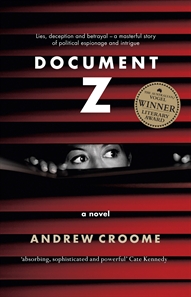
Document Z bookcover

Allen & Unwin

Croome, like many writers, is (or has been) somewhat peripatetic but is currently based in Canberra and has been for a couple of years at least. His first novel, Document Z (my review), which was published in 2008, deals with one of Canberra’s most famous stories, the Petrov spy scandal. It won  the The Australian/Vogel Literary Award and the New Writing award in the NSW Premier’s Literary Awards, and was shortlisted for others. I thoroughly enjoyed it, both for the perspective he presented and for his evocation of 1950s Canberra. His second novel, Midnight Empire, which I’ve also reviewed, was not set here though its main character had come from Canberra. It will be interesting to see where he goes next.

John Clanchy

Like many writers based here, indeed like many people of a certain age who live here, Clanchy came from elsewhere. I discovered in the ACT Writers Showcase that he moved to Canberra in 1975, the same year I did. He is still based here, as far as I know. In my recent review of his latest book, Six, I indicated that I was sorry I hadn’t read Clanchy before this. He has published 10 works of fiction, some of which are short story collections and two of which are crime thrillers co-written with another Canberra writer, Mark Henshaw. He apparently taught writing at the Australian National University, and in addition to fiction has co-written non-fiction books on academic writing, research and related topics. A versatile writer.

Julian Davies

Julian Davies, Crow mellow Book cover

Finlay Lloyd

You may remember Davies because, like Clanchy, he’s another established writer that I’ve come to late. He is also one of two men behind the Finlay Lloyd non-profit publishing venture. He has published around 6 novels, plus many short stories and essays. According to the ACT Writers Showcase, he has lived in Canberra or what we call the Southern Tablelands for most of his life. I’d like to think the grand house in Crow Mellow (my review) is located in the region, though I suspect it’s a little north. Regardless of where it is, I did enjoy the descriptions of place in the book, of which this is one:

This far view was unmistakably Australian, the bunched crowns of eucalyptus gleaming blue on the ridge-tops, deep green plumwood trees and sassafras holding to their lower creases. In the valley, the farm’s paddocks showed their patchwork of varying greens, some farm sheds and, higher than the others, an old two-storey building, a brick mill which Mitchell had painstakingly restored. At the valley bottom, the enormous dam, and beyond it, short reaches of the creek gleamed between stands of dusky she-oaks.

Nigel Featherstone

Courtesy: Blemish Books

Blemish Books

Nigel Featherstone is the local writer who has featured most in my blog, through my reviews of his novellas, a guest post, and an interview. Featherstone was born in Sydney, has lived in Canberra, and currently lives in Goulburn, an hour’s drive away. He has published a novel, novellas, short stories and is a freelance writer for the Canberra Times. He is also the founder of the online literary journal, VerityLa. He is active in the ACT (and wider Australian) arts community, being committed to the idea that a strong arts community is critical to the health of our society. He walks the talk – and I look forward to seeing what he comes up with next.

Alan Gould

Alan Gould, author of The lakewoman which I reviewed, is yet another under-recognised Australian writer. English-born he came to Canberra in 1966. He is a poet and novelist – and I did mention him in my Capital Male Poets post, so will move on to others whom I haven’t mentioned before.

Mark Henshaw

Henshaw is the writer least known to me, though I do have his latest, Snow kimono, on my TBR, and I did attend its launch. He lives in Canberra and worked until recently at the National Gallery of Australia. He made a big splash with his first novel, Out of the Line of Fire, which, Susan Wyndham, literary editor of the Sydney Morning Herald, wrote “bedazzled critics with its post-modern playfulness, philosophical intelligence and European sophistication”. It was shortlisted for the Miles Franklin and Age Book of the Year awards. It was also, she says, “translated into several languages, and became one of the best-selling Australian literary novels of the decade”. Between it and Snow kimono which came twenty-six years later, he co-wrote two crime thrillers with the aforementioned John Clanchy. I am greatly looking forward to reading Snow kimono which, he told us at the launch, he wrote without ever visiting Japan. A brave and clearly interesting man!

Roger McDonald

McDonald is the most successful of the writers I’ve listed here, at least in terms of writerly accolades. These include his first novel, 1915, winning the Age Book of the Year award and being made into a successful miniseries; The Ballad of Desmond Kale winning the Miles Franklin Award in 2006; and When Colts Ran being shortlisted for the Vance Palmer, Miles Franklin and Prime Minister’s awards in 2011. Like Gould, he is also a poet. McDonald was born in Young, NSW, about 2 hours drive from Canberra. He has lived mostly in rural areas, on farms, as well as in Canberra. He is now based, I understand, in the Braidwood area (where Julian Davies also lives). His novels tend to reflect his rural background – pubs, sheep stations, and the lives of the men and women who live there. This description of young Colts from When Colts ran captures such lives perfectly:

Loose soil and road ruts baked in the sun were the material of his playground then, soil blunting his hearing as he wiggled a finger in his ear imitating the way men did, at the same time as holding their pipes. The grainy feeling of Limestone Hills dirt, the taste of it spat from his tongue, clinging to damper cooked in the ashes, dirt stuck to a boiled lolly taken from a paperbag, was the medium Colts was born into, as far as he could tell. A fly got stuck in his ear, sizzling deeper. That was the feeling too. He’d never get over it, or past it either. The hum of the dry bush, crickets, Christmas beetles, cicadas.

This book, too, is on my TBR. So much to read …
John Clanchy, Six: New tales (Review)

ClanchySixFinlayLloydJohn Clanchy, like Julian Davies whose Crow mellow I recently reviewed, is another Australian writer I’d heard of but not read until his piece in the Canberra centenary anthology, The invisible thread. What a treasure trove that has turned out to be! Anyhow, titled “The gunmen”, Clanchy’s contribution was an excerpt from his first novel, The life of the land, published in 1985. He’s a versatile writer, it seems, crossing genres (such as crime and mystery) and form (novels, short stories, and non-fiction). Six, the book I’ve just read, is a collection of six short stories – long short stories, in fact. An earlier collection of his, Vincenzo’s Garden, won the 2005 Queensland Premier’s Literary Award for Short Stories and the 2006 ACT Book of the Year. If it’s anything like Six, I can see why.

But, before I get onto the book itself, a little about the publisher. Finlay Lloyd describes itself as a

a non profit publisher dedicated to encouraging imaginative and challenging writing, to subtly innovative design and to celebrating the pleasures of print on paper in an electronic age. Without the commercial imperative of most publishers, we are able to champion ideas and authors for their intrinsic interest and quality. We support independent bookshops as local outlets for these ideas and authors. Our books are printed in Australia to support the local industry (by Griffin Press and Ligare Book Printing).

It’s the “subtly innovative design” I particularly want to mention here (while also appreciating the rest of their philosophy). I’ve handled now about four of their books and they are beautiful. The shape varies, with some, such as Six, being long and thin. Subtly different (just like all planes!), and nice to hold. Six has an additional special touch – the first page of each of the stories is on slightly whiter, finer paper. There’s no table of contents, but you can quickly locate each of the stories by flicking the book through to these pages. These are simple things, but they make you feel that the book in your hand has been produced with love and care.

Anyhow, onto the book itself. I found all six stories completely engaging, imaginative, and one, surprisingly, laugh-out-loud funny. I say surprisingly because it’s rare that I’d read a truly funny short story, although there’s often one or two in a collection that make me smile. This story, “Slow burn”, is, I suppose, a “mere male” story, and, while I don’t really approve of “mere male” stories – they can be somewhat condescending – this one is too funny, too beautifully controlled, not to make me laugh. It’s all about Daryl Turtle who is “ill. Dangerously, perhaps fatally ill” and his wish to make himself a comforting piece of toast to go with the thermos coffee his thoughtful wife has left for him.

The other five stories – “Slow burn” is the third in the collection – are more serious. They deal with contemporary situations, a father who turns out to be gay and another who is discovered to have had a second family in another country. There’s a husband whose affair with an indigenous woman exposes an ugliness that shocks him. And there’s a powerful story about a couple whose daughter was killed overseas in a Bali-style bombing. These are the sorts of situations you read or hear about and wonder how the people at the centre of them cope. Clanchy explores just this, with sensitivity and authenticity, teasing out the underlying humanity of his characters. Whether they are a philandering husband, or rebellious daughter, a grieving father or lonely postman, we empathise and are encouraged to see the extent of human capacity to accommodate the unexpected. To put it another way, Clanchy’s characters tend to be confronted with seemingly black-and-white situations but find themselves capable of recognising the greys and responding, in most cases, generously and/or with growth.

The stories are not tricksy. In other words, they are not the sorts of short stories that you get to the end and wonder, “what was that about?” This may come from Clanchy’s experience in writing genre – two collaborative crime thrillers with another Canberra writer, Mark Henshaw. It may also relate to the fact that these are long-form short stories. (My rough calculation is that they are around 15,000 words, some shorter, some longer, whereas short stories are typically half that or less.) You may have noticed that, with the exception of “Slow burn”, I haven’t named the stories I’ve referred to. This is to avoid spoilers implicit in my comments. That said, while each story has a strong narrative arc with clear plot points, the focus is not really the plot. It’s the characters – which is where my interest lies and why I enjoyed the book so much.

I also enjoyed Clanchy’s writing. It’s clear and direct, and abounds with sharp observation. There’s humour, even in the serious stories, and fun wordplay. Here’s a description I loved:

Dot runs the general store and post office in town. She hates the sound of ‘Dot’ and you won’t get the time out of day if you call her that. ‘Dot is what a pen does to an eye,’ she says to anyone who doesn’t know, ‘and I’m an optometrist’s daughter, so call me May.’ And since she’s in charge of the town mail, that’s exactly what people do, though most people think that Dotty would suit her better. (from “True glue”)

As I neared the end of the last story, I was reminded of one of my favourite quotes, Wallace Stegner’s “Civilisations grow by agreements and accommodations and accretions, not by repudiations” in Angle of repose. In Six, as in most fiction of course, the characters are challenged by some event or situation and need to decide how they will respond. Stegner’s quote can, I believe, be applied not just to civilisations but to relationships and, indeed, character. Six evokes this perfectly. I really don’t know why Clanchy is not better known.

John Clanchy
Six: New tales
Braidwood: Finlay Lloyd, 2014
245pp.
ISBN: 9780987592934

(Review copy courtesy Finlay Lloyd)

Monday musings on Australian literature: Debating Australian literature in 1908

Browsing digitised papers via National Library’s Trove yet again, I came across an intriguing 1908 article by Page Twenty-Seven columnist Norman Lilley. I gather that Lilley had made some pronouncements on Australian literature which had garnered some strong opinions. I haven’t searched hard for the original statements but we don’t necessarily need them to enjoy Lilley’s report of the ensuing discussion.

Lilley starts with two specific responses, which seem to be commenting on other opinions besides those of Lilley.

Tidminbilly (primarily a letter-to-the-editor writer I think) feels that 6×8 (pen-name of Dick Holt, about whom I’ll write more another day) was right to criticise “exaggeration” in Australian writing, but argues that the main problem is not in exaggerating “characters and incidents” as 6×8 had apparently said. Tidminbilly argues that the “defect” comes from writers exaggerating the importance of these characters and incidents. S/he says:

I cannot think, as our Australian scribes would have us do, that the harsh caw of the crow, on the top rail of the stockyard impresses the bushman more than the wealth of bird melody which greets him as he faces the early morning’s freshness. It is this diseased hankering after the abnormal which makes Australia, as viewed through its literature, appear more like a camping-ground than a home.

It is, Tidminbilly says, “the multitude of small joys and small sorrows which make up a man’s life”. Perhaps! But, not so exciting to write about methinks!

Talbot’s comments, as reported by Lilley, make me want to find 6×8’s comments. Here’s Talbot (please excuse the large chunk):

‘6×8’ makes himself ridiculous. Is it necessary for Lawson’s characters to exist? Characters do not “exist”: they are created. A story-writer is judged, by his ability to create them, ditto situations and scenery. Collection of fact is but a part, and a small part at that, of the writer’s business. If a writer uses South Pole matter, indisputably he ought to go there for it. Whether a writer spends 30 years or 30 days in the bush isn’t of any consequence. Perfect literal accuracy in small details is necessary to a traveller, but not essential to a story-writer. What is desired is the power to create situations, scenes, characters, and original incidents. … I only get THE WORKER occasionally, for its literary pages. Looking over such of the last few years, I find a considerable number of short stories ”by Phil Fairleigh”, ranging from Kanakadom in the far North to Western copper country and Bairnsdale (Victorian) hop land. The local color may or may not be correct, but of the writer’s power to correctly conjure up striking situations, invent new ideas, there can be no doubt. Let anyone who doubts this read “The Magic Stone,” “The Curse of Copper,” “Wire Netting,” “The Stowaway,” etc. The chief necessity of bush or any other writing your correspondents entirely overlook — style and originality. Can anyone deny in Phil Fairleigh the absence of that introspective egotism, bushranger glorification, and low-down pandering to not the best qualities in human nature which disfigure so much of Lawson’s work? The musical strength of Fairleigh’s sentiment, the melody of his style, the consummate ease of his long sentences — always a good test — will bear out a certain literary University professor’s statement: “He is likely to become the first stylist in Australia. A quality not much in evidence in Australia, which has been Bulletinized into snap sentences, so that the reader feels he is being shot at all the time, instead of passing easily and unconsciously on.”

First stylist? Lawson, whether he deserves it or not, has survived in our literary memory, while Phil Fairleigh hasn’t. Still, I agree with much of what Talbot says about what’s important in literature. Style and originality, the ability to “conjure up striking situations”, are more important than factual accuracy in fiction. (To me, anyhow).

Lilley then continues by discussing other opinions, such as those of “Simple Simon” (SS) and “Town Girl” (these could all be blog names today, don’t you reckon). SS, Lilley tells us, argues that “the secret why many readers are taking a dislike to Australian writing” is that it’s too “stolid”. SS says that Lilley’s own writing is “stolid” (which is defined in Lilley’s dictionary as “dull, foolish, stupid”) too! Lilley counters with:

If under any circumstances readers take a dislike to writings about their own country the fault is very evidently in the readers, not the writers. The writer must first please himself, then the editor, then the public: he could hardly do so by being either foolish, dull, or stupid.

Blame the reader, eh? Anyhow, SS apparently likes “imported reading matter” in which “there is absence of mere individuality”, but Lilley argues that writing, imported or not, that has no individuality is “rubbish”. That doesn’t sound like a “stolid” argument to me! Lilley goes on, presumably continuing to argue against SS, that:

Judging by the literary turnover of a single Australian publishing firm (Messrs. Angus and Robertson), amounting to about twenty thousand volumes per annum, there is no justification for the assumption that bush writers and their writings “fail to please the literary palate.”

He then praises Australian bush writing versus “drab stories … like the work of the Newlyn school of art, of Gissing and Gorky [which have] often proved very popular”. He continues that:

I do not think Lawson’s “handful of followers” (!) will be disturbed at the carping of “Simple Simon.” I have yet to find any “artificiality” or “stolidity” in the writings of Lawson or Sorenson. I should imagine writing of that description had no chance of getting past the eye of an editor.

I love his faith in editors and publishers. Anyhow, he then turns to 6×8,

6 x 8″ considers that no Australian writer has succeeded “in truthfully picturing bush life.” In the widest sense no one man could portray the life of a whole continent, but if he means to imply that Lawson, Barbara Baynton, Sorenson, Miles Franklin, Favenc, Edward Palmer, Gregory, “Nomad,” and a dozen others are incorrect with the section of it they deal with, he simply shows his own ignorance of that particular section. None of these writers “grossly exaggerate, caricature, or burlesque freely.” If any literary qualities are lacking it is those of fancy, passion, imagination, and invention, and Dorrington excels in these qualities.

Some of these writers, like the aforementioned Fairleigh, are no longer well-known to us. Clearly, though, we need to check out Dorrington.

Agreeing with Talbot, Lilley argues against a focus on facts, but says that

writers embellish and enhance on a basis of realism — the very thing they are required to do. It is a pity they do not do so to a greater extent. Editors will not print the simple fact: they want attractive fact. It is original skill, not fact, that is paid for.

There are the editors again!

And finally, he responds to “Town Girl” starting with an aside, “what is the matter with these girls?” Hmm… It seems that she criticised writing of his that had been published elsewhere. After defending himself somewhat and returning once again to praising Lawson, he concludes with, it seems, more references to her criticisms:

Will “6 x 8” particularise? Will “Town Girl” name an over-exaggerated bush character?” Lawson may have been “suckled by journalism”: he does not appear to be any the worse for it. … I did not say the yellow robin, which I know to be a silent bird, had a flute. I have been on the land several times my self; with the assistance of the undertaker I intend to go again. I hope there will be no girl critics there. The girl critic is usually better employed darning her brother’s socks.

Take that “Town Girl”! I guess this was 1908, but “6×8” didn’t come in for such a put-down.

Nonetheless, I found the article elucidating – combining a sense of “it was ever thus” with insight into some specific literary arguments of the times. I’ll continue exploring Trove …

Pulse: First 2014 (Review)

Now here’s the thing. I’m a librarian by training, so I have certain expectations of how publications are titled, and Pulse, I must say, confused me. However, we librarians also know that publishers and writers don’t care about our rules; they just do what appeals to them! Fair enough. They’re the creators after all. Still, when I see a serial publication titled Pulse: First 2014, my immediate assumption is that the serial’s title is Pulse, and that I have in my hand the first edition for 2014. Not so, in this case. In fact, the serial – here, an annual – is titled First, and the title for the 2014 edition is Pulse! Got it? I have now!

So, what is First? It is “an anthology of creative works by students at the University of Canberra”. It has been published as First since 1995, but it commenced in 1993 under another title, Analectica. The editors of the 2014 edition therefore see Pulse as the anthology’s 21st volume, a “coming-of-age” edition. An impressive achievement I think. I’m not an expert on student-writing publications but 21 years in a world where projects come and go with some rapidity demonstrates a wonderful commitment by the university to its teaching of writing, design and editing.

The volume was put together by an editorial committee comprising students, some of whom feature in the volume. We are assured however that entries were all read blind. According to the university’s online news site, Monitor Online, there were 130 entries from which the final 26 stories and poems were chosen. Two prizes were given, though this is not noted in the volume: Best short story to Andrew Myers for “Neon Snow”, and best poem to Madonna Quixley for “The Archeological Dig”. The Monitor Online article also says that this was the first time all first year design students at the University submitted designs for the book’s cover. Sarah Watson won with her design which suggests “a sharp and energetic heartbeat”. It’s an attractive design, simple but strong, and I like the way a simplified version of the heartbeat (or pulse) carries through at the bottom of each page. Very stylish.

So, the content. I’m always interested in the order used in anthologies. In this collection, the first story, Alex Henderson’s imaginative “Easiest job in the world”, is futuristic, about a new way of creating energy using human power. There is a sinister mismatch between the protagonist’s unquestioning acceptance of his/her role and the reader’s suspicion that this acceptance is dangerously naive. It makes for a powerful start to the anthology. The last story is, fittingly, about death! Titled “Death’s apprentice”, and by Kaitlyn Wilson, it’s a reassuring, somewhat light-hearted, but by no means trivialising exploration of dying. In between is a diverse collection of works including poems, a graphic short story and a travel piece, as well as more short stories. Let’s talk about the poems, first.

Nine, if I’ve counted correctly, of the works are poems. I laughed at Cameron Steer’s “Nuts”, and smiled at the wry but wistful “Love song” in which an uncertain Katherine McKerrow writes to her potential lover, as yet unknown:

I’m not sure you should
look for me.
Try someone made with more
reality, brave enough to sing with the world

I loved Marjorie Morrissey’s short but evocative poem, “Canberra”, in which she captures the life and noise of the bird we love to hate, the Sulphur-crested cockatoo. If you like dogs, you’ll relate to the powerplay between master and dog in Owen Bullock’s “On the beach”, and if you like Murakami you’ll enjoy spotting his books in Gloria Sebestyn’s “Ode to Murakami”. Then, of course, there’s Madonna Quixley’s winning “The Archeological Dig” to which I can certainly relate. It starts:

Called ‘my side of the bedroom’,
it bears imprints of
geological and metaphorical
layers; not necessarily
related to years or epochs.
Books, almost categorised,
files, letters, pretty pieces of
paper that wrapped
gifts, now unclothed,
lie strewn throughout the sediment.
There are attempts at organisation
amongst the dust.

Against this, in the margin, I wrote “oh yes”!

This is an unusual anthology – at least in my experience – for the diversity of forms it contains, the most surprising of which is a graphic short story. It’s “The bringer” by architecture student Christopher Olalere. The art is sure, with a lovely use of colour. Like a few of the stories in the anthology, it has a speculative fiction element, this one to do with a “wishing star” that isn’t what it appears.

I wish, as I’ve said before, that I could comment on all of the pieces, but we’d be here forever, so I’ll just comment now on a few of the short stories. I liked, for example, Kieran Lindsay’s “Emily”, which is a cancer story with an unexpected ending. Ashley John’s “Not a toy” is about an arguing couple in which the apparently down-trodden husband gets his own back in a shocking way, while Rachel Vella’s “The noose” is a surprising story about a rather sour mother-son relationship. Claire Brunsdon effectively builds up tension in “Run”. I enjoyed Niki van Buuren’s “Only silence leads to salvation” about a future world in which music has been banned! Wah! No music? The story itself is a little predictable, perhaps, but I did laugh at the idea of a “Silence Revolution”. Andrew Myers’ “Neon snow” is a father-son story about a father’s concern for his gay son, and his promise to always be there. Nick Fuller’s entertaining “How not to write”, on the other hand, provides some wise advice about writing, despite its “philonoetic hebephrenia*”!

I wasn’t sure what to expect of a tertiary student anthology, but I enjoyed it. Not all the students are young. Some, from the bios, are clearly “mature-age”. Consequently, there’s a range of stories from those dealing with transition to adulthood to those exploring more mature relationships. I was intrigued by the overall tone. Although individual pieces vary and although much of the subject matter – like cancer, the environment, noxious relationships, good relationships under threat, and technology – is serious, there is, somehow, a light touch. Misery isn’t laboured, and yet there is no sense that life is easy either. Interesting too is the fact that several pieces either fall into the speculative fiction spectrum or involve eerie happenings or other-world beings. Does this signify a loosening of genre division, a willingness to break free of the purely rational – or it simply that this is a broad-brush anthology?

Whatever the case, Davis puts it well in her Introduction:

There’s magic, humour, hope, fear, colour, variety, simplicity and complexity in this Pulse: First 2014.

There’s talent and heart too. It will be interesting to see where these writers go next.

awwchallenge2015Pulse: First 2014
Managing editor: Irma Gold
Introduction: Brooke Davis
Faculty of Arts and Design, University of Canberra, 2014
85pp.
ISSN: 1838-5303

(Review copy courtesy University of Canberra)

* “Philonoetic : intellectual” AND “Hebephrenia : a condition of adolescent silliness” (according to Nick Fuller)

Monday musings on Australian literature: Nettie Palmer on “Our Own Writers”

Today, I’m going to return to writing about early twentieth century Australian literature. Last year I wrote several Monday Musings on the topic, including two (Part 1 and Part 2) based on an article written by Nettie Palmer in 1927. Today’s post draws from an article Palmer wrote in 1935. It covers some similar ground, but from a different perspective. In that earlier article, Palmer shared the titles of novels that she believed were Australia’s best, commencing with the statement that only a small number of good novels had been published in Australia. In this article, written eight years later, she argues that the Australian novel has arrived.

I was intrigued by her confirmation of an observation I made last year that poetry had the ascendancy in Australian literature. She wrote in her typically direct way:

Furphy, Lawson, Barbara Baynton — a few names of story writers stood out like islands in an ocean of balladry.

Oh dear, but she’s right! (Interesting that she used last names for the male writers, and full name for the female.) She argues that there were a few reasons for this, one being that Australia didn’t have an established publishing industry. A poet, she explains, can get published in a journal and can then pretty much self-publish a collection of his/her works. “The publishing of poetry”, she writes, “can be an amateur matter”. Again I love her language:

It costs less to produce, in the usual small edition, the comparatively few words of a poet, stringing down the page like a small mob of cattle, than to publish the sixty, eighty or a hundred thousand words of a novel, and to put that novel into effective circulation.

Palmer was better known for her literary criticism than for her creative output, but she does have a lovely turn of phrase!

That is the main practical (or “external” as she puts it) reason. The other main reason relates to the form itself, and its development in Australia. She writes of Australia being in the “age of discovery”, novel-wise, the “age” that Russia was, perhaps, at the time of Gogol and Goncharov, and America at the time of Fenimore Cooper. She names some Australian novels (of which more anon), and argues that

Those of our novelists whose books are something more than imitative commercial products have had to write without models, and to descry their own patterns of life in this chaos; their work has indeed been

“All carved out of the carver’s brain.”

Attempting what had not been touched before they had to be original or perish and they have not perished.

The author who most established the novel in Australia, she says, was Henry Handel Richardson, with her trilogy The fortunes of Richard Mahony. She, Palmer writes, managed to break free of “the ‘colonial’ attitude” and “the conventional formula of the happy ending” that had been rife in the 1890s with writers like Rolf Boldrewood. She says that

… the existence of the Mahony trilogy had made publishers less reluctant to handle Australian books of literary quality, and readers less automatic in their demand for a happy ending at all costs.

The happy ending, eh? It’s still with us to some degree isn’t it? Anyhow, she continues:

It used to be assumed, at least by publishers, that an Australian novel would give its characters plenty of “out-west”, but no complex adventures of the spirit. That we are just beginning to live that down is due largely to the world-wide respect for H.H. Richardson, who … though it worthwhile to give 15 years to the construction of a novel on Australia’s major historical problem — that of the immigrant in all his resistances, faced by this new country in all its early crudities.

Have we finished with this topic, I wonder? I don’t think so, but it has become more complex and just as worthy of novelistic exploration, from the settler (past and recent) and indigenous points of view.

Anyhow, now to the names of the writers she identifies as moving the Australian novel on. One is Katharine Susannah Prichard (whose The pioneers I have reviewed). Palmer describes Prichard’s “literary courage” and praises the quality of Prichard’s writing, in books like Working bullocks and Haxby’s circus. She argues that

to suggest as Professor Hancock did some time ago that Miss Prichard has merely covered our geography with descriptive writing is to miss her fathomless and unfailing human sympathy.

Having read two books by Prichard, I agree with Palmer. Is there a gender issue here I wonder in Hancock’s dismissal? (I don’t know Hancock so won’t take this further now, but you can’t help wondering.)

Other writers Palmer mentions are Frank Dalby Davison and his novel Man-shy (which I read in first year high school and which I’ve been keen in recent years to read again), the collaborative author M. Barnard Eldershaw and their novel A house is built, and an author I’m not familiar with, Leonard Mann, and his war novel Flesh in armour. This book she says “in itself would justify that we were now adult” for “his fearless adherence to invigorating fact and his few passages of lyrical ecstasy”. Wow, I think I need to check out Mann.

She concludes by arguing that she doesn’t think poetry should yield its territory to prose but that “the production of imaginative prose literature is necessary to any country today”. Fair enough – we need all the arts to be strong and healthy for us to be an “adult” nation.

Delicious descriptions: Julian Davies on reading

A couple of weeks ago I reviewed Julian Davies’ Crow mellow. It’s an enjoyable and at times provocative read. I’d love to share many descriptions and scenes from it but, since this is a reader’s blog, I’ve decided to share some thoughts relevant to my focus made by the main character, poet Phil Day. Much of the discussion in the novel concerns the creation and criticism of art, but here Phil is considering its consumption, specifically in this case, reading:

Reading, writing. If writing was a perplexing activity, reading had to be somewhat puzzling. What could be more passive? He was more of a reader than most, an absorber of information on trust, on a whim and a wish. And what did he believe he was getting from the activity? Entertainment? Well, of a sort, but that was never enough. Betterment? He wasn’t so benighted a romantic as to believe anyone was improved by books. If it was information, wasn’t it a bloodless sort of knowledge? What else then? No, the most he hoped from reading were some silent conversations. If the authors were long dead, the interaction seemed more animated. This was a simple paradox simply to be enjoyed.

I was fascinated by this, because sometimes I wonder myself about whether this activity I so love is too passive. Should I be getting out there instead and doing something? There’s plenty to do – both around the house and outside it in the service of others. Of course, being a reader, I argue with myself that it’s not too passive, but on what grounds? Entertainment goes only so far – and anyhow, I’m not sure that I read specifically for entertainment, though reading is something I enjoy. And information is part of it, but less so – particularly if we are talking facts – from reading fiction. But betterment? This is a good one because there has been quite a bit of discussion recently about the value of reading.

In 2013 Huffington Post listed, with some supporting evidence, “7 Unconventional Reasons Why You Absolutely Should Be Reading Books” which include things like improved empathy and staving off Alzheimer’s. Last year, several newspapers reported on research published in Science which argued that “that social skills are improved by reading fiction – specifically high-end stuff*, the 19th-century Russians, the European modernists, the contemporary prestige names … [that] those who read extracts from literary novels, and then took tests measuring empathy, social perception, and emotional intelligence, did significantly better than other subjects who read serious nonfiction or genre fiction.” Science writer, Christian Jarrett, at the wired.com, though, does put some breaks on claims that reading changes our brains.

So, I’m sort of with Phil. I hope reading helps stave off dementia (which is “betterment” for me) and I’m romantic enough to hope that reading might improve our ability to empathise, but I don’t think “betterment” is the main reason I read. Conversation, however, is another thing – silent conversation with the author, sometimes conveyed via marginalia, and conversation with other readers about what I’ve read. These conversations challenge my intellect. But there are other reasons I read too. I read to escape into other worlds, both near to and far from my own, and I read for the emotional hit – to laugh, to cry, to feel all sorts of emotions (although I try to avoid fear!!) What all these add up to in the end is something very simple: I read because it gives me pleasure.

I’ve titled the post “Julian Davies on reading” but it’s his character Phil Day speaking. Is this what Davies thinks too? Possibly, though Crow mellow being the sort of satire it is, I think all we can assume is that Davies is throwing some ideas out there and that, since these ideas are coming from Phil, we should give them particular consideration.

And now, you know what I’m going to ask: Why do you read?

* The high-end literary word used by the Sydney Morning Herald writer!

Favourite quotes: from Thea Astley’s Coda

I’ve decided to start a new, occasional series – a bit like The Conversation does! I have two reasons for this. One is that I’m reading pretty slowly at the moment, partly because my current read is a big one, and partly because life is busy. The other is that during my current decluttering project I’ve come across a lot of old reading notes, and they contain such treasures that I want to share them (not to mention document them so I can toss out my notes!) Who better to start with than Thea Astley?

Coda, published in 1994, was her third last novel (a novella, in fact). You know how readers love to remember favourite first lines? Well, Coda’s first line is one of mine. It starts

I’m losing my nouns, she admitted.

This immediately tells us the main subject matter of the novel – aging – and hints at the speaker’s attitude. Kathleen, our speaker and protagonist, is getting old, and when her house is reclaimed by the government for a right-of-way, her children (daughter mainly) move her into a retirement community. This is a satire, so you won’t be surprised to discover that the name of this village is Passing Downs. Kathleen, needless to say, is not happy. She’s not ready to be, as she says, “corpsed”, but she’s a wily, acerbic old woman, a self-styled “feral-grandmother” who’s pretty clear-eyed about the way life goes, about the

… four ages of women: bimbo, breeder, babysitter, burden.

In a Sydney Morning Herald article written, as it turned out, the year before she died, Astley is described as one of Australia’s “prose-poets”, who were “led” by Patrick White. You can see it in this line can’t you? The confident alliteration that ensures the words are almost spat out as befits their meaning.

I’m not going to write a review here. It’s too long since I read it, but this is one of those books that has left a lasting impression on me. It’s wicked, funny, bitter and, yes, poignant, too, because it deals with a situation for which there are no simple answers (except, of course, compassion, which is lacking here). I will though share a few more quotes to show the way Astley uses language. You’d be hard-pressed to find a cliche in an Astley book.

Here is a description of, as I recollect (my notes aren’t clear here), her husband’s island dream going sour:

The island had become for him a bright stamp whose colours had run.

Then there’s Kathleen describing her income, her

Public service pension that drizzled brief fortnightly puddles of support into her bank account like a rusty tap.

And here she is, looking for words:

She was scrabbling and rooting about for words in that old handbag of her years.

I love how these images draw on the familiar – and yet they have a freshness that grabs me, and makes me smile, every time I read them.

For a recent review of this novel, check out Lisa’s at ANZLitLovers.

Monday musings on Australian literature: Story and Poetry Readings

I’ve written several posts in the past about festivals and awards – national and regional – but I haven’t written about ongoing lower-key literary events, sometimes called Readings, sometimes Salons, so today I’m going to highlight this aspect of Australia’s literary culture. I first planned this post a year ago when I read about the Whispers Salon (more anon), but left it in the background until I had time to research other events. Then, last week, author-blogger Dina Ross emailed me about a new Melbourne event, Shorts@45, which finally spurred me into action. As usual with these sorts of posts, I am not presenting an exhaustive list – how could I know what’s going on all over Australia’s nooks and crannies – but giving a taste of what’s happening.

So, here goes, in alphabetical order by name of event:

  • Outspoken occurs in the gorgeous Maleny area of southeast Queensland. It describes itself as “an extended literary festival taking the form of occasional conversations with writers”. It started in November 2010, and they charge $15 for the events. Last year they had authors as diverse as ex-treasurer Wayne Swan and Karen Joy Fowler (whose We are completely beside ourselves was shortlisted for last year’s Man Booker Prize), historical Henry Reynolds and debut novelist Ellen van Neerven. This event is more of a “conversation” than a “readings” event, but I’m including it because it is an ongoing event rather than an annual festival – and I’m sure the authors would read from their works during the conversation! (Website, Podcasts page)
  • Poetry at the Gods is the event I know best. I have written about it at least once before (most recently last year in a post about hearing Les Murray at the event). The event takes its title from the venue, The Gods Cafe/Bar on the ANU (Australian National University) Campus. It is run by poet Geoff Page (whose verse novel, The scarring, I have reviewed here). It’s a monthly event and involves readings by, usually, a couple of poets, sometimes one, sometimes more, starting at 8pm (with meals available for purchase earlier). The cost for the event itself is $20. Page manages to organise many of Australia’s top poets to read (including local poet and winner of last year’s Prime Minister’s Literary Award for poetry, Melinda Smith). I only wish the evening didn’t clash with other commitments because I’d love to attend more often than I do. (Facebook Page)
  • SHORTS@45 is the event Dina Ross emailed me about. It is a new bimonthly series, curated by Ross. Its name, too, comes from its venue, fortyfivedownstairs, in Melbourne. It will comprise readings by authors and actors, and aims to celebrate “the best short story writing at home and overseas”. The event is supported by fortyfivedownstairs, Reader’s Feast Bookstore and Allen & Unwin’s Faber Writing Academy. It costs $20, including a glass of wine. (I like the sound of that!). The first event of the year will be February 9, and is themed Love and Loss, with contributions by Carrie Tiffany, Arnold Zable and Toni Jordan (all of whom I’ve reviewed here). There will also be a reading by actor Paul English, of a short story by Liam Davison who died in the MH17 crash last year. (Webpage)
  • Sunday Poetry (or, Sydney Poetry, or, Poetry Readings at the Brett Whitely Studio) is a free, monthly poetry reading event – held, yes, on Sundays – that seems to be supported by the Art Gallery of New South Wales. “Most months”, they say, “feature a poet from our curated program. At other times there are special open-mic readings”. I can’t locate the 2015 program, but it seems for have been running for at least 3 years, so I am assuming it will run again this year. Last year they had single poet readings (such as Omar Musa), multiple poet readings (Harbour City Poets), and open mic days (Aural Anthology).
  • Whispers Salon is organised by the Queensland Writers Centre (QWC) and is a bimonthly event. It’s free, and the QWC describes it as follows: “Whispers cuts across genre and style – short and long form – to showcase exciting new voices alongside some of Australia’s best-loved authors in a series of dynamic reading events.” The first events were, I believe, held at the State Library of Queensland, but in 2015 the event, they say, will be hosted throughout Queensland. The first event for the year, to be held on February 7, will be at the Fox Hotel in Brisbane, and is titled “A New Day” but it’s not clear exactly who will be reading.

These are just five events but I think they all sound pretty interesting. For an excellent list of Australian literary events, you might like to check Jason Nahrung’s blog page, 2015 Australian Literary Festival Calendar.

Have you been to any of the events I’ve listed – or to similar ongoing literary events like them?

Julie Twohig, Full circle (Review)

When I review individual stories, I tend to choose ones that are available on-line. Is that fair, I wonder? It means the author receives no payment for the story I review, but it does mean readers can enjoy a story that they may not otherwise easily access and, I suppose, that the author receives some exposure. Does that make sense? Whatever! This is what I do!

So, to Julie Twohig. She came to my attention when she commented on one of my posts. As most of us do when people who have blogs themselves comment on our blogs, I checked out her blog. It turned out that Twohig is a short story writer, and has had some success, winning or being shortlisted for various awards/competitions, and being included in a few published anthologies. She’s a good example – I hope she doesn’t mind being held up as an example – of the hard work short story writers put into getting their stories known and published.

She provides the text for a few of her stories on her blog, but I chose to read “Full circle” because it is, she writes, her “first winning story and first short fiction to be published”. It won the Leader (Leader being a newspaper group) Darebin (being a community in Victoria) Short Story Competition and was also Commended by The Society of Women Writers Victoria Inc. I enjoyed the story. It’s not one of those tricky short stories that leaves you wondering at the end, but it’s a story from the heart about a middle-aged woman, Jean, returning to the Luang Prabang area of Laos, alone, thirty-two years after her previous visit with Peter, the man who was to become her husband. Peter isn’t with her because, we soon realise, he has died (not because of divorce). Early in the story Jean remembers him saying “I’ll rest when I’m dead”. The tone, here, is sad, nostalgic, not angry or bitter.

The story starts like a typical travel story. Our protagonist is on a bus in an unfamiliar environment, trying to work out how to navigate a different culture. It’s nicely done:

After freeing her backpack from an overhead rack Jean tries to dodge the spillage while scrambling past passengers packed tightly along the aisle. ‘Sorry, sorry … excuse me.’ She had thought it might be rude to thump her fist on the ceiling the way the locals do to make the driver stop. She wishes now she had.

All travellers are, I’m sure, familiar with this uncertainty about how to act. Anyhow, we are not sure what Jean is doing except that it is something she feels she must do – “this trip is for her. For Peter. Full circle”. Aha, there it is, the title, half way through the story.

I’d love to discuss what she is doing because it rang true to me – not that I have experienced exactly the same thing (my spouse is still alive), but I’ve experienced enough for it to have that lovely sense of “ah yes, this makes sense”. The story is well structured. There are a few flashbacks to give us a sense of where Jean is in her life, but only as is needed to convey who Jean is and why she might be doing this trip. The imagery isn’t particularly original, but it is effective, and not overdone, which suggests that Twohig has taken care to hone her story.

At the end of the story on her website, Twohig tells us that poor handling of the publication of the anthology resulted in a furore, which led to the competition not being repeated. Interestingly, the very same Leader newspaper group ran an article in February last year announcing the inaugural Mayor’s Writing Awards in Darebin, with two prizes – for Adult and Children’s short fiction. The winners of these prizes were announced in June on the Darebin Arts website. The winning and highly commended stories earned a cash prize and the “option to be published in n-SCRIBE issue 9″, the City of Darwin’s community arts magazine, which is published annually. It remains to be seen whether this competition will be run again in 2015. Full circle?

awwchallenge2015Julie Twohig
“Full circle” in Around the block: Our Darebin Community
Greensborough, Vic: Flat Chat Press, 2007
Available online at the author’s website

Monday musings on Australian literature: Noted Works series

In early December I wrote a post about online journal The Conversation‘s occasional series they call The case for …. I promised that I would write my own case, and I will – soon. It’s just that I feel like a – well – a reader in a library. So many great books to choose from. I think I know which one I’ll choose, but I’m still thinking …

In the meantime I thought I’d share another occasional series The Conversation has created in its literary area, Noted Works. They describe it as:

 a new series on The Conversation devoted to long-form reviews of significant new books.

They go on to say that “If you’re an academic or researcher and you’d like to write on a recent work that has been a game-changer in your field, please contact the Arts + Culture editor.” So far it seems that not many have contacted the editor – but more on that anon. First I want to clarify these two literature-focused series: “The Case For …” is about arguing for “the merits of one Australian book, one piece of writing” which means it can be any sort of written work from any period, while “Noted Works” is intended to be long-form reviews of new works. Hmm, fair enough though the title “Noted Works” is not particularly self-explanatory. However, wot’s in a name? The important thing is that The Conversation is supporting the idea of long-form reviews.

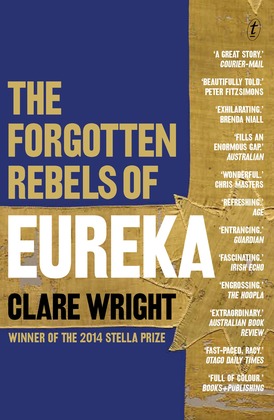
Book cover, The forgotten rebels of Eureka

Courtesy: Text Publishing

But, although they announced this series in July last year, so far, if I have searched the site correctly, only three “Noted Works” reviews have been published. They are (in the order published):

  • Carolyn D’Cruz and Mark Pendleton’s (ed) After Homosexual: The legacy of gay liberation (UWA Publishing): After Homosexual, reviewer Peter Robinson writes, is a celebration, or festschrift, of Dennis Altman’s Homosexual: Oppression and liberation which was published in 1971. Robinson argues that the book explains “the rhetoric and underpinning philosophies of gay liberation in the 1970s and queer social movements that have been bubbling along in the four decades since then”.
  • Nicholas Clements’ The black war: Fear, sex and resistance in Tasmania (UQP): Reviewer Lyndall Ryan begins by contextualising this book as a descendant of the now well-known Australian “History Wars” in which historians argued, fiercely, over how we interpret the history of settlement in Australia in relation to our indigenous inhabitants. She then discusses Clements’ analysis of the “war” in Tasmania, arguing that his approach identifies a different way of looking at its major triggers, and confirms that it was indeed a significant war that should be recognised as such.
  • Clare Wright’s The forgotten rebels of Eureka (Text Publishing) (My review): Reviewer Zora Simic‘s aim is to “locate The Forgotten Rebels of Eureka as part of the wider field of Australian feminist history”. She discusses the challenges feminist historians face in the inevitable “historical silences and ambiguities”, because, of course, women’s stories/lives/actions (like those of other disempowered groups) were regularly not deemed important enough to capture and document at the time. She argues that Wright’s history is as important for its contribution to the way history (women’s history) can be researched and written, as it is for the arguments she’s presented about Eureka.

So, here we have three thoughtful reviews tackling significant social/historical issues. It’s interesting that all three books featured to date are non-fiction, and all are historically focused. Where are the academics in literature? Surely there are recently published fictional works or poetry that warrant in-depth reviewing – from the point of view of their content and style, or perhaps in terms of their reception (or lack thereof), or even, say, exploring different theoretical approaches that might be taken to understanding them?

The three reviews I’ve described here were all published in July and August last year. Will there be any more or has this series died an early death? I hope not.