Kate Jennings, Moral hazard (Review)

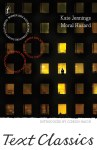
Kate Jennings, Moral HazardHow often do you read a book that connects in some ways with something you’ve recently read or thought about? Kate Jennings’ award-winning Moral hazard, my latest read, links pretty directly to our discussion about autobiographical fiction in my Monday Musings post on Robert Dessaix two weeks ago. Dessaix, you may remember, criticised Garner’s The spare room (and other works) arguing she was just writing her life, but defended his own autobiographical fiction because he changed things around. Garner, though, argues that in her novels she shapes and orders, plays with time, examines motives etc. What is all this about? Why does it matter? The reverse – calling something non-fiction that is in fact fiction – does matter, I think. You all know the cases, I’m sure. But, if a writer draws from his or her life and calls it fiction, does it matter? Really, does it matter? Well, in this case it does matter, because, while Jennings is another of those writers who draws closely from her life, there are parts of the story that could be very tricky, legally, if they were, in fact, “fact”.

I’ve reviewed two of her works here before – Snake, her first work of autobiographical fiction, and Trouble: The evolution of a radical, which she describes as her “fragmented autobiography”. Jennings, like Helen Garner, is a fearless writer, and I love her for it, so when Text Classics published Moral hazard, her second novel, I was ready and waiting.

Moral hazard is about a woman whose husband is diagnosed with Alzheimer’s and who, to obtain the money needed for his care in health-care expensive USA, gets a job as speechwriter for a mid-level investment bank on Wall Street. The wife’s name is Cath (not Kate) and the husband’s name is Bailey (not Bob Cato, the name of Jennings’ husband). Kate Jennings, though, did work as a speechwriter on Wall Street. Fictional Bailey and real Bob are both artists/designers, and both men were diagnosed with Alzheimer’s, but Bailey’s end has a particular drama to suit Jennings’ purpose.

From its very start, in fact, it’s clear that Moral hazard has been carefully written and structured, despite its closeness to Jennings’ life. Take the title, for example, and its pointed word play. Economically, “moral hazard occurs when one person [or organisation] takes more risks because someone else bears the cost of those risks”. Jennings, in the Wall Street component of her novel, explores this very condition with great – should I say scary – clarity. It is particularly interesting to read her description and analysis of escalating greed, because it is set nearly a decade pre-GFC. It’s all there, though, and the cracks were showing even then. For Cath the moral dilemmas are real. Not only does she need to rationalise her personal moral values as a lefty feminist against her financial district job, but she has to be the carer (also decision maker) for her increasingly ill husband. This is complicated care that encompasses not only economic and physical demands, but also emotional, mental and philosophical. And this care also has, not surprisingly, a moral dimension.

The novel (a novella, really) is told in short chapters that alternate, though not rigidly so, between Cath’s life with Bailey and her work life. It is told first person, and Cath tells us, on the first page:

I will tell my story straight as I can, as straight as anyone’s crooked recollections allow. I will tell it in my own voice, although treating myself as another, observed, appeals.

In other words, it’s from life, but there is artifice. The novel opens with this brief introductory chapter, which is followed by a chapter describing her first meeting Mike. He also works at Niedecker Benecke investment bank, and also, like her, is a square peg in a round hole, though he’s been doing it for longer! He becomes somewhat of a teacher to her, as well as a sounding board, and a welcome like-mind.

From this set up, we flash back to Cath, her husband Bailey and his diagnosis, and we don’t return to the bank until Chapter 6. The story continues chronologically following Cath. We watch her work out how to work within the company, and we feel her pain as she tries to manage Bailey as he becomes less and less stable and predictable. Cath chronicles the hedge-fund crisis – the increasing greed, the living on (the belief in) “zero capital and infinite leverage” – in parallel with Bailey’s decline. A true coincidence, perhaps, but a writing choice too.

I loved Jennings’ writing. It’s clear and direct, but has a poetic sensibility. She describes the bank as:

a firm whose ethic was borrowed in equal parts from the Marines, the CIA and Las Vegas. A firm where women were about as welcome as fleas in a sleeping bag.

She describes the financial district, New York’s skyscrapers:

I looked at them and didn’t see architecture. I saw infestations of middle managers, tortuous chains of command, stupor-inducing meetings, ever-widening gyres of e-mail. I saw people scratching up dust like chickens and calling it work. I saw the devil whooping it up.

She sees the New York Fed, after bailing out hedge-funds, behaving “as if afflicted with Alzheimers” sticking with deregulation, letting the industry police itself, despite evidence to the contrary.

Meanwhile, Bailey’s decline is inexorable, he moves from home to an institution. He has a “living will” but it is ignored, so, she writes:

Scar on my soul be damned. He’d asked me to take care of it when the time came. Now I would. Mrs Death.

But far be it from me to spoil Cath’s story – except to say that as well as tackling Wall Street, Jennings also quietly buys into the euthanasia debate.

The good thing about Text Classics, besides their existence and excellent price, is that each classic is accompanied by a commissioned introduction. For Moral hazard it is by sport and business journalist Gideon Haigh. He concludes his introduction, which focuses on the financial aspect of the novel, with the statement that “Modern working life is replete with unpalatable compromises and perverse incentives”. Cath would probably say that this is true of life too. Moral hazard is a rare book in the way it looks not just at our contemporary globalised financial world, but more widely at work, our relationship to it, and the moral choices we make in work and in life. Drawn from life, yes, but a very worthy winner of the 2003 Christina Stead Award for Fiction!

awwchallenge2016Kate Jennings
Moral Hazard
Melbourne: Text Classics, 2015 (orig. pub. 2002)
155pp.
ISBN: 9781922182159

(Review copy courtesy Text Publishing)

Monday musings on Australian literature: Blak and Bright

I should have written about the Blak and Bright last Monday, as the Festival was held last weekend, but unfortunately I only heard about it – my inattention, I’m sure – a few days ago, via an ABC RN program (which you can listen to online). However, although the actual Festival is now over, I think it’s still a worthwhile topic – and, anyhow, most of you who read my blog wouldn’t have been able to attend, given it was held in Melbourne.

So, what is (was) Blak and Bright? From the website, link above, it is described as the debut event of the Victorian Indigenous Literary Festival. Their “about” page lists sponsors and supporters, and says:

We believe Indigenous writing is relevant and exciting to literature lovers and readers everywhere.

What a simple, straightforward “mission statement”! Unfortunately, there is no program online. However, there is a list of artists, and from that you can locate the sessions they were involved in. Via this method, I found a fascinating variety. Here are a few:

  • 6 Plays in 60 Minutes: six short play readings from Australia’s longest running Indigenous theatre company, Ilbijerri.
  • Blak Book Club: an opportunity to discuss two Indigenous books, Gayle Kennedy’s Me, Antman & Fleabag and Tony Birch’s Ghost River.
  • Borrow a Rare (Living) Book: opportunity for attendees to have one-on-one sessions with Indigenous storytellers/Elders (Aunty Di Kerr, Uncle Larry Walsh, Aunty Kerry Reed-Gilbert and Aunty Judith ‘Jacko’ Jackson).
  • Cross Continental Conversations: explored the international Indigenous writing scene, by discussing the experiences of a contingent of Aboriginal writers who travelled to the Native American literary organisation, Woodcraft Circle, and the Literary Commons exchange in India. Participants were Lee Francis IV, Bruce Pascoe and Ali Cobby Eckermann.
  • Fresh Blak Writers: Maurial Spearim (playwriting), Hannah Donnelly (speculative fiction), and Elijah Louttit (screenwriting) talking about how they got started with their writing.
  • Ellen van Neerven, Heat and light, book coverPublishing and Editing Blak: about the challenges faced by Blak writers working with white editors and publishers, and the challenges faced by Blak editors and publishers. Posed the question: Is there a need to make Aboriginal language or depiction of culture easy for a white readership? It involved Rachel Bin Salleh, Ellen van Neerven (whom I’ve reviewed) and Sandra Phillips.
  • Sistas are Doing It: Tammy Anderson, Anita Heiss, and Kate Howarth share how to “build and sustain a career as a Blak writer”.
  • Yung, Blak and Bold: involved young writers presenting new ways of presenting the world. “Listen”, the program advised, “as we bust stereotypes and discuss how words in new contexts can activate change”. Featured Benson Saulo, Amelia Telford and Nayuka Gorrie. (All new to me, but that’s the point I guess!)

It looks wonderfully varied, catering for all sorts of interests. It involved several writers I don’t know; and some, like Bruce Pascoe, Ally Cobby Eckerman, Gayle Kennedy, who are on my radar to read. Sessions were supported (sponsored I presume) by some wonderful literary “players” like the Small Press Network and the Stella Prize. I would be interested to see an assessment of how it went, recognising that these sorts of events can take a few years to build.

There is a blog on the site. I’m not sure if it will continue post-festival, but in addition to posts about events, it has a series on the topic “Why I read Blak?”:

  • Associate Professor at the Graduate School of Language and Culture at Osaka University, Sei Kosugi: on the global reach of Australia’s Indigenous storytellers, naming a couple of the writers she teaches and why.
  • Writer and crossword-maker, David Astle: on “an important lesson he’s learnt from reading Blak”.
  • Writer Drusilla Modjeska: on the various ways reading Blak has enriched her reading and writing life. She looks more widely, starting with African writer China Achebe’s Things fall apart (which I will be reading and reviewing in a few months – at last!)
  • Our very own Auslit blogger Lisa Hill: on the value to her of reading books by Indigenous Australians. She writes that “I feel as if I am being invited to get to know my country better. I’m being welcomed in to share in an ancient story”.

Finally, in the RN program I heard (link in the opening paragraph), Anita Heiss spoke on why people should read Blak. She has fleshed it out on her blog. It not only gives excellent reasons – such as “we write human rights” and “we write the search for self” – but it provides a useful but by no means complete list of works and authors well worth checking out.

Delicious descriptions: Gerald Murnane’s landscape and imagination

A couple of years ago I reviewed Gerald Murnane’s The plains. I found it a mesmerising book, but a challenging one to fully get my head around, to grasp and hang onto what I’d grasped. Then a couple of days ago, I reviewed his memoir, Something for the pain: A memoir of the turf. It was quite a revelation – and among those revelations were some ideas that seemed to flesh out The plains, though he doesn’t specifically address those ideas to the novel in his memoir.

The main revelation relates to his feelings about landscape. Murnane hates the sea and doesn’t much like mountains either. What he loves are plains. In chapter 6 he refers to his “lifelong dislike of travel”, initially developed when he was still a boy. He also, as a boy

settled on what would be my ideal landscapes for the rest of my life: the green and mostly level countryside of south-western Victoria.

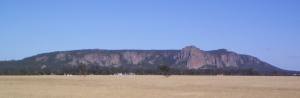
Mount Grapples

Mount Arapiles, Western Victoria (released on Wikipedia to Public Domain, without conditions)

Plains, in other words. In chapter 15, he talks about a horse owner P.S. Grimwade. (An aside. In this, as elsewhere in the book, he focuses on what he “imagines” Grimwade to be like, stating that he suspects he wanted “to keep in mind the ideal man rather than have in sight the actual man”! “Perhaps”, he writes, “I wanted to think of him as someone for whom racing was better imagined than experienced – someone such as myself”.) Anyhow, he goes on:

I would have envisaged P.S. Grimwade as owning an extensive property in what I consider the centre of the universe, in the quadrilateral bounded by Ballarat, Ararat, Hamilton, and Camperdown in the Western District of Victoria, which is a landscape of plains and low hills and vast skies. I’ve never felt comfortable when surrounded by steep hills, and I’ve always tried to keep away from mountains.

In fact, Grimwade, he discovered, lived in a different part of Victoria, one he’d never visited – but, it’s telling I think that he places this horse owner, who fascinates him, in a place comfortable to him. He writes that he’s entitled to his imagination about Grimwade:

In the unlikely event that this book should be read by some or another descendant of a man named P.S. Grimwade, and that the descendant should wish to tell me that my account of the man is untrue, inaccurate, preposterous, whatever, I urge that descendant not to waste energy, time, or ink on the matter. Nothing will keep me from revering my saint as he was revealed to me.

Are you getting the picture of this memoir? It’s the imagination that’s important …

Then we get to chapter 22, “Sir Flash and the Borderers”, the chapter that gave me a big ah-so moment. Early in the chapter, he writes again of his ideal landscape:

… the ocean itself repelled me, and I’ve kept well away from it all of my adult life. During my brief holidays on my grandfather’s farm in the 1940s, I was more interested in another sort of ocean. Whenever I stood on a tall cliff above some or other bay, I got inspiration not from the blue-green Southern Ocean reaching away towards the South Pole but from the yellow-brown ocean of land reading towards places I had seen only from a distance, if at all: the plains of the Western District to the north and the north-east of Warrnambool or, away to the north-west, a mostly level landscape …

This discussion introduces a story about a group of horse-owners and horse races in what he calls the Border District. It’s here that I was reminded of The plains, because of the way he imbues the Border Country – and the Borderers who live there – with a sense of “otherness”. These people and their horses came from a real part of Australia, obviously, but it’s a part that was unknown to him when he came across them, so he unfolded a map and “set not only my eyes but my imagination also roaming”. He gives it and its people the aforementioned names, and he awards the people – imagines, in other words – certain characteristics, including “the usual amount of shrewdness and sagacity attributed to people living far from the capital cities”. I won’t tell you all that he ascribes to them – it makes for wonderful reading – but here’s the final bit that brought The plains to my mind:

I would not have my Borderers thought of as wholly devoted to gain, however. They numbered among them many a man who wore his hair bunched above his ears and on his neck and who stood out on a racetrack on account of his elegant dress and proud bearing. Such a man owned a vast cattle or sheep property and lived in a mansion with a veranda on three sides and groves of deciduous trees all around. His mansion included a library and a study. The walls of the study were covered with photographs of the finishes of races won by his own horses. The walls of the library were covered, of course, with books …

This imagination, this creation of a place that seems both in and separate from the Australia we know, a place populated with people who have dreams and an artistic sensibility, is very reminiscent to me of The plains. Rightly or wrongly – but I hope the former – I now feel I understand Murnane a little more, his aspirations, how his imagination works and the absolutely fundamental role it plays in his life.

Many years later, Murnane moved to live in this very landscape – in Goroke where I believe he lives now – and discovered the people aren’t quite as he imagined. But that’s another story.

Monday musings on Australian literature: Spotlight on Robert Dessaix

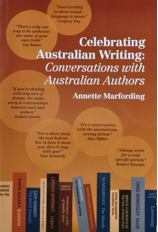
Courtesy: Annette Marfording

Courtesy: Annette Marfording

Last year, I published a guest post by Annette Marfording, who was, for many years, the Program Director of the Bellingen Readers and Writers Festival. At the time of this post, she had just self-published her book, Celebrating Australian Writing: Conversations with Australian Authors, containing a selection of interviews she’d conducted over many years with a wide range of Australian writers. Rather than review it, I’ve decided to use it for an occasional series within Monday Musings. I won’t be quoting large slabs of the text, or giving away all the content of the interviews. Besides the fact that that would break her copyright, I’d like to see people buy the book because not only is it a good read but Marfording is generously donating the profits (see the end of the post). My plan is to use Marfording’s interviews to springboard brief discussions about some writers who interest me. OK?

I won’t necessarily discuss my selected authors in the same order as Marfording’s book, but I am starting with the first author, Robert Dessaix. I haven’t reviewed Dessaix here because I haven’t completed any of his books since I started blogging. However, I have read his first book, the critically acclaimed memoir A mother’s disgrace (1994). I’ve also dipped into other books, including his collection of essays and articles As I was saying (2012), and I have enjoyed his thoughtful, engaging contributions on language to ABC RN’s old Lingua Franca program. He also presented, for many years until 1995, ABC’s Books and Writing program. Language and literature, as you’ve probably gathered, are his passion

So, who is Robert Dessaix? Wikipedia describes him as a novelist, essayist and journalist, but it would probably be more correct to call him an essayist, memoirist, journalist and novelist, because novels – of which he’s written two – form the smallest part of his output. He reminds me, in this regard, of writers like Drusilla Modjeska and Helen Garner (though Garner does have a good number of novels under her belt as well as other writing.) Anyhow, for a better bio than that provided by Wikipedia, it’s worth checking out his own website. He was born in Sydney, adopted as a young child, and was married, but now lives with a male partner. Much of this story is told in A mother’s disgrace. Here is an example of his writing from that book:

There’s something deeply comforting, after all, about the promise of a linear narrative: birth, school, university, marriage, family, career, onwards, upwards … the autumnal years a bit misty, perhaps, the phut as the fuse runs out, best not thought about too graphically but on the whole not a bad way to live out a sequence of years. The trouble is that, once you’ve set out on that alluringly straight track, it’s hard to swerve off it or come to a standstill. It’s hard to live what I’d call swoopingly.

I have tried to swoop and veer. I didn’t have the wit to veer away from marriage, I had to be sent packing. But I did curve away from teaching Russian literature to university students into working at the Stables Theatre in Kings Cross and then in radio, I did swerve sharply away from Canberra to experiment with being a Sydneysider again, I did deviate (after a messy start) from the heterosexual straight and narrow to try more fulfilling, multifaceted ways of loving …

But now, to Marfording’s interview. Marfording clearly researches her subjects and asks questions specifically relevant to each of her interviewees, rather than rely on a standard set of questions. She talked to him about some of his specific writings of course, and a bit about his writing practice. She also talked with him about travel, which features in much of his writing. He has some interesting things to say about what he looks for in travel, and how that has changed over time. What he now looks for, he tells Marfording, is conversation. It’s also one of the topics in As I was saying. He writes:

‘The grand business of our lives,’ the novelist Henry Fielding said, ‘the foundation of everything, either useful or pleasant’ is conversation. It’s quite a claim. His contemporary Samuel Johnson was hardly less emphatic: ‘There is in this world,’ he said, ‘no real delight (excepting those of sensuality) but the exchange of ideas in conversation.’ They were eighteenth century English gentlemen, so their enthusiasm is not surprising: the eighteenth century was the heyday of conversation in England …

He goes on to discuss those with opposing views. The Hebrews, he suggests, cared little for conversation, neither did Jean-Jacques Rousseau who saw it as “frivolous”, and Presbyterianism, he writes, “has never been good for animated intercourse”. He concludes by analysing the art of conversation then and now – but that’s a discussion for another day, because …

The part of the interview that particularly interested me stemmed from his contribution to the Little Books on Big Themes series (from which I’ve reviewed Dorothy Porter’s On passion). Dessaix chose his topic – On humbug! I enjoyed this section of the interview because it got into discussing truth and facts. He shares two of his epigraphs. For A mother’s disgrace, he used a line from Jeanette Winterson, “I’m telling you stories, trust me”, and for Arabesques, it was “When I invent things, it is to make the truth clearer”. He explains:

I try to distinguish between fact and truth […] things can be broadly speaking true without being absolutely factual, if you know what I mean.

Yes, I do, Robert! Marfording then questions him about his review of Helen Garner’s The spare room, a raw novel based on her experience with a friend who had terminal cancer. Dessaix, and he wasn’t the only one, said that it shouldn’t be described as fiction because it’s based on fact. Yet, Marfording questions, putting him on the spot, Dessaix’s own novel Night letters is also based on his life. Dessaix’s answer is that his was “partly fictionalised” and that he “changed the order”, implying that Garner hadn’t. Indeed he suggests that she simply publishes her notebooks and that “she should come out and admit what she does”. Hmm … all this said, the  interview does conclude with Dessaix talking about his favourite books and writers:

I do actually love Helen Garner’s writing; I love Michelle de Kretser’s writing, The Hamilton case and The lost dog; I was very taken with Thea Astley at the time, I mean I haven’t read her for years, but I just read book after book of Thea Astley’s …

His very favourite books, though, are the 19th century Russians.

Dessaix is an interesting, erudite – dare I suggest, Renaissance – man who’s well worth reading. Thanks to Marfording for an excellent interview.

Annette Marfording
Celebrating Australian Writing: Conversations with Australian Authors
Self published, 2015
273pp.
ISBN: 9781329142473

Note: All profits from the sale go to the Indigenous Literacy Foundation. You can purchase the book from its distributor, lulu.com.


Stella Prize 2016 Longlist

The announcement of the Stella Prize Longlist is a red-letter day for the Australian Women Writers Challenge … and also for me of course. So, today, I share the list with you. The shortlist will be announced on March 10.

The judges look good to me: writer Emily Maguire, memoirist/essayist Alice Pung, author/academic Brenda Walker, literary critic/author Geordie Williamson, and bookseller/founder of the Indigenous Literacy Foundation Suzy Wilson.

Alice Robinson, Anchor Point

Anyhow, here is the longlist:

  • The women’s pages by Debra Adelaide (Pan Macmillan) (I’ll be reading this soon)
  • The other side of the world by Stephanie Bishop (Hachette)
  • Panthers and the Museum of Fire by Jen Craig (Spineless Wonders)
  • Six bedrooms by Tegan Bennett Daylight (Random House)
  • Hope Farm by Peggy Frew (Scribe)
  • A few days in the country: And other stories by Elizabeth Harrower (Text) (on my TBR, and now higher in my priority list)
  • A guide to Berlin by Gail Jones (Random House)
  • The world without us by Mireille Juchau (Bloomsbury)
  • A short history of Richard Kline by Amanda Lohrey (Black Inc)
  • Anchor point by Alice Robinson (Affirm Press) (my review)
  • The natural way of things by Charlotte Wood (Allen & Unwin)
  • Small acts of disappearance: Essays on hunger by Fiona Wright (Giramondo)

As is usual for the Stella, the list include novels, short story collections (a few in fact) and non-fiction … And as is usual, I have most on my radar. I have read the first three Stella Prize winners: Carrie Tiffany’s Mateship with birds, Clare Wright’s The forgotten rebels of Eureka and Emily Bittos’s The strays. All have been excellent reads, which augurs well for my enjoyment of this year – although as we have been hearing lately past practice is no predictor of the future!

I’m sorry that this is a basic post … I am holidaying for a few days in a gorgeous Aussie country town, and am without my normal computing facilities. The iPad us not conducive to long post writing. Phew, do I hear you say?

Monday musings on Australian literature: National Libraries Day (UK)

Caroline of Book Word blog has written a wonderful post about National Libraries Day in the UK, which took place just this last weekend, on Saturday, 6th February. Caroline provides three witnesses to argue for the value of libraries:

  • Peter Balaba, Head Librarian, Nakaseke Community Library, Uganda, who talks about the outreach programs they provide in a book-poor region.
  • novelist Zadie Smith who tried, but failed, to save Kensal Rise Library in London and who notes the government’s shameful behaviour, saying that “it’s always difficult to explain to people with money what it’s like to have very little”.
  • novelist Ali Smith who last year published Public library and other stories, which is so titled not because there’s a story titled “Public library” (there isn’t) but because interspersed through it are “comments from other bookish people about the importance of libraries”. Love this.

ALIA Library Lovers Day 2016 GraphicYou’re probably wondering why I’m telling this story in my Monday musings on Australian literature post series. Well, firstly it’s because I thought it was a great initiative and wondered whether we have anything like this here in Australia.  I found that we do have something similar: ALIA (Australian Library and Information Association)’s nomination of Valentine’s Day as ALIA Library Lovers Day. They suggest a bunch of activities that libraries can use to promote library love (including using the social media hashtag #librarylove) and they have merchandise for sale. There’s a 2015 wrap up page which suggests that only a few assorted libraries around Australia took up the idea but those which did seemed to have got into the swing of it. What I didn’t find on their site is any sort of overall statement about the day – its genesis and history, its goals, its long term plans. Clearly it is about encouraging people to use their libraries, but is there a stronger, more coordinated political agenda?

I searched a little more and found an online article on a site called Infotoday. The article, written in 2011 it seems, says this:

As with many great ideas, the genesis of LLD is lost in time, but here in NSW we launched our first LLD in 2006, claiming Feb. 14 for library lovers and renaming it in honor of their passion. To celebrate, public libraries across NSW gave away more than 50,000 “love libraries” wristbands in green, blue, and orange and invited their clients to wear their hearts on their wrists. In 2007, the campaign went national under the auspices of the Australian Library and Information Association (ALIA) and Public Libraries Australia (PLA) as their first combined advocacy event. (Today Australia, tomorrow the world!)

So it sounds like it’s been going for around 10 years now. The article describes some of the activities that have happened over the years, and concludes that LLD has been

an enduring and unqualified success story for NSW public libraries. Staff members love to get involved by dressing in red and pink, decorating their libraries, baking, and choosing and reviewing books. And the community members welcome the opportunity to thank library staff, enjoy a chocolate or two, and share their love of books and reading.

Again, it doesn’t say how they define or measure success of the program, but it sounds pretty localised and low key (not to mention rather female oriented. Aren’t there any male librarians? Not that men can’t enjoy baking or dressing in red and pink, but …!) Still, I’m glad there’s something promotional happening.

My other reason for writing this post is that it gives me an opportunity to share a couple of quotes from Steve Toltz’s Quicksand, which I reviewed last week. Here’s our anti-hero looking for a book:

The salesgirl at the third bookstore I tried suggested the local branch of the public library. I know what you’re thinking bailiffs: What is this, 1996? I raced through the streets as if through a time tunnel, to the bland underwhelming brick building behind the train station. My heart sank when I came across an island desk with twenty computer terminals, leather couches and espresso machines, but upon asking the librarian directed me to the appropriate shelf. It was there …

Not very positive really, but the second reference is worse:

After half an hour drive, the van halted and the door opened onto an abandoned-looking prison courtyard reminiscent of a library on Sunday.

Hmm … I guess it’s a good thing that Toltz notices libraries enough to satirise them, but if his is a common attitude it’s a worry.

Are you aware of a library promotion “day” in your neck of the woods? And, if so, do you take part?

Steve Toltz, Quicksand (Review)

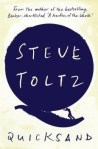
Steve Toltz, Quicksand, soverAldo Benjamin, the anti-hero of Quicksand, accuses wannabe-writer-friend Liam of having “such little imagination”. You could not, however, accuse the novel’s author, Steve Toltz, of this. Quicksand reads a bit like a 19th century satirical novel transplanted into the 21st century. It is big in size (though not as big as his first, A fraction of the whole), broad in subject matter, and full of colourful characters. It’s wild, imaginative, and darkly funny. It’s the sort of novel that you can tackle from different angles depending on what interests you most. Religion, god and fate? Tick. Life and death? Tick. Love and friendship? Tick. Social commentary? Tick. Art (broadly), artists and the making of art? Tick.

“Bad luck is my pathology” (Aldo)

Before I tell you what interested me, though, a little about the plot. Quicksand is the story of Aldo Benjamin, told partly by his friend, Liam Wilder, and partly by himself. Meeting at high school, Aldo and Liam remain friends until the book closes when they are in their early to mid 40s. Together they reveal the ups and downs – mostly downs – of Aldo’s life as he tries to make his way against what he sees as the tide of fate or bad luck. The novel opens when they are in their early 40s and Aldo, a wheelchair-bound paraplegic, has just been released from prison. We don’t know how long he’s been in the wheelchair or how that came to be, and we don’t know why he’d been in prison. These come out in the course of the novel, which flashes back in chapter 2 to their schooldays and then moves between the past and present to tell the story. We also discover in the opening chapter that Liam is trying to restart his writing career by writing Aldo’s story, much to Aldo’s resigned disgust: “I’m nobody’s muse”, he says. Ironically, though, not only is he Liam’s muse but he’d also been one for his musician wife, Stella, and photographer lover, Mimi.

Aldo, “The King of Unforced Errors” as Liam calls him or a sufferer of “clinical frustration” as Aldo sees it, gets into all sorts of strife. He is regularly bailed out by friends (who cover “the full suite of professional services” such as policeman Liam, Doc Castles, his old school teacher Mr Morrell) and lovers. Nothing much works for him, particularly not his various get-rich-quick business ideas, like the device that was supposed to detect the presence of peanuts in food, or clothing for obese toddlers, or tanning salon taxis, or maternity clothes for goths (“a demographic with an 85% abortion rate”). Moreover, his marriage fails, his child dies, his multiple suicide attempts are unsuccessful, and, to rub salt into his wounds, he ends up in the two places he most fears, prison and hospital. As Liam says in response to Aldo’s question about why write his story:

Because you’ll inspire people. To count their blessings.

I love this sort of writing, this dark humour. It’s full-on to read because lines like this frequently fall over each other, sentence after sentence, leaving you wanting to stop and smell the roses for a minute. Still, I was hooked by page 5 when Aldo presents to Liam a long list of our 21st century insecurities, pretensions and self-deceptions, including

‘You know how people are worried their kid’s going to turn to them and say, What did you do to the biosphere, Daddy?

AND

‘And you know how there’s no replacement cycle too short for today’s consumer?’

AND

‘You know how while we’re enjoying reading dystopian fiction, for half our population this society is dystopia?’

These go on for three pages. Wonderful satire. No matter how superior we might feel about most of the pronouncements, there’s bound to be one or two that get us where it hurts! Toltz looks unblinkingly at our lives and shines them right back at us in the most direct, no-punches-pulled way. It made me laugh – but ruefully, if not guiltily at times – almost every page.

“To troubleshoot the human spirit” (Liam)

The other aspect I enjoyed was the thread about art, artists and art-making. The major focus of this is Liam’s novel about Aldo’s life. After years of failure and giving up, Liam finally decides that Aldo is his “natural subject”. Writing about him, Liam tells Aldo, would be “to troubleshoot the human spirit”. It would, he thinks, throw him “into a head-on collision with the meaning of fate, humanity’s sure, but Aldo’s strange specific one too”. Aldo and Liam discuss Liam’s progress frequently, with Aldo always ready with an astute comment or criticism. “Does my character in your book”, Aldo asks, “need to be more consistent than my character in real life?” “No,” says Liam, though in fact many readers do, I find, prefer it to be so!

Liam is not the only creator in the novel. Aldo’s musician wife Stella plunders Aldo’s life for her songs, and then there’s the art teacher from Liam and Aldo’s school, and the artists in the artists’ residence where Aldo lives for a time. Through all these the novel interrogates why we make art, what art is about. Early on, before he starts his Aldo novel and after years of failure, Liam decides to give up writing. He says

I had settled into a life I had always feared but secretly desired, a life uninterrupted and unencumbered by art.

Chapter 2, though, begins with art teacher Morrell’s statement that:

We make art because being alive is a hostage situation in which our abductors are silent and we cannot even intuit their demands.

Art is not, however, presented as something that is easy or even always right. Toltz’s artists struggle to achieve, are frequently self-obsessed, and unapologetically mine their friends and family for material, all the while, thinks Aldo at least, having a good time. “Their brains are all pleasure centres and no circumference”, he tells the court. They are not, in other words, unilaterally lauded, but this is, of course, ironic, if not subversive, since what we are reading is a novel, a work of art itself. The wheels within wheels in this novel – the ironies, the paradoxes, the self-reflexivity – sometimes make your head spin, but in the end, there is an end, and it’s a surprisingly positive one.

And here, I’ll end! This novel is so full of funny lines, so full of ideas, so full of biting commentary, that it’s hard to know when to stop so, as EM Forster* wishes novelists could do, I think I’ll just end, not because I’m bored which is the reason he gives, but because I might as well.

Lisa at ANZLitLovers also enjoyed it.

Steve Toltz
Quicksand
Hamish Hamilton, 2015
435pp.
ISBN: 9781926428680

* Aspects of the novel, by EM Forster

Monday musings on Australian literature: New Australian releases for 2016

With the first month of 2016 already gone, I thought it was time I had a look around to see what new works are in the pipeline this year from our Aussie authors. This is a serendipitous list, partly because tracking down this information isn’t easy and partly because I’m more interested in providing a flavour than in being comprehensive. My main aim is simply to tantalise us all a little, so below you’ll find novels, short stories, poetry, essays and non-fiction. See what you think:

  • Larissa Behrendt’s Finding Eliza: Power and Colonial Storytelling (January 2016, University of Queensland Press) is a non-fiction work inspired by the story of Eliza Fraser, who was apparently captured by the Butchulla people after she was shipwrecked on their island in 1836. Fraser’s story has been fictionalised before. Behrendt springboards from Eliza’s story to explore how indigenous people in Australia and elsewhere have been portrayed in their colonisers’ stories.
  • David Brooks’ Napoleon’s roads (February 2016, University of Queensland Press) is the fourth collection of short stories from this writer, who is a poet and prose writer.
  • Maxine Beneba Clarke’s The hate race (August 2016, Hachette Australia) is a memoir by the author of the award-winning short story collection, Foreign soil. It’s the second of a three book deal she has with Hachette, the third one being a novel.
  • Helen Garner’s Everywhere I look (March 2016, Text Publishing) is a collection of essays. I’ve reviewed here a few books by Garner, including a novel, Cosmo Cosmolino, a book of short stories, Postcards from Surfers, and a non-fiction work, This house of grief, but I haven’t read any of her essay collections. This might be the one.
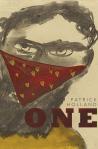
  • Patrick Holland, OnePatrick Holland’s One (April 2016, Transit Lounge) is an historical fiction about Australia’s last bushrangers. Known for his minimalist writing, Holland has written several works, including The Mary Smokes boys and Navigatio, both of which were shortlisted for various awards.
  • Fiona McFarlane’s The high places (February 2016, Hamish Hamilton) is a collection of short stories from the author of the multiply-shortlisted The night guest, which I reviewed last year.
  • Michelle Michau-Crawford’s Leaving Elvis (February 2016, University of Western Australia Publishing) is a debut collection of mostly, but not totally, linked short stories. Michau-Crawford is new to me but she won the Australian Book Review’s Elizabeth Jolley Short Story Prize in 2013, so this collection sounds worth checking out.
  • Meg and Tom Keneally’s The Soldier’s Curse (March 2016, Random House) is the first in The Monserrat Series (a new crime series). I wouldn’t normally include a crime book in a list like this because crime is not in my sphere of interest, but I’m including this one because it’s by Tom Keneally, who as you probably know is the Booker prize-winning author of Schindler’s ark, a Miles Franklin winning author, to name just a couple of accolades. And, also because it’s a collaborative novel with his daughter.
  • Ellen van Neerven’s Comfort food (May 2016, University of Queensland Press) is a book of poetry by the author of the award-winning Heat and light and the short story Sweetest thing, both of which I’ve reviewed.
  • Terri-Ann White’s Desert writing: Stories from country (February 2016, University of Western Australia Publishing) is something a little different. It’s a collection edited by White, comprising stories that resulted from writers’ workshops held with indigenous people in remote communities.
  • Dominique Wilson’s That devil’s madness (February 2016, Transit Lounge) is a novel set in Algeria. It tells story of a photojournalist who, while covering current politics decides to also retrace the steps of her grandfather a century earlier. Wilson was a founding editor of the now defunct but much lamented literary journal Wet Ink. (For an advance review of this book, check out Lisa’s at ANZLitLovers.)
  • Arnold Zable’s The fighter (April 2016, Text Publishing) is a biography of Henry Nissen, a boy from Melbourne’s Carlton who became a champion boxer but who now devotes his spare time to helping disaffected people on the streets. It’s also about his mother and her decline into mental illness. I’ve read a few of Zable’s novels, including The sea of many returns which I reviewed early in this blog’s life.

Steven Amsterdam, Ashley Hay, Toni Jordan and Hannah Kent, some of whose earlier books I have reviewed here, also have books coming out this year … Meanwhile, Text Publishing is continuing to put out its classics, and Fremantle Press is starting a Treasures series celebrating its 40 years of publishing. Nice to see backlists (or older works) continuing to get second lives.

Do any of these inspire or you? Or are there books coming up in your region or area of interest that you are keen to read. 

Halina Rubin, Journeys with my mother (Review)

Halina Rubin, Journeys with my motherI’ve read a lot of World War 2 literature over the years, but very little from the Polish point of view, so I was more than willing to read Halina Rubin’s Journeys with my mother when it was offered to me a few months ago. Rubin was born in Warsaw on 27 August 1939. Note the date: her mother, Ola, was still recovering in hospital when Germany invaded Poland a few days later. Within two months, her parents, secular Jews, had fled to the Soviet Union, and this is where the young Halinka and her mother saw out the war. It’s a fascinating story – and it’s told in a thoughtful way.

Rubin divides her story into two parts. Part 1 is mainly background. It provide some family history about her parents, Ola and Władek, and their parents before she was born, but it also describes the depth of anti-Semitism with which they lived, long before the war started. It tells how her parents were radicalised early, how for them “the ideals of communism offered a way to solve the twin problems of unemployment and poverty, and put an end to racial hatred”. Oh, such idealism … but her parents, despite experiencing political betrayal, never fully lost their values and commitment to social causes.

Anyhow, part 2, which conveniently aligns with the start of the war, tells the story of her nuclear family after she was born. “I try to imagine” she writes of those opening days of the war, “how abruptly, how without mercy, their world changed”. She describes how, with their faith in the Soviet Union, her parents fled to Białystok, once a Polish town but now under Soviet control, while other members of the family made different decisions or timed their flight decisions differently, with, in most cases, tragic consequences.

Halina and her family lived there for nearly two years, Ola working as a nurse, until Germany betrayed the Soviet, invaded – and the atrocities began. So, they fled again, heading further east for Russia itself. Władek was taken to join the Red Army, but Ola and Halina made it to Oryol where Ola worked again as a nurse. Later, mother and daughter, who were evacuated under German orders from Oryol, went to Lida in Belarus, and from there they escaped into the forests where they joined the partisans – because, remember, Ola was a committed communist. It’s astonishing, really, that Ola and her oh-so-young daughter survived the threats and privations of such a life, but survive they did:

Around us was a forest so dense that even wild animals – boars, deer and wolves – chose to follow the same known tracks. The myriad of lakes made the terrain marshy.

Only the locals knew how to get their bearings, how to keep away from the swamps ready to swallow you up; how to keep the wolves away. It was a perfect place to hide, but tough to survive.

They were wet, cold, and desperately hungry. A truly amazing story of survival against a backdrop of egregious political treachery.

Journeys with my mother doesn’t end with the war, however, but follows her parents as they return to Poland, then move to Israel, and finally, after her father’s death, her mother’s move to join her in Australia. Rubin describes the early days of peace – the adjustments that had to be made as people separated from war-time friends and connections, and reunited, if they were lucky, with family members; the impact of political decisions being made about governance and borders; and, shockingly, the continuing anti-Semitism. She asks:

Who could have predicted that peacetime would be so difficult?

Although a very different book about a different war, this reminded me of Olivera Simić’s book Surviving peace which I reviewed a year or so ago.

But I’ll leave the story here – to move onto the telling.

I’ve categorised this as an autobiography or memoir but it could also be described as biography, since Rubin’s prime focus is the life of her parents. And that required research, as she didn’t manage to capture all she could before they died. This is partly because she didn’t start thinking about (aka wasn’t very interested in) documenting her parents’ lives until after her father had died, by which time her mother was old, but also because the story was so stressful that her mother found it hard to tell. Rubin writes:

As always, whenever remembering her parents or sisters or the years of the war, eventually her voice would turn into a whisper and tears would well up her eyes. In the very last tape, I hear her say, ‘That’s enough, I cannot go on.’ The tape is still recording when I say, ‘Let’s have tea.’ The conversation was never resumed. I did not have the heart to put her through that ordeal again.

Rubin had done this taping before her mother’s death in 2001, but it was not until some years later, with the encouragement of her daughter, that she delved into “two boxes filled with papers, photographs, letters, notebooks and correspondence”. These plus her mother’s stories got her going, but there were gaps, so she travelled back to the places they’d lived, talked to old friends and a surviving cousin, trying to complete the story. She reports this directly and consciously in the book, switching between describing her fact-finding trips (revisiting places, meeting people) and recounting her and her parents’ lives in the places she visits. In other words, she takes us on her research journey – and I like that. It does give the story a disjointedness that might irritate some readers, but for me it adds to the interest and, yes, authenticity.

Like all such research, there are serendipitous finds and wonderful coincidences. One such occurs during a meeting with Valerii Slivkin from a museum in Lida. He shows her a document written by partisans after the war. They mention “the presence of ‘a four-year-old-girl'”. That girl of course was her! Earlier in the book, during one of her discussions of her mother’s stories, she says:

My mother was my first, albeit sketchy, narrator. When talking about the past she would get distressed so her storytelling could be convoluted, meandering around events, places, people. And I had not been a good listener. Perturbed, intent on not missing as much as my mother’s sigh, I could hardly concentrate. Later, however, I would discover how clearly she, in fact, remembered the events of the past.

Slivkin is one of those whose information confirms “how accurate she was”.

However, Rubin is also realistic about the limits of what you can know or discover. Looking at photo of her aunt who died early in the war, she wonders about the story behind the photo:

Ewa looks pregnant. I wonder if this is another family secret or simply a never told story. And if the complexities of our lives are at times impossible to unravel, how much more impossible are the events of the past. Nothing is certain.

It sure isn’t. But that doesn’t mean you shouldn’t look for the certainties – and Rubin, in this book, has given it a red hot go.

Lisa (ANZLitLovers) also enjoyed the book.

awwchallenge2016Halina Rubin
Journeys with my mother
Melbourne: Hybrid Publishers, 2015
251pp.
ISBN: 9781925272093

(Review copy courtesy Hybrid Publishers)

Monday musings on Australian literature: Aussie writing duos

My inspiration for Monday Musings comes from various sources – my own interests, roving around Trove, news articles or stories I come across, or other bloggers. Today’s post was inspired by Lisa’s (ANZLitLovers) post on Gert Loveday’s novel, Writing is easy. Gert Loveday is a collective pseudonym for two sisters, Joan Kerr and Gabrielle Daly. I’ve written about literary couples here before – couples in literature like The Bloke and Doreen, and Australian literary couples like Vance and Nettie Palmer – but, while I did some work on writing duos in Wikipedia some years ago, I haven’t written about them here. Lisa put the challenge to me to do so – so, yes ma’am, here I am!

As I often do with posts like these, I’m going to list a few Aussie duos, roughly in chronological order of their writing:

M. Barnard Eldershaw

Marjorie Barnard and Flora Eldershaw are probably the best known writing duos in Australia. While both of them wrote individually, particularly Marjorie Barnard after Eldershaw’s death in 1957, they produced a significant body of work as a duo, starting with A house is built which won the Bulletin prize in 1928 (a prize they shared with Katharine Susannah Prichard’s Coonardoo). They went on to write four more novels, three histories, plays for stage and radio, a collection of short stories, and several collections of critical essays and lectures. There has been much discussion regarding how they worked together, with the suggestion that Barnard was more the creator, and Eldershaw more the editor, though I suspect the situation varied somewhat from book to book. However, Barnard did write, much later in 1974, that

Well, collaboration is like a bedroom secret; it all hinges on vanity and not having vanity. You must talk everything over before you put pen to paper […] I did most of the writing. Because I had more time and Flora’s forte was criticism […] I’d of ahead, writing with enthusiasm, and we’d talk it over afterwards and she would curb some of my exuberances; that’s what was the matter with “Tomorrow and tomorrow”. I wrote that alone.

It is, though, listed as one of their collaborative novels, but by then they were living in different cities.

They were, in addition, literary luminaries in the 1920s-1940s making a significant contribution to Australian cultural life. They supported and promoted Australian women writers, and argued for government support for writers. They also held “salons” in a flat they shared, at which both literary and sociopolitical issues were discussed.

Miles Franklin and Dymphna Cusack

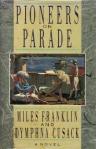
Miles Franklin and Dymphna Cusack, Pioneers on paradeMiles Franklin and Dymphna Cusack mostly wrote solo, but they collaborated on two works, a novel, Pioneers on parade published in 1939, and a play in 1945 titled Call up your ghosts. Unlike Barnard and Eldershaw, they didn’t create a collective name. However, like them they were active in Australia’s literary scene, and were, for want of a better word, social reformers. Pioneers on parade satirised Australia’s 1938 sesquicentenary celebrations, mocking, so says the dust jacket of a later edition”established beliefs and institutions”.

The typical question we want to know of collaborators is how did it work? I checked Miles Franklin’s diaries to see if she said anything. Here she is on 9 May 1939:

Went to town at 3 to do shopping & get proofs at A & R … D.C. [Dymphna Cusack] came too. She is no help – lazy – thinks she is such a genius that she need not slog. Got home at six & read proofs until 10.

The things you can say in diaries! She did, however, work with Cusack again on Call up your ghosts, so it surely wasn’t all bad.

Dymphna Cusack and Florence James

I have reviewed Dymphna Cusack here twice – her novel Jungfrau and memoir A window in the dark. She wrote 12 novels, of which just two were collaborative, Pioneers on parade (1939) and her best known novel, Come in spinner. (1945). Her collaborator was journalist and literary agent Florence James, about whom I wrote early in this blog. Check it out if you’re interested in her take on the life of a freelance journalist in 1940. They wrote the novel while sharing a house in the Blue Mountains. Adapted much later for a successful television series, it beautifully evokes Sydney during World War 2, when American troops were in town and life was changing quickly.

Researching this post, I found a letter from Katharine Susannah Prichard to Miles Franklin (19 April 1951):

“Come in spinner’s” a delightful piece of work. Very well done, I think. With  very real bits & pieces of Sydney & the happenings of those war days. The people all vital and true to type. It headed the list of best sellers here for 3 weeks … […]

I was so pleased that Dymphna had dedicated “Come in spinner” to you. Feels she owes you so much of literary style and intrepidity.

I also found in the same book – As good as a yarn with you – reference to the banning of a radio serialisation of the novel. Miles Franklin wrote (5 April 1954) to Cusack and James, then living in London:

It shows how far we still have to go or that the radio firm which did the serial is spurious. In no sense is procurement a main theme and God save us if mothers of girls can’t stand to hear what happens.

Morris Gleitzman and Paul Jennings

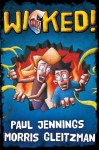
JenningsGleitzmanWickedAnd now for something completely different, two successful-in-their-own-right children’s authors collaborating on two series of children’s books, Wicked (1997) and Deadly (2000). Both series comprise 6 novels, and Jennings and Gleitzman wrote alternate chapters. A British online magazine for children’s books, Books for Keeps, interviewed Jennings and reported this:

The publishers adopted a high risk strategy for this venture [ie. Wicked]. Jennings and Gleitzman wrote alternative [sic] chapters, faxing them to each other and leaving the fantastic complications which end each episode for the other to sort out. The first books appeared well before they had any idea of how the final one would end.

‘It was fun getting the characters into terrible fixes knowing you didn’t have to worry about getting them out of it, but imagine what would have happened if we’d had a fight; it would have been a catastrophe.’

Gert Loveday

Gert Loveday have (or should it be has?) written five novels, the last being the aforementioned Writing is easy. I have it on my Kindle – in the TBR folder. Oh dear! It is apparently a funny book about writing workshops, which sounds highly appealing to me. Presumably our collaborators Joan and Gabrielle have experienced one of two in their day! Anyhow, I’m not going to write much about this duo, because one of my favourite bloggers, the US-based but Aussie lit fan Guy Savage, has interviewed them. Do check out the post. They talk about their process, how they resolve their differences, and, in wonderful irreverent tongue-in-cheek humour, they describe Gert:

Gert is Gert. We both have other writing identities in different forms, but we have a sense of Gert, or a Gertish way of looking at things. She looks like Elinor Bron, with wild white curly hair. We think she smokes (we would never do that) and she has an Irish wolfhound. She is at once much freer and more ruthless than we are. So she feels separate.

Must get back to my Kindle TBR clearly.

There seems to be such liveliness behind all these collaborations. I love the idea of active minds butting up against each other to produce something together.

Have you read any collaborative works? Does the collaborative factor affect how you think about them?