I had planned another topic for today’s Monday Musings, but when I heard via AustLit News about the inaugural First Nations Australia Writers Workshop to be held in May this year, I decided to write about it sooner rather than later …
The workshop aims to bring together established and emerging writers of Aboriginal and Torres Strait Islander backgrounds with a view to further developing indigenous arts practice. It is being presented by the First Nations Australia Writers Network (FNAWN) and is to be held at the State Library of Queensland, in Brisbane, from 9th-10th May, 2013. The Network was apparently established last year and its Chairperson is Canberra-based Wiradjuri poet, writer, activist Kerry Reed-Gilbert.
The workshop has an impressive line-up of presenters, including writers I have reviewed here:
Alexis Wright whose Carpentaria (see my review) won the Miles Franklin Award in 2007. It has been published in many countries and been translated into multiple languages. She has written several other works, and has a new novel coming out this year.
Melissa Lucashenko who won the Dobbie award for her first novel Steam pigs. Her latest novel is Mullumbimby (2013). (See my review for her short story “The silent majority).
Anita Heiss about whom I’ve written several times on this blog. Her most recent book is her memoir, Am I black enough for you?, which I plan to read and review in a couple of months. Heiss also co-edited The Macquarie PEN Anthology of Aboriginal Literature. (See my review of her Paris dreaming.)
Kim Scott whose novel That deadman dance (see my review) won multiple awards including the Miles Franklin Award in 2011. Like Wright, Scott has had several novels and short stories published.
Marie Munkara whose Every secret thing (see my review) won the David Unaipon Award in 2008 and whose next novel will be published this year.
Exciting list, eh? Other presenters are Kerry Reed-Gilbert, Bruce Pascoe, Sam Wagan Watson and more, including some new names to me. AustLit News also mentions Tony Birch whose novel Blood was shortlisted for the Miles Franklin Award last year, but I can’t find him on the Workshop’s website. Sharon Shorty, a Canadian First Nation writer, will also be presenting.
The program is broad-ranging with an emphasis on practical issues – copyright, preparing your manuscript, the future of the book, “writing our stories” – which is what you’d expect for a workshop. Creative Partnerships Australia puts it this way:
With the rapid and seemingly constant changes in the publishing and literary sectors it is imperative that Australia’s Indigenous writers embrace the knowledge, technology and global context for the sustainable development of their livelihoods and their art.
If you would like to keep in touch with the Workshop:
Tax-deductible (for Australians anyhow) donations are welcome to support attendance, particularly by writers from remote areas. Click this link if you are able to help.
This is going to be a difficult post to write because, really, my knowledge is superficial, but I figure that if I put out some feelers, I just might learn something from those who read this and, hopefully, comment. I was inspired to write it by – yes, you’ve probably guessed it – Canberra’s centenary, because at last Monday’s “Very Big Day Out” celebration, we were given a beautifully produced program titled Centenary of Canberra: Celebrating First Australians. It describes the major events that are/will be occurring in Canberra over the centenary year involving indigenous Australians. Many of these events involve indigenous people from other parts of Australia – but given Canberra’s role as the nation’s capital it seems right that we don’t narrowly focus on ourselves. There’s a big Australia out there.
To today’s topic though … the first thing I need to say is that the history of indigenous culture in the Canberra region is a complicated one, and is still being researched. It appears that several groups are associated with the area, representing several languages, with the Ngunnawal,Ngambri and Wiradjuri people having the closest association. I don’t intend to write more on these groups and what connections they may or may not have with each other and the land, as it’s not relevant to my main concern here. The important thing is, I think, the conclusion in Our Kin Our Country report published in August 2012 by the ACT Government’s Genealogy Project:
the verification of a distinct regional Aboriginal population that survived, resisted and adapted to European occupation and settlement in the areas surrounding what is now known as Canberra.
Indigenous writers associated with Canberra include the late activist Kevin Gilbert, Jennifer Martiniello who established the ACT Indigenous Writers Group, and Jeanine Leane whose David Unaipon award-winning book, Purple threads, I reviewed last year. Kevin Gilbert and Jennifer Martiniello are represented in both the ACT Centenary anthology, The invisible thread, and the Macquarie PEN anthology of Aboriginal literature.
Kevin Gilbert and Oodgeroo Noonuccal (or Kath Walker) were the first indigenous writers I became aware of, back in the late 1960s. They were both activists who exposed the devastating effect dispossession had on indigenous people. In 1992, Gilbert, a Wiradjuri man, made a speech at the Aboriginal Tent Embassy (in Canberra), stating:
You cannot build a vision, you cannot build a land, you cannot build a people, on land theft, on continuing apartheid and the denial of one group of Aboriginal people … (from the Macquarie PEN anthology of Aboriginal literature)
He was a prolific writer of poetry, plays and non-fiction.
Jennifer Martiniello‘s piece in The invisible thread is also highly political, speaking particularly of the impact of loss of language:
I could tell you about growing up in a voided space. What it is like as a child to be an echo, a resonance of something unnamed in the silence. I could tell you about my grandmother’s and my father’s first three languages – Alyerntarrpe, Pertame, Arrernte – and about my own eliminative reduction to one, English. My father’s fourth language, and the supreme evidence of colonial obsession with an abstracted literacy that could not read the forms and expressions of our multiple literacies. I could show you the void of two hundred blank white pages of history unmarked with the black ink of our lives … (from “Voids, Voices, and Stories without End”).
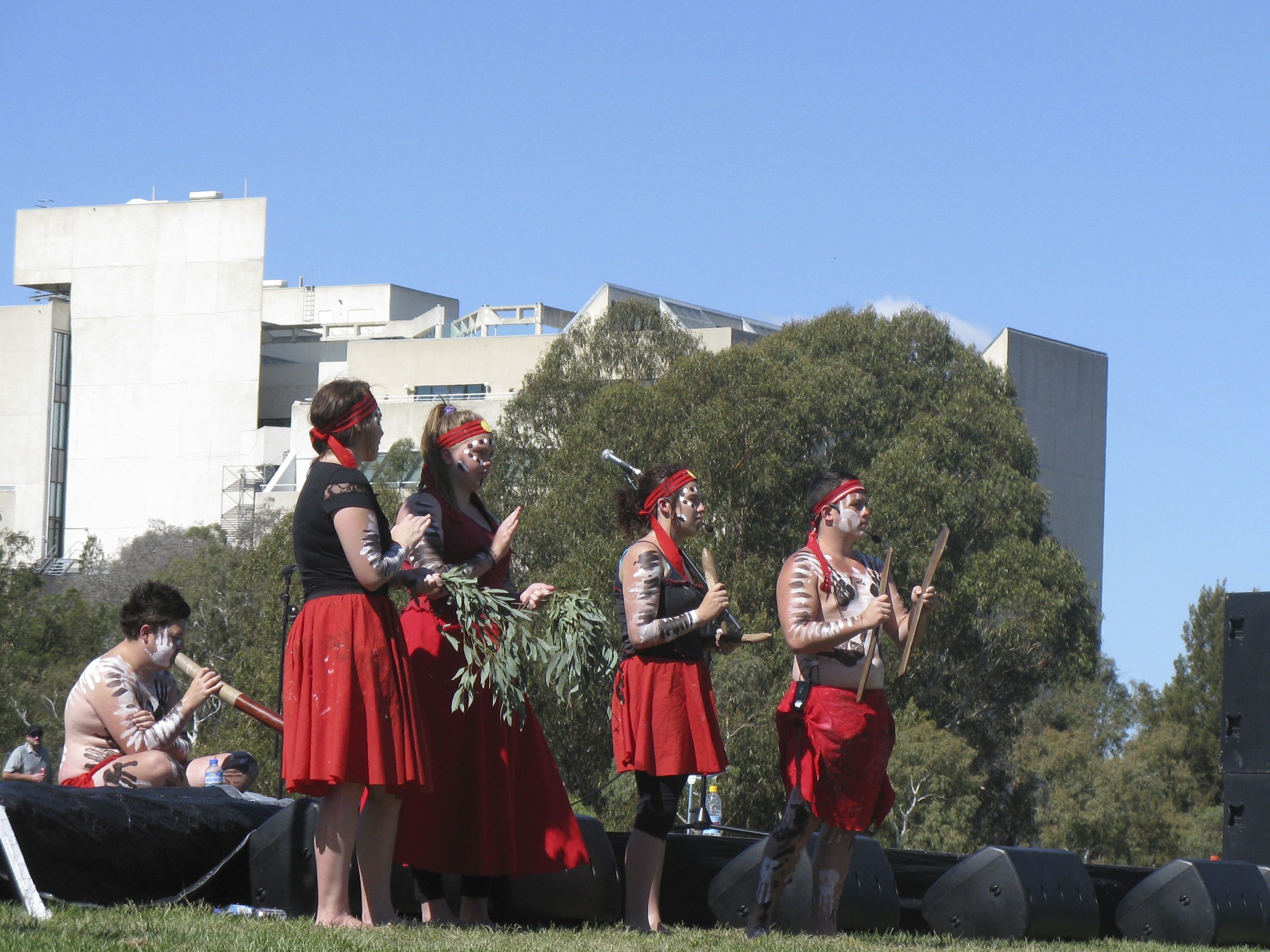
Wiradjuri Echoes, at “The Very Big Day Out”, 11 March 2013
Martiniello is of Arrente, Chinese and Anglo-Celtic descent.
Jeanine Leane‘s Purple threads also has an activist element, albeit couched in stories which are warm and funny as well as sometimes dark. They are set in a world where, she says, “black was not the ideal colour”. (By the way, when I reviewed this work I wasn’t sure what to call it but I have since seen it described as a “story cycle”. That sounds good to me!). Leane, a Wiradjuri woman, has also written and published poetry.
There are, I’m sure, other indigenous writers associated with Canberra, but these are the three best known to me. Identifying writers as belonging to a group – indigenous, migrant, women, gay, and so on – is an uncomfortable thing. It would be good to simply see writers as writers, people as people, but when you are a minority, when recognition doesn’t come easily to your “group”, there is value I believe in overcoming my discomfort … to help bring other ways of being and seeing to the attention of us in the majority culture.
As I was researching this post I came across a comment made by Cara Shipp, a local teacher of secondary English, at the Dare to Lead Conference: Leading indigenous perspectives in the national curriculum (Sydney, November 2010):
I think there is a danger in concentrating too much on the traditional cultural stuff. In terms of the way it is delivered, that can play into the stereotype that Aboriginal culture is dead and past. The only texts suggested for teaching in the draft National Curriculum are Dreamtime stories and I am not sure this is a good thing.
Really? Only Dreamtime stories in 2010? She has a point. I sure hope the final National Curriculum includes some of the great indigenous writing we know is out there.
If you’re not already aware of it – through my blog or elsewhere – Canberra turns 100 this year. Tomorrow, Tuesday 12 March, is THE day. How does one date a city with such precision? Well, in Canberra’s case it’s pretty easy because it was (is) a planned city. I suppose a number of dates could have been chosen – the date the location was announced or when the design competition or its winner was announced, perhaps – but the date we use is the date it was officially named, the date a bunch of white people came riding across the sheep paddocks and declared this place would be Australia’s national capital and called Canberra. We have movie footage of the event – and the city has been well-documented in all media ever since.
Cover (Courtesy: Irma Gold and Halstead Press)
I’m not going to dwell long on this, because I’ve talked about it before and will again during the year, but I thought I’d list three useful resources for those interested in the city’s literature:
The invisible thread, edited by Irma Gold, is the anthology I’ve written about several times already. It’s not exclusively about Canberra but the 70-odd pieces within are all by writers who have a connection with the city. It includes fiction (short stories and novel excerpts), non-fiction and poetry.
Meanjin Quarterly Vol 72 No. 1, 2013, The Canberra Issue. Meanjin, arguably Australian’s most venerable literary magazine, aims in this issue “to take the pulse of our elusive, much maligned-capital”, the city often dubbed, writes editor Zora Sanders, The National Capital of Boredom. Little do they know, we longstanding residents mutter, but quietly so (for we rather like our secret). This beautifully produced issue is organised into sections labelled Essays, Fiction, Gallery, Memoir, and Conversation, with poetry interspersed throughout. The contributors include Gideon Haigh, Drusilla Modjeska, Marion Halligan, Dorothy Johnston and Alan Gould. (Click here for subscription and stockist details).
Dinner at Caphs is a blogger whose Centenary project is to “attempt to read in 2013 only fiction that is set in Canberra. I want to try to see this city the way others see it, and to examine how I feel about what they see”. Dani has a page on her blog listing books she has identified as being set in or about Canberra. I’m hoping she’ll update it as she comes across more. My own reading group has decided on a (not exclusive) focus on Canberra-related writing this year so I was chuffed to come across Dinner at Caphs.
I started this post by mentioning how well Canberra’s history has been documented. I’ve mentioned film and writing, but music too has played a part. What better way to close this week’s Monday Musings than on the chorus from popular Australian songwriter Jack Lumsdaine’s song written in the late 1930s and titled “Canberra” or “Canberra’s calling to you”. Click this “Canberra’s calling to you” link to read more about the song and hear some old and new versions. (It’s a bit of a hoot.) The chorus begins:
Like a jewel so rare,
In a setting so fair,
A city of white was born.
With its gardens of blooms and its rare perfumes
That greet each sunny morn,
Australia’s creation the heart of a nation
‘neath azure skies of blue.
I was inspired to write this post last year when commenter Wendy Borchers mentionedCatchfire Press and described it as being associated with the University of Newcastle. I’d never heard of it. It is a community-based press primarily run by volunteers, but their covers, they say, are chosen by competition between senior design students at the University of Newcastle. The link is perhaps a little tenuous though there may be other connections not mentioned on their website. Whatever, they look like a delightful press with a wonderful heart doing something good for a local community, and they reminded me to look at the role university presses play in Australian publishing.
So, let’s look at some of the university presses which are out there promoting and publishing Australian literature – and I’m going to focus mainly on fiction. There’s probably a lot going on that I’m not aware of, but there are a few publishers who for me really stand out, and the grandma of them all is …
Way back in the 1980s when I rediscovered Australian writers, and particularly Australian women writers, it was UQP that brought some of the best to me, like the wonderful Olga Masters who died way too early. Their imprint is recognisable and when I see it I know to expect quality. But then, they’re Queenslanders and so am I! UQP has apparently been going since 1948. They started as a traditional academic press but moved into more general publishing of fiction, poetry, indigenous writing and children’s literature. They published the early works of writers like David Malouf, Peter Carey and Kate Grenville and are now moving into digital publishing. Check out the authors page of their website and you can’t help but be impressed at their contribution to the Australian literary landscape.
Now, jump three decades and we come to the next university press to make an impression on me, and that is …
This was the first publisher to send me books to review. It was a new thing for me, and Lisa of ANZ Litlovers, and it was new for them. That was in late 2009 and what they sent us was their first lot of books in their Australian Classics Library, some of which they had already captured and published via their SETIS digital program. They introduced me to writers like Price Warung, encouraged me to read CJ Dennis, and gave me another Jessica Anderson to read. Their focus is still, I think, more traditionally academic, but I love and appreciate their commitment to some lesser known Australian classics.
And then, in just the last week or so I heard, via Twitter from bloggers Marilyn and Yvonne, of
Australian National University
And its ANU E Press which is publishing, electronically and free of charge, books in its ANU Lives Series in Biography. You have to buy the print versions but the online versions are free. These aren’t fiction – being biography – but are of interest to me with titles like Maori and Aboriginal women in the public eye and Transnational ties. I need to keep an eye on them.
That’s three but I’m sure other Aussies can point to more … and I hope they do because universities are well placed to offer different spins on publishing as these three examples do. It looks to me as through each is operating under different economic imperatives but achieving something important in our local publishing scene.
And here I will close, well aware that it is now nearly Wednesday … My excuse is that I am currently on the other side of Australia and my personal time clock is out of whack! Or something like that ….
Oh, and I will add more links when I am back in my more comfy computing domain …
Miles Franklin, c. 1940s (Presumed Public Domain, via Wikipedia)
I have mentioned the new Stella Prize before but, for those of you who may not be across this new award on the Australian literary scene, here is a brief recap. It is named for Miles Franklin – her full name was Stella Maria Sarah Miles Franklin – and is “for the best work of literature (fiction and non-fiction) published in 2012 (for this inaugural one) by an Australian woman”. The prize of $50,000 will go to one author.
The award was created by a group of 11 women, including the writer Sophie Cunningham, in response to what many of us felt was an abysmal under-representation of women writers in Australia’s major literary awards and other literary activity (such as reviewing and being reviewed). The Stella Prize people want to turn this around and, as they say on their website, to:
raise the profile of women’s writing
encourage a future generation of women writers
bring readers to the work of Australian women.
The judging panel is a varied lot and should, I think, do an interesting job:
Kate Grenville: best-selling and award-winning Australian novelist. (Surely she doesn’t need any further introduction?)
Claudia Karvan: actor, producer and television scriptwriter
Rafael Epstein: television and radio journalist who has won the prestigious Walkley Award twice
Fiona Stager: bookshop owner and past president of the Australian Booksellers Association.
And, in fact, I think they have if the longlist – quite different to most literary prize longlists I’ve seen before – is any guide:
Romy Ash, Floundering: a debut novel on contemporary themes
Dylan Coleman, Mazin Grace: an historical novel about mission life, by a Kokatha-Greek writer
Courtney Collins, The burial: a debut historical crime novel which has apparently already been optioned for film. It reimagines the life of Australia’s ‘lady bushranger’, Jessie Hickman
Robin de Crespigny, The people smuggler: described as “a non-fiction thriller and a moral maze” and I think I’ll leave it at that!
Michelle de Kretser, Questions of travel: the fourth novel by an award-winning Sri Lankan born writer. I’ve read two of her previous novels and am keen to read this one.
Amy Espeseth, Sufficient grace: novel by a Wisconsin born writer. It won an unpublished manuscript award back in 2009.
Lisa Jacobson, The sunlit zone: a verse novel which writer and reviewer Adrian Hyland describes as combining “the narrative drive of the novel with the perfect pitch of true poetry”
Cate Kennedy, Like a house on fire: a collection of short stories by one of Australia’s best short story writers. I’ve only read a couple of hers but need to find time to read more.
Margo Lanagan, Sea hearts: a fantasy or speculative-fiction novel about selkies and the like that also appeals to non-genre readers (I believe). Her prose is said to be beautiful.
Patti Miller, The mind of a thief: a memoir exploring issues around native title.
Stephanie Radok, An opening: subtitled “twelve love stories about art” this one sounds hard to classify but fascinating to read. I think the judges called it “mixed genre”.
Carrie Tiffany, Mateship with birds: the second novel by the author of the truly splendiferous Everyman’s rules for scientific living. This is waiting patiently in my TBR.
What a fascinating list eh? It contains few of the usual suspects – even among our somewhat maligned women writing fraternity, we do have some “usual suspects” – but some great sounding works. By longlisting such a diverse collection the judges are surely sending out a message about the depth and breadth of women’s writing in contemporary Australia. Some of the books have been reviewed by participants in the Australian Women Writers challenge. Paula Grunseit has provided a brief survey of these reviews at the challenge site. If you go there you can enter a book giveaway at the same time!
The shortlist for the 2013 Stella Prize will be announced on Wednesday 20 March. and the inaugural Stella Prize will be awarded in Melbourne on the evening of Tuesday 16 April. I’ll keep you informed.
How many Halls of Fame are there specifically for writers? I’m not sure I’ve come across many, but last year I became aware of the Western Australian Premier’s Book Awards Hall of Fame when Tim Winton was inducted into it. The hall of fame is hosted on the State Library of Western Australia website. I’m not sure what the criteria are – I haven’t been able to find out anything about it, not even when each writer was inducted, besides a page for the actual “hall” and some press announcements of inductees. These announcements variously describe it as a hall of “acclaimed Western Australian writers” or “of notable and prolifc WA writers”.
Some of the inductees have been dead for some time suggesting that writers don’t (or didn’t) have to be alive to be inducted into it. There are currently 16 writers in the hall. Is that what you say, “in the hall”? They include:
Mary Durack …
who’s best known for her novels Kings in grass castles about her pioneering family and their role in the Kimberley region of northern Western Australia. I have reviewed a biography of her, True north, by Brenda Niall, and her poem “Lament for the drowned country”. The hall of fame describes her as “one of our great literary figures”. Most of her novels were not, I think, great literature but her contribution to Western Australian and Australian literary life through her writing (novels, non-fiction, short stories, poetry and journal/newspaper articles) and her support of other writers makes her a worthy recipient of the accolade.
Nene Gare …
who is best known for her novel, The fringe dwellers, which I read many years before I started this blog. The novel was made into a film of the same name by Bruce Beresford. She probably doesn’t have the national standing or recognition that the other writers I’ve listed here did and do but The fringe dwellers, like Thomas Keneally’s The chant of Jimmie Blacksmith, is an example of a novel confronting indigenous issues by a non-indigenous Australian writer. An obituary for her husband, who was the last commissioner for Native Welfare, says that “In 1965, Gare rewrote the manual for Native Welfare officers. His premise for his section on children was: ‘Under all normal circumstances children are best reared by their parents’.” This is a view that was still not well accepted at the time, as the Stolen Generations report made clear.
Elizabeth Jolley …
who, those of you who read this blog regularly, know is one of my favourite writers. I have written about her many times, including reviewing the first of her set of three autobiographical novels, My father’s moon, and her slim memoir-like work, Diary of a weekend farmer. The hall writes that she is (was, now) “acclaimed as one of Australia’s leading writers. She has received an Order of Australia , honorary doctorates from Western Australia Institute of Technology (now Curtin University) and Macquarie University, and the ASAL Gold Medal for her contribution to Australian Literature.” I will be writing more about her in years to come!
Katharine Susannah Prichard …
who is one of our political women writers. Prichard was a member of the Communist Party of Australia. I have reviewed her novel The pioneers,which reflects many of her social concerns. The hall describes her as “communist, feminist, social reformer and pacifist”. She wrote novels, plays, short stories and poetry.
Randolph Stow …
who is the other writer I’ve listed whom I haven’t reviewed on this blog. I have had his novel, The merry-go-round in the sea, on my TBR for a long time. One day! Lisa, at ANZ LitLovers has reviewed (and loved) it. He wrote several novels which have become Australian classics including To the islands and the children’s novel Midnite.
Shaun Tan …
would be the youngest of the list. I have only reviewed a small work of his, Eric, which comes from his collection, Tales from outer suburbia. He is an author and illustrator of books for children and adults. He is happy to collaborate with creators from all fields and is not precious about his works being adapted, supporting for example the Australian Chamber Orchestra’s presentation of his The red tree. His short film The lost thing won an Academy Award in 2011 for Best Animated Short Film. The experience of being “other” is one of his major themes.
Tim Winton …
who is one of only two writers to have won the Miles Franklin Award four times. (The other was, in case you’ve forgotten, Thea Astley!) I have read most of Winton’s oeuvre, but have only reviewed one here, Breath. Even if you’re not Australian, chances are you’ve heard of Winton. His most popular book, Cloudstreet, regularly wins polls as Australia’s best or most loved book. He writes for adults and children, and like many of the writers here, writes in multiple forms. He is passionate about the environment and works actively for it – as well as writing, fishing and surfing.
Are you aware of other specifically designated literary Halls of Fame?
Today’s Monday Musings is the second in a series of posts I plan to write this year about Canberra writers to commemorate our centenary. The first post covered Canberra’s women poets. Like that post, all the poets mentioned below appear in The invisible thread, Canberra’s centenary anthology that I’ve mentioned before.
The American poet Ezra Pound apparently once said “I haven’t known anyone worth a damn who wasn’t irascible”. Well, we have, I believe, a few Aussie poets who would live up to that description, and AD Hope, one of Australia’s most significant poets, would be one of them. He is famous, for example, for describing Patrick White’s novel The tree of man as “illiterate verbal sludge”, which, not surprisingly, offended Patrick White who was, I must admit, also known for being irascible. All this, of course, has little to do with Hope’s poetry except that, like White, he was highly critical of Australia. Reviewers have variously described his poetry as “sardonic”, satiric” and “sharp-edged”. One of my favourite poems of his, “Country Places“, makes fun of Australian place names and was included in Jamie Grant’s 100 Australian poems you need to know. Being of a certain age, I also like the following lines from “Spaetlese” in his collection A late picking:
Old men should be adventurous. On the whole
I think that’s what old age is really for:
Tolstoy at Astapavo finds his soul;
Ulysses hefts his oar.
But, the poem in The invisible thread, “Meditation on a bone“, is a different thing altogether. Inspired by an inscribed bone from about AD1050, it is about passion, rage and age, ending with:
Canberra is a small city, and was even more so a few decades ago. Consequently, poets like AD Hope, David Campbell and Rosemary Dobson knew each other pretty well. In fact, I mentioned David Campbell in my Capital Women Poets post because he and Dobson were good friends and, among other things, translated Russian poetry together. Like Hope, who was born in a country town about 100kms south of Canberra, Campbell was born in an even smaller country town a similar distance by road due east of here. But, unlike the highly academic Hope, Campbell was a war hero, a skilled sportsman, and a keen fisherman, among other things. His humorous poem, “The Australian Dream”, which gently mocks Australia’s fascination with royalty around the time of the 1954 Royal Tour, is included in Grant’s abovementioned anthology.
The poem included in The invisible thread, “Mothers and daughters“, is short and sharp but complex too. Its subject is mothers and daughters, but its themes are youth and age, competition between women, anxiety about sexuality, and there’s a little revenge sting in the tail because the first line of this taut 8-line poem introduces the male gaze as well:
Geoff Page is particularly special to me – not that he would know it – because he taught my son English at Narrabundah College and he was also the first author to attend my reading group’s discussion of his work. We did two of his verse novels, The scarring (my review) and Freehold, and Geoff was wonderfully generous in sharing his thoughts with us. The scarring is one of the most shattering works I’ve read in a long time. Geoff is, in fact, well-known in Canberra, in certain circles at least, because he has, for many many years, supported Australian poetry and jazz through his monthly Poetry at the Gods and Jazz at the Gods events, of which I have attended a few over the years. He also holds a popular Dead Poet’s dinner every winter and is a regular reviewer of poetry for ABC Radio National.
Page is also represented in the Jamie Grant anthology by one of his best-known poems, “Smalltown Memorials“, about the plethora of World War 1 war memorials in country towns. His poem in The invisible thread is “My Mother’s God“, a rather wry but affectionate look at the beliefs of his protestant mother’s generation:
…
His second book, my mother says,
is often now too well received;
the first is where the centre is,
tooth for claw and eye for tooth
whoever tried the other cheek
Well, Christ maybe,
but that’s another story
…
Oh, and he too was born in a country town, Grafton, some long distance north of Canberra.
Alan Gould is another poet I’ve reviewed here – but for him it was his novel, The lakewoman – and he also agreed to attend my reading group’s discussion of that book. I haven’t, I must say, read much of his poetry – and, unlike the first three poets, he was born in a city. London, to be exact! His poem in Jamie Grant’s book – yes, he’s there too – is called “Pliers“.
“The roof tilers“, Gould’s poem in The invisible thread, immediately brought to mind a delightful short film that I fell in love with, oh over 30 years ago now, called The Log Driver’s Waltz. Made by the National Film Board of Canada in 1979, and sung by the gorgeous Kate and Anna McGarrigle, it delighted me with its whimsy but also because it’s an ode to the grace (and courage) that can be found in the working man. Of course, I had to check You Tube and there it was. Have a look …
Thanks Alan Gould for a beautiful poem and for letting me wander down memory lane!
Both are slender; one is already high.
You watch as he steps on his wire legs,
from batten to batten, pauses, steps,
My last poet – unlike the previous four – is younger than I and, while he hasn’t attended my reading group, I have seen him perform live. He is a poet and rapper from Queanbeyan – sometimes unkindly called “struggle town” – which is the New South Wales town that borders Canberra. Our cities are, as a result, bound closely together, even if sometimes those binds fray a little. Musa is, for an oldie like me, exciting and refreshing. He performs at poetry slams (and can be found on You Tube) and his subject matter often deals with social justice issues to do with multiculturalism, youth opportunity, and similar. His poem in The invisible thread is, of the poems I’ve quoted here, the most grounded in our region. It’s called simply, “Queanbeyan”, and describes his love-hate relationship with a city that contains some of the worst of urban life – “alcos”, “used syringes”, bullies, and people playing pokies – but that’s also “a place where you can still see the stars”. I plan to keep an eye on Omar Musa in coming years.
Who are your favourite male poets?
Note: if a poem is hyperlinked, it is to a copy of that poem on the web.
I feel a little uncomfortable being a white person writing on indigenous issues. It’s difficult in situations of such immense power imbalance as currently exists between indigenous and non-indigenous Australians not to come across as patronising or a self-congratulatory do-gooder. However, I’m also aware that consciousness needs to be raised and good programs promoted, so here I am. I just hope I don’t offend those who really know what they are talking about.
I’ve been aware of a number of initiatives for some time now – such as the Indigenous Literacy Foundation – but this post was inspired by a small article I saw in my city’s newspaper about an initiative called the Indigenous Reading Project. So, I thought it might be time to talk about some of the things that have been happening in recent times. Indigenous literacy rates in Australia are at scandalous levels, which I find incredibly embarrassing for a so-called first-world nation. The situation is particularly bad in remote areas. According to a National Indigenous Literacy Day press release, “only one in five children living in a remote Indigenous community can read or write to the accepted minimum level”. One in five and only to the minimum level! This really isn’t acceptable.
Here are some activities/organisations that I’m aware of, but there are more, many at local community levels:
Indigenous Literacy Foundation: A not-for-profit charity established, I believe, with the support of the Australian Book Industry and other private sponsors. It doesn’t receive government funding. Its aim is “to make a positive difference in the lives of Australian Indigenous children by focusing on ways to improve their literacy levels”. It is a broad ranging organisation that sponsors or supports a wide variety of events and activities. According to its website, it raised $600,000 in 2012, and over the course of its existence has supplied some 85,000 books to over 230 remote communities.
Indigenous Reading Project: The project that finally inspired me to write about this issue. The article I read – here – describes a project developed by a Canberra-based public servant. It aims to “improve indigenous reading standards by giving students a Kindle in an effort to boost their interest in reading”. The project, very new still, has had significant success, in terms of the measures they’ve devised. It is geared to 10-15 year olds who are independent readers but “at or below national benchmarks in literacy”.
Australian Literacy and Numeracy Foundation: Describes itself as “the first independent charity in Australia dedicated to raising national language, literacy and numeracy standards, especially in remote and marginalised communities.” Its tagline is, simply, “being able to read and write is a basic human right”. It targets literacy and numeracy throughout the Australian population, but indigenous people clearly form a major part of its constituency. It supports a variety of literacy projects at the individual, family and community level.
National Indigenous Literacy Day: Organised by the Indigenous Literacy Foundation, and now 6 years old, the Day has two main aims: to encourage Aboriginal and Torres Strait Islander children to read; and to raise money to buy books for children living in remote Australia. A wide range of organisations are gradually getting behind this initiative including literary organisations like the Wheeler Centre, public libraries, schools, broadcasters like the ABC. I hope it becomes a universally recognised event on the Australian literary calendar.
There are also indigenous writers who are working hard to support literacy programs. Two whom I’ve heard speak (live) are Anita Heiss and Boori Monty Pryor. They are (of course!) both passionate about their cause, and are effective (and entertaining) public speakers.
Anita Heiss is an Indigenous Literary Foundation ambassador. She is actively involved in all sorts of literacy initiatives, from grass roots activities like writing books collaboratively with school children to lobbying and working at organisational levels. Boori Monty Pryor is one of Australia’s first two inaugural Children’s Laureates. He has made sharing and promoting indigenous culture his life’s work, with his main focus being, as I understand him, to encourage cultural pride and literacy skills in indigenous Australians and awareness of and respect for indigenous culture in non-indigenous Australians.
Literacy is essential to Aboriginal people’s self-determination. If we cannot read we cannot make the decisions that inevitably impact on our lives …
Reading, as we all know, is that important!
If you believe in the cause of indigenous literacy, and have some money to spare, please click on the organisational links above and consider donating.
Oh, and if you know of successful literacy organisations, programs and/or campaigns, I’d love to hear about them.
A change of pace for this week’s Monday Musings to give you a bit of a rest after my few rather lengthy posts of late. Enjoy!
I have already mentioned Patrick White a few times this month. One was my reference to his calling himself a “painter manque” in my review of his debut novel, Happy Valley. Another was mentioning his willingness to stand up for issues important to him, in last week’s Monday Musings on Australian women poets. Today’s post takes up both these points … You see …
In 1973 the Australian Government bought Jackson Pollock‘s painting Blue Poles. With a price exceeding $1 million, the painting’s purchase could not be approved by the then director of National Gallery of Australia, James Mollison, but had to be signed off by the Government. It just so happened that this Government was the new Labor Government which had won power the previous December after 23 years of conservative rule. Australia was ripe for change – and for philosophical and intellectual debate if not downright conflict between the conservatives and the progressives. And so, with announcement of the purchase, all hell broke loose, so to speak. Here is where our “painter manque”, Patrick White, enters the picture.
Campaigns were mounted to prevent the acquisition. One of these was a petition which Patrick White was invited to sign by a Canberra resident. Now Patrick White, as those who know him would expect, wasn’t having any of it. Here are some words from his letter, which you can view in full on the Leski Auction Site (where it was advertised for auction in 2012):
I am not signing the petition because I think you are wrong. You are the kind of person any creative Australian has been fighting against as long as I can remember, the aggressive philistine, often in disguise, who has held us back.
After a couple more paragraphs, he concludes
I regret to say, Mrs English, you are the (perhaps) well-meaning, but destructive, Australian busy-body, we must continue fighting against in the arts.
Don’t you love those parentheses around “perhaps”? How very White!
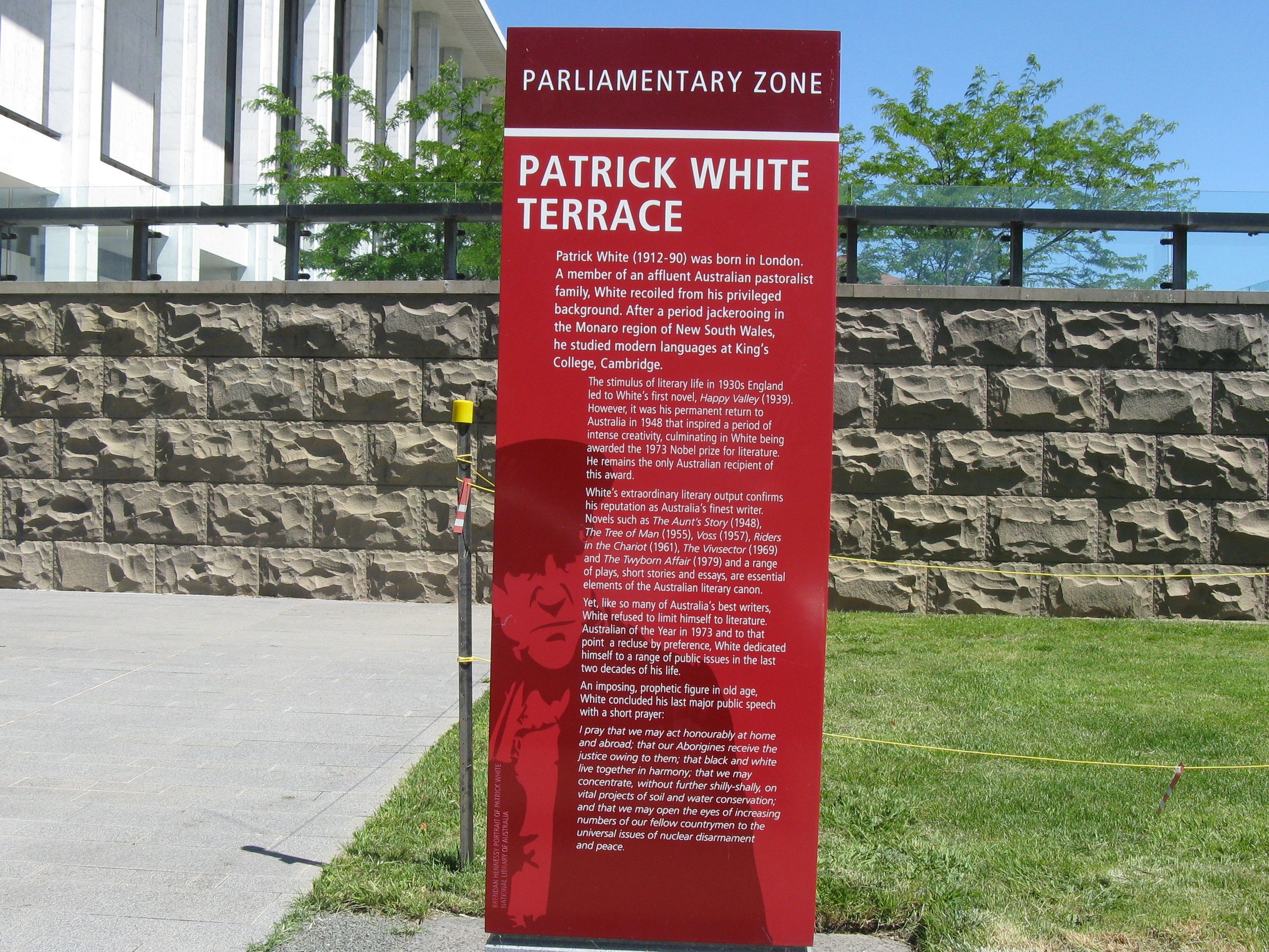
Patrick White Terrace, National Library of Australia
Since Australia’s capital, Canberra, is celebrating its centenary in 2013, it seems timely to devote a few Monday Musings posts – scattered throughout the year – to its literature. Comparatively speaking, Canberra is a small city, but it is rich in poets, past and present, female and male, so I’ve decided to make my first topic Canberra’s women poets. I’ll write, as I usually do in these sorts of posts, about a representative few. They all appear in The invisible thread, Canberra’s centenary anthology about which I’ve written before.
Judith Wright (1915-2000)
Australian high country (Mt Stilwell)
Wright spent the last 28 years of her life in the wider Canberra region, and is arguably Canberra’s best known woman poet. She was a prolific writer, and a committed environmentalist and Aboriginal rights activist. Her poetry ranges over a huge range of subjects from the bush, birds and nature, through life and relationships, to all sorts of social justice and political issues. Like her contemporary Patrick White, she was not afraid to speak out about the issues that concerned her. As pretty well every biography reports, she took part in an Aboriginal Reconciliation March in Canberra not long before she died at the age of 85. Several of her poems, including “Bullocky”, “Woman to man”, and “South of my days”, are anthology standards. A self-confessed lover of our bush, I adore this from “South of my days”:
I also like the lesser known (to me, anyhow) poem selected for The invisible thread, “Counting in sevens”, in which she counts off her years in, yes, sevens:
Seven threes are twenty-one.
I was sailing my own sea,
first in love, the knots undone.
Rosemary Dobson (1920-2012)
Another grand dame of Australian poetry, and also a prolific one, Dobson moved to Canberra in 1971 with her husband Alec Bolton. I’ve written about them before in my Literary Couples post. Like Wright, she turned her hand to many forms of writing and also worked as an editor. Both women knew that to make a career out of writing, you wrote … but in Dobson’s case she also translated – Russian poetry! I quoted a couple of her poems in the post I wrote after her death, including the one she wrote to/for Christina Stead. The poem from which I’ll quote here, though, is the intriguing “Child with a Cockatoo” in which a child, sitting for a painting by Simon Verelst in a time before the discovery of Australia, is given a sulphur-crested cockatoo, presaging Europe’s future contact with the southern land:
That sulphur-crested bird with great white wings,
The wise, harsh bird – as old and wise as Time
Whose well-dark eyes the wonder kept and closed.
Susan Hampton (b. 1949)
I must say I know Susan Hampton more as the editor, with Kate Llewellyn, of The Penguin book of Australian women poets, than as a Canberra-based poet, but I’ve discovered that she’s lived in Canberra since 1993. Her poems, from what I’ve seen, tend to be personal with a witty, whimsical or poignant edge, such as this one about “Hands” which starts
for some reason are battered and speckled,
the claws of an old hen poke through the skin.
I stare at my hands the way Escher
makes you stare at his …
I know the feeling … and isn’t that partly what poetry is about?
Melinda Smith
Now Smith, who has been in Canberra, on and off apparently, since 1989, is new to me, but I do love her cheeky poem in The invisible thread. It’s titled “No bed” and here is its beginning:
When love is on the wrong side of the sheets
romance must give way to expedience
and, short of coupling in the public streets,
all places serve at love’s convenience.
Kerry Cue at Poem Pig quotes another of Smith’s poems, “Mother love”. It’s a beautifully structured poem but you’ll have to go to Poem Pig to see that, as I’m just going to quote a verse:
Heaving itself onto an empty beach,
the sea still finds the energy to give.
I start a task whose end I’ll never reach.
I give you life, not knowing how you’ll live.
And here are the first two lines of a poem called “Virginia Woolf” from Smith’s own blog, Mull and Fiddle:
Veiled in muslin,
intellect like a steel ribbon.
“Intellect like a steel ribbon”. Love the combination of strength and fragility, masculinity and femininity, solidity and fluidity, in that image.
Penelope Layland (b. 1962)
My last poet – but there are many more in Canberra, including one I’ll review soon – has spent pretty much all her life in Canberra. I’m most aware of her through her work as a journalist and columnist but she is also a poet. I’m rather tickled that the poem of hers included in The invisible thread speaks to an earlier Monday Musings, that about the “lost child” theme in Australian literature. The poem was published in 2005 and doesn’t feel dated. The “myth” clearly resonates still. The poem starts:
They search the stock dams first –
neighbours, solid men feigning nonchalance,
the self-righteous, the busy-bodies, the merely excited
and somewhere the father, whose looks keep going
to the bush beyond, gathering itself.
And there you have it … an all too brief introduction to some of our capital women poets.



 Whispering Gums
