Monday musings on Australian literature: Pascall Prize

The Pascall Prize is one of those under-the-radar sorts of awards, that is, one that tends not to get much general press. However, that doesn’t mean it’s not significant. In fact, I’ve had it in my list of topics for a couple of years but, having mentioned in my David Malouf birthday post last week that he was a recipient, I decided that now’s the time.

The Pascall Prize has another name which better explains what it is – “The Australian Critic of the Year”. Its aim, defined on its website, is:

to reward a critic or reviewer whose work changes the perceptions of Australians, opens their eyes to a different perspective of their culture, develops a new interest in the subject and is both imaginative and creative.

The Pascall Prize celebrates incisive and well-crafted critical writing in areas including literature, art, architecture, food and wine, music, theatre, film, television, and radio [and now the Internet].

It specifically excludes sport from its definition of culture. Fair enough. I suspect there are significantly more well-paying opportunities for sports writers/analysts than there are for those in the arts, though maybe I’m biassed. I have, for the record, read some excellent pieces of sports journalism. But, enough of that, back to Pascall. The website tells us that it was named after Geraldine Pascall, “a flamboyant journalist” who died suddenly of a stroke/brain haemorrhage in 1983, when she was just 38. (Scary!) She apparently didn’t have a will, so her Estate passed to her father, Fred Pascall. He wanted to establish a memorial to his daughter, and so the Pascall Prize was born. It’s awarded annually, usually I believe at the Sydney Writers’ Festival, and currently provides $15,000. David Malouf is listed as the first recipient, having received the award in 1988.

I could be clichéd and say that the recipients represent a veritable who’s who of Australian critics, but I won’t, although it does – at least as far as I can tell from my admittedly uneven knowledge of the field! Last year’s winner was Kerryn Goldsworthy. The announcement describes her as “a writer, critic, reviewer, essayist, columnist, fiction writer and blogger”. She has reviewed for many of Australia’s most significant publications, for over 30 years. I have quoted her here more than once, the first time being in 2009 in a post on Thea Astley when I quoted Goldsworthy’s reasons for loving Thea Astley. That they happen to accord with my reasons was the icing on the cake. I’ve mentioned her several times since, including recently in relation to her being the chair of the Stella Prize Judging Panel.
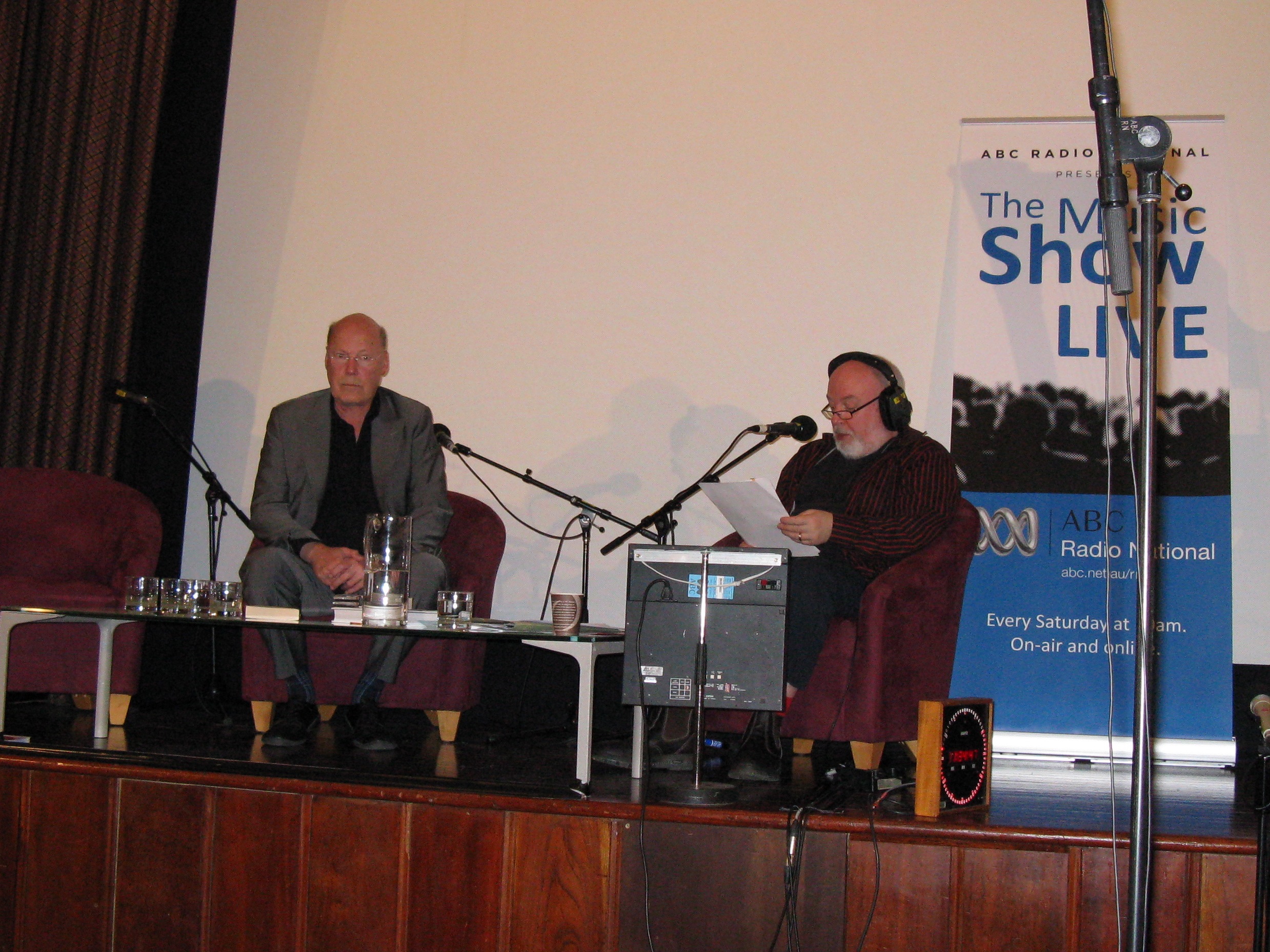
Andrew Ford and Jim Sharman

Andrew Ford interviewing Jim Sharman, Voss Journey, 2009

Of the other winners, the best known to me (which says more about me than anything else), include Andrew Ford (1998, music critic, composer and radio presenter), Marion Halligan (1990, critic and author), Andrew Riemer (1990, critic, academic and author), Peter Craven (2004, literary critic and editor), and Geordie Williamson (2011, literary critic). You can see a full list of the winners and the judging panels on the Prize’s Wikipedia page.

I’m not going to ramble on for long about this award, important as I think it is, but I would like to share a couple of comments made by Goldsworthy in her acceptance speech, one about the essence of being a good critic, and the other about the future. Here’s the first one:

in order to be an effective critic, you need a left brain that knows what your right brain is doing. My ideal as a critic is to come up with a rational intellectual response while at the same time continuing not just to acknowledge but to honour those mysterious places of the oceanic deep, the places where you connect most vitally and instinctively and electrically with whatever is going on in a work of art.

It’s a real juggle, and one that many of us bloggers (of whom Goldsworthy has also been one) try also to achieve. It’s what she calls “a critical brain finding ways to articulate the heart’s response”.

Regarding the future of criticism, she says:

There’s a lot of talk as we move into the digital age about what the fate of criticism will be, but I’m an optimist who thinks the that cultural conversation will continue no matter what medium it moves through, or what form it takes. What I worry about more is whether critics will go on being able to balance hearts and minds as the humanities continue to be devalued in the universities, the arts continue to be devalued in government, and fewer and fewer people are formally taught how to expand their knowledge and hone their critical skills as we navigate our way through cultural life.

Being an optimist too, I can’t believe that there won’t always be people ready, willing and able to engage with the arts in a critical way. Life sure would be poorer if there weren’t.

Do you have favourite critics you like to read? And what do you think about Goldsworthy’s left brain right brain approach to analysis?

Monday musings on Australian literature: More on nurturing Australian literary classics

In early 2012, I wrote a post on nurturing Australian classics in which I mentioned, among other things, some publishing initiatives such as Text Classics and Sydney University’s Australian Classics Library. Text Publishing has continued since then to publish more and more titles, with over 70 titles now being available. Presumably this means that sales are good enough to support the project continuing. What’s particularly special about this series is that Text has commissioned new introductions for these books.

Around the same time I believe, Australian publisher Angus and Robertson also started publishing an Australian Classics series which they sell for similar prices to those by Text, that is in the $12-14 price range. The series doesn’t seem to have been promoted as well as the Text series, but there are some good books here. And, like Text’s series, they include non-fiction as well as fiction, and again like Text, the books can be purchased in print and e-versions.

I’ve been meaning to write about Angus and Robertson’s (A&R) series for some time, but what finally spurred me into action was seeing, recently, that they have republished Drusilla Modjeska’s wonderful book, Exiles at home: Australian writers abroad 1925-1945. I have dipped into this book many times, but always at the library. I didn’t buy it when it was first released in 1981, and have never organised myself to pick up a second-hand version. But now, now I have it – and I purchased the e-version so I could have it straight away. Somehow, and perhaps it’s obvious really, I’m more comfortable buying non-fiction in e-versions than fiction.

Exiles at home is an excellent book if you are interested in Australian classics, specifically Australian women’s classics, because Modjeska discusses in some depth, the women who led an impressive flowering of Australian literature in that period leading up to and including the Second World War. They include Dymphna Cusack, Christina Stead, Eleanor Dark, Marjorie Barnard and Kylie Tennant. Some I’ve reviewed here, while others I’ve read way before blogging existed and certainly before I started blogging. When Modjeska wrote her book, many of these authors would not have been in-print – but fortunately they were held in the library of the Australian National University where she started her research.

Now, though, many of those authors are published by A&R (and the other companies republishing classics). We can now buy the likes of Eleanor Dark’s The timeless land, Kylie Tennant’s The battlers, and Dymphna Cusack and Florence James’ Come in spinner from A&R, just as we can buy works by Henry Handel Richardson, Miles Franklin and Elizabeth Harrower from Text. We can also read the men, of course, such as George Johnston, Martin Boyd, Xavier Herbert and Kevin Gilbert via these publishers. (Patrick White, of course, has always been available – to some degree.)

I will, though, finish with the women since it was buying Modjeska’s book that inspired this post. She talks about two major flowerings of women writers in Australia – the period she was writing about and, in her introduction to later editions, the 1980s (when we saw Helen Garner, Kate Grenville, Elizabeth Jolley, Olga Masters, Glenda Adams among others, appear on the scene.). Modjeska refers to this uneven visibility of women’s writing. Given the recent discussions about this issue, in the light of various publishing and reviewing statistics, I thought I’d finish with this comment by Modjeska:

Writing the history of women’s writing is not simply a matter of filling the gaps, slotting people and works into existing literary traditions. Rather, it should be an attempt to unearth new, dialectically related history. The relationship of women writers to cultural history is, however, highly complex and is mediated by ideology, by class and by the ways in which women become social beings in the first place.

This is why, even though women seem to have been featuring well in recent Australian literary awards, we need to keep watching – and why we so appreciate publishers keeping our (male and female) literary traditions alive.

Monday musings on Australian literature: Capital women novelists

Hmmm … it’s taken me a while to get back to my so-called series on Canberra’s writers. Over a year ago I wrote posts on Capital women and Capital men poets, and fully intended to write about the fiction writers last year too, but somehow the year got away from me. However, today is Canberra Day, the day we celebrate the “birth” of Canberra, and so it seemed like a time to get back to my series. As I did with the poets, I’ll start with the women, some of whom you’re sure to recognise from other posts.

Canberra Seven or Seven Writers

I have written before about this group of seven women. On one occasion, my post on Canberra’s Centenary, Dorothy Johnston wrote in the comments:

I don’t know whether you all had young families when you began your reading group in 1988, but half of us had small children, when 7 Writers started in the early 1980s. I remember Margaret Barbalet bringing her twin boys, and I quite often took my daughter – it was that, or not go to the meeting. I also remember that we held a small celebration when the combined number of our published books finally outstripped our total of children and grand-children!

Lovely story eh? The seven were, in alphabetical order: Margaret Barbalet, Sara Dowse, Suzanne Edgar, Marian Eldridge, Marion Halligan, Dorothy Horsfield, Dorothy Johnston. I have reviewed some here – Suzanne Edgar’s collection of poetry The love procession, Marion Halligan’s Valley of grace, and Dorothy Johnston’s The house at number 10 and Eight pieces on prostitution. Long before blogging, I read several others by Halligan and Sara Dowse’s West block. I still, to my embarrassment, have a book by Margaret Barbalet in my pile! Several of these authors are excerpted in Irma Gold’s anthology, The invisible thread.

A Canberra setting isn’t the criterion for this series of posts, but of course I’m interested in works that are set here. Many of these writers did set at least some of their books here, such as Sara Dowse in her novel West block: The hidden world of Canberra’s mandarins. In addition to being a novelist and artist, Sara Dowse was a high profile bureaucrat. Indeed, she was head of the Whitlam Labor government’s women’s affairs section, a position she held for around 3 years until she resigned in 1977. West block, set in the mid 1970s, draws from her experience as that public servant. My reading group, Canberrans all, loved reading about something so close to our understanding, but, looking at it now I feel rather depressed. Here is the character Cassie, fearing the impact of Labor losing the coming election:

She would have liked to thrash it out with someone. State it baldly. Look here, she might say. Women, blacks, migrants, kids, old people, the unemployed. We’re the ones who need a public sector. Not the bastards who take it for their own, then disavow it …

Oh dear … she could have written that last year, and it wouldn’t have been out of place!

Blanche d’Alpuget

I’ve only read one book by d’Alpuget, and that’s her biography of one of our most colourful prime ministers, Bob Hawke (to whom she is now married). However, she is also a novelist, with her books including Monkeys in the dark, Turtle Beach (which was adapted for a movie), and Winter in Jerusalem. She wrote her first novel, Monkeys in the dark, in Canberra, when she had a young baby. Turtle Beach, which won The Age Book of the Year in 1981, is set in Canberra and Malaysia, and explores the plight of Vietnamese boat people in Malaysian refugee camps. I’ve always meant to read this book and it seems like now – Australians will know why – would be a good time.

Francesa Rendle-Short book cover Bite your tongue

Bite your tongue Bookcover (Courtesy: Spinifex Press)

Francesca Rendle-Short

Born in Queensland and now living in Melbourne, Rendle-Short lived in Canberra for a couple of decades. She has written, among other things, novels, short stories and the fictional memoir, Bite your tongue, which I reviewed a year or so ago. Her novel, Imago, which I haven’t read, is set in Canberra in the 1960s. Blogger Dani reviewed it last year in her blog Dinner at Caph’s, and included a couple of lovely descriptions of Canberra from the book. Lisa (ANZLitLovers) also reviewed it recently. She includes a lovely description of English Molly revelling in Canberra’s summer heat. This book sounds like it might be an interesting companion to Frank Moorhouse’s Cold light (my review) which covers the same time period but looks at life in Canberra from a very different perspective to Rendle-Short’s two suburban wives.

Kaaron Warren

Warren is an author I hadn’t really heard of before reviews of her books started appearing in the Australian Women Writers Challenge, and even then I didn’t realise her Canberra connections until Irma Gold’s The invisible thread anthology. Warren has, in fact, lived in Canberra for over 20 years. However, her genre is science fiction, which is not something I seek out. I did, nonetheless, enjoy her contribution to the anthology, an excerpt from her short story, “The glass woman”. She is a multi-award winning author in her field, so if you are into science fiction and horror, and haven’t discovered her, she is clearly worth checking out.

Irma Gold

I’d like to end this post on Gold. She has not had a novel published yet though I believe she has written one and is now on the publisher trail. However, she has published a collection of short stories, Two steps forward (which I reviewed a couple of years ago and which was shortlisted for the MUBA award). It’s an excellent collection that demonstrates a sure grasp of form. I particularly liked the way she mixes up voice and point of view. There are mothers, teenagers, children, old men, and they all – this is fiction after all – confront challenges, the sorts of real challenges anyone can face, such as a miscarriage, or seeing a terminally ill friend, or working in a detention centre. I can’t wait to see what her novel is about!

As with all my regional literature posts, this contains an idiosyncratic selection and is by no means comprehensive. Some have written about Canberra, while others haven’t necessarily made Canberra their focus. They are all, though, interesting writers well worth following up when you have the inclination.

Monday musings on Australian literature: Confronting Australian novels

Recently I wrote a post about reading difficult novels and proposed categories for different sorts of “difficulties”. One of those categories was “emotionally confronting”, but I realise now that a better category would have been “emotionally and/or intellectually confronting”. By intellectually confronting I don’t mean challenging in terms of style, language, structure, but in terms of ideas. Many books which confront us with difficult ideas can, of course, evoke an emotional response in us, but I didn’t explore that in my original post. However, having just read Tsiolkas’ Barracuda (my review) I now plan to.

An intellectually confronting book is, I’d say, one that shocks us out of our complacency. This is what Christos Tsiolkas wants to do. In a conversation with Heather Taylor Johnson in Meanjin‘s Canberra issue, he expressed his concern that:

We are reading for confirmation of ourselves rather than to challenge ourselves and I think that is a real danger.

And said, in response to a question regarding mixed reactions to The slap, that

I want to pose questions that are unsettling or troubling.

He certainly does that. I’d love to hear what you think about novels that confront you – that unsettle your mind, shake your world view, disturb your core. Meanwhile, I’m going talk about some of the authors whose novels have surprised or challenged me over the last 2-3 decades.

Thea Astley could hardly, I think, be said to write to confirm ourselves. Her books face head on the ugliness in our culture – between white and black, rich and poor, city and country. The first book of hers that I read, the ironically titled A kindness cup, deals with racism and violence in a country town. The multiple effects of rain shadow (my review) explores the impact on a group of people of a violent episode on Palm Island. Interestingly, given my recent post on the subject, one of the voices telling the story is indigenous. Drylands is concerned with the impoverishment of the spirit as she sees it in late 20th century Australia. I wonder what she’d think now! One of her characters in The multiple effects of rainshadow says:

There must be a million readers out there who crave boredom! Who love the dangling participle! Who wallow in truisms and fatuous theorisings! … Slap in your popular aphorisms, buddy, but don’t make ‘em think!

Helen Garner has to be one of our bravest writers. Her nonfiction books, The first stone and Joe Cinque’s consolation, and her novel, The spare room, in particular, demonstrate her willingness to explore ideas that may be unpalatable, that run against the status quo. Somehow, she’s managed to confront the resultant criticism – which she’s faced since her first critically acclaimed but also slammed first novel, Monkey grip –  and keep on going. I’ve said it before – and will probably say it again – I don’t always agree with Garner, but I like that she confronts us with ideas that we need to think about in our dealings with others. Whether you agree with her take on the Ormond College sexual harassment case or whether you relate to her frustration with her terminally-illl friend, you have to admit that she doesn’t let us get away with “soft” thinking.

Elizabeth Jolley unsettled readers from the beginning with her willingness to expose the soul’s darkness in ordinary people and to have them enact that darkness in often shocking ways. It was Weekly’s ruthless action at the end of The newspaper of Claremont Street, the second or third Jolley book I read, that sold me. Really! I soon learnt not to be surprised by anything her characters thought or did. Jolley is more about the interior, the psyche, than the other writers I’m mentioning here but she’s no less confronting to our comfort.

Andrew McGahan‘s first two novels Praise and 1988 are examples of Grunge Lit or Generation X literature. I found them, particularly Praise, confronting because of the nihilism, hopelessness of the characters. They have no goals, they immerse themselves in sex, drugs and alcohol rather than “honest work”.  According to Wikipedia, Grunge Lit, a term not necessarily accepted by those it’s been applied to, did not last long. But, in these two books, McGahan did present Australian readers with something that made us sit up and take note – not just for the writing, but for the unappealing lifestyles he presented.

Kim Scott‘s That deadman dance (my review) is an historical novel, so we could perhaps tell ourselves that things are different now, but any honest reader would realise that Bobby’s statement in the novel that –

We learned your words and songs and stories, and never knew you didn’t want to hear ours

– continues to have ramifications today, and that, in fact, we are still not very good at hearing their story. Scott is just one of several contemporary indigenous writers, such as Alexis Wright, Melissa Lucashenko and Jeanine Leane, who are starting to confront us with their story, with their perspective of what living in Australia today is like for those who have been disenfranchised.

Christos Tsiolkas needs little introduction if you’ve been reading my recent posts. He has been shocking readers pretty much since his first novel, Loaded, which I’m embarrassed to say that I haven’t read. I did, though, hear about it! His books are firmly urban/suburban and tend to be set within immigrant subcultures. As far as I understand, most if not all traverse similar subject matter, the cultural conflict, social mobility, sexual identity confusion, racism, that often lead to aggression if not actual violence. His language is raw, and unapologetic, but his characters are real. You may not like them all, you may feel you aren’t like them or that you don’t know people like them, but they seem to be part of contemporary Australia, an Australia in which ridicule of and violence against people who are different seems to be getting worse. At least, I fear it’s not getting better. Tsiolkas wants us to think about this, to not sit in our comfortable middle-class suburban homes and worry about nothing more than our generally self-serving concerns.

Australian feminist, Anne Summers, said in a lecture that “I found [Helen Garner’s] The First Stone to be brave and honest and quite confronting–the hallmarks of a very good book.” I think she’s right. There’s nothing wrong with reading books that reflect ourselves and explore our concerns, but surely our reading has the most value when we are shaken out of the familiar and made to face other worlds and different ideas.

Now, over to you …

Monday musings on Australian literature: The Bread and Cheese Club, again

I promise that this, my third post on Melbourne’s now defunct Bread and Cheese Club will also be my last, but it was such an interesting club that I can’t resist one more post. Just to remind you, it was formed in 1938, with the following goals:

To promote mateship and fellowship among persons of mutual interests, to foster a knowledge of Australian Literature, Art and Music and to cultivate an Australian sentiment … (from H.W. Malloch’s Fellows all, p. 17)

My first post introduced the club, and particularly one of its founders, John Kinmont Moir (1893-1958), who was clearly the Club’s leading light, while my second post focused on some of the ways in which the Club supported indigenous Australian culture. In this post I want to give a flavour of how widely their activities and, probably, influence extended. To keep it simple, I’m just going to list a few of the activities I came across while researching the Club in the National Library of Australia’s Trove database for newspapers. Here goes:

  • Children’s Poetry Competition. Reported in The Argus, 1939
  • Exhibition of art and literature at the Velazquez Gallery. The writer in The Argus, 1940, saw it as a “mixed bag” (I love the language here!):

If the club had a selection committee to deal with the art side of the show, it was doubtless a committee more anxious to obtain a wide representation than a particularly high standard. It is doubtful whether a more mixed lot of pictures has ever been hung on the walls of any gallery in Melbourne. They range from admirable examples of the work of some of Australia’s most capable artists to hopeful (or despairing) efforts by the veriest tyros.

  • Publication of Frank Clune’s book, Chinese Morrison, about George E Morrison who, as many Australians will know, became an influential political adviser to the Chinese Republic in the early 20th century. Reported in The Argus, 1941
  • Short story competition, judged by Mrs Vance (aka Nettie) Palmer. Reported by the Courier Mail, 1942
  • First art exhibition by members of the Bread and Cheese Club Art Group. Reported in The Argus, 1946
  • Publication of naturalist David Fleay’s book, Gliders of the gum trees. Reported in the Queensland Times, 1947
  • Junior Art Competition. Reported in the Cairns Post, 1948
  • Surprising Dame Mary Gilmore with a bouquet of flowers on her 84th birthday. Dame Mary apparently said that “I had forgotten it was my birthday, but I’m so happy that my friends all over Australia remembered”. Reported in The Daily News (Perth), 1949
  • Organising significant people to address its meetings, such as Chief Justice of the High Court, Sir John Latham. (I liked this one because Latham is a mentor of the fictional Edith in Frank Moorhouse’s Edith trilogy). Reported in Barrier Miner (Broken Hill), 1951
  • Awarding annually the Australian Natural History Medallion. According a report in The Argus, 1956, the award was instituted by J.K. Moir in 1938 and was the most coveted natural history award in Australia. The 1956 award was given to Stanely Mitchell “for work on the artefacts of the Australian aborigines”.
  • Erecting a memorial in Darwin to commemorate Northern Territory pioneer Jessie Litchfield who, when she died in 1956, left “most of her estate for the encouragement of Australian literature”. Reported in The Canberra Times, 1964

Besides the variety of the Club’s activities evidenced in this (pretty) random selection, one of the most interesting things about these newspaper reports is where they are from. While the Club was Melbourne-based, albeit with some interstate members, its activities were clearly national, and were reported nationally. Sir John Latham’s talk in Melbourne, for example, was reported in a Broken Hill newspaper, and the Jessie Litchfield monument in a Canberra one. Is it just that these papers were desperate for copy or was the Club widely influential?

I will end my mini-series on the Bread and Cheese Club with a report on one more activity, because the report made me laugh. In The Argus of 14 September, 1951, Christina Mawdesley wrote an article titled “Nothing is new about prefab. houses”. She shares information from a reader who advised that Governor Latrobe’s cottage was an early prefab home, dating to 1839, and therefore earlier than the 1853 home that the paper had written about. She then goes on to quote Sir Thomas Mitchell writing from London, in 1830s-40s, about one “Manning of Holbourn” who was building wooden houses in sections for use in Australia. Mawdesley concludes her article with:

Could we discover the remains of one such pioneer prefab?

I am sure the Bread and Cheese Club would mark the spot with an engraved plaque, commemorating the good old days and “Manning of Holbourn”.

Is there anything, I wonder, that the Bread and Cheese Club didn’t do?

Monday musings on Australian literature: White writers on Indigenous Australians

Over the years I’ve read many books written by white Australian writers on indigenous Australians*, including Mrs Aeneas Gunn’s We of the Never Never, Nene Gare’s The fringe dwellersThomas Keneally’s The chant of Jimmie Blacksmith, Kate Grenville’s The secret river, Peter Temple’s The broken shoreand several books by Thea Astley. Later this week I’ll be reviewing another, Margaret Merrilees’ debut novel The first week. I avoid reading reviews of books before I write my own, but I did want to find out about Merrilees, who is new to me. My research uncovered an essay written by her in 2007 titled Tiptoeing through the spinifex: White representations of Aboriginal characters.

In it, as the title implies, Merrilees tackles the dilemma faced by white writers in Australia:

To write about Australia, particularly rural Australia, without mentioning the Aboriginal presence (current or historical) is to distort reality, to perpetuate the terra nullius lie. However, for a non-Aboriginal writer to write about Aboriginal people is to run the risk of “appropriating” Aboriginal experience; speaking on behalf of … There’s been too much of that already.

I don’t think this dilemma is confined to writers, but writers occupy a particularly visible and influential position which heightens the challenge for them. Thomas Keneally has said that if he wrote his 1972-published The chant of Jimmie Blacksmith today he would not write in the voice of Blacksmith but from a white perspective, because “the two cultures are so different in their maps of the world that it was reckless to do it”’. Kate Grenville, whose The secret river was published in 2005, wrote in Searching for The secret river that:

I’d always known that I wasn’t going to try to enter the consciousness of the Aboriginal characters. I didn’t know or understand enough – and felt I never would. They – like everything else – would be seen through Thornhill’s eyes.

Fair enough. However, as Merrilees realises, it’s not always that simple. She looks broadly at the history of white representation of indigenous Australians in literature, suggesting it has often been well-intentioned but fraught nonetheless. She “listens” to what indigenous writers such as Jackie Huggins, Melissa Lucashenko and Kenny Laughton have said about “whites writing on blacks” and the resultant distortions and misconstructions. She explores some examples of fraud and theft of indigenous stories and culture by white Australians, such as Elizabeth Durack painting as Eddie Burrup and Patricia Wrightson using Aboriginal mythology. And she discusses the dangers of the opposite of appropriation, that is, the complete absence of indigenous people. She recognises that the situation hasn’t been helped by the paucity of indigenous writers, although this has started to slowly improve in recent decades.

So what are white Australian writers to do? Merrilees argues that

a novel which attempts to capture the Australian consciousness, and in particular a novel with a rural setting, or in which landscape plays a part, is impoverished if it does not address in some way the question past and current Aboriginal presence.

The question is how to do this. Taking herself as an example, Merrilees suggests that while she would decide not to write in the voice of an Aboriginal character, she wouldn’t want Aboriginal people to be silent. However, as soon as she made her indigenous characters speak, she writes, she’d be “tramping about” inside their heads “even though I said I wasn’t going to. A character who speaks is generally doing so in first person. So speech is just a form of first-person narrative after all … How am I going to explain this to all those Aboriginal writers who don’t want me speaking for them?”

Australian academics Kenneth Gelder and Jane Jacobs, she says, state that appropriation is implicit in fiction. If we accept this, we are then confronted with assessing the authenticity of the representation, but this raises more questions:

In the present political climate it is not for a white writer or critic to decide what is appropriate. Only Aboriginal people can decide. And of course, there is never going to be a unified Aboriginal view, any more than there is a unified white view. There is no such entity as “the Aboriginal people” to provide answers.

She therefore argues that “questions of appropriation become issues of personal ethics, conscience issues” and that there can be no definitive conclusions. She’s right, I believe. The only answer, I think, is something she says very early in the essay:

the best thing I [we] can offer Aboriginal Australians is to shut up and listen to them, actually find out what they think.

Genuine, thoughtful trial-and-error seems to be the way to go. Listen, give it a go, and listen again. What do you think?

* I will primarily use the term indigenous Australians to refer to Australia’s Aboriginal and Torres Strait Islander people.

Monday musings on Australian literature: Bread and Cheese Club and Indigenous Australians

Since last week’s Monday Musings post on Melbourne’s curious, but now defunct, Bread and Cheese Club, I’ve been doing further research into its various activities, and have found it to be an amazingly vibrant organisation. The club’s motto was “Mateship, Art and Letters” and a major focus seemed to have been Australian writers. Certainly its first Knight Grand Cheese, JK Moir, was a significant book collector, and it did publish around 40 or so books. However, its activities spread widely across what they would have described as Australiana. I might come back to them again, but today I want to write about their relationship to indigenous Australian culture.

Publishing

The club was quite an active publisher and among its publications were some rather significant works, for the time in particular, to do with Australian Aboriginal culture:

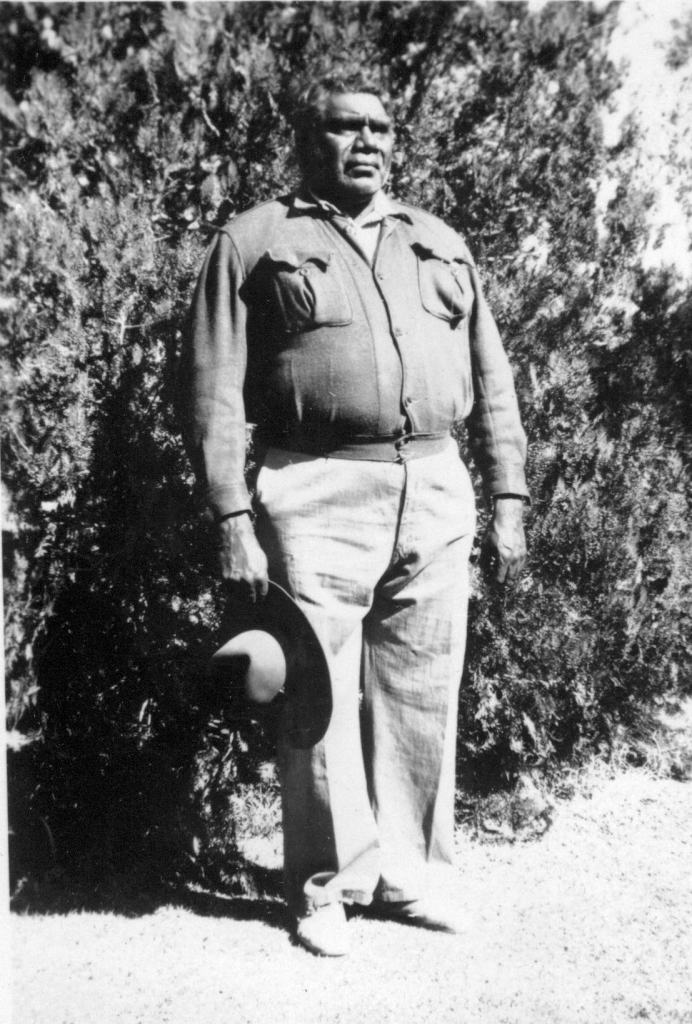
Albert Namatjira, 1949 (Public Domain, via Wikipedia)

Albert Namatjira, 1949 (Public Domain, via Wikipedia)

  • Art of the Australian Aboriginal by Charles Barrett and Robert H. Croll (with a foreword by anthropologist AP Elkin), in 1943. Charles Barrett was a naturalist and journalist, and R.H. Croll an author and public servant. Both travelled widely throughout Australia. Barrett was passionate about protecting ancient Aboriginal art, writing that its protection “should be a national concern: white morons have already disfigured many”.
  • The art of Albert Namatjira by C. P. Mountford, in 1944. Albert Namatjira is one of Australia’s best known Aboriginal artists, a pioneer. Mountford was a mechanic and public servant turned anthropologist who, by the 1920s, was developing the interest in indigenous Australian culture that stayed with him the rest of his life. He was particularly interested in art, but I was intrigued to read in the Australian Dictionary of Biography that “in 1935 he was appointed secretary of a board of inquiry to investigate allegations of ill-treatment of Aborigines in the Northern Territory, at Hermannsburg and Ayers Rock”. He also travelled with Norman Tindale who is famous for his detailed map of indigenous Australia.

Interesting, I think, that it was this “little” club which published these books.

Donation to the Adelaide University’s fund for Aboriginal research

This one intrigued me, and is what inspired this post, in fact. I read in The Argus, 19 May 1951, that Albert Namatjira had donated £1000 to the Adelaide University’s fund for Aboriginal Research. But, apparently, the story goes, he did not make the donation himself because “as Australian law now stands, an aborigine cannot control an income of his own”! Enter Bread and Cheese Club founder JK Moir who made the donation on Namatjira’s behalf out of the proceeds of the book by CP Mountford. Moir is quoted as saying:

Albert, as an aborigine, cannot control his affairs, but I know what we have done has his enthusiastic endorsement. There is no precedent for this anywhere. An aborigine raising £1000 through his work for the cause of his own people is unique. I can assure you it will not be the last donation if we can help it.

Coranderrk and the Barak Grave

The final story activity I want to share is more in the style of those working bees that groups like Rotary and Lions have often done. It concerns the cemetery at Coranderrk. Coranderrk was an Aboriginal reserve established by the government for dispossessed indigenous Australians. It operated from 1863 to 1924. It’s quite a story that I won’t detail here, but in 1950 the land was handed over to the Soldier Settler Scheme. The cemetery, which of course contained graves of the previous indigenous residents, was by then in disarray. In a letter to the editor of the Healesville Guardian on 19 May 1951, naturalist David Fleay wrote of being “shocked at its state of absolute neglect and ruin”. Only two graves, one being that of, Barak, the last king of the Yarra Yarra tribe, were distinguishable he said. He also refers to the marble monument to Barak that had been in a significant position in the town of Coranderrk but was now in a depot. He argued that money should be put aside to renovate the cemetery and that the Barak monument go to its “rightful place”. He also suggests that “it is possible that the Melbourne Bread and Cheese Club, champions of Australiana would take a decided interest”.

And so, in fact, they did. A Healesville Guardian column by Oswald C Robarts on 11 November 1955 writes of their contribution. They seem to have become involved in 1952 and carried out at least one working bee in 1955. It’s not clear what else they did. A report in the Club’s journal, Bohemia, states that “we did a good day’s work and those who remember the terrible state of the Cemetery when we saw it on our first visit would be surprised. Much remains to be done.”

I will conclude though with Oswald C Robarts:

On January 23 this year, several members of the Club travelled from Melbourne, bringing with them the necessary materials and equipment for handling the heavy parts of the memorial. Working throughout the day in near-century heat, they completed the job. It should be scarcely necessary to add that these men, like others who have previously urged that something should be done about Coranderrk, were not concerned with public kudos nor material gain.

Basically, interest in the “old” Australians who have gone, and wise, firm and considerate care for those that remain, are matters of public conscience. There is by now fairly wide general agreement that far too often in the past, as well as today, they have been handed the seamiest side of Western civilisation. Here is a paradox to be removed, for Australia today is spending millions on the Colombo Plan, and bending over backwards to assure our Asian neighbours that there is no such thing as a “White Australia” policy in a racial sense.

There is an element of paternalism in “the wise, firm and considerate care for those that remain” but this seems to be to be pretty strong stuff for 1955. Thanks once again to Trove for making these papers available.

Monday musings on Australian literature: The Bread and Cheese Club

I bet that title has you wondering! It was certainly new to me when I came across a book in my late mother-in-law’s collection titled Fellows all: The chronicles of the Bread and Cheese Club. Published in 1943, and written by HW Malloch, this book is a history of  the early years of the club by its first voted-in member.

I was intrigued, of course, so did some research. The Bread and Cheese Club, as it turns out was formed in Melbourne in June 1938. Its motto was “Mateship, Art and Letters”, and it was particularly active in promoting Australian writers. The Club apparently published around “40 volumes of verse and tributes” as well as a journal titled Bohemia. The founder* and Knight Grand Cheese (oh dear!) was John Kinmont Moir (1893-1958), a Melbourne book-collector. He apparently died in 1958, and the club gradually declined, finally ending in 1988. I wonder how many Melburnians know about it now?

Delving further, I learnt a little more about Moir and the club. Moir, in particular, is a rather significant man in Australian letters. According to the State Library of Victoria, Moir, from the 1930s to 1950s, “set himself the daunting task of collecting one copy of every work of fiction, poetry and drama ever published by an Australian author.” This, they said, at a time when Australian literary authors were neither fashionably read nor collected. The result was “one of the finest private libraries of Australian literature ever assembled”, one that he donated to the State Library in the 1950s. It remains one of their most significant collections. You can read more about him – and it’s an interesting story – online in the State Library’s La Trobe Journal.

John Shaw Neilson

John Shaw Neilson (Presumed Public Domain, via Wikipedia)

But, back to the Club. It was male only. The twelve founding members included the poet John Shaw Neilson (1872-1942) and balladist Edward Harrington. According to Malloch, the unusual name was chosen because they wanted something “Bohemian” and “arresting”, and it had the desired effect: it made people curious and provided an opportunity for members to explain their aims. Malloch tells a lovely story, too, about one of its practices – quaint to our point of view but indicative of their era – which was making it “a penal offence” to address each other as “Mister”.  Doing so incurred a fine of one penny which helped, in the early days at least, to swell the club’s coffers!

John Arnold in the La Trobe Journal says that Moir was conservative – right-wing, in fact. But the club was not political – though I suspect from my reading of Malloch that it leaned more right than left. Its goals were:

To promote mateship and fellowship among persons of mutual interests, to foster a knowledge of Australian Literature, Art and Music and to cultivate an Australian sentiment … (Malloch, p. 17)

It did this not only through publishing but by undertaking a wide range of projects and activities such as art exhibitions, song of the year competitions, short story competitions, and lobbying government. Malloch describes some of the earliest activities, including a short story competition which was judged by Nettie Palmer. Searching the National Library of Australia’s digitised newspaper database in Trove provides a fascinating picture of the breadth of the Club’s** activities. One report states that the Bread and Cheese Club was behind the Commonwealth Government’s providing a grant for the writing of a biography about JF Archibald, the founder of The Bulletin.

The club also invited guest speakers, and often opened those meetings to the public. Malloch tells us that these speakers included artist Max Meldrum, indigenous Australian activist, pastor and state governor Doug Nicholls, and journalist-author Frank Clune.

I could go on … it’s a fascinating story of passion and commitment to Australian culture. They even printed 50,000 stickers with such slogans as “Combine Pleasure and Patriotism and Read Australian Books” and “Let Your Christmas Gift be an Australian Book”. Where are these people now!

Finally, before I go, I can’t resist sharing one of those odd little reading synchronicities. I have, as my regular readers know, just read Eleanor Catton’s The luminaries. It starts with 12 men gathered in a hotel room, but they became 13 when a hotel guest wanders in. The Bread and Cheese Club started when 12 men met in a studio with the aim of “fostering Australian Art and Literature”. Having had their meeting, they adjourned to a nearby “city hostelry” where they met Malloch, and promptly asked him to join them. And so, he writes, there were 13. I know, I’m being silly, but I enjoy such, dare I call them, coincidences!

* POSTSCRIPT: While some reports describe Moir as the founder, Malloch’s book doesn’t state this. On page 10, he writes that: “Twelve turned up at the studio of Fellow E. J. Turner, 132 Cubitt Street, Richmond, and set the ball rolling with the definite aim of fostering Australian Art and Literature”. And on page 13, he specifically names these twelve as “the founders”. Moir was elected president (aka Knight Grand Cheese) and Turner secretary (or Worthy Scribe).

** Searching Trove surprisingly retrieves another Bread and Cheese Club in Melbourne! Malloch tells us briefly about that too. It was a very small club of solicitors and in 1859 merged into the Law Institute of Victoria.

Monday musings on Australian literature: Australia’s difficult novels

A week or so ago I wrote a post about reading difficult novels. As I researched that post, I came across many lists of difficult novels, including the one I included at the end of the post. The interesting thing is that none of the lists I saw included any Australian novels, and yet they included novels from most of the other continents. Do we not have any, or, more likely, are we just not on the world literature radar enough? Anyhow, I thought I’d get the ball rolling and suggest a few possibilities:

  • Patrick White’s Voss. It’s logical to start with White, because, currently, he’s Australia’s only Nobel Prize winner for literature. (I’ll do the rest alphabetically!).I’m not sure that Voss is his most difficult novel, but it depends on your definition of difficult. White’s prose is dense, with complex sentence structures and intense, but vivid imagery. Many readers find Voss particularly hard to read, though, because of the spiritual communion between Voss in the desert and Laura in the city. However, it appealed to my teenage sense of romance and resulted in my falling love with White.
  • Thea Astley’s Drylands. I’ve read quite a few Astleys. After all, she’s one of my favourite writers. She has a reputation for being difficult, with her earliest novels being particularly so, but I’ve chosen her last because of its form and its sense of desperation. Writer Mandy Sayer, an admirer like me, agrees that she is not “an easy read”, saying that she is “at once poetic, quirky, and literary”. Her imagery can be over the top, and she doesn’t shy from exploring our brutality, but she has such a heart. Every Australian should read her.
  • Peter Carey’s Illywhacker. Carey is hard to pin down, as his books vary so greatly. It’s one of the reasons I like him. You never know what you are going to get, from the at times surreal, to something like True history of the Kelly gang with its 19th century vernacular, unpolished grammar and largely absent punctuation, to the complexly structured like Parrot and Olivier in America (my review) and The chemistry of tears (my review). I’ve chosen Illywhacker, not because it’s regarded as his hardest but because I haven’t read it (yet).
  • JM Coetzee’s Diary of a bad year (my review). Coetzee, in this book and its predecessor Elizabeth Costello, pushes the envelope in terms of “the novel”. Some argued that Elizabeth Costello was more a series of lectures than a novel. Diary of a bad year presents readers with a very specific challenge. How do you read it, with its three (two to begin with) concurrent strands running across the top, middle and bottom of the page? Do you read one strand and then come back and read the next? Or do you try to read them concurrently? This is one of those books that is a challenge to read for its unusual structure and for the interplay between ideas and story that the reader needs to tease out.
  • Gerald Murnane’s The plains (my review). As blogger M. Sarki has written, “There is nothing but difficulty in reading a book written by Gerald Murnane.  But the reading gives me an enormous amount of pleasure…”. Murnane is one of our most innovative writers. He’s a challenge to read – where am I?, what is he saying? – but there’s exhilaration in that. I need to read more of him.

I think five is probably a good start, particularly given I’ve rambled on about each one. Other writers well worth considering if you are looking for “difficult” Australian literature include Rodney Hall, Thomas Keneally (his early works), David Malouf, Frank Moorhouse, Christos Tsiolkas. Not all works by these writers are “difficult” but many are recognised to be so.

I’ve read works by each of the writers I’ve named, but I’m sure other Aussies could name some favourite writers and “difficult” novels too. Has anyone read, for example, Eleanor Dark’s Prelude to Christopher? I’d love to hear your thoughts on the matter. Let’s get our Aussies out there!

Monday musings on Australian literature: Here come the men!

Women really have dominated the literary awards season in Australia over the last two years. In 2012, the majority of the awards were won by Anna Funder with All that I am and Gillian Mears with Foal’s bread. Last year it was mostly Michelle de Kretser with Questions of travel and Carrie Tiffany with Mateship with birds. ML Stedman also won an award with her The light between oceans. As well as all this, last year we had, for the first time ever, an all female shortlist for the Miles Franklin Award! Where, you may have been wondering, were the men?

Well, in their writing rooms it seems, beavering away, because by late last year their books started appearing in droves … and nice to see it is. I love reading fiction by women, but I also love reading fiction by men. Let’s face it, I love reading good fiction! Anyhow, I, and others like The Australian’s literary editor Stephen Romei, expect some strong showings by our male writers in this year’s award lists. Books like:

  • Richard Flanagan’s The narrow road to the deep north
  • Tom Keneally’s Shame and captives
  • Roger McDonald’s The following
  • Alex Miller’s Coal Creek
  • Christos Tsiolkas’ Barracuda
  • Tim Winton’s Eyrie

Stephen Romei predicts that Winton and Flanagan will battle it out, though says there are other strong contenders from a bumper year for Australian fiction. I will be reading Tsiolkas and Winton with my reading group over the next few months, and received Flanagan for Christmas. I am greatly looking forward to getting my teeth into these writers, each of whom I’ve reviewed before on this blog, and each of whom I respect and enjoy.

None of these, though, are debut authors. Every one has won and/or been shortlisted for the Miles Franklin at least once, and most, more than once. Of course it takes a little time for a debut to make it into public consciousness. However, you may remember that last year’s Miles Franklin Award shortlist of five titles contained three – yes, three – debut novels (Floundering, by Romy AshThe Beloved by Annah Faulkner, The Mountain by Drusilla Modjeska). That was healthy, and augurs well for the future, but I wonder if we’ll see any debut novels by male authors in the shortlists this year? While I don’t report regularly on awards, I’ll certainly be keeping an eye out for new authors appearing on the scene – or, indeed, for more established authors making their debut on the award lists.

Meanwhile, of course, I’ll continue to read Aussie women for the Australian Women Writers’ Challenge, including Hannah Kent’s debut novel Burial rites which could very well give the men a run for their money this year if the buzz surrounding this book is right.

2014 looks to be another exciting year for Australian fiction. How do you – Aussies and otherwise – see your reading shaping up for the year?