Monday musings on Australian literature: Australian flash fiction initiatives

It seemed sensible to follow up my review last week of Angela Meyer’s collection of flash fiction, Captives, with a selective survey of some Australian initiatives for this sort of fiction.

While flash fiction is not new, the internet does seem to be giving it renewed life. An online search will reveal many sites and blogs – individual and communal – on which writers can post their pieces. Here, though, I will focus on more “organisational” support for the form in Australia.

  • 52-Week Flash Fiction Challenge, on Facebook: Created, as far as I can gather, by Australian children’s author Sheryl Gwyther, this is an open flash fiction challenge, which means anyone from anywhere can post a story. Her definition is 20-500 words, and she has set a topic word for each week of the challenge. By way of example, the first three for this year, which started in March, were “silk”, “basic”, “sermon”.
  • Antipodean SF‘s Speculative Flash Fiction: AntiSF is a site “devoted to the online publication of short-short science/speculative fiction stories”, which they define as having an upper limit of 1000 words. You can read their flash fiction online. Everything they’ve published – flash fiction, reviews, and other short works – can be found at their Pandora archive.
  • Australian Horror Writers Association’s Flash and Short Story Competition: Entries are about to close for this year’s competition, but if you’re quick there’s still a chance. For the AHWA, flash fiction can be up to 1000 words. The winner of their competition will receive paid publication in the Assocation’s magazine, Midnight Echo, and an engraved plaque.
  • Fellowship of Australian Writers (Qld) Flash Fiction Competition: For FAWQ’s competition, flash fiction needs to be under 250 words, and “must have a beginning, middle and an end. It must also have conflict and resolution”. The theme for 2015 is “Harvest”. Hmm … that might get some creative juices going! There are two prizes of $100 and $50.
  • Flashers: An initiative of Seizure, Flashers promotes itself as the “online home of Australian flash fiction”. They publish new pieces, of 50 to 500 words, every week. They describe flash fiction as work that “could be written in an hour and read in a minute”, but they also recognise that it has “peculiar challenges – and authors have to make every word count”. This means to me that it often isn’t written in an hour, that it takes time to hone those words! But, here is the good news – at least it sounds good to me – Seizure actually pays for the pieces it publishes. Just $50, but a start eh? This payment is due to the support of the Australia Council.
  • Spineless Wonders, run by UTS alumni, states that they publish “the only annual anthology of microliterature (including Flash Fiction) in Australia”. Spineless Wonders cover the gamut of what they call “brief” fiction, that is, “short story, novella, sudden fiction and prose poetry”. Since 2011, they have sponsored The joanne burns Micro-Lit Award. For the 2015 award, won by Nick Couldwell, pieces had to be no more than 200 words, and meet the theme “out of place”. The winner and finalists will be published in an anthology titled, yes, Out of place. The prize also included $300.

This brief list represents only a slice of the action out there, but I’ve enjoyed sussing out what I think is a variety of ways in which the form is supported and promoted. I’d love to hear of sites you know and love.

Monday musings on Australian literature: Dymphna Cusack

It’s been nearly a year since I devoted a Monday Musings post to a specific author, my last one being Barbara Baynton last June. It seemed like time for another one, and Dymphna Cusack (1902-1981), I decided, could do with a little push. Best known for her collaborative novel, Come in spinner (1951, with Florence James), Cusack was, in fact, a prolific writer. According to Wikipedia, she wrote twelve novels, seven plays, as well as non-fiction and children’s books.

This is not, however, going to be biographical. I did cover some of her history in my review of her memoir as a teacher, A window in the dark. Here, I want to explore her role in the development of Australian literature using commentary from her contemporaries found via Trove.

Deserting the bush tradition

Dymphna Cusack, Jungfrau

Courtesy: Allen & Unwin

I’ve written before about the bush focus in Australian literature. It’s an important part of who we are but, Australia, believe it or not, has long been an urbanised nation. Cusack knew this as did some of those who reviewed her debut novel Jungfrau (my review). The reviewer in the Australian Women’s Weekly comments, in 1936, that 50 years hence Australians would not be shocked to see books dealing with “contemporary city life, and with the young, modern people of our capital cities”, but that right now such novels are “noteworthy”:

We have had fine novels of pioneers and the bush; the world knows Australia as a land of gum trees and sheep, convicts and cattle, sundowners and flies. It is doubtful, however, whether an overseas student of our literature would even suspect that a very large percentage of the country’s population eats, dreams, strives, succeeds or falls in cities larger than most of those in Europe and America.

Dymphna Cusack has realised this; she has deserted what has become almost a tradition in our fiction; she has broken new ground, and therein lies the importance of her book.

The reviewer comments on Cusack’s “convincing” picture of Sydney, and writes that “Surf, streets, trams, newspaper offices, churches, bookshops – these are the scenes against which the characters in “Jungfrau” move. S/he is particularly impressed by Cusack’s handling of modern young women:

The general conception of the “modern” girl is that she is hard, brittle, ready for anything – that, to use a current expression, she “knows all the answers.”

Miss Cusack has laid bare the fallacy of this; the young woman of this era is still vulnerable; despite her mask of self-assurance she is still as open to hurt as the young woman of any previous generation. Perhaps even more so.

Writing novels of ideas

The reviewer in Adelaide’s The Advertiser in 1937 was similarly impressed by Cusack’s achievement, but looked at it from a different angle. S/he reviews three novels by Australian women, starting with a general comment:

“It is not wholly fanciful to suggest that within a decade or so most novels of ideas will be written by women, “a distinguished English literary critic wrote recently. “Modern intelligent men,” he added, “express themselves and their thoughts more easily in autobiographies, biographies, essays, and books of travel than in the form of fiction. And the future of the English novel is already largely in the hands of women.”

I’m chuffed that something which I’ve been deducing from my rather general study of the period was being noticed at the time. Anyhow, our reviewer agrees with this critic commenting that

Australian women seem to be developing an individuality in recent novels that is far more interesting and inspiring than the efforts of their contemporaries among the men.

S/he describes Cusack’s Jungfrau “as a valuable picture of our city life that should do much to dispel persistently recurring illusions abroad concerning Australians’ homes, culture, manners, and way of speech”. S/he praises Cusack for “her irony, insight, and deft handling of human nature, and … [her] beautiful and thoughtful writing.”

Two years later in 1939, a writer in The Australasian reports Cusack as saying that

the job of translating Australia into words is too big a job for one person. It is probably the most exciting job in the world, because we are breaking new ground all the time.

This writer says of Cusack:

as a conversationalist she sparkles, brilliantly and wittily. She confesses to two passions (1) listening to Beethoven, and (2) surfing. And she would spend her spare time in the perfect world in arranging revolutions, for she thinks, most emphatically, that any kind of revolution is A GOOD THING.

That sounds like Cusack, and explains beautifully why she wrote novels of ideas. Read on …

Well-meaning, but …
Cusack, Southern SteelUnfortunately, it seems, in the opinion of contemporary reviewers anyhow, that Cusack’s interest in ideas/revolution/protest started to be detrimental to her fiction.

The Western Mail‘s reviewer, writing in 1953 of Cusack’s novel Southern steel, paid her a rather backhanded compliment:

It’s doubtful whether Miss Cusack’s most ardent admirers, even, would describe the book as a fine piece of writing, but at the same time it could not be denied that the Government [who gave her a grant] spent its money wisely.

The novel is set in the steel town of Newcastle, where Cusack had taught, and deals with “family disunion, feminine rivalries, big business and war-time Australia”. But, according to our reviewer, it is “unnecessarily crude”, “seems outdated”, and puzzlingly introduces so many characters it “becomes rather difficult to keep up with them all”. Nonetheless, s/he describes it as “vigorously written” and says “it gives a forceful, though somewhat imaginative, account of the Australia we lived in during the war”. That “though” is interesting, implying the imagination here has not been used appropriately.

And then there’s “the colour question”. Cusack wrote a novel, titled The sun in exile, about Jamaicans in London. The reviewer in The farmer and settler, in 1955, was not particularly impressed. S/he writes that “in an attempt to present a cross-section of views Miss Cusack puts into their [her characters’] mouths opinions often superficial and outdated” and, further, argues that “in highlighting the conflicts which flare up between immigrants and Londoners she seems to have written with an eye to dramatic effect rather than reality.” It’s “a well-meaning book”, s/he says, but it fails “to get under the surface of people and events”. And then the clincher: why, s/he asks, did Cusack have “to look overseas for her background and theme — Australia has racial problems of its own”. Good question, and in fact, Cusack went on to do just that.

Jean Battersby (at last, a by-line) writes in The Canberra Times in 1964 about Black lightning in which Cusack “applies some stinging social criticism to … the situation of our Aborigines”. Battersby clearly agrees that such criticism is needed:

By any enlightened standards the social status of Australian Aborigines, their living conditions, education and prospects, our dilatory and torpid national conscience and the leisurely progress of our policies are little credit to a modern, wealthy, civilized and Christian community.

However, she feels that Cusack took up the fight “with courage, sympathy and indignation, but without very much subtlety or skill”. Battersby writes that Cusack’s

enthusiasm leads her to over-simplify what is an immensely complex problem. There are more than two dimensions to this problem of race relations, and it is neither realistic nor good strategy to portray the blacks as all white and the whites as all black.

And here comes the crunch – the ongoing challenge faced by all novels of ideas:

Miss Cusack has not been able to avoid the main pitfall of the social novelist …. the temptation to overstate a strong case.

Art, properly exploited, is probably the most powerful ally of the social critic, for it allows objective argument to be translated into direct emotional experience. But its disciples must be observed … its special ways of making points, its dependence on balance and proportion. If they are not, it easily degenerates into pleading and propaganda, which tend to defeat their own ends, discrediting their cause by the methods which they use.

Now I need to read some of these later novels to see what I think. Have any of you read them?

My survey here of contemporary responses is pretty superficial. It’s possible, probable even, that others felt differently about Cusack’s writing. Regardless, though, of whether critics universally admired all of her work, there’s no doubt that Cusack made a significant contribution to the development of Australian literature.

Monday musings on Australian literature: On labelling writers

Today’s post was inspired by a tweet from Aminatta Forna which led me to an article she’d written titled “Don’t judge a book by its author”. The Guardian led the article with the following pull quote:

I have never met a writer who wishes to be described as a female writer, gay writer, black writer, Asian writer or African writer …

It’s a fascinating article that raises some meaty issues. It is, I recognise, about writers and writing in general, not just Australian, but I’ve decided to  write about it in my Monday Musings series because it touches on some issues I’ve talked about here before.

But first, Forna’s main thesis … it’s that labelling (or classifying) is “the very antithesis of literature”. She starts with the practice of labelling writers. Now, I admit, I am guilty of this. I have categories and/or tags on my blog for “women writers”, “Australian writers”, and so on. I’m a librarian/archivist by training and I find classification useful to support searches for specific information. Forna would possibly ask why we might want to search by such labels or categories, but I’ll come to that later.

As a librarian/archivist, I also know the limitations of categorising. How, for example, do you categorise Forna herself? She was born in Scotland to a Sierre Leonian father and a Scottish mother. She has lived in several countries but now lives in London, I believe. I decided, somewhat uncomfortably, to opt for British writer. We librarians also know about the implications of categorising, and Forna explores some of this too. The white male writer, she says, is “the only one called simply ‘writer'”. This is all very interesting, but is just the entrée to her main point, and to the main reason I wanted to talk about her article here … so let’s move on.

She argues that labels are the antithesis of literature because “the way of literature is to seek universality”, while labels are limiting. She uses the example of China Achebe who is “often called the grandfather of African literature”. As labels go, she argues, it isn’t the worst that could have been “pinned” on him, but the problem is that he “often found his universal themes overlooked in favour of an ethnographic reading” of his novel Things fall apart. Forna’s point is that

Writers do not write about places, they write about people who happen to live in those places.

This certainly rings true for her own The hired man, which I reviewed last week. She provides very little detail about the particular war it concerns, but focuses instead on its impact on people.

This sense of limitation extends further, however, as Forna explains. She posted, she said, a question on Facebook:

Where did the new orthodoxy arise that writers must only set stories within their own country of origin or nationality?

If you’re a regular reader here, the penny might now have dropped regarding why I am writing about this article here. It relates to my discussion last year concerning white Australians writing about indigenous Australians. I quoted Margaret Merrilees expressing concern about non-Aboriginal writers fearing “‘appropriating’ Aboriginal experience”. Forna reports that one respondent to her Facebook post, British (ha, she labels this writer!) writer Linda Grant, suggested

it’s about authenticity … And probably came in with post-colonial studies. If white people can’t appropriate the experiences of the oppressed for fiction then it no longer becomes possible for anyone to write outside their own experience.

Forna then quotes another writer, the Pakistani-British writer Kamila Shamsie, continuing this point:

What started as a thoughtful post-colonial critique of certain types of imperial texts somehow became a peculiar orthodoxy that essentially denies the possibility of imaginative engagement with anyone outside your little circle.

I think you get the drift without my going on. The political issue, as we’ve discussed before, has a lot to do with power. It requires sensitivity and awareness, if you’re the majority, but it should not deter writers from exercising their imagination. Forna talks about “authenticity” – and some writers’ fear that they can’t authentically write about a “culture” not their own. But what is authenticity, she asks, and who’s the judge.

I’m not going to continue with Forna’s argument here, because you can read it yourself, except to say that Forna concludes that “a novel is a work of imagination” in which the writer offers to take the reader on a journey. It’s a journey, she says, in which the novelist uses imagination to show readers something they have not seen before, and in which, readers, in return, bring their own experiences and imagination. I like it …

We have though moved quite a long way from the initial point regarding labelling and classification. Forna does return briefly to it suggesting that “sometimes we need labels just to describe the thing we are talking about”. I’d agree. I’d also say that sometimes we need labels for practical reasons, such as to identify issues or problems and right them. We Australians, for example, need to hear indigenous stories, but if disadvantage, prejudice and/or the commercial imperative mean these stories don’t get out, then we need to find those writers and support them. To do that we need to label them – don’t we?

Monday musings on Australian literature: Reading Australian literature

Reading Australian Literature is a lecture series inaugurated at the University of Sydney last year by its School of Letters, Arts and Media. The idea is for writers to talk about a literary text that means something to them. Here is how the website describes it:

Writers’ festivals and other popular forums invite writers to talk about their own work and creative practices. But what might they have to say about the books that excite their imaginations? There are few opportunities for writers to substantially engage with literature in the public sphere.

Reading Australian Literature is a series in which acclaimed Australian writers reflect on the Australian books they value. In a thoughtful and engaging public lecture, each writer will discuss a favourite Australian literary text. What has led them to these books? What do they find remarkable about them? Have these encounters with Australian books left an imprint on the speakers’ own writing?

As far as I can gather there were three lectures last year, and they plan four this year. Because I love hearing authors talk about writing and writers, I thought I’d share with you the writers and their chosen texts to date in the series:

  • Michelle de Kretser: Jessica Anderson’s Tirra Lirra by the river. De Kretser, whose Questions of travel I reviewed a couple of years ago, likes this novel, which I read and loved many years ago, because it’s “one of the great novels of place”.
  • Drusilla Modjeska: Randolph Stow’s Visitants. Modjeska chose this “underrated” novel set in the Trobriand Islands because it “remains unsurpassed in outside fiction of our complex near-neighbour”.
  • Fiona McFarlane: Patrick White’s The aunt’s story. McFarlane, whose The night guest I reviewed recently, said that White’s novel “produces a bodily reaction” in her. She reacts to it, she said, “with a kind of horrified, delighted rapture.”
  • Charlotte Wood: Shirley Hazzard’s The transit of Venus. Wood describes Hazzard’s novel, which I have also read, but a long time ago, “as a novel I could return to for the rest my life, each time finding a new experience within its pages.” An edited version of Wood’s lecture can be found online at the Sydney Review of Books. Wood writes here that the novel is “concerned with much deeper moral courage than that required simply to love”. She also sees it as being about self-sovereignty. In my reading notes, I wrote that it’s about the discrepancy between who we might be and who we are, about the failure of many of us to be the best we can because we let ourselves be distracted by superficial concerns.
  • Delia Falconer: Christina Stead’s Seven poor men of Sydney (lecture scheduled for 21 April). Falconer, whose The service of clouds I’ve read, again long before blogging, says she’s come to this book late. She loves its evocation of Sydney in the 1920s’s, but also says she’s impressed by “the intensity of Stead’s artistic vision”. She plans to argue “against the accepted view that this is an uneven book marred by the excesses of a first-time author” because she sees “the astonishing maturity and political sophistication of her use of form”.

How difficult it must be for these authors to choose just one literary work to talk about, but these particular choices are fascinating – not just for the books they’ve chosen but for the reasons they’ve chosen them. Those reasons tell as a lot about their interests as readers and writers. Drusilla Modjeska’s focus on “outside” fiction and Michelle de Kretser’s on place, for example, make sense if you know the sorts of things they write.

Intriguing all the authors so far have been women. It would be good to see male writers in the last two planned for this year.

Just a little post this week, but I thought this lecture series was worth sharing. Unfortunately, it doesn’t seem that the lectures are published online by the organisers, in either oral or written form. What a missed opportunity!

Monday musings on Australian literature: Social media reviewing

I’ve been a bit distracted lately by life and so missed an article which appeared a few days ago in the online journal, The Conversation. Luckily, there’s Twitter, so I didn’t miss it entirely! Isn’t social media grand? Except, of course, when you botch it. And this is where this article I nearly missed comes in …

Written by Jane Messer of Macquarie University, it asks, perhaps a little too cutely, “Should authors Rushdie to judgment as book reviewers?” The article springboards from a recent brouhaha involving Salman Rushdie giving “public 1-, 2- and 3-star ratings to books by well-known and esteemed writers such as Kingsley Amis, the late father of his friend Martin Amis, and Hermione [I think she may have meant Harper] Lee” on GoodReads. He was not a popular man, but claims that he didn’t realise his ratings were public.

However, my focus today is not Mr Rushdie, but social media reviewing. Messer quotes Charlotte Durack, Marketing Executive at Pan MacMillan Australia, who told her that GoodReads “is the most important site at which authors should have a presence, ‘as this is where the majority of reviewers live'”. Social media, Messer says, offers authors the opportunity “to engage with readers and the industry” in all sorts of discussions.

Messer’s focus in her article is authors reviewing authors. She continues:

The negative reaction by other authors to Rushdie’s book ratings demonstrates how sensitive writers can be to the public discussion of the literature of their peers or literary antecedents. But why shouldn’t an author as reader, or expert reader, give however many stars they like to a book?

Stars without reviews can be “glib” she says, and GoodReads, unlike Amazon, does not provide “ethics guidelines or even tips or warnings”. I must say that I tend to be bemused by these sorts of guidelines. Should we have to be told that it’s not ethical, if you’re an author, to post anonymous negative reviews of other authors (or anonymous positive reviews of yourself)? (What is wrong with us that we need to be told this?)

Anyhow, Messer’s point is that writers are readers too – and the literary world, she says, encourages critics and reviewers to be courageous when speaking publicly. She quotes a number of sites as supporting this philosophy: Sydney Review of Books, the Australian Women’s Writers Challenge (woo hoo!), and the Pascall Prize for Australian Critic of the Year. She continues:

These relatively new initiatives are having influence and impact, by expanding the depth and range of reviews of books and writing, and a diversity of reviewers, among whom are authors (my emphasis).

She’s certainly right about the Australian Women Writers’ Challenge where several authors – such as Annabel Smith, Amanda Curtin, Jessica White and Jane Rawson, to name a few – are among our reviewers. The challenge team greatly appreciates their contribution to and engagement in the process. The more perspectives we have, surely the better for Australian literature – and authors, I find, can often have quite a different perspective. I love hearing their thoughts about how a book is put together – they know intimately the challenges of getting a plot to work, of making characters engaging, of not upsetting readers with incorrect facts!

Social media reviewing is, of course, a mixed bag – and users need to recognise that many (most, even) of the reviews they read are by amateurs who vary greatly in interest and skill, and can, in fact, have different ideas about what reviewing is. It’s not all great, but it’s not all bad either. Indeed, George Orwell suggested in his essay “Confessions of a book reviewer” (my review) that amateurs could be fine reviewers of novels.

Anyhow, I’m rather glad that this article came to my attention now, because it has given me the opportunity to announce that the Australian Women Writers Challenge has just made available the ability to search all reviews (some in blogs, some on GoodReads) posted by challenge participants since the beginning of 2013. Reviews posted in 2012, the first year of the Challenge, will be added soon. The search page is still being tweaked, and sometimes a bug or two appears, but we’d love readers to start using it and give us feedback. You can access the page here.

Now back to Messer who concludes her article by saying that:

Authors need to be very digitally literate to make the best use of their voices.

But that, I’d say, is true for all social media users. The consequences of digital illiteracy may not be as dramatic for us “ordinary” readers, but they are there. Best to be wise before the fact!

Monday musings on Australian literature: Short Stories, 1920s style

“A good short story is a work of art, and a joy of forever!” So wrote the author of The Sydney Stock and Station Journal’s “Our Book Column”, back in March 1920. I hadn’t planned to write about this topic today, but the various discussions of short stories I found while researching Trove distracted me. You all know how much I enjoy short stories. I couldn’t resist delving a little deeper – and by a little, I do mean a little, but still, I found some interesting ideas and perspectives.

Back to my opening quote. I love the fact that it comes from a stock and station journal. It suggests that short stories were widely popular then – in those days before television, and even radio (which started around 1923-1924 but of course was not immediately available to everyone everywhere). The writer (or writers) in The Queenslander’s Literature pages wrote frequently about short stories in the early 1920s, usually in reference to published collections or anthologies, most of which were not Australian. I’m mentioning them here though, not so much for the books being reviewed or promoted but for the commentary they provide on short stories. Here’s a fairly random selection of comments from The Queenslander.

  • On the value of short stories: “A book of short stories is usually a boon, and when the short stories are good it is a distinctly pleasant possession”. Well, duh – though I do like the idea that short stories are “a boon” by their very existence. Do readers still feel this way?
  • On the first of a planned annual, clearly international, anthology, The Best Stories of 1922: “In their first collection, “The Best Short Stories” of 1922″ (Jonathan Cape) they include some that certainly ought never to have got beyond the page of the magazines in which they were originally printed, and merely mention in a second-class a great number of others that must be considered with the year’s best. It may be, of course, that they were handicapped by the copyright. A few of the stories, however, are really first-class, including “Seaton’s Aunt,” by Walter de la Mare”. I like the fact that the writer doesn’t pull punches about the mixed quality of the selection.
  • On a growing interest in English language short stories: “For a great many years the short story was supposed to be the special property of the French writer, and for a generation the short story had only two notable exponents in English—Kipling and “O. Henry,” masters for all time. Recently, however, there is hardly a British or American writer of note who has not sought to excel in this special field, and one concludes that the English-speaking world is at last waking up to the value of the short story.”
  • Another par on the growing interest in short stories: “That the short story has gained a hold on the imagination of the English speaking peoples is very evident, for scarcely an English or American mail comes in without a book or two of short stories from the publishers. One of the latest is “Thirty-one Stories” (Thornton Butterworth), collected by Ernest Rhys and C. A. Dawson Scott, and containing stories by such writers as H. G. Wells, Arnold Bennett, John Russell, Aumonier, Galsworthy, May Sinclair, and others.” One of the things I enjoy about these articles is seeing the writers they include – some I know, some I don’t know, and some I’d forgotten about.
  • And another one in the same year on, yes, the popularity of short stories: “The world evidently cannot have too many short stories. Almost every author of note has published, or is publishing, a volume of short stories, and occasionally some discerning publisher collects a number of short stories of various authors and the result makes a very readable book.” The article mentions a recently received American collection called Marriage, which includes stories by Hergesheimer and Booth Tarkington among others. I wonder how these stories would read today?

Other articles I found talk about fostering and encouraging local writers. Evening News wrote in 1921 that it would continue to publish short stories by Australian authors in its Sunday News edition, as part of its “policy of endeavoring to give a stimulus to native literature”.

The writer of The Western Mail, probably the Fairfax I mentioned in a post earlier this year, praises the stories of Dowel O’Reilly whose humour, he says, “never degenerates—as is the case with some Australian writers—into the unedifying antics of sheer larrikinism”! The Western Mail was not so pleased with the stories of Elizabeth Fairfax. I’ll quote this par in full:

We have received from the publishers, (Melville and Mullen Pty. Ltd., Melbourne) a copy of “Garden o’ Memories and Other Stories,” by Elizabeth Fairfax. Reprinted from the pages of various Australian periodicals, the stories contained in this little volume are no better and no worse than the majority of their kind. Whether they were worth reissuing is another matter altogether. Perhaps “Time and Tide” is the pick of the bunch, but they are all of them afflicted with an incurable tendency to sentimentalism in its most advanced stage.

The book has a frontispiece in colour – and a pictorial cover design.

Hmmm … sounds like the cover might be the best part.

Finally, something practical. Here is the writer in The Argus responding to a query regarding how to get short stories published. S/he writes: “It is only possible to find publication for the stories if they are equal to the standard required by the editor to whom they are submitted. The stories should be typewritten on one side of the paper only, and a stamped and addressed envelope should be forwarded with the manuscript for its return in the event of its proving unsuitable. The manuscript should be addressed to the editor of the magazine or newspaper to whom it is to be submitted, and on no account should a copy be sent to two papers at the same time.”

I’ve filled this post, I know, with excerpts from newspaper articles but I do enjoy these insights into the thinking of a different time. I hope you get something out of them too.

Monday musings on Australian literature: First winners of The Bulletin Novel Prize

“Once again women have proved that they can triumph over men”! So starts a 1928 newspaper article announcing the winners of the first Bulletin Novel Prize. Hmmm … fascinating to read this the week we heard that eight of the ten books longlisted for the 2015 Miles Franklin Award are by women. I don’t like to think that today we are talking about one gender triumphing over another, but about equality of opportunity to be published and considered for awards. However, I suspect there was an element of competition back in those more gender-divided days.

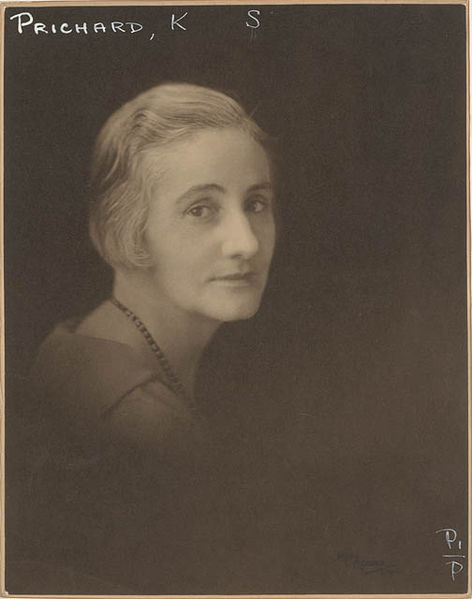
The Bulletin Novel Prize was announced in 1927, and was first awarded in 1928. The first First Prize was shared between three women writers – the previously published Katharine Susannah Prichard for her novel Coonardoo, and the debut collaborators, Majorie Barnard and Flora Eldershaw, writing as M. Barnard Eldershaw, for their A house is built. Third prize went to Vance Palmer, husband of Nettie Palmer. (He went on to win the prize in its second year with his most famous novel, The passage).

I’ve mentioned this prize before in a post on early literary prizes. Today I thought I’d share some of the reporting on the first award because – well, because I found it interesting. And I found it interesting for two main reasons, besides that opening salvo. One is that most of the reports I found via the National Library of Australia’s Trove focus more on Prichard than on M. Barnard Eldershaw, presumably because she was a well-respected, award-winning, previously published author, while they were unknowns. My other reason relates to how her winning book was described.

Katharine Susannah Prichard

Prichard, 1927/8 (Courtesy: State Library of NSW, via Wikimedia Commons)

The main article announcing the award – the one starting with the words with which I opened this post – appeared in city and regional newspapers throughout Australia. It tells us nothing about A house is built, but has this to say about Coonardoo, which was a ground-breaking and controversial novel for its depiction of “the sexuality of white men and black women” (ADB). The article describes it as follows:

‘Coonardoo’ is thoroughly typical of her penmanship, frank, vigorous, full of life and movement. Its setting is a station in the north-west of Western Australia, where a widow brings up her only son. Its men and women, made to live in her pages with remarkable reality, are typical of those who are everywhere making the real Australia — the Australia that is outside the cities. The relationships of the white settlers and the blacks, dealt with   firmly and quite frankly, supply the main theme of the story. Coonardoo from whom the novel takes its title (the word means “the well in the shadow”), is a little black girl of unusual type. In the background is the pioneering life; and woven through the story are the strange superstitions of the aboriginals and their weird customs. ‘Coonardoo’ is unquestionably one of the most powerful and absorbing novels ever written in Australia.

I love what this tells us about the times. There’s the idea that “real” Australia is “the Australia that is outside the cities”. It’s taken us a long time to accept, in our literature, that we are and always have been, in fact, a highly urbanised nation. And then there’s the description of Coonardoo as being “a little black girl of unusual type”. What does this mean? The writer doesn’t explain, and it’s too long since I’ve read the book for me to identify whether indeed she was of “unusual type” or whether this is the white writer’s assumption that any indigenous person mixing in a white world was unusual?  The writer also tells us that the story is woven with “the strange superstitions of the aboriginals and their weird customs”. How far we have come since then (I hope) to the point where we now see indigenous customs as not being “superstitions” or “weird” but an alternative world view, and one that we non-indigenous Australians not only respect but can learn from. Articles like this provide such rich pickings for researchers looking for values and attitudes of past times, but also for more casual readers like me interested in seeing where we have come from.

There are several brief articles announcing the prize, and a few advising that Coonardoo would start being serialised in The Bulletin forthwith, but I’ll just share one other. Its headline is: “PRIZE NOVELISTS: VANCE PALMER’S SUCCESS”! Why does third prize-getter Vance Palmer get the headline? We could jump to the conclusion that it’s because he’s a man, but the more likely answer is implied in the opening sentence: “Much satisfaction was expressed in Brisbane yesterday at the announcement in the “Courier,” in a message from Sydney, that Katherine Susannah Prichard, of Western Australia, and Vance Palmer, of Caloundra, had achieved success in the “Bulletin” prize novel competition”. The newspaper from which this article comes is The Brisbane Courier, that is, the main newspaper for the state in which Palmer was born. We’re not parochial! Poor old joint winners Flora S. Eldershaw and Marjorie Barnard don’t get a mention until the second paragraph.

I wonder what people reading our papers a hundred years hence will think of the assumptions and values we express!

Monday musings on Australian literature: Scattered thoughts on memoirs

I’ve titled this Monday Musings “scattered thoughts” because I don’t want to raise expectations that I’m going to write a treatise on what is a fascinating but oh-so complex topic. I was inspired to write this post by author Annabel Smith’s asking me to take part in her Friday Faves* post on favourite memoirs. For this post, Smith asked six writers/bloggers to nominate their favourite memoir. Three of us chose Australian memoirs. Do check the link I’ve provided if you’re interested – I certainly enjoyed reading my co-invitees’ selections.

According to my stats, I have read and reviewed 24 autobiographies or memoirs over the history of this blog. I don’t want to get into discussions about autobiography vs memoir now, except to say that Wikipedia’s definition is pretty much how I see it:

An autobiography tells the story of a life, while a memoir tells a story from a life.

By this definition, a memoir will tend to focus on an aspect of a person’s life, often an event or activity that defines who they are or why they are the way they are! Over half of the 24 books I’ve reviewed are memoirs, and a little over half of them are by Australian writers.

The main point I want to make here is that while memoirs reach far back into time, as the Wikipedia article describes, they started gaining popularity – and, with it, visible literary status – in the last couple of decades. Early standouts for me were an Australian one, Sally Morgan’s My place, and an Irish-American one, Frank McCourt’s Angela’s ashes. Who hasn’t read these! Both are moving stories, and both are written by people who can write! It’s all very well to have a story to tell, but there’s more to it than that …

So much more, in fact, that memoirs have become the subject of academic and critical discussion. Where, for example, is the boundary between memoir and autobiographical fiction? Why would an author pass off as memoir a work that was fiction – such as James Frey’s A million little pieces. Despite controversies like this, however, memoirs have cachet and are appearing on literary prize shortlists.

Take, for example, the Kibble Literary Awards (the Nita B Kibble Literary Award for an established Australian female writer, and the Dobbie Literary Award for a first published work by a female writer). These awards are for “life-writing” and can be won by “novels, autobiographies, biographies, literature and any writing with a strong personal element”. In recent years, memoirs have been among the winners, such as Kristina Olsson’s Boy lost: A family memoir (2014), Kate Richards’ Madness: A memoir (2014), Lily Chan’s Toyo: A memoir (2013), and Inga Clendinnen’s Tiger eye (2001).

These awards, though, are for life writing so it’s not surprising that memoirs feature. Memoirs, however, also appear in non-fiction awards. Kate Richards, for example, won the non-fiction prize in the Adelaide Festival Awards for Literature in 2014 for Madness: A memoir. Kristina Olsson’s Boy lost: A family memoir won the Douglas Stewart Prize for Non-fiction in the 2014 New South Wales Premier’s Literary Awards, and Malcolm Fraser with Margaret Simons won the same award in 2011 for Malcolm Fraser: The political memoirs.

And then there’s the Stella Prize, established in 2012 for “writing by Australian women in all genres”. So far, a memoir hasn’t won, but they have been short and long-listed. The 2012 longlist included Patti Miller’s The mind of a thief; the 2013 longlist had Gabrielle Carey’s Moving Among Strangers: Randolph Stow and my family and Kristina Olsson’s Boy lost: A family memoir. Kristina Olsson also made it to the shortlist. This year, Biff Ward’s In my mother’s house which, coincidentally, will be my next review, was longlisted, though it didn’t make the shortlist.

Don’t worry, I’m not going to keep listing awards won by memoirs, because I think I’ve made my point that memoirs are worthy of serious consideration. Certainly, I enjoy a good memoir – and I like thinking about what makes a memoir. I’ve read several Australian memoirs last year which did not feature in awards but which had strong voices that engaged me, such as Margaret Rose Stringer’s And then like my dreams (my review) and Olivera Simić’s Surviving peace (my review).

I’m intrigued by novels which are closely autobiographical, like, say, Kate Jennings’ Snake (my review). It’s a novel, but Jennings used excerpts from it in Trouble (my review), which she called her “fragmented autobiography”. Barbara Hanrahan’s The scent of eucalyptus (my review) is also highly autobiographical.

Francesa Rendle-Short book cover Bite your tongue

(Courtesy: Spinifex Press)

Then there are the books that more explicitly span the memoir-fiction divide. Kate Holden’s The romantic: Italian nights and days (my review) is, she says, memoir. She started it as a novel, feeling memoirs are “narcissistic”, but realised it was her “life” so she turned back to memoir – and wrote it in third person! And this brings me to the book I nominated for Annabel Smith’s post, Francesca Rundle-Short’s Bite your tongue (my review). Described as a fiction-cum-memoir, it too is told third person – in the main, because a few first person chapters are interspersed in the book. Rendle-Short chose third person because the story was too hard to tell so she had to come at it “obliquely”, while Holden chose third person to maintain “critical distance” from her former self.

Oh dear, I think this has been a bit of a ramble … but it’s a topic I love thinking about. Thanks Annabel for inspiring me to post on it today!

Now I’d love to know whether you, reading this, are memoir readers, and if you are, what makes a good one for you.

Friday Faves is a series on Smith’s blogs in which she asks one or more writers and/or bloggers to write about a favourite book, often on a specific topic. I reviewed her novel/ebook/app The ark last year.

Monday musings on Australian literature: Miles Franklin, and the mysterious Brent of Bin Bin

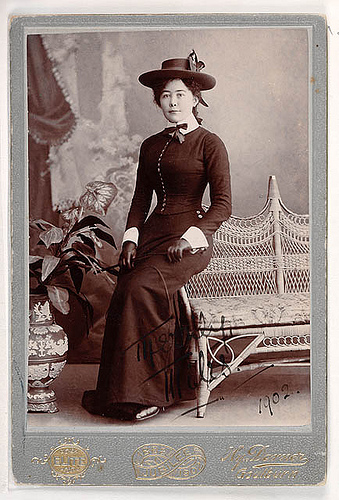
Miles Franklin, 1902

Miles Franklin, 1902, by H.Y. Dorner (Presumed Public Domain)

In last week’s Monday Musings I discussed an article by Canadian-born author Aidan de Brune on the novelist Bernard Cronin in his West Australian series on Australian Authors. The now little-known Bernard Cronin was no. 3 in his series. Number 4, though, was one of the giants of Australian literature – then, and still now – Miles Franklin. Most of you will know that she bequeathed our most significant literary prize, the Miles Franklin Award, and you probably have also heard of her most famous book, My brilliant career. But, Miles Franklin did have a secret …

This secret, as we now know, is that in addition to several other novels published under her name, she wrote a series of six novels using the pseudonym “Brent of Bin Bin”. They were completed by 1933 but not all had been published by her death in September 1954. According to Paul Brunton, editor of The diaries of Miles Franklin, Franklin saw this as “a publicity device”. She wrote in 1929 that “hiding under a pen-name … will be more fruitful of publicity”. Her plan was to retain the mystery until the last book was published at which time she would reveal her identity. Unfortunately, she died before they were all finished. Nonetheless, Brunton says, she “enjoyed the speculation on Brent’s identity”. In 1941 she chaired, “with a straight face”, a meeting of  the Fellowship of Australian Writers at which Brent of Bin Bin’s identity was discussed. Brunton continues:

She had no scruples about praising Brent’s books publicly as though she had nothing to do with them, as she does in her diaries. She even praised them in her Commonwealth Literary Fund lectures in 1950.

She also wrote to others, including the critic Nettie Palmer, as Brent of Bin Bin. I should add here that the current theory is that she used “Brent of Bin Bin” (and her other pseudonyms) because she feared not being able to repeat her My brilliant career achievement.

Anyhow, back to Aidan de Brune writing in 1933. He commences his article with:

Thirty years ago literary circles in Australia were astounded by the publication of an extraordinary book, written by a girl of sixteen, Stella Miles Franklin. The title of the book was audacious — “My Brilliant Career.”

He praises the book saying:

It throbs with a passionate love of the Australian bush, and particularly of horses, and with an equal passionate hatred of the cruelties of life endured by the people on the land, particularly by the women. It is the first statement, and to this day it remains the greatest statement, of the case for Australian bush womanhood.

He also quotes Henry Lawson’s praise in the book’s preface for its “painfully real” depiction of “bush life and scenery”. De Brune is concerned that in 1933 it, like many “fine” Australian books had been allowed to go out of print, with copies being hard to come by. He then gives a little of Franklin’s biography – her twenty years abroad working for the Feminist Movement in the USA, in the Scottish Women’s Hospital in Salonika, and for a housing committee in London. But now, he tells his readers, she is back and in 1932 had published a book, Old Blastus of Bandicoot, “under her name”. (Hmm … !) It was highly praised by many critics including John Dalley in The Bulletin. He also advises that another book, a detective story, would be published in 1933.

But, he asks:

Is that, then, the whole story of Miles Franklin? We shall see. Is it likely, or possible, that a writer of such power and sheer genius as the author of “My Brilliant Career” should have been silent for more than twenty years?

Fair questions! He goes on to tell his readers that “Miles Franklin will not admit it” but many people are identifying her with

the mysterious “Brent of Bin Bin,” whose books (published by Blackwood, of Edinburgh, be it noted) are acknowledegd to be the finest presentation in fiction of the Australian outback epic which have yet been written. “Brent of Bin Bin” loves the bush and understands horses, and hates injustice to bush women, as only the author of “My Brilliant Career” and “Old Blastus of Bandicoot” could love, and understand, and hate.

Brent of Bin Bin’s books are now Australian classics he says but, like My brilliant career, are hard to come by. How lucky we are that publishers like Text Publishing, Allen & Unwin, and others, are bringing back Australian classics in our times, eh?

Anyhow, I did love the conclusion to his article:

If Miles Franklin is also “Brent of Bin Bin,” then she is the greatest Australian bush novelist alive. And if she is only Miles Franklin of “My Brilliant Career” and “Old Blastus of Bandicoot” she takes second place to one writer alone — the tremendously gifted and mysterious author who writes in Miles Franklin’s manner under the pseudonym of “Brent.”

Ha ha … I bet he had fun writing that! I’m intrigued though that the praise is qualified, that she is “the greatest bush novelist”. I sense though that he doesn’t intend to diminish her achievement but to simply describe the milieu she was writing in. What I hear is that the bush continued to be a significant concern in 1930s Australia and was therefore seen as a worthy topic for our literature.

POSTSCRIPT: In an article written after her death, Murray Tonkin asks whether her death will finally solve the literary mystery. So, although many were confident they knew the identity, Franklin clearly kept up the pretence to the end. Tonkin says that he will “gladly eat his hat” if Franklin is not identified as “at least a close collaborator”. Love it!

Monday musings on Australian literature: Bernard Cronin, an Old Derelict!

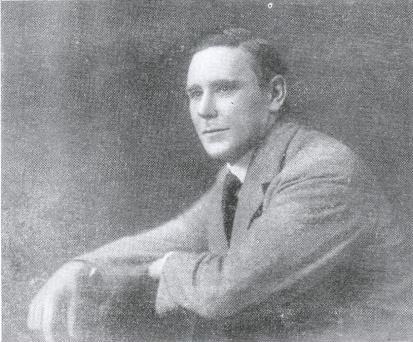
Bernard Cronin

Bernard Cronin (Presumed Public Domain, via Wikipedia)

It’s a bit cheeky, really, to write about a writer I’ve never read, but I do this occasionally, particularly in Monday Musings because I use them to educate myself as well as to share ideas and knowledge with you. I came across Bernard Cronin (1884-1968) when I was roving around Trove earlier this year. He’s an English-born Australian writer and you can read about him on Wikipedia and at the Australian Dictionary of Biography. If you want to read about his life, do go there, because my focus is not going to be that.

However, I will give you a nutshell! Cronin came to Australia when he was 6 years old, and graduated from an agricultural college. He worked in cattle-farming, as a salesman and clerk, and as a journalist, but for most of his life he was also writing. He wrote novels, short stories, plays, and verse, some in his own name and some using pseudonyms. In 1920, he co-founded the Old Derelicts’ Club (don’t you love that!) for struggling authors and writers. This became the Society of Australian Authors in 1927, with Cronin its first president, but in 1936 the society was wound up because, according to Cronin, it was becoming “infiltrated by politics”. Cronin St, in a suburb in my city, is named for him.

Cronin first came to my attention when he appeared in the top 10 of the 1927 plebiscite on Australian authors*. And then, as I was following other links, I came across him again in an article written in 1933 by Canadian writer, Aidan de Brune (1879-1946), who also settled in Australia. Aidan de Brune wrote a series of articles on Australian authors for The West Australian, devoting the third article to Cronin. By this time, 1933, Cronin had published around 15 or so novels, and saw himself as an Australian writer. De Brune writes that unlike many writers he had stayed in Australia, and quotes Cronin as saying:

The writer in the Old Country finds his scenery, as it were, ready made for him. In this country it is definitely not to be found upon the surface of things. One has to dig deeply to become aware of the very great natural beauties of the Australian landscape. Real treasure is mostly of the buried variety. To my mind there is more character in an old Aussie gum tree than in any other tree I ever heard of. Incidentally, I should say that that much abused genius, D. H. Lawrence, came closer to an understanding of the spirit of the Australian landscape than any other writer, local, or imported, has yet done. He is the first scribe definitely to sight the real genii of the bush.

De Brune interprets this as Cronin seeing “Australia as a literary theme”, but without a need to “sentimentalise” it. I’m intrigued by Cronin’s comment on DH Lawrence. I still haven’t read Kangaroo and, while I’m not driven to read Lawrence again, I feel I should make an exception for this, one day. I also love Cronin’s description the “Aussie gum tree”. Yes!

De Brune then quotes Cronin again:

Our trouble is that we lack real breeding, and crudeness is a poor scaffold for the Arts. Further, the indifference of our rulers to the absolute need to develop a national soul has not made matters any better. Hansard will never make this country aware of the sublimities of human destiny. We need to see Australia from her own standpoint, and with her own individuality. The Arts are our only hope of salvation.

De Brune comments that “by this last phrase our fierce realist is revealed as an idealist, after all”. Perhaps so. What interests me, these eight decades later, is that ongoing battle against indifferent rulers for validation of the arts, for recognition of the importance of the arts to our souls, national and otherwise.

Cronin’s next novel, to be published in 1933, was The sow’s ear. Set in Tasmanian timber country, it is, says De Brune, “a ruthless exposure of the tragic life of young girls enslaved by the system of marrying without love, at the command of domineering parents”. He writes that all Cronin’s novels have this “fierce” quality, exposing what Cronin “considers to be wrong, stupid or uneconomic. In this sense he is the strongest of the Australian writers who wish to make us aware of our short comings, so that we may eliminate them, and become a truly civilised nation.” So, Cronin had a very clear image of what sort of Australia, what sort of “national soul” he wanted us to develop.

After giving a brief rundown of Cronin’s life and career to date, de Brune concludes with Cronin’s role in the Australian Society of Authors. He again quotes Cronin:

There is much to discourage the Australian writer. Nevertheless, he holds steadily to his job. He hopes that the pioneering work which he is doing will prove an invaluable foundation for the generation of writers to come. Give him the support of his own Government and public, and he will win to wider distinction inside a decade. But he’ll win through, any way.

I love that optimism – that writers will “win through anyway”. In many ways I think they do – but I do often wish it were easier for them! De Brune ends his article forecasting that “when Australian authors have finally won recognition from their own people, the name of Bernard Cronin will stand high in the roll of honour of those who have fought for this objective”. Now, that makes me sad. Maybe this is a case of back-slapping between mates, but somehow, reading Cronin’s words, and of his role in various writers’ organisations, I suspect there is a good deal of truth in De Brune’s assessment – and yet I didn’t know Cronin. I’d love to know if other Aussies here do.

* I wrote on this plebiscite in a Monday Musings last year, but only gave the top 6 novelists. Cronin was number 7!