Monday musings on Australian literature: Eleanor Witcombe

Eleanor Witcombe

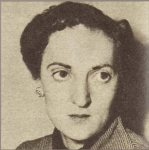
Eleanor Witcombe, 1950 from Australian Women’s Weekly (Presumed Public Domain)

Eleanor Witcombe, who died in October at the venerable age of 95, is not exactly a household name in Australia – but some of her work is, because she’s associated with the renaissance of Australian film in the late 1970s. She wrote the screenplays for The getting of wisdom and My brilliant careerHowever, her writing career long preceded that work.

Growing up

Eleanor Witcombe, then, was a playwright and screenwriter. She was born in 1923 in Yorketown, South Australia, where she went to Yorketown Higher Primary School until 1939 when her family moved to Brisbane. There she attended Brisbane Girls’ Grammar School. I was entertained to find, via Trove, all sorts of references to her schooldays because in those days, particularly in country towns, the papers reported on school doings. Yorketown’s The Pioneer regularly included “Honor Lists” in which the young Eleanor would appear, such as in 1931 for “Arithmetic” and “Mental”, or, in 1935, as winning a prize for “Schoolwork” in the Yorketown Show. In 1932 the paper reported on the formation of Yorketown’s first Brownie pack, and listed Eleanor and her sister among its first members, and in 1938, it reported that she had earned Honours in her Grade VI Music Theory exam. She was clearly a diligent girl …

… and she liked writing. The Sydney Morning Herald, in its obituary, says that her English teachers at Brisbane Grammar School encouraged her talent. She wrote her first play, “Omlet”, a skit on Shakespeare’s Hamlet, for a school concert.

Early working years

In 1941, the family moved to Sydney, and by mid-20s, she was living in Cremorne, Sydney. She went to art school where she knew Margaret Olley (also born in 1923.) This connection also popped up in Trove, this time in The Daily Telegraph of 23 January 1949 which reports on William Dobell controversially winning the Archibald Prize with his portrait of Olley. The report writes that of the 50 people viewing the portrait only two recognised “buxom, attractive 25-year-old Miss Olley”, and one of these was Witcombe. The report continues that:

Miss Witcombe attended East Sydney Technical College art school with Miss Olley. She said: “From some angles the portrait resembles Margaret. “There is a certain something about the whole thing that is Margaret. “I think it is glorious. I think it glows. It jumps out of the wall and really gets you. “But no one who does not ‘know’ Margaret would recognise it as a portrait of her.”

However, by this time, Witcombe had moved from art to writing and the theatre. In 1945, her short story “The Knife” was one of 43 out of over 2000 entries chosen for publication by the Sunday Telegraph in its short story competition, though I suspect she wasn’t among the final winners. Her story is available on-line.

It was drama though that captured her interest. Her biography at AustLit records that she enrolled in Peter Finch’s Mercury Theatre School, and that between 1948 and 1950 she was commissioned by the Mosman Children’s Theatre Club to write three plays for children: Pirates at the BarnThe Bushranger, and Smugglers Beware. Searches on Trove find many, many references to these plays – over a long period of time, and in England as well as Australia. According to AustLit, Smugglers, Beware became the first Australian children’s play professionally produced in London.

In 1950, The Australian Women’s Weekly included her in an article on Interesting People. She was 27, and had written and had performed those three children’s plays. The article concludes with

Miss Witcombe has been writing plays since she was seven, likes action and says “fairies are only for adults.”

Throughout the early 1950s, she appears frequently in the newspapers, with her plays being performed all over Australia – in remote places like Bourke as well as the cities. She started writing for radio, and talks in interviews about original versus adapted works.

However, she also spent part of the 1950s abroad, going to London in 1952 where she worked and studied for 5 years, not returning to Sydney until 1957.

Television years, and beyond

On her return, she wrote for the ABC and commercial radio – including many one-hour drama adaptations of plays, books, and stories – as well as for the theatre. She initiated the Australian Theatre for Young People in 1963, and was a foundation member, in 1962, of the Australian Writers Guild. We have a picture, in fact, of an active successful writer – of both original and adapted works.

When television appeared on the scene, Witcombe turned her hand to that medium too, writing for sketch comedy series The Mavis Bramston Show and, for three years, for the television soap opera Number 96, both of which, for different reasons, are important parts of Australian television history. She adapted children’s novels for television: Pastures of the blue crane (1969), which is one of the first miniseries I recollect seeing, and Seven little Australians (1973).

And, just to show her complete versatility, she adapted Norman Lindsay’s The magic pudding for the Marionette Theatre of Australia, a show that was performed at Expo 70 in Japan. When this show was revised in 1980 for new puppets, the Australian Women’s Weekly reported that

The script for the new production is by screen writer Eleanor Witcombe. Richard [the Theatre’s artistic director Richard Bradshaw] believes she’s the best.

“Eleanor used great huge chunks of the original book but we had to develop Pudding’s part. Her additional dialogue is perfectly in character.”

Meanwhile, of course, there were those films, The getting of wisdom (1977) and My brilliant career (1979). Both were adaptations of Australian classics, and both earned Witcombe AFI Awards for Best Adapted Screenplay.

I found a lot more in my research that I’d love to share, but will just tell this, before concluding. Around 1976, Witcombe was invited by Sir Robert Helpmann to research Daisy Bates for a film in which Katharine Hepburn wanted to star! Who knew! It was Witcombe, apparently, who uncovered that Bates had once been married to “Breaker” Morant.

After her death, the National Film and Sound Archive posted an excerpt from a 1998 oral history interview with her by Stuart Glover. In the excerpt she discusses writing adaptations, and the need to find the wood amongst the trees, the essence of the story. The excerpt ends with Glover suggesting she’d had a good career and asking her whether she’d enjoyed it. She replied:

No, I’m disappointed in myself. Because I don’t think I’ve – I haven’t adapted myself well. [Laughs] I haven’t found my centre enough and quickly and solidly and surely enough, to be able to go for that centre, y’know? I haven’t looked at me like a book and said, ‘This is what this book is about, and that is where the centre is.’

Sounds to me like an artist – never happy with her work – because, if you ask me, she had a brilliant career.

Have you heard of Eleanor Witcombe, or seen any of her plays or films?

Horne Prize – the “political correctness” controversy

Help Books Clker.com

(Courtesy OCAL, via clker.com)

Dare I step into the breach? I think I will. Let me start by saying I’m a strong supporter of political correctness, though I hate the term itself and the way it is bandied about with little thought or nuance. To me, political correctness fundamentally means respect for and sensitivity to the feelings and place or position of others – of others, that is, who are less powerful, have less agency and status than the prevailing majority. It means, essentially, in our culture, not privileging the western white straight abled male perspective in the way we speak and write, and in who gets to speak and write.

Having this fundamental view means that I (generally) support indigenous Australians’ call for non-indigenous writers not to write in the voice of indigenous characters. I say “generally” because I’m not a believer in black-and-white rules when it comes to art. I also say it because I think that non-indigenous writers should be able to include indigenous characters in their books where relevant. Otherwise, the risk is that oppression and invisibility is being perpetuated by their absence. There’s a fine line here between oppression-through-absence and oppression-through-appropriation. This line needs to be trodden carefully and must be in consultation with relevant indigenous people. Not all indigenous people agree with this approach, but some do I believe. This opinion of mine is set in jelly not concrete – as I have no wish to continue oppression – but it’s my intellectual position on the issue.

So, the Horne Prize. Named for the late public intellectual Donald Horne who wrote on Australian culture and identity, the Horne Prize was established in 2014 by Aesop and The Saturday Paper. It is “for an essay of up to 3000 words, addressing some part of the theme ‘Australian life’ – shining light on a particular aspect of who we are, from a contemporary perspective.” It’s probably not well known in general circles, but it came to the fore on the weekend when two judges – writer Anna Funder (whom I’ve reviewed here) and journalist/public intellectual David Marr – resigned from the panel when they discovered that some restrictions had been added to this year’s submission guidelines.

David Marr explains it in The Guardian:

But, without warning the judges, Jensen [The Saturday Paper editor] decided to radically narrow the rules and issued a list of what the Horne prize was “not seeking or accepting” this year: “Essays by non-Indigenous writers about the experiences of First Nations Australians. Essays about the LGBTQI community written by people without direct experience of this community. Any other writing that purports to represent the experiences of those in any minority community of which the writer is not a member*.”

Marr continues in this article that on seeing this, he immediately contacted Jensen expressing his disagreement with such restrictions and advising that he could not be on the panel as a result. To his credit, Jensen immediately emailed the other judges – Funder, indigenous Australian academic Marcia Langton, and a representative of Aesop – explaining his reasons:

The guidelines attempted to reduce the number of essays we received that offered chauvinistic or condescending accounts of particular groups of Australians, especially First Australians.

Funder withdrew because she felt that much of her own work would not be approved under the guidelines, while Marr reports this of Langton:

Langton told me: “I don’t think you should completely rubbish Erik’s attempt to get rid of the rubbish.” She views the new guidelines as: “Probably a mistake because it’s not the done thing. I’ve got a lot of sympathy for what he’s trying to achieve but it crosses the line on censorship and free speech.”

Another article in The Guardian by Calla Wahlquist quotes some who agree with Jensen’s new conditions: Kerryn Goldsworthy who thought they were “absolutely fair enough”, Anna Spargo-Ryan (whose The paper house I’ve reviewed here) who “wished guidelines restricting writers from venturing outside their own experience and authority weren’t necessary, but that the negative reaction to the entry criteria proved they still were”, and two indigenous Australian writers, Nayuka Gorrie and Jack Latimore. Wahlquist writes this of Latimore:

Latimore said it was part of a broader global push to ensure people from minority groups retained control over and any benefit that stemmed from the telling of their stories.

“If you want to get a deeper or richer Aboriginal story, an Aboriginal journalist is going to be the one who gets that more than anyone else,” he said.

Now, my opinion is – and I think it is similar to Marr’s – that no such “rule” should be needed because good, sensitive, intuitive judges should be capable of identifying essays which are chauvinistic, condescending or worse. Such works should not make the first cut. My belief is that the “best” works on marginalised or dispossessed peoples, on “other” – and of course not all essays will be on these subjects – will, almost by definition, be by people who have the appropriate lived experience. (But, perhaps, I am naive to believe all this?)

The critical thing, then, in regards to general awards like this (ie not those targeted to specific groups like The Stella Prize for women or the David Unaipon for indigenous Australians) may be less about who can write what, but who should judge (an issue I discussed recently in fact). This panel seems diverse: it includes a white woman (Funder), a gay white man (Marr), and an indigenous woman (Langton). Knowing these three, I’d (if anyone asked me) say that they are knowledgeable and skilled enough, are thoughtful and sensitive to prevailing community values and attitudes, to make a good decision. (Yen-Rong Wong, though, may disagree.)

And the end result? Jensen has withdrawn these additional conditions and the deadline for the prize has been extended by a month. Nice to see someone willing to change his mind publicly eh?

I feel a little nervous writing this – but I’d like to think we can discuss this issue from a fundamental basis of respect for all, with the understanding that there is in fact no right or wrong but a multiplicity of opinions which are best shared rather than buried under the carpet.

* None of the discussion here, or that I read, addresses the tricky issue of labelling and identification, of how you prove you are part of the valid community for your topic.

Monday musings on Australian literature: Writing NSW

Today’s Monday Musings is the fifth in my little series on Australia’s writers centres, and it’s New South Wales’ turn. Originally called the NSW Writers Centre, it was renamed this year as Writing NSW.

Writing NSW was founded (under its original name) in 1991, as a not-for-profit organisation providing services to writers. On its Our History page, it says that it was created when writer Angelo Loukakis and others from the literary community “lobbied the government to establish a facility for the development of writers.” Clearly they were successful – and the Centre was officially opened in Garry Owen House in Callan Park in 1991.

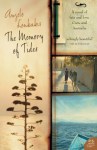
Angelo Loukakis, The memory of tides

I’m embarrassed to say that I don’t really know Angelo Loukakis, but Wikipedia does! Besides being a writer, and besides being the Centre’s founding Chair, he was also Executive Director of the Australian Society of Authors from 2010 to 2016. He’s been a teacher, editor, publisher and scriptwriter, and has written three novels, two collections of short stories, as well as several non-fiction works.

But now, let’s get to the centre itself. Like other writers centres, Writing NSW is largely a membership organisation, but also obtains funding from the government and donations. Its aim from the start was to support writers, particularly emerging writers. Emily Maguire (whose An isolated incident I’ve reviewed here) and fantasy/historical fiction writer extraordinaire, Kate Forsyth, credit it as playing a significant role in their early development.

Here are some of the things the centre does:

Courses

Courses – whether on-line or in-person, single workshops or over a period of time – seem to be the main services offered by writers centres, and Writing NSW is no different. Some of the courses coming up are:

Bianca Nogrady, The best Australian science writing 2015
  • The Year of the Novel, Phase 3 (with Emily Maguire, no less!): it starts tomorrow, and runs for 8 sessions. Members get a whopping 30% off the price, which more than covers the annual membership fee! The course is about making “your very good novel … brilliant.”
  • Finding the Detail: Research Tools for Writers (with Eleanor Limprecht whose novels Long Bay and The passengers I’ve reviewed): a 2 1/2 hour seminar about research (for fiction and non-fiction). The description says it will cover “how to organise your research, the ethics of research and how to put your research aside and just start writing.”
  • The Secrets of Science Writing (with Bianca Nogrady who has also appeared in my blog):a 6-hour course on such topics as finding good science stories, the basic principles of science writing, and interviewing and pitching to editors.

These are just three of many, many courses, workshops and seminars they offer on topics that include, in addition to the above, playwriting, poetry, comedy, writing for schools, marketing, speculative fiction … you name it, in other words …

Events

  • Festivals: Writing NSW runs various festivals, including, the new biennial Boundless Festival, first held in 2017 and focusing on” Indigenous and culturally diverse Australian writers and writing”, and, coming up, Quantum Words, a one-day festival on the meeting of science and writing. Its speakers include astronomer Fred Watson (who has appeared here a few times, with the Griffyn Ensemble) and cli-fi novelist James Bradley.
  • First Friday Club: a monthly, free, members-only event that runs on the first Friday of the month from March to October. The event involves a guest speaker – such as an author, editor, publisher, journalist – and, they say, “a delicious morning tea.” October’s speaker is Bronwyn Mehan from the innovative Spineless Wonders.
  • Talking Writing: ad hoc panel discussions (as far as I can tell) on various subjects relating to writing. One held in April this year, for example, was called Make it Funny.
  • Ad hoc events: such as an all-afternoon Open House event with publishers HarperCollins and Harlequin at which members will get an opportunity “to meet one-on-one with a publisher to get feedback on your submission.”

Prizes and Grants

  • Quantum Words Poetry Prize: established in 2018 this prize is for “science poems”, that is, they must “include or address some aspect of science.” Pretty broad.
  • Boundless Indigenous Writer’s Mentorship: supported by Writing NSW and Text Publishing, for “an unpublished Indigenous writer who has made substantial progress on a fiction or non-fiction writing project.” It pairs the “emerging Indigenous writer (from anywhere in Australia) with a senior Indigenous writer in the same genre for a structured year-long mentorship.”
  • Writing NSW Varuna Fellowships: awarded annually for writers with a work that is “ready for the next stage of development.” It involves a week-long residency at Varuna (Eleanor Dark’s old home which I’ve mentioned here before.) Two will be awarded this year, with one specifically for a writer under 30.

The above is just a selection of what Writing NSW offers. Like most writers centres they offer a wide range of services, including a library, newsletter, manuscript assessment, all sorts of mentorships, space for writers groups to meet. They aim to specifically support regional writers, Indigenous writers, and writers with a disability. A lovely service that I suspect not all writers centres have the resources to provide is their Space to Write. This enables writers who have trouble finding quiet places in which to write the opportunity to book space or a room at Gary Owen House (some are free, and some involve rent.)

Oh, and they have run workshops on blogging (such as Power Your Blog), since at least 2012, though I couldn’t find any for this year. It’s good to see this type of writing and publishing also being recognised by writers centres.

… and that’s about it for another busy, active Writers Centre.

Writers Centres covered to date: the ACT, the Northern Territory, Queensland, and Tasmania.

Canberra Writers Festival 2018, Day 2, Pt 2: Words (Last ones) and Music

My last Canberra Writers Festival event was, in a way, a little left field, because it primarily comprised a musical performance – but one with a strong literary element …

Turning Last Words into Music

I chose this one, for a couple of reasons, but mainly because it involved music and was at a time that would work for Mr Gums to join me. It featured a composition by Australian composer, writer and radio presenter, Andrew Ford (who appeared here long ago in my post on the Voss Journey). The session was MC’d by Jane O’Dwyer, Deputy Chair of the Canberra Writers Festival Board.

So, what was it about? Well, it was a performance of Ford’s 30-minute song cycle titled, yes, Last words. It comprises “the final poems, letters and diary entries of some of history’s most iconic figures” set to music. However, before we heard the music, Ford talked about its genesis and some of the challenges he faced in creating it.

He started by describing music as the most abstract of the arts, and song as the most ubiquitous type of music. But, he said, listeners will only pay attention to the words if the music attracts them first. He then explained that his wife suggested the project – that he set people’s last words to music, for soprano Jane Sheldon, and that he include Captain Scott’s last words.

Then the challenges started. For example, he said, “last words” tend to be very short which is hard for song, but then a friend suggested “last poems”, which he took up. Another challenge was the order, and structure. Given the topic, the mood/tone of course tended to the slow and mournful. Something fast, some relief, was needed to prevent its becoming tedious, but what? He lit upon the idea of including a fiction character, and chose Fish Lamb’s death from Tim Winton’s Cloudstreet. Then there was Virginia Woolf’s suicide note. What sort of music would work with that? In the end, he decided it didn’t need music (though in fact some minimal cello and piano did sound occasionally during that song.)

Goethe's bed, Goethe House, Weimar

The bed Goethe died in, Goethe House, Weimar

Finally, there was the challenge of his opening “last words” from Goethe: “Mehr licht, mehr licht” (More light, more light.) He was reading them as portentous, but then his wife suggested that perhaps they could be read simply – as Goethe simply wanting more light!

Responding to a question from moderator O’Dwyer, he talked a little about music and emotion. Debussy apparently said that music is “pure emotion” but Ford said that he didn’t consciously try to “embed” emotion in the music, because that would be manipulative. In composing this piece he tried to find the notes that would approximate how he would say the words. Simple, eh?

Anyhow, then the concert started, and I found it engrossing and moving. It’s not easy music, but neither is it hard – and it was performed beautifully, even though the performers had their first and last rehearsal only two hours before they took to the stage. The lyrics were provided to the audience, and are available on line at Andrew Ford’s website.

Some of the things I liked included the structure (or order). I liked, for example, that it starts with some of those brief last words …

Mehr licht, mehr licht … (Johann Wolfgang von Goethe)

Now comes the mystery. (Henry Ward Beecher)

Auftakt! Auftakt! (Alban Berg)

… and ends with some more brief last words:

Mehr licht, mehr licht …

Goodnight, my darlings. I’ll see you tomorrow. (Noël Coward)

Last Words trio and sopranoI think these beginning and endings gave the cycle a bit of a narrative arc, albeit the actual plot is death, death and death – if you know what I mean.

I also liked that Goethe’s words are used as a refrain, appearing intermittently to provide a transition between some of the songs – but sung with different dynamics or emphasis in different places.

I was particularly moved by Captain Scott’s last words, and thought that Ford, and singer Sheldon, handled its prose form very well. (As they did Fish Lamb’s faster piece, And Woolf’s suicide note.)

Appropriately, Emily Bronte’s last words were set to heavier more dramatic music, and ended in a screeching “Me”, which surely alluded to Cathy (from Wuthering Heights.)

And, I loved that texts included a favourite (last or otherwise) poem of mine, Dorothy Porter’s “View from 417”, with its final lines:

Something in me
despite everything
can’t believe my luck

The music here was more lightly lyrical. In other words, the mood and tone of the music did shift during the piece, despite the repeating death motif.

Performers: Jane Sheldon (Soprano), Helen Ayres (violin, replacing the advertised Tor Frømyhr), David Pereira (cello) and Edward Neeman (piano).

Q & A

There was some time for Q&A at the end, during which people asked:

  • does some writing “fit” music more easily than others (yes)
  • can music create new emotions (are there new emotions to be found?)
  • why does the voice occasionally get lost in the music, where mostly the music was subtle (it got “lost” in Fish Lamb’s scene because he’s drowning, so here the voice becomes another instrument.)

This was, for me, a delightful last session of the Festival – despite its theme!

Canberra Writers Festival 2018, Day 2, Pt 1: Art, Books and Politics

For my last day of the Canberra Writers Festival I chose two quite different sessions, as you will see! This post is on the first one …

(Note: these two posts will be in lieu of this week’s Monday Musings.)

The Art of Books

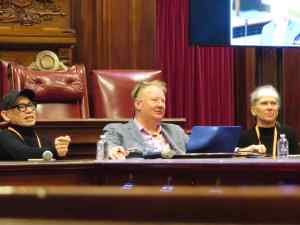
Chong, Bowers, Katsoukas
Chong, Bowers, Katauskas

I chose this session primarily because one of the participants was the multi-award-winning book designer, WH Chong (from Text Publishing) and, woo hoo, he was there, even though, once again, one of the advertised panelists, cartoonist-illustrator Jules Faber, was not. The other panelist was political cartoonist Fiona Katauskas, and the session was moderated by The Guardian Australia photographer and Talking Pictures presenter, Mike Bowers. It was, I must say, a hoot of a session – and it was held in the old Senate Chamber in Old Parliament House. I was keen to attend an event in one of the parliamentary chambers there and so that was an added plus.

Bowers was an lively moderator, sharing the questions, back and forth, between the two panelists, which was a bit of a challenge given they work in somewhat different fields. Still, Chong had started in journalism – working in The Age’s newsroom – and maintains an interest in political cartoonists, and Katauskas has illustrated books, so the disjunction wasn’t too great. For this post, I’m going to organise my discussion by person, though the actual session see-sawed between the two.

WH Chong

Jonathan Galassi, Muse

Bowers, who had also known Chong in earlier days, focused most of his questions, and examples, on Chong’s covers that feature typewriters and typewriter-style fonts. This gave Chong a chance to share his love of typewriters, and the fact that for most of those covers he used typewriters for the font, not digital fonts. One of the covers discussed was for Jonathan Galassi’s Muse, a novel about a poet. The letters of the word Muse are created with the letters for the word Poet (ie the M is made using “p”s, the U “o”s, etc). A concrete poem, in a way. A clever, striking design.

Janet Frame, In the memorial room

Bowers asked Chong whether he thought the online world is causing the death of good design, but Chong felt not, arguing that the ratio of good to bad design, remains the same. There’s some great design online he said. Bowers also asked him whether the rules of design changed for online books versus print. Chong wanted to know what those “rules” were! But then said that they were basically the same, regardless of form: you make author’s name and the title as big as possible, and use as much colour as possible!

Another question concerned fonts, and whether Chong had favourite and disliked fonts. Chong admitted to having changing favourite fonts, but quoted someone (whose name I didn’t catch) as saying that there is “no such thing as a bad type, just type badly used”. Chong added, with a straight face, that typeface (or font) is a serious matter and he ”won’t be typecast.” Haha.

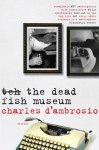
D'Ambrosio, The dead fish museum

Some process issues were discussed, such as who approves covers. Chong said, basically everyone, including the author’s hairdresser, dog, etc etc! Haha, again. But, he did say that Text works collegially, which was lovely to hear. Bowers then asked how important is the cover. Chong seemed to think that it’s not that important, but that marketing and publishers believe “it is important in our noisy world” so  “who is he to complain?”

Bowers, you can see, did well at asking all those questions we’d like to ask. Another one was whether he looks back – perhaps in horror – at old work. Again Chong quoted someone else, this time I did get the name, Bob Dylan, who said “Never look back, you might catch up.”

Finally, before we leave Chong, Bowers asked him whether he reads the book first. He prevaricated a bit here saying “y-e-e-s” which meant, I gathered, “mostly but not always.” He’s a slow reader he says, and he only sees the draft.

This was a frustrating session because almost every book cover shown introduced me to a book I want to read.

Fiona Katauskas

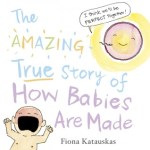
Fiona Katauskas, The amazing true story of how babies are made

Now, Katauskas. Bowers started by asked her about her book The amazing true story of how babies are made. She wrote it, she said, because when needing to answer her 5-year-old son’s questions she discovered the only book around was the now old Where do I come from? The book has been very successful, shortlisted for both the CBC and ABIA awards, and is now being animated. It was a different project she said from her more usual work of political cartooning. For one thing, it was not cynical! Bowers then asked her to share the shock! horror! furore that developed in the UK and USA after someone posted some images from the book on Facebook. Katauskas has written about the story in July’s The Monthly article. The ridiculous thing is that the book hadn’t even been published in those countries. It was a good lesson in clickbait, she said, but the result is that a US book deal now looks likely!

John Birmingham, Popeland

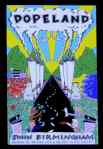
Bowers then asked Katauskas about her cover for John Birmingham’s Popeland. She loves doing book illustrations, even though it’s one of the worst-paid jobs, but unfortunately, she said, this sort of work is drying up these days. Anyhow, her illustrations – cover and inside – were inspired by books like Captain Goodvibes, boys’ own adventure books and The Beano. She described researching the fun of 1930/40s Beano books in the State Library. These commissions tend not to come with briefs. She receives the manuscript, and a statement that, say, there’s a budget for 10 illustrations. She talked about the process of ensuring there’s a “visual cadence” underpinning the illustrations through a book.

The conversation then turned to political cartooning which forms the bulk of her work. You really had to be there and I’m afraid I’m going to say that, to some degree, what happened in the room – such as stories about (very) contemporary (if you know what I mean) Australian political figures – will stay in the room.

I will however share some of the discussion about modern political satire. Katauskas admitted that the “best of times for satire is worst of time for everyone else.” Ouch! Chong asked whether we were beyond parody and satire, to which Katauskas replied (not perhaps answering Chong’s question) that “it’s hard to take the piss when they’re giving it away.” (You can guess who some of “they” were!) Bowers shared that satirist comedian Bryan Dawe is so concerned about politicians moving into the satirists’ domain that he’s considering bringing a class action against them. You can see what fun we had.

Fiona Katauskas, Obama and Rudd
Fiona Katauskas cartoon

Katauskas commented on the importance of publisher Scribe’s annual Best Australian political cartoons publications because they recognise that political cartoons are historical documents. She also talked about her job of researching cartoons for the annual exhibition of political cartoons, Behind the lines, and how she sees some recurring themes over the last fifteen years, the two major ones being asylum seekers and climate change.

Chong then asked whether we are beyond (or past) hope – but that question just hung.

Q & A

There were several questions, but I’ll just share the one about what media or technology Chong and Katauskas use. Both, interestingly, prefer to work in an analog way. Katauskas said she’s “old school”, and loves working with her pen dipped in ink. Chong said he was “very analog.”

Moderator, and photographer, Mike Bowers talked about the joy of working with good journalists, and named some of those he loves working with –  Paul Daley (with whom he has produced the book Armageddon), Katherine Murphy, Gabrielle Chan, and Lenore Taylor. With the breakup of the media and more people working alone, these important relationships are being lost.

He ended with the plea to us to “pay for your journalism.” I do, I wanted to say.

The Griffyns inspire us in Science Week

Griffyn Ensemble One Sky Many StoriesIt’s been two years since I last wrote about the Griffyn Ensemble. In that post I reported that they were not returning with their usual season in 2017. Wah, I wrote. They did, in fact, perform in 2017 – presenting a special Music Festival – but I didn’t write that up, because I was unwell and barely made the concerts. They’ve returned again this year, this time with a concert designed to coincide with National Science Week. And what a concert it was, because it was much more than “just” a science inspired concert. As you’d expect.

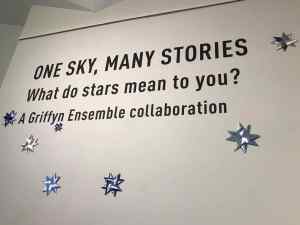
One Sky, Many Stories

Now, when the Griffyns “do” science, more likely than not it will involve astronomy. They have collaborated with composers and scientists in the past to create programs focused on the skies. In 2012 and 2013 they performed Estonian composer Umas Sisask’s Southern Sky composition, which he created in the 1990s after visiting Australia, and in which he incorporated his response to indigenous Australians’ ideas about astronomy. Those Griffyn performances included astronomer and science communicator Fred Watson introducing each movement, describing the constellations and stars referenced by the music. In 2015, they presented director Michael Sollis’ response to Sisask’s work, Northern Lights, which he composed after visiting the Northern Lights on a tour with the aforementioned Fred Watson.

And now, three years later, they’ve produced a new show titled One Sky, Many Stories. To create it, Michael Sollis and past-Griffyn Wyana O’Keeffe went to Tennant Creek in the Northern Territory to work with indigenous performer-composer Warren H Williams and other local musicians. Their aim was “to discover and create some more stories and songs about the stars” and the end result was last night’s event which combined “music, film, and astronomy to explore Western and indigenous conceptions of the night sky.” The music combined a selection of reworked movements from Sisask’s “Southern Sky” with new pieces composed by Warren Williams and themselves. Once again, Fred Watson was present to guide us through the program, linking the music to the science and the stories.

There was no printed program so I don’t have a list of the pieces played, but the music was eclectic in style, which is a hallmark of Griffyn concerts. You never know what you are going to get. In this show, ballads, jigs and country-rock style pieces were interspersed with new chamber music. I was impressed by how well soprano Susan Ellis’ classically trained voice blended with Warren Williams’ more country-music-mellow style. In some pieces, the versatile Ellis backed Williams’ words with haunting, mystical sounds, but on one occasion she sang a “Southern Sky” piece in its original Eesti while Williams sang his part in Western Arrernte. (I must say I love that we are more frequently hearing indigenous languages spoken/sung these days.)

Wyana O’Keeffe’s percussion playing – on a range of instruments from vibraphone to hand-struck wooden drum (a cajon?) – drove much of the concert. It was clear she loved being involved in the project. It’s one of the great things about Griffyn Ensemble performances, in fact, the enthusiasm with which they share their music and engage with their audience – and the way they balance serious musicianship with a more relaxed informality.

Culture meets science

But it was about more than music. It was about ideas, and how we think about the stars, ourselves and the universe. And so, interspersed with the music were Fred Watson’s introductions – to the various constellations represented in the music, including Sagittarius, Oktans and Reticulum – and video clips of Tennant Creek residents from all ages and various cultural backgrounds speaking about what sky and stars mean to them. Some of these meanings were philosophical or spiritual, some wishful, and some self-deprecatingly humorous. They were an engaging, but also integral, part of the whole: they encouraged us, the audience, to consider our own responses to the sky and stars and conveyed the diversity of responses different people and cultures have. It was unfortunate, however, that we couldn’t always hear all the words (perhaps due to the room’s acoustics.)

Anyhow, I loved one person’s story that he had always believed he heard the stars twinkling until he was told it was the crickets! Other people talked about stars representing people who passed away, and another how separated lovers use stars to feel together across space. Some talked about how the sky informs them about bush tucker and the seasons. And some struggled, like I would, to find the words to explain exactly how they felt. One lad got quite mixed up with his stars and galaxies and constellations and how they all fitted togehter and decided that they were all just “one big dimensional plane.” I felt his pain!

But, check out this YouTube teaser. It will tell you more than my words ever could.

It was a different line-up from the usual Griffyn Ensemble, as you’ll see in the list at the end of the post, but the combination resulted in an engaging, sometimes toe-tapping, concert that entertained while also giving us plenty to think about. I liked the idea suggested by Fred Watson near the end that maybe not everything’s measurable, that the point may be less about what happens to the universe and more about the universe happening to us.

The concert ended with us, the audience members, being invited to pin our own written wishes-upon-a-star onto Comet Bryn Leon (named for Michael and Kiri Sollis’ brand new baby boy) on the wall. I do hope they share those wishes on their website sometime in the future – perhaps when they are no longer waking up through the night sharing the stars with Bryn!

Meanwhile, a big thanks to Michael Sollis and the Griffyns for their ongoing commitment – and contribution – to the Canberra music scene. They are to be treasured.

Griffyn Ensemble (and Friends): Michael Sollis (director and mandolin), Susan Ellis (soprano), past member Wyana O’Keeffe (percussion), Alex Castle (flute, filling in for Kiri Sollis who had just had a baby), with special guests Warren H. Williams (keyboard, guitar and voice), Rachel Pelser (electric guitar), and Fred Watson (astronomer).

Canberra Writers Festival and the Griffith Review 60: First things first

Yesterday (9 August) was, as you probably know, the UN’s International Day of the World’s Indigenous Peoples. I had planned to get this post completed by then, but, being on the road (again), it didn’t happen. I don’t think that matters a lot, though, as we should be caring about Indigenous Peoples every day until the disparities between us are removed, n’est-ce pas?

So now, my post. The title may look a bit strange. It’s because this post was partly inspired by my wanting to mention the Canberra Writers Festival. This year is its third under its current iteration, and the theme has remained the same: Power, Politics and Passion. Now, some of us literary types, are a little disappointed by the Festival because of this focus. We want more literature, as in literary fiction, but what we get is quite  lot politics. I understand this. We are Canberra, the national capital, and this is a way of positioning our Festival as something different from others around the nation. Fair enough I suppose – it’s just not what I would prefer.

However, there are sessions that I’m very interested in, and two of these relate to indigenous Australian literature and culture. They are:

  • GR60: First Things First: A panel discussion inspired by the recent Griffith Review, the one numbered 60 and titled First Things First. It was inspired by the Uluru Statement from the Heart, and the panel comprises some of the contributors to that edition, Dr. Sana Nakata, Shireen Morris, Paul Daley and Melissa Lucashenko. It is moderated by Dr Sandra Phillips.
  • An Evening with First Nations Australia Writers: Comprises poetry readings by Ellen van Neerven, Yvette Holt, Jeanine Leane and Charmaine Papertalk Green, followed by a panel discussion titled Sovereign People – Sovereign Stories, involving Kim Scott, Melissa Lucashenko, and Alexis Wright, and moderated by Cathy Craigie.

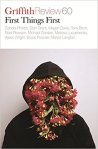
Griffith Review No. 60Now, I’m not always very good at doing homework for writers’ festivals, but I have started reading the Griffith Review in preparation for that panel. I haven’t got very far, having only read editor Julianne Schultz’s introduction “Whispering in our hearts”, indigenous constitution lawyer Megan Davis’ piece “The long road to Uluru”, and Alexis Wright’s poem “Hey ancestor!”

For this brief introductory post, I’m just going to focus on Davis’ piece. Griffith Review’s bio for her says she is “a constitutional law professor and Pro-Vice Chancellor Indigenous at the University of NSW. In 2011 she was appointed to the Prime Minister’s Expert Panel on Recognising Aboriginal and Torres Strait Islander Peoples in the Constitution, and in 2015 she was appointed to the Referendum Council and designed the council’s deliberative constitutional dialogue process.”

This process – the First Nations Constitutional Dialogues – is the one that resulted in the Uluru Statement from the Heart. It was a rigorously defined and executed process that was, she writes, “quite different to the usual tick-the-box consultation.” It had to be, given the diversity of the groups involved, the importance of the work they were doing and the significance of the outcomes they desired – which was essentially to advise the government on a process for recognising the sovereignty of Aboriginal and Torres Strait Islander peoples in the Australian Constitution. Davis writes that

A concrete model of recognition was needed to focus the nation’s attention and move the project forward. Uluru eventually provided the model.

In this article, she describes clearly, and in detail, the recent political history of “the progress toward recognition”, and then the development of a dialogue process aimed at ensuring that the results would be valid and authentic. It involved a Civics education module, so that the participants would understand the western democratic system within which they were working. This is an important point I think. We are not talking revolution here but a willingness to work with the wider Australian people and the government to resolve the ongoing issue concerning constitutional recognition of indigenous Australians – and all that that entails.

The article is excellent, and makes some significant points, including:

  • that recognition of indigenous Australians in the constitution must be more than symbolic – it must be substantive.
  • the importance of truth and justice, of the fact that the truth must be told and understood before justice can be achieved. She reported that “There was an overwhelming view in the dialogues that a nation cannot recognise people they do not know or understand. The Aboriginal experience in Australian history is critical to recognition.” A valid point – and one on which progress is being made but not fast enough.
  • why the Voice to Parliament is so important – which includes that it “could provide a front-end political limit on the parliament’s power to make laws for Indigenous peoples.” In other words, it could head problems off at the pass, avoiding the current situation where inappropriate or ineffective or, worse, discriminatory legislation is enacted, which then costs money and time to challenge.

Indeed, in terms of priorities, she writes:

The First Nations Regional Dialogues ranked the Voice to Parliament as the primary reform priority. The next priority was treaty or agreement-making. The third was truth-telling.

How gut-wrenching then for this priority to have been dismissed so summarily by Prime Minister Turnbull, as it was within four months of the announcement. Many of us are still shaking our heads.

I could say more because this is a rich essay – but this seems to be a good point on which to finish for the moment. I’m sure I’ll be saying more after I attend the session at the end of August.

Monday musings on Australian literature: about Arnhem Land

When this post goes live (during NAIDOC Week) I will be in Australia’s Top End, touring a region called Arnhem Land – and will most likely be incommunicado. Located in the north-east of the Northern Territory, it is named after the ship captained by Dutchman William van Colster who visited the area in 1623. The ship, the Arnhem, was named for the city of the same name, in the Netherlands.

According to Wikipedia, the region has a population of around 16,000, of whom 12,000 are Yolngu, the traditional owners. The main town is Nhulunbuy, with other major population centres being Yirrkala, Gunbalanya, Ramingining, and Maningrida. Mr Gums and I will be visiting most of those places during our 12-day tour. Arnhem Land is known for the fact that a large percentage of its indigenous people live on small outstations on their traditional lands, with minimal western cultural influence. Arnhem Land is almost like a separate country – and visitors need a permit to enter.  Many of its leaders continue to push for a treaty that would allow the Yolngu to operate under their own traditional laws.

East Alligator River, western Arnhem Land

Arnhem Land borders, on its west, Kakadu National Park, which we have visited twice in the past. On both occasions we have done short indigenous-led tours of that border area – one on the East Alligator River, and the other into the country as far as the Injalak Art Centre. Those tours introduced us to some of the culture – the law, the art – of the people. It’s gratifying to feel our understanding of our country growing through these experiences.

However, for my Monday Musings of course, I want to share something of the region’s literary heritage, which given that the traditional culture there is oral, includes song. This list is very little, highly eclectic and very selective.

Some musicians

Yothu Yindi

Probably because I lived some of my childhood years in northwest Queensland, Arnhem Land was familiar to me, but it didn’t really, I think, become known to many Aussies until the band Yothu Yindi burst on the music scene in the early 1990s. The group was formed in the mid 1980s, but it was their song “Treaty” (I did mention of treaty in my intro, after all!) from their album Tribal Voice which brought them to national attention in 1991. The lead singer was Mandawuy Yunupingu and his nephew Dr G Yunupingu, about whom I posted last week, was an original member. The song “Treaty” was a collaborative work by the two Yunupingus, and other members of the band, and non-indigenous museum Paul Kelly. “Treaty” has gone on to become one of Australia’s most significant songs, being named in 1991 by Australasian Performing Right Association (APRA) as one of the Top 30 Australian songs of all time, and being added, in 2009, to the National Film and Sound Archive’s Sounds of Australia registry.

Yothu Yindi could occupy a whole post to themselves, so please check the link I’ve provided if you are interested. They have played a major role in promoting and developing Yolngu culture, to both Yolngu and wider Australia’s benefit.

There are many performances of the song, which includes words in language and English, on YouTube, including this one published by mushroomvideos. Here are a few lines:

This land was never given up
This land was never bought and sold
The planting of the union jack
Never changed our law at all

Dr G Yunupingu

I won’t add much here, because I spoke about his legacy in my above-mentioned post on Gurrumul, the documentary film about him. Besides the fact that his music is beautiful, and that he sang about his culture (and lived his culture for all to see), Dr G also made a significant contribution to Australian culture by writing and performing most of his songs in the languages of his region. The pride in culture that singing in language gives to his people can’t be underestimated.

A writer from Arnhem Land

Marie Munkara

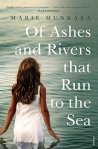
Marie Munkara, Of ashes and rivers than run to the seaA member of the Stolen Generations, Munkara was born on the banks of a river in Arnhem Land, but she was taken, at the age of three, to a mission at nearby Melville Island (part of the Tiwi Islands). From here she was passed on to European foster parents, and didn’t see her mother again until she was 28 years old. You can read some of her story at SBS. I have reviewed her glorious David Unaipon Award winning book, Every secret thing, and plan to read her memoir Of ashes and rivers that run to the sea while I’m in Arnhem Land (for Lisa’s ANZlitLovers Indigenous Literature Week which coincides with this year’s NAIDOC Week. This year’s theme is, appropriately, Because of her we can.)

A blast from the past

Of course, I had to check out the digitised newspapers in Trove, and by narrowing my search to “Arnhem Land Literature” I retrieved a small number of hits, all from the 1930s, only two of which specifically related to Arnhem Land. Both were short stories by non-indigenous writers about Japanese pearlers in the region. I’ll just share one, because it’s by one of Australia’s most popular authors of the day, Ion Idriess (1889-1979). According to Wikipedia (the link’s on his name), he spent some time, after returning to Australian after World War I, travelling in the remote Cape York region, and working with pearlers and missionaries in the Torres Strait islands.

His story, titled “The massacre on the No Gawa Maru”, was published in Sydney’s The Sun on July 11, 1936, and clearly draws from his knowledge of pearling. It’s about a Japanese pearl-shell poacher, Captain Toyama of the “No Gawa Maru”, who “knew he was cruising here against the laws of his own Government and the Australian.” He knows about the Three-Mile limit, and he’s also aware of the Australian patrol boat, the “Larakia”, with its machine gun. It’s “nervy” business this pearl-shell poaching, but they are driven by “fatalism and greed and hope”, the idea of “easy wealth, quickly won.” (Something Idriess likens to the Australian gold field mania which also sent men to “lonely graves”.)

Anyhow, Idriess sets the scene:

They had passed Groote Eylandt lying away eastward with its hills rising as if from a great grey cloud upon the sea. Captain Toyama now stared for’ard where along the Arnhem Land coast islands were taking shape in silhouettes of tree-tops. Presently he saw the sun sheen on straw-colored grass.

Toyama’s crew tell stories of brutal indigenous attacks on boats, too, and of indigenous men selling their women “cheerfully” and the women going “eagerly”, but to accept this “is a death trap. Their women are only a snare. They kill for blood lust and loot.” He refers here to King Wongo of Caledon Bay, who was a real person. Idriess’ story is a gruesome, dramatic story about an indigenous attack on Toyama’s boat. According to the Australian Dictionary of Biography (ADB), it appears that Idriess bought into the idea of Wonggu/Wongo as an “evil genius” behind this sort of brutality, but not all agreed. ADB’s article on Wonggu concludes:

A man of influence, authority and charisma, he represented a romantic and little known aspect of Northern Territory history. More importantly, the events in which he was involved drew attention to the issues of Aboriginal justice and rights to land.

Trove, which I’ve only dipped into about this, certainly includes some very positive articles about Wonggu/Wongo.

The other story is by Keith Ellis, and is called “Sampans”. You can read it online if you like.

I hope that by the time we’ve ended our Arnhem Land tour we’ll know not only more about contemporary culture, but about some of its history and past characters too. I’ll report back if we do!

PS: There’s a good chance I will not manage to post a Monday Musings next week. Enjoy the break!

Monday musings on Australian literature: New Territory 2018

New Territory LogoLast year, some of you will remember, I was a mentor for the ACT Writers’ Centre ACT Lit-bloggers of the future program. It was great fun, and I really enjoyed working with Angharad and Emma over the six-months the program lasted. I wrote a couple of posts about the program, but if you’d like to refresh yourself, this one soon after it started would be a good place to start.

Well, it’s on again this year, but newly branded as New Territory: Adventures in Arts Writing, and with the Street Theatre joining the ACT Writers Centre and the National Library of Australia as program partners. The program, as last year, provides for two emerging ACT-region writers to attend events at the National Library of Australia, the Street Theatre and, in fact, the Canberra Writers Festival, and post their responses on the Writers Centre’s Capital Letters blog.

The ACT Writers Centre’s advertising of the program described it as follows:

[It] is a program that is committed to developing a deeper conversation about the arts: why we make art, how do we engage in art, and to what end? We aim to develop the arts writers, thinkers and provocateurs of the future.

In other words, the writers are encouraged to explore the arts in Canberra – and particularly the events offered by the partner organisations, which they can attend at no charge.

The two writers were chosen in June, and the program is now officially under way, so I’d like to introduce this year’s bloggers to you:

  • Amy (armchaircriticoz): like last year’s Angharad, Amy has a full-time job, and is developing her blog and critical writing skills on the side. Currently her blog roams across film, television, exhibitions, books and other topics that grab her fancy. Do check it out.
  • Siv Parker (On Dusk): and like last year’s Emma, Siv has some writing credentials behind her. Indeed, she won the  David Unaipon Award in 2012, and, in fact, I mentioned her twitter fiction piece in my post on the Writing back anthology last year. She is keen to rekindle her writing career, particularly in this arts writing area, and wants to explore how social media can be harnessed to this purpose. Check out her blog too.

I have asked Siv and Amy whether they’d like to write a guest post here during the program, as Emma did last year, and both seemed keen so you will hopefully see them here sometime in the not too distant future.

I will report back mid-program and point you to some of the work Amy and Siv have been doing, but meanwhile please do check out their blogs and Capital Letters (links above).

Until then, thanks again to the ACT Writers Centre, the NLA and the Street Theatre for sponsoring this program – and a special thanks to author Nigel Featherstone for overseeing this program and gently, encouragingly, shepherding us all through it. I am thrilled to be involved again. I loved getting to know, and spending time with, Angharad and Emma, and look forward to developing a similar relationship with Amy and Siv. Writers – of all sorts – are such fun to be around.

We’d love to hear if you know of any similar programs in your neck of the woods.

My literary week (12), some art, a film, and an unseen play

Much as I’d like to, I don’t have time to write full posts on the three “events” I’m writing about today, but I do want to at least document them. I don’t, in fact, document every film, show or exhibition I attend but I have particular reasons, which will hopefully become obvious, for wanting to share these three.

MoMA at the NGV (National Gallery of Victoria)

For a very exciting reason – Mr Gums and my becoming grandparents for the first time – we made a flying trip to Melbourne last weekend, and, as we couldn’t spend all our time gazing at the adorable newborn, we took ourselves off to the current exhibition at the National Gallery of Victoria during our long weekend. Titled MoMA at NGV: 130 Years of Modern and Contemporary Art, it comprises a selection of MoMa’s world-famous collection. About 200 pieces the website says. The works are organised pretty traditionally – that is, in chronological order, but within this order there are themes, mostly relating to specific art movements, such as Cubism, Fauvism, Abstract Expressionism, Pop Art, and so on. The website says that “the exhibition traces the development of art and design from late-nineteenth-century urban and industrial transformation, through to the digital and global present.” It’s an inspiring exhibition, but like all such big, dense, exhibitions, we had tired by the end, despite breaking for lunch in the middle – so my concentration, not to mention my feet, did start to fail, affecting what I remember.

Anyhow, the exhibition opens with a wall comprising a work each by van Gogh, Gauguin, Cézanne and Seurat, who, the audioguide explained, are deemed to mark the beginning of modern art.

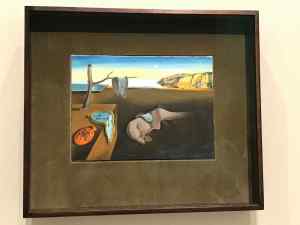
Salvador Dali, The persistence of memory, 1931

So, what did I enjoy? Of course, I liked seeing famous works by well-known artists, such as Dali’s “The persistence of memory” (the famous melting/dripping clocks painting). Who knew it was so small? Well, you do know it, if you read the small print in art books, but you don’t tend to remember that – at least I don’t always. It’s only seeing the work itself that makes this stick. This is partly what makes going to exhibitions so worthwhile. I also enjoyed seeing lesser known works by well-known artists, and works by artists I barely know or didn’t, until last weekend, know at all! And, I appreciated the inclusion of women artists, such as photographer Margaret Bourke-White (1904-1971) who was apparently looked at askance for photographing machines.

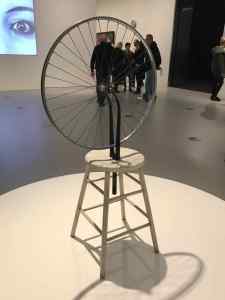
Marcel Duchamp, Bicycle wheel, 1951 (original was 1913)

There is so much more I could say, but, this being a litblog primarily, I’m going to end on one idea that particularly tickled me. Early in the exhibition is a work by Marcel Duchamp, the originator not only of Dada but of the art of “readymades“. The audioguide argued that one of Duchamp’s contributions to modern art was the idea that a work of art is not complete until it is joined with the viewer’s perception and questions (even if, the guide said, that question is, “is this art?”) This got me thinking once again about reading, and the fact that a book has as many meanings as it has readers, because each of us brings our own perspectives to it. An old hat idea, now, I guess, but I liked that Duchamp’s ideas resonated for me beyond the visual arts.

Gurrumul (Cinema Nova, Carlton)

Another exciting event in our lives – one still to come – is that in a few days we’ll be heading off to Australia’s Top End, to tour Arnhem Land and then spend a few additional days in Darwin. I can’t wait for the warmth – nor to experience Arnhem Land which has been on my must-visit list for some time now. Luckily for us, two friends have just returned from the same tour, and they advised us, in preparation, to see three films: Ten canoes (which we’ve seen before, but looked at again, via DVD last week), and two recent documentaries Gurrumul and West wind: Djalu’s legacy.

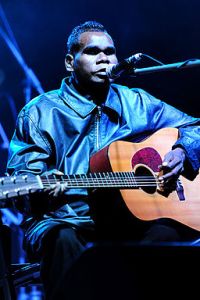
Gurrumul Yunupingu

Dr G Yunupingu @ Fremantle Park (17/4/2011), By Stuart Sevastos, using CC BY 2.0 (Wikimedia Commons)

Unfortunately we’ve missed West Wind on the cinema circuit, and it’s not available on DVD until later this year, but Gurrumul is still screening. So another time-filling activity for us in Melbourne was to see it at the Cinema Nova in Carlton. For those of you who don’t know, the film is about the recently deceased indigenous Australian musician, Dr G Yunipingu (the name used for him since his death in respect of indigenous Australian funerary practices. Permission was given, by Yunipingu himself the film says, for the film to be released, despite another indigenous practice of not showing images of deceased persons for some time after their deaths.)

Dr G Yunupingu was born on Elcho Island, in Arnhem Land, and was discovered early in his life to be blind. He taught himself to play music, and was clearly gifted – though it was his voice (“the voice of an angel” some said) that really captured attention. He wrote his own songs, which he sang mostly in language. The film chronicles, primarily, his musical life, but given his close connection to his culture, that couldn’t be done without reference to his family and culture.

It’s a traditional documentary, style-wise, but it’s the content, the subject himself, that makes this such a moving film. I was quite wrung out by the end – and not only because it had been an emotional couple of weeks leading up to it. One of the issues underpinning the film is an age-old story for indigenous people – the challenge of moving between two opposing cultures. It was a challenge that brought indigenous artist, Albert Namatjira, undone in the end. Dr G Yunupingu managed it better overall – partly because of his own sense of self and strong attachment to his country and culture, but partly also because his non-indigenous mentors had learnt from history and were respectful of Yunupingu’s wishes. This doesn’t mean that there weren’t tense times! The film will, I’m sure, enhance our Arnhem Land trip – but it’s worth seeing regardless.

Tourmaline (The Street Theatre)

Randolph Stow, TourmalineAnd, well, this last stop in today’s post is exciting too – but disappointing also, as I will be missing it. Yes, I am concluding this post by discussing something that not only have I not seen, but won’t be seeing either. I have a very good reason though for this strange behaviour, and it’s that the production, an adaptation of Randolph Stow’s novel Tourmaline, was written by Emma Gibson, one of the bloggers I mentored in last year’s Litbloggers of the Future program. Emma, in fact, wrote a guest post for this blog on Stow and the novel.

It is part of a double bill of adaptations of sci-fi-futuristic texts, the other being HG Wells’ War of the worlds. In her guest post, Emma said that the book has been described as an “ecological allegory”. This would slot nicely into Emma’s main interest, at present anyhow, which is writing about place. According to the promotions, the adaptations are made for radio – which is great to see in itself – but are being performed on stage at the Street Theatre. I am so sorry that I will be missing it – but I wish playwright Emma, and The Street, the best success with it.

Do you have any cultural outings to share?