
Another post in my Monday Musings subseries called Trove Treasures, in which I share stories or comments, serious or funny, that I come across during my Trove travels.
Today’s story popped up during my research for a post on Beatrice Grimshaw for the Australian Women Writers blog. It stunned me, and I had to share it. It is, ostensibly, a review in the Sydney Morning Herald (25 July 1953) of a new-to-me Ruth Park novel, A power of roses. The review is titled, pointedly, “A power of women”, and the author, S.J.B., does not mean this as a compliment.
It opens with:
THE visitor from abroad venturing into these barbarian lands for the first time might be pardoned for concluding that women have an almost unbreakable grip on fiction in Australia.
“These barbarian lands”? And visitors need to be “pardoned” for thinking women have the upper hand in Australian fiction? Oh, the horror.
S.J.B. then says that “this domination” had “become increasingly evident” in recent months, with novels, “varying in quality from the excellent to the ordinary”, appearing in rapid succession from “Eleanor Dark, Kylie Tennant, Ruth Park, Dymphna Cusack, Elyne Mitchell, Dorothy Lucie Sanders, Helen Heney, Marjorie Robertson and Maysie Greig”.
He continues:
This flourishing femininity is not exactly new. For the past half century or so, our literature has been notable (if that is the right term) for its women contributors.
If “notable” is the right word to describe women’s strong role in Australian literature? He lists these “women contributors” as “Mrs. Campbell Praed, Mrs. Aeneas Gunn, G. B. Lancaster, Henry Handel Richardson, Miles Franklin, Beatrice Grimshaw, Ernestine Hill, Mary Grant Bruce, Henrietta Drake-Brockman, Marjorie Barnard, Flora Eldershaw, Katharine S. Prichard, Mary Mitchell, Eve Langley”. He is right, women had played a major role in Australian literature in the first half of the century, as this impressive list – representing a significant legacy – shows. Many of these writers are still read, and respected, today.
But, this long introduction to his review gets worse, because he then suggests that these writers “may go some way towards explaining why our fiction is somewhat distinguished for its garrulity, its repetitiveness, its attention to inessentials, its false humour, and its gracelessness” [my emph]. What? Who was saying all this!
However, he admits that this long list of women writers
does not explain why our male writers make such a poor showing. Can it be that Australian men are so occupied with keeping wolves from the door that only their little women [my emph] have time to write?
Perhaps breadwinning plays some role, he says, but he thinks something more is going on:
We note, for example, that in so far as Australian men are active in writing, they tend to concern themselves with social documentation – they record and interpret rather than invent.
The reason? Perhaps the fact is that Australian men lack an ability to sustain imaginative flights and the resolute patience necessary for putting a novel together. Whatever the solution, our male novelists are grievously outnumbered.
And whatever the reason, it’s interesting that it was around this time that things started to change, for the men. Patrick White’s much admired fourth novel, The tree of man, was published in 1955, and during the 1950s other “serious” male writers appeared like Martin Boyd, Randolph Stow and others.
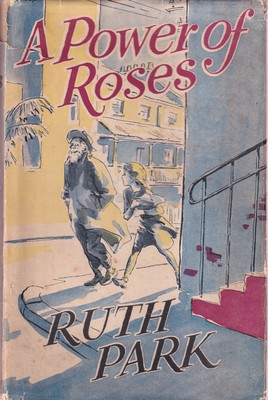
But, back to S.J.B. … Having made these points, he finally gets to his review of A power of roses, to which he gives three small paragraphs. The novel is, he says, “in the tradition of squalor, sentiment and grotesquerie that Miss Park has made distinctively her own”, and then quotes Odysseus’ complaint about hearing the same story twice. He concludes:
Book reviewers are expected to be more tolerant. But even the most generous reviewer cannot help feeling that Miss Park’s grime, bug-infested rooms’ and poverty-stricken ratbags have lost much of their novelty as subjects for fiction. We have had it all before-and better – in The Harp in the South and Poor Man’s Orange.
At least he does think those two books written by a woman are good.
I have quoted heavily from the article because, while paraphrasing would have conveyed the meaning, the actual words have a “power” I had to share. As for who S.J.B. is I have not been able to ascertain. AustLit lists S.J.B. as an author of some newspaper articles, but all it can tell me is “gender unknown”. “S.J.B.” does not appear in its list of pseudonyms, which rather confirms that they don’t know who this person is, despite the fact that S.J.B. wrote several articles around this time.
Comments?
 Whispering Gums
Oof, this article seems like a way of airing pent up contempt that nobody wanted to listen to! I think Beem Weeks said something like: Anonymity is the calling card of the fearful and the courage of the cowardly.
Thanks Lisa. I think that is often true regarding anonymity, but when I looked at the newspapers and, for example, reviews in brief columns, SJB was just one of several initialled contributors so it was more likely to be a practice at that time rather than this person trying to hide, I believe
sigh…
Good response, Denise!
The Americans have an action they call “flipping the bird” …
Haha, MR, I have heard of it!! It sounds from what Meg has found that he didn’t get on well with women. (He was born in New Zealand!)
Hi Sue, I am probably drawing a long bow, but I think this man is Sidney John Baker. “He had the reputation of fractiousness and irascibility, and was not an easy person to live with”. He married three times and was a reporter for the Sydney Morning Herald from 1947. No doubt a clever man, as he wrote some interesting books, but one who didn’t like women!
How did you find him, Meg? I tried various ways and even AustLit couldn’t … but sounds possible.
Hi Sue, I searched all the reporters for the Sydney Morning Herald, and he was the only one with the initials S J B.
Thanks Meg, I think you are right. I found him in ADB, where I think you quoted from, and they said “he edited the latter’s [SMH] Saturday book pages in 1953-63”. But, where did you find that list of SMH reporters which enabled you to track him down. I am pleased that you did – this is great.
ADB also said he had MS from around 1942 “which made his life a struggle” (which doesn’t excuse what comes across as misogyny).
Hi Sue, as usual I forget where I found the info on Baker, I thought it was at Wikipedia. And it was a list of all its reporters, but not in alphabetical order. But for the life of me I cannot find it. I have looked at my history and still nothing. I will keep searching. I could not have made it up!
I understand this dilemma very well. I don’t think it’s Wikipedia as if you do a find Sidney John Baker in pages in Wikipedia, he doesn’t some up. If you made it up you were very clever!! The SMH has some archives but most of them seem paywalled, but maybe you have access to them? I looked at them yesterday but couldn’t get in.
You certainly find some treasures in Trove.
I do, Pam. I would like to spend more time on each one – like this one, with a Ruth Park novel I don’t know – but I figure that at least if I share it, people might find something of interest to think about to explore.
My grandmother was the novelist Vera Baker, who was published by Bookstall Press in 1920s. I note you mention her work Mystery Outlaw, she also wrote Equality Road. Both held by the NLA. Nice to come across your blog exploring writers like Vera. Thank you!
Oh thanks Swiftly. I’m glad you found the post, and how exciting to have that heritage. Her books should be held by the NLA so I am very glad they are. Have you read these books? Do you recommend one of hers over the other?
That’s thoughtful. There are so many rabbit holes to go down . Too many, lol🌻
Thanks Pam … there sure are.
Writing under initials was common, at least in the late 1800s/early 1900s. I have pinned several by J.R.C. to my grandfather, John Rutledge Clark.
Until Meg turned up the probable answer, I was even toying with it being a jealous competitive female author. What a hoot that would have been.
Is there ANY validity to this review? I have read Harp in the South, Poor Man’s Orange, A Fence Around the Cuckoo – but never heard of A Power of Roses.
Haha, Gwendoline, that did cross my mind, though I thought it unlikely.
I have read more Park besides those three: the other memoir Fishing in the Styx, Missus which is the prequel to the Harp series, and her MF winning novel, Swords and crowns and rings. all of which I have loved. I found an academic paper on this novel by Brigid Rooney in the ALS journal, and among other things she says “as the third in Park’s sequence of novels focused on Sydney slums, A power of roses risked seeming repetitive; indeed it was met with a mix of praise and derision. The Bulletin’s anonymous Red Page reviewer called it yet another ‘hovel-novel’ that revels in grimy poverty (‘The new Ruth Park’). This attitude reflects a strand of criticism of Park’s fiction as sentimental and sensational rather than politically serious”. I think that answers your question! The reviewer also says this book has received scant critical attention. When you search it on the internet, however, you can find several editions so it was more than a one-off edition. It was also serialised before it was published.
I ran a search on Sydney Morning Herald reporters and promptly came up with (probably because by now I’m not the only one looking)
https://journalists.feedspot.com/sydney_morning_herald_journalists/
It’s not a Ruth Park I’ve heard of either. I mostly fine her over-sentimental, I dislike Swords and crowns and rings and I seriously dislike Fishing in the Styx. Must be a guy thing.
W.A.D.H.
Dear W.A.D.H.
Thanks very much for this. I did find this list in my search but I didn’t scroll through it because I thought it was contemporary journalists only. Did you find him in there? I’ve just looked and it seems I can only see the first 100 names and he’s not there. It seems you have to email to get the full list, which still may not be historical journalists I think?
As for Ruth Park. I guess there’s some sentimentality in her work, but I wouldn’t call it overly. I call it “warm”. Why don’t you like Fishing in the Styx? I can’t remember much about it, except that I seem to remember liking it.
As you say, might be a guy thing, but I thank you for commenting!
S.A.E.T.
I grew up loving The Drums Go Bang but Fishing in the Styx is completely different, even some of the facts are different. It’s still on my shelves though it’s a long time since I read it (probably around 2005 when I was doing my degree).
Oh that’s interesting Bill … I’ve read both but so far apart that I didn’t notice any fact differences. Can you remember any of them now?
Dear S.A.E.T
This type of misogynistic ranting makes me want to read the book now. It’s not one I’ve come across before either, but will certainly scour the secondhand shops for it. And for the record I really enjoyed Swords and Crowns and Rings.
B.J.R.
Thanks B.J.R, let me know if you find it. I liked Swords etc too. S.A.E.T.
I mean, to be fair to the author, one time a little, tiny, harmless snake got into our house, and my dad beat it to death with a toilet plunger. Does that count as keeping the wolves at bay? I hope this man realized what a dink he is and immediately lit himself on fire in apology. Unless this is a brainwashed woman against her own, and in that case, I say, “there is a special place in hell for women who don’t support women.”
Haha, love this Melanie. I think with the help of commenter Meg we have worked out that the author is indeed a man – and one who seemed to have it in for women!
Oh, thank gracious that those serrrrrious men emerged onto the scene and allowed the wolves to keep to their own furry selves. both so the little women could have a lie-down and the men could get on with the important business of menzzing.
Couldn’t have said it better myself Marcie!