Kate Grenville and Paul Daley with Craig Cormick
The program described the session as follows:
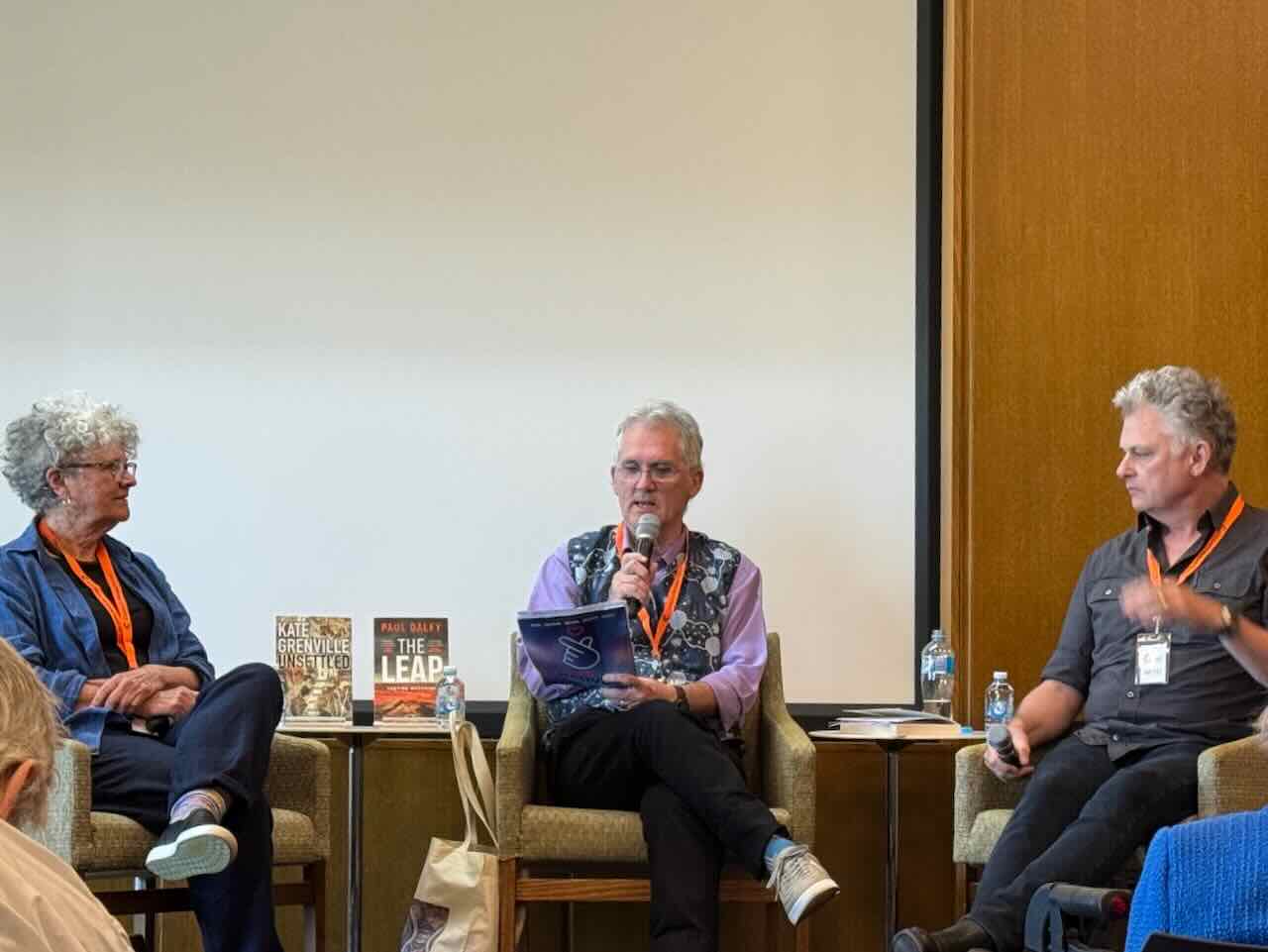
Kate Grenville’s ancestors were ‘the sharp edge of the moving blade’ of colonisation through the Hawkesbury region – the subject of her bestseller The Secret River. Now in Unsettled: A Journey Through Time and Place, she reflects on the reckoning that comes with truly confronting the past and her family story. She’s joined by Paul Daley, whose novel The Leap examines fear and violence in a frontier town. Two years after the Voice referendum, this timely conversation is about non-Indigenous Australians doing the work and personally reckoning with the past. This conversation, moderated by author Craig Cormick (Warra Warra Wai) will reflect on the role of non-Indigenous authors in contemporary writing exploring Indigenous issues.
You know you are not with the zeigeist when the session you choose is not in the big venue. This was the case for me with my last two sessions of the day, and to be honest, I was unsure about whether I wanted to attend this session. Did I want to hear more of us white peole talking about our guilt. It’s not about us. And yet I’m a white person so I decided there might be something new for me to think about, or another way of thinking about the issue. As it turns out, there was … read on …
Craig Cormick started the usual way – by acknowledging the traditional owners but also asking us to say hello – Yuma – in the local language. He then introduced the writers, noting in particular that Kate Grenville’s The secret river was ranked 20 in the ABC’s Top 100 books of the 21st Century. He then explained that we would be talking about white fellas writing black stories, black history.
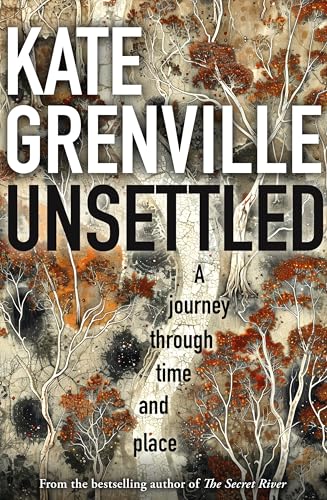
On how a white writer writes respectfully about black issues (to Kate)
There is no simple answer, but it involves a big cloud of context requiring awareness – of truthful knowledge of a dark history, of what might be the effect of what you write on First Nations people (which can include grief, insult, rage), and of how non-Indigenous readers will read what you write. The respectful way might be not going there, or engaging in consultation, or …
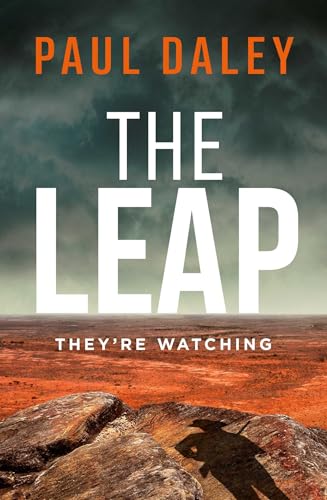
Do we need more than good intentions (to Paul)
Paul thinks of the journalists and anthropologists who wanted to save, hoard stories and culture – the equivalent of what literary writers want to do – so he asks himself the question “why am I going there?” He turned to fiction after years of journalism, as medium to tell about an Australia that is not seen enough. He said that both fiction and nonfiction requires respect, but fiction can be more “arbitrary”. Who do you consult when you are writing a character. It can be laborious. You need to forget deadlines.
On writing from an Aboriginal perspective (to Kate)
She never has – except very briefly in her novel Joan makes history. She wouldn’t do that now. She wrote 25 drafts of The secret river. The consciousness of the book was based on her white ancestor, but is about his relationship with local indigenous people. She started by giving them some dialogue, but felt she was othering or diminishing them, so she tried to individuate them without stepping into their world. Her latest book is nonfiction involving a road trip, which sort of mirrors Craig’s (in Warra warra wai). It was about private soul-searching, which she feels must be done before we talk to First Nations people.
On writers not including First Nations people in rural noir (to Paul)
The three main reasons writers give are: they don’t want to locate their book, or, they don’t want to upset their conservative readers, or, it’s just too hard! But, said Paul, many books are about white people’s crimes against white people on lands owned by others who are never mentioned. The leap is like an update of Wake in fright, which was reflective of the white male Australia of the time.
Is it too hard to go there (to include First Nations people) (to Kate)
She looked at Eleanor Dark’s 1941 The timeless land, in which Dark entered the consciousness of an Aboriginal character. It would be wrong now, but at the time Dark was “writing into a profound silence”. She was, in fact, revolutionary.
But, as long as white writers are aware of boundaries, they can “go there”.
Are there boundaries writers shouldn’t cross (to Paul)
Yes, he wouldn’t write in a First Nations first person voice, would not get into secret sacred areas/places/topics, and would not embed a story in a First Nations community.
The conversation then further explored this idea of boundaries, and issues like consultation.
Craig shared a comment made by Harold Ludwick (with whom he collaborated on the novel On a barbarous coast, my review) that “we earnt your way of thinking more than you learnt ours”.
Kate said that with her road trip, she did not speak to First Nations people. She believes that we want to jump too quickly to reconciliation, to forgiveness, but she believes we need to do soul-searching (a bit like you do in “time-out”) about what it means to be a non-indigenous person in Australia. She didn’t want to ask for things from First Nations people, like asking them to explain their feelings to us or to forgive us. She talked about the first time she asked Melissa Lucashenko to read a book (as a sensitivity reader I presume). Lucashenko said, “Sure, but pay me”. Another time, she said, “Yes, but first read White privilege“. In other words, she asked for something in return.
Paul picked up this idea of “wanting” things from First Nations people. He said he will ask friends to read his manuscript. He realises it is burden, and he explains that the end product is his, not their responsibility. If, after consultation, they say they don’t want him to do it, he wouldn’t.
Paul drew an analogy between Australian writers’ current concern about AI ripping off their work, and how First Nations’ people’s stories have been ripped off for so long.
The discussion turned to some examples of “ripping” off, such as last year’s controversy over Jamie Oliver’s children’s book, and its egregious depictions of First Nations people and their practices.
Overall, consultation is a difficult thing. Who you consult, can be a fraught issue. It is often, for example, not the Land Council. They do not necessarily represent the elders. Consultation can exacerbate divisions. (Some of this issue about who speaks for whom was covered in Wayne Bergman and Madelaine Dickie’s Some people want to shoot me, my review.)
There was a Q&A, but most of it revisited ground already covered. For example, one audience member spoke of writing a story inspired by a First Nations person. He had consulted the relevant elders and descendants, and they were comfortable. He had checked his motivation. But AIATSIS had said it wasn’t his story to write. The panel agreed this was difficult. There are no answers. Sometimes, said Kate, you just have to take a risk. Paul agreed, but gave the example of Jesus Town. He had a misgiving on the eve of publication, so pulled back, reworked and published later.
There was agreement that it was great to see First Nations people now telling their own stories, and about experienced writers doing all they can to help them.
The discussion ended on two points that encapsulated the discussion perfectly and validated my decision to choose this session:
- that writing in the voice of a person in which you don’t have lived experience [however you define that] would not be adding to the sum of human knowledge
- that in relation to our history, there is no atonement. We have to live with that.
Canberra Writers Festival, 2025
Reckoning
Saturday 25 October 2025, 12-1pm
 Whispering Gums
<<First Nations’ people’s stories have been ripped off for so long>>
Everyone’s stories get ripped off.
Hmmm, yes, you could say that, but some more than others, and some more egregiously don’t you think?
I am unqualified to say.
But maybe Shakespeare ?
🙂
Haha, now there’s a bag of worms!
I think it’s an interesting aspect of literature, the way stories are retold. Homer, Shakespeare. It cements them in our culture.
Aboriginal stories are a different thing altogether. White people tell them out of context. I think we must wait and see whether Aboriginal story tellers introduce their stories into Australian culture
Do white people tell Aboriginal stories ? – they might steal and disguise them, yes, Bill ?
Yes, they do and have in so many ways, MR. Thomas Keneally famously did in The chant of Jimmie Blacksmith. He said he would not now do that book. White writers have published children’s books of “Aboriginal legends”, not always with any Aboriginal involvement or consultation. Now, there’s the issue of white writers including First Nations characters in their books. They are a bit damned if they do – repeating stereotypes – and damned if they don’t – continuing the invisibility of First Nations people. It’s a complex issue that writers who are setting stories in places where you would expect First Nations people to be are grappling with.
I forgot – “The Way of the Whirlwind” by one of the Durack women. Grew up on it.
That was Mary. But it was Elizabeth who was most egregious, as she masqueraded as a First Nations artist, and didn’t see she’d done anything wrong. After all, she grew with with First Nations people, I think she said.
Ah yes: Mary Durack Miller (and Elizabeth Durack Clancy). WA was a very racist community, but without beastliness: we looked on our Nungahs in a fondly patronising way. 😦
I won’t direct you then MR to the murders committed on the Durack property in the north and which Mary chose not to write about in Kings in Grass Castles
I do know about those horrors, Bill: in my normal fashion I was failing to be clear – I actually meant Perth (in which town I lived till I was 21).
Our household on the beautiful Freshwater Bay of the river included an Aboriginal maid, Esther, whom we all loved. We did our best to turn her into a white brown person – my parents gave her a wedding and my mother made her wedding-dress – in our jolly patronising way. Our hearts were good but our thinking …? – To describe it as ‘very West Australian’ will be sufficient for anyone who was there up to around the turn of the century …
Patronising … that’s it isn’t it for many of us snd our families back then. Not intentionally cruel or brutal but so oblivious to what our “kindness” was saying and doing!
Thank you for that response MR.I gathered you meant Perth (where I have lived since the turn of the century, and for a few years around 1980). The detail was wonderful. I’ve never met someone who had a servant. There is a memoir by an Aboriginal woman one of whose jobs was as a house servant for AO Neville, When the Pelican Laughed.
Where in Perth do you live ?
Rivervale, in a flat on the river. My wife grew up on the opposite side of the tracks to you, in state housing in Hamilton Hill and Rivervale (Eric Cook country).
Ah, the country Drewe traverses in Shark net?
From my side of the river to MRs side. Drewe’s story must have been very familiar to her. One person I gave it to couldn’t believe someone she knew growing up was in a novel
Haha … particularly someone like that.
Oh, right up east ! You’ve got water-edge, too.
https://www.google.com/maps/place/138+Victoria+Ave,+Dalkeith+WA+6009/@-31.9974132,115.7846683,15.5z/data=!4m6!3m5!1s0x2a32a46ed92945c1:0xadeefbad07046fdf!8m2!3d-31.9981649!4d115.7898346!16s%2Fg%2F11c0z4gnc6?entry=ttu&g_ep=EgoyMDI1MTAyMi4wIKXMDSoASAFQAw%3D%3D
Thanks Bill for this contribution to truth-telling. It’s important to keep it all together in our heads.
Of course you know these women! I occasionally forget your WA origins!
Thanks Bill … but can you explain what you mean by Aboriginal story tellers introducing their stories into Australian culture? I can think of a meaning or two for this, but rather than guess would like to know what you specifically mean.
“Aboriginal story tellers introducing their stories into Australian culture?” In answer to both of you really, and just an example, ‘Dreamtime’ is often used by white writers to mean something or other, our beginnings maybe, but I think until Aboriginal writers choose to introduce Dreamtime stories and explanations of Dreamtime into white discourse then we should leave it alone.
Ah, good, thanks very much Bill. Yes, I agree. And I think this was what Paul meant really although he said sacred and secret, but I think he also meant anything cultural that we do not properly comprehend ourselves. I may be putting words into his mouth, but I suspect not.
You and I don’t agree about Kate Grenville. But then nor do we agree about Historical Fiction. I think Dr Chelsea Watego would be an interesting addition to a panel on ‘white guilt’
You won’t be surprised Bill to hear that I thought a lot about you as I listened to and wrote up this session! I hoped you might change your mind about Kate Grenville, but clearly not! I think she is trying to grapple with the whole issue as respectfully as she can, and is prepared to put her thoughts and approach out there, including to Melissa Lucashenko who is not pushover in my experience? I have still to read Watego’s book. I keep hoping a great swath of time will open up before me! This was a panel of all white writers. It would be good to get a mixed panel together to tease out some of these ideas.
Grenville landed on my MRE list of her own accord (via her Booker-Prize nomination for The Idea of Perfection, which brought her to Toronto for a literary festival and introduced me to Joan Makes HIstory). But I was assigned a review of The Secret River when I was just beginning to publish reviews, so it was one that I reread and thought about more than usual, and it is now the book I think of first, when I think of her. So I really appreciated being able to peer into this panel via your summary, and I’m so glad you attend the small-venue events (tough conversations are good for us and there’s not much of a price to pay, when we are simply listening to them happen, and when we aren’t obliged to verbalise he he).
I like hearing all the different ideas about what’s necessary for reconciliation and to see how each settler grapples with it in their own way (for those of us who are trying) because it’s not as though there is One Correct Way to navigate this relationship. In the end, I think the fact that there are many dfifferent approaches will help ameliorate historic and ongoing harm. It’s not as though the damage all happened in the same fashion, so it makes sense to me that the healing efforts won’t be all the same either.
Don’t tell Bill that The secret river is the one you think of first! It is now, for me too, though I have to say that The idea of perfection is a favourite book so I can understand that it got you in to likely her too.
And yes, I agree that it’s so useful to hear different people’s (different settler’s) response to grappling with our history. There is no One Way as you say, and if you ask First Nations people their response to us, to what they expect of us, to what they want us to do, to how they think we should go about educating ourselves, varies too. The main thing is that good intentions do mean something if they are back up with relevant action/behaviour even if not everyone agrees with that action/behaviour. The problem is that too often it’s been First Nations people being generous towards us, and not getting a whole lot back in return.
heheh Well, I took note that he had already commented by the time I read this, but I bet he subscribed to comments and is quietly seething somewhere, reading our exchange, with a glass of wine and a tasty sandwich. Bill’s position is one of the essential ways by which we move forward too though, and I share (I think you do too) his concerns about a workshop like this; I think it really only works in concert with other panels that are 100% Indigenous/First Nations’ led and still others that include a combo. But I’m sure not every festival/venue does schedule all those events, and the historic power structure does favour the settlers-only-need-apply perspective from the gate. Ultimately, if Grenville wasn’t interrogating/querying her own craft as much as she is/has, I would feel differently too (quite likely the other writer is just as thoughtful, but I’m unfamiliar beyond what you’ve shared).
Agree with all you’ve said Marcie. I will say this Festival has frequently had 100% First Nations panels, including one this year (one on them was the our Worlds, Our Way one). I would like to see more combo panels though and did make a comment about that in my feedback. Of course I only attended a very small number of sessions so there may have been some.
That sounds very promising; just one panel solely comprised of First Nations/Indigenous contributors would be suss (feeling like a token, a gesture, rather than a sincere effort to reconcile and create space for fair/just relationships in future) but, it being “frequently” the case as you’ve described, that seems hopeful.
I think it is. I’ve attended a few over the years. And thinking about it, it’s where I have got the best sense of the strength of some of their feelings, of the difference in how they express that (probably more different in expression than in their actual feelings about the ongoing impacts of colonialism and its aftermath – or should I say the ongoing colonialism.)