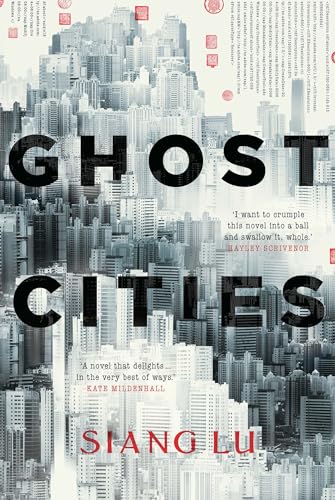
The winner of the 2025 Miles Franklin Literary Award, worth AUD60,000, was announced this evening by Australian journalist Fran Kelly during her program, The Radio National Hour. And the winner is:
Siang Lu’s Ghost cities
Kelly described the novel as being about an “epic conquest of ancient empires and tyrannical leaders”, and also about “what is truth and power”. Also, she said, “it makes you laugh sometimes”. Ghost cities was inspired by the migrant experience, and living in a diaspora. Consequently, it “grapples with the tensions of being Chinese but not Chinese enough”. She and Lu talked a little about his experience of living in such a diaspora.
The judges described the book as “at once a grand farce and a haunting meditation of diaspora”. Lu was happy with the “grand farce” description.
Publisher UQP starts its page on the novel with this description:
Ghost Cities – inspired by the vacant, uninhabited megacities of China – follows multiple narratives, including one in which a young man named Xiang is fired from his job as a translator at Sydney’s Chinese Consulate after it is discovered he doesn’t speak a word of Chinese and has been relying entirely on Google Translate for his work.
Steinberg – see my link below – concludes his short discussion of the novel, with:
Ghost Cities both embraces and defies its emperor’s directive to abandon “the pursuit of beauty” for art that favours “furrowed brows and scholar-like interpretation”. In its zany intertextuality, it displays a level of intellectual ambition rarely found in recent fiction.
Kelly discussed the novel with Lu, teasing out many of the ideas raised in the above descriptions, and in a review of the novel by Tara June Winch (which had, apparently, made Lu cry!) I didn’t capture it all for my post, but Australians, at least, will be able to listen to this interview on the program’s podcast. However, I did like Lu’s final comment regarding current concerns about the impact of AI on writing (and on the arts in general). He said that “if authors imbue their life and soul into their work, that’s the lodestar, and is something AI can’t replicate”. I love his confidence – and surely he’s right (for a while at least)?
To recap, the shortlist
- Brian Castro, Chinese postman (Giramondo) (on my reading group’s 2025 schedule) (Lisa’s review): Castro has been shortlisted for the MF before
- Michelle de Kretser, Theory & practice (Text Publishing) (my review): de Kretser has wont MF twice before, and this book won this year’s Stella Prize
- Winnie Dunn, Dirt poor islanders (Hachette Australia) (review coming next week): debut novel by a Tongan-Australian writer
- Julie Janson, Compassion (Magabala Books): sequel to Benevolence, which I reviewed; Janson’s author’s first shortlisting for the MF
- Siang Lu, Ghost cities (UQP): Lu’s first shortlisting for the MF – and now on my TBR!
- Fiona McFarlane, Highway 13 (Allen and Unwin) (kimbofo’s review): McFarlane has been shortlisted before, but for a novel; this book straddles the short story/novel divide. I’m keen to read it.
For a succinct discussion of the shortlist, you could check out the one posted at The Conversation, by Western Australian postdoctoral fellow, Joseph Steinberg. But there are others.
To recap, winners since 2020
To put this in context, I thought it would be interesting to share the winners, since 2020:
- 2020: Tara June Winch, The yield (PRH, my review)
- 2021: Amanda Lohrey, The labyrinth (Text Publishing, on my TBR, kimbofo’s review)
- 2022: Jennifer Down, Bodies of light (Text Publishing, Rose’s review)
- 2023: Shankari Chandran, Chai time at Cinnamon Gardens (Ultimo Press, my review)
- 2024: Alexis Wright, Praiseworthy (Giramondo, Bill’s second post with a link to his first)
All women writers, and encompassing diverse backgrounds. Now, for the first time since 2016 (AS Patrić’s, Black rock white city – my review), we have another book by a male writer. Interestingly, like that 2016 winner, it’s a book inspired by migration.
This year’s judging panel comprised Richard Neville (Mitchell Librarian, the State Library of NSW and Chair), Associate Professor Jumana Bayeh (literary scholar), Dr Mridula Nath Chakraborty (literary scholar and translator), Professor Tony Hughes-d’Aeth (literary scholar and author) and Professor Hsu-Ming Teo (author – of Love and vertigo, among other books – and literary scholar).
A big congratulations to Siang Lu. I have been toying with buying this book, particularly because I’d heard it has a humorous element. After all, it was listed for the Russell Prize for Humour Writing, and the VPLA John Clarke Humour Award (see my post on Humour Writing prizes). A big plus for me.
Thoughts anyone?
 Whispering Gums
A hugely well deserved win!!
This is a more detailed review from UWA’s Steinberg:
Miles Franklin 2025: Siang Lu’s Ghost Cities is a haunting comedy about tyranny. Is it the funniest winner ever?
https://theconversation.com/miles-franklin-2025-siang-lus-ghost-cities-is-a-haunting-comedy-about-tyranny-is-it-the-funniest-winner-ever-261584
Thanks very much Qin Qin. Good question. I’d have to go back through the list to see what I thought, but then I haven’t read them all so it would be hard to assess. We’ll have to ask someone who has!
If Fran Kelly announced it, does it mean they didnt have a winner’s ceremony? I do wonder about the management of this prize at times…
As to the book, I haven’t read it but, like you, have toyed with buying it. I saw a good critique of it on Instagram months and months ago. But, as ever, too many books and not enough time!
That’s my feeling kimbofo. She said “it’s just been announced” but I really think to all intents and purposes that she announced it! I knew she was going to name the winner on her program from promos. I did several search engine searches to see what the formal announcement was and all I could find was that then when it would be announced on 24 July with no details. Maybe around the same time it was put on the website or a press release was issued, but Fran actually did the main announcement? I haven’t checked the website. If this is how they did it, I was thinking it’s a cost thing. Putting on those big events must be expensive, and thus take away from the money available for the prize itself (unless they can get sponsors for the event)? Interestingly, Stella this year had a public event but it was during the Sydney writers festival so I suppose it wasn’t hugely expensive.
It doesn’t need to be big… I went to plenty of award announcements in London where it would basically just be the shortlisted, their publishers and a handful of guests, so maybe not even 40 people and a few bottles of wine. I feel sorry for the authors and publishers who can’t celebrate together. I hope Siang Lu’s publishers take him out for a nice meal at least! It’s not every day you win the MF!
Oh I like this kimbofo. I agree. It doesn’t have to be big. Small events in fact are beautiful. Maybe there was a small party that evening – I hope so as you say. I must say that I was surprised about how little fanfare or promotion there was about when and where the announcement would be.
I’m no closer to reading the de Krester, which at least is on my shelves, but I like the sound of Ghost Cities so I might pick it up. Was the Patric – which was excellent – so long ago? He seems to have gone quiet.
Yes I like the sound of Ghost cities too Bill, and yes the Patrić was so long ago. I remember he had another book/story out around then but as you say I’ve not been aware of anything since.
Who would you have chosen and why?
Oh good question, Josie. I haven’t read them all so can’t really make a sensible choice. I’m looking forward to reading the Castro, and I did wonder whether he would win, given his excellent body of work. But I haven’t read it …
If I really had to say – based on my personal interests and from the amount of positive recognition it has been receiving – I wouldn’t have been sorry to see Highway 31 win. BUT having heard Siang Lu on the announcement, I think his novel sounds like a good choice. I’m certainly not going to complain.
That “not enough of this and not enough of that” thing is so painful. I experience that myself because I’m hard of hearing. I don’t hear like hearing people. I’m not deaf. I’m always in the middle, I’m always explaining myself, I’m never just me. While interpreters know better than to say “hearing impaired” about deaf people, I’ve noticed that when they talk about me, they still say things like “hearing struggles” or “disability.”
How would you like them to describe you Melanie? Life is becoming so difficult – this is not a whinge (whine to you I think) – but an observation. Re how, with all the best intentions and with good feelings in our hearts we can offend. And that offence then gets in the way of relationships.
I guess I didn’t feel like I need to be described. Instead, the word “support” or “assistive” goes a long way, e.g. Melanie uses assistive devices or works best with support tools. It’s less about being offended, I think, and more about emphasizing what’s negative, like saying Steve uses ramps instead of Steve can’t function on stairs.
Oh this makes very good sense Melanie. And I understand.
I wouldn’t be surprised if this ends up in our Fullers Book Group. I don’t have the energy for it now but it does sound interesting.
I understand that Pam … I’d like my reading group to choose it.
I read the articles about the win and thought what was said about his book was very interesting indeed. Especially his determination to keep the story on its own terms and to continue working on it during difficult times. It’s available as an epub already in Canada which is a good sign that it will make it into print before too long. If you do get to it sooner, I’ll be curious about your thoughts on its universal use of humour (joking about our lengthy discussion about whether sad or happy stories are likely to attract wider audiences and which elements are/n’t more universal…in case anyone mis-reads my comment).