Of all my Forgotten Writers posts, this one is the most questionable because I’m not sure she is completely forgotten. For baby-boomer and I think some Gen X readers, Catherine Gaskin was a household name. Just ask Brona who reviewed her 1962 novel I know my love, and said in her post that she’d read her mother’s whole bookshelf of Gaskins. But, Gaskin has, I believe, now slipped from view and is worth a little post. Her big, breakout novel was her sixth, Sara Dane (see Wikipedia), which was published in 1954. It remained popular through the 1960s to 1980s, when it was adapted to a miniseries in 1982. So, who was this writer …
Catherine Gaskin
Catherine Gaskin (1929-2009) was, says Wikipedia, a romance novelist – but I seem to remember her books as being historical fiction so I’d say her genre was mostly historical romance. She also included mystery and crime in her stories, at times. The youngest of six children, she was born the same year as my mother, but in County Louth, Ireland. She was not there long, however, as when she was only three months old, her parents moved to Australia, settling in the Sydney beach suburb of Coogee. She wrote her first novel, This other Eden, when she was 15 and it was published by Collins two years later, while she was still a schoolgirl. It sold 50,000 copies, and she never returned to school.
After her second novel, With every year, was published, she moved to London with her mother and a sick sister, Moira (who also published two novels). Three best-sellers followed, Dust in sunlight (1950), All else is Folly (1951), and Daughter of the house (1952). Wikipedia lists 21 novels to her name. In his obituary, Stephens tells that as a child she had loved reading, and read such authors as Ernest Hemingway, Graham Greene and Scott Fitzgerald.
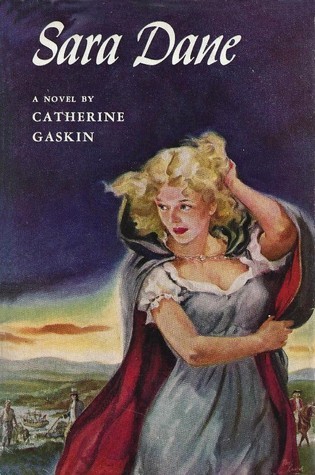
According to Wikipedia, she completed her best-known work, Sara Dane, on her 25th birthday in 1954, and it was published in 1955. It sold more than 2 million copies, was translated into a number of other languages, and was made, as I’ve said above, into a television mini-series in 1982. It is loosely based on the life of the Australian convict businesswoman Mary Reibey. Stephens writes that ‘a Herald critic described the novel as “most readable”‘ although the critic also suggested “that Gaskin’s understanding of history was not deep”. He says that “after Sara Dane, many of her books were overlooked by critics, although welcomed by readers”.
At least three of her novels – Sara Dane, I know my love, and The Tilsit inheritance – were adapted for radio, by Australia’s Grace Gibson Radio Productions, and many others besides Sara Dane, were translated into other languages.
Gaskin met the man who became her husband in London, and they married in 1955. He was a TV executive and 19 years her senior. They lived in various places together, including the USA, the Virgin Islands, and Ireland. However, she returned to Sydney at the end of her life, and died there in September 2009.
I was inspired to write this post by some research I did for the #1970 Year Club last year. Journalist Rita Grosvenor visited her in Ireland around the time of the publication of her novel, Fiona. Grosvenor writes that:
She is among the elite of the world’s women novelists, with such a faithful following of readers she can be sure that every time she produces a new book it will sell 50,000 copies in hard-cover – and that’s more than most authors sell with a handful of books. With paperback sales she often passes a million.
Grosvenor’s article was for the Australian Women’s Weekly, so there’s much about her living arrangements and house, but towards the end, she shares Gaskin’s thoughts about her writing. Despite her success, Gaskin is depressed every time she starts a book, fearing that “this time it is not going to work out, but somehow it does”. However, she says:
“I know I can never be a Graham Greene, but I always want to improve within my limitations. I’m a perfectionist.”
As Stephens writes, “she knew her limitations but didn’t like being regarded as a romantic writer”. She saw herself as “an entertainer and good craftswoman who married romance with history and studies of such subjects as trades and places”.
According to Stephens, Gaskin retired after her last novel, The charmed circle, was published in 1988. She wanted to travel with her husband, without publishers’ deadlines. So, they did travel, apparently, until his death in 1999. She then moved to Mosman, in Sydney, and spent the rest of her life there. Stephens quoted her as saying, ”I am not an Australian by birth but I think like one”.
Have any of you heard of or read Catherine Gaskin?
Sources
- Catherine Gaskin, Wikipedia [Accessed: 23 June 2025]
- Catherine Gaskin: Best selling Coogee author, Coogee Media [Accessed: 23 June 2025]
- Rita Grosvenor, “Ireland is home for Australian novelist“, The Australian Women’s Weekly, 6 May 1970 [Accessed: 7 October 2024]
- Tony Stephens, “The girl with the golden pen: Catherine Gaskin, 1929-2009“, The Sydney Morning Herald, 18 September 2009 [Accessed: 23 June 2025]
 Whispering Gums
Oh yes, hers was a name very often seen on the Returns shelf when I worked in the Fremantle Public Library, ’61-’62. I had no idea she was Australian – or sort of. Her oeuvre was definitely seen as ‘romance’ by the readers, of whom I was, therefore, not one.
(I think that many of those who’re still around would take exception, as you posit, to her being forgotten, ST …)
No, I didn’t read her either MR … but I remember my friends reading her. So many of the titles ring strong bells from my high school reading days.
I have a Spotlight (on author) sub series too but they are all contemporary authors and so I decided to stick with Forgotten and find out just how forgotten she is!
So you were stirring, eh …? [grin]
Let’s just call it market research!
Fairy nuff, me old china. 🙂
Thank you for the shout out Sue! The Sara Dane TV series get me started on her books when I was 13. I then read all the ones that mum had on her backshelf at that time.
For the record I read All Else Is Folly (1951), Sara Dane (1954), Blake’s Reach (1958), I Know My Love (1962) my favourite, The Tilsit Inheritance (1963), The File On Devlin (1965), Edge of Glass (1967), Fiona (1970) and The Lynmara Legacy (1975). Mum continued to read all her books, but I moved onto other authors by the time I was about 16.
They were fun at the time and I remember them fondly.
I loved finding your post Brona … and I love these reading family stories. Thanks so much for filling all that in. I didn’t read her but many of my friends did. They read Georgette Heyer and Jean Plaidy and the like and I didn’t read them either. I liked Nevil Shute and more contemporary stories. I have no idea why that is.
I discovered A Town Like Alice at a similar age thanks to the miniseries with Bryan Brown – the 80’s were big on the miniseries!! But I never went read his other books until more recent times.
I also tackled James A Michener’s Centennial at that time too. It was the biggest book I’d ever read at that point and was very proud of myself! My reading was very much determined by the books that mum and dad decided to buy for themselves. Thankfully they never suggested that at 13 perhaps I shouldn’t be reading them, so I just devoured them all – Peyton Place, A Patch of Blue, A Summer Place are some that I remember. All were made into movies, so I’m beginning to see a pattern in my parents reading!
I don’t know how I got into Shute because I am talking the 60s before all those miniseries. There was a film of his novel No highway which I saw, also the films of A town like Alice and On the beach. My first could very well have been On the beach because of the Cold War. These were the first three Shutes I read. I read a lot of books about race and social issues by my mid-teens – To kill a mockingbird, To sir with love. I got into a white South African writer, Joy Packer, in my teens too. They were contemporary romances as I recollect. I remember A patch of blue too.
My parents didn’t tend to read the big best sellers. I remember my maternal grandmother reading all the historical fiction series – The Pallisers, the Heyer books etc
Love the movie-book link in your parents’ reading!
My mother was more into the classics and the more literary writers like Thea Astley. I can’t remember what my father read in the 60s. I think he was very busy with work and mostly read the paper and watched TV, but as he got older he got into war novels, war history and stories of Australian pioneer families partly I think because of his work in Mount Isa in the 60s and his love of Banjo. Lest this all sounds a bit uppity, they also read the Readers Digest magazine which was my father’s sister’s annual Xmas gift to them! I do remember Michener and Leon Uris being around. But even then I didn’t much like huge books.
Hi Sue, I did read Catherine Gaskin. I think it was my mother who introduced her books to me. I did love them. I don’t know why, but I thought she was Australian.
Love this Meg … that is, the stories of mothers and daughters passing on reading.
I didn’t say this in my post but I have a signed copy of two of her novels, including Sara Dane (to Mr Gums’ father).
That is wonderful!
It’s pretty special isn’t it.
My goodness! There’s a name I’ve not heard for years. I read ‘Sara Dane’ many years ago.
Haha Jennifer … I think Gaskin and that novel brinks back memories to many born in the 60s and before?
I happen to be reading a biography of Catherine Cookson; her books were always on the shelves with Gaskin’s. Michener, too, as Bron mentions: also Howard Fast, James Plunkett, John Jakes, Jeffrey Archer, Belva Plain, the Plaidys as you’ve said, Norah Lofts, Mary Stewart, Diana Pearson, etc. And, yes, absoLUTEly, the TV series were what landed books in the stacks for the older generation in my family too. The only Steinbeck on the shelf was East of Eden (another 80s gem lol).
Oh yes, I remember Catherine Cookson being popular and Mary Stewart, Norah Lofts, Jeffrey Archer but I didn’t read any of them. I did read some Steinbeck. Love that East of Eden was the only Steinbeck on your older generation’s shelves!
Several Aussie books were made into TV series in the 70s to 90s – books by George Johnston, Ruth Park, Nancy Cato and of course there was The Thornbirds! Colleen McCullough was another popular writer but after Gaskin, Stewart, Plaidy, et al.
Yes, of course McCullough, though once she got “into” Rome that dwindled. heh And, yes, Ruth Park was there! I was eyeing Swords and Crowns and Rings as a reread but not this year for sure.