In 2023, The New Yorker published a piece on Helen Garner. Written by Australian journalist, Helen Sullivan, its title, “The startling candor of Helen Garner”, captures exactly what I like about Garner, as does this a little further on:
Her writing is elegant but colloquial, characterized by an impulse to say and share things others might keep private.
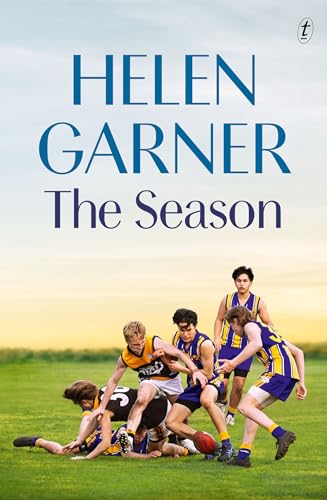
Garner’s latest book, The season, is a gentler book than most, if not all, of her previous books, but these things – the writing and the honesty – are still in play. BeeJay Silcox, in conversation with Garner about the book, described it as “a graceful book, a love letter from a grandmother to boys and men” and suggested that it’s “not very different” from Garner’s other books as some have said. As is my wont, I take a middle ground. I did find it quieter, less contentious, but it still has her openness, her often self-deprecating honesty, and her clarity about what she is and isn’t doing.
“a nanna’s book about footy”
What Garner isn’t doing in this book, and what surprised many of those she spoke to as she was writing it, is some sort of social or societal analysis of footy. “Blokes”, for example, who’d been “formed by footy”, expected “fact and stats and names and memories”, while others, particularly women, assumed she was writing “something polemical, a critical study of football culture and its place in society” (like, say, Anna Krien’s Night games. Indeed, in my review of that book, I reference Helen Garner’s writing.) These assumptions panicked Garner somewhat. She was not writing these, but “a nanna’s book about footy”, a book
about my grandson and me. About boys at dusk. A little life-hymn. A poem. A record of a season we are spending together before he turns into a man and I die.
Pure Garner: it describes what her book is, but belies the insights and observations that lie within. However, both sides are described and hinted at in the opening pages of the book, when Garner writes about her grandchildren. She understands her granddaughter she says, but
having never raised a son, I now began to learn about boys and men from a fresh angle, to see their delicacy, their fragility, what they’re obliged to do to themselves in order to live in this world, the codes of behaviour they’ve had to develop in order discipline and sublimate their drive to violence.
During Melbourne’s extended pandemic lockdowns, Garner watched more footy, and saw it in a new light. She glimpsed “what is grand and noble, and admirable and graceful about men”.
Given all this, and the fact that Amby (Ambrose) is her youngest and last grandchild, she wanted to better know him, “before it’s too late”. She wanted to “learn what’s in his head, what drives him; to see what he’s like when he’s out in the world, when he’s away from his family, which I am part of”. She decided to follow his Under-16s football team, driving him to training and attending their matches.
“It’s boys’ business. And my job is to witness it.”
The footy season starts, and there is Garner, “a silent witness” on the sidelines, with notebook in hand. She’s the quintessential invisible woman, and happy to be so, albeit she asked Amby’s and the new 21-year-old coach’s permission first. What follows is something that reads rather like a diary. In the aforementioned conversation, Garner said she initially struggled to turn her experience into a book. She started writing it in the past, but that gave it an historical feel, so she changed to present tense, and voilà, she had her story. And she was right. It feels fresh and personal.
The book, essentially a memoir, is well-paced, partly because of the chronological drive implicit in the training-playing season, but also because of the way Garner mixes gorgeous description and small snatches of dialogue, with astute reflections and self-questioning. There are times when she loses heart: it’s cold on the sidelines; is she “trespassing on men’s territory, ignorant of their concerns and full of irrelevant observations and thin-skinned responses”; who does she think she is, “intruding on his [Amby’s] privacy, feeding off his life”. But she “slog[s] on”, because writing is what she does.
What she also does – whether it be a novel about a dying friend (The spare room) or a true crime book about the trial of a man accused of killing his children (This house of grief) – is capture life in all its messiness. If you’ve read any Garner, you will know that she understands messiness and will not shy away from it. Here, it encompasses her own aging and being a grandparent who can only ever be on the periphery; an adolescent boy’s challenge in coping with school, girls, and training; and the emotional ups and downs of football, the rigours of training, the errors that let the team down, the wins and losses.
I am not into football, but I found The season compelling. I enjoyed spending time with Garner again, but I also appreciated her insights into masculinity. Throughout, Garner asks the men and boys around her – Amby in particular, but also coaches, trainers, fathers – pertinent questions, such as why have a mullet (haircut), what is good about tackling, is he proud of his battle scars. The answers are sometimes surprising, occasionally funny, but nearly always enlightening. Amby tells why he likes tackling:
“I guess it’s basically inflicting physical harm but with no actual hard feelings. It’s just aaaaapchwoooooo and then you get up and keep playing, and then at the end you shake hands, and no one remembers anything.”
Football, Garner sees, is “a world in which a certain level of violence can be dealt with by means of ritual behaviour”. I never will understand this violence and men thing, but Garner’s sharing her time with the boys and men – particularly her willingness to ask the right questions, to listen and to reflect – did continue my education (and hers).
However, it’s not all about masculinity. There are all sorts of other observations, some self-deprecatingly humorous, such as this reflection on a match where Amby’s team “verses” a bigger, stronger team:
How quiet our team’s supporters are! We stand there like inner-city intellectuals, analysing our boys, criticising their every move, using modal verbs in knuckle-rapping tenses: should have, ought to have.
This made me laugh, but it also conveys Garner’s ability to mix tone, and to flip modes, between the grittiness of football and quiet, humorous, compassionate observations.
The season is exactly what Garner intended, a warm-hearted “life-hymn” about a season spent getting to know her youngest grandson as he transitioned from boy to man. It’s an attempt to understand what makes men tick, and the role footy can play in forming young boys into men. I find it hard to buy the “warrior” stuff that goes with male sport, as Garner seems to, but I can understand where it comes from, because there can be nobility and grandeur in sport.
If, like me, you are not a football follower, don’t let that put you off. The season is not a sporting memoir full of facts, figures and rules. Instead, it’s a nanna’s story about time spent with a loved grandson, a story with footy at its centre but that is, fundamentally, about the things Garner does best, character, drama, and emotion.
Kimbofo also loved this book. It would make a good companion to Karen Viggers’ novel about youth football (soccer), Sidelines.
Helen Garner
The season
Melbourne: Text Publishing, 2024
188pp.
ISBN: 9781922790750
 Whispering Gums
Ahh – lovely, ST ! Super review, me old china !!
Of course, it helps that I am also a Garner fan: in fact, I’ve said many times that were I able to choose which successful author to embody in writing (but differently, of course !), it would most certainly be she. She is entirely wonderful.
Thanks MR … of course I agree with your choice of writer to embody. She does nonfiction so well, with such a storyteller’s eye, which you also have. I assume you’ll listen to this one?
I’ve bought it from Audible, and will be listening to it just as soon as I finish binge-watching “The BlackList” on Netflix (I’m a big James Spader fan).
Let me know what you think … who is the reader? We don’t have Netflix so I don’t know The blacklist.
She reads it HERSELF !!! 🙂
Oh that’s great … she was a teacher so she knows how to speak and present, unlike some authors, I think.
I have had a small binge on Helen Garner starting with her short story collection Letters from Surfers, then Monkey Grip and finally this one – all over the last few weeks. I have to admit, I have not been that particularly captivated.
The Season, to me, was a pleasant read at best, but then I also have to take in that it is “a nanna’s book about footy” and her relationship with her grandson and not going to be too deep and meaningful.
What I will add was her use of the word “versing” caught my attention. It was always “verses” in any football circle I have engaged in. I am informed that a younger generation is using “versing” so I presume that Helen used it throughout as that is what she was hearing from her Grandson and his peer groups. Language changes over time, I except that, but I did not enjoy reading it.
A writer friend of mine who works in a games shop had to tell me (some time ago now) that “versing,” that new-fangled active verb version of “versus,” comes from gaming culture. And when I say “gaming”, I mean online computer games, not lightening one’s wallet at one’s local casino. 🙂
As someone who writes poetry, this particular usage of the word “versing” amuses and horrifies me in equal measure…
Haha Glen … me too. I’ve started hearing it more and more but seeing it on the page – and frequently – was actually rather confronting because it somehow validated it. I didn’t realise its origins in gaming (whose meaning I assumed from your games shop reference!)
I had a chat on a private footy site I am a member of (no trolling praise be) and made mention of “versing” in The Season. One reply mentioned the gaming communities use. I just could not get used to it when reading The Season.
No trolling … great to hear. I guess I didn’t like it – and it jumped out at me every time – but it also felt right. I would have been happy with “played” or “playing”, that is, those words would have felt perfectly ok to me!
Yes, fourtriplezed, as I replied to Glen, the versing got me too. I’ve been hearing it often enough but seeing g it on the page was something else.
I’m intrigued that you haven’t loved her as much as many of us do. You make an interesting point about the relationship with the grandson not being overly d&m. Who knows what it really was because I imagine she’d not want to betray his trust. On the other hand I think the little interactions that she shares do give more away about their relationship and who he is than might seem on the surface. There are hints – such as re girls – that she doesn’t explore, presumably to not betray his confidence?
I have actually given thought as to what it is with her that has not grabbed me considering her place in Australian literature. The book of short stories was good, as far as short story compilations go. Some I liked others less so. Monkey Grip on the other hand just left me cold with the repetition of the theme seemingly page after page. And maybe in my youth, and to this day, I do not understand intelligent girls being attracted to men who are just users. To me Monkey Grip was about the girl not being able to get a way from the boys “heroin blue eyes” that seemed to get a mention every 2nd or third page. I won’t even bore you with my thoughts on the sex descriptions other than the lack of “subtly” for want of a better word. I do get that that was the point though.
As to The Season I except that it was a homage to her love of her Grandson and as much as he may have been happy to be part of the book, she had to be careful to, as you say betray his confidence. I am OK with that, but it did make it just a kind of love letter to me. I am a footie type, until recent time I attended every Brisbane Lions game and had done for decades but as to sports reading, I tend to get bored as to me, in a strange way I am unable to explain, the discussion hardly changes book to book for me. The Season to give it its due was a little different but, maybe just another sports book to me? Also, that feeling of slight repetition of the theme.
Thanks for thinking about and explaining all this fourtriplezed. It does just sound like she’s just not for you, because everything you say makes sense. It’s just that those things are not issues for me. I have reviewed Postcard from Surfers on my blog.
PS I don’t get women being attracted to drug users or (bad boys, for that matter) but I’m interested in reading about women who do so I can better understand those I meet! That said, in O’Reilly’s Other houses the protagonist is attracted to a user but is not prepared to date him because of that. Then he gets clean and she does, and he is a very decent partner. But to date someone still using feels a recipe for disaster on all sorts of fronts to me. Garner though, personally, was I understand rebelling against a very tough father so her character probably reflects that.
I don’t know anything about Helen’s life but the fact she had a bad relationship with her father maybe telling. I read your review of Postcard from Surfers after I had read my copy. My favourite by far was All Those Bloody Young Catholics and is what I can only describe as a drunken stream of dribble by a bloke at the pub who catches up with an old female acquaintance from the past. Kind of reminded me of someone’s youth, hopefully not mine 🙂 You made mention of that one as well.
Thanks – yes I did. I must go back and read some of those stories. I remember that one to some degree, but I mostly remember the first one with the parents and aunt, and the Philip references.
Amongst other examples of her short fiction, I have always loved Garner’s story “The Life of Art.” I can’t remember now if this story was in “Postcards from Surfers”; I almost certainly first read it in an anthology alongside other stories by Australian writers. But it would have to be one of my favourite short stories of all time, from any writer.
Yes, it is is that collection, Glen … I remember liking it. I’ve read it a couple of time, and must read it again.
Hi Glen. The Life of Art was the other shot story in that collection that stood out for me.
Love it fourtriplezed … glad two stood out for you.
Hi Sue,
I will readily admit to my longtime admiration for Garner’s early and middle-career works, though I’m not particularly au fait with her more recent books. I’ve also heard nothing but good things about The Season from the commentary that has come before yours. However, a few points in your review have given me pause.
First of all, Garner’s observation that boys and men need to “sublimate their drive to violence.” I haven’t read the book, so I can’t assume that she’s claiming that this drive is limited to males, even though it looks like it from the way you’ve quoted her here. She does, however, highlight young males’ fragility in the same passage. She also makes no bones about her own violent impulses under provocation in her other works, not just as a socially conscious writer, but as someone “who has fought men all her life.” The great pity is that she’s hardly alone in this, even within the world of letters. We all know that the vast majority of violent crimes are committed by men, which should be a source of concern and regret for everyone.
Speaking purely for and about myself, I’m prepared to believe that I have a (latent) tendency towards violence because I’m human, but NOT because I’m male. Perhaps it’s a lust for dynamism and a predilection for fantasy that keeps some of us, male and female, watching dramatised shoot-outs and car chases, or fondly remembering the pyrotechnics and anvil-dropping of old Warner Brothers cartoons. And perhaps I take the implication of the “male taint” of violence a little too personally, when my own conscious values and conscious behavioural inclinations are the opposite.
Secondly, Amby’s explanation about the benefits of tackling. Perhaps one point about football (and about football barracking, even) is being able to work off aggression and even do a (limited?) amount of damage with impunity, and not have to take especial responsibility for it afterwards. At least if one “plays within the rules.”
I often think of diaries (and particularly writers’ diaries) in Jungian terms i.e. as a kind of repository for people’s shadow side that allows it to be expressed without causing any lasting harm. Perhaps blood sports operate in a similar way, albeit with a full-time siren, an expectation that certain injuries will be inevitable, and (at the professional levels) an umpire’s notebook and a midweek tribunal. In other words, it’s a kind of damage limitation that allows a certain amount of damage to be inflicted within (somewhat) controlled circumstances. I don’t know too many Jungians who are also football followers that I could test this theory out on, and I am fairly immune to the charms of football myself. But this idea of damage limitation is why I don’t think writers should ever publish their diaries. Or at least, they shouldn’t if their diaries are to function in this way, as opposed to being more curated or even deliberately performative. And yes, I appreciate that I’m on shaky ground with that last statement, given that Garner herself has done what I’m warning against!
Thirdly, I couldn’t suppress an inward smile at Garner’s expressed qualms about trespassing on other people’s territory with this book. There are many people who will say that she’s made a career out of doing just that, so why should she stop now? It’s an oversimplification of her oeuvre, but much of her work is (to me) a kind of lyrical, insightful reportage: she writes beautifully and courageously about the messiness (as you put it) in her life, and the messiness (and tragedy and injustice) in other people’s lives.
Finally, I think Garner is more than entitled to write a quiet and reflective book in her twilight years. It shouldn’t have to be another “Night Games” at this stage of her writing life. As I think she’s said in interviews, it was the book she wanted to write at this time, as opposed to any number of feature articles that she’s frequently offered, but can’t get interested in. She doesn’t have to prove anything to anyone anymore. Unless, of course, she wants to.
Sorry for such a long-winded response. I would be fascinated if someone were to ask a female footy player to read this book, and then ask them what they thought of it. Has anyone thought to do this yet?
Oh my Glen, this is wonderful response, to which I can’t do full justice. I agree with a lot of what you say, but will try to tease out a few things that particularly caught my attention.
This, for example, ” “sublimate their drive to violence.” I haven’t read the book, so I can’t assume that she’s claiming that this drive is limited to males, even though it looks like it from the way you’ve quoted her here”. This book is about men so she doesn’t really address women’s “drive” here. I must say that I have “almost” zilch drive to physical violence, and have no interest in watching car-chases or shoot-em-ups. I don’t understand why this is escapism. When I watch crime I prefer police procedurals which focus on the investigation not the crime itself. I never really understood my son’s drive to violence, his interest in Fight Club. (He is a primary school teacher now, so has certainly “sublimated it”). And yes, that point about football being able to work out aggression with impunity – but controlled – comes out a few times in the book. There’s another time when Amby says something about hurting but not injuring in tackles.
(Re female footy players, there’s a brief moment in the book where she sees some training. As I remember, they had turned to footy from, I think basketball, and what they said they loved was tackling! Internally, I said, “really?”!)
I enjoyed your Jungian analysis, and while Garner did publish her diaries, she did curate them, but does expose some shadow side all the same. As in The season, she admits to vulnerability and petty feelings.
And yes, I agree she has a right to write whatever book she likes. I understand there is a contract for another one. What will it be?
Thanks for linking to my review.
It was an interesting writing exercise, I think, for Garner rather than her usual wanting to get to the bottom of why good people do bad things, aka her true crime reportage. But I do think she has an issue with men… she tends to be more forgiving of them than she does women and her focus tends to be on males. It’s interesting… and I suspect it’s probably something to do with the relationships she has with her own parents.
That’s an interesting point Kimbofo re men. I did read somewhere where she said something about – and I might be misquoting a bit – her books always being about arguing with her father. I think his rejection hurt her badly but I don’t want to get into pop psychology because who am I to know.
Hi Sue, I loved Seasons, and I belong to two book clubs and all enjoyed the read. There were some who were not interested in football and had never had children involved in the game. But all loved the connection that Helen had and encouraged with her grandson. We all love and dote on our grandchildren. Though the book is about football, it is also about our love to be with our grandchildren, even though it may mean been very cold and wet. Amby is a good young man, as he also takes out time to communicate and associate with Helen, his grandmother.
Thanks Meg. I love hearing about your reading groups’ responses. You are right about Amby. His affection for his grandmother, and their easy relationship was delightful to read.
Re 4ZZZ – there’s a lot of years between the young woman of Monkey Grip and the grandma of The Season! In between, Garner interrogates pretty thoroughly the whole share house culture she (and I to a lesser extent) became adults in.
This is an amazing conversation to come in a the end of, but I’d like to make a distinction between ‘footballers’ and kids playing football. I played football both in school sport and at the weekend, from grade 5 to form 6 – without ever being very good – and it was mostly about running around with your mates and almost never about working off aggression.
Thanks Bill for your comments. Good point re the years that have past. Garner is still partly that person – as we all probably are – but well tempered by experience, I presume, as hopefully most of us also are!
I love your distinction between footballers and working off aggression. Do you think that distinction still exists? Or, maybe it does in the “lower” grades but not in “first grade” whatever they call it in AFL, as these kids must have been given there’s mention of talent scouts. Your comments on your football sounds a bit like my son’s experience of cricket in 2nd/3rd grade.
It’s been a great discussion. I’ve enjoyed it.
Hi Bill. I totally except your comment and that has gone through my mind as well over the reading Helen reading journey these past few weeks. What we, author or reader, wrote/related to in our early 30s, and we write/relate to 30 odd year later are usually far apart. And my youthful sports life is like yours, not very good but the lots of great mate, fond memories. I am with you on the aggression part, I was not that competitive’
I think my share house experience was a bit different from Helen’s. We drank a lot, but it never involved drugs, everyone worked as well. What I found interesting about Monkey grip was the references to the literature that was being read. I recall looking up plenty of what was being read and thinking how good that was. With that where I related to Praise by Andrew McGahan as a Brisbane book I maybe related less to a Monkey Grip as Melbourne book?? Nor sure on that one.
I’ll have to remember to check out the books being read next time I read Monkey Grip, which I agree is very Melbourne. I lived for 6 months in a divided up queenslander in New Farm in 1972 (then I got a trucking job in Nambour). I really enjoyed McGahan’s first two books but when he decided to experiment with genres I’m afraid he lost me.
I am one out of two with him. I thought Praise very good but Underground a bit ordinary at times. I have 5 on the TBR so one day, maybe.
I really liked Praise too.
I enjoyed this book so much. I still think about it. Her approach to the subject of both young men and football was completed in such a way as only she is capable of.
I laughed at the mullet description. Liking the way the hair flies out behind as they run down the field. I understand mullets better niw😃. I enjoyed your review.
Thanks Pam … yes, I loved the mullet description too and also feel I understand them more now. I’m glad you enjoyed my review.
I do feel like I’ve read someone’s review of this book before. I appreciate that she’s trying to understand men, but I wonder what she would have learned if she asked people who weren’t football players. Her grandson’s answer scares me. When he says, “inflicting physical harm” and then notes that everybody shakes hands and no one remembers, I feel like he’s basically saying that he’s very excited about violence, so long as there are no consequences. I guess it’s consensual violence? But then do people who are into consensual violence actually listen when somebody says no, like a domestic partner? The rate of athletes in the US who beat their wives and partners tells me maybe not.
I guess you could describe it as consensual violence Melanie and I still don’t understand it – like you it seems. Good point about players and their partners. I know it is an issue here, particularly when their team loses. It was an issue too during the pandemic when men were locked down as were their partners of course but it’s more often men who resort to violence under stress. We are not in caves any more and haven’t been for a long long time.
Why are people, men in this case, happy to get hurt? To be in pain? To risk injury? At the hands of others. Boxing too. And women are taking up these things. I don’t get any of it.
Many sports people have exceptionally low pain thresholds, so maybe that plays a part.
Maybe… do you think they self select?
I’m not sure what self select means. What I think is that with a lack of pain thresholds, sports types can crash in, in most situations. You have to be a tough type to do martial sports such as Boxing for example. I have mat a couple of famous boxers over the years through friends / relatives, and they felt little in terms that we might. For example, one Australian world Champion told a group of us that when he got knocked out defending his world championship, it was the accumulation of hits that stopped his arms from working. He claimed that he watched every punch come his way but, though not feeling pain, could not move. I am not saying that all boxers were like that, but many were.
Jonathan Brown, the Brisbane Lions player got knocked off his bike https://www.abc.net.au/news/2012-10-23/brown-shrugs-off-car-collision/4329896
Work that one out!
I’m no expert on this subject, but my youthful footie career was over as a youngster because of the pain, I couldn’t stand it. But if say Helen Garners grandson feels little, he is going to just go for it when playing.
Thanks fourtriplezed. Fascinating stuff that makes sense. What I mean by self-select is more or less what you did. You removed yourself from the sport (self-selected yourself out) because you hated the pain. If the pain doesn’t bother you, you self-select yourself to keep playing. It’s another way of saying we go where our skills/talents/genetics lead us.
I will check out that link.
I enjoyed that article about Garner in TNY and kept that issue somewhere, thinking I would enjoy reading it again at another time. My other comment isn’t so much about this book but about the idea of how we speak of violence and masculinity, as I recently read a Canadian novel that also explores these ideas. Therein the main character is male, another younger male was a victim in a public “mass” (9 dead, the definition of “mass” shifts) shooting, and various older men with the narrator are all in attendance at a luxury hunting camp to “commemorate” the younger man’s killing. What interests me is that many people who talk about the book talk about the male-ness of it all, but the fact that the luxury resort is owned and operated by women is not examined in the same way. That gave me a lot to think about, and it feels like some of the comments here brush up against similar questions. All part of a vitally important discussion.
Oh interesting Marcie – about the novel, the ownership of the luxury camp and the emphasis in the conversations about the book. We aren’t very comfortable talking about women and violence – sanctioned or otherwise, are we.
Some time later, I came across this piece I’d saved, which you might enjoy.
Oh thanks very much Marcie I will read that later… I did enjoy Anne Enright’s piece. It will be interesting to compare this take.
You almost convinced me to read it – almost – but only for the eloquence of her descriptions.
A wonderful review!
Haha, thanks Forestwood. I’m glad you enjoyed the review, even if I didn’t quite convince you to read it!
Hi again Sue,
I had to write a little addendum to this review and discussion after reading Anne Enright’s review of Volume 3 of Helen Garner’s diaries (How to End a Story: Diaries 1995 – 1998) in the upcoming issue of London Review of Books. I think it will be free for your viewers to read as a one-off, if they’re not already subscribers:
https://www.lrb.co.uk/the-paper/v47/n08/anne-enright/i-stab-and-stab?
Now, I haven’t read any of this volume, but I’ve known for some time who ‘V’ is, and that Garner’s marriage to him ended badly. And I’d already had an inkling that ‘V’s’ behaviour contributed significantly to the breakdown of the relationship. But I read this sympathetic summary of Garner’s own precis of their union with more than a touch of sympathy myself, together with liberal helpings of morbid fascination and (at times) sheer disbelief.
The point is, the attitude I’ve adopted about writers publishing their diaries has come about after reading certain other authors’ diaries over the years, in which many of the interlocutors blithely show themselves to be deeply flawed, if not downright odious individuals. This isn’t me wishing that they wouldn’t spoil whatever illusions of them I might have had previously, but more of a general warning against anybody being so eager for their own warts-and-all characters to be spotlit in this way. Particularly if those warts happen to be very warty indeed, and the owner of them implies (or says outright) that they’re comfortable with them, or even proud of them. But I think I’ve read enough of Garner’s writing to say confidently that she doesn’t fall into this unfortunate category—not by a long shot. However curated her self-portrayals or disturbing her material might be at times, her perspectives are always fascinating and beautifully rendered.
The other thing to say about all this is that, although I’m familiar with the problematic natures of diaries and biographies as literary and historical texts, I’m as a big a sucker for “the goss” they serve up as any other reader/fan-boy out there…
Thanks Glen. I had this article sent to me by another person too, and loved it. I have read the first two volumes of her diaries, but not this one yet. I feel that having read that article I might now have pretty much read the volume!
I agree with your assessment that “However curated her self-portrayals or disturbing her material might be at times, her perspectives are always fascinating and beautifully rendered” and with your concluding comment too. We all do this sort of thing – recognising the limitations of something we can’t, however, resist – frequently (from having that extra glass of wine to being drawn to the “goss”.) Seriously though, the way Garner can express herself. Her description of going about her writing says it all doesn’t it – the crafting, and the thought and goal behind that crafting.
By the by, I also thought Enright captured the challenge of The first stone so well. It was a great book to read, think and talk about, but I am sorry for the grief and pain she experienced. It did feel like a naive thing to do, but such an honest one that put out into the open a range of feelings and ideas that were barely being publicly discussed back then. I had big discussions with some feminist friends at work about that book, and I’ll never forget it. We would never have had those discussions if it weren’t for that book.
And, I love Enright’s closing sentence! Perfetto!
I really valued your review, and it has pushed me closer to reading it. I was/am very torn between loving Helen Garner and hating reading about sport – but it sounds like my distaste for sport isn’t too great a barrier.
Thanks Simon. I don’t think your distaste for sport would be a huge barrier for this one, although there is quite a bit about sport one way or another. I reckon if you can borrow it just start it and give it a go.