It’s a strange coincidence that my second review for Bill’s Gen 1-3 Aussie male writers week is for a novel titled Dusty, when my first was for a short story titled “Dust”. One of those funny little readerly synchronicities. The title, however, is about the only synchronicity because, although both stories allude to the dusty Australian landscape, Casey’s short story is about miners’ lung dust disease while Davison’s novel is about a part-kelpie part-dingo named Dusty.
A bit about Frank Dalby Davison
Davison (1893-1970) was best known as a novelist and short story writer, and was a significant figure in Australian literary circles of his time. There are useful articles for him in Wikipedia, and the Australian dictionary of biography, and I plan to devote a Monday Musings to him soon. Meanwhile, as background to this post, it’s relevant to say that he was born and schooled in Melbourne, but left school in his early teens to work on his father’s farm near Kinglake. The family moved to the United States in 1909, when he was 16. After working there in the printing trade, he travelled more, eventually enlisting for World War 1 in England. After the war, he took up a Soldier Settlement selection near Injune, in central western Queensland.
Davison wrote several novels, but his best known is probably Man-shy (1931), which won the Australian Literature Society Gold Medal. Featuring a red heifer, it was my introduction to Davison in my first year of high school in the 1960s. Dusty (1946) is also about an animal – this time a dog – and has been in my sights for some time. Both novels drew on his experiences in Injune. AustLit reports that the manuscript of Dusty, ‘entered under the title “Stranger”, and the pen-name “Tarboy”, won the Melbourne Argus and Australasian Post 500 pound Novel Competition in 1946′.
Dusty
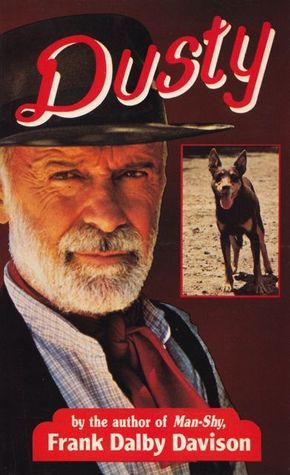
At the end of my edition of Dusty is a promotion for Man-shy which quotes from H.M. Green, the literary historian who inspired Bill’s “generations”. Green writes:
Although other novelists have made animals their principal characters and drawn them realistically, Davison is the first to make a serious attempt to get inside their minds. The red heifer and the mob of wild cattle to which she belongs stand for the spirit of freedom and dogged, untameable resistance; their struggle is made extraordinarily real to us … Davison has a genuine and individual talent.
This could equally apply to Dusty, which tells the story of a dog, sired by a kelpie to a dingo mother. Violently wrenched from his lair when he was a few weeks old, he is sold to a decent man, a bushman named Tom. Tom is no fool. He recognises the mixed blood, but also sees potential in the pup, and trains him to become a champion sheep dog. Their bond is strong but is tested when Dusty’s “dingo blood” starts asserting itself, and he turns sheep-killer by night. This will not do, and Tom knows it. The novel, however, does not play out quite the way you’d expect, and we are left guessing until the end about what will, indeed, happen to Dusty.
That’s the plot, but like many plots it doesn’t tell you much about what the book is really about, or what makes it a good read. Told in three parts, Dusty is a realist novel, detailing life on Australian sheep stations and cattle properties, and told mostly through the perspectives of Tom and Dusty. Yes, you heard right, Dusty, the dog. I was completely engaged because not only is there none of the sentimentality common in stories about a man and a dog, but there’s also nothing anthropomorphic in the dog’s point-of-view. He feels pure dog, which I thought quite a feat. Early on, for example, Tom, having previously given Dusty his dinner without ceremony, puts the food down and starts some training:
Then followed a series of mystifying events. A hand appeared just above the dish and twitched, giving forth a series of soft snapping sounds; then there was a little soft whispering, and then a voice that, like the hand, kept repeating a small noise over and over again. He could make nothing of it …
This dog’s-eye view of the world, based on his experiences to date, continues through the novel.
Soon, though, bigger issues are at play involving the two parts of Dusty’s being, “the ancient battle between conflicting heredities, and between early influence and present environment; the mother against the father, nature against art”. Then Davison adds something interesting. The dingo is the product of nature, while the kelpie, the working dog, is “a product of art”. But, Davison adds, “nature, if man fails in toil or vigilance, hastens to reclaim her own”.
In other words, beneath this deeply interesting story about a man, his dog and outback farming, is a wider story about “nature”, or the essence of our beings. Contained within Dusty is the struggle between the two forces – that of freedom, of following his instinct, and that of living by his training, by rules and responsibilities. After Dusty’s dingo side becomes apparent to all, Tom knows what must be done but chooses to change his life rather than kill his dog. He becomes a self-employed possum scalper in cattle country, and finds, “without meaning any ingratitude for past kindnesses”, that he relishes his new situation in which he is invited to share a meal as “a guest and not just the hired man”. In other words, as a possum scalper, Tom is freer to be his own man.
But, while I think Tom’s life is part of this wider theme, the main focus is animals, and the idea that, in them, “is a whole scheme of values outside those familiar” to us.
There is no easy ending for Tom and Dusty, and we are left, three paragraphs from the end, with a dingo howl, “a cry of mournfulness and dark mirth, of drollery and love and hate and longing, of the joy and sorrow of life, of the will to live, of mockery and despair”.
Dusty is not a didactic book. There is no moralising, no subjective pronouncements about choices. Instead, with its objective tone, and plain but expressive prose, it feels more elemental, something that examines the essence of who we are and what we do to live. And that makes it feel timeless.
Frank Dalby Davison
Dusty
Sydney: Angus & Robertson, 1983 (Arkon ed., orig. 1946)
244pp.
ISBN: 0207133891
 Whispering Gums
Oh my that cover, it’s so horrid and makes the book look like some wild west outlaw gambling redemption story or something.
It’s not fetching is it Stefanie! It’s typical I guess of cheap paperback classics of the time I guess. There are many better covers out there.
Judging by the movie-tie-in cover there must have been a film starring Bill Kerr.
You got it in one Brona … it was released the same year as my edition, funnily enough! (Or should I say vice versa, my edition was published the same year it was released!)
From my first job out of school – the public library in Fremantle – I’ve been aware of his name but haven’t read anything he wrote.
Dusty seems to have an unhappy ending: perhaps that’s why … I am an animal lover who goes well beyond common sense, and may have read the precis on the cover. 😦
I think most animal lovers would love this book MR … but of course I’m not sure about those without commonsense!!! I didn’t want to give away the ending but it didn’t play out quite the expected way.
I haven’t read Dusty but your review reminds me of White Fang by Jack London, which is also told from the animal’s point of view. The lack of human morals being imposed on the story really struck me when I read this.
Ah interesting Rose … I saw someone comparing it with Call of the Wild. I haven’t read any London novels. I probably should.
The Call of the Wild is harsh but I thought it worth reading. It’s a short book too, if you can find the time.
I probably don’t right now, but I will certainly keep it in mind.
I’m not so familiar with Dusty as I am with Man Shy which I read (and enjoyed) as an allegory about the Independent Woman. I wish I had picked up the parallel with Jack London who was hugely popular when Davison wrote this.
Thanks Bill … I should read Man-shy again as I was 13 when I read it. I’m sure I read it pretty literally. I’m not sure than Davison would have intended it as an allegory of the Independent Woman, but I can see how it could be read that way.
Pingback: Australian Writers: Men’s Week, a Wrap | The Australian Legend
I remember this book. My son, then aged 7, named his first dog Dusty.
Haha, thanks Jennifer – and what a good name it is too.
The cover is bad. The story sounds interesting but Dusty would have me nervous as I don’t cope with dogs as a protagonist as they often end badly. I’m not familiar with the author.
I kept wondering when you were going to discuss the fantasy element, which is when I realized that my brain automatically replaced “kelpie” with “selkie.” Heh. Anyway, I like the sound of this book and ways in which animals don’t follow human rules or desires. Reminds me the gated community that was swamped with, I believe it was, capybaras? Did you see that in the news? Rich people upset by nature will never cease to amuse me.
Haha, very funny Melanie, but I understand how that happened given kelpie would be an unfamiliar word to you.
Oops, and yes, that’s interesting about the gated community. Was that int the last month or so? I think I did see something. I would have loved it. Though I’d align with the rich people if it had been alligators! There’s nature and then there’s nature …!
I think it was a while back.
Ah then, we may not have seen it over here!
I started to get nervous as soon as I realised it was a dog story. They so rarely end well for the dog.
No they don’t Marcie … this one is interesting though in the way it plays out.