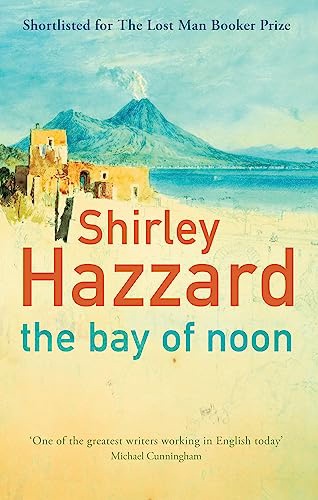
Shirley Hazzard’s novella, The bay of noon, has been in my sights for a long time, but finally, this Novellas-in-November year, I managed to get it out of my sights and into my hands. It’s the first of two novellas I read for the month, but the second to review. Such was my November (and we are now well into December!)
Published in 1970, The bay of noon was Hazzard’s second novel. It was one of six books nominated for the Lost Man Booker Prize in 2010. This was a special award created to, in effect, right a wrong which occurred when a change in the Booker Prize rules resulted in books published in 1970 missing out on a chance for Booker glory. The award was decided by public vote, with JG Farrell’s Troubles emerging the victor.
I’ve read three books by Hazzard before blogging, but since then I’ve just read one short story – “The picnic” – for the 1962 Club. In my post on that story, I referred to a review in The Guardian of Shirley Hazzard’s Collected stories. The reviewer Stephanie Merritt writes that “Hazzard’s recurring themes here – enlarged upon in her novels – are love, self-knowledge and disappointment”.
This is true of The bay of noon, which tells of a young Jenny, who, though born in England, had been sent to Cape Town with other young children to escape the Blitz. Post-war she was reunited with her older brother but, realising that her love for him was unhealthy, she leaves England to take up a job with NATO in Naples, bringing me to another of Hazzard’s recurring themes, that of young women leaving home to find their place. I understand from her biography that Hazzard herself worked for NATO in Naples in the timeframe this book is set, so she knows whereof she writes – which is not to say that she is writing her life. This is fiction, so while Hazzard draws on her own experiences, Jenny’s story is not hers.
Anyhow, we are in Naples, and it is some years after World War II, the mid 1950s in fact. Hazzard loved Italy, and her description of Naples at this time is imbued with a love born of knowing a place authentically, not as a sightseer. Naples is poor, and damaged both by war and a Mt Vesuvius eruption in 1944. Hazzard’s evocation of the city is a joy to read. A “through the looking-glass” city of both “apartness” and “continuity”, it also provides a moody, sometimes metaphoric, backdrop for our newcomer Jenny.
The storyline is straightforward. Knowing no-one outside of her work, Jenny follows up a letter of introduction to the charming and welcoming writer Gioconda, whose married lover, and Roman film director, Gianni, she also meets. Soon, however, through her work, Jenny also comes to know a Scotsman, Justin Tulloch, and a relationship of sorts develops between them. These relationships, and how they play out – with their mysteries and betrayals – form the nub of the story, but they are not what the novel is about. That is not so straightforward, but there are clues.
The title offers one clue, particularly, for me, the idea of “noon” as a time when the sun is at its highest, when the light is brightest, and so, perhaps representing a moment of clarity and, perhaps, also, of transition or change? Another clue is in the epigraph from Auden’s “Goodbye to the mezzogiorno” and in the opening paragraphs, both of which encompass ideas about memory and experience. The story is told first person through Jenny’s eyes, and there is a sense as the novel progresses of her working through an experience. Or, perhaps, not so much “working through” as allowing the passage of time to do its work. In the opening paragraphs, Jenny speaks of experiences building up “until you literally sink under them” but is also aware that, with the passage of time, memory, which was once “clouded with effects and what seemed to be their causes”, can become protective. As Auden concludes his poem:
… though one cannot always
Remember exactly why one has been happy,
There is no forgetting that one was.
But of course, not all memories are happy – and time can’t make them so. Gioconda, who had suffered loss, says
‘When people say of their tragedies, “I don’t often think of it now”, what they mean is it has entered permanently into their thoughts, and colours everything…’ (p. 67)
Just prior to this, she admits:
‘When I talk of it this way, now, to you, it all comes out as if there were some sequence, some logic, instead of moods, contradictions, alternatives. The design imposes itself afterwards. And is false, must be false.’ (p. 66)
It’s a curious but beguiling novel. The writing has a formal, intellectual – almost dispassionate, and sometimes elegiac – tone. It feels as though it belongs to a much earlier time, earlier in a way than the time in which it is set. This works somehow, partly because of Hazzard’s clear and measured prose, partly because the characters themselves seem to belong to an earlier time, and partly because Jenny is telling us the story from some time in the future.
As I read The bay of noon, I kept trying to place it within a wider literary tradition. It belongs, in part, to those stories about young people being taken under the wing by more experienced elders. Jenny observes the world she is drawn into, gradually becoming a more active and confident player in it. However, an Englishwoman, she remains an outsider, so retains her observer status which, over time enables her to see some realities she had missed in the first flush.
This is not a simple coming-of-age story, as it might look on the surface. Jenny is not an ingenue, but neither is she, at the start, experienced enough to understand the complex emotions and tragedies her older friends have experienced. Moreover, Hazzard has set the novel in a time that was itself complex, as Europe, and Naples specifically, was emerging from the war and – hmmm, was what? I wanted to say remaking itself, but that’s not the sense we get of Naples. It’s more one of being itself.
Towards the end, Jenny, reflecting on that past time in Naples, likens it to a
vineyard that had been left to flourish intact … among the deadly apartment buildings, not so much showing how it was as what has happened to it.
And that is the book’s ultimate meaning for me. It is not about who we are, what we hoped for, or where we have arrived, but about, in the closing words of the novel, “how we came”. Life, in other words, is a process, a journey that doesn’t always take us where we plan or expect.
Read for Novellas in November. Also read by Brona for the month. Read very late for the 1970 Year Club run by Karen (Kaggsy’s Bookish Ramblings) and Simon (Stuck in a Book)
Shirley Hazzard
The bay of noon
ISBN: 9781860494543
Virago Press, 2005 (originally published 1970)
182pp.
 Whispering Gums
Your usual thoughtful and considered (she said, tautologically) review.
Thanks MR … I’m really glad it reads ok, because I know you’d tell me if I didn’t. I haven’t quite nailed it in the way I wanted but I’d spent long enough on it and just needed to move on as I’m unusually behind in my review posts, and I hate it when that happens.
Well, you WILL spread yourself almost indescribably thin, ST ! 🙂
Yes, Mum!!
[grin]
Thanks for the link up Sue. I loved your final summation. It’s something we all do – tell the stories of our lives ‘how it happened’ but trying to make sense of it in retrospect.
Thanks Brona … yes, we do don’t we … I like the complexity buried in “how we came”.
I’ve been ignoring Hazzard as insufficiently Australian, and I still don’t think a US resident should have got a MF for a novel about England, but this sounds interesting.
I do find it interesting to look for books by Australian authors only to learn they moved to England or the U.S. and barely write about Australia. The legacy of colonialism still appears to affect who born in Australia ends up where, and why.
There was a time when people feel they had to leave Australia to make their name. But with Hazzard, neither parent was Australian born, and they left Australia for when she was 16, so I sense her ties to Australia were not as strong as some. Her mother did return here I believe so she retained some links.
Oh Bill … isn’t the most important thing whether the writing is good? I prefer to be fluid about the author and focus on the work. That said, there are exceptions – and I do appreciate that the MF Award has its specific criterion regarding Australian life (which doesn’t require the writer to be Australian, as you know). So, I can understand there being arguments about whether or not The great fire met that criterion. But, leaving that aside, The bay of noon and Transit of Venus are great reads regardless of the author’s nationality. And in The bay of noon’s case you would love that she knew Naples very well. Hazzard is a fascinating writer, for many reasons.
I think I found out why it’s hard to place her in time in literature: “But there are other elements that underpin her lack of renown. Hazzard was a writer slightly out-of-step with the late 20th century. Her short stories and her first two novels are often described as Jamesian, and, indeed, her graceful, epigrammatic prose, always technically and morally exacting, has much more of an affinity with the style of 19th century writers than the work of many of her contemporaries.” This is from LitHub, By Lucy Scholes, June 2, 2023. I don’t want to include a link or my comment might end up in spam jail, but you can Google it.
Thanks Melanie … I found it … that makes sense to me … I was thinking 1920s/30s more than 19th century but I take her point.
“love, self-knowledge and disappointment” I think these themes summarise the work of many of my favourite writers. Hazzard remains woefully unexplored from my shelves, but that doesn’t stop me from being convinced that she’s one for me.
Haha Marcie … I “have” a few writers like that! You just get a sense don’t you?