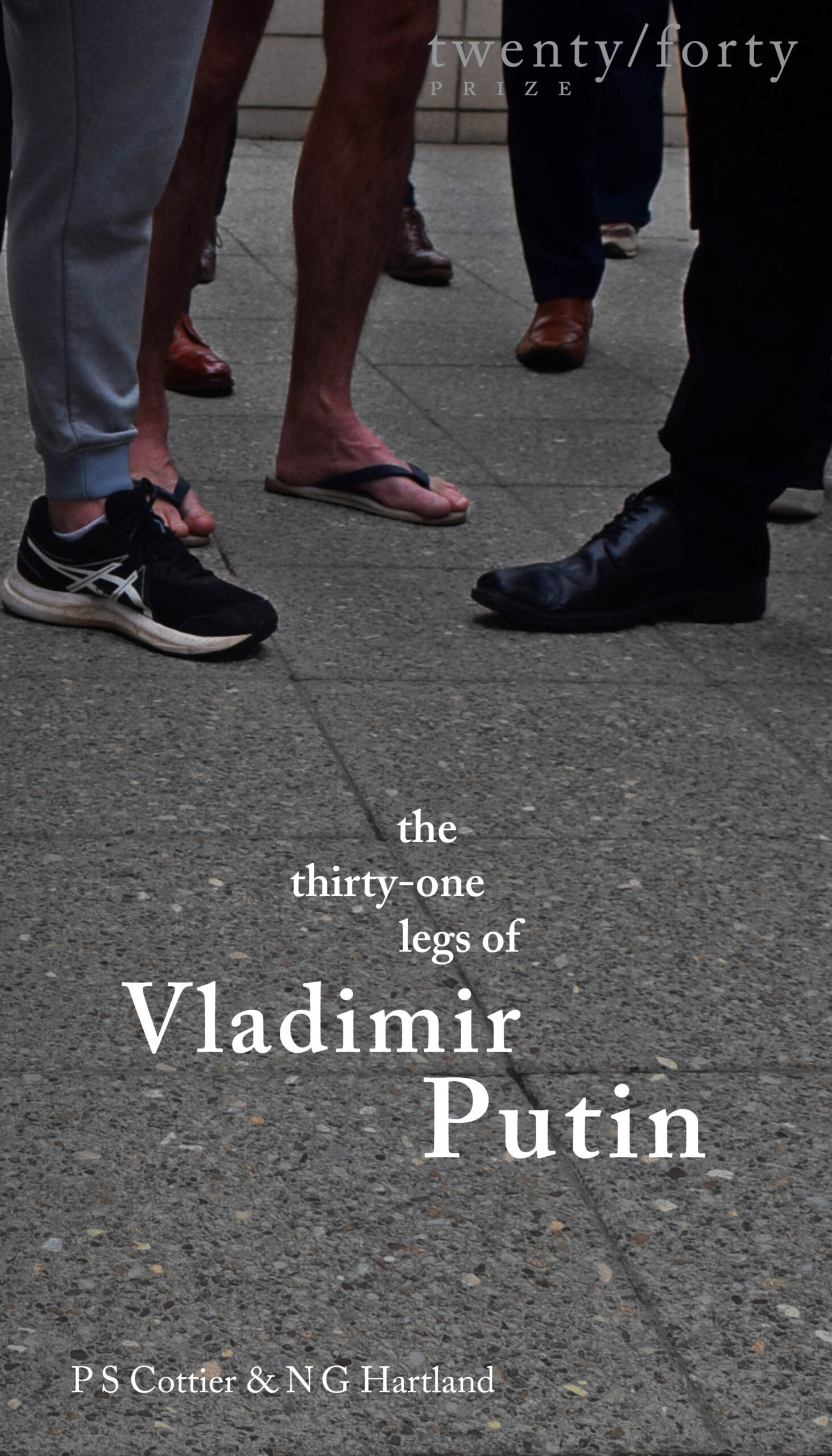
Earlier this month, I posted on a conversation with the winners of the 2024 Finlay Lloyd 20/40 Publishing Prize, P S Cottier and N G Hartland, who wrote The thirty-one legs of Vladimir Putin, and Sonya Voumard, who wrote Tremor. On the surface, these books look very different, but conversation facilitator, Sally Pryor, found some similarities suggesting both explore ideas related to identity, one’s place in the world, and how we can be captured and defined by the systems within which we live. Having now read Cottier and Hartland’s novella, and having started Voumard’s memoir, I can see she has a point.
If you didn’t read my conversation post, you may be wondering what the heck this book with its curious title is about. Besides the fact that it’s a novella, which I love, I was attracted to it from the moment I saw it on the shortlist because the description said it “spirits us away on a comedic journey into a world where the reality and absurdity of political power are increasingly indistinguishable”. That sounded just too delicious and I was glad to see it win.
Ok, so I still haven’t told you what it’s about, but be patient, I’m getting there. The novella was inspired, said Cottier and Hartland, by the idea that there are such things as Putin “body doubles”. There is even a Wikipedia page about this “theory” so it is a thing, as they say! The titular “thirty-one legs” belong to 16 of these body doubles whose stories are told in the book. Sixteen, you ask? That doesn’t compute from 31? True, but one of the doubles only has one leg! How can that be, you might also ask, how can a “double” of two-legged Putin only have one leg? Good question, and I won’t give it away, but let’s just say that the idea epitomises the absurdity of the notion.
Now, this is a collaborative novel, and if I understood correctly from the conversation, Cottier and Hartland started by “pushing out” individual Putins. In fact, the novella reads rather like a set of interconnected short stories because each Putin stands alone, with minimal connection between them except they are all Putin doubles and most of them assume there must be others. However, there is a narrative arc to the whole. Each Putin tells us something about their recruitment and its impact on their lives, with some threads recurring through the different Putins, depending on their location and personality. Two Putins also bookend the story. Surfing Putin, Dave McDermott in Western Australia, opens the book in the Prologue and concludes it with his own story, while English Putin Samuel Chatswood starts off the stories proper, and returns with the penultimate story. Each chapter is titled with the name and location of a Putin, so we have, for example, “Maja Dahl, Oslo, Norway”, “Richie ‘The Putin’ Rogers, Cirencester, England”, “Joppe Stoepke, The Hague, Netherlands”, and “Andrei Galkin, Rostov-on-Don, Russia”.
The set-up, or plot, is simple. People from around the world who look like Putin have been recruited to act as Putin doubles should they be so needed. This recruitment has happened over twenty years, but the book is set post the Ukraine invasion, so our doubles suspect they will not be called upon to play Putin. Some are quite edgy about this, while others are more phlegmatic. For all of them, though, being paid – because paid they are, monthly, from an anonymous bank account – comes with questions, if not challenges.
Our first fully-fledged Putin, Samuel Chatswood from London, sets the scene. He tells us about his fears about being a double. Not only is he frequently teased about his resemblance to Putin and asked “why anyone would want to invade Ukraine?”, but he’s anxious because he has been increasingly getting dark looks from strangers since the Skripal poisoning. However, having recently spied another lookalike, he is “comforted” by the idea that “whatever suspicion and recriminations are possible, they are less likely to entangle me if I’m not the only Putin lookalike”. He also heralds the denouement, when he returns to find that such comfort might have been misplaced.
We meet all sorts of Putins, from the fearful, through the deluded, and the thoughtful, to the confident or more upbeat, but all ponder what being a Putin double means for them. For some their own identity gets lost in the role, and some are confused, or at least perplexed, about what’s expected of them. For others, like the resourceful Chilean, Sebastian Soto, it’s a business proposition, while several capitalise on their lookalike-ness. Steve Pinebrother in “International Waters”, for example, not only makes money, secretly, as a double but, publicly, as a performer on a cruise ship. Each one is beautifully individuated, and I find it hard to pick a favourite. There’s much humour in many of their stories, but there’s pathos too, particularly with those who get lost in – or fearful about – their roles. Life is not simple when you accept money without clarity, eh?
“the butterfly of truth does not need questions to emerge from its cocoon of facts”
So, what’s the takeaway. An obvious one is contemporary culture’s focus on appearance and its willingness to monetise looks without much substance behind it. But another is murkier. This novella, I’m tempted to say, could be read as an allegory of the changing world order. No matter where the Putins live, recent changes are unsettling them. The ground is shifting and they (we?) don’t know how to react. Do they bury their heads in the sand, believing it will be alright? Do they wait for the inevitable or, try to withdraw? Or do they take action, and if so, what action can they take? For French Putin, Hugo Fournier,
It matters not, I conclude, what is reality and what is an extravagant theory from a feverish mind. The answer of course is that I should trust no one. I am the only Putin who can, and will, look after me.
Is such isolationism the answer? Through their various Putins, Cottier and Hartland pose serious questions, including, what do we believe and what we can or should we do?
The thirty-one legs of Vladimir Putin is an audacious “what if” story. Its episodic approach works well in the novella form. Were the book much longer, the conceit would, I think, start to lose its freshness. As it is, there are enough Putins to provide a variety of stories, without becoming repetitive. The tone is light enough to be highly entertaining, but the content is informed and thoughtful enough to engage our minds. This book would make a perfect Christmas stocking stuffer, which is not to say I put it on a par with chocolates and scratchies, but that it is small in size, well-priced, physically lovely, and a thoroughly absorbing read.
Read for Novellas in November.
PS Cottier and NG Hartland
The thirty-one legs of Vladimir Putin
Braidwood: Finlay Lloyd, 2024
115pp.
ISBN: 9780645927016
Review copy courtesy Finlay Lloyd.
 Whispering Gums
Dear whispering gums /Sue, just a note that lately I have had trouble getting onto your blog, I guess it’s to do with passwords etc etc, but I don’t seem to have cracked spending the time that it appears I have to spend to get back onto your blog. But I’m still reading it! And love your reviews. I recommend your blog to many literary friends. Moira
Oh I’m so sorry Moira. You are not the only one I’m afraid to say – and I have problems commenting on some WP blogs but not others?! Why? I have no idea.
Thanks so much for managing to get through this time. (You had put all your contact details in the body of your comment, but I’m not sure you expected them to go public, so I have deleted them. If you’d like them back there let me know and I can add them back in.)
What an interesting concept. I have heard a lot about Putin doubles but no idea where they might turn up.
You’ve got it Pam, such an interesting concept. And they had the skill to make it a good read.
Hmm yes … but I hate this bastard so much that anything remotely resembling enjoyment or humour arising from the subject of him will not elicit either from me.
I long for the day when someone stabs him in the leg with a poisoned umbrella.
Fair enough MR, but I suspect the authors feel similarly about Putin. I don’t think having a laugh means you approve in any way what he is doing. There’s joyful laughing and then there’s a whole lot of laughing that’s way at other end of the spectrum, don’t you think?
Mostly.
Fair enough! To each her own!
Pingback: The Thirty-One Legs of Vladimir Putin – PS Cottier & NG Hartland – Yarra Book Club
I know I’ve heard about the Putin body doubles, but I believe I heard there are also doubles for Kim Jong Un. Fun fact: it just blows my mind that Kim Jong Un is about the same age as me. His birth year is not clear, but it’s guessed to be 83-85. I can see how this topic would be rich with opportunity to explore what it means to be Putin, to put aside yourself and embody another person, to reckon with the violence in Ukraine and have the face of the monster behind the violence.
My son is in that age group too, Melanie, and it blows my mind also when I think about it.
You’ll be amused to know that the cruise ship Putin does good show with a Kim Jong Un!
And yes, the idea is rich with possibilities. And you get such a rich idea of human nature when you see how different people cope with the whole situation. I reckon brainstorming this would have been a hoot and that they probably had to rein themselves in (which of course is what brainstorming is about isn’t it?)
The novella is such a perfect opportunity to explore these “what ifs”, I agree!
Oh, how did I miss this comment Marcie … but yes, the novellas is so good for little experiments like this.
Oh my goodness, this sounds delightfully absurd! I’ve heard of the Putin doubles. ow wonderful that this books takes it up and runs with it. Sadly not published in the US. I’ll put it on my list to watch out for and how it becomes available here 🙂
Thanks Stefanie … so glad it tickled your fancy! Fingers crossed it will get over your way somehow.
Pingback: 2024 20/40 Prize Co-winners: Tremor (2024) by Sonya Voumard and The Thirty-One Legs of Vladimir Putin (2024) by P. S. Cottier and N. G. Hartland | ANZ LitLovers LitBlog
Fancy, I found this book stuffed in my ‘Christmas stocking’! A very fine, engaging and thoughtful book and increasingly dark. Thank you, WG, for the ‘stuffing’ and for your review.
Fancy, I found this book stuffed in my ‘Christmas stocking’! A very fine, engaging and thoughtful book and increasingly dark. Thank you, WG, for the ‘stuffing’ and for your review.
Haha thanks Ian … always happy to stuff stockings with books I like! Seriously, I’m so glad it engaged you too.