In conversation with Karen Viggers
Karen Viggers is no stranger to this blog (my posts), and I have read Robbie Arnott’s previous novel, Limberlost (my review). One of several “Your favourites” sessions with loved authors, this one was described as
Robbie Arnott’s fiction is steeped in the wild: women return from the dead as walking ecosystems; mythic birds circle the skies; the water calls to us. In writing these sumptuous, near-sentient landscapes, he grapples with our most wrenching and necessary questions: eco-grief, stolen land and human frailty. He joins local author Karen Viggers to talk about his new novel, Dusk, a tale of a feral creature loose in the Tasmanian highlands.
Karen commenced by acknowledging the Ngunnawal people, their generosity and their stories, and spoke with passion about the importance of stories in our lives.
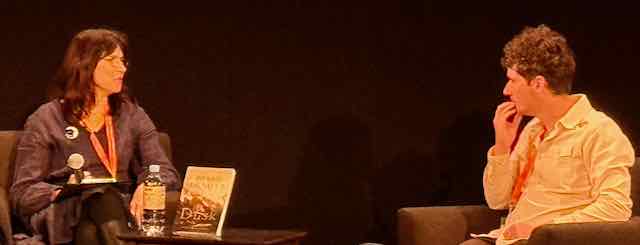
She then introduced herself, explaining that as an animal and landscape person, she relates to Robbie’s books and was keen to conduct this conversation for the Festival. She then introduced Robbie, his four books to date, and his many awards – Flames (2018), Rain heron (2020), Limberlost (2022), and Dusk (2024). Wildness and landscapes feature in all his work.
This was a fascinating but sometimes somewhat anarchic discussion in which Robbie didn’t always quite answer the question being asked, or, perhaps, not in the expected way. But Karen is an expert at going with the flow, so we got great insights into Robbie and his approach to writing – which is what it’s all about.
On how the accolades make him feel and their effect on his writing
It’s nice to be acknowledged, but living in Tasmania, away from the literary scene, they don’t make much difference to his daily life. Career-wise they’re good, but they don’t affect his writing. He is all about his work, to the detriment of his other responsibilities.
On the novel’s origin
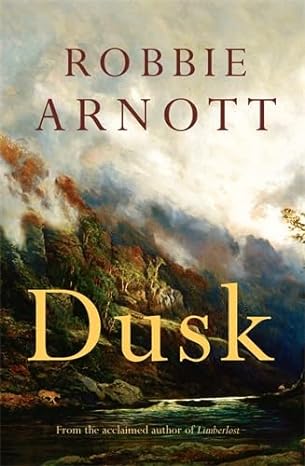
Dusk is about twins Iris and Floyd joining the hunt for a feral puma, the titular Dusk, because a bounty has been offered. Karen described it as a story of wildness, freedom, connections, relationships, and asked about its origin. Robbie said it goes back to his childhood, and times in the bush when they would see feral deer which shouldn’t be there. He wanted to write this story.
On the siblings and their relationship to their parents
Iris and Floyd are 37-year-old twins whose parents had been convicts, then bushrangers, and had dragged their children through their life of crime. Now these children want to live straight. They need the bounty cash, but they have no idea about what they are doing.
He wanted two protagonists who have a close relationship, like siblings do. He didn’t make them twins for any particular twin-connection idea, but because he wanted a flatness of hierarchy between them. However, Karen felt that the sort of connection twins have comes through.
Karen wondered about the twins’ outsiderness, and whether it comes from within himself. Robbie, though – and this was reiterated throughout the interview – said he had no idea about himself. He hasn’t had therapy! They are outsiders because we live in colonial landscape. The other characters – except for some near the end (First Nations I’m guessing) – are outsiders too, but don’t realise it.
Later, Robbie talked about the deep trust Iris and Floyd have in each other. They are committed completely to each other, they rely on each other, despite frequently irritating each other.
On Dusk the puma, and wild beast myths
Dusk was not inspired by big cat stories but people are more scared of cats. They are terrifying, and play into our idea of wild landscapes. He is interested in outsiders tracking outsiders, in the strangeness of the colonial landscape. Colonists would bring things to new countries to hunt, also to rid other pests, so he had the idea that someone might bring a cat over to get rid of deer. But his pumas were more interested in easier animals than deer, like sheep. Like the cane toads brought over to eat cane beetles, but which ended up eating other things. (And, to extend this example, before the cane toads, the sugar cane itself was introduced, which then led to blackbirding.)
As for the name, Dusk, he didn’t choose it for any metaphorical meaning, but liked it as a name for a creature which appears at a liminal time of day.
Robbie doesn’t seek metaphor when he’s writing. It feels more like cleverness than openness. Karen suggested that a joy for writers is when readers see things that the writer doesn’t see. Robbie agreed, sharing Richard Flanagan’s advice that the least interesting thing in a novel is the writer’s intention. Flanagan, we learnt, is a friend and writing mentor for Robbie.
Despite this, readers did, said Karen, think about metaphorical meaning of Dusk!
On the wild and dangerous creatures in his novels, their source, relevance, meaning
Robbie has had no therapy, he reiterated, so can’t explain why! But, currently there is a focus in writing on the self and raising mundanity to art. However, he is interested in the world outside humanity. In stories, wild animals are often the impetus for change, but animals don’t work like that. They just are, going about their lives.
The discussion then turned to savagery and brutality. Humans can be as savage and brutal as wild animals, but in urban societies we fear wildness and savagery, and try to keep it at bay. However, we keep bumping up against the edges of it. Robbie has had publishers and readers complain about brutality in his novels, though it’s drawn from reality. For example, Iris and Floyd slaughtering bobby calves with sledgehammers comes from a friend’s experience in 2012. In another novel, his publisher tried to talk him out of a scene involving the skinning of rabbits. Where do they think meat comes from, Robbie asked. Savagery and brutality are part of us.
We have become separated from the bush. We say we love it but is our attitude to it essentially about power and control? For Robbie, taming the wilderness is ridiculous. He shared a scene from Richard Powers’ beautiful novel, Overstory, in which people suggested removing sticks and natural debris from the forest floor.
Staying with the idea of animals, Karen spoke of Iris and Floyd living in a savage world but taking such exquisite care of their horses. She asked Robbie about his thoughts on the human-animal bond. He wanted to show the intensity of the relationship, that it was an unquestioned one, and a necessity.
On what landscape means to him, and how he writes it
Robbie always starts with the landscape, not plot or character, and then thinks about who would be there. Landscape moves him. It offers the greatest way to feel small, the most beautiful form of insignificance. To write about landscape with feeling, the first thing he does is to free it of baggage, like the idea that the forest is green. He describes it as it is, which is not green, and then focuses on emotional reactions to it. For him, the aim of fiction is not to render the world as it is but how it feels.
To write freshly about landscape he gets out into it, and draws on his memory (memory is critical). He searches for the “atmosphere”. He most enjoys a book when he has slid into its atmosphere.
Staying with the idea of feelings, Karen asked him about the feelings he wanted for Dusk, who is omnipresent from the beginning. Robbie said that it wasn’t quite menace but a “hauntedness”. She’s not vengeful. He wanted her to feel alive.
On his novel as Western (and more!)
Robbie has described the novel as being something like a western, in that it is framed like a western, like a quest. It is also a journey novel, which makes it fun to write and enjoyable for the reader.
The discussion got into other aspects of his writing, such as his blurring of the line between realism and the magical in most of his books. It’s about, he said, conveying how the world feels. The magical wasn’t needed in Limberlost which was inspired by his grandfather. He edits a lot out, because it must feel real.
Karen loves the opening of Rain heron, and suggested that cutting out is an art. Robbie doesn’t want to waste anyone’s time. He wants to keep his books vivid, vibrant, alive. He doesn’t write drafts, but writes sentence by sentence, crafting each one carefully as he goes, so that by the end he has his book.
On Iris
Is Iris looking for belonging? Robbie said Iris feels connection to the landscape, and realises she doesn’t want to leave but she also recognises that she has no cultural connection to the place. Does she have a right to stay? This is the unanswered question – for Iris and for us. She does her best but the question is never resolved.
This point, this, above all else, makes me keen to read Dusk.
Q & A
On his becoming a writer, and his influences: He was a bookworm from the start (as soon as he learnt his sister got to stay up later because she could read!) He started writing when he was 11 or 12. There was never a decision, he just started writing. His literary influences are many, but he loves Annie Proulx for her amazing descriptions of the world; he loves Denis Johnston “at the sentence level”. He thinks Kevin Barry’s new novel is excellent, and later he mentioned David Mitchell and Claire Keegan.
On his thoughts about relationships between humans and wild animals (like the seal and fisherman in Flames): He agrees with ecologists who advocate staying away, but narratively he is pulled to these relationships.
On how he manages to keep his unique, glorious style: He can tell when he Is writing like himself, and when he “is wearing his influences too heavily”. When this happens, he writes a description of something he knows – not necessarily related to his current project – to get back to his own style.
On other art forms that influence or inspire his writing: Photography; poetry for its imagery; oh, and when he is writing he often puts on moving image of salmon leaping and grizzly bears trying (and usually failing) to catch them. This live and unscripted action inspires him.
Karen concluded by simply saying that Robbie’s writing is magical. This conversation would surely have convinced anyone not already in agreement.
Canberra Writers Festival, 2024
Your favourites: Robbie Arnott
The Arc Theatre, NFSA
Saturday 26 October 2024, 2-3pm
 Whispering Gums
Yet another marvellous and detailed insight into life at the Canberra Writers’ Festival. Again I feel immersed in the words of the speakers.
Thanks Carmel. It’s been a great festival – and I still have two to go.
Thank you for this excellent report, Sue. Interesting to hear that he “writes sentence by sentence, crafting each one carefully as he goes” because that’s how I write, too, which I have been reliably informed (by a corporate comms consultant) is a BAD HABIT. But I’ve written like this for years, polishing sentences as I go, and yes, it can take a long time, but seems to work out OK for me. I once heard Colm Toibin explain that he writes this way too so I figure I’m in good company 😆
I reckon you are. I pretty much do that too though it can depend on the situation. And I’m only writing short stuff. I reckon your consultant is way off. I reckon whatever works for someone is a good habit for them.
For non-blog stuff, I tend to plan the structure of the piece first. I have taught people to plot their ideas and to write them out on to sticky notes, one per note. You can then move the notes around to play with the order. Then you can start writing. This method works well for reports and essays.
Wonderful recap as always Sue.
I also saw Robbie in a live gathering at Gleebooks is Sydney a week ago, took lots of notes and haven’t written a word about it yet! So bravo, for getting it all down while it’s fresh in your mind.
Thanks Brora… it took a lot of effort to get these done… I couldn’t have coped with going to more sessions! I’d love to know if he said much different. How much do different questioners bring out different ideas?
This idea that the least interesting element of a book is the writer’s intention is so curious. On one hand, I feel like cheering, as though it intuits something that I deeply relate to as a reader. On the other hand, for reviewers like me, who begin with the idea of whether or not a book has achieved what the writer intended (as opposed to the concept of there being an objective definition of what constitutes a Good Book), that shifts the foundations fundamentally.
Yes, thanks, Marcie. You have articulated exactly what has been going through my mind in relation to that comment. In some ways, it feels ingenuous to say that the intention is the least interesting thing because it’s a significant part of what the author is all about. I guess his point is that we should not be focusing on the author’s intent but on our experience of reading a work. And like you I cheer about that. It also reduces the stress on the reader “to get it right” and on the author’s fear that they are being judged on whether they communicated their intention well enough.
But, I agree with you that as a person who writes about books, if you can’t relate in some way to what you think the book is about, and therefore to what you think the author is intending, it can be hard to know where to start.
Thanks very much for addressing this question.
Pingback: Dusk | Robbie Arnott – This Reading Life