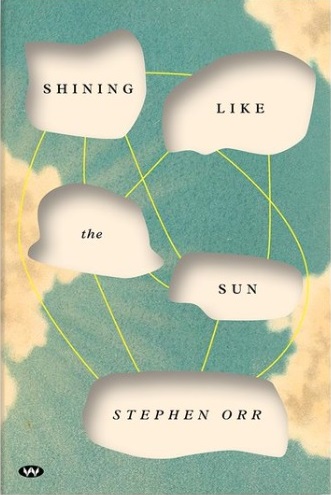
A question that confronts many young people as they reach adulthood – in western cultures at least – is, should I go or should I stay? This is particularly so for young people in small rural towns, and is the issue at the heart of Stephen Orr’s latest novel, Shining like the sun. Wilf Healy, the oldest of three brothers, stayed in Selwyn which is now dying, while his brother Colin left for the bright lights of America, as soon as he could. Now eighty years old, the widowed Wilf is confronting the rest of his life, and he is again pondering the question, except he is not thinking of heading for the bright lights but for Louth, the island on which he grew up. The thing is, that island is empty. No-one lives there now. But this doesn’t dissuade Wilf from his dream. Meanwhile, his 17-year-old great-nephew Connor is about to lose his Mum to cancer and sees no life for himself in Selwyn.
That is the basic plot. Selwyn is a fictional wheatbelt town in South Australia – only identified because Louth Island is a real island off the coast. Selwyn has “three hundred people coming and going, dying, lost in the cracks”, plus one of those signposts pointing to far-flung places around the world. Wilf lives and works in Monk’s pub, delivers the mail (not to mention vegetables and pharmaceuticals) around the community, and drives the school bus, all because he can’t say “no” when yet another job needs doing. However, as the novel opens, he’s had enough. He wants to retire, but his plans to leave are half-hearted at best – and not just because of his sense of responsibility for his sick niece Orla and her son, the disengaged Connor. Why?
The three epigraphs provide a clue, but so of course does the story. We follow Wilf through his days, as he engages with the people of Selwyn, people whom Orr paints beautifully with a description here, a piece of dialogue there. Take young Connor, “an out-of-tune whistle that just needed a breath of air”, or Bobby, the 85-year-old vegetable grower and builder of a kit plane “who is too old to deliver vegetables, but not fly”. Take the school principal, Noah, for whom Wilf drives the school bus. He’s a weak man, who, when a certain crunch comes, cannot stand up for right. And take Wilf’s school bus passengers who are so entertainingly individuated from the opinionated Sienna to the JK Rowling-wannabe Luke, from the withdrawn Trevor to the entitled bully Darcy. The bus-rides are interspersed through the novel, providing perfectly pitched comic relief while also playing an important role in moving the narrative along. It is something that happens on the bus that triggers the novel’s main crisis.
But, Wilf and Connor provide more than two ends of the “do I leave” spectrum. Wilf’s reflections on his growing up provide a stark contrast to the lives of Connor and his peers. Wilf, of course, came from the often brutal “spare the rod, and spoil the child” era, when you did what you were told and expected little else, whilst Connor is growing up at a time when young people are not directed, but encouraged to find themselves. Orr does not judge either way, but lets his readers see and ponder how it all plays out in a life.
I opened this post on the question of staying or going, identifying it as the novel’s central issue – which it is. However, this is not the theme. Rather, it is the question which gives the theme its push. The theme, itself, is something deeper, something so fundamentally human that it could almost sound trite, except it’s not. I’m talking about the idea of community, of connection, of being where you are part of something bigger, where you can make a difference to the lives of others. This might sound schmaltzy. However, because Orr’s characters are fallibly human, and because the socio-economic challenges facing small towns (in particular) are real, connection doesn’t come easily. Shining like the sun, with its cast of authentic characters and array of specific, yet also typical situations, teases out whether this connection, this idea of community, can in fact still fly.
“the possibility of being happy” (Connor)
Orr’s intention? There is surely some political intent, some wish to convey the value and importance of these towns which are being allowed to die through neglect and poor policy (“farms flattened”, and so on). But, it is also personal in terms of exploring what sustains human beings the most – a fancy job or house? Or connections with your community? Mr Gums and I wait for the cliched “tight-knit community” which is unfailingly trotted out after whatever disaster (natural or personal) is on the day’s news. Like most cliches, however, it has an element of truth. A “real” tight-knit community is worth its weight in gold – another cliche for you. Orr knows this, so does Wilf. There is nothing romantic to this story, just real life with all its questions and toughness alongside moments of humour and mutual support in which, even Connor realises, there is “the possibility of being happy”.
Shining like the sun, then, is another special Stephen Orr novel. It is not fancy in voice or structure. That is, it is told third person – albeit a first person narrator opens the proceedings – and is told chronologically, with occasional flashbacks as Wilf remembers his past. What makes it special is the quality of the descriptive writing, the knowing characterisation, the authentic dialogue, and the serious but warm tone leavened by natural humour that comes from ordinary people going about their business.
I read this novel immediately after my return from touring outback Queensland. We saw many small country towns, most of which were variations on the theme. Orr’s story rings true to these towns. Indeed, to end on a cliche – because, why not? – Shining like the sun is a love letter to an Australia little known to its mostly urban inhabitants. It has much to offer on both political and personal levels, but, beyond that, it is just a darned good read.
Stephen Orr
Shining like the sun
Mile End: Wakefield Press, 2024
313pp.
ISBN: 9781923042278
Review copy courtesy of Wakefield Press.
 Whispering Gums
I looked up Louth Is., it’s off the Eyre Penninsula, a bit north of Port Lincoln. As you say, wheat farming country. And that’s the problem, in our lifetime the average size of a viable wheat farm has gone from 1,000 to 5,000 acres, people are willing to travel further and, often, the rail lines and silos are closed.
My mother’s family are (were) all wheat farmers, and only 2 of my 12 cousins stayed on the land. I agree community is important, but most wheatbelt towns are beyond saving.
Thanks Bill … yes you found it! I guess “beyond saving” depends a bit on whether they can diversify in some way but I suppose this is not always possible. Certainly we saw some very tiny towns with populations of 50 or less in Queensland. When does a community become a town I wonder?
Surely in today’s world, ST, it’s more a case of when does a town become a community …?
Fair point MR … I’ll pay that!
When the wheatbelt was opened up, around 1900, a community was a cluster of farms around a one teacher school. Towns formed around the silos spaced 6 miles apart along the rail lines. But I’ve found that all country towns have strong community spirit.
Ah that’s interesting Bill re communities and towns. Makes sense. Some of those silo art towns we’ve visited in Victoria seem these days to be a silo with a pub across the road. Other buildings were minimal but I noted that there was always a pub across the road. I think the description of Selwyn suggested the pub was a critical aspect.
I think you are right about country towns though with one comment which is that I’ve heard it can be very hard for outsiders to be accepted. Is that still true? I do know people who experienced it though I don’t really think my parents did. Then again I guess everyone knew we’d be passing through.
My parents’ experience, like yours, was that there was a divide between the old timers and the 2-3 year teachers, bank managers etc. Though with so many new soldier settlers in the 1960s, it was not particularly marked.
Yes, I was thinking your parents would have had similar experiences to mine. The stories I mostly heard were people who moved to towns to stay, like council staff. We could treat it as an adventure to enjoy not as “home”.
I will, with my dying breath, argue against hitting children as a form of discipline. It’s so frustrating that alllll the studies show not only is it ineffective, it creates worse outcomes, and yet the myth persists. I always ask, okay, so at what age does it become illegal to hit someone to punish them? Why? If [the person I’m talking to] does something I think is wrong, should I hit them to teach them? As the child of someone who was beaten mercilessly, it’s such a triggering topic, one that makes my blood boil. Now, professionals advocate for putting a frustrating child in their room, closing the door, and walking away if the parent is feeling like hitting, shaking, etc. The kid won’t die if the parent takes a moment to collect themselves. Anyway, I know this isn’t the focus of your review, but that part about the character being raised back in the “glory days” of child beating stuck out to me.
Oh I agree with you Melanie. And thanks for responding to something that meant something to you. I didn’t say – and I hope I didn’t imply – “glory days”. My point was that Orr doesn’t judge. The character himself, Wilf, didn’t like being beaten, but he also thinks some of the children he sees behaving badly need some sort of discipline. The question for the reader is, do we agree they do, and what should form should it take. (I should add that most children from my generation were hit, because that’s just the way it was. I don’t think most of us suffered in any major way from it BUT that’s because most of us were not “beaten”. There’s a world of difference. And to be honest I think there are other forms of discipline that are worse than a slap on the legs. However, like most in my generation, I felt there were better ways, and decided that hitting would not be the form of discipline I would choose.)
No, no, my understanding was there was a heyday for abusing children under the guise of training them to be responsible citizens. I never thought you supported that.
I still don’t think there is any form of physical punishment that is acceptable because you still have to ask yourself if you have a right to punish other adults who behave poorly. I can’t imagine walking up to a grown person in the grocery store who is using their cell phone on speaker mode and slapping them on the legs. Typically, the point of disciple is to teach empathy, whether the child stole or said something mean or was causing a ruckus. How do other people perceive that? Why? Is the child okay with the other person’s feelings, or do they want to be treated the same way and not have mean things said about them, be disturbed, stolen from, etc.
Love this reply Melanie. Sorry I’m a bit late responding, but I was driving back from Melbourne for two days and I wanted to give this some attention. Thanks for clarifying what you meant. I didn’t think you thought I was supporting abusing children but I wanted to make sure you knew where I was coming from!
I really like your idea that the point of discipline is to teach empathy. It can also, with children, be about teaching good habits that will stand them in good stead for later life, teaching self-control, teaching right behaviour. It can be so difficult working out what is important to teach and instill, and then how to do it. Our little grand-daughter is two-and-a-half and we can see her testing us re things she knows you don’t want her to do like draw on furniture. Such fun!
That’s the perfect age at which children test boundaries, and for the sake of learning them! Keep at her, and then she’ll be a confident little person who knows what’s what. ☺️
Yes ma’am… will do! Seriously, yes you are right and we are all doing our best!
This sounds like a rich and rewarding read for sure; I think a lot about this divide of rural and urban having lived for so long on each side and feeling quite between. You’re quite right that many urban dwellers don’t think much about the other side, but many rural residents take pride in having no experience of urban life either. So much snobbishness on both sides.
Haha, it’s the old “never the Twain shall meet isn’t it”. Having also lived in both, I have a preference for small but love the “cultural” options in cities hence as soon as I finished university I chose Canberra. Probably 250,000 then and now still never half a million. Never regretted it but it is the best of both worlds …
Anyhow, Orr’s writing is quiet but glorious.
Pingback: ‘Shining Like the Sun’ by Stephen Orr | The Resident Judge of Port Phillip