The forgotten writers I have been writing about vary greatly, and most will stay forgotten because, to be honest, their time has past and not all writing remains relevant. This is not to say, however, that they are not worth revisiting. They are, after all, part of our literary culture, and they paved ways, whether we are aware of it or not. Grace Ethel Martyr is an example. She is notable enough to have entries in AustLit and Wikipedia, and was interesting enough in her time to catch the attention of Zora Cross (who wrote about her for a series she did for The Australian Women’s Mirror.)
Martyr is another writer I have posted about on the Australian Women Writers (AWW) blog, but again, I am not including here the piece written by her that I published there. Titled “The blue jar”, its subject is domestic violence, though that term would not have been used then. It’s not typical of her best-known work. However, in the light of our own times, it is worth reading. It is told from the 1920s perspective that women just need to put up with brutal husbands and manage as best they can. They didn’t have much choice. But, in this story, a bit of luck comes the wife’s way … check it out at AWW.
Grace Ethel Martyr
Grace Ethel Martyr (1888-1934) was a Victorian-born poet, short story writer and journalist. She wrote under various permutations of her name – G. E. Martyr; E. Martyr; Ethel Martyr; Grace E. Martyr; and G. Ethel Martyr.
Born in Ballarat, she was the only daughter of James Kent and Grace Flora Martyr. She grew up in Maldon in central Victoria, but spent much of her working life in Bendigo. She apparently passed the University of Melbourne matriculation examination in 1906, but I haven’t found evidence that she went on to university. AustLit and Wikipedia both say she was employed by the Bank of New South Wales, for whom her father had worked, for four and a half years, but left due to ill-health. While working at the bank, she published a collection of patriotic war poems, Afterwards and other verses (1918), but she didn’t begin to write seriously until she had left the bank. Zora Cross (writing as Bernice May in The Australian Women’s Mirror) tells how this book was given to her to by Martyr’s cousin who wanted her assessment of it, and says it was she, Cross, who encouraged Martyr to leave the bank (though the ill-health part is also true, I believe).
The Sydney Morning Herald, 18 May 1918, commented on Afterwards and other verses, describing it as “unequal” (meaning “uneven”?) but also as
characterised by sincerity, depth of feeling, and a burning patriotism which redeems many shortcomings. Her technique, though not faultless, is usually correct, and at her best Miss Martyr can reach a high level of dignified expression.
Perth’s Western Mail, 31 May 1918, offers similarly qualified praise:
War has given inspiration to Miss Martyr’s muse, and if her verse does not reach the loftiest peaks, the level of its quality is rather beyond that common to such collections.
Writing about Martyr ten years later, Cross says that
So far, Miss Martyr’s best work has been done in verse. But her true vein is the child story and child-verse. I know of no Australian writer who has so beautifully caught the spirit of the child in verse as she has. And she is that rare writer, the one who never forgets that child-verse should also be poetry.
Martyr, then, wrote children’s poetry and fiction, including several stories serialised in The Australasian, but AusLit says that her principal literary output is the poetry she published in The Bulletin and The Australian Woman’s Mirror. In addition to this writing, Martyr also worked for The Bendigo Advertiser, where she edited the women’s columns and the children’s page, and she was Bendigo’s social correspondent for several Melbourne publications.
Cross praises much about her work, saying
She shows inner melody in her verse which is often of a very high standard. Her love of music and nature comes out in her poetry. Like all Australian writers her best work has appeared in the Bulletin.
Martyr won prizes at Ballarat’s South Street Literary Awards – in 1918 for best patriotic poem and in 1919 for best original poem. In 1920 she came second to David McKee Wright, from a field of 125 entries, in the Rupert Brooke Award, which was established by the Old Collegians’ Association of Melbourne’s Presbyterian Ladies’ College.
Martyr was also a pianist, and worked with musicians Margaret Sutherland and William James on various projects. In particular, she wrote stories and verses for the 3LO children’s hour, with James setting her verse to music. (William James is best known, to me anyhow, for the 15 Australian Christmas Carols he composed with lyricist John Wheeler. I wrote about them early in my blog.)
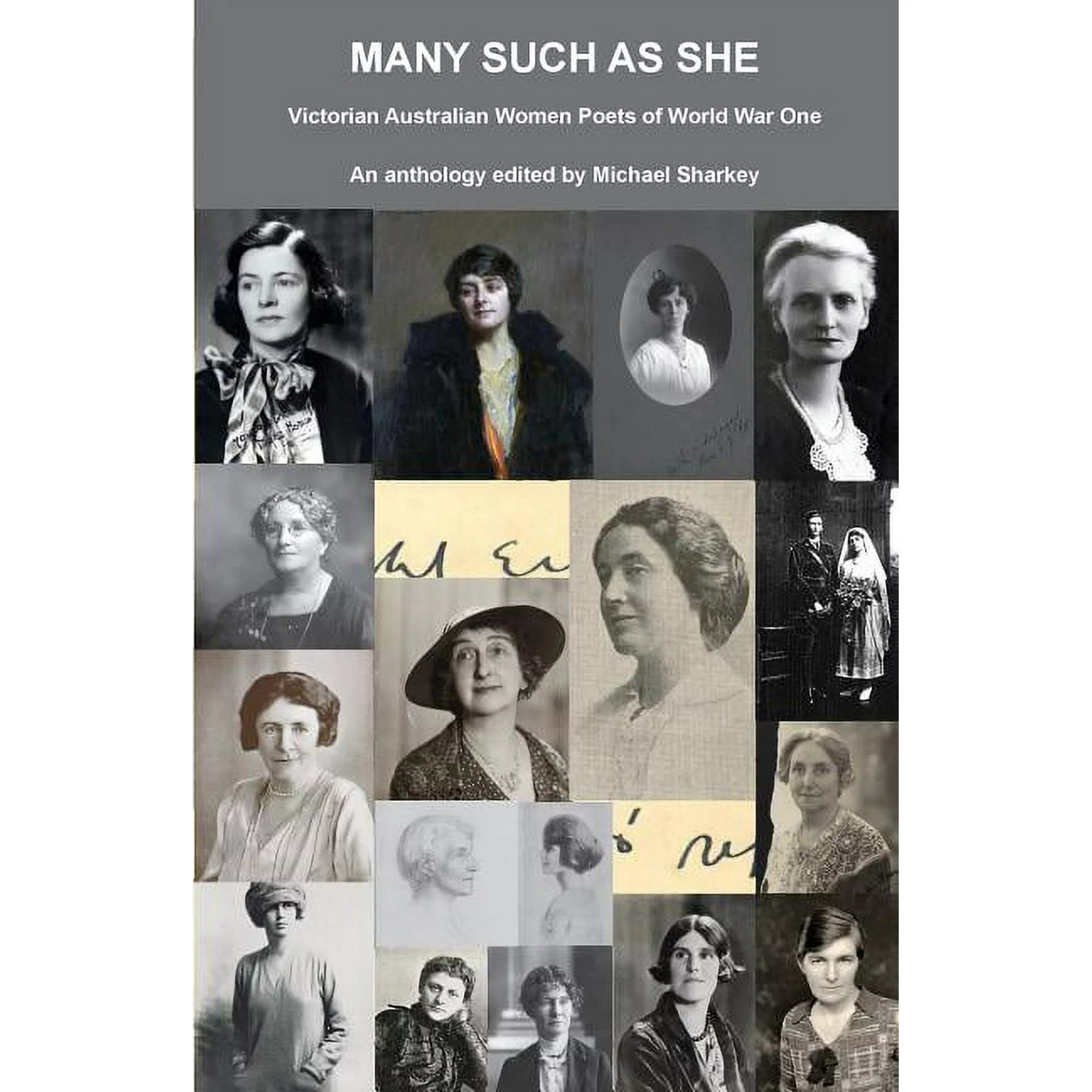
Martyr seems to be another example of a woman who managed to make a career for herself as a writer, by turning her hand to a wide variety of forms and audiences, but she also died relatively young. She was not completely forgotten, however, because five of her poems were included in Michael Sharkey’s 2018 anthology, Many such as she: Victorian women poets of World War One. An exhibition was held at Bendigo’s Soldiers Memorial Institute Military Museum in association with this book. Curator Kirsten McCay specifically mentioned Martyr, saying “Poet Grace Martyr lived locally and was a journalist for the Bendigo Advertiser. She also gave illustrated talks on famous composers at St Paul’s Cathedral, where a cross commemorates her life.”
Cross concluded her 1927 article with:
Grace Ethel Martyr’s work is always getting better, which is surely the best sign in any writer. Time, I think, will prove her to be one of the most sincere writers among us.
Six years later, at the age of 46, Martyr was dead. The report of her death, which was repeated in several Victorian newspapers, is brief but says that:
Miss Martyr’s literary gifts were apparent at an early age, and during the years that followed she established something of value to Australian literature.
I rest my case!
Sources
- G. Ethel Martyr, “The blue jar” in The Australasian, 5 April 1924
- Grace Ethel Martyr, Wikipedia [Accessed: 3 July 2024]
- Grace Ethel Martyr, AustLit [Accessed: 3 July 2024]
- Bernice May (aka Zora Cross), “Grace Ethel Martyr”, The Australian woman’s mirror, 2 August 1927 [Accessed: 22 July 2024]
- “Miss G. E. Martyr Dead”, The Sun News-Pictorial, 24 December 1934. [Accessed: 22 July 2024]
 Whispering Gums
Oh, wow, this introduction to a forgotten writer reminds me so much of the post that I shared called Sweet Bells Jangled. If you recall, that one was about a deaf woman who lived during the American civil war and made a living by traveling around and speaking to soldiers, writing journalism pieces, yes, but also patriotic poetry. There’s even a town named after her because the founder of that town felt that she was the ultimate patriot. It’s believed that he didn’t know that she was deaf or a woman. She was so well known at the time that her name appears in many civil war soldiers’ memoirs. Interestingly, some of what you wrote about your subject here sounds similar.
I like what you said about some writing not really being as relevant anymore. I’m going to think more about that. In fact, some of these writers have transcended from literary folks to subjects for history. That doesn’t mean that we should stop writing about them in history books, but it might be a total hurdle to try and get people to read them. Then again, Zora Neale Hurston went out of fashion, and her writing had to be necromanced back to life by Alice Walker.
Ah yes, I remember her and that post Melanie. Regarding some writing not being as relevant anymore, yes, I agree of course that even if we don’t read them anymore, we can write about them. All writing can, in a way be relevant, because it can provide a picture of a time, but I think we are less likely to read it if that’s all it does, if, for example, it is only about story with not much attention paid to “universals” in human nature or if the issues in the story are no longer issues now and of little interest to now. Many writers I think who have been “re-discovered” like Zora Neale Hurston still have much that is relevant to now even if the settings/details of their stories are different? I guess they have been lost for political reasons, for fashion (in writing) reasons, etc, but also because with people keeping on writing it’s just not possible for everything to stay in general view. Movements like Femininst, Blak, Queer, and others, can be great at bringing to the fore again those writers who are worth reading and knowing about. That’s my current thinking anyhow, but I’ll be interested in your thoughts.
As for Hurston, she had an amazing way of telling stories that were funny and relatable and part of a subculture that many find fascinating. She went out of print and renowned because at the time, other Black writers felt like her work made them look dumb, though she felt like she was simply writing people she knew. I know that at that time in history, there was a push for Black people to raise the bar and be as cleaned up as white people to prove they were civilized. There are many stories full of shame about southern Blacks arriving in the cities for jobs only for their families already established in those cities to find their relatives not wearing shoes and with unkempt hair. Detroit even had a league of folks who would go to the bus stop to pick up southerners and clean them up before they could “embarrass” the entire race.
Ah yes, that makes sense too … thanks Melanie.
Her writing style – I did follow your link and read The Blue Jar – is simple to the point of child-like (note: not childish). Well, in this little story it is. I have to wonder if this example is why she was so successful in writing for children.
She was certainly a woman of parts; and I believe all the things she turned her hand to would’ve contributed to the simplicity of her writing. Only when all you do is write can you create sophistication.
Crumbs ! You’d think I actually knew what I was talking about !! [grin]
You read it! I’m so glad. And I like your analysis. And you are probably right. When writing is your career I guess you learn to hone your skills. I did read another story called “The train”. It’s much lighter but it has a poet’s sense of rhythm.
You’ll be pleased to know that another thing Zora Cross wrote of her is that “nevertheless there is a precious simplicity about Grace Ethel and her work which makes everything she does individual and her own”. See, you do know what you are talking about.
You are lovely, ST !!!!!
Just honest!
I just read “The Blue Jar”. A good piece that had me reflecting on my parents’ nightly arguments. Thanks for pointing us to it. Loved the dialogue and the accent, which is hard to write and spell. But Grace Martyr got it right.
Thanks Trish. I hope those reflections weren’t too difficult for you…
And yes, I thought she got the vernacular right. She was observant. As far as I understand she lived with her parents all her life – I think her mother outlived her – but she clearly wasn’t a retiring violet.
I enjoyed the above comments conversation as much as your post. Have you ever thought of putting a book together of forgotten Australian women writers? You would certainly be a person who could do it wonderfully. 🌻🌻🌻
Very nice of you to say Pam … but I think life is getting too short for the stresses it would involve!!! It would be an interesting project however.
Perhaps the timeline and responsibility should be shared; surely it wouldn’t be QUITE such a daunting project if more hands (and eyeballs! hahaha) were engaged. With the existence of Trove over there, it really does seem as though there’s a curiosity and a potential market for such a work.
Good idea Marcie, but someone would have to coordinate it, and right now I coordinate enough activities (or groups) in my life.
There is an excellent biography of composer Margaret Sutherland by William Graham, which has just won the National Biography Award for the best debut biography. Apart from being beautifully written it has the most beautiful cover ever.
Thanks Desley … sounds worth reading.
That should read Gillian Graham.
Thanks Desley … I checked it out for the cover and it looks like it’s Jillian.
Revisiting forgotten writers is always a good idea! Your post reminded me of the now probably-in-oblivion Irish writer Norah Hoult whose work (from 1940s/50s) rather cries out for reissue. I remember reading a collection of stories Poor Women which was quite excellent. I somehow lost my copy so will look her up!
Yes I obviously agree too Ian … about revisiting forgotten writers. So many interesting stories about them let alone what they wrote.
I have added Hoult to my list but when I look at that list it’s full of interesting recommendations I’d love to track down and read.
Delighted to find out that Hoult is in print including her masterpiece There Were No Windows which is a novel of memory loss and living in the London blitz.
Thanks Ian … I don’t know much at all about forgotten British writers – and have never heard of Hoult. I will add her to my list. Great title.
I (belatedly I know) read the story. I enjoy a happy ending. Such stories reinforce my belief that Australian women writers were surprisingly vocal about marriage not being an unalloyed joy.
My great great grandfather owned ‘John Moore’s Maldon Coach Factory’ at the turn of the last century – and I thought he was just a blacksmith – so some of his younger children might have been at school with Martyr, though it was a few more generations before any of that family (on my mother’s side) made it through school to matriculation. I might even have been the first.
Thanks Bill … I don’t need a happy ending but how can one not enjoy them! Do you think Australian women writers were unique in seeing marriage as challenging? I can think of American and English writers who saw the difficulties for women.
Tantalising connection potentially? The things we may never know.
It’s interesting to me how many of the early women writers were primarily writing (working) as poets and how quickly that categorises them in my mind as having written work I’m less curious about but, in fact, the narrative styles back then likely mean I would find those poems more accessible and relatable (although perhaps a lot of them about nature, which is the case over here, and not as interesting, to me, as Mary Oliver, say, writing about the same things).
Yes, I can relate to that Marcie as I think I react the same way. It seems to me, probably based on too small a sample, that a lot of the poetry that appeared in papers was sentimental and/or patriotic and/or overly religious. I don’t mind nature but it has to have life, and perhaps, some larger meaning than simply revelling in its beauty, majesty, etc. I do like humour and satire in poetry, as well as more intense poems about “the human condition”.
Good point: even though structurally and stylistically they might be more accessible, the way you’ve identified the themes perfectly encapsulates what’s kept me at a distance (and why I tend to think, well, they’ve not written what I most like to read…and what a relief to find one’s TBR is NOT growing exponentially with every mention of a writer’s name too lol).
Ha ha, yes that relief is worth its weight in gold sometimes, isn’t it?