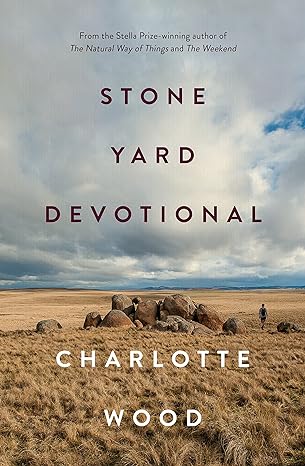
It’s some time since I wrote a Delicious Descriptions post, but I want to explore Charlotte Wood’s novel Stone Yard devotional (my review) just a little more. Although I finished it over a week ago, I keep thinking about its evocation of quiet lives in retreat – and what Wood might be saying.
I am, admittedly, a woman of “a certain age”, but, nonetheless, I am surprised to find that where once I loved filling my life with noise and action, I am now enjoying quiet. By noise and action, I don’t mean energetic activity – I’ve never minded being sedentary – but I mean I have never actively chosen quietness. Recently, however, this has changed. Now when Mr Gums and I drive long distances, for example, we often drive in silence – no music, no audiobooks, podcasts or radio programs, just silence. And, I like it.
It is this silence that Wood’s unnamed narrator in Stone Yard devotional seeks, and Wood writes about it in a way that not only makes it meaningful in terms of why we might seek it, but that is calming to read.
It starts the afternoon our narrator arrives at the abbey. “The silence is so thick,” she writes, “it makes me feel wealthy”. What an idea that is, “the silence is so thick it makes me feel wealthy”. A couple of paragraphs later, she explains that the abbey’s welcome booklet says they “accept that guests might want total solitude”. “Noise is discouraged”, and guests “are free to decline joining others for eating or worship”. She “cannot think of a greater act of kindness than to offer such privacy to a stranger”.
A couple of pages after this, and despite not being required to join in, our narrator decides to go to Lauds in the little church, and finds herself wondering how they get anything done with all this toddling into church every couple of hours. But then she realises that this “is the work. This is the doing”. She finds herself “drenched in a weird tranquility” and she wonders whether this has come from
being somewhere so quiet; a place entirely dedicated to silence. In the contemporary world, this kind of stillness feels radical, illicit.
Such silence, however, while appealing in theory, is not as simple as it sounds. She talks about the Lectio Divina, which Wikipedia describes as a traditional monastic practice comprising “four separate steps: read; meditate; pray; contemplate”. This is a step too far for our narrator at this point in her journey, and she finds herself arguing internally with what she is seeing, but
Despite this, the process is strangely beautiful. Sister Bonaventure says getting caught on a word is the point, and if you remain troubled or confused by it, you just ‘hand it over to God’. This is so antithetical to everything I have believed (knowledge is power, question everything, take responsibility) that it feels almost wicked. The astonishing – suspect – simplicity of just . . . handing it over.
The narrator is an atheist and the novel is not about religion per se, so she comprehends this concept more broadly in the sense of letting the things that bother you just sit, instead of endlessly turning them over.
This brings me to the idea I shared in my post on the novel, that of
waiting. An incomplete, unhurried emergence of understanding, sitting with questions that are sometimes never answered.
Thoughts about stillness, silence, solitude, and contemplation, freedom and peace, form the backbone of this novel, but they are tested by the visitations or “visitants”. They are also specifically tested by the idea of an active life. Sister Helen Parry distances herself from the abbey’s inhabitants, getting on with her activist work via “internet video calls … calling for action on this or that”. She brings, says the narrator, “everything we so painstakingly left behind”. Local farmer Richard Gittens’ wife, Annette, views life at the abbey as “sick … unnatural”.
And yet … (indeed, Elie Wiesel’s “and yet” is the narrator’s favourite phrase) … the end, when it comes, seems to suggest that there is a place for all. And that, maybe, there is no either-or, but what is right for us at different points in time. A gift of a book for anyone interested in thinking about how to live in our noisy, troubled and troubling world.
Charlotte Wood, Stone Yard devotional, Crows Nest, Allen & Unwin, 2024
 Whispering Gums
“Lectio Divina … a traditional monastic practice comprising ‘four separate steps: read; meditate; pray; contemplate'” could so very easily be adopted by all decent-thinking people as a way of life, provided one took prayer as something self-directed rather than addressing a deity.
Yes, exactly MR … and I think this is how the protagonist views it I believe. She suggests a broader understanding of prayer. And it comes from the Sister in charge in fact (if I read her correctly)
Speaking for myself (but possibly for all who follow you, ST !), I cannot imagine your reading any writer incorrectly.
I have spoken.
[grin]
I wish I had your confidence in me MR, but I appreciate it.
Seeing the explanation of Lectio Divina and the idea of letting something just be, instead of constantly chewing over it, makes me think whether there is a modern day version in the practice of mindfulness?
That’s exactly what I thought Karen, and nearly said it in this post, but decided that our modern protagonist didn’t say it that way so I wouldn’t either. But it does sound like a similar idea to me.
It occurs to me that I made a brief retreat at a Benedictine establishment in Colorado almost 50 years ago. The residents were nuns except for the retreat master, and as I recall it was a working farm. It must have been the Abbey of St. Walburga, which has since moved a considerable distance north, though still within Colorado: https://walburga.org/
I wish I could recall more about this, but it has been a while.
Haha, George, I guess you could call “almost 50 years” “a while”! What an interesting thing to do. Were you living in Colorado at the time? I think of you as an Easterner.
My family moved from Ohio to Colorado in 1969. In 1978, I moved to the Washington, DC, area and have been here since. We were in what the Postal Service calls Golden, but in fact was unincorporated Jefferson County–six or seven miles from Golden proper.
Ah, thanks George. You’ve moved around a bit. When I saw Golden, I thought, I’ve been there, but while I’ve been near there, I now realise that the Golden I’ve been to (more accurately I think, through) is the one in New Mexico. As we might have discussed I lived in the DC area (but in Northern Virginia, near Dulles) for two years, 1983 to 1985. Our son was born during that time in the Columbia Hospital for Women. (Now gone!)
Our son also was born at Columbia Hospital for Women, and I think that his best elementary school friend also was.
I was born in a Washington hospital now gone, Providence Hospital, back when it was on Capitol Hill. A slightly younger cousin is said to have been the first child born in the maternity ward of the new establishment in the Brookland neighborhood.
Here’s to your son, my son, and all of us (as it were) orphaned offspring of since-closed Washington hospitals!
And here’s to our daughter whose Canberra hospital has also gone! What is it with hospitals? BTW I had great care at Columbia.
Thanks again Sue. Your phrase, ( very lovely, by the way)
“An incomplete, unhurried emergence of understanding, sitting with questions that are sometimes never answered.”
does, I think , describe very well what the narrator is experiencing .
It also puts me in mind of traditional indigenous ways of communication and resolution of problems, as I understand them. A slow , quiet process that eventually produces a shared understanding.
I wonder if you’ve stopped thinking about the book now?😊
Thanks Paula … I think this has worked it through and I’m about to put it on the shelves! But I like what you say about Indigenous ways of communicating. It makes sense to me.
One of my favorite things is not realizing I am in a noisy environment and then leaving and it’s dead silent. Such contrast.
I love that Melanie. When you get older you might start to find you are also realising you are in a noisy environment! It seems to creep up on you!
I think we spoken about this before, but we now also have many times during our roadtrips when we have no radio, music or podcast. It is so peaceful to mull over our thoughts in companionable silence as we watch the scenery pass by. We tend to do it at home now as well.
Once upon a time we also had the radio on in the background in the kitchen. Now we only listen to the morning programs while we have breakfast before turning it off for the rest of the day. We sometimes listen to music whilst cooking & eating dinner, but not always, depends on our mood on the day.
I have never listened to podcasts while I walk either. I tried it a while back and it didn’t work for me. I prefer to hear the sounds of birds and wind and even the cars going by.
Perhaps I should try this book after all 🙂
We are very alike. Re radio during the day too! And music is a specific choice not on all the time. I know I’m missing a lot of info etc but the peace is beautiful isn’t it.
I can’t recall in this moment if I had done my search and shared the results in time for your previous post, but I have been able to find this and another (via Europa) in the TPL. Now, only to make time to read it. heheh But I’m sure I would love her work.
I think you would Marcie … but I know about time.