This year I attended, for the first time, the announcement of the ACT Book of the Year award, which was held at the Woden Public Library. For some reason our award doesn’t get the media recognition or attention that it deserves. Sure, it is not one of the wealthiest literary prizes in the country, and it is geographically limited to local authors, but, we have some impressive authors here. They produce good books that are worth shouting about – within and without the ACT.
The ACT Book of the Year is one those broad-based awards, meaning that it encompasses fiction, nonfiction, plays, and poetry. The award is presented by the ACT Government, and was first made in 1993, making this year its 30th anniversary. The first award was shared by poet AD Hope and novelist Marion Halligan. Halligan has won it three times.
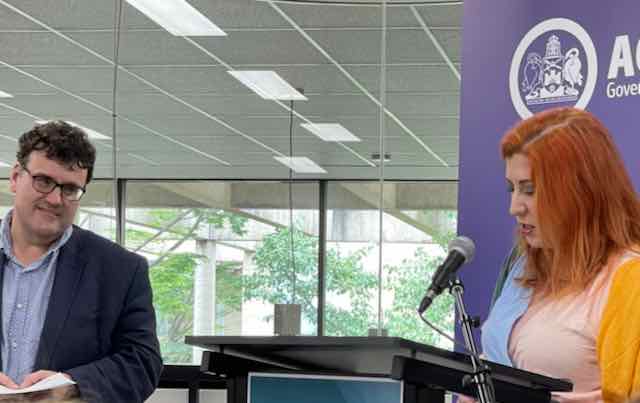
The award was announced by ACT Minister for the Arts, Tara Cheyne. She advised that the winner would receive $10,000, and the highly commended authors, $2,000.
I posted last year on the 2022 shortlist. It had seven finalists from 43 eligible nominations, and comprised a play, a short story collection, a book of poetry, a novel, and three works of non-fiction (two histories and a memoir). The novel, Lucy Neave, Believe in me (my review) won.
The 2023 shortlist was very different. It comprised ALL nonfiction, which Tara Cheyne said was not surprising coming from Canberra, the “knowledge capital”. There were 38 entries – books published in 2022 – and they included books which have been shortlisted in other awards over the last year. The shortlist comprised 6 titles.
The 2023 shortlist and winner
- Frank Bongiorno, Dreamers and schemers: A political history of Australia (political history; winner of the Henry Mayer Book Prize; shortlisted for this year’s NSW Premier’s History Awards)
- Robert Bowker, Tomorrow there will be Apricots: An Australian diplomat in the Arab world (memoir)
- Marion Halligan, Words for Lucy (memoir; on my TBR)
- Julieanne Lamond, Lohrey (literary criticism; Lisa’s review)
- Katrina Marson, Legitimate Sexpectations: the power of sex-ed (social science)
- Niki Savva, Bulldozed: Scott Morrison’s fall and Anthony Albanese’s rise (political history; winner of the the 2023 Australian Political Book of the Year)
Cheyne announced that the judges had made two Highly Commended awards, Marion Halligan’s book which the judges described as ““empathetic … and relatable” and Julieanne Lamond’s which they called, among other things, “immersive”. But, the winner was:
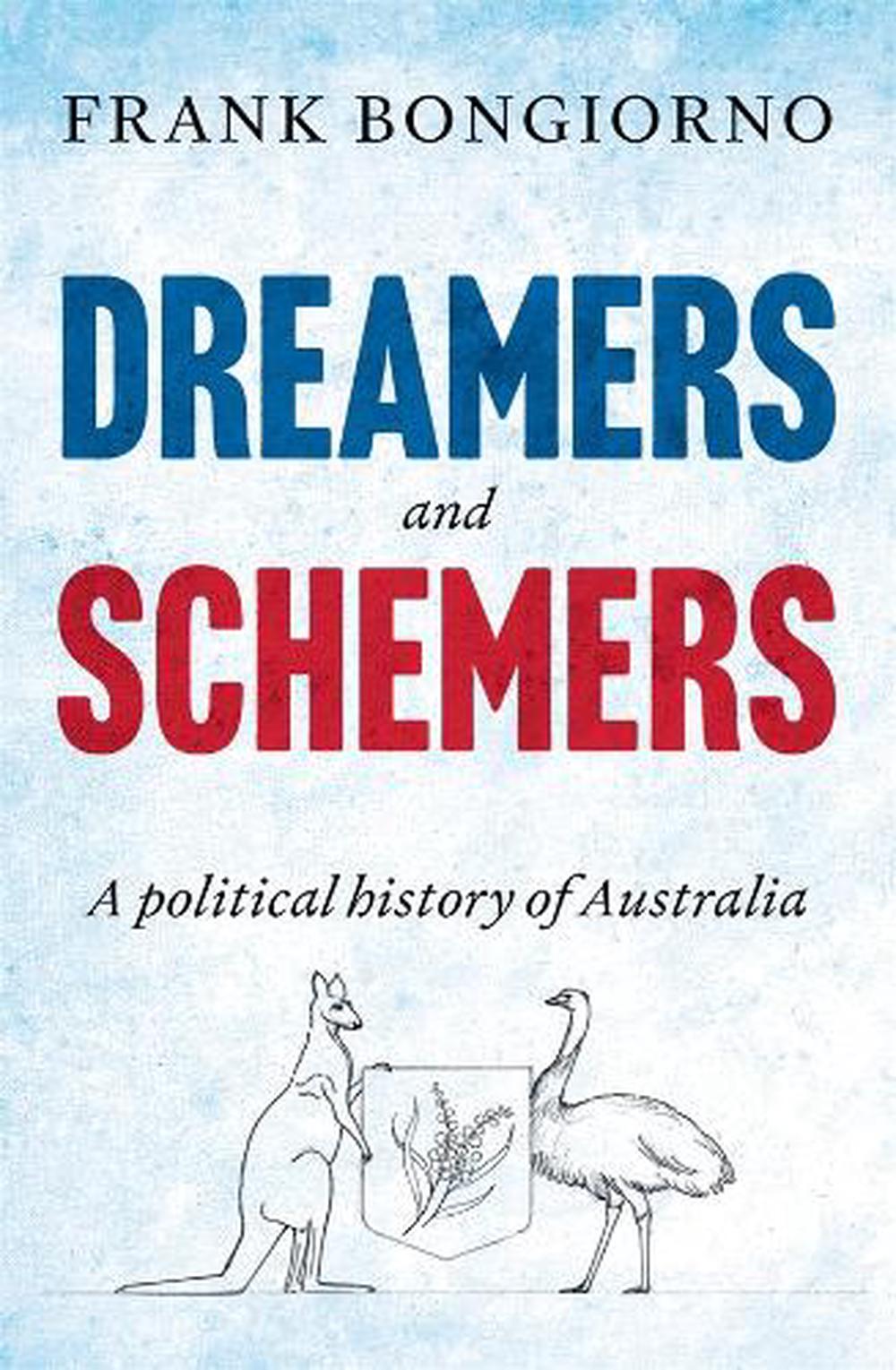
Frank Bongiorno’s Dreamers and schemers: A political history of Australia
Bongiorno, who is one of Canberra’s well-loved and generous academics, spoke briefly. He described himself as an academic historian, but one who believes that academics should be writing “accessible and affordable” books. I liked that he included “affordable” because so many academic books have stratospheric prices which put them out of the market for the general reader. The judges’ statement included that:
Through Dreamers and Schemers Frank Bongiorno has skilfully combined multiple elements to deliver a captivating account of Australia’s political history. The book’s perceptive honesty and contemporary sensibility shine throughout the narrative, providing readers with a fresh perspective on the subject.
With this win, Frank Bongiorno joins Marion Halligan as a three-time winner of the award.
This year’s judges were fiction writer Kaaron Warren, writer Adam Broinowski, and playwright Dylan Van Den Berg.
Big thanks to my reading group friend and Marion Board Member, Deb, for inviting me to join her at the announcement.
Tara Cheyne closed the event by encouraging us all to share “literary joy” in 2024! Couldn’t have said it better myself.
 Whispering Gums
Guilty as charged m’lud, though I did post on it in 2021 and 2022 and I’ve read most of the previous fiction winners, and a couple of the NF winners.
But if I’ve read a book before it wins a prize, I don’t always get back to tagging and categorising it as a winner. (I hadn’t, for example, with Lucy Neave’s, or Subhash Jaireth’s., an omission which I’ve now fixed)
But TBH, *shrug* I do novels, mostly, that’s what I do, so this years list, all NF, didn’t excite me much except for Lohrey…
Thanks Lisa … no I don’t always go back to tag books I’ve already read – though that happens far less frequently than for me. This year’s narrow mix was interesting. I suspect there will be more fiction in the mix next year, but, time will tell.
I guess it depend on who writes what.
The Halligan memoir notwithstanding, the days of the Canberra Seven seem to be petering out, with no obvious successors in sight, though I did find this list of Canberra authors and was pleased to see that I’ve read one of them, i.e. Emma Batchelor though it’s too soon to see if there is more to come from her. (See
https://hercanberra.com.au/local-loves/canberra-authors-and-their-books-to-gift-including-to-yourself-this-christmas/)
Interesting novels have come from Lucy Neave (2) and Robyn Cadwallader (3) and I do enjoy the work of Subhash Jaireth and Kim Mahood. Hopefully there’s more good fiction in the pipeline.
HerCanberra is a great site… we do have a lot of good fiction writers here.
I didn;t realise Marion Halligan lived in the ACT. I’ve not heard of any of these books except what I see posted by someone.
Oh yes Pam. She came from Newcastle but has been here for decades. I think all her literary career has happened here.
I’d heard of the Halligan, Lamond, Bongiorno and Savva, but some through blogs as you say.
I have seen Sava at Fullers for a launch. Really enjoyed her. Forget now what she was launching. It’s been awhile but political.🌲🌲🌲
She’s written a few but came to notice I think with “The Road to Ruin: How Tony Abbott and Peta Credlin Destroyed Their Own Government”
I love that accessible and affordable comment, too!
It always niggles me a little when, with the “smaller” literary awards (meaning either a smaller purse, or narrower terms of eligibility, or having less access to publicity for the award and ceremony) someone wins repeatedly. It makes me wonder whether the jury members were rushed and simply read the frontrunners and went with that result. To be fair, juries are not fairly compensated, financially, for their time and it’s essentially volunteer “work” in most cases, and I’m also not saying that happened with this award or that it happens often, but it looms in my mind all the same as a factor I’d rather not have to consider.
Yes, I understand what you are saying, Marcie, but I’d add that in smaller literary awards, the pool can be smaller, too and in this case Halligan in particular is an Australian literary giant, so it’s not surprising.
I think the judges are heroes. I don’t know which ones are recompensed, but even those that are are not fully recompensed (at least as far as I’ve seen (which is not a lot because this information is not often shared.)
Yes, I get it. And I can imagine how, in those instances, it might be really hard to make a decision for another author, given the established author’s stature.”
I suppose the average person doesn’t find it all that interesting. Weird. lol