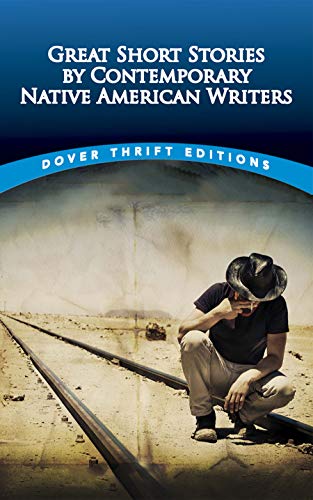
Mary TallMountain’s “Snatched away” is the ninth story of fourteen in the anthology, Great short stories by contemporary Native American writers, that I’ve been working through this year. It, like the previous three, was published in the 1980s, in 1988 in this case.
Mary TallMountain
Anthology editor Bob Blaisdell provides minimal information about her. He gives her heritage as Athabascan, Koyukan and Russian on her mother’s side, and tells us she was born Mary Demoski in Alaska in 1918, and died in 1994. Wikipedia’s article on her describes her as “a poet and storyteller of mixed Scotch-Irish and Koyukon ancestry” (Koyukon being Alaska Native Athabascan). Later in the article Wikipedia also mentions her Russian heritage.
Wikipedia provides more background, though not as much as on some of the other writers I’ve read in this anthology. She didn’t start writing until she was in her 50s, which means the 1970s , and she was part of the Native American Renaissance. However, the works listed seem to be primarily poetry, and there’s no discussion of her prose writing. It describes her main themes as being Native and Christian spirituality, including a connection to nature. It also tells us that she was given up for adoption when she was 6, by her tubercular mother, who knew “she would inevitably die” from the disease. It was not a happy experience for TallMountain. Her step-father was abusive, and she was forcefully dislocated from her culture.
TallMountain’s whole life was a challenge – from the unsurprising alcoholism, given her difficult childhood, to serious health problems, including cancer and a stroke.
“Snatched away”
“Snatched away” is told through the eyes of a white man, Clem, who has an Athabascan partner, Mary-Joe, and two children, though this is only slowly revealed. The framing story takes place over a day, in the 1920s, as Clem manoeuvres his way down the Yukon river, meeting rivermen and reflecting on his life. Through him, TallMountain tells of the culture of Athabascan river people whose survival depends on their river, fishing and hunting skills:
Quick dark silhouettes against the greens of alder and cottonwood, the Indians were part of sky, river, earth itself: they wove their dories through tumbling water, poled schools of darting salmon, strode like lumberjacks. Born rivermen, Clem thought with respect. Still, the river was a tough customer. In the seven years he’d been here, ten men and boys had downed between Nulato and Kaltag.
The river might be tough, but it is nature, and its spirit and theirs are entwined. The more problematical thing is the impact on their lives and culture of the arrival of white people, particularly with their diseases like small-pox and tuberculosis.
TallMountain doesn’t gloss over or romanticise life, before or after the arrival of the whites. Rather, she tells it as it is. Early in the story is a scene, told in flashback, in which Clem spends an afternoon on the riverbank with locals, young Andy, who had later drowned, and Little Jim. They see a bundle rolling fast down the river and, on his asking what it is, Clem is told it’s a “Baby. Throwed away”. A common practice in the “old time” for imperfect babies, with a “bum leg” maybe, or “head mashed”, it happened less now, but women will still do it, he’s told, if the baby is “too bad”.
Death pervades the story, actual or intimated – from the babies and the drownings to the aforementioned diseases – but its handling is unsentimental.
From the opening paragraph describing the Yukon as being in a “fierce, frowning mood” to the end when Clem’s “words are snatched away by the wind”, it is the river that controls the story. Its power and potential to both sustain with fish and birds and to kill, and its associated spirituality, are evoked through the people Clem interacts with on his journey – like the consumptive Floyd out hunting mallard and Willy the fisherman who “looked as if he had always been there” and who tells Clem “you got to watch that river” – and through Clem’s physical struggle to keep his boat upright and on course. The river is a living thing, and should never be underrated. Nor perhaps, should be the Woodsman, an Athabascan bad spirit about which Clem asks Willy. It’s a joking reference, but with a tinge of something else all the same, given soon after this Clem senses “something besides fish alive, out there in the river”.
There is clearly an autobiographical element to the story, with Clem’s partner, like TallMountain’s mother, contracting tuberculosis and the local doctor offering to adopt the children, just as Tallmountain had been. Clem is bothered, but philosophically believes “it will all work out in the wash”. Will it? Much is left open in this story.
Like many of the stories in the anthology, “Snatched away” is at least partly about the intersection of cultures. TallMountain, like many of the authors, is of mixed heritage, and in the little I’ve found about her on the Internet, she was comfortable with that. In fact I found an Interview with her in which she describes herself as an “inbetween”*, by which she means having “a connection between two different cultures” to which must be done justice. As Clem fights his way down the river, he thinks about his own heritage and background, as well as of the Athabascan people. As he tires, he sees the faces of his wife and children “wavering” in the mist. But, his specific pronouncement about “Indianness” just after this – “what difference now, how much the blood is mixed” – felt sudden and a bit out of the blue.
It may be that TallMountain was more poet than storywriter, but I did still enjoy the story, even if more for its gorgeous writing about the river and its people than for its narrative coherence. And it has been anthologised more than once, which says something.
* Joseph W. Bruchac III, “We are the inbetweens: An interview with Mary Tallmountain”, Studies in American Indian Literatures, Series 2, Vol. 1, No. 1 (Summer 1989), pp. 13-21
Mary TallMountain
“Snatched away” (orig. pub. 1988)
in Bob Blaisdell (ed.), Great short stories by contemporary Native American writers
Garden City: Dover Publications, 2014
pp. 65-74
ISBN: 9780486490953
 Whispering Gums
Don’t be offended, ST, when I say that phrases like ” gorgeous writing about the river” bring to mind the movie “The River of No Return”; for in spite of its being a glamourized adventure, it’s full of the beauty of those huge Canadian rivers and their environs, as is this Yukon story.
Not offended at all MR… glad it brings to mind something,
Having only in the past year or so come across ‘Harlem Renaissance’ I am interested to see the term ‘Native American Renaissance’ and went quickly to look it up. That’s a wikipedia entry I wish I’d seen during my North America project last year – Marcie, why didn’t you tell me? – but it’s never too late, and hopefully I’ll follow up the suggested reading.
Too many things to keep up with Bill aren’t there… but this is a good one to know about.
HAH! Are you testing my fresh resolve to resume online bookchat, to see if I’m reading comments as well as contents! Hee hee These Renaissances make me nervous because it always feels like some people get left out. Here, for instance, as a fan of Louise Erdrich, I’m pleased to see there’s attention drawn to her work with her inclusion (and, in some ways, the list also excites me because I’ve not read many of the male authors included) but, then, it’s said that two scholars agree that another era begins, after the Renaissance era, when Sherman Alexie emerges, but what does one make of the fact that Erdrich is still actively publishing and perhaps also considers herself very much of THIS era and not THAT.
Haha Marcie… that was Bill and I did note the implication! You’ve risen. to the challenge.
Good question. My response would be that writers, particularly those with long careers like Erdrich, can be part of more than one tradition or movements?
/nods In that kind of generous context, I think the concept of grouping them is a curious and interesting thing, that invites a different kind of questioning and understanding. My sense is that the scholars view these as static matters of belonging, but we can choose to interpret more generously.
Exactly!
I wasn’t testing, I was assuming. I have the same problem with generations of Aust women writers, but the boundaries are always going to be blurred. My first thought was that the N A renaissance was drawing on the prestige of the Harlem R. but that is only a guess.
Indigenous writing here is booming, but I’m not sure I’d call it a renaissance.
Haha, Bill, good answer.
And yes, I agree, boundaries are always blurred. Good way of saying it.
And yes, good point re Renaissance here … I’m not sure I’d describe it quite that way here either.
Heheh At least this time I was paying attention! It feels as though the question of generations is less complicated because one’s year of birth is non-negotiable (unless you’re Zora Neale Hurston!) but here it’s a matter of who has achieved or is “enough” to be Renaissance-worthy. But, if I think of it like a way to re-think, instead of a method to adopt, I’m less troubled by the slippery-ness of it all.
Yes, I like that way of thinking about it Marcie … I always like to think of things like this in the broadest most generous way I can because otherwise we can waste too much time fussing about detail and missing the bigger points, can’t we?
Is this a collection that has been lingering unread on your shelves for some time or one which you’ve read previously (at least, in part) and now return to? I’ve found myself looking at anthologies differently in the past year or so, since having read a collection of environmental essays (that had been unread wholly on my shelves for about twenty years, though I’d read two of the pieces at the time of purchase), realising that they might contain some real gems (and I’ve overlooked them in favour of single-author works).
It was given to me last Christmas, Marie, by my Californian friend, as we’d been discussing how little Native American literature we’d read. Like you I mostly readsingle author collections
i think I misread the date of the story to indicate that the collection as a whole dated to the ’80s, whereas it must be a chronological assortment.
Yes, it is, Marcie. It’s called Contemporary but it starts with stories at the end of the 19th century. I am working my way through them.
But, what I meant to add was that I do like closely themed anthologies – in preference to more general ones from which I might be more likely to pick and choose.
Themed anthologies are probably my favourite (although I do naturally select single-author collections most often) but I have recently gathered a couple of anthologies that are simply focussed on the form and I’m curious whether that will be a treat or a chore.
In my experience, those just focused on form – like the O Henry Prize stories for example, or, here, the Margaret River Short Story Competition, or Best Short storied of [name the year] – can reveal some real treasures, but of course they are mixed.
This author’s background reminds me of the story about the two basketball teams, and the one team being deemed not Indian enough. The author has mixed heritage, and she was separated from her culture; however, I’m glad that she’s represented here because she’s a big part of the story of Americans destroying native American heritage and culture through separation of children from families. Granted, she was separated because her mom had tuberculosis, but I do know that a lot of illnesses can spread on reservations due to lack of medical care. It happened with COVID.
Yes, good catch Melanie. Her story of not being allowed to speak her language when she was adopted is a very common one here, and so destructive.
Oh yes, I suppose it happened all over again with COVID. There was a lot of effort made here to keep COVID out of remote First Nations communities in places like the Northern Territory.