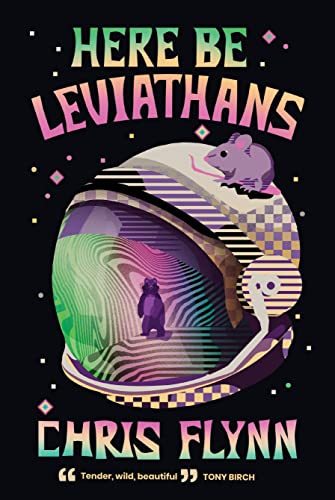
All being well, my next post – or, a very near future one – will be on Chris Flynn’s astonishing short story collection, Here be Leviathans. As I was reading it, I came quite serendipitously across Nina Culley’s article titled “Weird is in“, in Kill Your Darlings*. The article references Chris Flynn’s collection and some other works I’ve read recently that are a bit, well, off-centre.
Culley opens the article with:
Australian fiction has long been dominated by the realist novel. A new wave of writers continue the avant-garde tradition—but are experimental and offbeat stories always destined to be relegated to a literary niche?
Now, I do tend to prefer realist (or realistic) novels. I am not much into the various forms/subgenres of speculative fiction (though I don’t mind dystopias, which just seem to me to be future realism!) However, this is not to say that I don’t occasionally venture into the more imaginative, surreal or even fantastical. I like Murakami, for example; I loved Jane Rawson’s A wrong turn at the Office of Unmade Lists (my review); and in more recent times I enjoyed Chris Flynn’s Mammoth (my review). I am certainly enjoying his Here be Leviathans. Would Culley’s article, I wondered, explain why?
She follows her intro with the point that “experimental and strange fiction is often viewed as a niche of the literary world, reserved for audacious writers who dare push the boundaries of storytelling and their open-minded readerships”. Such writing is also, she says, “frequently subjected to mixed reception – some ardent, some bamboozled”. I can understand the latter, because, almost by definition, weird writing tends to subvert, if not actively eschew, the conventions against which many of us think about what we read. When that happens, we can struggle to work out how to assess it. or example, if our benchmark is realistic characters, what do we do with characters who are determinedly not so?
Culley, who actively sought out unusual fiction, was surprised to find that there was more out there than she’d thought. It’s hard to categorise but she found it under genre labels like “bizarro fiction” and “new-weird fiction”. She suggests that these genres seem “to have a lot in common with post-modernism and early avant-garde movements, with self-reflexive tendencies towards satire, irony and pastiche”. They “playfully comment on their own artifice” and challenge readers with “bold questions”. I often enjoy writing like this. I have no problem with writers reminding me that it is art I’m consuming, not a representation of reality, because, well, it is art I’m reading and I want to think about the art.
Anyhow, she argues that Australian literature has moved on from a focus on ‘bush and beach’ to something she calls ‘urban existentialism’. Much of this is “wonderful” albeit often “bleak”, but it is also Euro-centric. She characterises it as being concerned with “weaving together a character’s multi-faceted relationship with their country—how it’s threatening and how it’s beautiful, notions with complex colonial implications”. The problem is that this writing might be significant to a point, but it is also homogenising. It “undermines the demand and presence of a diverse literary scene”.
And now, before you jump in with but, but, but, she agrees that Australia has “fostered bold voices and innovation” from the likes of Patrick White through Helen Garner, Gerald Murnane, Murray Bail, and that fascinating import from South Africa, JM Coetzee, to newer writers like Alexis Wright, Robbie Arnott, Ellen van Neerven and Evelyn Araluen. I’ve reviewed all of these writers here at lest once (and admit that while I have enjoyed their writing, most have challenged my reviewer faculties! Which is no bad thing!)
Culley then discusses the publishing of weird writing – who is publishing it and why enough isn’t publised – but I want to explore a little about why read “weird” fiction.
Take weird narrators, for example. Some readers don’t like them, they don’t like, say, skeletons (in Carmel Bird’s Family skeleton) or foetuses (in Ian McEwan’s Nutshell) but in the hands of authors who know what they are doing, weird narrators can jolt us with fresh perspectives on an idea or issue. Chris Flynn’s Mammoth, as I wrote in my review, tells the story of humanity’s destructive, often brutal march through time, through the eyes of those we supplanted, the fossils of extinct creatures. Seeing the world through such eyes is mind-bending and eye-opening.
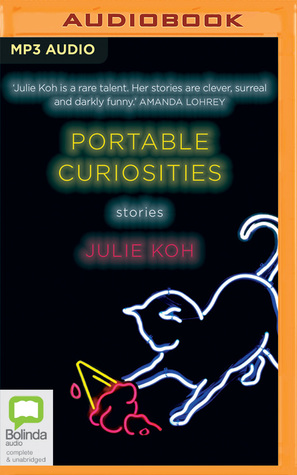
Julie Koh takes a different approach. Most of her stories in Portable curiosities (my review) start realistically but often turn surreal or absurd. Her targets, though, are grounded – in issues like consumerism, capitalism, commercialism, and the stereotyping of Asian people in Australia. Again, the weirdness can jolt us into seeing (or feeling) things that realism may not expose because it’s all so familiar.
With First Nations writing, the situation can be different again. What we western readers might think is weird is perfectly natural to First Nations people, because, for example, there is no line between the humans and country. It is all interconnected. There is no hierarchy, but mutual responsibility. Reading the writing of others may not change our own worldview, but I like to think it can help us understand different worldviews and see that they are just as valid as our own.
Returning to Culley now, towards the end of her article, she says that Flynn’s Here be Leviathans was described as “boundary pushing”. His response was that this kind of labelling indicates “that the Australian literary scene has been beholden to a streak of misery realism for so long that it’s forgotten to…have fun.” I am not averse to “misery realism” – it has its place – but it’s not my only diet. I also like fun. I like cheeky writers who know how to make points with a light – or even bizarre – touch. Watch out for my review of Here be Leviathans to see what I mean.
Meanwhile, do you read “weird” fiction? Why or why not?
* KYD is an online subscription journal, but some free access is provided.
 Whispering Gums
I had thought this to be a review of “Here be Leviathans” (because I have no capacity for focus and always rush in, thus missing most of everything), and was beginning to get grumpy because you weren’t getting to the point ! [grin] Happily I finally understood that it’s a review of weird fiction. Hate that phrase, I gotta say, ST: “weird fiction” .. sounds quite awful. But what else to call it ?, I suppose. I have only ever read one example of what I consider fits in under that heading – the wonderful Italo Calvino’s If on a Winter’s Night. Wow – what a journey ! Oh, if only some brilliant linguist would translate his works for an anglophone to read ..
You will be pleased to hear that William Weaver (who translated If on a Winter’s Night) also translated Invisible Cities, which I am currently reading, and I have five more by Calvino in translation, on my TBR including one from my parents’ bookshelf published in 1959. I bet they didn’t buy it here in Australia, I think it’s one of the few they brought with them from the UK.
PS I’ve just reviewed The Distance from the Moon on my blog.
Lisa, you are a gem ! But one whose brilliance is reduced by being in the shadow of moi, the bull in the china shop who is frequently imprecise (as well as crashing): I should have added “as narrator for audiobooks”.
😦
You may shoot me now.
Ah, I see, I’m sorry.
That’s a different proposition altogether…
Ain’t it ?!!
I think M-R means translated to audio form Lisa. She doesn’t read text these days. Can you help there?
Haha M-R, I know what you mean about rushing in and sometimes missing the point. Sometimes with blogs I am about to comment on something and then I think, I’d better check to make sure the blogger didn’t explain that (etc) and I missed it.
[holds hand up, being a blogger known for confusing readers ..]
But with you, ST ? – unforgiveable.
Ha, I just made that point to Lisa M-R ie that you are an audiobook person. Once they’ve been translated to English it’s possible, but perhaps the market for audiobooks is a bit different to the market for text so there are different priorities probably for what to produce in audio form.
Oh, definitely; especially when you consider that Audible is an Amazon company, and all the others – that I know of – are American. AND aimed at The Avrij Reeda.
PS I rather liked the term “bizarro fiction”! But, I agree, terminology is tricky: “unusual writing” is too mundane; “weird fiction” is perhaps too much the other way.
I’d call it
NYUF
pronounced “enyuff”.
Not Your Usual Fiction.
🙂
I should have called the book If on a Winter’s Night a Traveller, of course.
I just thought you were abbreviating!
I woz. 😐
Couldn’t be anything weirder than Gerald Murnane or Murray Bail, although I realise I’m spitting against the wind here. But, really … to me it’s a classic emperor with no clothes situation. Possibly a feminist one at that.
I take your “possibly a feminist one” point Sara, particularly, regarding the latter. I’ll need to think a bit more about the former.
Okay. I accept that mine is a minority opinion.
But an opinion worth thinking about …
“in the hands of authors who know what they are doing” … Yes.
I have just finished reading Pip Adam’s Audition, and she knows what she’s doing.
But doing it for the sake of *not doing* something else is inane.
PS I believe The Experts in the Trade call it absurdist fiction but if we give it a new name it seems like something new…
Oh yes, thanks Lisa, I have heard that term too. In the article, Culley says that Julie Koh is “co-founder of the absurdist lit collective Kanganoulipo”. Culley gave a few more genre names besides the two I chose to share, but I didn’t want to give away all her ideas, so I just chose one I’d heard and one I hadn’t as examples.
I don’t usually seek out weird fiction. I have read three of James Hynes’s volumes, which mix academia and the occult: Publish and Perish, The Lecturer’s Tale, and Kings of Infinite Space. He is American, and his novels are set in the Midwest and Texas. Vasily Aksyonov’s The Burn, published in the 1980s, might well qualify.
Thanks George – and thanks in particular for adding a North American flavour (and names) to our discussion. I have heard of either of those writers.
I’ve certainly read and enjoyed a few speculative fiction titles over the years, but whether I can then apply sub-genres like new weird or bizarro or slipstream (I wikipedia’d!) to them as well, I do not know. I did notice that Margo Lanagan was one of the few Australian AND women on the list though.
Haha Brona … slipstream was another genre label she shared, as was post-grunge lit! A rose by any other name!
Margo Lanagan? Interesting. I only remember one of hers. Was it this “genre”? Anyhow, I’ve come across so many Australian women – I named some in my post and Bill added a few more in his comment – so Wikipedia sounds a bit out-of-date. I will try to check!
I didn’t mean to add to your workload, but the wiki page did look like it was need of an update!
Ha ha Brona. I may or may not take it on. It’s not my area of expertise. I see that Wikipedia has pages for Bizarro, New Weird, Weird, Slipstream… I gave up at that point. There’s not a lot of reference between them, so are they completely different or is the terminology just completely anarchic?!
I don’t think there’s much fantastical Australian fiction predating this current generation of Indigenous writers, who, as you say, see the ‘real’ and spirit worlds as a continuum. I love their writing even if I don’t agree with their worldview.
I don’t agree with Sara Dowse about Gerald Murnane … he talks a lot about what he is imagining, but I don’t think he wants us to believe that it is real.
The most fanciful novel I can think of pre this generation is Keneally’s A Dutiful Daughter. I wonder, if I sleep on it, if I can come up with anything earlier.
You don’t have to agree with their worldview Bill – but you do need to accept it as theirs. I don’t think the issue is about agreeing, really. Different people have different worldviews, often based on their culture. They are not looking for us to agree with their worldview but to accept and respect them. And that I’m prepared to do because who says my worldview is the right or best one?
I haven’t read some of those early less-realistic works of Keneally, but I should.
I think Sara’s point is more about their attitude to/representation of sex/gender than about their realism (or not). Unless I misunderstood her.
BTW I liked your definition of dystopias as future realism. But, apart from the straight SF writers, Claire G Coleman for example, there are a number of the current generation writing futuristic fiction as we have discussed elsewhere who are definitely not realist: Jane Rawson as you say; Krissy Kneen, An Uncertain Grace; Elizabeth Tan, Rubik; Ellen van Neerven, Water, and of course Alexis Wright, would be my favourites. Guys I don’t know so well, but there’s Rodney Hall.
Thanks Bill .. and I’m glad you like that definition of dystopias. It just came to me and it felt sort of right.
I read the Book of Job today on which God fangirls over his creation of the Leviathan and the Behemoth. It’s amusing.
I do hope you check out Asphyxia, who wrote a dystopian novel set in Australia when there are food and fuel shortages. She’s the author who’s Deaf and uses Auslan.
Did Bill recently also review her Melanie? I would like to but I’m SO behind with reading the books I already have so will have to see.
I love the idea of God fan girl-ing!
Yes! Actually, Bill is the one who brought Asphyxia to my attention, and then later reviewed her as well.
Ah I knew I remembered something!
Hi Sue, I am not too sure what is ‘weird fiction”, but I did enjoy a Wrong Turn at the Office, and If on a Winter Night A Traveller. I enjoyed Only the Animals by Ceridwen Dovey and Animals in That Country by Laura Jean McKay. If they are I consider myself a ‘weird fiction’ reader! At the moment I am reading Rivers of London by Ben Aaronovitch, which I think would be considered ‘weird fiction’. I am only reading this because a friend suggested I give it a ‘go’. I am liking it.
Does Gould’s Book of Fish count, or is the story too straightforward?
Some might say magical realism.
It’s so long since I’ve read it fourtriplezed that I remember “weirdness” but how I’d define it I’m less sure about. Magical realism is probably a good start!
If I was going to suggest an Australian weird fiction from years back, David Ireland’s The Flesheaters from 1972 was the first I recall that I thought weird, and compelling for that matter.
Thanks fourtriplezed for this … you are right that weird didn’t come down in the last shower.
A promising Australian sub-genre of weird fiction might be “Troppo Fiction” (I just love that word!
There is, of course, plenty of weird British fiction. Favourites night be the tradition of the ghost story or the rather unsettling fictions of Walter De La Mare or the urban horror of a Ramsey Cambell.
Also: HP Lovecraft a nothing-if-not weird writer with (perhaps unfortunately) mainstream appeal.
Oh, that’s good Ian, “troppo fiction”. Why didn’t I think of that?
I haven’t heard of Ramsey Cambell, so you have intrigued me there. I’ve heard of HP Lovecraft but never have read him. Would you like to explain your “perhaps unfortunately”?
BTW It’s good to hear from you again.
In his history of science fiction, Billion Year Spree published in the 1970s, Brian Aldiss dismisses the cult of Lovecraft with its characters that sound like breakfast serials and general rather racist paranoia. I suppose he is a sort of weird fiction Ayn Rand!
He does have a sort of mythic power though and is worth a look.
I will try … though I don’t quite know how to react to “weird fiction Ayn Rand”!