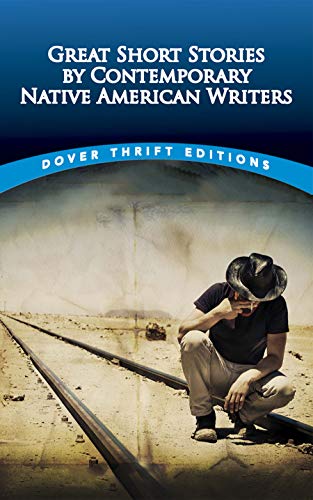
After a two-month hiatus, I return to my reading from Great short stories by contemporary Native American writers with a three-decade jump from D’Arcy McNickle’s 1936-published “Train time” to Leslie Marmon Silko’s “The man to send rain clouds”, which was published in 1968 .
Leslie Marmon Silko
Again, I’m using anthology editor Bob Blaisdell’s brief intro and Wikipedia’s article to introduce the author. According to Wikipedia, Leslie Marmon Silko (b. 1948) is one of the key figures in “the First Wave of what literary critic Kenneth Lincoln has called the Native American Renaissance“. I don’t know much about the trajectory of Native American writing, within the larger American culture, so this gives me a bit of a guide to how it has gone.
Silko was born in Albuquerque, of Laguna Pueblo ancestry, and grew up on the Laguna Pueblo reservation – which I visited with my family on a memorable road trip through New Mexico in December 1991. (For those of you who haven’t been to New Mexico, I recommend it as a special place to visit – physically, historically and culturally.) Silko, says Wikipedia, was schooled at local Indian schools, before attending the University of New Mexico from which she graduated with a BA in English Literature, in 1969. She then briefly attended law school, before deciding to pursue a literary career full-time, which has included teaching at several universities.
This post’s short story, “The man to send rain clouds”, was published while she was an undergraduate. It earned her a National Endowment for the Humanities Discovery Grant, and continues to be a popular anthology choice, apparently. She has, since then, written several novels, a “poetic memoir”, and many essays. In one of those essays, Wikipedia says, she criticised Louise Erdrich for abandoning “writing about the Native American struggle for sovereignty in exchange for writing “self-referential”, postmodern fiction”. Interesting. I’ve only read two books by Erdrich, and one so long ago I can’t recollect the details, but The bingo palace (1995) does confront the challenge of marrying tradition with contemporary life.
Blaisdell’s introduction includes a statement by Silko on why she writes, which is
to find out what I mean. I know some of the things I mean. I couldn’t tell you the best things I know. And I can’t know the best things I know until I write.
I understand what she means here. I don’t find talking easy. I find it easier through writing to work out what I know and mean.
“The man to send rain clouds”
Wikipedia summarises Silko’s themes as being grounded in a wish “to preserve cultural traditions and understand the impact of the past on contemporary life”. Her career, it says, “has been characterised by making people aware of ingrained racism and white cultural imperialism”. Many of her characters “attempt what some perceive a simple yet uneasy return to balance Native American traditions survivalism with the violence of modern America”. This is all part of a continuing theme in the Southwest regarding “the clash of civilisations” and “the difficult search for balance that the region’s inhabitants encounter”. Much of this is already evident in this early short story of hers.

“The man to send rain clouds” concerns the interaction between Pueblo Indians and Christianity. It reminded me in a small way of Marie Munkara’s Every little thing (my review) except that Munkara’s is a full-length and often laugh-out-loud work versus Silko’s more wry short story. However, both show the power-play between the original people of a land and the churches that came in to save them, and also how the oppressed First Nations people can sometimes, at least, work it to their advantage.
Silko’s story concerns the death of an old man, Teofilo. It opens with his body being found under a “big cottonwood tree” by brothers-in-law Ken and Leon. It describes their going through some traditional death rites, including preparing the old man’s body with face-paint, before bringing him back to the pueblo. It’s here that the title is explained: they say to the old man, after scattering cornmeal, “Send us rain clouds, Grandfather”, which specifically introduces the importance of rain to them and suggests its role in their rites. On their way back into the pueblo, they meet the priest who asks whether they had found Teofilo, but they give a noncommittal reply, telling him that “everything is OK now”. When the priest replies that they “shouldn’t allow him to stay at the sheep camp alone”, they continue with their obfuscation:
“No, he won’t do that any more now”.
I loved Silko’s subtle use of humour in the story. In this brief conversation, Silko sets up exactly how the locals deal with the priest, politely but also determined as much as possible to keep him out of their business. The rest of the story concerns their funeral business, including another delightful encounter with the priest when one of the pueblo’s members feels that some “holy water” wouldn’t go astray.
It’s a quiet story, but a strong one. The tone is measured, the pace unhurried, mirroring the values and attitudes of the pueblo people who are doing their best to preserve their customs while maintaining peace with those who have the power. The same tone is used for the priest’s non-confrontational response, and his own decisionmaking, reflecting, presumably, his need to work with rather than against the people. It’s a story ripe for discussion.
The imagery is beautiful, evoking the snow-capped mountains, the arroyos, mesas, and sandy flats that characterise that part of New Mexico. There is a strong use of colour, which is mostly muted, supporting the tone, with a touch of red to herald something bigger. And of course there’s the rain motif that runs through the story, reflecting its importance to the pueblo’s survival.
A moving story, that I commend to you. It’s a quick read.
Leslie Marmon Silko
“The man to send rain clouds” (orig. pub. 1968 under the name Leslie Chapman)
in Bob Blaisdell (ed.), Great short stories by contemporary Native American writers
Garden City: Dover Publications, 2014
pp. 45-49
ISBN: 9780486490953
Available online via the University of New Mexico.
 Whispering Gums
I thought she was a bloke because women called that are meant to spell it with an ‘ey’ at the end. Someone should’ve told her. 😉 Nono, a joke.
Very good/nice to read that America’s First People have such a wry sense of humour; they could be forgiven for having none left.
As could all First Nations people I think, M-R.
And yes, I did a second-take about the name too.
I like the sound of a story where the First Nations People get the better of their ‘rescuers’, and done with humour is all the better.
Thanks Mallika … I do too!
I don’t see much new Native American books coming out in the U.S., but my book blogger friend Anne, who lives in Canada, frequently reviews new Native voices. I’ve read quite a few recently, and I wonder if Canada is putting grant money into supporting Native voices. I know that in general Canada puts more money into the arts that the paltry bit in the U.S.
Good question Melanie … one I can’t answer, either regards Canada or the USA. I think most of us who love the arts believe that they are not supported enough on our countries. First Nations writing is on the rise here. There are grants but a lot of that comes from publishers who have made a commitment to supporting those voices like UQP.
Pingback: ≫ Leslie Marmon Silko, El hombre que envía nubes de lluvia (#Reseña)
That was a great little story and it really captured the atmosphere of the pueblo in winter, didn’t it? I loved the gentle humor too.
Thanks Carolyn … it is a beautiful and skilful little story.